
Our readers keep the lights on and the weekend projects moving. As an Amazon Associate, I earn from qualifying purchases.
An auto heads up display puts critical driving data directly in your line of sight, so you never have to glance down at the dashboard. Whether you want to monitor engine coolant temperature, track exact GPS speed, or keep your RPMs in check, a dedicated HUD makes every trip safer and more informed.
I’m Rikta — the founder and writer behind FitlyFast. My research focuses on real-world performance differences between OBD2 and GPS systems, the impact of display brightness on driver fatigue, and which dual-mode units actually deliver stable readings across a wide range of vehicle models.
Buying a best auto heads up display means deciding between wired OBD2 accuracy, universal GPS simplicity, or a dual-system hybrid that gives you both — each approach has clear trade-offs in installation, data depth, and long-term reliability.
How To Choose The Best Auto Heads Up Display
An HUD acts as a secondary instrument cluster projected at windshield height, but the range of designs, data sources, and mounting styles is wider than most buyers expect. Nail these three factors first, and the rest becomes straightforward.
OBD2 vs GPS vs Dual Mode
An OBD2-connected HUD pulls live data from your car’s ECU — speed, RPM, coolant temperature, voltage, intake pressure, and even fault codes — making it the richest data source for monitoring mechanical health. However, OBD2 compatibility is limited to vehicles built after 2008 that use the OBDII/EOBD protocol, and many units explicitly exclude diesel, hybrid, and certain European or Asian brands. A GPS-only HUD works in any vehicle, including classics and motorcycles, but only displays speed, altitude, time, and distance — no engine diagnostics. A dual-mode unit gives you the best of both: use OBD2 for deep data when your car supports it, and fall back to GPS when it doesn’t.
Display Quality and Mounting
There are two display approaches: a reflective panel that sits on the dash and projects data, or a direct LCD screen you simply place in your peripheral vision. The reflective method (windshield projection) offers the most natural heads-up feel, but requires careful angle adjustment to avoid ghosting — particularly in bright sunlight. Direct screen units are easier to install and usually offer higher contrast, but your eyes must refocus a few inches forward. Regardless of type, look for automatic brightness adjustment (light sensor), adjustable color schemes, and an anti-glare coating. Mounting options include adhesive dash pads, windshield suction cups, and A-pillar trim clips — pick one that keeps the display stable without blocking your view of the road.
Alarm Functions and Safety Features
Most modern HUDs include configurable alarms for overspeed, high water temperature, low voltage, and sometimes fatigue driving reminders based on elapsed time. These alerts switch the ambient light from blue to red, or flash the display, providing a non-verbal warning that doesn’t require reading a number. For drivers who regularly haul heavy loads, drive older vehicles with finicky cooling systems, or simply want to avoid speeding tickets, these alerts transform a data display into an active safety assistant. Make sure the alarm thresholds are adjustable — default values may not suit your engine’s real operating range or your local speed limits.
Quick Comparison
On smaller screens, swipe sideways to see the full table.
| Model | Category | Best For | Key Spec | Amazon |
|---|---|---|---|---|
| Liiiyuan C2 | Premium | Ghost-free projection with wide data | Transparent reflective panel | Amazon |
| HAOYICHE X100 | Premium | Solar charging and rugged builds | IP67 + solar panel | Amazon |
| MAIMEIMI MA-A8 | Mid-Range | True windshield projection | Windshield projection screen | Amazon |
| wiiyii P6 | Mid-Range | Dual-mode with wide gauge selection | OBD2 + GPS 2-in-1 | Amazon |
| MH P6 | Budget | Fault code scanning capability | OBD2 fault code reader | Amazon |
| MAIMEIMI MA-P6 | Budget | Compact dual-system for older cars | OBD2 + GPS dual system | Amazon |
| wiiyii P8 | Budget | A-pillar mount for clean installs | A-pillar trim mounting | Amazon |
In‑Depth Reviews
1. Liiiyuan C2 Head Up Display
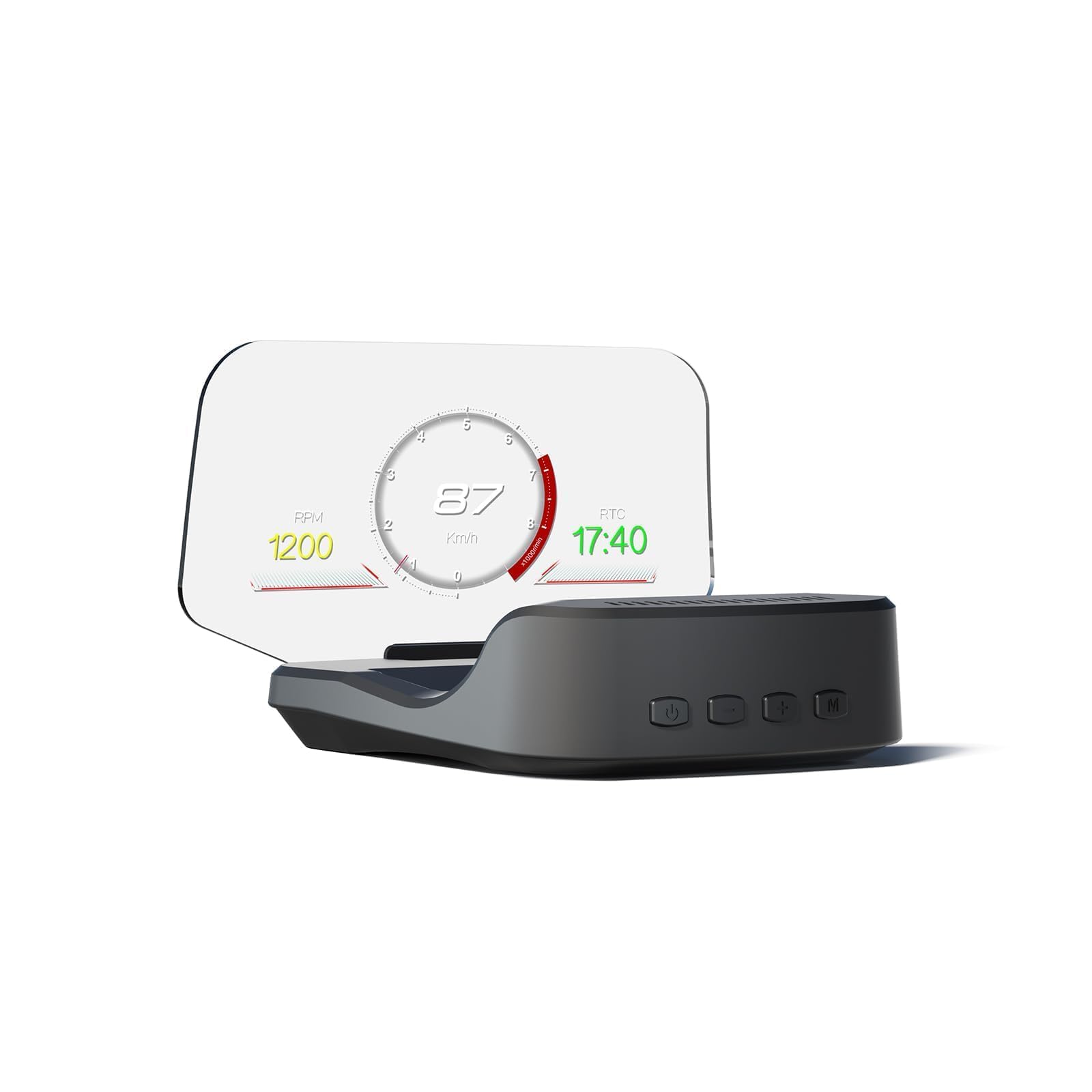
The Liiiyuan C2 stands apart from the pack because of its transparent reflective panel design — a dedicated glass that sits between the windshield and the dash, projecting data with zero ghosting or double-image distortion. In practice, this means speed, RPM, water temperature, voltage, and fuel consumption numbers appear crisp and stationary regardless of your viewing angle. The panel is hinged so you can tilt it to match your eye line without adhesive or permanent mounting.
Under the hood, the C2 runs OBD2 and GPS dual mode, with the OBD2 cable unlocking the full data stream — intake pressure, oil temperature, turbo pressure, air-fuel ratio, and even diagnostics like DTC clearing and acceleration/brake testing. GPS mode serves as a fallback for pre-2008 vehicles and includes speed, altitude, direction, and satellite count. The built-in alarm system covers overspeed, high water temperature, and low voltage, each with adjustable thresholds. Actual user reports note speed accuracy within 1 mph up to 50 mph, with a slight offset beyond that which can be corrected in the settings.
One nuance found in long-term reviews: the auto-wake function on the OBD connection works reliably on most modern cars, but some 2020+ EV models (like the Mustang Mach E) required the C2 because competing units failed to maintain continuous power. The only recurring complaint is that the magnified panel can cause eye strain at night for some drivers — worth testing the brightness adjustment before committing to a permanent position.
Why it’s great
- Ghost-free reflective panel eliminates windshield double-image issues
- OBD2 data stream covers 18+ parameters including turbo pressure and air-fuel ratio
- Alarm thresholds are fully adjustable for speed, temp, and voltage
Good to know
- Magnified display can feel harsh on eyes during nighttime driving
- Speed accuracy drops slightly above 50 mph without manual offset adjustment
2. HAOYICHE X100 GPS Speedometer
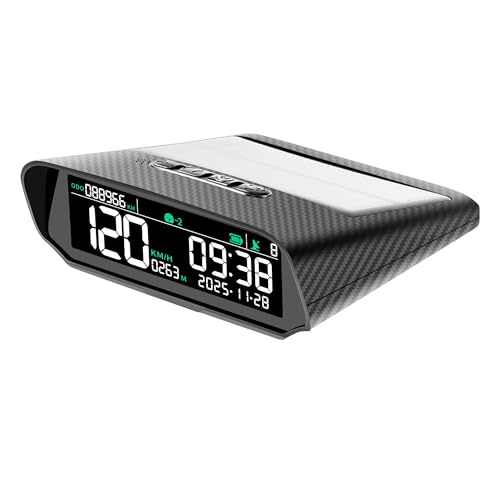
If you drive a classic car, a motorcycle, or anything without an OBD2 port, the X100 is your best bet. It is a pure GPS unit, meaning it handles speed, altitude, temperature, total mileage, and time — but does not pull any engine data. What makes it unique is the integrated solar panel on top, which keeps the internal battery topped off indefinitely in sunlight, supplemented by a USB-C port for cloudy stretches. Real owners report charging it once every two months when parked indoors, and never plugging it in during daily summer use.
The LCD screen uses a carbon fiber background with large, high-contrast digits that remain readable in direct sun, and the auto-brightness adjustment ramps down well for night driving. Build quality exceeds most dash-mounted HUDs: IP67 rating means it can handle heavy rain, dust, and even a short submersion, plus the shock-resistant housing is designed for off-road vibrations. Overspeed and fatigue alarms are built in, and the vibration wake-up sensor turns the display on automatically when the engine starts — no manual power button required.
The trade-off is data depth. Without OBD2, you cannot monitor coolant temperature, RPM, voltage, or fault codes. The included adhesive mounting stickers are also a weak point — several buyers advise replacing them with heavy-duty 3M tape immediately. Solar charging is effective only when direct sunlight hits the panel, so dark windshields or tinted glass reduce its benefit significantly.
Why it’s great
- Solar charging eliminates cable clutter and battery anxiety
- IP67 waterproof and shock-resistant, ideal for off-road or motorcycle use
- Works on any vehicle — no OBD2 port required
Good to know
- No engine diagnostics — speed and altitude only
- Included mounting stickers are low quality; plan to upgrade
3. MAIMEIMI MA-A8 Windshield HUD
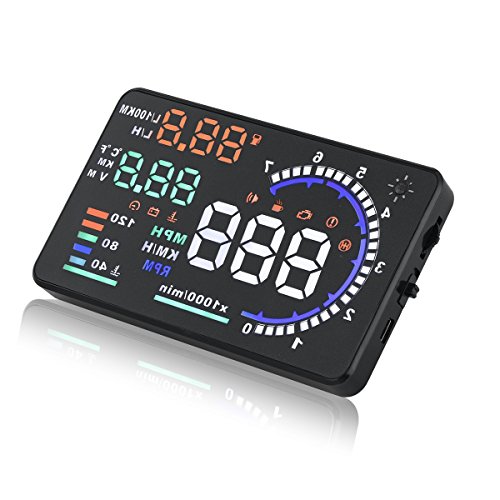
The MAIMEIMI MA-A8 uses the car’s own windshield as the projection surface, with an OBD2-connected projector that reflects large-font speed data directly onto the glass in real time. This gives the most traditional heads-up experience — your eyes never leave the road. The unit includes a built-in light sensor for automatic brightness adjustment across day and night cycles, and you can manually override the brightness level as well. A selection of display colors helps contrast against different windshield tints and weather conditions.
Data coverage includes speed, RPM, water temperature, trip distance, voltage, and fuel consumption, all pulled from the OBD2 port. The alarm set is robust: overspeed, fatigue driving, speed fluctuation, and engine failure alerts, each with configurable thresholds. The device itself is slim — 0.59 inches thick — and mounts with a reflective film sticker on the glass rather than a bulky dash stand. Metal and plastic construction feels more solid than the all-plastic budget options.
However, the MA-A8 has a documented flaw: in rare cases, it interfered with transmission shifting on certain vehicles, requiring the unit to be unplugged and the ECU codes cleared. That appears to be an isolated compatibility issue rather than a widespread defect, but worth noting if you own a late-model car. The second most common complaint is a 2-second input lag during initial boot-up, which resolves once the unit stabilizes.
Why it’s great
- True windshield projection without a separate display screen
- Four distinct alarm types with adjustable trigger points
- Compact 0.59-inch profile hides neatly behind the rearview mirror area
Good to know
- Some users report OBD2 interference that affects transmission shifting
- 2-second input lag on cold start before live data appears
4. wiiyii P6 Head Up Display
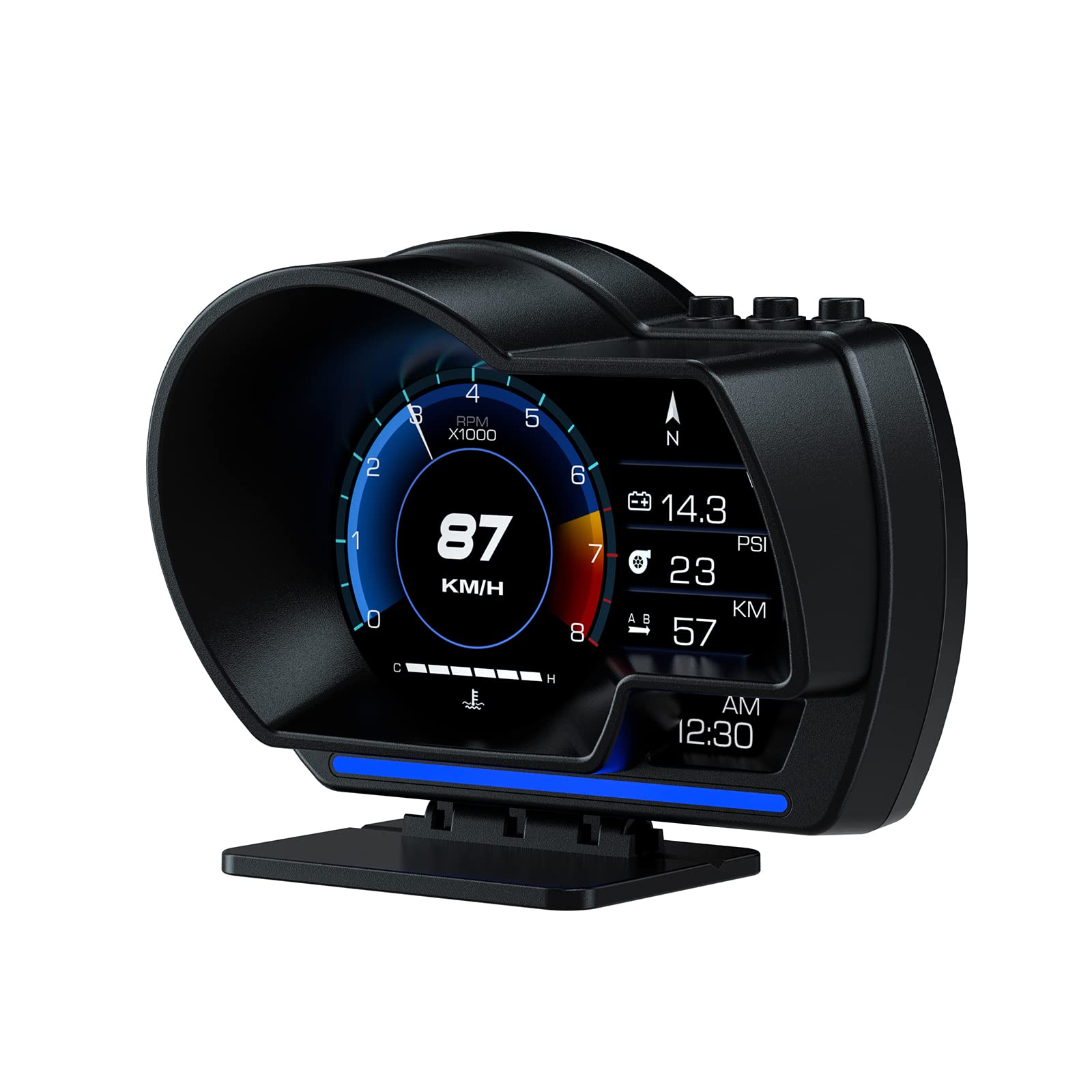
The wiiyii P6 is a dual-system HUD that defaults to running OBD2 and GPS simultaneously, giving you the richest data blend in this list: speed, RPM, coolant temperature, voltage, fuel consumption, and even CVT transmission temperature on compatible vehicles. It cycles through 10 customizable display interfaces, each with a different arrangement of gauges, so you can prioritize the data that matters most for your drive — engine temps during summer towing, or RPM for manual-shift timing.
A standout feature is the ambient light ring around the display housing. Under normal driving, it glows blue; the moment you exceed a set speed threshold or a parameter goes out of range, it switches to red. This color-shift alert system works peripherally, so you notice the warning without taking your eyes off the road. The brightness also adjusts automatically based on ambient light, and the contrast holds up well even in direct sun.
The main drawbacks come down to documentation and hybrid compatibility. The included manual is notoriously poor — tiny text, vague menu descriptions, and minimal guidance on setting the sleep voltage threshold that prevents battery drain. Hybrid vehicles (like the RAV4 Prime) may show inconsistent readings, particularly on voltage. Owners also note that the clock defaults to 24-hour format with no analog option, and the GPS time zone setup requires a few trial-and-error attempts.
Why it’s great
- Simultaneous OBD2 + GPS data for maximum gauge coverage
- Color-switching ambient light (blue/red) for peripheral warnings
- 10 fully customizable interface layouts
Good to know
- Manual is nearly useless for setup and configuration
- Hybrid compatibility is inconsistent, especially on voltage readings
5. MH P6 Head Up Display

The MH P6 is a strong contender if you want a HUD that doubles as an OBD2 diagnostic scanner. Beyond the standard speed, RPM, water temperature, and voltage display, it can scan and clear engine fault codes (DTCs), read real-time data streams, and perform acceleration and brake tests — tools usually reserved for standalone code readers. For DIY mechanics who monitor engine health as a daily habit, this eliminates the need for a separate scanner.
The device runs OBD2 mode primarily, with GPS mode as a backup for vehicles that lack OBD2 compatibility. The display offers 10 interface layouts and adjustable brightness across 8 levels. Alarm functions cover overspeed, high water temperature, low voltage, and RPM limits — each configurable from the menus. Installation is simple: plug into the OBD2 port and attach the adjustable bracket to the dash or windshield. The bracket allows full rotation for angle and orientation adjustments.
Reliability reviews are split. Many owners report flawless operation — accurate RPM, useful A/F ratio readouts, and clear DTC descriptions. But a notable fraction received dead-on-arrival units that fail to connect to OBD2 at all, even on compliant vehicles. Additionally, some users found that leaving the MH P6 plugged in caused their car to fail a smog check (CAT test); unplugging the device for several days resolved the issue. The auto-shutoff timer is also unreliable, so consider unplugging it manually during long parking periods.
Why it’s great
- Built-in OBD2 scanner can read and clear engine fault codes
- 8-level brightness control with good sunlight readability
- Full rotation bracket for precise dash or windshield positioning
Good to know
- Inconsistent auto-shutoff timer risks battery drain
- Some units arrive DOA; test immediately upon arrival
6. MAIMEIMI MA-P6 Speedometer

The MAIMEIMI MA-P6 delivers OBD2 and GPS dual functionality in a compact 4.29-inch-wide body with a metal and plastic chassis that feels sturdier than most budget HUDs. It offers 10 different UI interfaces, each with a distinct data layout and color scheme that you can switch on the fly. In OBD2 mode, it monitors speed, water temperature, oil temperature, voltage, fuel consumption, RPM, clock, trip distance, and driving direction. GPS mode adds altitude, satellite count, and satellite time.
One unique strength is the included stand base that allows the display to rotate freely in all directions, making it easy to find an angle that works on curved dashes. It can sit flat on the dashboard or attach to the windshield, depending on your preference. The unit is also one of the few in this class that explicitly supports a 1998 Mitsubishi Lancer in GPS mode — a strong signal that the GPS fallback works well on genuinely old vehicles with no OBD2 data.
Compatibility warnings are extensive. The OBD2 mode explicitly excludes Dodge, Jeep, Chrysler, French and Italian models, Suzuki, Mazda6, hybrids, diesels, trucks, RVs, modified ECUs, and several specific Lexus, Infiniti, and Honda models. If your car falls into any of those gaps, the MA-P6 still functions in GPS mode but loses all engine-related data. A few users also report a slight display lag in OBD2 mode and that the temperature unit can be stuck in Celsius despite switching to Fahrenheit in settings.
Why it’s great
- Full 360-degree rotating stand for flexible dash placement
- GPS mode works reliably on vehicles from the late 1990s
- Metal-reinforced construction at a budget-friendly price
Good to know
- Long list of incompatible brands and models in OBD2 mode
- Temperature units can be locked to Celsius in some configurations
7. wiiyii P8 Head Up Display
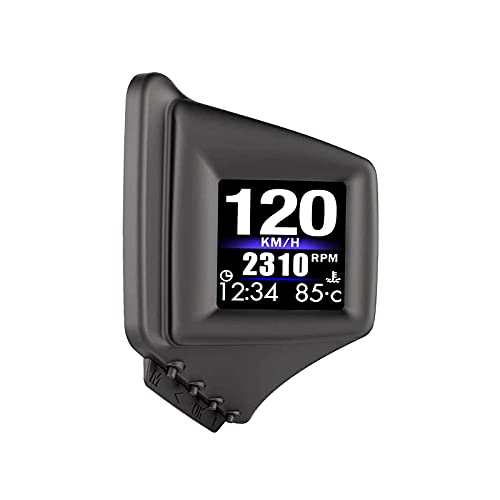
The wiiyii P8 is unique among these options because it is designed to mount on the A-pillar trim — the vertical panel between the windshield and the front door. This mounting location keeps the display at natural eye level without taking up dashboard real estate, and the adjustable angle lets you direct the screen toward the driver’s seat. It can also sit on the dash traditionally, but the A-pillar approach is cleaner for cars with limited dash space.
Functionally, the P8 is an OBD2 + GPS dual system with 8 display interfaces that cycle through speed, RPM, clock, voltage, water temperature, coolant temperature, intake pressure, MAF flow, fuel flow, and boost pressure. For turbocharged vehicles, the P8 serves as a dedicated boost gauge — a function that owners of tuned AMG and Subaru models specifically praise. The speed offset is adjustable, and after calibration, accuracy sits within 1 mph of the vehicle’s ECU reading. The auto sleep setting works reliably, shutting down based on RPM inactivity to protect the battery.
The P8 has a few construction compromises. At 2.56 ounces, it is very lightweight and feels plasticky compared to metal-reinforced units. The included Velcro mounting strips are weak — most owners end up using heavy-duty adhesive pads for a secure fit. Also, the top row of parameters on the 6-item display layout is locked to time and distance, meaning you cannot customize those four data spots. A portion of users also mention the screen stays too bright at the lowest night setting, causing distraction in very dark conditions.
Why it’s great
- A-pillar mount keeps the dash completely clear
- Excellent boost gauge for turbocharged gasoline engines
- Accurate speed reading within 1 mph after calibration
Good to know
- Plastic build feels light; Velcro strips need replacement
- Top-row display parameters are fixed; cannot be customized
FAQ
Will an OBD2 HUD work on my 2005 car or older?
Can an auto heads up display drain my car battery?
Why does my HUD show the wrong speed compared to the dashboard?
Do all HUDs work with diesel engines, hybrids, or electric cars?
Final Thoughts: The Verdict
For most users, the best auto heads up display winner is the Liiiyuan C2 because its ghost-free reflective panel delivers the cleanest projection while offering the deepest OBD2 parameter set at a fair mid-range cost. If you want a rugged GPS-only unit that works on any vehicle without draining your battery, grab the HAOYICHE X100. And for DIYers who need a built-in OBD2 fault code scanner alongside their driving data, nothing beats the MH P6.