
Our readers keep the lights on and the weekend projects moving. As an Amazon Associate, I earn from qualifying purchases.
Lower back pain turns a simple ride into a grinding misery. Every bump, every stretch forward, every hard seat punishes the lumbar spine until the only relief is stopping. The right bike changes the equation: a supported pelvis, a reclined posture, and a drivetrain that absorbs shock instead of transmitting it straight up your vertebrae. That’s not a luxury feature — it’s the only design spec that matters when your spine dictates your limits.
I’m Rikta — the founder and writer behind FitlyFast. I’ve spent years analyzing ergonomic hardware specifications and cross-referencing patient outcomes to isolate which frame geometries, seat contours, and resistance systems actually reduce spinal load during stationary cycling.
Finding a bike for lower back pain means ignoring marketing fluff and hunting for specific design elements: a contoured lumbar support, an oversized seat cushion, a semi-reclined frame angle, and a magnetic drive that eliminates jarring chain vibration. This guide breaks down the 11 models that deliver those specs and actually work.
How To Choose The Best Bike For Lower Back Pain
Selecting a stationary bike when you have lower back pain isn’t about brand names or flashy screens. It’s about three non-negotiable biomechanical factors: frame geometry, seat construction, and drivetrain smoothness. Ignore any of these and you’re inviting flare-ups instead of relief.
Recumbent vs. Upright: The Only Real Debate
An upright bike forces your torso to lean forward, recruiting the lumbar erectors as stabilizers and loading the spinal discs under constant tension. A recumbent bike places your hips at an open angle with your back fully supported. Every model in this guide uses a recumbent frame because that reclined position offloads the lumbar spine by up to 40 percent compared to an upright posture. If a bike does not have a full backrest with lumbar contouring, it does not belong on a back-pain shortlist.
Seat Cushion Thickness and Backrest Design
Thin foam seats transfer the full reaction force of each pedal stroke into the ischial tuberosities and up the sacroiliac joint. Look for cushion thickness above 3 inches in the seat pad and a backrest that follows the natural S-curve of the spine. Mesh backrests improve airflow but must still provide rigid lumbar support — a mesh that sags under your weight defeats the purpose. Contoured backrests with adjustable tilt allow you to dial in the exact recline angle that takes pressure off the discs.
Magnetic Resistance and Belt Drive Systems
Friction-based resistance systems introduce jerky starts and variable drag that force your core to compensate. Magnetic resistance delivers constant, fluid tension with zero stuttering — your back stays relaxed while your legs work against a predictable load. Pair that with a belt drive: chains transmit micro-vibrations through the frame and into the seat base. Belt drives absorb that vibration, producing a near-silent, shock-free pedal stroke that protects the lumbar spine over long sessions.
Weight Capacity and Frame Stiffness
A frame that flexes under load creates an unstable platform, forcing your lower back to stabilize the entire body. Steel frames with a weight rating of at least 350 pounds typically provide the torsional rigidity required to keep the pedaling plane true. Models rated at 400 pounds or higher use reinforced cross-bracing that eliminates wobble even during high-cadence intervals. That stability translates directly into a safer spine environment.
Quick Comparison
On smaller screens, swipe sideways to see the full table.
| Model | Category | Best For | Key Spec | Amazon |
|---|---|---|---|---|
| 3G Cardio Elite RB X | Premium | Tall riders (up to 6’5”) needing lumbar support | 25-position seat, 5-position tilt backrest | Amazon |
| Spirit Fitness XBR95 | Premium | Heavy rehab with 40 resistance levels | 30-lb flywheel, 40 magnetic levels | Amazon |
| XTERRA SB4500 | Premium | Touchscreen program variety | 7-inch touchscreen, 24 resistance levels | Amazon |
| Schwinn 130 Upright | Mid-Range | App-based virtual rides via Zwift | 16 magnetic levels, Bluetooth FTMS | Amazon |
| LFEYYD W215 | Mid-Range | High capacity (450 lbs) with elliptical motion | 450-lb cap, 16 magnetic resistance levels | Amazon |
| MERACH S19 | Mid-Range | Knee rehab with lumbar padding | 8-position seat rail, 6.6-lb flywheel | Amazon |
| pooboo W216 | Mid-Range | Arm exerciser with ergonomic mesh backrest | 400-lb cap, 8 magnetic levels, mesh backrest | Amazon |
| Sunny Health SF-RB424006 | Mid-Range | App connectivity with no membership fees | 16 magnetic levels, foam-grip resistance bands | Amazon |
| XVGVSV W241 | Mid-Range | 2-in-1 recumbent-elliptical motion | 400-lb cap, 16 magnetic levels, elliptical stride | Amazon |
| VANSWE RB405 | Mid-Range | Infinite seat slider for perfect leg fit | 400-lb cap, 3.4-inch thick seat cushion | Amazon |
| VANSWE VSRB408 | Mid-Range | Infinite slider plus full-body arm handles | 400-lb cap, 8 magnetic levels, infinite slider | Amazon |
In‑Depth Reviews
1. 3G Cardio Elite RB X Recumbent Exercise Bike

The 3G Cardio Elite RB X is the gold standard for back pain sufferers because it treats the spine as the primary design constraint rather than an afterthought. The Airflow Mesh Flex backrest tilts through 5 positions and the oversized seat slides through 25 discrete positions, letting you dial in the exact recline angle that unloads your lumbar discs. At 115 pounds with a 350-pound capacity, the frame is rigid enough to eliminate any flex-induced spinal compensation during high-output pedaling.
FreeSync FTMS Bluetooth connectivity allows integration with third-party apps for structured rehab pacing, and the included wireless heart rate strap gives real-time feedback without reaching for hand sensors. The narrow Q factor — the distance between the pedals — keeps your hips in a neutral, externally rotated position that reduces SI joint strain. Every detail, from the step-through frame to the metal transport handles, is built for accessibility and stability.
What sets this apart is the commercial-grade warranty: lifetime frame, seven-year parts, and one-year in-home labor. The seat accommodates users from five feet to six-foot-five, making it the most adjustable recumbent on this list. For chronic lower back conditions where bike fit is non-negotiable, this is the benchmark.
Why it’s great
- Oversized seat with 25 forward/back positions and 5 tilt angles for precise lumbar alignment
- Narrow Q factor keeps hips neutral and reduces sacroiliac joint irritation
- Commercial-grade warranty with lifetime frame coverage
Good to know
- Assembly may require two people due to the 115-pound weight
- No built-in touchscreen — relies on bring-your-own-device setup
2. Spirit Fitness XBR95 Recumbent Bike
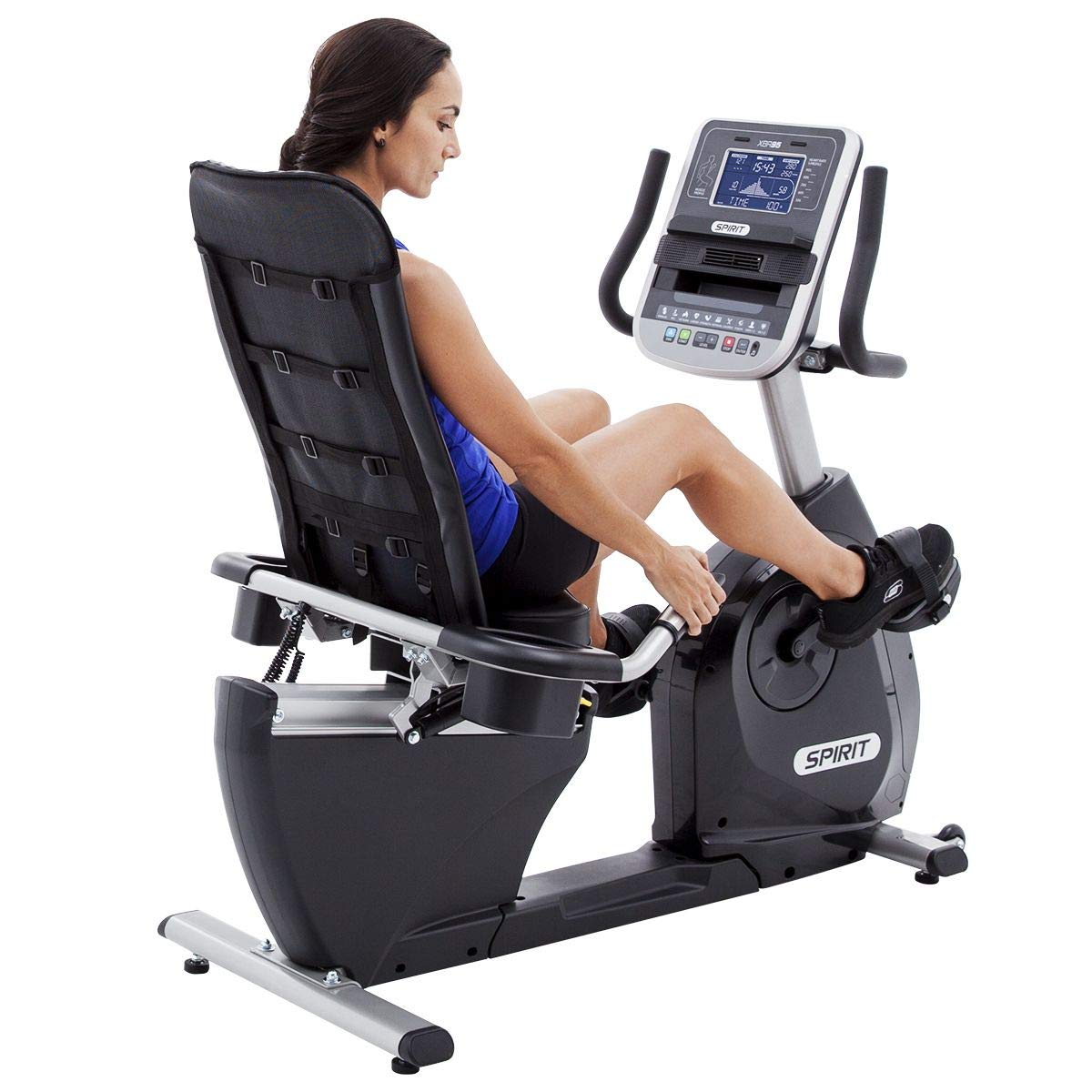
The Spirit XBR95 is built around a 30-pound perimeter-weighted flywheel with 40 levels of magnetic resistance, giving you the widest range of tension control on this list. That granularity matters for back pain rehab because it lets you progress from passive recovery spins at level one to challenging interval work at level 40 without any jerky transition that might trigger a spasm. The cooling mesh back seat adjusts in recline and provides continuous airflow to prevent sweat buildup during longer sessions.
The generator-powered system eliminates the need for batteries or a wall outlet — pure pedal input drives the 7.5-inch backlit LCD. Hand pulse grips and wireless heart rate monitoring give accurate cardiac data without the distraction of a chest strap for those who prefer it. The step-through frame simplifies mounting for users with limited flexibility, and the 350-pound weight capacity ensures the frame stays torsionally rigid under load.
Feedback from users recovering from hip replacement surgery specifically highlights the recline feature and manual program as the most comfortable settings for extended rehab sessions. The 30-pound flywheel provides enough inertia to smooth out pedal stroke dead spots, reducing the need for core engagement to keep the cranks turning.
Why it’s great
- 40 magnetic resistance levels offer precise tension progression for rehab
- Generator-powered — no batteries or outlet required
- 30-pound flywheel smooths pedal stroke and reduces core compensation
Good to know
- Some reports of monitor alignment issues after assembly
- Seat slider may develop wobble over extended use
3. XTERRA Fitness SB4500 Recumbent Bike
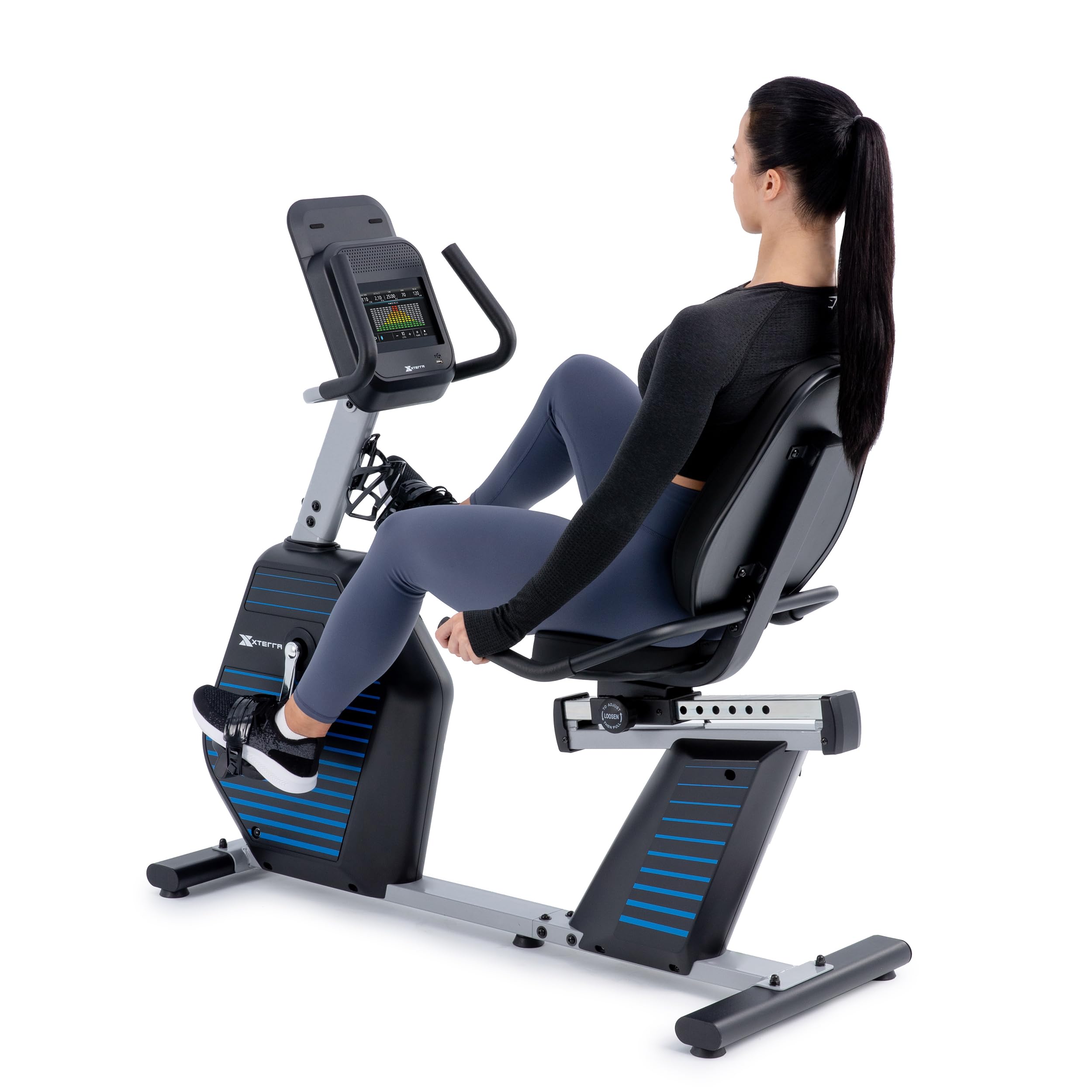
The XTERRA SB4500 sets itself apart with an intuitive 7-inch touchscreen display that lets you adjust resistance, browse 11 workout programs, and view metrics without scrolling through a tiny LED window. For back pain sufferers who want distraction-free structured workouts, the built-in programs provide specific pacing that prevents overexertion. The step-through frame design makes it easy to mount and dismount without twisting the lumbar spine.
Bluetooth FTMS compatibility connects the bike to third-party apps like Zwift, giving access to virtual routes that auto-adjust resistance based on terrain. The 24 resistance levels cover everything from gentle assisted motion to challenging climbs, and the belt drive keeps the operation whisper-quiet. The accessory tray and USB charging port add convenience for long sessions with entertainment devices.
Users report the seat provides excellent comfort for riders up to six-foot-two, and the 265-pound weight capacity, while lower than other models, still covers the majority of the population. The package weight of 82 pounds makes it manageable for solo repositioning, and the commercial-grade steel frame delivers consistent stability during interval work.
Why it’s great
- Built-in 7-inch touchscreen with 11 workout programs for structured rehab pacing
- Step-through frame eliminates lumbar twisting during mount/dismount
- Bluetooth FTMS compatibility for virtual training routes
Good to know
- Speaker may develop static noise over time
- No built-in cup holder or device ledge
4. Schwinn Fitness 130 Upright Bike
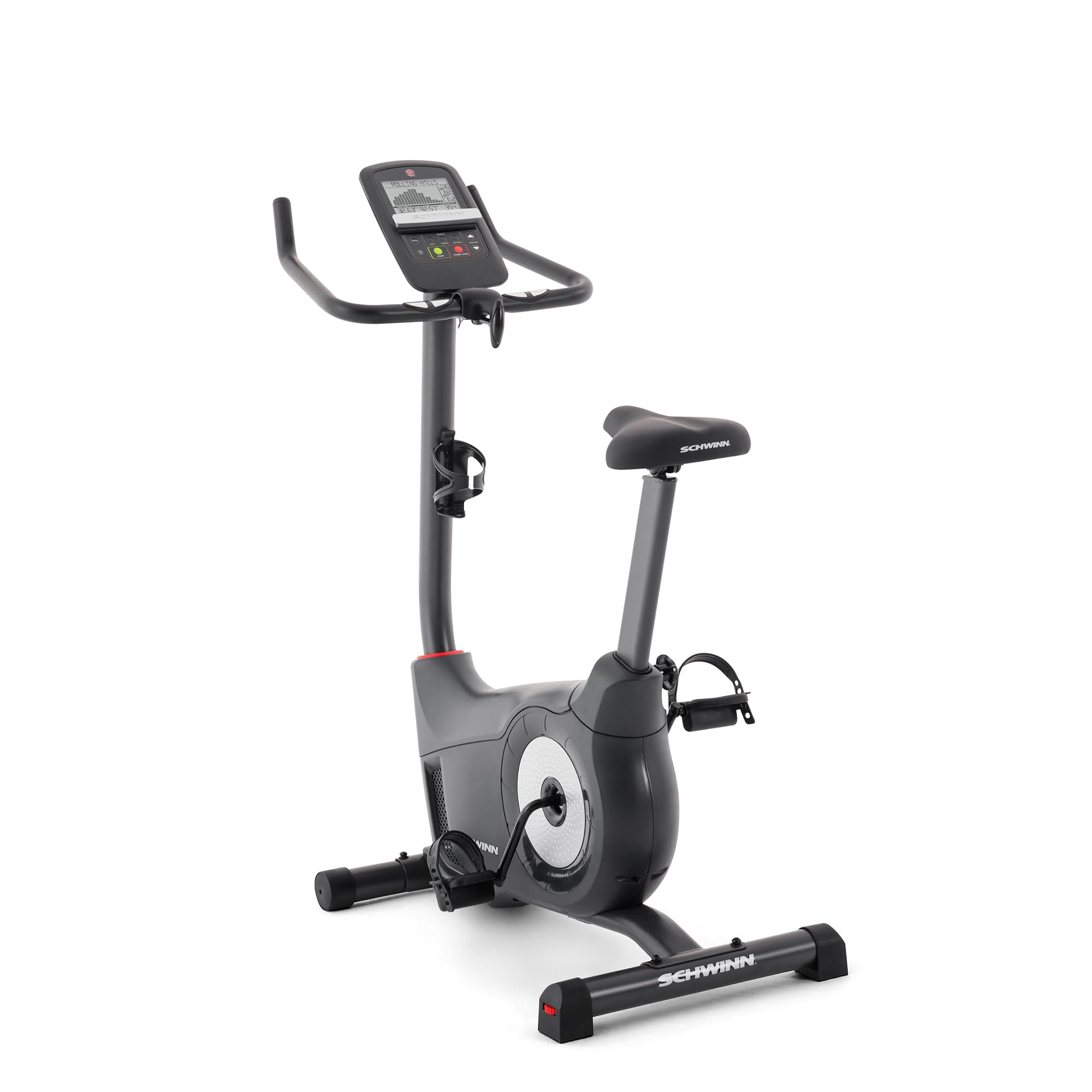
The Schwinn 130 sits in a unique position because it is an upright bike that earns its place on a back-pain list through sheer drivetrain refinement and app integration that offloads cognitive load. While upright frames are generally less ideal for lumbar support, the 16 levels of magnetic resistance paired with a perimeter-weighted flywheel deliver a glass-smooth pedal stroke that minimizes the micro-vibrations transmitted through the saddle. The telemetric heart rate and grip sensors support heart-rate-controlled programs that prevent you from overexerting into a pain flare-up.
The 5.5-inch LCD display provides 13 workout programs and connects via Bluetooth to Zwift and Explore the World for real-time route resistance adjustment. The foam comfort seat is firmer than recumbent cushions but breaks in within a week, and the adjustable handlebars allow some torso position variation. The bike is light — 57 pounds — making it easy to move between rooms.
For users whose back pain is aggravated by the monotony of indoor training but who can tolerate a semi-upright position with proper core bracing, the Zwift integration makes the Schwinn 130 a compelling option. It is not a recumbent, but for those who prefer an upright posture with world-class app support, the drivetrain quality reduces spinal loading compared to budget upright alternatives.
Why it’s great
- Flawless Zwift/Bluetooth FTMS connectivity for immersive virtual training
- High-inertia perimeter-weighted flywheel smoothes pedal stroke
- Lightweight frame (57 lbs) is easy to reposition
Good to know
- Upright posture may aggravate certain lower back conditions
- Handlebar is not height-adjustable
5. LFEYYD W215 Recumbent Exercise Bike
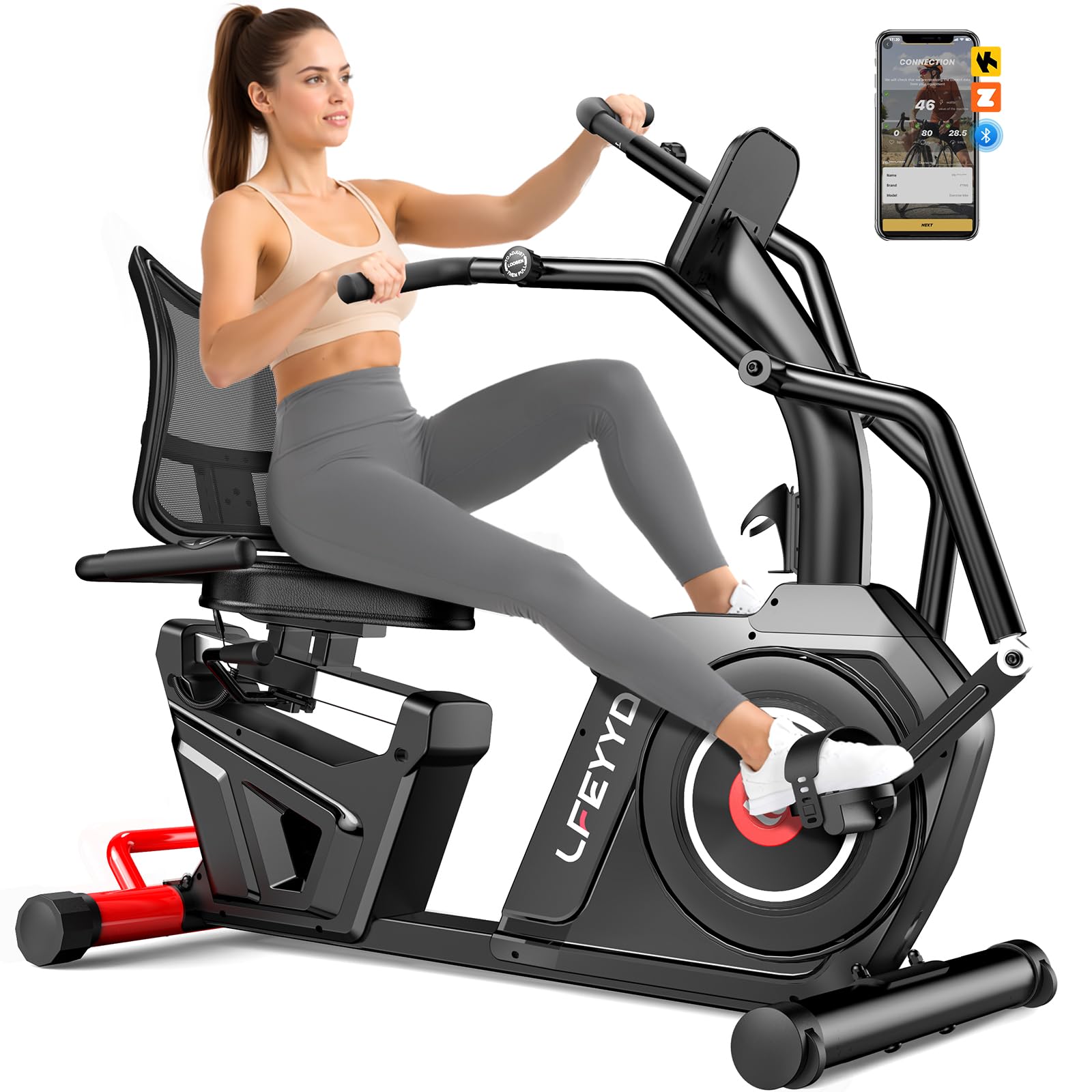
The LFEYYD W215 stands out with a 450-pound weight capacity — the highest on this list — combined with a unique recumbent-elliptical hybrid motion. This dual-action design engages both upper and lower body in a coordinated stride that offloads the lumbar spine while still providing a full cardio load. The oversized padded seat cushion uses high-density foam with a breathable surface to reduce heat buildup during extended sessions.
Sixteen levels of magnetic resistance offer a smooth progression from gentle rehab to intense intervals, and the belt drive keeps operation silent. The press-lever seat adjustment allows quick changes between users without fumbling with pins, and the integrated LCD monitor tracks time, speed, distance, calories, and heart rate via grip sensors. The 80 percent pre-assembly and built-in transport wheels make setup and relocation straightforward despite the steel frame’s heft.
Riders who need a commercial-grade foundation for daily use — particularly larger individuals who struggle to find stable, wobble-free bikes — will appreciate the thickened steel tubing and anti-slip foot pads. The wide seat base and supportive backrest create a stable pelvic platform that discourages compensatory movement patterns.
Why it’s great
- 450-pound weight capacity with reinforced steel frame for zero flex
- Hybrid recumbent-elliptical motion spreads load across more muscle groups
- Press-lever seat adjustment tool-free for multiple users
Good to know
- Hybrid design may feel different from standard recumbent pedaling
- Display is basic LCD — no Bluetooth app integration
6. MERACH S19 Recumbent Exercise Bike
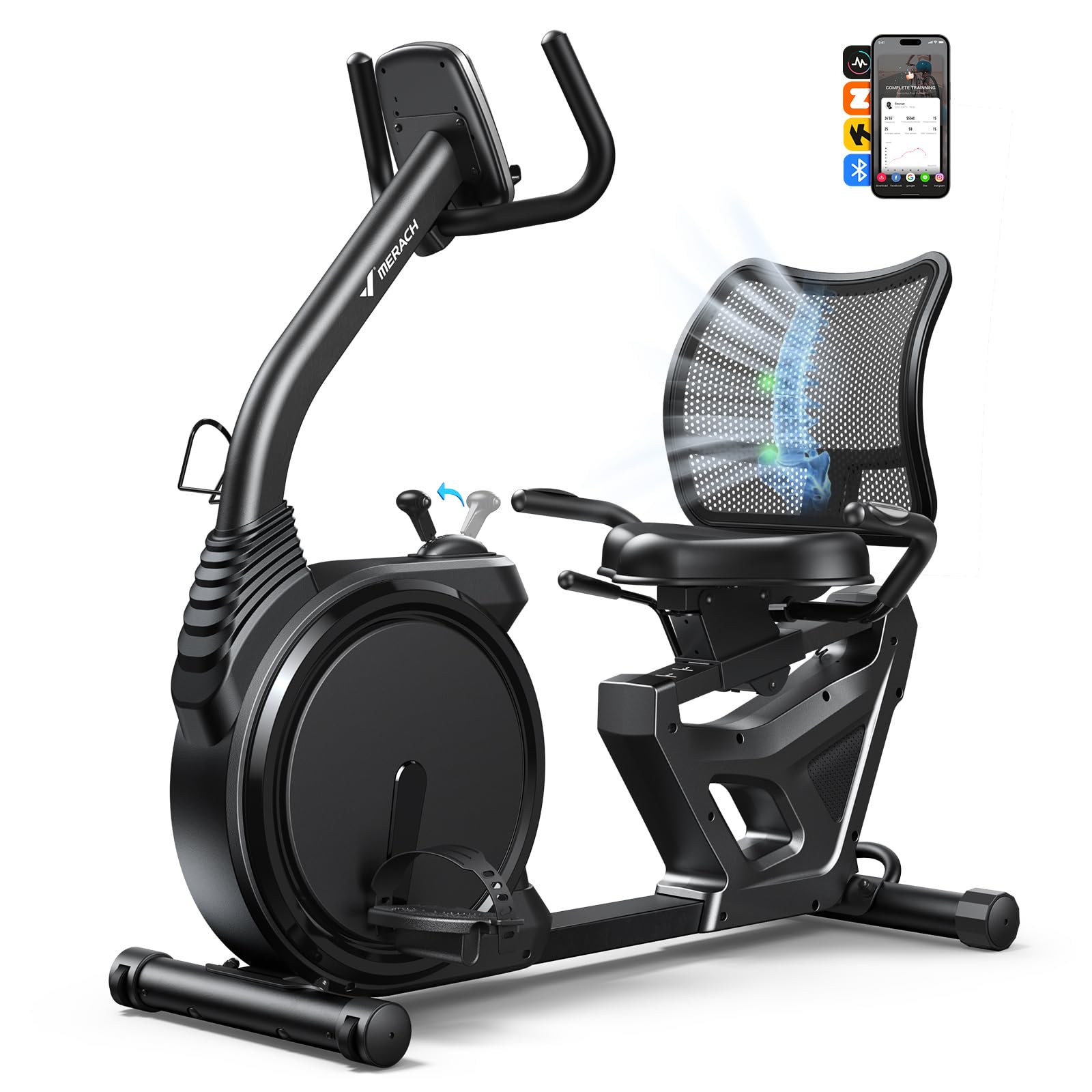
The MERACH S19 is optimized for knee and back rehab recovery with a 6.6-pound perimeter-weighted flywheel and an 8-position adjustable seat rail that accommodates leg lengths from 28 to 35 inches. The frosted handlebars provide a non-slip grip that keeps hands dry even during intensive sessions, and the breathable mesh backrest delivers targeted lumbar support without trapping heat. The ergonomic thicker seat cushion provides more padding than typical mid-range recumbent models.
The “car-style” resistance lever lets you shift through 8 magnetic levels without taking your hands off the grips, which is useful when you need to quickly reduce load during a flare-up. The MERACH app connects via Bluetooth to track distance, time, calories, and heart rate, and the FantomFite gamification mode turns rehab sessions into interactive challenges that encourage consistency. The LCD display shows all core metrics at a glance.
User reports confirm the bike is exceptionally quiet — the dual-belt drive system produces virtually no mechanical noise, making it suitable for early-morning or late-night sessions in shared living spaces. The 330-pound weight limit and 84-pound total weight provide a stable platform without requiring reinforcement bolts.
Why it’s great
- 8-position sliding seat rail fits leg lengths from 28 to 35 inches
- Car-style resistance lever allows instant tension changes mid-ride
- Whisper-quiet dual-belt drive for shared living spaces
Good to know
- Seat cushion is firm — some users add an extra gel pad
- Handlebar heart rate sensor may not stay in raised position
7. pooboo W216 Recumbent Exercise Bike
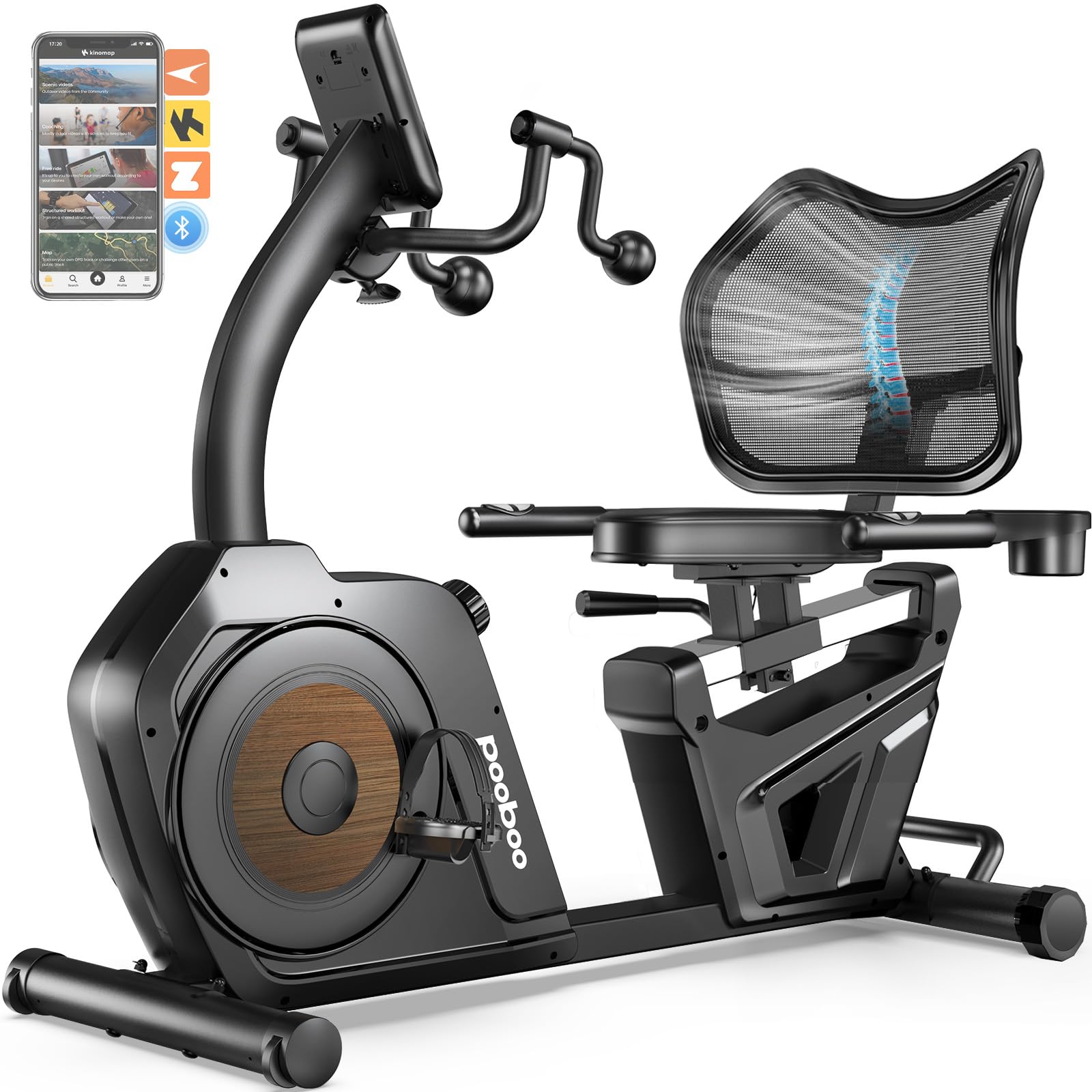
The pooboo W216 integrates a hand-cranked arm exerciser that lets you work upper and lower body independently or simultaneously — a feature that offloads the lumbar spine by distributing the cardiovascular load across more muscle groups. The ergonomic breathable mesh backrest is contoured to follow the natural curve of the human spine, providing continuous support that reduces shock transmission through the waist. The 15-pound flywheel delivers high-inertia performance for smooth pedal rotation.
Eight levels of magnetic resistance are controlled via a simple knob, with each resistance band mapped to specific training zones: warm-up, cardiovascular building, and fat-burning climbs. The LCD monitor tracks speed, distance, time, calories, odometer, and pulse, and the built-in sensor is compatible with KINOMAP and Zt fitness apps for data logging. The sliding seat rail offers 18.5 inches of adjustment, accommodating users up to six-foot-three.
At 80 pounds, the frame is heavy enough to eliminate wobble during vigorous workouts but includes integrated transport wheels for room-to-room mobility. The 400-pound weight capacity provides a generous safety margin, and the belt drive keeps noise levels at roughly 20 decibels — quieter than a typical conversation.
Why it’s great
- Hand-cranked arm exerciser distributes load and spares the lower back
- Spine-contoured mesh backrest fits waist and reduces shock
- 18.5-inch sliding seat rail fits taller riders
Good to know
- Monitor is non-backlit — hard to read in low light
- Only 8 resistance levels compared to higher-tier competitors
8. Sunny Health & Fitness SF-RB424006 Smart Recumbent Bike
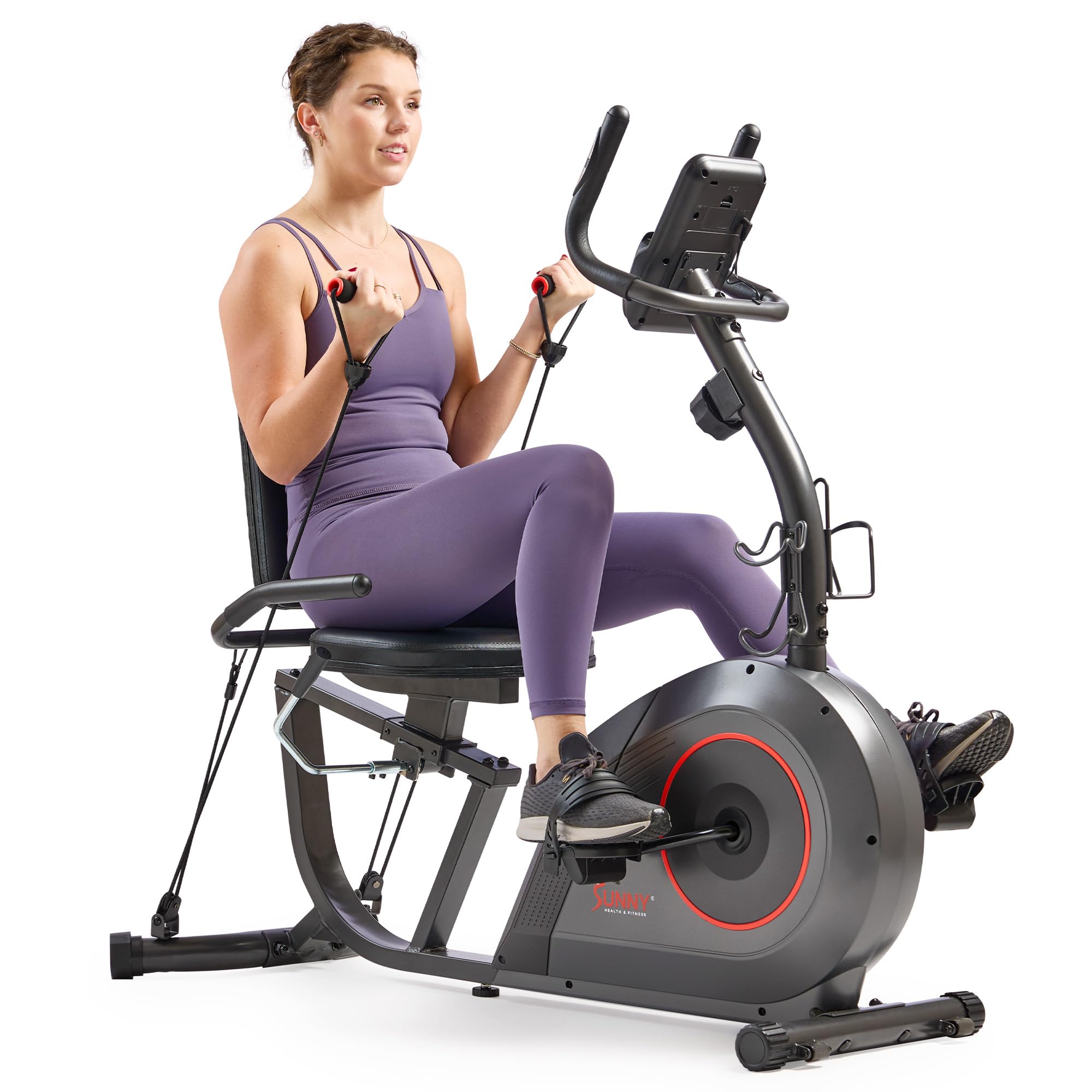
The Sunny Health SF-RB424006 is the only bike in this guide that comes with two 20-pound resistance bands integrated into a pulley system, enabling upper body work without a separate arm exerciser mechanism. The wide cushioned seat and padded backrest provide a stable pelvic base, and the flip-able side handle makes mounting easy for users with limited hip mobility. The recumbent frame positions the rider in a supported recline that reduces lumbar loading compared to upright bikes.
Sixteen levels of magnetic belt-drive resistance deliver the quietest operation in its class, and the SunnyFit app — with no membership fees — unlocks over 1,000 trainer-led workouts and 10,000 virtual scenic tours. The app integration supports real-time progress tracking and social challenges, which helps maintain consistency during long rehab periods. The adjustable seat accommodates a range of inseam lengths, though riders above six feet may find the maximum legroom insufficient.
The bike weighs 64 pounds, making it the lightest recumbent on this list, which simplifies repositioning but reduces the inherent stability of heavier frames. Users report the magnetic resistance provides constant tension without the sticky feel of less expensive magnetic systems, and the pulse monitor on the top handles offers accurate readings when hands are held steady.
Why it’s great
- Includes two 20-pound resistance bands for coordinated upper/lower body work
- SunnyFit app with zero membership fees and over 1,000 guided workouts
- Very quiet magnetic belt-drive system
Good to know
- Maximum legroom may feel short for riders over 6 feet tall
- Lightest frame on this list — less mass to dampen vibration
9. XVGVSV W241 Recumbent Exercise Bike
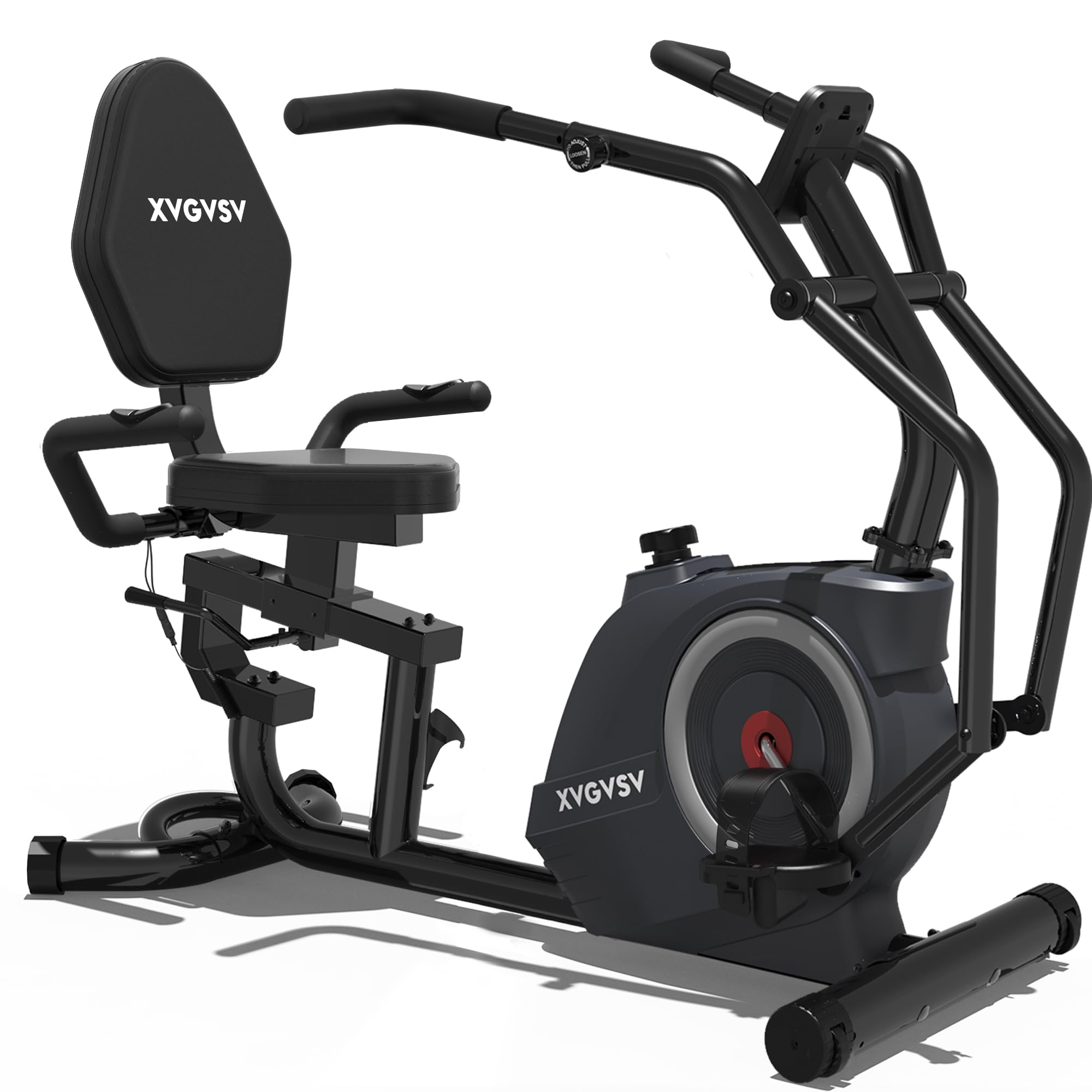
The XVGVSV W241 brings a 2-in-1 recumbent-elliptical hybrid design that shifts between cycling and elliptical motion, allowing you to change the joint angle and muscle recruitment pattern mid-session without changing machines. This variability is valuable for back pain sufferers because alternating between pedaling modes prevents repetitive loading on the same spinal segments. The plush padded seat and ergonomic backrest maintain pelvic support in both motion modes.
Sixteen levels of magnetic resistance ensure the transition between cycling and elliptical feels seamless, and the lever-based seat adjustment fits users of different heights. The LCD monitor tracks time, speed, distance, calories, odometer, and heart rate via built-in pulse sensors. The commercial-grade steel frame supports up to 400 pounds with zero perceptible wobble, and the 85 percent pre-assembly cuts setup time to roughly 30 minutes.
The elliptical stride targets different muscle groups than standard recumbent cycling — the glutes and hamstrings get more activation — which can help strengthen the posterior chain and reduce compensatory loading on the lower back. Front transport wheels make relocation manageable despite the 66-pound weight.
Why it’s great
- Dual recumbent-elliptical motion reduces repetitive spinal loading
- 400-pound capacity with commercial-grade steel frame
- Elliptical mode strengthens glutes and hamstrings to support the lower back
Good to know
- Pedal threading is reversed on one side — check before assembly
- Display is non-backlit LCD
10. VANSWE RB405 Recumbent Exercise Bike
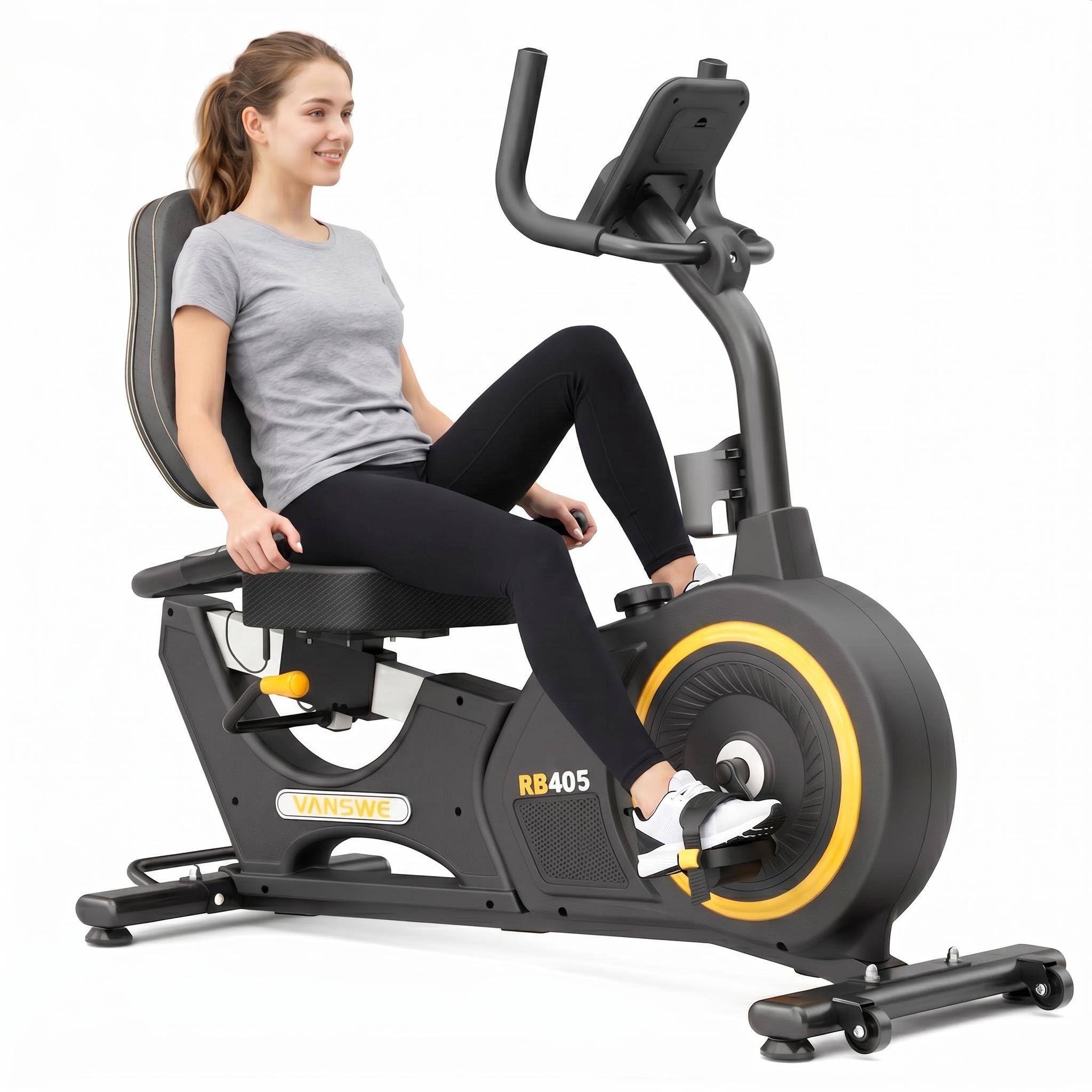
The VANSWE RB405 eliminates the limitation of pre-drilled seat holes with its Infinite Slider Seat System that adjusts down to the exact millimeter, accommodating leg lengths from 29 to 40 inches and user heights from five-foot-one to six-foot-four. This precision fit ensures the pelvis stays in a neutral position without the compromised posture forced by fixed-position rails. The 3.4-inch extra-thick padded cushion is among the thickest in the mid-range category, reducing pressure on the ischial tuberosities.
Eight levels of magnetic resistance are controlled by a simple adjustment knob, and the 11-pound precision flywheel delivers smooth, silent operation. The bright backlit LED monitor shows all key metrics clearly, and Bluetooth connectivity links to Kinomap and Zwift for structured training. The step-through frame design and 90 percent pre-assembly reduce setup to about 30 minutes for most users.
The 400-pound weight limit is supported by a commercial-grade steel frame that remains rock-solid at high cadence, and the integrated transport wheels make repositioning simple. The ergonomic contoured backrest provides continuous spinal support without forcing an unnatural recline angle.
Why it’s great
- Infinite slider seat fits leg lengths from 29 to 40 inches — no pre-set holes
- 3.4-inch extra-thick cushion reduces ischial pressure
- Backlit LED display with Bluetooth app connectivity
Good to know
- Bluetooth pairing may be inconsistent on first connection
- Pedal clips may feel small for larger shoe sizes
11. VANSWE VSRB408 Recumbent Elliptical Cross Trainer
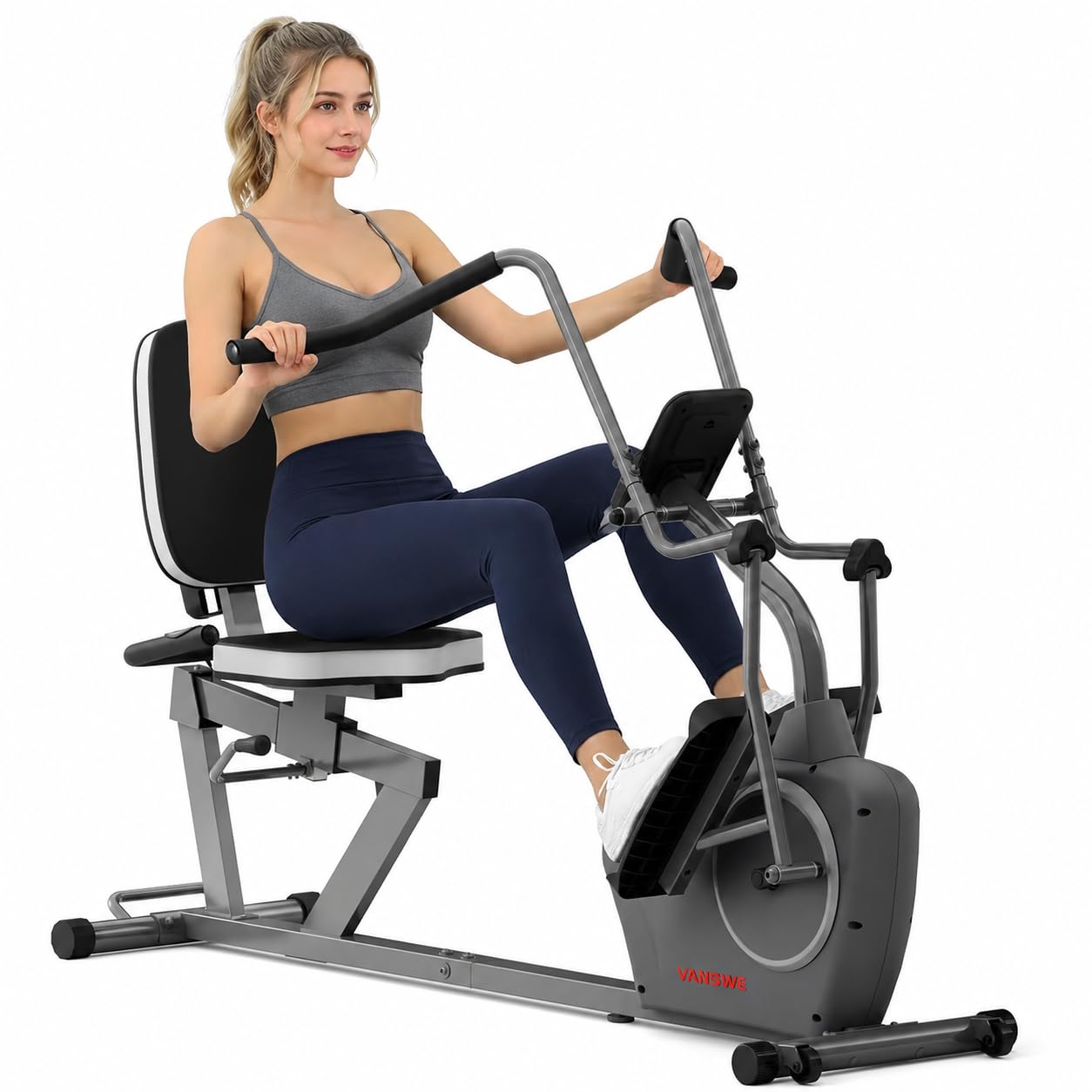
The VANSWE VSRB408 combines the infinite seat slider of the RB405 with movable arm handles and elliptical-sized foot pedals, creating a full-body recumbent experience that offloads the lumbar spine by spreading the workload across upper and lower extremities. The 8-level magnetic resistance system delivers whisper-quiet performance — user reports describe it as “no sound at all” — making it ideal for apartment dwellers or those who exercise while others sleep.
The recumbent reclined seat reduces strain on the back, knees, and ankles compared to upright bikes, and the ergonomically padded seat and backrest provide enough comfort for sessions exceeding 45 minutes. The LED backlit monitor tracks time, speed, distance, calories, and heart rate, and Bluetooth connectivity supports Kinomap and Zwift for virtual rides. The 400-pound weight capacity ensures the frame remains torsionally rigid regardless of rider size.
The infinite seat slider accommodates inseam lengths from 29 to 37 inches, covering user heights from five-foot-two to six-foot-five — making it the most height-inclusive option on this list alongside its RB405 sibling. The heavy-duty steel frame weighs 75 pounds but rolls easily on front transport wheels. Assembly is straightforward for one person, though a second set of hands speeds up the process.
Why it’s great
- Full-body arm handles and elliptical pedals distribute spinal load
- Infinite seat slider fits users from 5’2” to 6’5”
- Exceptionally quiet magnetic belt drive — inaudible at low resistance
Good to know
- Pedal zip tie must be cut carefully to avoid damaging the crank arm
- Only 8 resistance levels compared to 16-level competitors
FAQ
What recumbent bike features directly reduce lower back strain?
Can an upright bike ever be safe for a bad lower back?
Why does a recumbent bike cause lower back pain in some users?
What does an “infinite slider seat” do for back pain?
Should I use a recumbent bike if I have a herniated disc?
Final Thoughts: The Verdict
For most users, the bike for lower back pain winner is the 3G Cardio Elite RB X because its 25-position seat and 5-position tilting backrest provide the most precise lumbar fit at any price point, backed by a commercial-grade warranty that reflects confidence in the frame’s stability. If you want full-body load distribution with an arm exerciser function, grab the pooboo W216. And for the most forgiving seat cushion and infinite adjustability in the mid-range tier, nothing beats the VANSWE RB405.