
Our readers keep the lights on and the weekend projects moving. As an Amazon Associate, I earn from qualifying purchases.
Choosing a stereo receiver often comes down to more than just a big wattage number on the box. The real measure of a receiver is its ability to deliver clean, distortion-free power to your speakers across the entire frequency range, whether you are spinning vinyl, streaming hi-res audio, or building a dedicated home theater system. Many buyers get drawn to peak power claims only to find the unit runs hot, adds audible hiss at low volumes, or lacks the connectivity needed for modern sources.
I’m Rikta — the founder and writer behind FitlyFast. I have spent years analyzing the audio market, cross-referencing amplifier topologies, DAC chipsets, and real-world thermal performance to separate genuine engineering from inflated marketing specs.
Whether you are outfitting a dedicated listening room or upgrading a multi-zone setup, finding the right audio stereo receiver means balancing power delivery, connectivity options, and build quality to match your specific speaker setup.
How To Choose The Best Audio Stereo Receiver
An audio stereo receiver serves as the brain and brawn of your passive speaker system. Unlike powered speakers that have built-in amplification, a receiver must cleanly amplify line-level signals while managing multiple source inputs. The key is matching the receiver’s real-world power to your speakers, room size, and listening habits without overpaying for features you won’t use.
Power Ratings: RMS Over Peak Every Time
Look for continuous RMS power per channel, measured with all channels driven, typically into 8 ohms. A unit rated at 45–70 watts RMS per channel can comfortably drive most bookshelf speakers to moderate volume levels. Peak power figures (800W, 1000W) are marketing numbers tied to a fraction-of-a-second burst and do not reflect sustained performance. For budget-friendly receivers, RMS rarely exceeds 25–40 watts per channel, which works for small rooms or high-efficiency speakers. Premium models often deliver 100–120 watts RMS with robust power supplies that handle dynamic peaks without strain.
Connectivity Options: Match Your Sources
Start by listing the devices you will connect: a turntable requires a built-in phono preamp; a TV needs optical or ARC/eARC input; streaming from a phone depends on Bluetooth codec quality (aptX HD, LDAC) or Wi-Fi with AirPlay 2 support. Digital inputs (optical and coaxial) let you leverage the receiver’s internal DAC instead of your TV’s weaker audio output. Multi-room capability through MusicCast, Sonos certification, or zone 2 pre-outs adds flexibility but raises the budget threshold.
Build Quality and Thermal Management
A receiver that runs hot shortens component lifespan and may trigger thermal shutdown during long listening sessions. Look for units with toroidal transformers, aluminum heat sinks, and adequate ventilation — either passive vents or temperature-controlled fans. Premium models with Dirac Live or YPAO calibration go further by using the supplied microphone to measure your room’s acoustics and apply correction filters, dramatically improving clarity and bass response regardless of your speaker placement.
Quick Comparison
On smaller screens, swipe sideways to see the full table.
| Model | Category | Best For | Key Spec | Amazon |
|---|---|---|---|---|
| Cambridge Audio AXR100 | Stereo Receiver | Pure Music Listening | 100W RMS/ch at 8 ohms | Amazon |
| Onkyo TX-RZ50 | AV Receiver | Immersive Home Theater | Dirac Live Calibration | Amazon |
| Denon PMA-600NE | Integrated Amp | Audiophile 2-Channel | Analog Mode DAC Bypass | Amazon |
| YAMAHA RX-V6A | AV Receiver | Multi-Room Music & 4K Gaming | Dolby Atmos Height Virtualization | Amazon |
| Onkyo TX-NR6100 | AV Receiver | THX Certified Gaming | THX Select Certification | Amazon |
| YAMAHA RX-V4A | AV Receiver | Compact 5.2 Setup | YPAO Room Calibration | Amazon |
| Donner Stereo Receiver | Karaoke Receiver | Karaoke & Party Use | Dual Mic with Echo Control | Amazon |
| Pyle PDA77BU | Budget Receiver | Garage/Workshop Audio | 800W Peak Power Rating | Amazon |
| blafili B3 | Bluetooth Receiver | Upgrading Powered Speakers | ESS ES9018K2M DAC + XLR | Amazon |
In‑Depth Reviews
1. Cambridge Audio AXR100

The Cambridge Audio AXR100 delivers 100 watts per channel into 8 ohms from a robust toroidal transformer, giving it the headroom to drive demanding floor-standing speakers without breaking a sweat. Its Class A/B amplification stage produces a warm, spacious sound signature that reviewers consistently describe as slightly sweet on the top end while maintaining tight bass control. The built-in MM phono stage is notably clean, allowing turntable users to bypass an external preamp without sacrificing detail.
Connectivity covers the essentials: four analog RCA inputs, two digital optical inputs, one coaxial input, and a dedicated subwoofer output. The front-panel headphone jack uses a discrete amplifier circuit rather than a cheap resistive tap, so even 300-ohm headphones get adequate drive. The included remote controls volume, source selection, and tone adjustments, though the IR range is somewhat limited from extreme angles. Notably, the AXR100 lacks any USB input or network streaming — it is a pure stereo receiver for users who prefer external streamers.
Reviewers consistently praise the absence of fan noise — the unit relies on convection cooling via a large finned heatsink. The grey metal chassis is solid and vibration-resistant, and the straightforward front panel with large knobs feels satisfyingly mechanical. Some users report that Bluetooth range is shorter than expected, dropping connection beyond 10–15 feet through walls, so the streamer should remain in the same room.
Why it’s great
- 100W RMS per channel provides genuine dynamic headroom for large speakers
- Built-in phono stage saves cost and clutter for vinyl listeners
- No fan — silent operation even during extended listening sessions
Good to know
- No USB playback or network streaming built in
- Bluetooth range is limited by metal chassis and lack of external antenna
- Remote control IR is weak from off-axis positions
2. Onkyo TX-RZ50

The Onkyo TX-RZ50 is a 9.2-channel AV receiver that brings professional-grade room correction to the consumer market via Dirac Live. The included calibrated microphone runs a series of sweeps to measure your room’s acoustic response, and the software applies precision filters to flatten frequency peaks and tame problematic bass nodes. Owners consistently report that Dirac transforms muddy, boomy rooms into spaces with clear imaging and tight low-end — a significant upgrade over typical auto-calibration systems.
Power is rated at 120 watts per channel (two channels driven, 8 ohms), but the high-current transformer design delivers clean current into low-impedance 4-ohm speakers without sagging. The seven HDMI 2.1 inputs support 8K/60 and 4K/120 passthrough with HDR10+, Dolby Vision, and eARC, making it a strong pairing for next-gen gaming consoles. For home theater, it processes Dolby Atmos and DTS:X up to 7.2.4 with an external amplifier for the rear height channels.
Reviewers note that the front panel is dense but logical after initial setup, and the web-based interface allows adjustment from any browser. A known soft spot: the Sonos certification integration works well once configured, but initial pairing can be finicky. The cooling fan is temperature-controlled and generally inaudible during music playback, but can become noticeable in very warm rooms or during extended high-volume movie sessions.
Why it’s great
- Dirac Live delivers measurable improvement over standard room EQ
- 11.2 channels of processing for 7.2.4 Atmos setups with external amp
- HDMI 2.1 supports 8K/60 and 4K/120 for future-ready gaming
Good to know
- Fan becomes audible under heavy thermal load
- Sonos integration setup can be temperamental
- Runs warm; requires at least 5 inches of open space above
3. Denon PMA-600NE

The Denon PMA-600NE is a two-channel integrated amplifier with a built-in DAC, Bluetooth, and phono stage wrapped in a compact chassis. Its defining feature is Analog Mode: pressing a front-panel button physically disconnects the digital circuitry from the analog amplification path, removing any noise from unused digital sections. Audiophiles describe the resulting sound as warm and tube-like, with airy highs and a spacious midrange that makes vocal recordings feel present.
The amplifier section uses Denon’s Advanced High Current (AHC) circuit, delivering 70 watts per channel into 4 ohms. While that seems modest on paper, the power supply is generously rated — the unit draws 185 watts from the wall, indicating strong continuous current delivery. Reviewers report the amplifier drives 87 dB sensitivity bookshelf speakers to satisfying levels in medium rooms without strain. The built-in DAC handles 24-bit/192kHz signals via optical and coaxial inputs, and its headphone output easily drives 300-ohm Sennheisers.
The slim profile and vibration-resistant design make it suitable for desktop or shelf placement where full-size receivers won’t fit. A common critique: the remote control volume adjustment has a noticeable lag and steps in coarse increments, making fine level matching tricky. Also, there is no subwoofer crossover adjustment — the fixed 80 Hz output is fine for most subs but limits customization. The unit does not support Wi-Fi streaming or multi-room audio.
Why it’s great
- Analog Mode completely isolates digital noise for purer playback
- Compact size fits well in desktop or shelf setups
- High-current power supply delivers clean output into 4 ohm loads
Good to know
- Remote volume control is laggy with coarse steps
- Subwoofer crossover is fixed at 80 Hz with no adjustment
- No Wi-Fi or network streaming capabilities
4. YAMAHA RX-V6A

The YAMAHA RX-V6A is a 7.2-channel AV receiver that bridges the gap between stereo music and surround sound without requiring a massive equipment budget. It delivers 100 watts per channel (two channels driven) and supports Dolby Atmos with Height Virtualization, which simulates overhead effects using standard speaker layouts. The YPAO R.S.C. (Reflected Sound Control) calibration uses the included microphone to measure your room and correct for early reflections, tightening the stereo image in real-world listening environments.
MusicCast is the standout feature: it allows the RX-V6A to share audio with up to 30 other Yamaha MusicCast devices in different rooms, streaming from Spotify, TIDAL, Amazon Music HD, or your local NAS over Wi-Fi. AirPlay 2 and Alexa/Google Assistant voice control are built in. For video, the seven HDMI inputs include three that support 8K/60 and 4K/120 passthrough with HDR10+ and Dolby Vision, making it a solid hub for PS5 or Xbox Series X owners who want high-refresh gaming alongside surround audio.
Reviewers consistently praise the sound improvement over older Yamaha units, noting clearer dialogue and more dynamic action scenes. The main criticism targets the setup process: the on-screen menu is dated and somewhat slow to navigate, and firmware must be updated before the unit reaches full HDMI 2.1 bandwidth. A small number of users experienced HDMI handshake issues resolved by updating cables to 48 Gbps certified versions. The eARC implementation works reliably but does not auto-power on with all TV brands.
Why it’s great
- MusicCast enables multi-room streaming without extra hardware
- Dolby Atmos Height Virtualization works with standard 5.1 or 7.1 layouts
- Three HDMI 2.1 inputs support 4K/120 for gaming
Good to know
- On-screen setup menu is dated and slow to navigate
- Firmware update required for full HDMI 2.1 performance
- eARC does not reliably auto-power on with all TV brands
5. Onkyo TX-NR6100
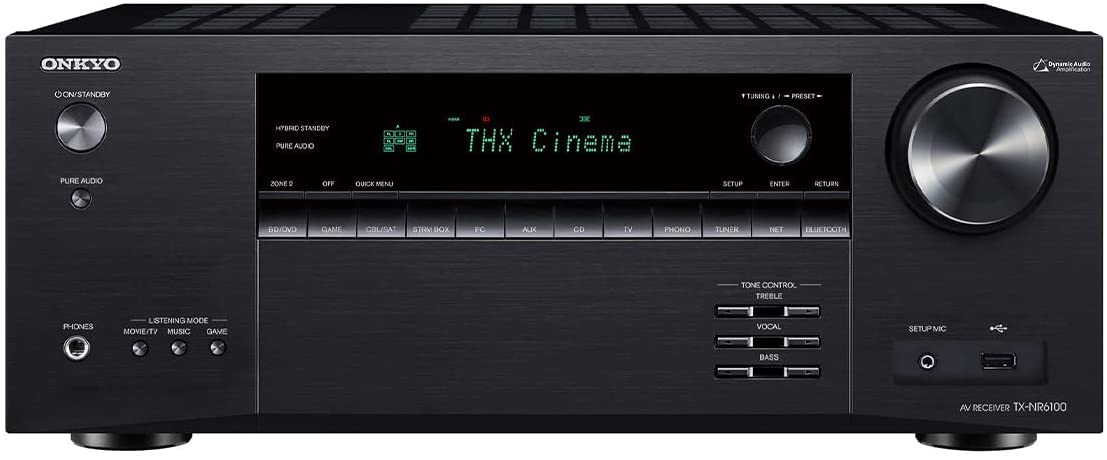
The Onkyo TX-NR6100 is a 7.2-channel THX Select Certified receiver that brings THX’s strict quality standards to a mid-range price bracket. Certification means the amplifier noise floor, crosstalk, and power delivery all meet THX’s reference specifications, guaranteeing that the unit adds nothing and takes nothing away from the source material. The Dynamic Audio Amplification system is rated at 210 watts per channel dynamically (all channels driven, 6 ohms), providing noticeable headroom for explosive movie soundtracks.
On the video side, three HDMI 2.1 inputs support 40 Gbps throughput, enabling 4K/120 and 8K/60 passthrough plus VRR and ALLM for gamers. The unit handles Dolby Atmos and DTS:X in 5.2.2 configuration (5 ear-level channels, 2 subwoofers, 2 height channels). Reviewers using Klipsch systems note the on-screen speaker configuration guide simplifies bi-amping. The built-in app streams from Spotify, TIDAL, and Pandora, and the rear-panel includes a discrete Zone 2 HDMI output for sending different content to a second room.
Build quality is solid: the chassis weighs 23 pounds, and the large internal heat sink keeps the amplifier running cooler than several competing Denon models of similar power. A common long-term complaint involves the HDMI 2.1 processor — some early production units had handshake dropouts that required a main board replacement under warranty. The remote is basic and not backlit, a surprising omission given the price. The fan is audible during intense movie sessions but quiet during normal music playback.
Why it’s great
- THX Select ensures consistent performance to reference standards
- Runs cooler than competing Denon and Yamaha units
- Zone 2 HDMI output for dual-room video distribution
Good to know
- HDMI 2.1 processor had early reliability issues on some units
- Remote is not backlit and feels basic
- Fan noise is audible during extended high-volume use
6. YAMAHA RX-V4A

The YAMAHA RX-V4A is the entry point into Yamaha’s modern AVR lineup, offering 5.2 channels with YPAO automatic room calibration and HDMI 2.1 with eARC. It is physically smaller and lighter than the RX-V6A, making it appropriate for tight cabinets or TV stands with limited depth. The YPAO microphone detects reversed speaker wires and corrects for basic room issues, and Spotify Connect works directly without needing the app to stay open on your phone.
The amplifier section provides 80 watts per channel (two channels driven, 8 ohms), which is sufficient for standard 8-ohm bookshelf speakers in rooms up to about 300 square feet. The four HDMI inputs support 4K/60 and 8K/60 passthrough with Dolby Vision and HDR10+, and the eARC port simplifies audio return from the TV. MusicCast is built-in, allowing the RX-V4A to participate in multi-room audio groups alongside other Yamaha devices. Voice control via Alexa or Google Assistant is supported after linking accounts.
The main limitation is channel count: 5.2 means no rear surround speakers, so it is not suitable for 7.1 or Atmos setups. Reviewers report that earlier firmware caused HDMI handshake issues, but models with newer firmware (check the unit’s Version sticker) are generally stable. The YPAO calibration is basic compared to Dirac or Audyssey, lacking multi-point measurement. The remote has tiny, recessed buttons that are difficult to operate in dim lighting.
Why it’s great
- Compact size fits in shallow cabinets and tight spaces
- MusicCast multi-room compatibility at a lower entry price
- YPAO calibration catches basic phase issues like reversed speakers
Good to know
- Limited to 5.2 channels with no rear surround capability
- YPAO calibration is basic compared to competing room EQ systems
- Remote control has tiny buttons that are hard to see in the dark
7. Donner Stereo Receiver

The Donner Stereo Receiver packs karaoke-friendly features into a compact 4-channel amplifier chassis at an entry-level price point. The 1000-watt peak power rating translates to a more realistic 25 watts RMS per channel (4 channels, 8 ohms) — enough for modest bookshelf speakers in a living room or party space. The standout additions are two 1/4-inch microphone jacks with independent volume, echo, and delay controls, making this the most receiver-like option for casual karaoke use without separate mixer gear.
Input flexibility is surprisingly broad for the price: Bluetooth 5.0, USB (up to 64 GB), two pairs of RCA inputs, FM radio, and both optical and coaxial digital inputs. The remote controls treble, midrange, and bass in any input mode, and the Talk Over function automatically lowers background music when speaking into a microphone. The front-panel knobs feel reasonably smooth, and the digital LED display shows current input and FM frequency clearly.
Reviewers are split on power delivery. Users pairing with high-efficiency speakers (90 dB or higher) report satisfactory volume in medium rooms. However, multiple reviews note the unit struggles to drive tower speakers or 4-ohm loads, producing thin bass at moderate volumes. The speaker connection system is unconventional: four pairs of binding posts (Left 1, Left 2, Right 1, Right 2) with independent volume knobs, which confuses some buyers expecting a standard A/B switch. A small number of units had audible hum when no music was playing.
Why it’s great
- Dual microphone inputs with echo and delay for instant karaoke setup
- Optical and coaxial digital inputs for TV connection
- Full tone controls (treble, mid, bass) accessible from remote
Good to know
- RMS power is limited to 25W/ch — not suitable for large speakers
- Confusing 4-pair speaker binding post layout
- Some units produce audible hum in silent passages
8. Pyle PDA77BU

The Pyle PDA77BU is a 4-channel stereo receiver that markets itself around an 800-watt peak power rating but operates in the budget tier with practical RMS output sufficient for garage, workshop, or outdoor patio setups. The amplifier supports up to four speakers with independent binding posts, and the Bluetooth 5.0 connection maintains a stable link up to about 30 feet in open air. The front-panel digital LED display shows FM frequency, input selection, and volume level in a bright blue readout.
Input versatility covers the basics: Bluetooth, USB-A (with MP3 playback from flash drives), SD card slot, FM radio, RCA line inputs, and 3.5mm auxiliary. The dual 1/4-inch microphone jacks include independent volume controls and basic reverb/delay effects, making this usable for karaoke at parties. The remote control duplicates the front-panel functions, allowing source switching and volume adjustment from across the room. The chassis is compact, and the weight (11 pounds) suggests a modest transformer inside.
Real-world performance matches the price: sound quality is decent for background music and speech, but the unit is not designed for critical listening. Bluetooth reconnection is finicky — some users report having to unpair and re-pair when switching back from a TV connection. The 800-watt peak figure is a marketing spec based on a momentary burst, not sustained output. The binding posts accept banana plugs but feel slightly loose compared to higher-end terminals. Several long-term owners report the unit exceeding expectations for its intended use case; one reviewer noted feeling value after seven years of garage use.
Why it’s great
- Exceptionally affordable entry point for powered speaker setups
- USB and SD card direct playback without external device
- Compact chassis fits easily in tight workshop or garage spaces
Good to know
- 800W peak rating does not reflect sustained RMS power output
- Bluetooth reconnection can be unreliable with some devices
- Binding posts feel less robust than mid-range receivers
9. blafili B3

The blafili B3 is a Bluetooth receiver, not an amplifier — it converts wireless audio signals into analog and digital outputs for connection to powered speakers, preamplifiers, or existing receivers. Its core component pairing (Qualcomm QCC5125 chipset with ESS ES9018K2M DAC) is found in products costing significantly more. The ES9018K2M delivers a high dynamic range of 124 dB and low THD+N, resulting in clean, detailed sound that approaches wired-CD quality over aptX HD or LDAC connections.
Output options are unusually complete: unbalanced RCA, balanced XLR (true differential, not pseudo-balanced), optical Toslink, and coaxial digital, all active simultaneously. This means you can feed a DAC-free powered speaker via RCA while sending a separate digital signal to a preamp in a secondary system. The removable RP-SMA antenna extends Bluetooth range up to 100 feet in line of sight. The 1.3-inch display shows connection codec status — useful for confirming you are getting LDAC rather than SBC — and the unit is silent during pairing, with no loud beeps or voice prompts.
Reviewers consistently highlight the audio transparency: listeners using high-end tube amplifiers describe the B3 as revealing previously masked detail in familiar tracks. The USB DAC function is limited to 16-bit/48kHz, adequate for casual computer use but not for hi-res archive listening. The unit requires a 5V USB power adapter (not included), and the power cable is short at about 3 feet. The acrylic window covering the display is larger than the active screen, which some owners find visually misleading.
Why it’s great
- ESS ES9018K2M DAC delivers near-audiophile sound from Bluetooth
- Simultaneous XLR, RCA, optical, and coaxial outputs for flexible system integration
- Removable antenna enables range extension to 100 feet
Good to know
- USB DAC mode is capped at 16-bit/48kHz resolution
- Power adapter not included in the box
- Acrylic window is much larger than the active display area
FAQ
What is the difference between a stereo receiver and an AV receiver?
Can I use a Bluetooth receiver with my existing stereo amplifier?
How many watts do I really need for my speakers?
Is automatic room calibration worth paying extra for?
Final Thoughts: The Verdict
For most users, the audio stereo receiver winner is the Cambridge Audio AXR100 because it delivers genuine 100W RMS per channel, a clean phono stage, silent operation, and a warm musical signature that satisfies both vinyl purists and digital streamers. If you need room correction and immersive surround as your system grows, grab the Onkyo TX-RZ50 with Dirac Live calibration built-in. And for a compact setup where analog purity matters most, nothing beats the Denon PMA-600NE with its Analog Mode that bypasses digital noise entirely.