
Our readers keep the lights on and the weekend projects moving. As an Amazon Associate, I earn from qualifying purchases.
A standard acoustic stethoscope hits a wall when patient sounds are faint, background noise is high, or your hearing is less than perfect. An amplified stethoscope bridges that gap by boosting subtle heart murmurs, lung crackles, and Korotkoff sounds that a conventional scope would miss entirely. This guide cuts through the marketing to find the models that actually deliver clean gain without introducing distortion.
I’m Rikta — the founder and writer behind FitlyFast. I’ve analyzed hundreds of hours of user feedback on digital and high-amplification acoustic stethoscopes, comparing gain curves, noise cancellation specs, and real-world durability across the to range.
Whether you’re a cardiologist, an ICU nurse, an EMT working a chaotic scene, or a home user monitoring a chronic condition, choosing the right amplified stethoscope comes down to understanding gain, noise rejection, and how the hardware translates body sounds into audible, usable data.
How To Choose The Best Amplified Stethoscope
Picking an amplified stethoscope isn’t simply about the loudest output. The quality of the gain, the method of sound transmission, and how the device handles ambient noise all determine whether you’ll hear clinically relevant details or just a louder mess.
Amplification Type: Digital vs. Acoustic
Digital stethoscopes use a transducer and electronic circuitry to boost the signal before it reaches your ears. They often include adjustable gain levels, active noise cancellation, and the ability to record or visualize sound waves via a smartphone app. Pure acoustic amplified stethoscopes rely on mechanical resonance and larger diaphragms to passively enhance sound. Digital models (like the 3M Littmann CORE) offer up to 40x amplification and noise filtering, while high-end acoustic units (like the Cardiology IV) use tunable diaphragms and deeper bells to naturally increase volume by roughly 2x compared to standard scopes. Digital is superior for hearing-impaired users and noisy environments, but it requires batteries and app connectivity.
Noise Cancellation vs. Acoustic Seal
Active noise cancellation (ANC) uses microphones and phase-canceling electronics to reduce ambient sound inside the earpiece. This is critical in emergency departments, ambulances, or busy clinics. Passive noise isolation comes from soft-sealing ear tips and the physical fit of the binaurals. A digital scope like the Littmann CORE combines both, while an acoustic model like the ADC Adscope 601 relies purely on a tight ear seal and dual-lumen tubing. If you work in consistently loud environments, prioritize models with confirmed ANC. If you work in a quiet clinic, a well-sealed acoustic scope may be sufficient.
Chestpiece Design and Material
The chestpiece is the sensor. Stainless steel is the standard for durability and sound transmission. Heavier chestpieces (like the MDF ProCardial or ADC 601) can pick up lower frequencies more efficiently but cause neck fatigue during long rounds. Lighter materials (titanium or aerospace alloy) reduce weight without sacrificing acoustic performance. For amplified scopes, the chestpiece also houses the electronic transducer. A high-quality digital transducer with a large pickup surface (like the CORE’s 40% larger chestpiece) captures more acoustic information before the amplification stage. For dual-purpose use, a convertible head (adult diaphragm that swaps to a pediatric diaphragm or open bell) adds versatility.
Quick Comparison
On smaller screens, swipe sideways to see the full table.
| Model | Category | Best For | Key Spec | Amazon |
|---|---|---|---|---|
| 3M Littmann CORE 8480 | Digital | Maximum gain & noise cancel | Up to 40x amplification | Amazon |
| 3M Littmann CORE 8870 | Digital | Premium digital with visual data | Up to 40x amplification | Amazon |
| MDF ProCardial Core 797DD | Acoustic | Premium acoustic, adult/peds convertible | Dual lumen + 2 sound channels | Amazon |
| 3M Littmann Cardiology IV 6163 | Acoustic | Critical care, high analog volume | 2x louder than next leading scope | Amazon |
| ADC Adscope 601 | Acoustic | Convertible cardiology, value | AFD tunable + pediatric adapter | Amazon |
| MDF ProCardial 797BO | Acoustic | Durable daily use, variety of colors | 34-channel etched C34 tubing | Amazon |
| Bell Dual Head KS-771 | Acoustic | Budget alternative to name brands | 45mm diaphragm + 35mm bell | Amazon |
| Specialist Single Head K971 | Acoustic | Long tube for distancing | 30-inch tube, oversized diaphragm | Amazon |
| Stemoscope II Digital | Digital | Home use, recording, pets | Bluetooth app + recording | Amazon |
In‑Depth Reviews
1. 3M Littmann CORE Digital Stethoscope 8480
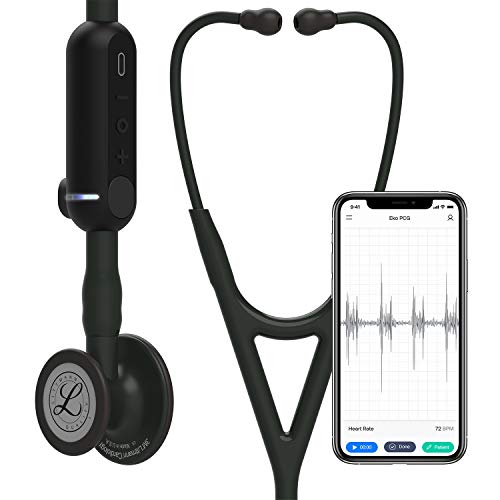
The 3M Littmann CORE 8480 sets the benchmark for what a digital stethoscope should do. Its proprietary electronics deliver up to 40x amplification at peak frequency, which is more than enough to pull out faint S3 and S4 gallops or subtle lung crackles that even high-end acoustics miss. The active noise cancellation system uses phase-canceling microphones to suppress ambient chatter and machinery hum, making it a legitimate tool for ER, ICU, and pre-hospital settings. Toggling between analog and amplified modes lets you compare raw acoustic input against the boosted signal in real time.
The dual-sided tunable stainless steel chestpiece gives you an open and closed bell, so you can switch between low-frequency Korotkoff sounds and higher-pitched breath sounds without swapping heads. It weighs 87 grams, which is lighter than many premium acoustic scopes, reducing neck strain during multi-hour assessments. The Eko software integration allows you to visualize heart sound waveforms on a smartphone screen, record clips for later review, and share data with colleagues or telemedicine providers. This is not a gimmick — it is genuinely useful for documenting change over time or consulting specialists remotely.
The 27-inch black tubing is latex-free and resists kinking, and the soft-sealing ear tips create a comfortable acoustic seal. Because this is an electronic device, you will need to keep the battery charged and remember that some advanced app features require a subscription. A few users note that the hard plastic case leaves room for a better carrying solution, but the core performance is unmatched at this level. For any clinician who needs reliable gain in variable noise environments, this is the amplified stethoscope to beat.
Why it’s great
- Unmatched 40x amplification for hearing subtle heart and lung sounds
- Active noise cancellation effectively reduces background noise in busy settings
- Eko app allows sound wave visualization and recording for documentation
- Lightweight design (87g) improves comfort during prolonged use
Good to know
- Requires periodic battery charging and app subscription for full features
- Premium cost places it above budget-conscious buyers
- Carrying case could be more protective
2. 3M Littmann CORE Digital Stethoscope 8870
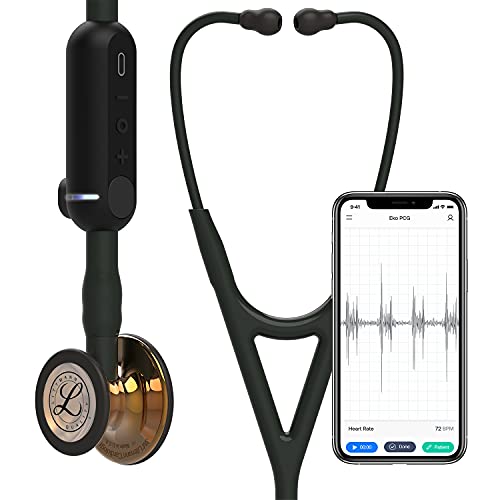
The 3M Littmann CORE 8870 shares the same digital engine as the 8480 — the same 40x peak amplification, the same active noise cancellation, and the same Eko software integration — but it comes finished in a high-polish copper chestpiece. This is purely an aesthetic distinction; the underlying acoustic and electronic performance is identical. The copper finish is more visually striking and may slide slightly differently against a patient’s skin, but the sound pickup, gain profile, and noise rejection are unchanged.
Because the hardware is the same, you get the same dual-sided tunable chestpiece with open and closed bell modes, the same ability to toggle between analog and amplified listening, and the same lightweight headset design. The soft-sealing ear tips and flexible, kink-resistant tubing deliver a comfortable fit over long shifts. For hearing-impaired clinicians or anyone working in critical care, this model provides the same life-changing clarity as the 8480.
The decision between the 8870 and 8480 comes down entirely to personal style and whether you want the high-polish copper look. Both are functionally identical and represent the pinnacle of what a digital amplified stethoscope can do. Consider this option if a visual statement matters to you in a clinical setting. The same caveats apply: battery dependence, subscription for advanced app features, and a premium investment point.
Why it’s great
- Same industry-leading 40x amplification and ANC as the 8480 model
- Eko app support for viewing, recording, and sharing sound data
- Lightweight and comfortable for extended wear
Good to know
- Functionally identical to the 8480; paying extra for cosmetic copper finish
- Requires battery management and app subscription for full features
3. MDF Instruments ProCardial Core MDF797DD
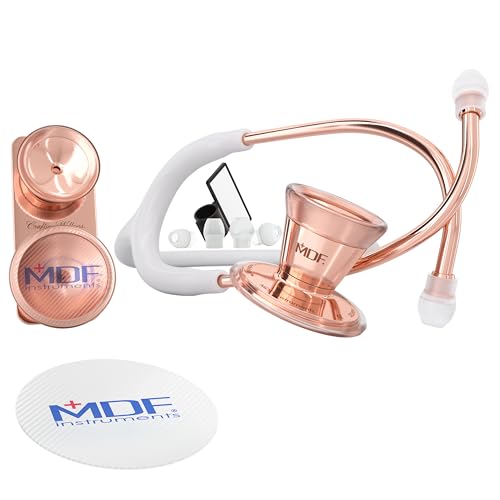
The MDF ProCardial Core MDF797DD is a premium acoustic stethoscope designed for the clinician who needs exceptional analog sound without batteries or digital complexity. Its standout feature is the convertible pediatric diaphragm that screws onto the chestpiece, allowing you to switch from adult to pediatric auscultation without buying a second scope. The stainless steel chestpiece is heavier than most — users reliably report it as 275g or more — and that mass translates to excellent low-frequency pickup for subtle heart sounds.
MDF uses dual-lumen tubing, which creates two independent sound channels from the chestpiece to each ear. This design reduces ambient noise cross-talk and preserves channel separation for more accurate lateralization of sounds. The ErgonoMax headset is pre-angled at 15 degrees, which aligns the ear tips with the natural angle of the ear canal for a more comfortable, acoustically tight seal. Many clinicians who have used both MDF and Littmann scopes note that the MDF is louder and clearer by a measurable margin in analog mode, though it is also heavier.
The Free-Parts-for-Life and Full Lifetime Warranty programs are a genuine differentiator — if ear tips wear out or a diaphragm cracks, MDF sends replacements at no cost. The Rose Gold/White color option is the most popular, but the all-black variant is favored by those who want a discrete, professional appearance. The main trade-off is weight: at nearly 10 ounces, this scope will pull on your neck during busy shifts. Some users have also reported the ear tips unscrewing, though a drop of thread locker solves it. For pure acoustic clarity and pediatric versatility, this is a top-tier choice.
Why it’s great
- Convertible adult-to-pediatric head eliminates need for a second stethoscope
- Dual-lumen tubing improves sound isolation and channel separation
- Free-Parts-for-Life program reduces long-term ownership cost
- Superior acoustic volume reported compared to many competitor analog scopes
Good to know
- Significantly heavier than digital or titanium scopes; can cause neck fatigue
- Ear tips may loosen over time without thread-locking adhesive
4. 3M Littmann Cardiology IV Diagnostic Stethoscope 6163
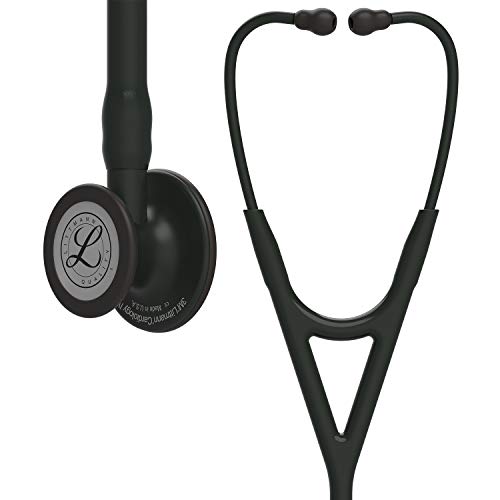
The 3M Littmann Cardiology IV 6163 is the gold standard for pure analog acoustic stethoscopes in critical care. Littmann’s own tests claim this model is more than twice as loud as the next leading stethoscope in its class, and that is achieved through mechanical design rather than electronics. The chestpiece is 40% larger and the bell is 60% deeper than the Classic III, creating a larger resonant cavity that naturally amplifies low-frequency sounds like Korotkoff blood pressure sounds, S3 and S4 gallops, and mitral stenosis murmurs.
The tunable diaphragm system lets you hear high-frequency lung sounds with light pressure and low-frequency heart sounds with firmer pressure, all on a single-sided chestpiece. The non-chill bell sleeve improves patient comfort during chest contact. At 5.9 ounces, the Cardiology IV is lighter than the MDF ProCardial and many other cardiology scopes, which makes a real difference during 12-hour shifts. The soft-sealing ear tips are comfortable and block ambient noise effectively through passive isolation, though there is no active noise cancellation.
This stethoscope is designed and manufactured in the USA, comes with a 7-year warranty, and is the standard-issue choice in many hospital cardiac ICUs and step-down units. It does not offer recording, visualization, or extreme amplification of the digital CORE models — it is purely analog. If you want the best acoustic-only amplified stethoscope for detecting subtle cardiac changes without relying on batteries, this is the one. The main complaints are that it is heavy enough to be noticeable and that its high value makes it a frequent target for theft in shared workspaces.
Why it’s great
- More than 2x louder than comparable acoustic stethoscopes in its class
- 40% larger chestpiece and 60% deeper bell for superior low-frequency pickup
- Lightest cardiology-grade scope at 5.9 oz, reducing neck fatigue
- Excellent for detecting subtle S3, S4 gallops and Korotkoff sounds
Good to know
- No digital features — no recording, visualization, or active noise cancellation
- High theft risk due to brand recognition and value in shared clinical spaces
5. ADC Adscope 601 Convertible Cardiology Stethoscope

The ADC Adscope 601 is designed around proprietary Adjustable Frequency Design (AFD) technology, which tunes the diaphragm to respond to different pressure levels. With light pressure, you get low-frequency amplification for heart sounds; with firm pressure, the diaphragm accentuates higher-frequency lung sounds. The chestpiece is convertible from a fixed adult diaphragm to an open bell by unscrewing the threaded pediatric diaphragm, which also serves as a second diaphragm for children. This is a true dual-use design that competes directly with more expensive stethoscopes.
The weight is on the heavier side at 8.5 oz, but the build quality is exceptional. The large-bore aluminum binaurals are paired with Adsoft Plus snap-on silicone eartips that create an excellent passive acoustic seal. The dual-channel phthalate-free tubing is thick and kink-resistant. ADC backs this with a free parts forever and complimentary refurbishment program, which is rare at this price tier. Many users directly compare its acoustic performance to the Littmann Cardiology III, noting virtually indistinguishable sound quality at a fraction of the cost.
One practical downside is that the convertible mechanism adds a bit of height and weight to the chestpiece compared to a fixed-head design. The Iridescent Tactical color in the photos may appear different from the actual product depending on the specific colorway ordered. For the clinician who wants cardiology-grade acoustic performance, the flexibility of an adult/pediatric convertible head, and a lifetime service commitment, the ADC Adscope 601 is the best bang-for-the-buck amplified acoustic stethoscope on the market.
Why it’s great
- AFD tunable diaphragm offers pressure-based frequency tuning without moving parts
- Convertible head works as adult scope and pediatric scope in one
- Free parts forever and complimentary refurbishment is a strong value proposition
- Acoustic quality rivals top-tier Littmann Cardiology III at lower cost
Good to know
- Heavier and slightly bulkier than fixed-head cardiology stethoscopes
- Color finish in photos may not exactly match the delivered product
6. MDF Instruments ProCardial Cardiology Stethoscope MDF797BO

The MDF ProCardial MDF797BO is the standard dual-head cardiology stethoscope from MDF’s ProCardial line. It features a stainless steel chestpiece with an extra-deep diaphragm for low-frequency sensitivity and a true bell for high-frequency sounds. The signature C34 tubing has 34 internal channels etched to guide sound waves cleanly from chestpiece to ears, reducing internal turbulence and signal loss. This is a fully analog scope that relies on acoustic engineering rather than electronics.
At 8.2 ounces, it is one of the heavier stethoscopes in its class, which gives it a solid feel and excellent low-frequency pickup but also creates noticeable neck pull during long rounds. Many users who have owned both MDF and Littmann scopes report that the MDF is louder and clearer for heart sound detection, though it may feel bulkier. The dual-leaf spring construction is heavy-duty and less likely to lose tension over time compared to single-leaf designs. It ships with three pairs of soft silicone eartips (small, medium, large) and an extra diaphragm.
MDF backs this with a Full Lifetime Warranty and the Free-Parts-For-Life program. The scope is available in over 20 color combinations, giving you the option to personalize your tool. The main drawback is the weight: for clinicians who prefer a lighter feel, MDF offers a Titanium version of the same scope. If you prioritize durability, sound clarity, and a long-term parts guarantee over low weight, this is a proven workhorse that has been in continuous production since 2007.
Why it’s great
- C34 internal channel tubing delivers clean, resonant sound transmission
- True bell and deep diaphragm provide versatile frequency coverage
- Lifetime warranty and free parts for life reduce long-term cost
- Wide range of color options allows personalization
Good to know
- Weight (8.2 oz) can be fatiguing during extended daily use
- Consider the Titanium version if weight is a primary concern
7. Bell Dual Head Cardiology Stethoscope KS-771
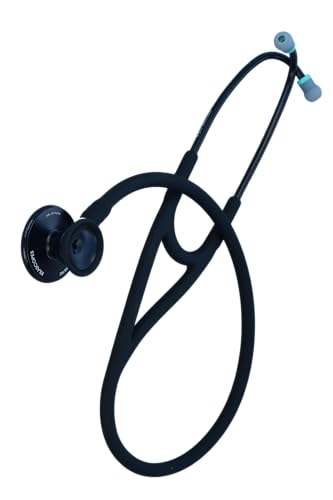
The Bell Dual Head KS-771 is an entry-level-to-mid-range acoustic stethoscope that punches well above its price tier. It uses a 45mm adult diaphragm and a 35mm bell, both machined from stainless steel, to deliver clear cardiac and respiratory sounds. The dual-head configuration is standard cardiology design: you rotate the stem to engage the diaphragm or the bell depending on whether you need high-frequency or low-frequency auscultation. The 30-inch long tube is latex-free and dual-bore, which helps reduce external noise artifacts.
Clinicians working in ICU and pre-hospital settings have compared this scope directly to high-end Littmann models and found the acoustic performance “just as good if not better,” especially for lung sound clarity in noisy environments like moving ambulances. The adjustable headset tension lets you dial in the binaural pressure for a personalized fit, and the soft ear tips provide good passive noise isolation. An extra diaphragm and two additional pairs of ear tips are included.
The main limitation is the limited color selection — black is the standard choice, though some colorways like neon orange are occasionally available but may appear brighter than expected in person. The build quality is good for the price point, but it does not have the same heft or precision finish as a premium-tier stethoscope. For the nursing student, EMT, or home user who wants cardiology-grade sound without paying a premium, the Bell KS-771 is a surprisingly capable option.
Why it’s great
- Excellent acoustic clarity comparable to much more expensive stethoscopes
- Long 30-inch tubing provides safe distancing from patients
- Includes extra diaphragm and multiple ear tip sizes for customized fit
Good to know
- Limited color options compared to MDF or Littmann lines
- Build quality is solid but not at the level of premium analog scopes
8. Specialist Single Head Cardiology Stethoscope K971 Grey
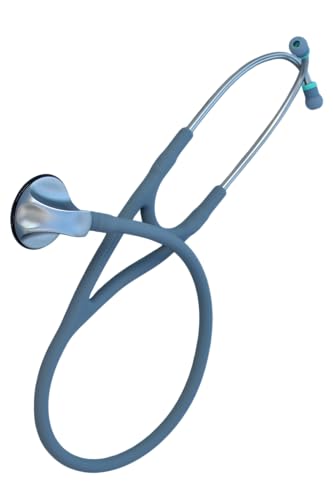
The Specialist K971 is a single-head cardiology stethoscope that prioritizes a few specific features: a large 48mm oversized diaphragm for increased sound pickup surface, and a 30-inch (76cm) extra-long tube. The long tubing was explicitly designed during the COVID-19 pandemic to allow clinicians to maintain physical distance while still performing auscultation. The single-head design is simpler than dual-head models, offering one large diaphragm that covers both high and low frequencies through pressure tuning — lighter pressure for lower frequencies, firmer pressure for higher frequencies.
The stainless steel chestpiece is sculpted but lightweight, and the dual-bore, latex-free tubing is soft and flexible, reducing the risk of cracking over time. The large-bore stainless steel binaurals provide a wide acoustic pathway, and the soft ear tips seal comfortably against the ear canal. Users in hospitalist and emergency medicine roles specifically praise this scope for its clear acoustic output and the safety margin provided by the longer tubing.
One limitation is that the neon orange color option may appear much brighter in person than in product photos, which may be a pro or con depending on whether you want high-visibility equipment. The scope also lacks the dual-head versatility of a true cardiology scope with a separate bell. For the clinician who needs to maintain distance from patients — or simply prefers a long tube for comfort — the Specialist K971 delivers reliable amplified acoustic performance at a fair price.
Why it’s great
- 48mm oversized diaphragm captures more sound signal per placement
- 30-inch tube allows safe distancing during respiratory or COVID-19 assessments
- Large-bore stainless steel binaurals improve sound conduction
Good to know
- Single-head design lacks a dedicated bell for low-frequency tuning
- Color may appear more vibrant in person than in online photos
9. Stemoscope II Digital Stethoscope

The Stemoscope II is a small, portable digital stethoscope designed for a broader audience than just medical professionals. It uses a zinc alloy casing with an electronic transducer that sends sound via Bluetooth to the DrStemo app on your smartphone. You then listen through earbuds or headphones connected to your phone. This setup allows sound recording, playback, and sharing with a doctor or veterinarian. It also records heartbeat waveforms on the app screen for visual reference, which can be useful for home health monitoring.
The Stemoscope II is marketed for human and pet use, and users report satisfactory sound pickup on bare skin. It is compact — roughly the size of a large watch — and connects to the app relatively quickly. Recording heart sounds and emailing them to a specialist is a real convenience for telemedicine. The ability to use your own preferred earbuds (silicune-tip noise-cancelling models recommended) gives you control over the listening experience.
However, the app has had stability issues over time, and some users report difficulty pairing via Bluetooth or sound that is barely audible even at maximum gain with multiple earphone models. The device picks up a lot of handling noise — the microphone is sensitive to friction against clothing and movement. The included carrying solution has been described as inadequate by several users. For a medical professional in a clinical setting, the Stemoscope II is not a reliable primary tool. It is best suited for home users or pet owners who want to record and share body sounds from a still, cooperative subject.
Why it’s great
- Compact and portable for home health monitoring and pet auscultation
- Bluetooth app records sound waves and shares files with providers
- Works with your own earbuds for a personalized listening experience
Good to know
- Bluetooth pairing and app reliability can be inconsistent
- Handling noise is significant; best used on still, bare-skin subjects
- Not a dependable alternative for clinical diagnostic work
FAQ
Can an amplified stethoscope help a hearing-impaired clinician hear better?
How much gain do I actually need for routine clinical use?
Do I need a subscription for the digital stethoscope app features?
What is the difference between tunable diaphragm and dual-head chestpiece?
Final Thoughts: The Verdict
For most users, the amplified stethoscope winner is the 3M Littmann CORE 8480 because it combines industry-leading 40x digital amplification with effective active noise cancellation and intuitive sound visualization through the Eko app. If you want a premium analog scope with exceptional low-frequency pickup and a convertible pediatric head, grab the MDF ProCardial Core MDF797DD. And for the best value acoustic option that rivals the performance of scopes costing twice as much, nothing beats the ADC Adscope 601 with its lifetime refurbishment program.