
Our readers keep the lights on and the weekend projects moving. As an Amazon Associate, I earn from qualifying purchases.
Building a solar storage system means matching chemistry, capacity, and communication protocol to your inverter and daily load profile—one wrong spec choice can strand hundreds of amp-hours in your garage. The difference between a battery that cycles daily for a decade and one that fails in year three often comes down to BMS configuration and cell grade, not brand name or marketing wattage.
I’m Rikta — the founder and writer behind FitlyFast. I’ve spent months analyzing discharge curves, BMS logic, and parallel scalability across the mid-range to premium solar battery market to separate genuine energy assets from expensive paperweights.
Whether you are building an off-grid cabin or fortifying your home against outages, finding the right battery storage for solar power requires matching voltage, capacity, and communication protocols to your existing gear.
How To Choose The Best Battery Storage For Solar Power
Selecting a solar battery involves more than comparing kilowatt-hour ratings. The chemistry, BMS (Battery Management System) logic, communication protocol, and physical form factor each determine how well the battery integrates with your inverter and handles daily cycling. A mismatch in any one of these areas can limit usable capacity or prevent the system from charging at all.
Cell Chemistry and Cycle Life
LiFePO4 (Lithium Iron Phosphate) dominates residential solar storage because of its thermal stability and cycle count. A quality LiFePO4 cell rated for 4,000 cycles at 80% depth of discharge (DoD) will last over a decade under daily use. Lower-grade cells or LTO (Lithium Titanate) chemistries offer different trade-offs, but LiFePO4 remains the safest and most cost-effective choice for stationary storage.
BMS Amperage and Low-Temperature Protection
The BMS is the brain of the battery—it manages charge/discharge currents and prevents damage from over-voltage, under-voltage, and temperature extremes. Look for a built-in BMS rated at or above the continuous current your inverter draws. Low-temperature cutoff protection (stopping charge below 0°C/32°F) is critical for installations in unheated garages or outdoor enclosures.
Communication Protocol Compatibility
Inverters from brands like Growatt, Victron, EG4, and Sol-Ark communicate with batteries using CAN bus or RS485 protocols. If your battery supports the same protocol as your inverter, you get closed-loop communication—the inverter reads the battery’s state of charge and adjusts charge parameters automatically. Without this, the system operates in open-loop mode and may undercharge or overcharge the battery over time.
Capacity, Voltage, and Scalability
Most residential solar systems run on a 48V (51.2V nominal) bus. A single 48V 100Ah battery delivers 5.12kWh of usable energy. To expand capacity, you parallel additional batteries of the same voltage and chemistry. Check the BMS limit for parallel units—some support up to 15 or 32 units in parallel, while cheaper models max out at 4. Server rack form factors are easier to cable and cool than stacked tower designs.
Quick Comparison
On smaller screens, swipe sideways to see the full table.
| Model | Category | Best For | Key Spec | Amazon |
|---|---|---|---|---|
| VATRER POWER 48V 100Ah | Mid-Range | Entry-level off-grid builds | 5.12kWh, 100A BMS | Amazon |
| Dumfume 24V 314Ah | Mid-Range | High-capacity 24V systems | 8kWh, 200A BMS | Amazon |
| Jackery Explorer 2000 v2 | Portable | Emergency home backup | 2kWh, 2200W output | Amazon |
| FOSSiBOT F2400 | Portable | Budget-friendly portable backup | 2kWh, 2400W output | Amazon |
| ABOK Ark3600 | Portable | Large portable with solar panel | 3.84kWh, 3600W output | Amazon |
| EF ECOFLOW DELTA 2 Max | Portable | Mid-size solar generator | 2kWh, 2400W output | Amazon |
| AOUSK 48V 200Ah (2-Pack) | Mid-Range | Rack-mount home storage | 10.24kWh, 100A BMS | Amazon |
| Anker SOLIX F3800 | Premium | Whole-home 240V backup | 3.84kWh, 6000W output | Amazon |
| Jackery HomePower 3000 | Premium | Compact home backup | 3kWh, 3600W output | Amazon |
| VTOMAN FlashSpeed 2400 | Mid-Range | Fast-recharging portable | 1.4kWh, 2400W output | Amazon |
| SaiJiaoYang 16kWh 48V 314Ah | Premium | Large stationary storage | 16kWh, 200A BMS | Amazon |
| EF ECOFLOW DELTA Pro + Extra Battery | Premium | Whole-home portable backup | 7.2kWh, 3600W output | Amazon |
| ECO-WORTHY Cubix100 6-Pack | Premium | Full off-grid home systems | 30.72kWh, 100A BMS | Amazon |
In‑Depth Reviews
1. AOUSK 48V 200Ah (2-Pack)
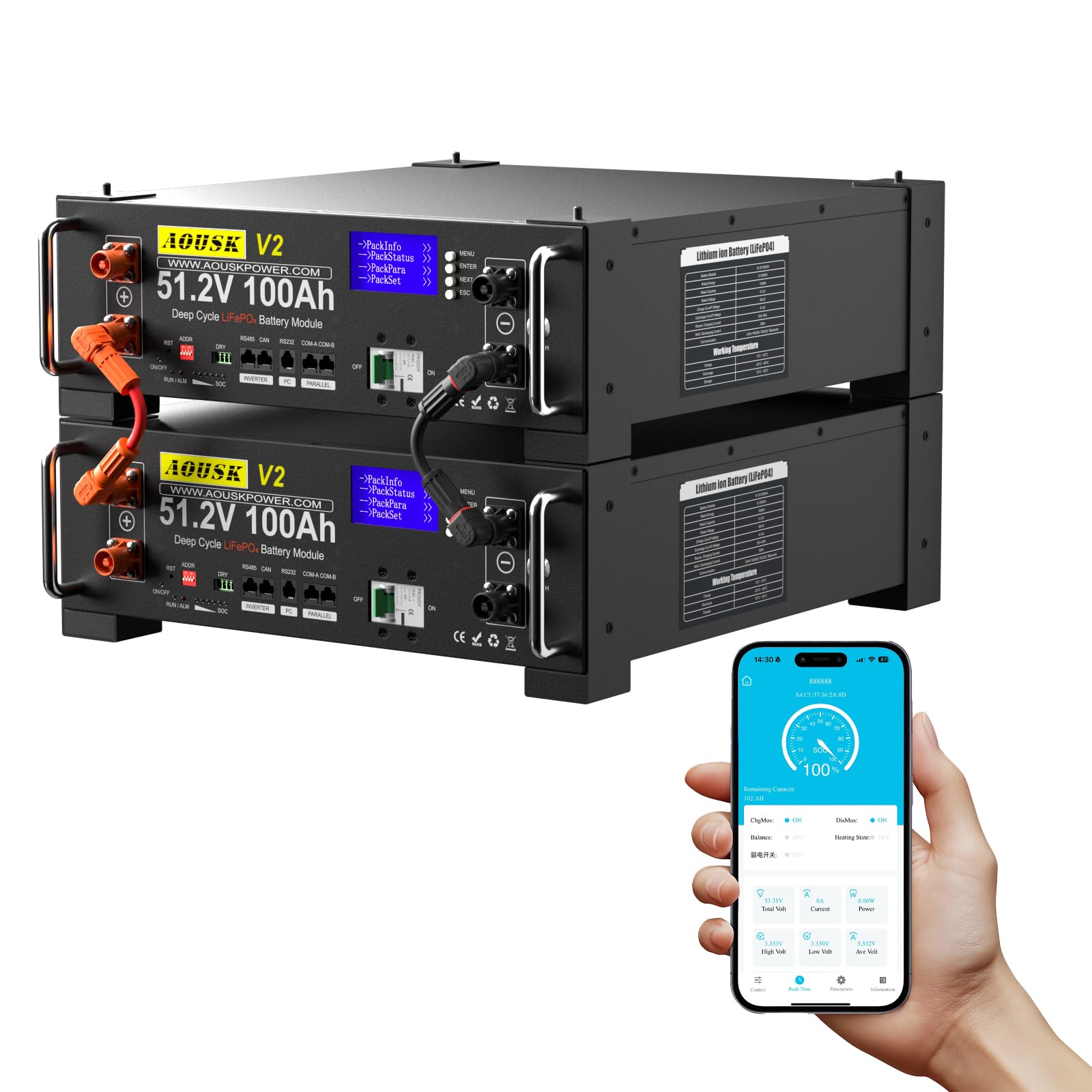
The AOUSK 48V 200Ah kit bundles two 100Ah server-rack batteries for a total of 10.24kWh of usable capacity. Each unit uses automotive-grade Grade A prismatic LiFePO4 cells and a 100A BMS that handles overcharge, over-discharge, and low-temperature cutoff. The BMS also supports CAN/RS485 communication, allowing closed-loop integration with popular all-in-one inverters like Growatt, Victron, and EG4.
Users report excellent cell balance—within a few millivolts across all cells—and smooth charge/discharge curves in parallel operation. The full-metal shell and integrated 125A air switch add a layer of physical safety that plastic-cased batteries lack. The included parallel wires, communication cables, and grounding wires make the initial install straightforward, even for first-time off-grid builders.
The 5-year warranty and responsive customer support provide peace of mind for a system this size. At roughly 95 pounds per 100Ah unit, each battery is manageable by one person for rack installation. The Bluetooth app gives real-time per-cell voltage and SOC data, though some users wish it offered deeper logging.
Why it’s great
- Grade A prismatic cells with tight voltage matching
- CAN/RS485 closed-loop inverter communication
- Full-metal shell with 125A air switch
- 5-year warranty and responsive support
Good to know
- Bluetooth app lacks historical data logging
- Rack-mount only; not suited for floor stacking
2. SaiJiaoYang 16kWh 48V 314Ah
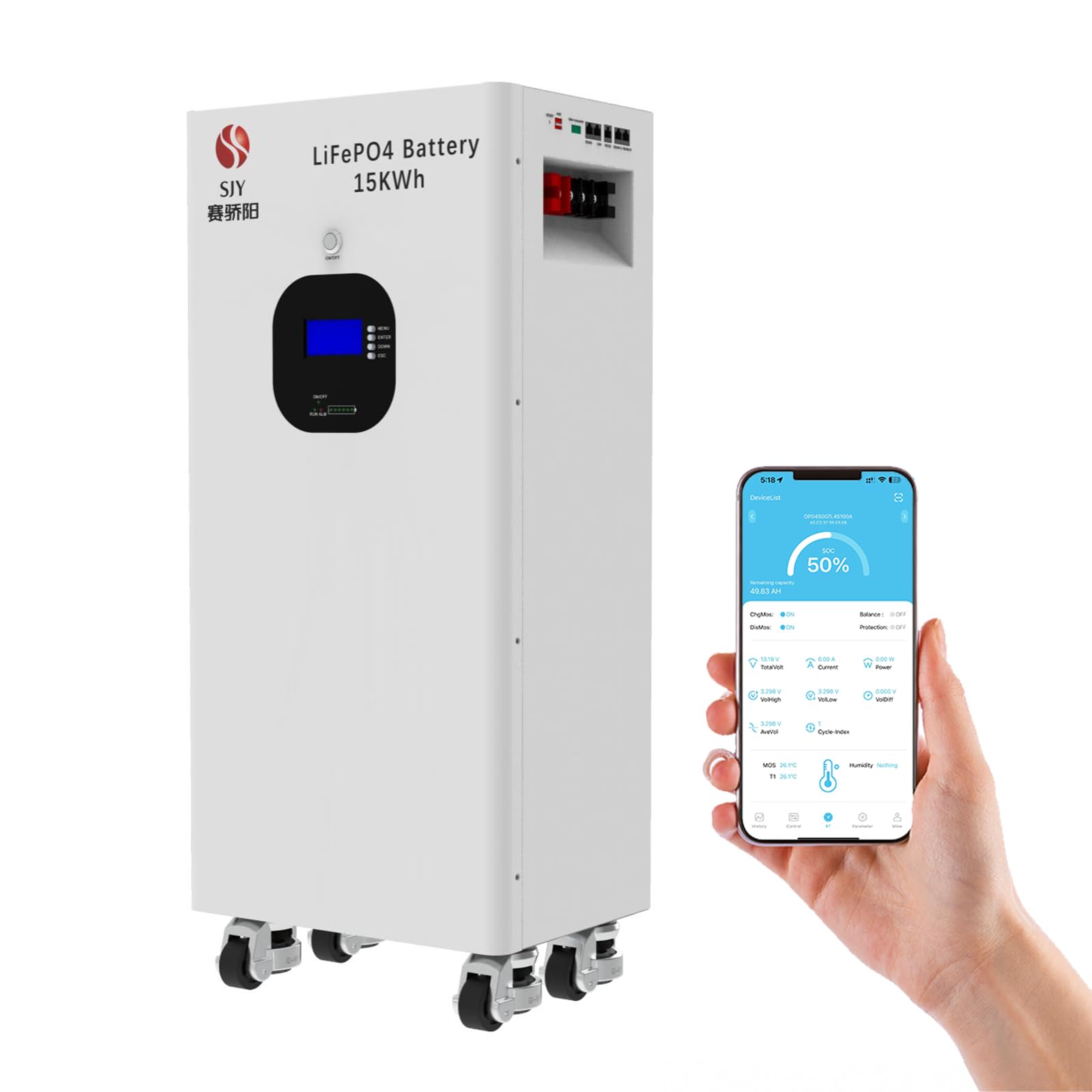
With a 314Ah capacity at 51.2V nominal, the SaiJiaoYang battery stores over 16kWh in a single enclosure—enough to run a typical home for a full day without solar input. The 200A BMS supports continuous discharge of 100A and peak of 200A, equating to roughly 11kW of output power. The built-in Bluetooth module and external LCD screen let you monitor per-cell voltages, current, and adjust CAN/RS485 protocols for inverters from Growatt, Victron, SMA, Pylontech, and Lux Power Tek.
Users who paired this battery with 10kW class inverters report stable performance over six months, though the included power cables are undersized for the full 200A output—buyers should budget for heavier-gauge cables and lugs. The large footprint and 112-pound mass require careful handling; the optional wheelbase helps but the center of gravity is high enough that strapping the unit down during transport is wise.
Up to 15 units can be paralleled for a 240kWh system, making this a scalable option for whole-house off-grid setups or EV charging stations. The Grade A cells show low internal resistance and excellent consistency across charge/discharge cycles. Note that the LCD screen supports protocol switching, but the initial configuration requires reading the manual closely.
Why it’s great
- Massive 16kWh single-unit capacity
- Built-in LCD with protocol switching
- 200A BMS supports 11kW peak output
- Up to 15 units parallel for 240kWh
Good to know
- Included cables insufficient for 200A loads
- High center of gravity; must be strapped down
3. Anker SOLIX F3800

The Anker SOLIX F3800 stands out in the portable power station space for its 120V/240V dual-voltage output. The 3.84kWh base capacity can be expanded with up to six extra battery packs for a total of 26.9kWh, and two F3800 units can be paired to deliver 12,000W max AC output. The NEMA 14-50 port allows direct EV charging at up to 6,000W, eliminating the need for a separate charger.
Users report the unit handles whole-home loads—well pumps, dryers, and RVs—through a transfer switch with seamless UPS switching. The LiFePO4 cells carry a 10-year lifespan estimate backed by a 5-year warranty. The Anker app monitors input/output and state of charge, though advanced features like Time-of-Use scheduling are missing from the current firmware.
One significant limitation: the MPPT is optimized for Anker’s own solar panels, and solar input performance with third-party panels may be lower than advertised. The unit also limits charging below 10°C (50°F), which can be a problem for winter use in unheated garages. At 132 pounds, it is heavy but manageable with the built-in handle and wheels.
Why it’s great
- 120V/240V output from a single unit
- Direct EV charging via NEMA 14-50 port
- Expandable to 26.9kWh
- Seamless UPS with <20ms switchover
Good to know
- MPPT tuned for Anker proprietary panels
- Charging limited below 10°C ambient
- App lacks Time-of-Use scheduling
4. VATRER POWER 48V 100Ah

The VATRER POWER 48V 100Ah battery delivers 5.12kWh of storage using 16 automotive-grade Grade A prismatic LiFePO4 cells. The built-in 100A BMS protects against overcharge, over-discharge, over-current, and short circuit, plus it includes low-temperature cutoff that prevents charging below 32°F. The unique touchscreen smart display lets you monitor SOC, voltage, and cell balance directly on the battery, and the companion Bluetooth app mirrors that data on your phone.
Users who tested the unit with an EG4-3000 inverter report flawless operation over several months—the BMS handled 65A continuous loads without issue, and cell voltage remained balanced within a 7mV span. The dual positive and dual negative terminals help equalize current distribution and reduce heat buildup at the connection point. The one-touch ON/OFF switch acts as a circuit breaker, automatically shutting down if load current exceeds safe limits.
One quirk reported by early buyers: the terminal design originally could not fit 2/0 or 4/0 cable lugs without modification or bus bars. Newer production units have reportedly addressed this, but it is worth verifying with the seller before ordering if you plan to run high-current loads.
Why it’s great
- Touchscreen and Bluetooth app monitoring
- Grade A cells with excellent voltage matching
- Dual positive/negative terminals for load sharing
- Low-temperature cutoff protection
Good to know
- Early units had tight terminal lugs for large-gauge cable
- Not designed for series connection (48V native)
5. ECO-WORTHY Cubix100 6-Pack
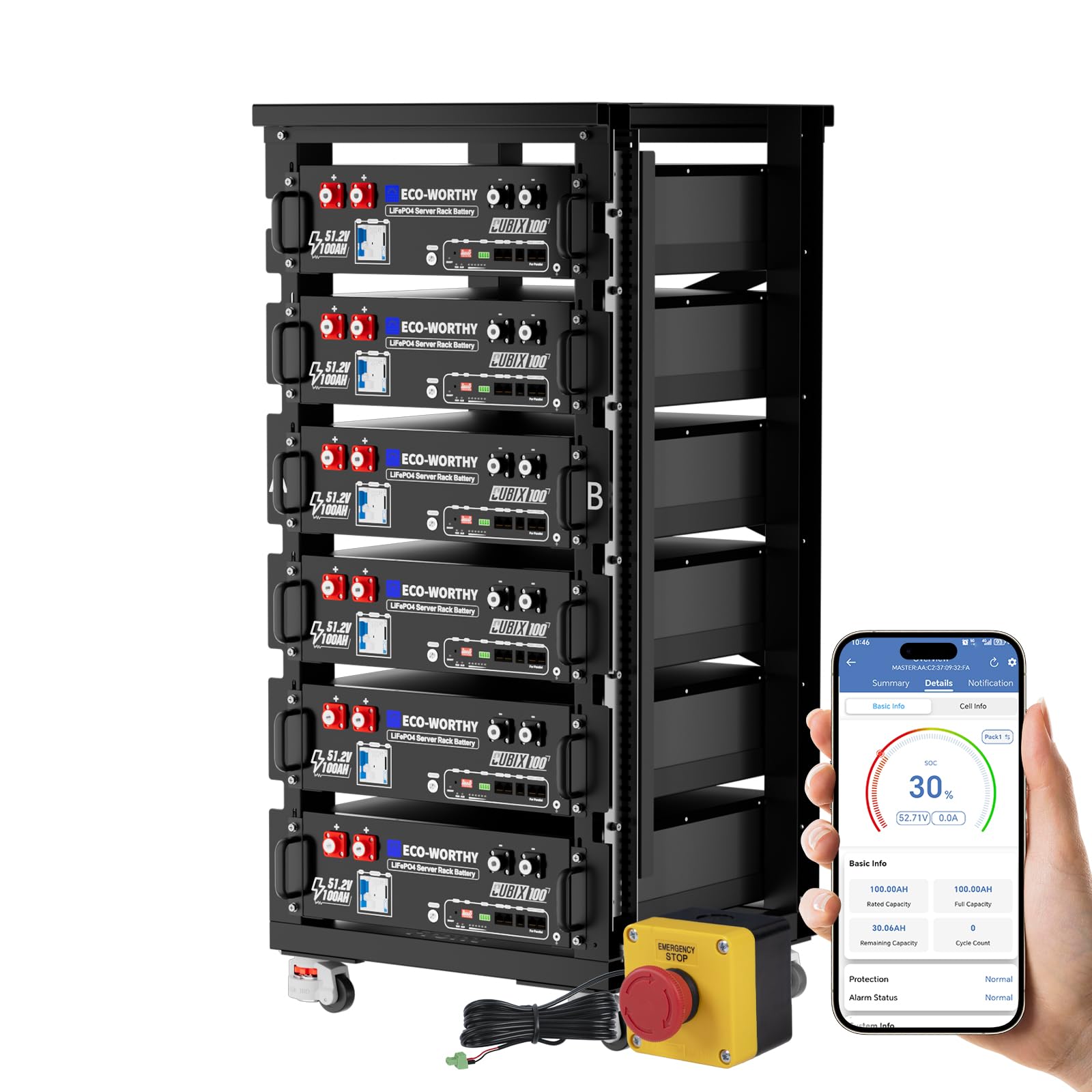
The ECO-WORTHY Cubix100 kit bundles six 51.2V 100Ah server rack batteries for a total of 30.72kWh—enough to power an entire household for a full day of off-grid usage. Each battery carries UL1973 and UL9540A safety certifications plus CEC listing, making them eligible for solar tax credits and building code compliance. The integrated CAN/RS485 communication with Bluetooth and WiFi allows closed-loop operation with inverters from EG4, Growatt, and Victron.
Users report the batteries pair seamlessly with EG4 6000XP units using the Pylon protocol, delivering full rated capacity in real-world testing. The included 6-layer rack with 600A bus bar and RSD button simplifies installation—just drop the batteries in, connect the pre-terminated parallel cables, and configure the inverter protocol. The Grade A cells show excellent consistency, with per-cell voltage variance under 10mV in parallel setups.
Early production units had the positive and negative terminals reversed on the bus bar, but the manufacturer corrected this in later runs. The mobile app provides real-time SOC and cell data but lacks time-to-empty estimates. At 600 pounds total, this kit is not portable—plan for permanent rack mounting in a dedicated battery room or garage.
Why it’s great
- UL1973/UL9540A certified for code compliance
- Complete plug-and-play kit with rack and bus bar
- 30.72kWh enough for full off-grid operation
- Up to 32 units parallel (163.8kWh max)
Good to know
- Early batch had reversed terminal polarity
- App lacks time-to-empty estimates
6. EF ECOFLOW DELTA Pro + Extra Battery
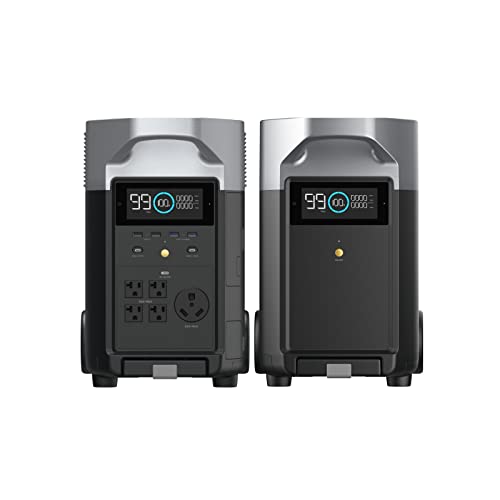
The DELTA Pro bundle combines the main 3.6kWh unit with an extra battery for 7.2kWh total capacity. The 3600W AC output (expandable to 4500W with X-Boost) and 7200W surge can run heavy appliances including RV air conditioners, well pumps, and power tools. The X-Stream charging technology refills the battery from 240V outlets in 1.8 hours or from 1800W wall outlets in 2.7 hours. Three 400W solar panels can fully recharge the system in 3.5 to 7 hours depending on sunlight.
Users who deployed the DELTA Pro after Hurricane Milton report it kept a full household (refrigerator, security cameras, TV, lights, and fans) running for several days without solar input. The EcoFlow app tracks input/output power, charge level, and temperature, and allows remote control of charging speeds and AC output. The battery uses LiFePO4 cells rated for 3,500 cycles to 80% capacity.
Several buyers noted the unit is significantly heavier than expected—183 pounds for the main unit plus extra battery—making the dolly and telescoping handle essential for moving it. Some units arrived with firmware that prevented charging out of the box, requiring a reset procedure. The system qualifies for the 30% Residential Clean Energy Tax Credit when used with qualifying solar panels.
Why it’s great
- 7.2kWh capacity with 3600W continuous output
- 5 charging methods including EV station
- X-Stream fast charging from 240V outlets
- 30% tax credit eligible
Good to know
- Very heavy (183 lbs combined)
- Firmware issues reported on some units
7. Jackery HomePower 3000
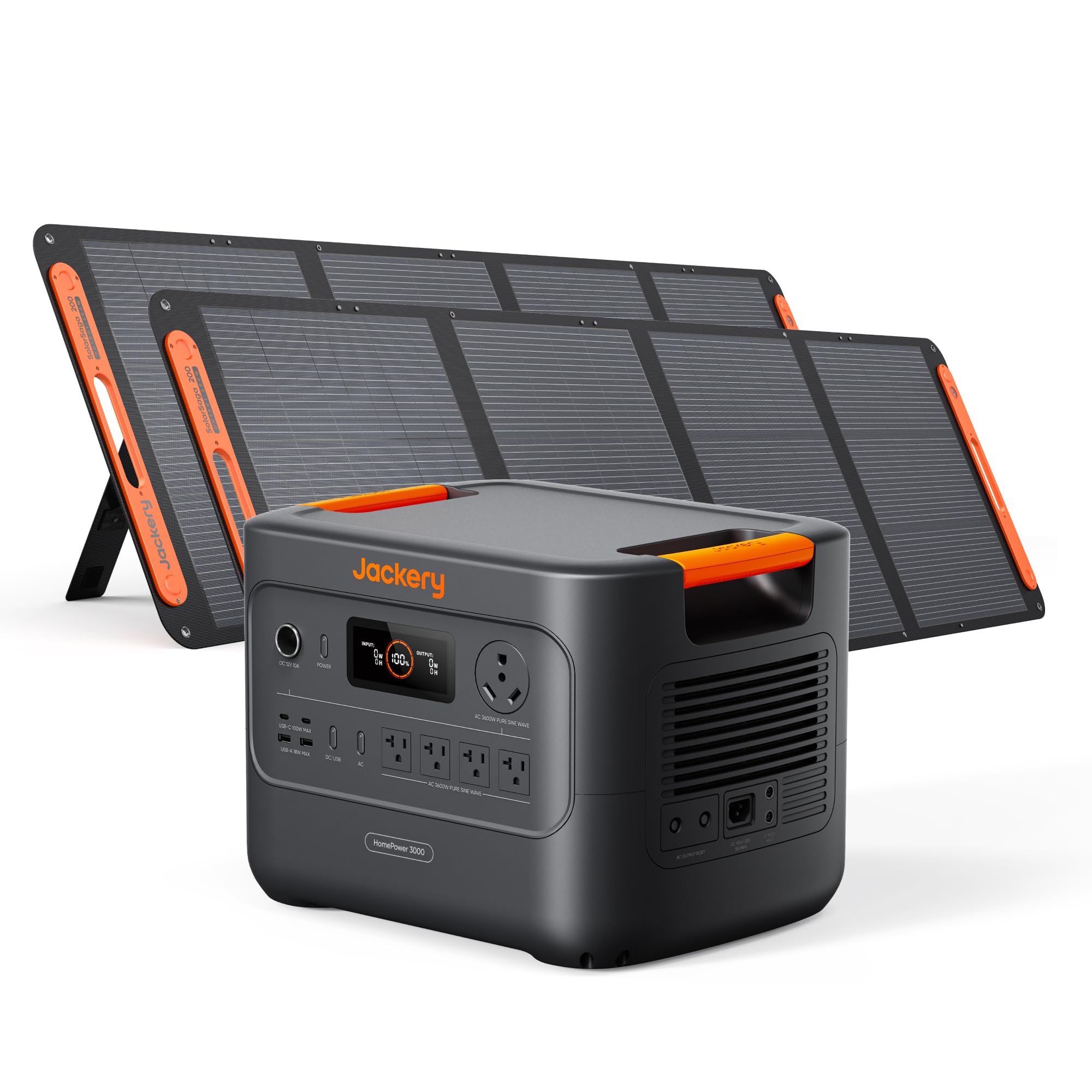
The Jackery HomePower 3000 uses CTB (Cell-to-Body) technology to pack 3,072Wh into a chassis that is 47% smaller and 43% lighter than comparable 3kWh portable stations—weighing in at 59.5 pounds. The 3600W output (7200W surge) powers most home essentials including refrigerators, fans, and sump pumps. The built-in TT-30 RV port allows direct connection to travel trailers and RVs without adapters.
The UPS switches within 20ms, making it UL-certified for sensitive electronics like medical refrigerators and network equipment. ChargeShield 2.0 technology adjusts charging parameters to extend battery life, and the LiFePO4 cells are rated for 4,000 cycles while retaining 70% capacity. Dual 100W USB-C PD ports provide fast charging for laptops, phones, and tablets simultaneously with AC loads.
Users report the unit runs a full-size refrigerator for 1-2 days on a single charge. The hybrid charging mode (AC+DC) refills the battery in 1.7 hours, while AC-only charging takes 2.2 hours. The bundled 2x 200W solar panels add significant recharging capability off-grid, though each panel is 16.4 pounds and somewhat unwieldy for portable use. The battery is non-expandable, so you are capped at the base 3kWh capacity.
Why it’s great
- Compact and lightweight for 3kWh class
- TT-30 RV port for direct camper connection
- 20ms UL-certified UPS switchover
- 4000-cycle LiFePO4 battery
Good to know
- Non-expandable capacity
- Solar panels shipped separately
8. ABOK Ark3600
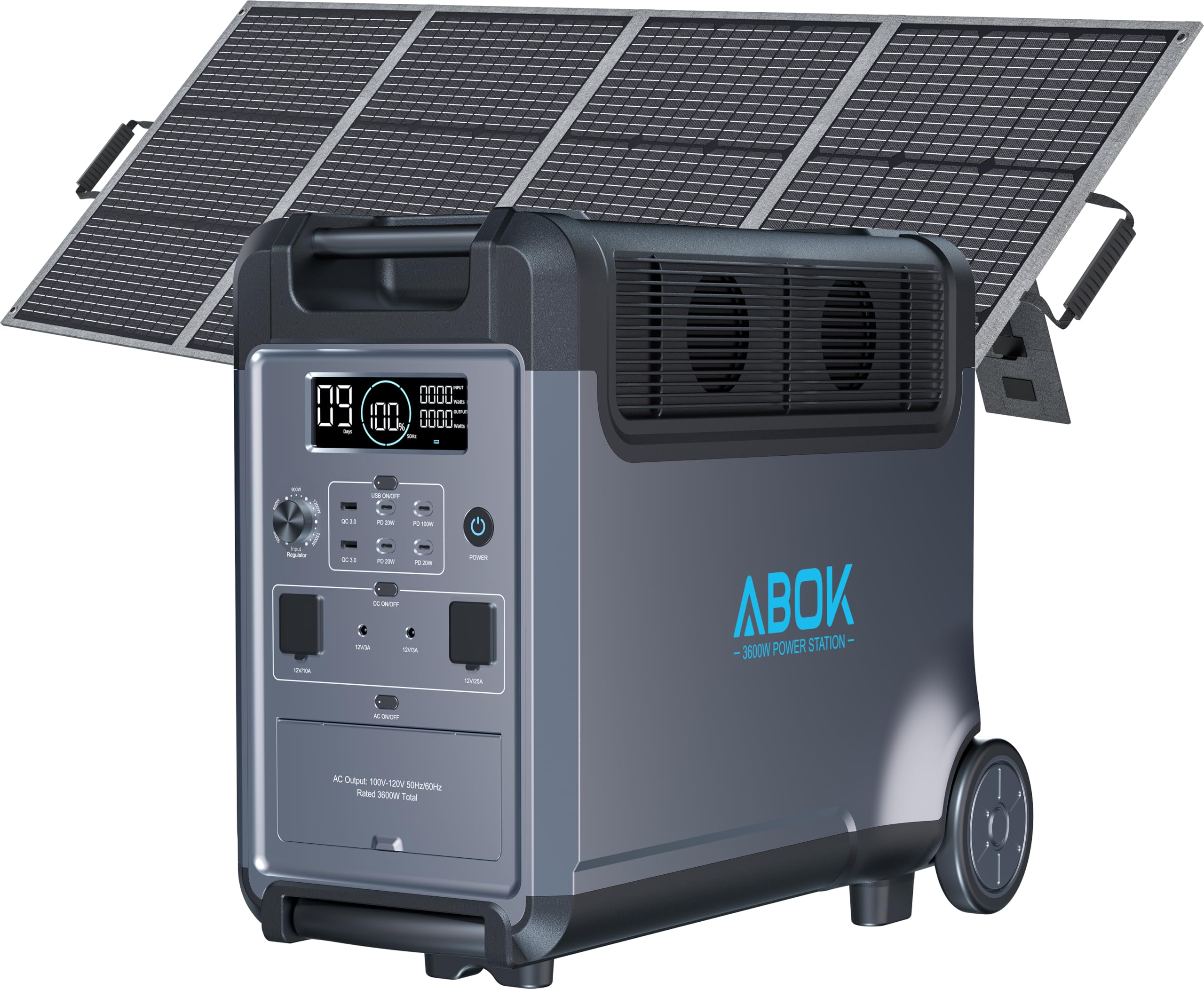
The ABOK Ark3600 offers 3.84kWh of base capacity expandable to 11.52kWh via additional battery packs, with a 3600W rated output (4500W peak). The 15 output ports include a 30A AC outlet, four 20A AC outlets, three USB-C (one 100W PD), and an XT60 12V/25A port for DC appliances. The included 200W solar panel (monocrystalline, 23% efficiency) provides a solid starting point for off-grid recharging.
Users running construction tools (wet vac, heat gun, SDS drill) simultaneously report the unit dropped to only 22% after a full workday—impressive real-world runtime for high-draw applications. The telescoping handle and durable wheels make the 92-pound station mobile, though it is not designed for frequent carrying. The Bluetooth app provides remote monitoring of input/output power and SOC, plus firmware update capability.
The unit charges via AC in 3 hours or AC+PV combined in 1.29 hours. The maximum solar input is 2000W (500W per MPPT input), which allows rapid replenishment when paired with multiple panels. A small percentage of users received units with charging defects; the 30-day return policy covers those cases, but shipping a 92-pound unit back can be expensive.
Why it’s great
- Expandable from 3.84kWh to 11.52kWh
- 15 versatile output ports including 30A AC
- Fast AC+PV combined charging (1.29 hours)
- Telescoping handle and wheels for mobility
Good to know
- Heavy (92 lbs); expensive to return if defective
- Some units shipped with charging faults
9. VTOMAN FlashSpeed 2400
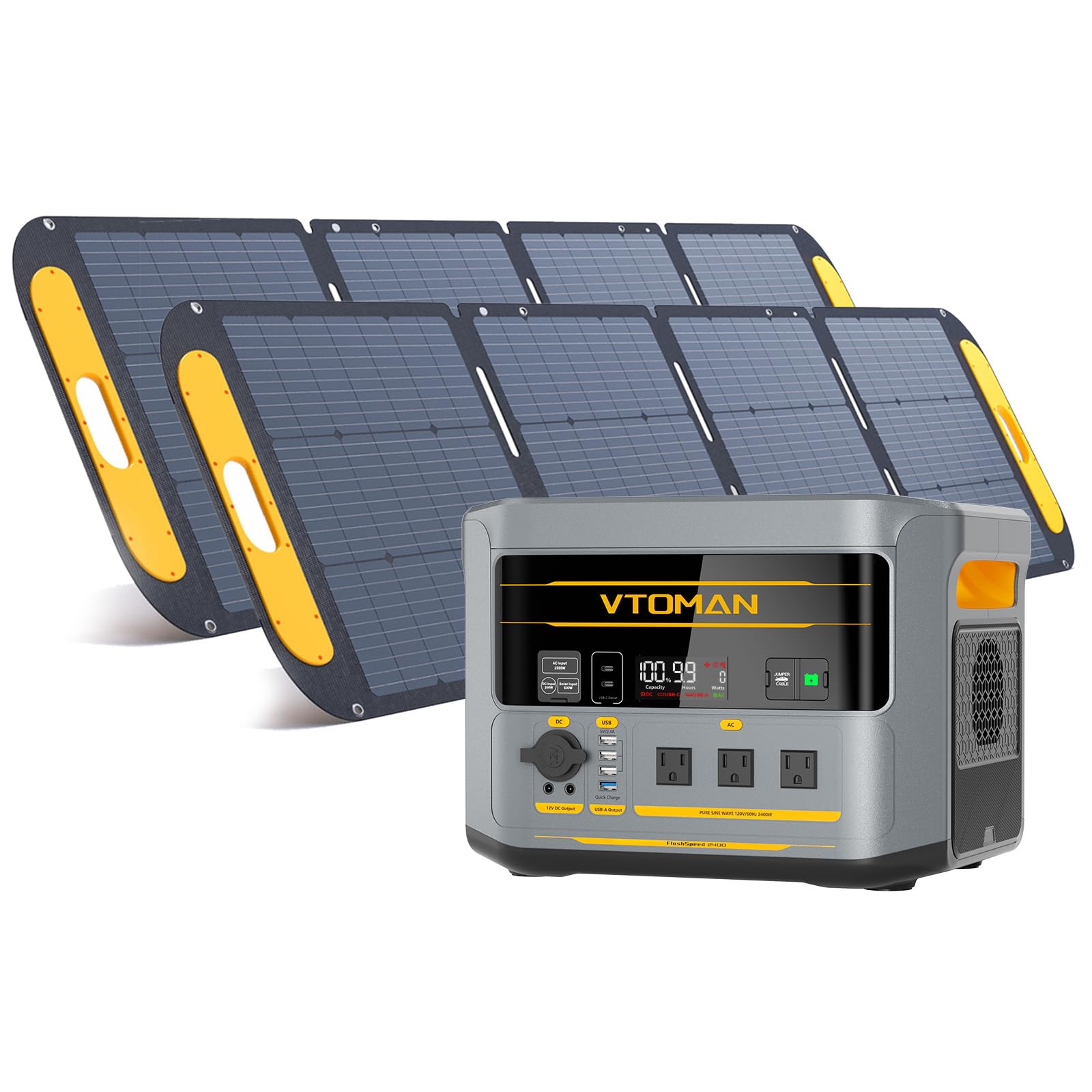
The VTOMAN FlashSpeed 2400 prioritizes recharge speed above all else: a 1500W AC input refills the 1.4kWh LiFePO4 battery from 0 to 100% in roughly one hour. The 2400W AC output (3200W peak) covers 95% of home and camping devices, and the 12 output ports (3 AC, 4 USB-A, 2 USB-C, 3 DC) allow simultaneous charging of multiple devices. The 10ms UPS switchover keeps sensitive electronics like CPAP machines and computers running during outages.
Users who have run the unit daily for three years report no degradation in capacity, confirming the 3000+ cycle rating. The 400W solar input (600W MPPT) provides off-grid recharging, though the included VS200Pro panels are the limiting factor in cloudy conditions. The 5-mode LED light (Low/Medium/High/Strobe/SOS) adds emergency utility beyond simple power storage.
At 41.9 pounds, the FlashSpeed is one of the lighter 2400W-class stations, but the DC auto-shutdown feature can be problematic when powering refrigerators that cycle their compressor on and off. The USB-C ports on some units feel slightly loose, and there is no jumper cable included for direct vehicle battery charging.
Why it’s great
- Full recharge in ~1 hour from 1500W AC
- 10ms UPS for sensitive electronics
- Very light for its class (41.9 lbs)
- 3000+ cycle LiFePO4 with minimal degradation
Good to know
- DC shutdown can cycle-refrigerators
- USB-C ports may feel loose
- No vehicle charging cable included
10. EF ECOFLOW DELTA 2 Max

The EcoFlow DELTA 2 Max occupies the sweet spot between capacity and portability: 2,048Wh of LiFePO4 storage in a 50-pound chassis. The 2400W AC output (3400W with X-Boost) powers 99% of household devices, and the 15 outlets include multiple USB-C, USB-A, and DC ports. Dual charging (AC + solar) brings the battery to 80% in just 43 minutes—among the fastest in the 2kWh class.
Users report the unit runs a 32-inch 4K TV, MacBook Pro, and fan for 15-20 hours on a single charge. The bundled 400W solar panel (IP68 waterproof, 23% efficiency) recharges the battery in 5.1 hours with one panel or 2.6 hours with two. The EcoFlow app allows time-of-use scheduling, solar priority settings, and real-time energy tracking—features that matter for those optimizing their solar harvest.
The LiFePO4 cells are rated for 3,000 cycles to 80% capacity, backed by a 5-year warranty. The foldable solar panels are IP68 rated for dust and water, but the case stand is somewhat flimsy—several users built their own PVC stands for off-grid use. The unit is not expandable beyond the base 2kWh without the optional extra battery (sold separately).
Why it’s great
- Ultra-fast 43-minute charge to 80%
- IP68 weatherproof solar panel included
- 15 outlets for multi-device power
- Advanced app with solar scheduling
Good to know
- Panel stand flimsy; may need DIY stand
- Non-expandable without extra battery pack
11. Jackery Explorer 2000 v2

The Jackery Explorer 2000 v2 uses CTB (Cell-to-Body) technology to pack 2,042Wh into a chassis that weighs 39.5 pounds—41% lighter and 34% smaller than typical 2kWh stations. The 2200W AC output powers 85% of home appliances, and the 20ms UPS switchover provides seamless backup during power outages. The USB-C PD 100W port charges laptops and tablets at full speed without an adapter.
Users report the unit powered a refrigerator for 21.3 hours in real-world testing. The AC fast charging reaches 80% in 66 minutes, and Emergency Super Charging (via the app) fills the battery in 102 minutes. The Silent Charging mode operates at under 30dB—quiet enough for bedside or office use without fan noise. The Explorer 2000 v2 is UL1778 certified for Uninterruptible Power Systems.
One limitation: the 2,042Wh capacity cannot be expanded, and the unit only accepts up to 400W of solar input, which translates to roughly 6 hours of solar recharge time. The included AC cable is short (5 feet), and the display does not show per-cell voltage or historical data. The unit is not designed for series/parallel connection with other Jackery units.
Why it’s great
- Lightest 2kWh station at 39.5 lbs
- 20ms UPS with UL1778 certification
- Silent Charging mode under 30dB
- Fast 66-minute charge to 80%
Good to know
- Non-expandable capacity
- 400W max solar input limits off-grid speed
- Short AC charging cable
12. Dumfume 24V 314Ah
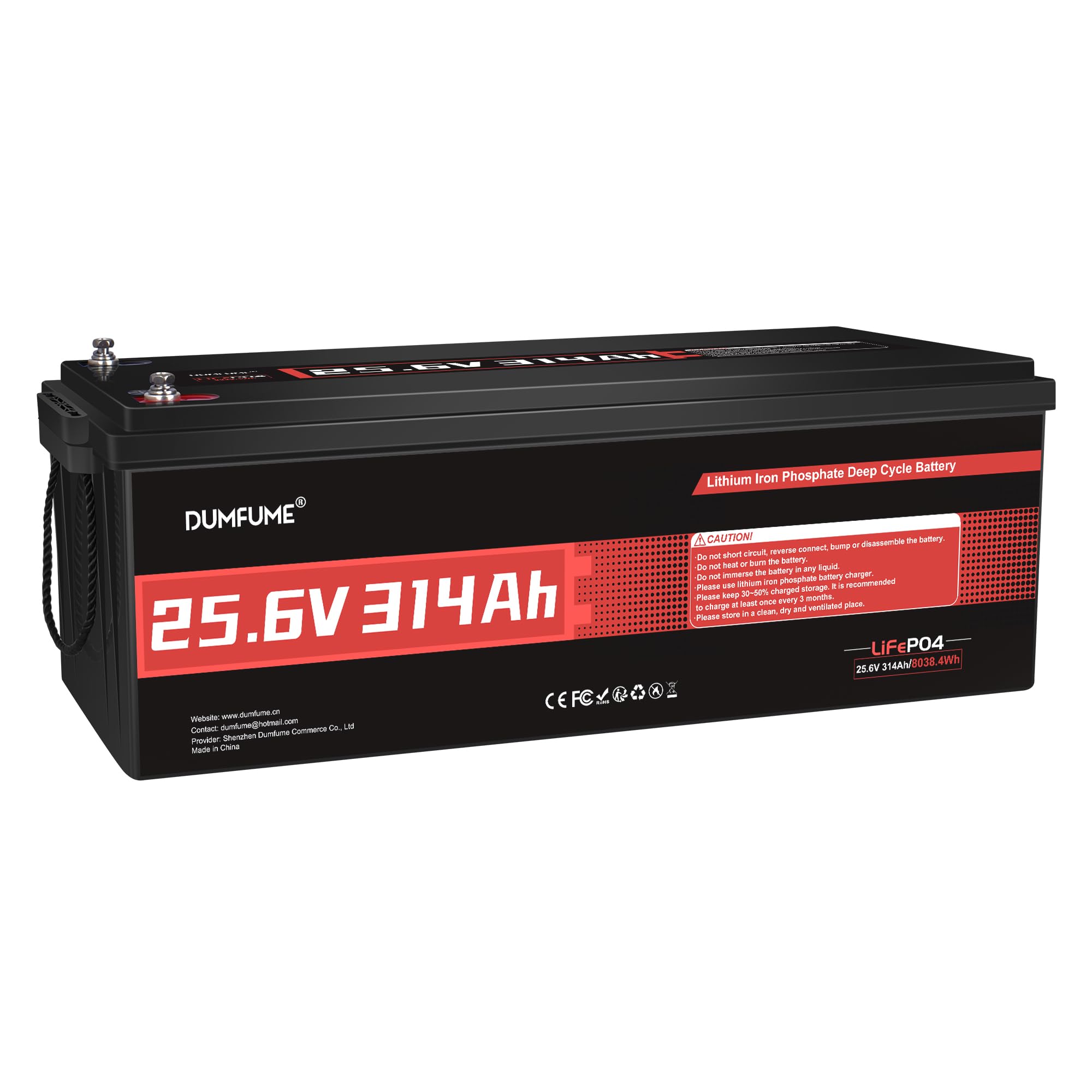
The Dumfume 24V 314Ah battery delivers 8kWh (8,038.4Wh) of capacity in a compact footprint of 25.19 x 9.64 x 8.86 inches. The 200A BMS provides full protection against overcharge, over-discharge, overcurrent, short circuit, and extreme temperatures. The low-temperature cutoff stops charging below 32°F while allowing discharge down to -4°F, and the IP65 rating means it can be installed in semi-outdoor enclosures without moisture damage.
Users report the battery works flawlessly as a drop-in replacement for lead-acid in RVs and solar applications. The M8 terminals accept standard cable lugs without modification, and the parallel/series configuration allows up to 2 units in series (51.2V) and 4 in parallel (1,256Ah) for a 64kWh+ energy bank. The Grade A automotive cells deliver over 4,000 cycles at 80% DoD, with self-discharge under 3% per month.
The 24V nominal voltage means this battery is best suited for 24V inverter systems—common in marine and small RV setups—rather than the 48V standard used in most home solar installations. The 112-pound weight and large size make it less portable than smaller 5kWh batteries. A small number of units arrived with slightly low voltage (around 13.5V per cell bank); this is normal for storage and resolves after the first charge cycle.
Why it’s great
- Massive 8kWh capacity in single unit
- 200A BMS with IP65 weatherproofing
- Low-temperature charge cutoff below 32°F
- Scalable to 64kWh+ in parallel/series
Good to know
- 24V nominal, not compatible with 48V systems
- Heavy (112 lbs) for one-person installation
13. FOSSiBOT F2400
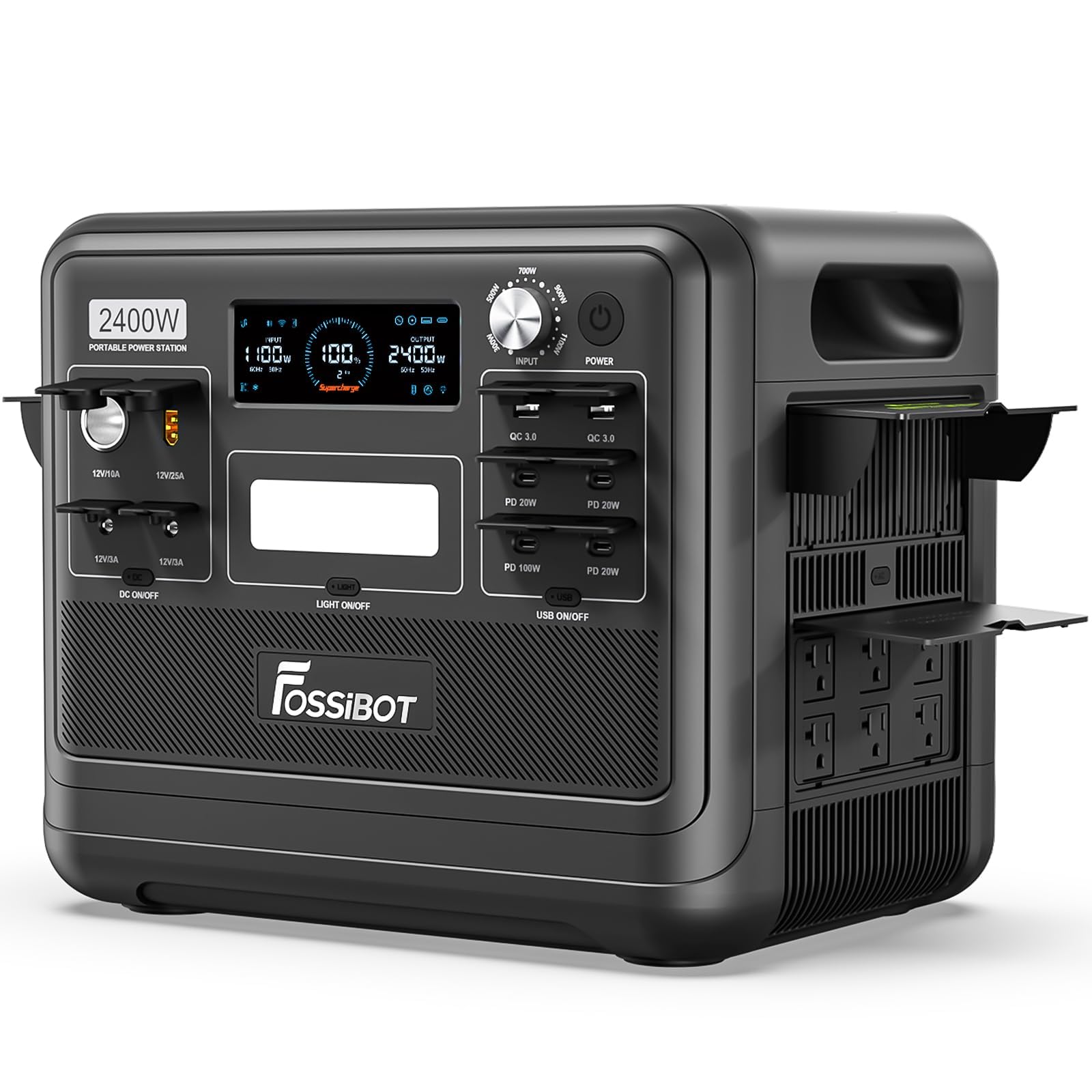
The FOSSiBOT F2400 brings 2,048Wh of LiFePO4 storage with a unique adjustable AC input knob—you can dial the charging speed from 0 to 1100W to avoid tripping home circuit breakers. The 2400W AC output powers 99% of household appliances, and the 15ms UPS switchover protects computers and CPAP machines during blackouts. The MPPT controller accepts up to 500W of solar input for off-grid recharging.
The battery drains more slowly than comparable EcoFlow units, and the Bluetooth app provides useful monitoring data. The unit charges fully in 1.5 hours at maximum AC input, and the LiFePO4 cells are rated for 3,500+ cycles to 80% capacity, backed by a 48-month warranty.
One recurring annoyance: the F2400 emits a rhythmic relay clicking sound in low-solar conditions when connected to PV panels. This can be solved by adding a remote disconnect relay between the panels and the unit, but it is an extra cost and complication that should not be necessary. The 48.5-pound weight is manageable for one person, but the lack of a telescoping handle or wheels makes rolling transport impossible.
Why it’s great
Why it’s great
- Adjustable AC input knob for circuit protection
- 1.5-hour full recharge at max AC speed
- 48-month warranty on LiFePO4 cells
- 48.5 lbs manageable for one-person carry
Good to know
- Relay clicking noise in low-solar conditions
- No wheels or telescoping handle
- 500W solar input max limits off-grid speed
FAQ
Can I mix different battery brands or chemistries in parallel?
What does low-temperature cutoff mean for solar batteries?
How many cycles should a good solar battery last?
Do I need a special inverter for LiFePO4 batteries?
How do I calculate how much battery capacity I need?
Final Thoughts: The Verdict
For most users building a new solar storage system, the battery storage for solar power winner is the AOUSK 48V 200Ah (2-Pack) because it offers 10.24kWh of Grade A LiFePO4 storage with CAN/RS485 communication, a rugged metal shell, and a 5-year warranty—all at a mid-range price point that undercuts premium brands without sacrificing essential features. If you need a massive single-unit 16kWh solution with protocol flexibility, grab the SaiJiaoYang 16kWh 48V 314Ah. And for extreme whole-home off-grid capacity with UL safety certification, nothing beats the ECO-WORTHY Cubix100 6-Pack.