
Our readers keep the lights on and the weekend projects moving. As an Amazon Associate, I earn from qualifying purchases.
A wooden floor, a grassy knoll, or a paved driveway — the first time a toddler lifts both feet and glides is a milestone that signals the beginning of independent mobility. The market for these no-pedal trainers has exploded, but the real differentiators are not flashy colors: they are weight, seat height range, tire composition, and the frame’s ability to survive repeated drops without bending. Choosing a poor fit means a wobbly, frustrating experience that delays your child’s confidence rather than building it.
I’m Rikta — the founder and writer behind FitlyFast. I spend my time analyzing frame geometries, wheel-bearing quality, and real-world durability data to separate hardware that delivers genuine progression from bikes that look the part but fail in daily use.
This guide breaks down exactly what makes a kids’ two-wheeler effective, covering frame materials, adjustable ranges, and tire types so you can pick the right balance bike for your child’s height and skill level without second-guessing.
How To Choose The Best Balance Bike
The most common mistake is buying based on an age range printed on the box rather than measuring your child’s inseam. A bike that sits too high forces the child to tiptoe, which undermines the entire learning process. Beyond fit, you need to evaluate weight, tire design, and steering limitations to ensure safety and progression.
Seat Height and Inseam Match
A proper fit allows your child to sit on the saddle with both feet flat on the ground and knees slightly bent. Look for a minimum seat height that is at or below your child’s inseam measurement. Most bikes in this guide adjust from roughly 11 inches up to 18.5 inches, covering children from about 18 months to 5 years old. If the seat cannot go low enough, the bike is useless until the child grows, and if it cannot go high enough, it will be outgrown too quickly.
Frame Material and Total Weight
A lightweight frame is critical — a bike that is too heavy discourages independent handling. Alloy steel frames offer a good balance of strength and weight, while carbon steel is heavier but more affordable. The bike should weigh no more than roughly 40 percent of your child’s body weight; for a 30-pound toddler, that means a bike under 12 pounds is ideal. Heavier frames can still work but require more effort for the child to control.
Tire Type: EVA Foam vs. Air-Filled vs. Solid Rubber
EVA foam tires are puncture-proof, lightweight, and work well on pavement and smooth floors, but they offer less traction on loose gravel or wet grass. Air-filled tires provide superior grip and vibration dampening on uneven terrain but require occasional inflation. Solid rubber tires sit between the two: durable, no maintenance, but heavier. For a toddler primarily riding on sidewalks and paved paths, EVA foam is the most practical and low-hassle choice.
Steering Limiter and Safety Features
A steering limit of roughly 135 degrees prevents the handlebars from turning too sharply and causing a sudden tip-over. Combined with a low center of gravity and rounded frame edges, this feature significantly reduces the risk of falls, especially for younger beginners. Closed-wheel designs on smaller bikes also protect feet from getting caught in spokes.
Quick Comparison
On smaller screens, swipe sideways to see the full table.
| Model | Category | Best For | Key Spec | Amazon |
|---|---|---|---|---|
| Retrospec Cub | Premium | Early learners building confidence | Seat height 11–14.5 in | Amazon |
| ACEGER w/ Basket | Premium | Taller toddlers (2.5–5 years) | Air-filled tires | Amazon |
| Yvolution Y Velo Junior | Mid-Range | 2-in-1 dual/rear wheel stability | Dual rear wheel mode | Amazon |
| KRIDDO | Mid-Range | Multi-terrain puncture-proof ride | 12-in puncture-proof tires | Amazon |
| Gotrax KS12 | Mid-Range | LED fun and ultralight build | Weight 8.6 lbs | Amazon |
| Liberry 4-Wheel | Entry-Level | 12–24 month old beginners | 4-wheel stability design | Amazon |
| Bobike | Entry-Level | Budget-friendly first bike | 135° steering limiter | Amazon |
In‑Depth Reviews
1. Retrospec Cub Toddler Balance Bike

The Retrospec Cub earns the top spot because it nails the core requirements: a low step-over frame that allows easy mounting, a seat adjustment range from 11 to 14.5 inches that covers the critical 18-month to 3-year growth window, and airless puncture-proof tires that deliver smooth rides on pavement, grass, and dirt without any inflation hassle. The frame is alloy steel, keeping the bike lightweight enough for a toddler to maneuver independently, and the rounded edges and non-slip grips show attention to safety that parents appreciate after a full year of daily drops. Customer feedback consistently highlights that the bike survives being dragged up stairs and left in the rain without rusting or losing structural integrity.
The quick-release seat post and handlebar clamp make adjustments tool-free, so you can raise the saddle as your child grows in seconds rather than wrestling with wrenches. The low center of gravity provides excellent stability for beginners who are still figuring out how to steer and stop by foot. Owners report that children transition from tentative walking with the bike to confident gliding within days, partly because the bike’s geometry does not force them into an awkward leaning position. After one year of use, the tires show minimal wear, and the frame still feels solid — a durability benchmark that budget bikes often fail to meet.
The only real trade-off is the lack of a foot platform or brake, which is standard for this class of balance bike and does not impede the learning process at all. Some parents note that the navy color, while attractive, can show dirt more quickly than lighter shades. Assembly is straightforward with the included tools, taking about 15 minutes if you follow the printed guide. For a balance bike that balances weight, adjustability, and build quality without any gimmicks, the Retrospec Cub is the most dependable choice on this list.
Why it’s great
- Seat adjusts low enough for 18-month-olds with short inseams.
- Alloy steel frame is strong without being heavy.
- Puncture-proof tires require zero maintenance and handle mixed terrain.
Good to know
- No footrest for gliding practice.
- Navy color shows scuffs more than lighter finishes.
2. ACEGER 12″ Kids Balance Bike with Basket

The ACEGER balance bike stands apart from the crowd because it includes a genuine wicker basket, a bell, and reflectors — small details that turn a training tool into a mini adventure vehicle. The frame is alloy steel, and the bike is designed for riders aged 2.5 to 5 years with a minimum inseam of 13 inches, making it one of the few options here that comfortably fits taller toddlers who have outgrown smaller 9-inch wheel bikes. The air-filled tires are a significant upgrade over EVA foam, providing noticeably better grip on grass and gravel and filtering out road vibration that can make the ride uncomfortable for small children. Assembly is straightforward with the included tools, and the quick-release seat post allows height adjustments without any hassle.
The basket is not just a decorative touch — it is sturdy enough to hold a small stuffed animal or a snack pouch, and kids love loading it up before a ride. The handlebar grips are rubber rather than foam, which holds up better to wear and does not degrade after sun exposure. Customer reviews consistently note that the bike looks gorgeous in person and that the bell lever is easy for small fingers to press, adding an element of control and fun. The reflectors enhance visibility for evening rides, a nice safety bonus that most balance bikes skip entirely. The tires ship partially inflated for safety, so you will need to top them off before the first ride.
On the downside, the bike does not include a brake, which is typical for this category, but the lack of a kickstand means adults have to find a wall or fence to park it upright. A small number of buyers reported a slightly wobbly front wheel upon delivery, likely from damage during shipping rather than a manufacturing defect, but the customer service team appears responsive about replacements. The maximum weight recommendation is listed at only 5 kilograms on the spec sheet, though the frame can clearly support a heavier child — the low number may be a translation error. For a balance bike that adds personality without sacrificing the core riding experience, the ACEGER is a fantastic choice for older toddlers who want a bit of flair.
Why it’s great
- Air-filled tires provide superior traction and comfort on rough terrain.
- Wicker basket and bell make the bike engaging and practical.
- Quick-release seat post allows fast height adjustments.
Good to know
- No kickstand for parking.
- Tires ship partially inflated and need air before use.
3. Yvolution Y Velo Junior 9″ Balance Bike

The Y Velo Junior takes a different approach from traditional balance bikes by offering a dual rear wheel configuration that provides extra lateral stability for absolute beginners. In its double-wheel mode, the bike essentially becomes a three-wheeler that will not tip over sideways, which is a game-changer for timid toddlers who are scared of falling. Once the child gains confidence, you can switch to the single rear wheel mode for a standard balance bike experience. The seat adjusts from 11 to 14.2 inches, making it suitable for children as young as 18 months up to about 3 years or 44 pounds. The larger 9-inch wheels and higher ground clearance help the bike roll over small bumps and uneven surfaces better than many flush-tire models.
The frame is alloy steel, and at 7.7 pounds, it remains light enough for a toddler to lift and carry short distances. The assembly is straightforward and does not require any special tools beyond the included hex wrenches. Parents report that the dual-wheel mode was especially helpful for their 2-year-olds who were initially unsteady, and most were able to switch to single wheel within a few weeks. The bike’s bright pink color and refreshed design make it visually appealing to young children, and the build quality feels noticeably solid compared to similarly priced options. The footrests on the rear axle give kids a place to put their feet when gliding, which encourages proper riding posture from the start.
The main limitation is the weight capacity of 44 pounds, which means heavier or taller children will outgrow it faster than some of the 12-inch models. Some parents noted that the bike is slightly narrow, so children with wider hips may feel a bit squeezed. The 9-inch wheels are smaller than the 12-inch standard, which means the bike rolls more slowly and struggles slightly with tall grass or deep gravel. If your child is already past their second birthday and shows good balance, the dual-wheel feature may be unnecessary, and a standard 12-inch model would serve them longer. But for the youngest riders who need that extra safety net, the Y Velo Junior is the most thoughtful design on the market.
Why it’s great
- Dual rear wheel mode eliminates tipping for beginners.
- Extremely lightweight at 7.7 pounds.
- Footrests encourage proper gliding form.
Good to know
- 9-inch wheels roll slower than 12-inch models.
- 44-pound weight limit means faster outgrowing.
4. KRIDDO Toddler Balance Bike
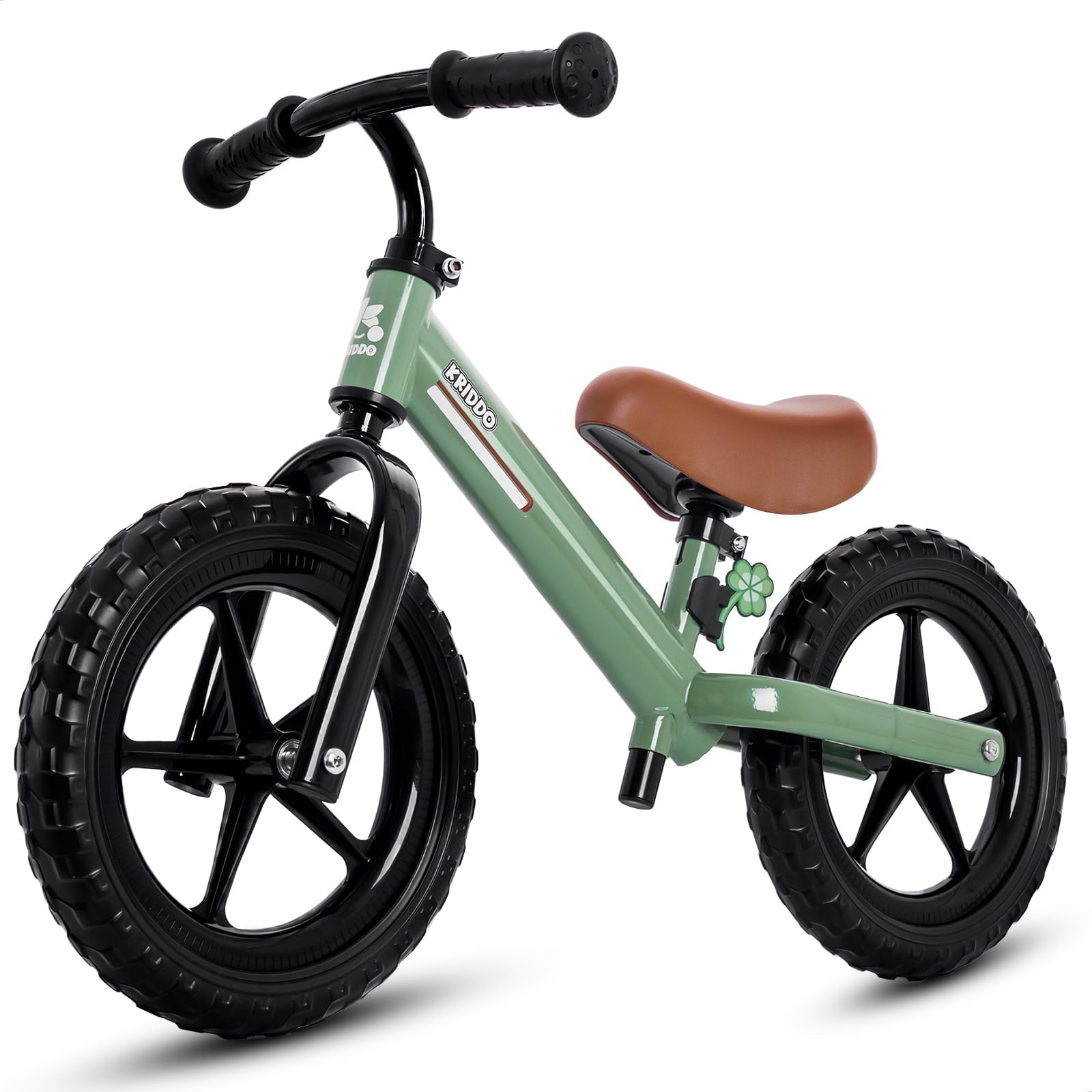
The KRIDDO balance bike punches well above its price point by combining a durable carbon steel frame with dual-bearing wheels that deliver a noticeably smooth, low-resistance ride. The 12-inch puncture-proof tires work across pavement, grass, carpet, and even wood floors without leaving marks, giving your child a consistent gliding experience no matter where they ride. The seat adjusts from 14.17 to 18.5 inches, and the handlebars go from 20.08 to 21.65 inches, accommodating kids from age 2 up to about 5 years. The cute flower and clover plates that attach under the seat are a clever touch that lets toddlers personalize their ride without adding any functional compromise.
Assembly is straightforward, and the included tools are of decent quality, meaning you will not strip any bolts during setup. The carbon steel frame is heavier than alloy steel alternatives, but the extra weight is distributed evenly, and most 2-year-olds manage it without issues. Customer reviews consistently highlight that the bike feels sturdy and well-built, with no wobble in the steering column or flex in the frame. The neutral green color works for both boys and girls, and the simple design avoids the overly plastic look that plagues some budget options. The dual-bearing system reduces rolling resistance significantly, which means your child can glide farther with each push — a feature that directly accelerates the learning curve.
The main drawback is the weight of the carbon steel frame, which at roughly 10 pounds may be challenging for very small toddlers to lift if they tip over. The tires, while puncture-proof, are not as grippy as rubber on wet grass, so limit outdoor use to dry conditions for best performance. The bike does not include any safety features like a steering limiter, so very young riders may turn the handlebars too sharply and fall sideways. This is a minor concern for most parents, and the bike’s overall value proposition — sturdy build, smooth bearings, and fun customization — makes it one of the smartest mid-range purchases available.
Why it’s great
- Dual-bearing wheels provide minimal rolling resistance.
- Puncture-proof tires work on multiple indoor and outdoor surfaces.
- Customizable plates add personality without compromising structure.
Good to know
- Carbon steel frame is heavier than alloy alternatives.
- No steering limiter for the sharpest turns.
5. Gotrax KS12 Balance Bike
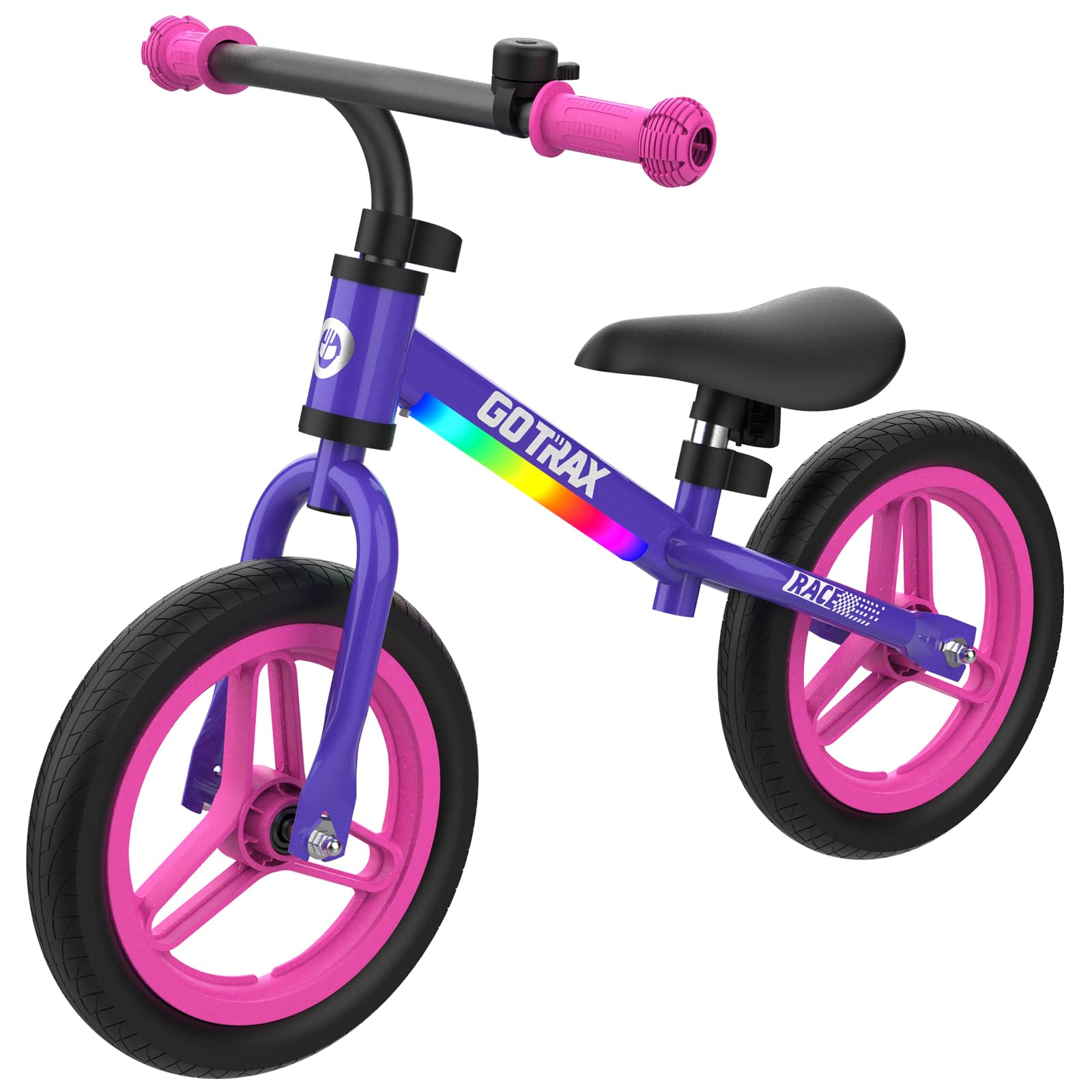
The Gotrax KS12 is the lightest bike in this lineup at just 8.6 pounds, making it the best option for smaller toddlers who need to manage their ride independently. The frame is iron, which is a bit heavier than alloy steel by material density, but the overall weight is kept low through efficient geometry and minimal components. The 12-inch EVA wheels are puncture-proof and roll smoothly on pavement and indoor floors, though they lack the grip of rubber on wet surfaces. The LED lights built into the frame are a major hit with kids, adding a visual reward that encourages evening rides without being distracting or draining the battery quickly. The adjustable seat ranges from 16.5 to 18.3 inches, and the handlebars go from 22.8 to 26 inches, covering the 2-to-5-year age range effectively.
The bike also includes a bell and a thicker seat cushion with silicone handlebars, which improve comfort on longer rides. Assembly takes about five minutes with the included tools, and the instructions are clear enough for a first-time builder. Customers consistently praise the smooth ride and the fact that the bike feels stable despite its light weight. The 110-pound maximum weight rating is far higher than any toddler will reach, indicating that the frame is overbuilt for safety. The Gotrax brand also offers a one-year manufacturer warranty, which provides peace of mind that most budget brands do not match. For parents who want a bike that their child can carry to the starting point without help, the KS12 is the clear winner.
The biggest caveat is the seat adjustment range: the minimum height of 16.5 inches is the highest on this list, meaning children under 3 years old with inseams shorter than about 15 inches will not be able to place both feet flat on the ground. Some buyers received paperwork that said the bike is recommended for ages 3 and up, despite the Amazon listing stating 2 years and up — this is a real concern if your child is on the smaller side. The EVA tires can feel slippery on smooth tile floors when turning quickly, so indoor use on carpet is safer. If your child meets the height requirement, this is a phenomenal lightweight option with extra fun features.
Why it’s great
- Exceptionally lightweight at 8.6 pounds.
- LED lights and bell add engagement for young riders.
- Silicone handlebars and thick seat cushion improve comfort.
Good to know
- Minimum seat height of 16.5 inches is too tall for small toddlers.
- EVA tires can feel slippery on smooth indoor surfaces.
6. Liberry Baby Balance Bike 4-Wheel
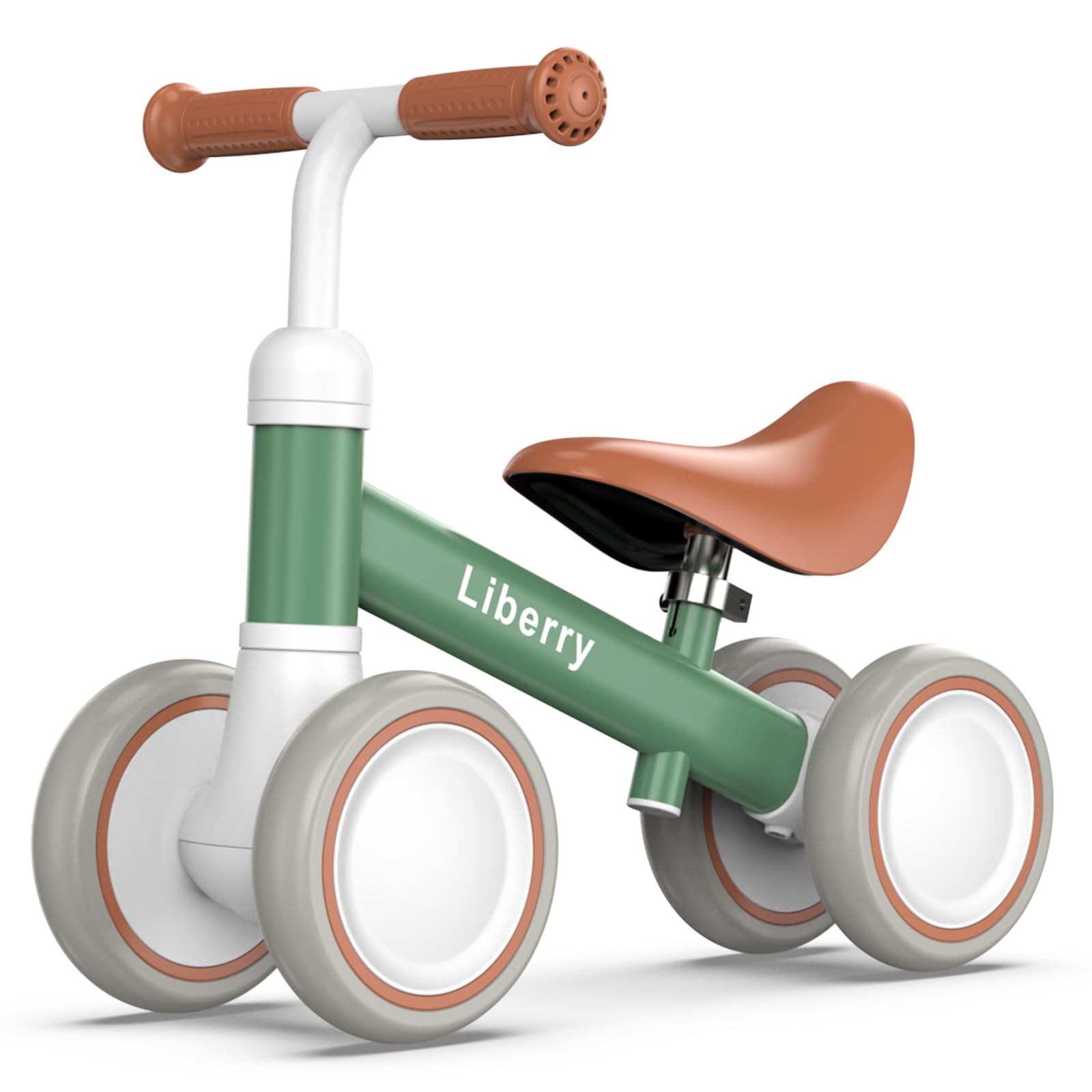
The Liberry balance bike is designed specifically for the youngest riders — children aged 12 to 24 months who have just started walking. Its four-wheel design provides exceptional stability, making it nearly impossible to tip over, which is exactly what parents of newly mobile toddlers need. The closed wheels protect tiny feet from getting pinched, and the PU seat adjusts from 9.7 to 11 inches, which is significantly lower than standard balance bikes and perfect for children with short inseams. At just under 5 pounds, it is the lightest bike in this guide, allowing even a 1-year-old to lift and reposition it. The EVA tires are smooth and quiet, so indoor riding on hardwood floors does not create noise or leave marks.
The handlebars are made of rubber rather than foam, which is safer for infants who tend to chew on everything and holds up better to slobber and outdoor dirt. The bike comes with letter stickers so you can personalize it with your child’s name, a small touch that makes the bike feel special. Customer reviews from parents of 13- and 14-month-olds confirm that the bike helps build leg strength and coordination without overwhelming the child. The four-wheel configuration means the bike glides in a straight line without the need for steering input, which is ideal for the earliest stage of balance development. Many parents noted that their child was able to get on and off independently within a day of receiving the bike.
The trade-off for this stability is that the bike does not teach steering — the front wheels turn only slightly, so the bike is essentially a walker with wheels. The manufacturer explicitly warns against using it on uneven surfaces like gravel, as the small wheels and low ground clearance will cause the bike to stop abruptly. The weight capacity is 55 pounds, but most children will outgrow the inseam range long before they reach that weight. This is not a bike that will last for years, but it is the best possible introduction to wheeled mobility for the youngest toddlers. If your child is already 18 months or older and walking confidently, skip this and go straight to a two-wheeled balance bike.
Why it’s great
- Four wheels eliminate tipping for absolute beginners.
- Extremely lightweight at under 5 pounds.
- Closed wheels and rubber grips are safe for infants.
Good to know
- Does not teach steering or leaning.
- Not suitable for uneven outdoor terrain.
7. Bobike Toddler Balance Bike

The Bobike balance bike is an entry-level option that includes several safety features typically found on more expensive models, including a 135-degree steering limiter to prevent sharp tip-overs and fully enclosed non-slip wheels that protect feet and reduce noise on hard floors. The frame is made of alloy steel, which is a step up in durability from cheaper plastic alternatives, and the adjustable seat grows with the child from 1 to 4 years old. The pink color and vintage-inspired design are visually appealing, and the bike comes with certifications including ASTM F963-11 and EN71, which matter for parents who prioritize safety compliance. Assembly takes only a few minutes with the included tools, and the instructions are straightforward enough for someone with no mechanical experience.
The bike’s weight is reasonable for its class, and the steel frame absorbs more vibration than plastic models, giving a slightly smoother ride on pavement. The 135-degree steering limit is genuinely useful for preventing the abrupt falls that happen when a toddler yanks the handlebars to the side. Customer reviews consistently mention that 2-year-olds love the bike and that it helped them learn balance quickly. The enclosed wheels also eliminate the risk of getting shoelaces or pant legs caught, a minor but real frustration with open-spoke designs. For the price point, the Bobike delivers a solid balance of safety, durability, and ease of use that is hard to beat.
The main issue raised by buyers involves product sourcing: some customers reported that the listing appears to be sold by a third party rather than directly from Bobike, which created confusion when they needed support. The handlebar height is not adjustable on some units, which can be a problem if your child is particularly tall or short. A few customers noted that the assembly required more force than expected for certain bolts, though no structural failures were reported. The bike is also narrower than some alternatives, which may not be ideal for children with wider hips. If you can verify the seller and your child fits the proportions, this is a very capable budget-friendly starter bike.
Why it’s great
- 135-degree steering limiter prevents sharp falls.
- Enclosed wheels protect feet and reduce noise.
- Alloy steel frame is durable for the price.
Good to know
- Seller verification may be required for warranty support.
- Handlebar height is not adjustable on some units.
FAQ
What is the ideal seat height for my toddler’s balance bike?
How do I know if my child is ready for a balance bike?
Are air-filled tires better than foam tires on a balance bike?
My child is tall for their age — which balance bike should I choose?
Final Thoughts: The Verdict
For most families, the balance bike winner is the Retrospec Cub because it combines the lowest starting seat height for the youngest riders with a durable alloy steel frame and maintenance-free tires that last through multiple children. If your toddler needs extra stability to overcome initial fear of tipping, grab the Yvolution Y Velo Junior with its dual rear wheel mode. And for older toddlers who want personality along with performance, the ACEGER with basket delivers air-filled tires and a charming design that makes every ride an adventure.