
Our readers keep the lights on and the weekend projects moving. As an Amazon Associate, I earn from qualifying purchases.
That rush of hot or cold air every time you pull down the attic stairs isn’t just uncomfortable — it’s a measurable energy leak. An unsealed attic opening can reduce the effectiveness of your entire home’s insulation by up to 20%, forcing your HVAC system to work harder and driving up monthly bills. The solution is a dedicated cover that seals off the opening while still allowing access when needed.
I’m Rikta — the founder and writer behind FitlyFast. I’ve spent years analyzing home energy efficiency products, focusing on the real-world specs and installation realities that determine whether an attic stair cover actually performs as advertised.
This guide breaks down the seven most reliable options on the market, helping you find the best attic stair insulation cover for your specific rough opening and budget.
How To Choose The Best Attic Stair Insulation Cover
Not all attic stair covers are created equal, and the cheapest option can end up costing more in lost energy savings and replacement. Focus on these five factors to get a cover that seals well and lasts for years.
Measure Your Rough Opening, Not Just the Stairs
The most common mistake is measuring the stairs themselves instead of the rough opening in the ceiling. The rough opening is the framed hole the stair assembly fits into — it’s usually 25 x 54 inches, but can vary. Always measure the inside dimensions of the frame, including the depth, to ensure the cover’s sidewalls fully enclose the mechanism.
R-Value vs. Air Sealing: Which Matters More?
R-value measures the material’s resistance to conductive heat flow, but with an attic stair cover, the primary enemy is air leakage — the chimney effect of hot or cold air moving through the gap. A cover with a moderate R-value but excellent air sealing (tight zippers, good stapling flange, and a radiant barrier) will outperform a thicker cover that lets air bypass it. Look for a reflective foil outer layer, which doubles as a radiant barrier and a vapor retarder.
Zipper Quality and Access Design
A cover is useless if it’s a hassle to open. The zipper is the most mechanically stressed part. Budget covers often use thin, single-slider zippers that bind at the corners. Premium covers use heavy-duty, double-slider zippers that allow you to open from either side. If you access the attic frequently, a well-built zipper is worth the extra cost.
Material: Double Bubble vs. Foam vs. Fabric
Double bubble reflective foil is the most common and offers good all-around performance. Some premium covers use a closed-cell foam or a layered nylon fabric construction that is more rigid and doesn’t sag over time. The material should be fire-resistant — look for clear language about the cover being non-toxic and non-carcinogenic, though specific fire ratings are rare in this category.
Installation Method: Staples, Screws, or Velcro
Most covers attach with a staple gun, which is simple but permanent. Some use Velcro straps or screw-in grommets, which allow removal without damage. If you live in a climate with extreme temperature swings, a screw-down method using wood battens provides the most secure seal, especially if your framing is uneven.
Quick Comparison
On smaller screens, swipe sideways to see the full table.
| Model | Category | Best For | Key Spec | Amazon |
|---|---|---|---|---|
| Energy Wise Premium | Double Bubble | Standard 25×54 fit | R-14.5 / 97% radiant reflection | Amazon |
| Thermal Armor Premium | Double Bubble | Garage temps control | R-14+ / 97% radiant reflection | Amazon |
| Insulation MarketPlace 30×60 | Pure Aluminum | Large non-standard openings | R-15.4 / 30x60x11 inches | Amazon |
| Miloo Attic Cover | Extra Thick Bubble | Highest R-value mid-range | R-15.6 / 6mm bubble layer | Amazon |
| Remington Solar ThermoClimb | Ceramic/Neoprene | Deep 13-inch sidewalls | R-3.8 / Ceramic, Neoprene | Amazon |
| Insulsure Attic Tent AT-2 | Nylon Tent | Rigid, durable enclosure | 7-inch height / Nylon shell | Amazon |
| Attic Tent AT-4 Cover | Nylon Tent | Contractor-grade durability | R-3.2 / 13-inch height | Amazon |
In‑Depth Reviews
1. Energy Wise Premium Attic Door Insulation Cover

The Energy Wise cover delivers an R-14.5 rating with its thick double bubble reflective foil construction, making it one of the most effective options at preventing both conductive heat transfer and radiant heat gain. The 11-inch sidewalls provide ample clearance for most standard pull-down stair mechanisms without the tent feeling cramped. Customers consistently report a dramatic temperature differential — one reviewer noted the attic stair cover eliminated a 10°F temperature difference in the adjoining hallway on the first installation.
Installation is straightforward with a staple gun, taking most users around 10 to 15 minutes. The material is surprisingly durable for its weight, and the zippers operate smoothly without binding at the corners, a common complaint with cheaper covers. The reflective foil also acts as a vapor barrier, preventing moisture from the house migrating into the attic space — a bonus that improves overall attic health.
One practical tip from experienced users: use a heavy-duty electric staple gun with at least 200 staples around the perimeter, and consider adding rubber weatherstripping on the frame before stapling for an even tighter seal. Some users noted that while the claimed R-value is high, the real-world savings tend to be around per month, which adds up quickly given the modest upfront investment.
Why it’s great
- Very high R-14.5 rating for the price tier.
- 10-minute installation with basic tools.
- Durable zippers that don’t bind at corners.
Good to know
- Fits standard 25×54 openings only; not for non-standard sizes.
- May require 200+ staples with an electric gun for best results.
2. Thermal Armor Premium Energy Saving Attic Stairs Insulation Cover
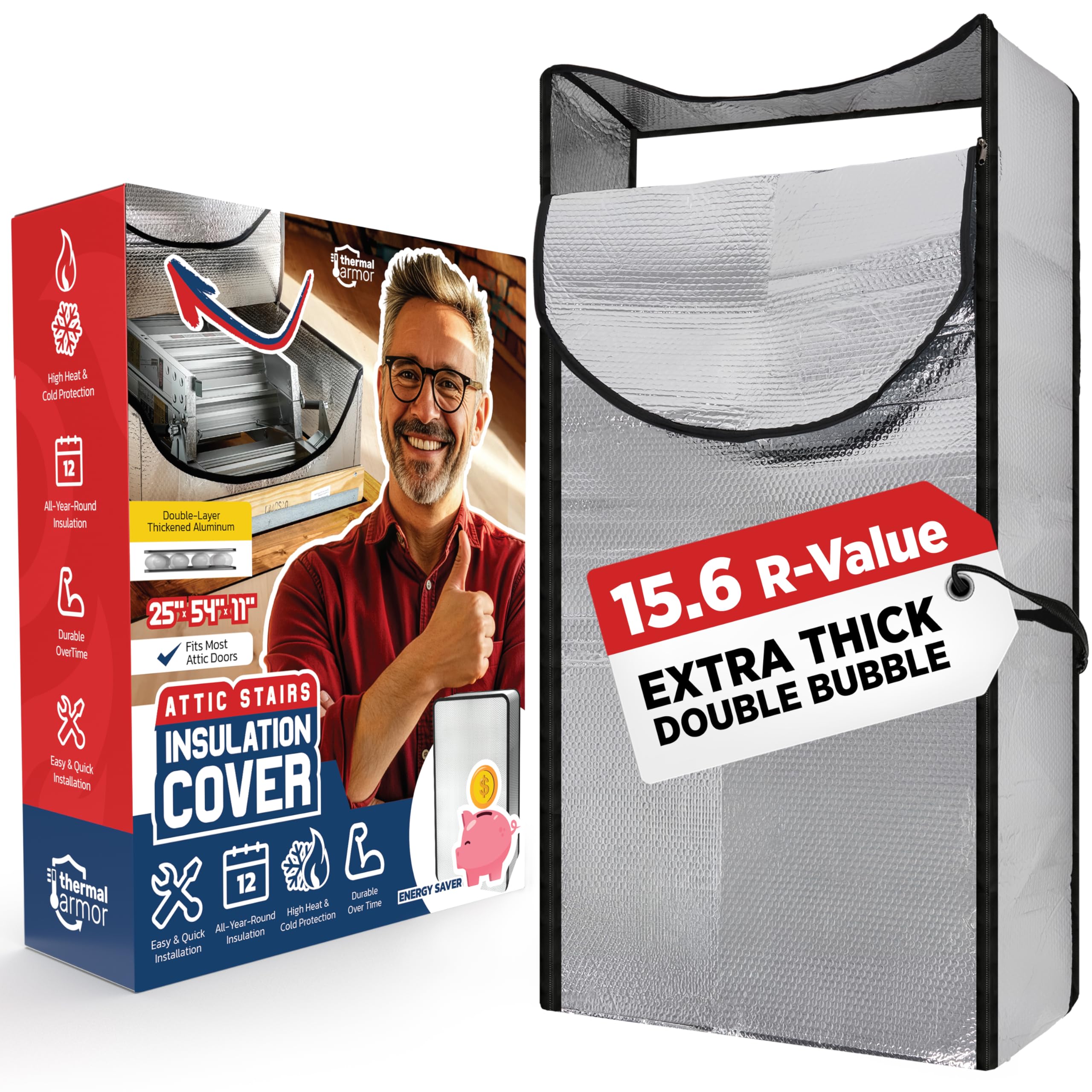
The Thermal Armor cover offers a compelling balance of performance and cost, using a double bubble reflective foil laminate that reflects up to 97% of radiant heat. It fits the standard 25 x 54 x 11-inch rough opening and includes a double zipper for easy access. The aluminum foil layers create a robust vapor barrier, which helps keep attic moisture and pollutants from migrating into living spaces — a feature that goes beyond simple temperature regulation.
Installation requires a staple gun, and users have noted that while the included stapler is serviceable, a quality heavy-duty staple gun produces a much cleaner seal. The cover has proven particularly effective in garage conversions and home gyms, with one reviewer reporting a 15°F drop in garage temperature during summer afternoons. The material is sturdy enough to handle the constant temperature swings of unconditioned attic spaces without degrading.
The primary concern mentioned by multiple users is that the zipper feels a bit flimsy compared to higher-priced competitors. While it works fine for occasional attic access, those who need to go up and down frequently might want to consider a cover with a more robust zipper assembly. The included instructions are basic, but the installation process is simple enough for most DIYers to complete in under 20 minutes.
Why it’s great
- Exceptional price-to-performance ratio.
- 97% radiant heat reflection helps in hot climates.
- Double zipper allows easy attic access.
Good to know
- Zipper feels less durable than premium alternatives.
- Included installation tool is not great; plan to use your own staple gun.
3. Insulation MarketPlace 30x60x11 Attic Door Insulation Cover

This cover from Insulation MarketPlace stands out because of its larger 30 x 60-inch footprint, making it one of the few options that accommodates non-standard attic openings without requiring modifications. The pure aluminum foil outer layers sandwich an extra thick double bubble core, achieving an R-15.4 rating — one of the highest in this comparison. It’s also notable for being explicitly billed as non-toxic and non-carcinogenic, which adds peace of mind for homeowners sensitive to off-gassing from building materials.
Installation is straightforward with a staple gun, and the cover comes in lightweight at just under two pounds. Because it’s a few inches larger than the standard 25×54 size, the manufacturer explicitly recommends folding the excess material neatly at the back of the opening before stapling, which creates a clean fit without bunching. One user reported saving on their gas bill in the first month alone, suggesting the higher R-value translates to real-world savings, especially in colder climates.
The main caveat is that the material is thinner than some bulkier foam-based covers — it relies on the reflective foil’s radiant barrier properties rather than thick padding. This makes it less effective at deadening sound transmission if that’s a concern. The zipper is adequate but not heavy-duty, and the cover works best for openings that are larger than average. Measure your rough opening carefully before ordering, as the 30×60 size is specifically designed for those wider or longer frames.
Why it’s great
- Only option for openings larger than 25×54 inches.
- R-15.4 is among the highest in this category.
- Lightweight at under 2 pounds despite large coverage area.
Good to know
- Thin material; less sound damping than foam-based covers.
- Requires careful folding at the back for a neat installation.
4. Miloo Attic Door Insulation Cover

The Miloo cover claims the highest R-value in this roundup at R-15.6, achieved through a 6mm thick double air-bubble inner lining combined with a reflective aluminum foil outer layer. The extra thickness is immediately noticeable when handling the cover — it feels substantial and well-constructed. The black fabric stapling border is a nice touch, providing a clear visual guide for where to staple and reducing the chance of tearing the foil during installation.
Customer feedback is overwhelmingly positive, with most users completing the install in under 10 minutes. The cover fits the standard 25 x 54 x 11-inch opening perfectly, and the zipper is positioned so that it doesn’t interfere with the folding stair arms. One reviewer with a particularly challenging moisture problem reported that the Miloo cover solved the issue after a professional insulation job had failed. The reflective film also creates a moisture barrier that helps prevent condensation from forming around the attic opening.
While the R-15.6 rating is impressive on paper, it’s worth noting that real-world performance depends heavily on how well the perimeter is sealed. Users recommend stapling every two inches and using aluminum foil tape on any exposed seams. The cover also works as a whole-house fan insulation cover, making it versatile if your home has multiple ceiling openings. The only minor downsides are the slightly higher price point compared to basic double bubble covers and the fact that the 6mm thickness can make the cover slightly less flexible when folding to fit.
Why it’s great
- Highest claimed R-value at R-15.6.
- 6mm bubble core provides substantial insulation thickness.
- Black fabric stapling border makes installation easy and clean.
Good to know
- Slightly more expensive than basic double bubble covers.
- Extra thickness reduces flexibility at fold points.
5. Remington Solar ThermoClimb Attic Door Insulation Cover

The ThermoClimb is a premium entry that uses a layered ceramic and neoprene construction instead of the standard double bubble foil. This material choice results in a denser, more rigid cover that doesn’t sag over time, and the 13-inch depth provides extra clearance for taller stair mechanisms or for those who want more headroom when climbing. The Velcro strap attachment system is a standout feature — instead of relying solely on staples, you can screw the included straps into the frame, allowing for easier removal and reattachment.
Build quality is the defining characteristic here. The zipper is noticeably heavier than what you find on mid-range covers, and it operates smoothly around the corners without binding. The ceramic layer adds a degree of fire resistance beyond what standard foil offers. Owners in extreme climates, particularly in Houston and other hot southern cities, have reported that the ThermoClimb effectively stopped the super-heated attic air from infiltrating the living space below, with one user noting it was worth the premium price over cheaper alternatives.
The trade-off is the higher cost and the R-3.8 rating, which is lower than the double bubble covers. However, because the ThermoClimb seals so tightly with its Velcro straps, the effective air leakage reduction may outperform higher R-value covers that leak air. Some users found the instruction sheet missing, but the installation is intuitive: staple or screw the perimeter to the frame, attach the straps, and seal the edges with foam tape or caulk for a finish that rivals professional installation.
Why it’s great
- Velcro strap system allows easy removal and reinstallation.
- Dense ceramic/neoprene material resists sagging better than foil.
- 13-inch depth provides extra clearance for tall stair mechanisms.
Good to know
- R-3.8 rating is lower than reflective foil covers.
- Higher price point; may not be necessary for occasional attic access.
6. Insulsure Attic Tent AT-2

The Insulsure Attic Tent AT-2 represents a fundamentally different approach to attic stair insulation. Instead of a flexible foil tent, it’s a rigid nylon enclosure that creates a dead air space above the stairs. The 7-inch height keeps the profile low, making it suitable for openings where there isn’t much clearance between the top of the folded stairs and the attic floor. The tent shape is designed to be freestanding, with a nylon base that staples directly to the attic floor sheathing around the opening.
Installation requires some careful planning, particularly with truss roofs where there may be framing members in the way. The staple flange is narrow, which some users found frustrating, leading them to use wood clamp bars instead for a more secure fit. Once installed, the results are impressive: one HVAC professional reported that after adding fiberglass batts on top of the tent, the attic opening was 100°F while the living space remained at 74°F. The cover also helps reduce the amount of dust and attic odors migrating into the home through the stair opening.
The AT-2 is built to last, with a durability that withstands years of occasional attic access. However, the 7-inch height may not be enough for some folding stair mechanisms — measure the height of your folded stairs before purchasing. The zipper is functional but not as smooth as some fabric covers, and the overall cost is significantly higher than foil tents. For homeowners who want a permanent, rigid solution that can be insulated further with loose-fill or batts, this is the right choice.
Why it’s great
- Rigid nylon construction creates a durable, permanent enclosure.
- Low 7-inch profile works in tight attic spaces.
- Can be topped with fiberglass batts for even higher insulation value.
Good to know
- More complex installation on truss roofs.
- Staple flange is narrow; some users prefer wood clamp bars.
7. Attic Tent AT-4 Cover/Insulator

The Attic Tent AT-4 is the larger sibling of the Insulsure AT-2, designed to fit the standard 25 x 54-inch rough opening but with a deeper 13-inch sidewall. This extra height accommodates most folding stair mechanisms comfortably, including those with 1×5 or 1×6 side rails. The material is a rigid nylon that feels far more substantial than foil tents, and the tent maintains its shape without sagging even after years of use. Professional contractors consistently name the Attic Tent brand as the best option when zipper durability and material feel are the top priorities.
Installation follows the same principle as the AT-2: staple the perimeter flange to the attic floor sheathing, seal the edges with caulk or spray foam, and you have an airtight enclosure. One professional contractor measured a 10°F temperature difference after installation, confirming the tent’s effectiveness. The tent is particularly good at stopping drafts in the hallway below, with one user noting that the improvement was immediate and eliminated the cold draft that had been present since they moved in.
The main drawback is the cost — the AT-4 is among the most expensive options on this list. Some users questioned whether the premium was justified, noting that the zippers, while better than budget models, still felt stiff at the corners. The lack of included hardware for sealing (foam tape or caulk) means you’ll need to purchase those separately. For homeowners who want a professional-grade solution that will last as long as the house, and who are willing to invest in the extra sealing materials, this is a top-tier choice that delivers consistent results.
Why it’s great
- Superior build quality preferred by professional contractors.
- 13-inch depth fits most standard folding stair mechanisms.
- Rigid material doesn’t sag or degrade over time.
Good to know
- Premium price point; not a budget-friendly option.
- Sealing tape or foam not included; requires separate purchase.
FAQ
How do I measure my attic opening for an insulation cover?
Can I install an attic stair cover myself without professional help?
Will an attic stair cover pay for itself in energy savings?
What’s the difference between a reflective foil cover and a nylon tent cover?
Can I add extra insulation on top of the cover?
Final Thoughts: The Verdict
For most users, the best attic stair insulation cover is the Energy Wise Premium because it delivers a high R-14.5 rating, excellent radiant heat reflection, and proven draft elimination at a price that pays for itself quickly. If you need to cover a non-standard opening larger than 25×54 inches, grab the Insulation MarketPlace 30×60. And for a permanent, contractor-grade solution that will outlast the house, nothing beats the Attic Tent AT-4, despite its higher upfront cost.