
Our readers keep the lights on and the weekend projects moving. As an Amazon Associate, I earn from qualifying purchases.
Indoor air can be two to five times more polluted than outdoor air, yet we spend most of our time inside. A dedicated monitor is the only way to stop guessing what’s floating around your bedroom, home office, or nursery.
I’m Rikta — the founder and writer behind FitlyFast. I’ve spent years analyzing sensor hardware, reading testing protocols, and cross-referencing real user data to separate monitors that actually track PM2.5, CO2, and TVOC from those that just blink colored lights.
This guide breaks down the seven most capable models on the market so you can choose the right air quality monitor for home without wasting time on overhyped features you don’t need.
How To Choose The Best Air Quality Monitor For Home
Not every monitor measures the same pollutants, and the cheapest models often skip the sensors that matter most. You need to match the sensor suite to your specific concern: CO2 for brain fog and sleep quality, PM2.5 for allergy and asthma triggers, or TVOC for chemical off-gassing from new furniture.
CO2 Sensor Type Matters More Than You Think
A Non-Dispersive Infrared (NDIR) CO2 sensor is the gold standard. Photoacoustic NDIR sensors, like the SCD4x chip found in some models, offer faster response and built-in pressure compensation. Avoid monitors that use chemical or “eCO2” estimation — they drift over time and can’t reliably detect the 1000 ppm threshold where cognitive performance drops.
Particle Counting vs. Light Scattering
True laser particle counters shine a laser through an air sample and count individual particles by size class (PM1.0, PM2.5, PM10). Cheaper modules use a simple light-scattering photodiode that estimates mass without sizing accuracy. For allergy and smoke detection, a certified laser counter that logs data is worth the extra spend.
Chemical Sensor Limitations
TVOC (Total Volatile Organic Compounds) and HCHO (formaldehyde) sensors in consumer monitors are semi-quantitative. They detect relative changes well — like the spike from a fresh coat of paint — but absolute ppm readings should be taken with a grain of salt. Calibration drift is common, and ethanol in cleaning sprays can produce false positives.
Quick Comparison
On smaller screens, swipe sideways to see the full table.
| Model | Category | Best For | Key Spec | Amazon |
|---|---|---|---|---|
| IQAir AirVisual Pro | Premium | Professional-grade PM2.5 & CO2 tracking | Swiss laser PM sensor + NDIR CO2 | Amazon |
| BREATHE Airmonitor Plus | Premium | Compact multi-sensor for desks & nurseries | Five-parameter sensing + app history | Amazon |
| Temtop LKC-1000S+ | Mid-Range | Data export for long-term trend analysis | 20,000-hour laser particle sensor | Amazon |
| KDWKD 16-in-1 | Mid-Range | Wide pollutant coverage on a budget | 9-parameter detection + 7 AQI alerts | Amazon |
| YNAK 16-in-1 Extended Battery | Mid-Range | All-day portable monitoring | 3500mAh battery, 12-hour run time | Amazon |
| GoveeLife H5140 | Value | Smart home integration & CO2 tracking | Photoacoustic NDIR CO2 + 2-yr data log | Amazon |
| KDWKD AK23CA | Budget | Entry-level multi-parameter awareness | 9-hour rechargeable + PM0.3 counter | Amazon |
In‑Depth Reviews
1. IQAir AirVisual Pro

IQAir’s AirVisual Pro uses a Swiss-designed high-precision laser sensor for PM2.5 paired with a dedicated NDIR CO2 sensor — the same sensor class found in commercial building management systems. It provides real-time and historical AQI data for both particles and CO2, with a forecast engine that uses outdoor station data to predict indoor changes.
The display is clean and readable from across a room, showing AQI, PM2.5, CO2, temperature, and humidity on one screen. Recalibration of the CO2 sensor after shipping is recommended (a brief outdoor exposure resets baseline), and users report consistent 300–400 ppm outdoor readings post-calibration. The unit also integrates with IFTTT for smart home automations based on air quality thresholds.
One shortcoming: the AQI calculation relies only on PM2.5, ignoring PM10 contributions, which can understate risk in environments with coarse dust. The unit also skips PM1, TVOC, and formaldehyde, so it’s not a full-spectrum monitor. A few units have experienced PM2.5 sensor lock at zero, and support responsiveness after the warranty period is mixed.
Why it’s great
- Professional-grade laser PM2.5 detection with proven accuracy
- NDIR CO2 sensor with reliable outdoor recalibration baseline
- Historic data, forecasting, and IFTTT integration for smart homes
Good to know
- No TVOC, HCHO, or PM1.0 sensor included
- AQI calculation excludes PM10 data
- Reported PM2.5 lock issues on a minority of units
2. BREATHE Airmonitor Plus
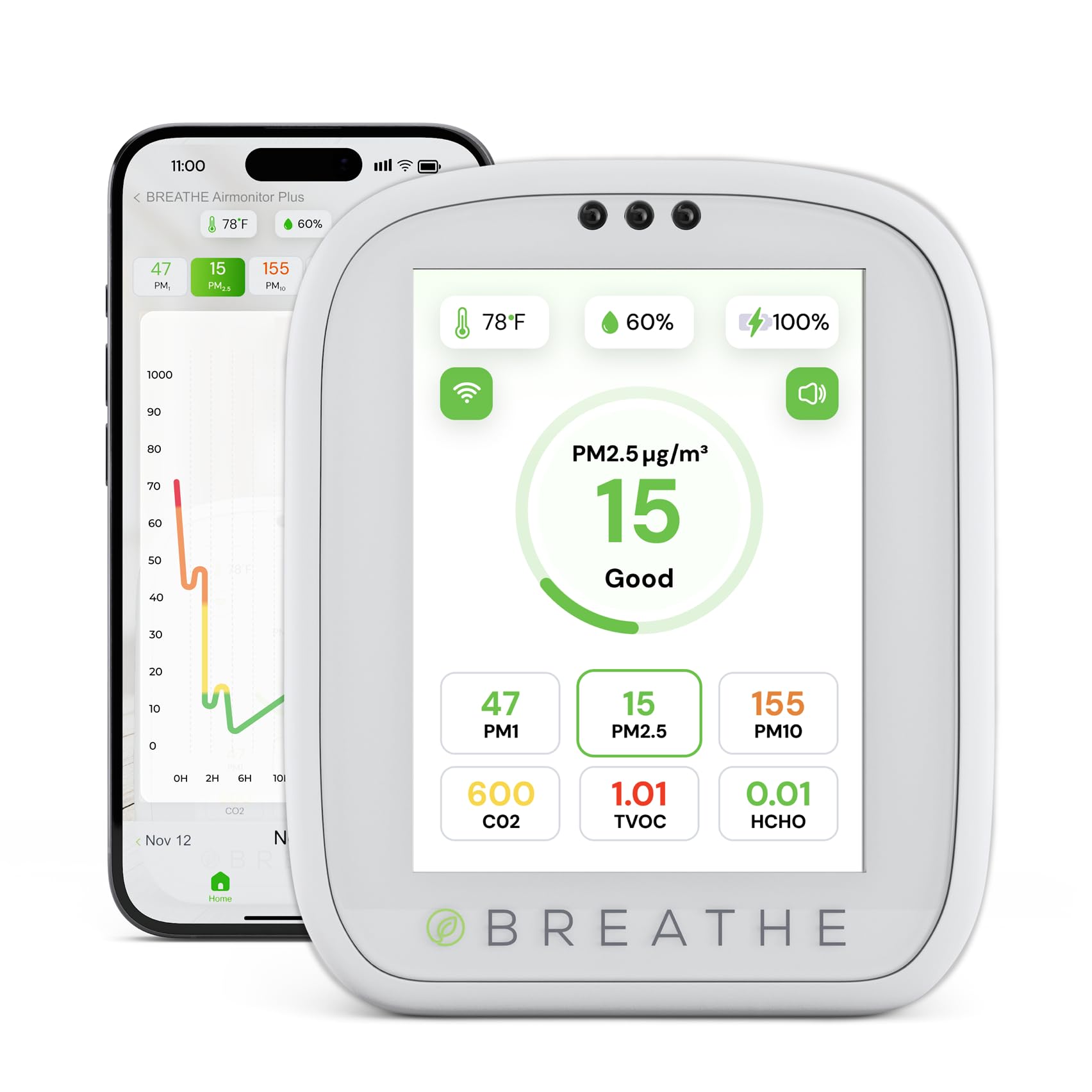
The BREATHE Airmonitor Plus packs CO2, PM1, PM2.5, PM10, TVOC, HCHO, temperature, and humidity into a slim 4-ounce enclosure that sits unobtrusively on a nightstand or desk. Its five-parameter sensor suite — particle, CO2, TVOC, HCHO, and environment — provides a genuinely complete picture without needing a second device.
Setup is fast via the Breathe Tech app, which logs 30 days of data and sends push alerts when thresholds are breached. Real-world tests show CO2 readings responding within seconds to ventilation changes: users report peaks above 4,000 ppm in closed bedrooms that drop to 405 ppm after opening a window. Particulate spikes from cooking smoke and outdoor infiltration are clearly visible.
The main friction point is a finicky WiFi pairing process that occasionally requires draining the battery and holding the power button for ten seconds. The screen is bright and lacks a true night mode — the proximity sensor merely dims rather than turns off the display. Some users find the automatic baseline recalibration algorithm can produce falsely low CO2 readings in persistently high-CO2 homes without daily manual calibration.
Why it’s great
- Measures CO2, PM1/2.5/10, TVOC, and HCHO in one device
- Fast 30-second response to air quality changes
- Compact footprint fits any room without visual clutter
Good to know
- WiFi pairing can be difficult on first setup
- Screen stays too bright for pitch-dark bedrooms
- ABC recalibration can drift in chronically high CO2 environments
3. Temtop LKC-1000S+
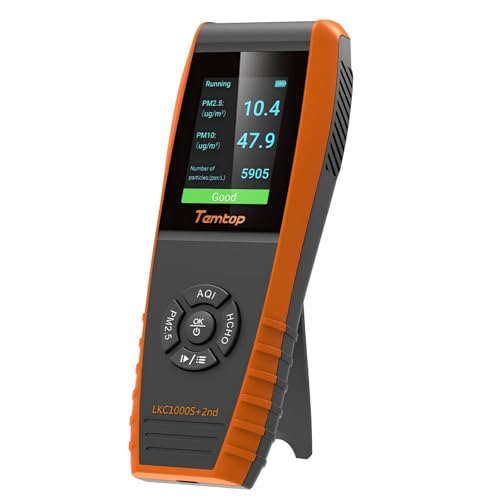
Temtop’s LKC-1000S+ (2nd generation) is built around a laser particle sensor rated for 20,000 hours of continuous operation — roughly eight years of 24/7 monitoring. It tracks PM2.5, PM10, formaldehyde (HCHO), TVOC, temperature, humidity, and calculates an AQI, with a dedicated histogram view for the last 12 hours of PM2.5 changes.
Data export to Excel via USB is a standout feature for anyone tracking air quality trends across seasons or post-renovation. The Dart electrochemical HCHO sensor is pre-calibrated and performs reliably within civilian-grade expectations, though it will flag false positives around alcohol vapors, air fresheners, and cleaning solvents. Users with chemical sensitivities find the consistent readings valuable for identifying problem rooms.
The interface is simple and button-driven, but the display is small by modern standards and lacks the vibrant color coding of newer 7-inch models. Battery life is adequate for room-to-room portability, but some users wish for longer runtime. A minority of units have been reported to miss moderate mold and chemical odors, suggesting the TVOC sensor may not capture every volatile compound family equally.
Why it’s great
- Long-life laser particle sensor with 20,000-hour rating
- Excel data export for trend analysis and record-keeping
- Pre-calibrated Dart electrochemical HCHO sensor
Good to know
- Small display without large color-coded readouts
- HCHO sensor can false-positive around alcohol/cleaners
- Battery life is adequate but not class-leading
4. KDWKD 16-in-1 Air Quality Monitor
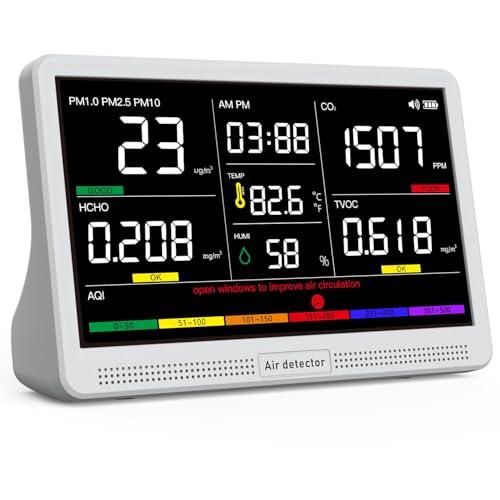
The KDWKD 16-in-1 offers the largest display in this roundup — a 7-inch LED screen that shows CO2, PM2.5, PM1.0, PM10, HCHO, TVOC, temperature, humidity, AQI, and time in a single glance. Nine detection parameters plus seven distinct AQI alert buzzers make it easy to identify which pollutant is causing a warning without menu diving.
External high-precision sensors sample air directly, claiming 0.001-unit accuracy for HCHO and TVOC. Real-world tests show a 20-to-30-second reaction time to laser cutter fumes or opening a window. The color-coded AQI display shifts from green to purple across a 150-to-500 range, with a simple horizontal line and smiley face that even non-technical family members understand instantly.
It runs on a 2500mAh battery for eight hours of cordless use, which is fine for intermittent checks but limits true whole-day portability. WiFi connectivity and display-mirroring features are referenced in marketing but aren’t clearly documented in the manual. Some users report that readings remain stubbornly green even when strong chemical cleaners are used nearby, raising questions about absolute accuracy in the TVOC channel.
Why it’s great
- Massive 7-inch LED display readable from across the room
- Detects nine parameters with seven distinct alert tones
- Fast 20–30 second response to air quality changes
Good to know
- WiFi features not fully documented in user manual
- TVOC sensitivity may miss some chemical spikes
- Battery life limited to eight hours on a charge
5. YNAK 16-in-1 Extended Battery Monitor
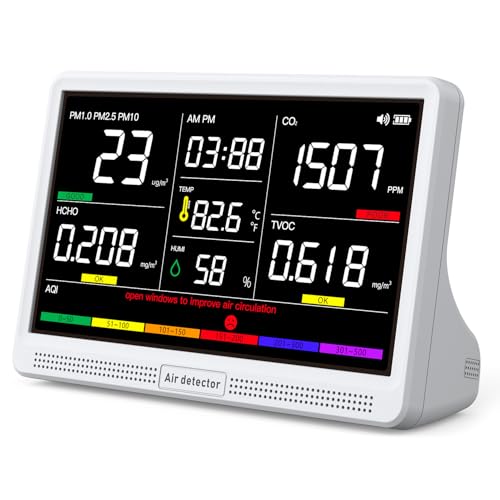
The YNAK 16-in-1 is essentially the same 9-parameter, 7-alert platform as the KDWKD monitor above, but with an upgraded 3500mAh battery that extends cordless operation to 12 hours. This makes it a genuinely portable option for moving from bedroom to living room to workshop without hunting for an outlet.
It shares the same 7-inch LED display and external high-precision sensor array for CO2, PM2.5, PM1.0, PM10, HCHO, TVOC, temperature, humidity, AQI, and time. The color-coded AQI bar and alert buzzers function identically, and response time to vape smoke or UV printer fumes clocks in at three to seven seconds for the PM and TVOC channels respectively.
Like its sibling, the WiFi connectivity for data logging or remote viewing is not clearly documented, and the TVOC sensor may not register all chemical exposures accurately. The larger battery adds about 0.04 pounds, which is negligible in hand. The display brightness adjustability works well, but the screen stays on constantly — there is no motion-activated sleep mode to save power during overnight use in a bedroom.
Why it’s great
- 12-hour battery life enables full-day cordless monitoring
- Large 7-inch color display with fast pollutant response
- Covers nine parameters with seven distinct alert types
Good to know
- No motion-activated screen-off for overnight use
- WiFi features lack clear manual documentation
- TVOC accuracy may not catch all VOC families
6. GoveeLife Smart Air Quality Monitor H5140
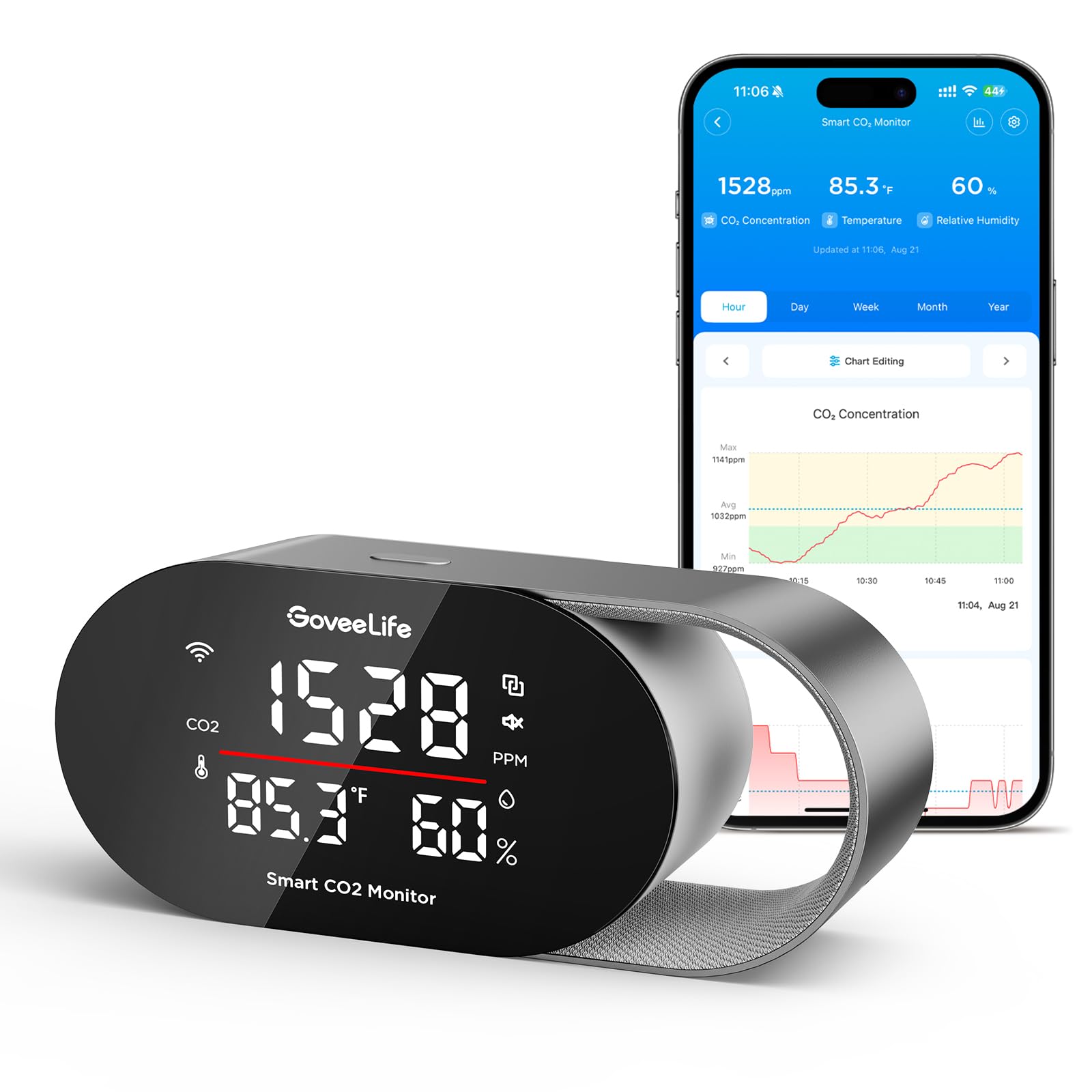
The GoveeLife H5140 uses a Sensirion SCD4x photoacoustic NDIR CO2 sensor — the same chip found in many high-end commercial monitors — delivering ±(40 ppm + 5%) accuracy with a 5-second refresh rate and built-in pressure compensation. It tracks CO2, temperature, and humidity, plus calculates dew point and VPD, making it a favorite for controlled environment growers and biohackers alike.
Where it stands out is smart home integration: CO2 data can be queried by voice via Alexa and Google Assistant, and the monitor can trigger humidifiers or tower fans through the GoveeLife ecosystem. A triple alert system (buzzer, app notification, email) ensures no CO2 spike goes unnoticed, and the programmable LED display with a day/night brightness schedule prevents sleep disruption.
Two years of historical data is logged in the app with CSV export for deeper analysis. The unit is AC-powered, so battery concerns disappear, but it also means placement is limited to outlet range. The obvious gap is the lack of any PM (particulate) sensor — this is a CO2-focused device, not a full air quality monitor for dust, smoke, or VOCs.
Why it’s great
- Premium SCD4x photoacoustic NDIR CO2 sensor with high accuracy
- Deep smart home integration with Alexa, Google, and Govee ecosystem
- Two-year data log with CSV export for trend analysis
Good to know
- No PM2.5, TVOC, or HCHO sensor included
- AC-powered only — placement limited by outlet proximity
- App calibration recommended outdoors for best baseline
7. KDWKD AK23CA Air Quality Monitor
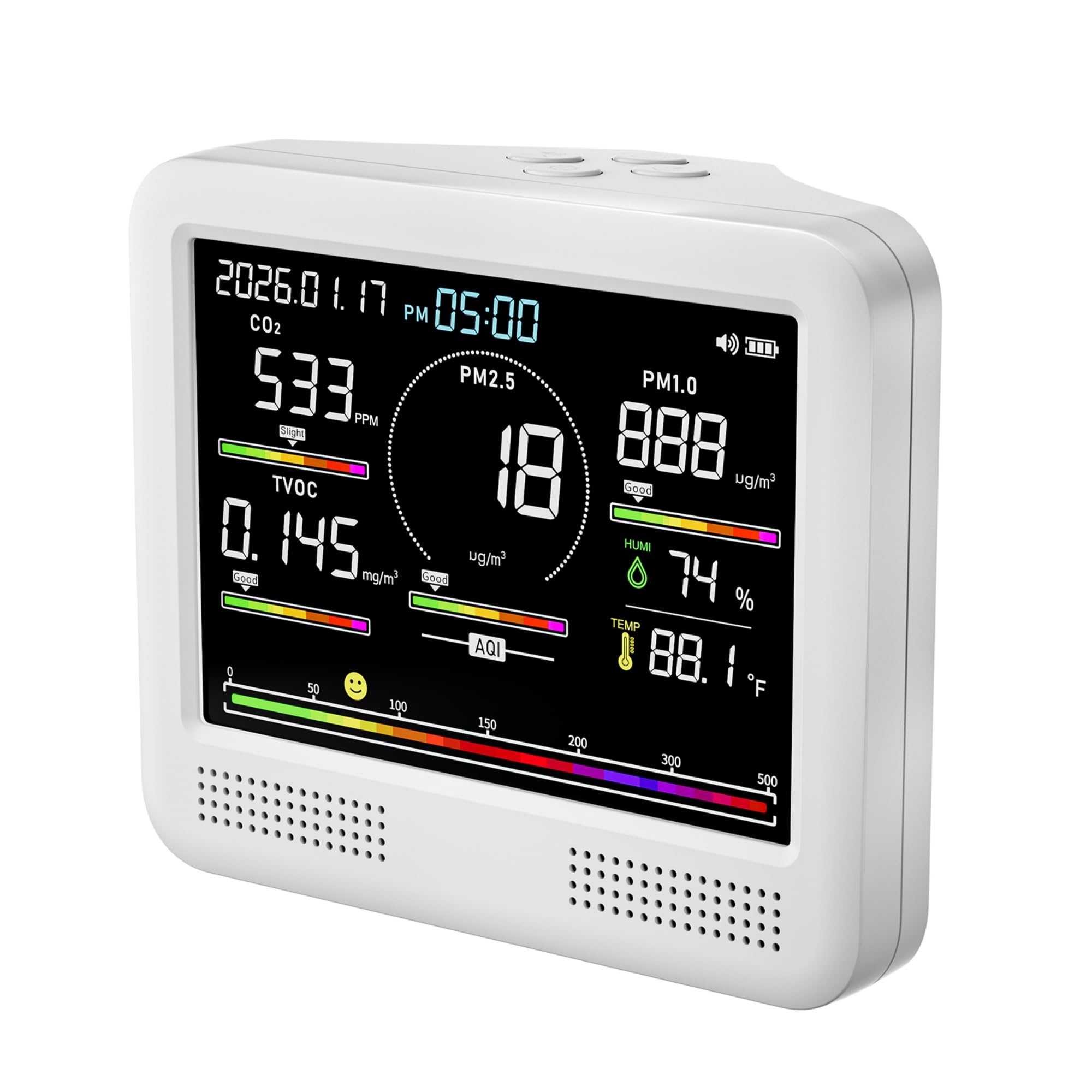
The KDWKD AK23CA covers PM0.3, PM0.5, PM1.0, PM5.0, PM10, CO2, HCHO, TVOC, temperature, and humidity on a rechargeable battery rated for nine hours. Its 7-level AQI display uses color coding and optional audible index alerts to flag unhealthy conditions without requiring you to stare at numbers constantly.
It’s designed for everyday awareness in bedrooms, baby rooms, and apartments, and the compact ABS body makes it easy to move between rooms. The large color screen shows AQI level, temperature, humidity, and battery status at a glance. Users report that it detects cooking smoke, wildfire smoke infiltration, and paint fumes within seconds, helping them ventilate proactively.
Customer reviews for this product listing are mixed, with several reviews apparently mismatched to cable railing and fencing products — a strong signal that the listing may have been repurposed. This raises concerns about quality control and long-term support. The sensor sensitivity to strong chemical odors is inconsistent, with some tests showing the unit staying green even around concentrated cleaning agents, which limits trust in its TVOC and HCHO readings.
Why it’s great
- Counts particles as small as PM0.3 for ultra-fine awareness
- Nine-hour battery for room-to-room portability
- Clear 7-level AQI color display with audible alerts
Good to know
- Listing history raises quality control and support questions
- TVOC/HCHO sensitivity inconsistent in real-world tests
- Some strong chemicals not flagged by the monitor
FAQ
What CO2 level should trigger me to ventilate?
Can a consumer monitor detect mold before I see it?
Do I need a separate monitor for formaldehyde?
Final Thoughts: The Verdict
For most users, the air quality monitor for home winner is the IQAir AirVisual Pro because its Swiss laser PM2.5 sensor and NDIR CO2 sensor deliver accuracy that matches commercial-grade references, backed by a clean interface and outdoor data integration. If you want a compact unit that also tracks TVOC and HCHO without sacrificing portability, grab the BREATHE Airmonitor Plus. And for whole-home smart automation with deep CO2 analytics on a budget, nothing beats the GoveeLife H5140.