
Our readers keep the lights on and the weekend projects moving. As an Amazon Associate, I earn from qualifying purchases.
Living in a rural area means trading city noise for open space, but it also often means trading reliable TV reception for a pixelated, frustrating guessing game. The right antenna cuts through the miles of interference from trees, hills, and long distances to pull in crystal-clear broadcast signals without a monthly bill.
I’m Rikta — the founder and writer behind FitlyFast. I’ve spent years analyzing signal propagation, antenna gain patterns, and installation variables to separate marketing claims from real-world reception performance for fringe and deep-rural setups.
After comparing range, build quality, and multi-band reception across the leading models, this guide pinpoints the most reliable options to help you find the best antenna for rural areas and finally get the channels you’re paying nothing for.
How To Choose The Best Antenna For Rural Areas
Picking the right antenna for a rural setup is different from grabbing any suburban model. You have to account for distance to towers, physical obstructions, and the type of broadcast signals in your area. Here are the factors that actually separate a reliable fringe performer from a frustrating dud.
Range vs. Real-World Reception
Manufacturer range claims are optimistic — 100 or 200 miles usually means ideal, unobstructed, flat-terrain conditions. In rural reality, trees, hills, and even your roof material cut that usable distance by half or more. Focus on antennas with proven gain specs (measured in dBi) and a reputation for weak-signal performance from real users at 50+ miles.
UHF vs. VHF — You Need Both
Most broadcast channels are UHF (channels 14-36), but critical VHF channels (2-13) still exist and often carry major networks. Many budget antennas skimp on VHF reception, leaving you with a blank screen on channel 4 or 8. A quality rural antenna must have dedicated, long elements for both UHF and high-VHF bands. Check the product specs for real frequency coverage, not just a generic sticker.
The Preamp Factor
A built-in or external preamplifier is essential for fringe reception. It boosts the weak signal before it travels down the coax cable to your TV, compensating for long cable runs and splitter losses. However, too much gain in a strong-signal area causes overload. The best rural antennas have intelligent gain control or at least an amplifier that can be powered on or off to match your specific situation.
Directional vs. Multi-Directional
For deep rural areas, a highly directional antenna is the standard. Its focused beam rejects interference from the sides and rear, pulling in a weak signal from a specific tower cluster. If your local towers are spread in different directions, a motorized rotator (like the CeKay model offers) or a less directional design becomes necessary, but you will trade some gain for that flexibility.
Quick Comparison
On smaller screens, swipe sideways to see the full table.
| Model | Category | Best For | Key Spec | Amazon |
|---|---|---|---|---|
| Televes DAT BOSS Mix LR 149884 | Premium | Maximum fringe range | 46 dBi UHF gain | Amazon |
| Televes Ellipse Mix 148883 | Premium | Intelligent signal management | 40 dBi UHF gain | Amazon |
| Antennas Direct Element | Mid-Range | Low-VHF reception | 44.5″L x 35.5″W | Amazon |
| CeKay Motorized Outdoor | Mid-Range | Towers in multiple directions | 360° motorized rotation | Amazon |
| Five Star Outdoor | Mid-Range | Multi-TV distribution | Supports 4 TVs | Amazon |
| PIBIDI UHD-8903 | Budget-Friendly | Simple fixed-direction install | 200-mile claim | Amazon |
| GE Outdoor Yagi 33685 | Budget-Friendly | Reliable brand, short-medium range | 80-mile claim | Amazon |
In‑Depth Reviews
1. Televes DAT BOSS Mix LR 149884
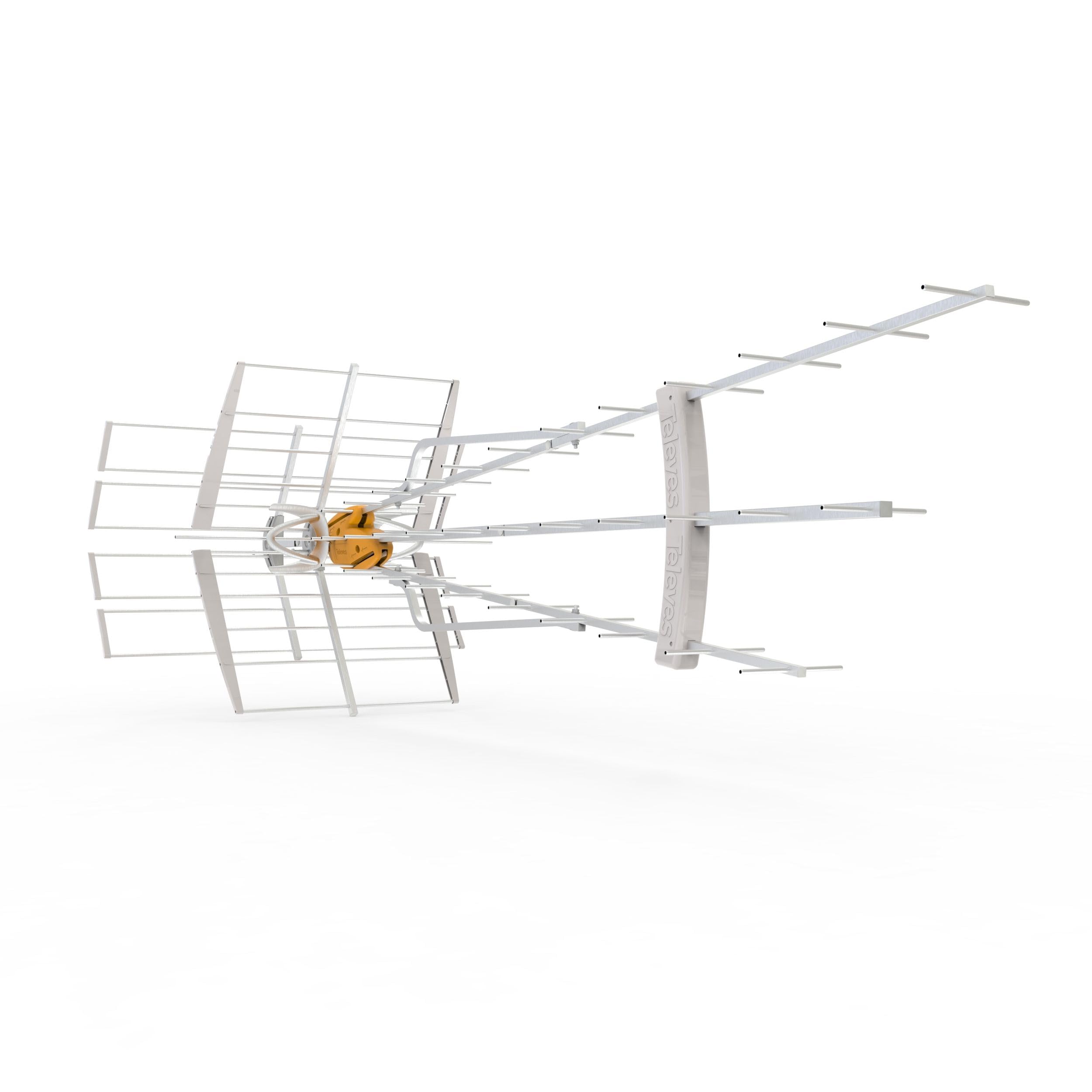
The Televes DAT BOSS Mix LR is the most serious piece of hardware in this lineup, engineered specifically for the hardest fringe reception scenarios. Its stacked triple-boom design with 12 directors delivers a front-to-back ratio of 25 dB on UHF, meaning it almost entirely ignores interference from the rear while focusing on a weak signal 70 or more miles away. The built-in TForce preamplifier uses BOSS-Tech to independently adjust gain per band — 38 dBi on high-VHF and 46 dBi on UHF — so you do not overload a strong nearby station while pulling in a distant one.
Real-world users in rural Wisconsin and the extreme fringe of Seattle report gaining 16 to 37 usable channels where previous antennas failed entirely, especially on high-UHF frequencies. The integrated FM and LTE/4G/5G filtering is a critical feature for rural areas where a nearby cell tower can swamp an unshielded antenna. At 84 inches long and 10 pounds, this is a large, permanent installation, but the all-metal construction with stainless steel hardware is built to withstand decades of weather.
The dual-operation mode — amplified when powered, passive when not — offers flexibility for splitting the signal across multiple TVs or a Tablo. Users consistently note the tool-free assembly is straightforward, though the sheer size requires a sturdy mast and at least one helper for roof mounting. If you live in a deep-fringe area where every dB of gain matters, this is the one.
Why it’s great
- Industry-leading 46 dBi UHF gain for truly distant towers.
- Intelligent per-band gain control prevents overload.
- Excellent front-to-back ratio minimizes multipath interference.
- Built-in LTE/5G filtering is essential for rural cell tower proximity.
Good to know
- Large and heavy — needs a solid mast and good planning.
- Premium-tier investment, but justified for fringe performance.
2. Televes Ellipse Mix 148883
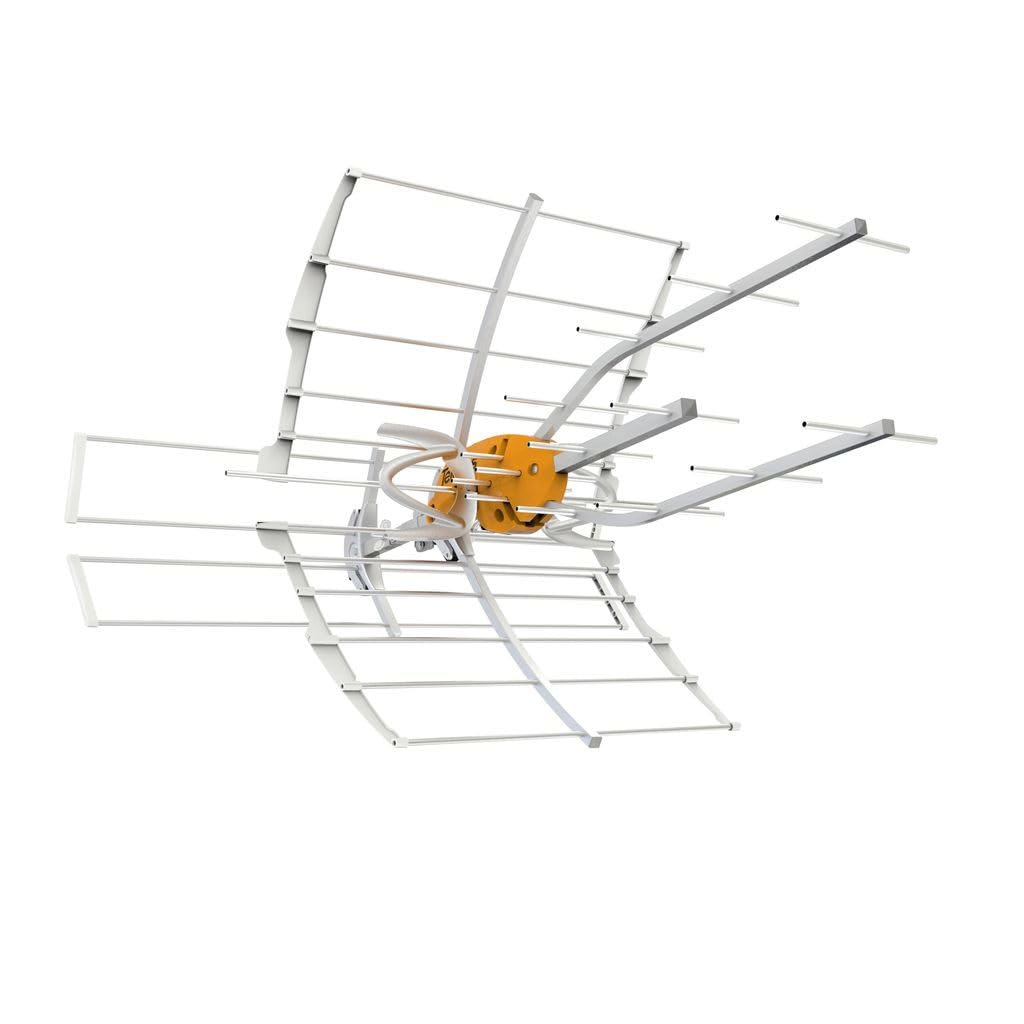
The Televes Ellipse Mix is the slightly smaller, slightly less expensive sibling of the DAT BOSS, but it shares the same core intelligence: BOSS-Tech automatic gain control. This means it dynamically adjusts amplification per band (36.5 dBi high-VHF, 40 dBi UHF) to deliver a stable output regardless of signal fluctuations, a feature that saves you from manually tweaking a separate preamp. Its triple-boom design with curved reflectors gives it a narrower, more focused beam than a standard Yagi, which is a major advantage in areas where broadcast towers are clustered in one direction.
Users in Central Florida and the suburbs of Chicago consistently report 90 to 113 channels with rock-solid signal strength, even when splitting the feed to multiple TVs and an HDHomeRun. The integrated FM and LTE/4G/5G filtering is identical to the DAT BOSS, making it equally effective at rejecting interference from nearby cell infrastructure.
The 75-mile range claim is realistic for most fringe scenarios, and several users have confirmed reliable reception at 70 miles with the amplifier active. The dual-output power inserter is a nice touch for installations that need to feed a separate preamp. If you need Televes-level filtering and intelligent gain control but do not require the absolute maximum range of the DAT BOSS, the Ellipse Mix is a superb choice.
Why it’s great
- Automatic per-band gain control prevents overload.
- Excellent LTE/5G filtering for rural cell tower areas.
- Compact and tool-free assembly for quick install.
- Reliable at 70+ miles in real-world fringe setups.
Good to know
- Lower maximum gain than the DAT BOSS LR model.
- Highly directional — not ideal for towers in opposite directions.
3. Antennas Direct Element

The Antennas Direct Element stands out for its exceptional performance on low-VHF channels (channels 2-6), a band that many modern antennas ignore or handle poorly. Its uni-directional design is a step ahead of conventional Yagi antennas, with precise, focused reception that gives it a surprising ability to pull in weak signals at 60 to 80 miles without a separate amplifier — several users report perfect reception at 42 miles and 70 miles with no preamp needed. This makes it an excellent choice for attic installations where adding a powered amplifier can introduce noise.
Measuring 44.5 inches long and 35.5 inches wide, it is a mid-sized antenna that fits on a standard mast without looking like a satellite dish. The all-aluminum construction with all-weather mounting hardware is built to last, and the included J-mount makes roof or eave installation straightforward. Users in hilly, heavy-foliage areas report that the Element solved UHF reception issues that caused pixelation during wind and rain, a common frustration for rural viewers.
The Element is NEXTGEN TV, 4K, and 8K UHD compatible, future-proofing your setup for ATSC 3.0 broadcasts. The only real caveat is its 60+ mile range estimate — it is not designed for extreme fringe scenarios beyond 80 miles, and its fixed-directional nature means it cannot adapt to towers spread widely apart. For the majority of rural homes within a 70-mile radius of a single tower cluster, this is a fantastic, no-fuss performer.
Why it’s great
- Exceptional low-VHF reception for channels 2-6.
- Works without a preamp in many 40-70 mile scenarios.
- All-metal build with weather-resistant hardware.
- Compact enough for attic or soffit mounting.
Good to know
- Real-world range tops out around 80 miles.
- Fixed directional — not suitable for multi-tower directions.
4. CeKay Motorized Outdoor HD TV Antenna
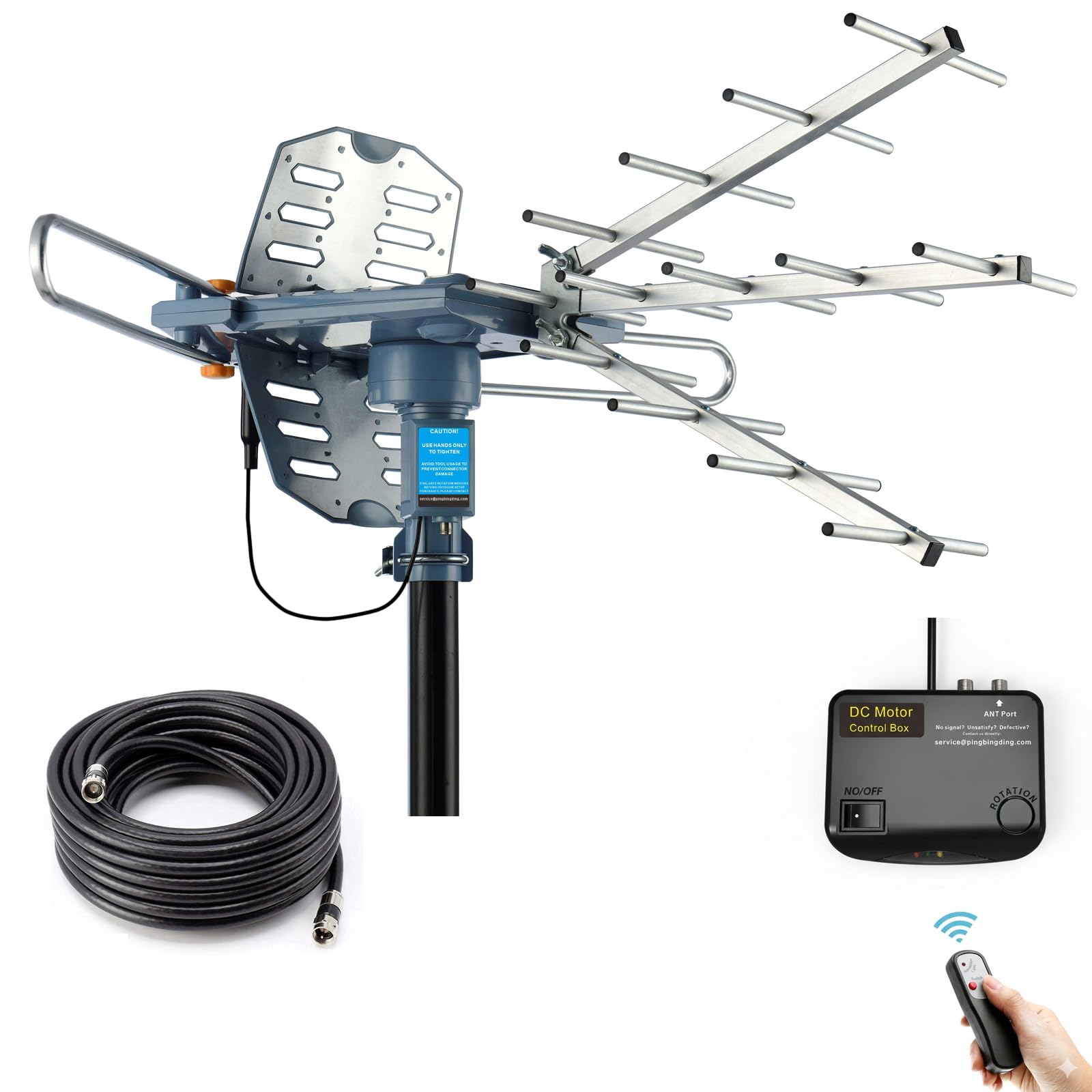
The CeKay Motorized Antenna solves a specific rural problem: what if your broadcast towers are in completely different directions? Its upgraded DC motor allows smooth 360° rotation via a wireless remote, so you can aim at one cluster for local news and rotate to another for network programming without climbing on the roof. This is a game-changer for properties where a single fixed-direction antenna would miss half the available channels.
The 150-mile range claim is aggressive, but real-world users 50 miles from the towers report picking up 70 to 79 channels with no pixelation, including signals that have to cut through significant tree cover. The built-in high-gain, low-noise amplifier improves reception quality, and the 40-foot RG6 coaxial cable is generous for attic or eave installations. The design prevents coax cable tangling during rotation — a common failure point on cheaper motorized units — and the control box is small enough to mount near your distribution panel.
Assembly is genuinely easy, taking about five minutes, and the antenna accepts a wider range of pole sizes than some competitors. A few users note that the remote is a simple one-button affair (left or right) and that fine-tuning the direction can take an hour as you check each channel. If you rely on signals from widely separated towers, this is the only mid-range option that gives you aiming flexibility without buying a separate rotator.
Why it’s great
- Motorized 360° rotation for multi-direction tower setups.
- No coax tangling during rotation — robust DC motor design.
- Included 40-foot RG6 and amplifier for flexible installation.
- Easy 5-minute assembly with wide pole compatibility.
Good to know
- 150-mile range is optimistic — expect reliable performance to around 60-70 miles.
- Remote is basic (left/right only), requiring manual fine-tuning.
5. Five Star Outdoor HDTV Antenna

The Five Star Outdoor Antenna is built for the rural household that wants to distribute a single antenna’s signal to multiple TVs without buying extra distribution gear. It comes with a built-in splitter and J-pole mount, supporting up to four TVs from one antenna. The 200-mile range claim, like others, is best-case, but users 45 miles from Houston towers report picking up 128 channels, and a setup at 7,300 feet elevation pulled in 90 channels with 72 in crystal-clear quality.
The extended element design is larger than many competitors (46 inches long), giving it better raw capture area for weak UHF signals. The included 40-foot coax cable is a welcome addition, and the J-mount allows for flexible installation on a roof, chimney, eave, or mast. Several users note that the instructions are sparse about VHF element alignment — you need to ensure screw heads face the same direction for optimal VHF reception — but assembly is otherwise straightforward.
For rural setups where towers are clustered in one direction, the Five Star is a solid performer at a reasonable investment. It is ATSC 3.0 ready and supports 4K and 1080p, so it will not be obsolete when your local stations upgrade. The main trade-off is the fixed-directional design — if your towers are spread out, you will need a rotator or a different approach. For a single-direction, multi-TV installation, this is hard to beat at this tier.
Why it’s great
- Supports up to 4 TVs with included splitter.
- Large elements provide strong UHF capture area.
- ATSC 3.0 ready for future broadcast upgrades.
- Includes J-mount and 40-foot coax cable.
Good to know
- Instructions are sparse — especially for VHF alignment.
- Fixed directional — not for towers in multiple directions.
6. PIBIDI Outdoor TV Antenna UHD-8903

The PIBIDI UHD-8903 is a straightforward, no-frills directional antenna that delivers surprisingly good results for its modest price point. Users report pulling in 64 to 86 channels after careful aiming, outperforming previous antennas that could only manage 15 to 50 channels in the same location. The extended receiving elements are longer than many competitors, which helps with raw signal capture, especially for UHF frequencies.
Assembly is tool-free and takes just a few minutes, with most elements arriving pre-assembled. The weather-resistant design with lightning protection is adequate for outdoor mounting, and the antenna pairs well with existing satellite dish coax and boosters. Several users have successfully run 100+ feet of cable from the roof to the TV without signal degradation, a testament to the antenna’s solid passive gain.
The biggest limitation is the lack of a built-in rotator — aiming is a one-time, hands-on task on the roof. If your towers are in a single direction, this is not an issue, but if you need to switch between tower clusters, you will need an external rotator. For a budget-conscious rural setup where you can climb up once and aim carefully, the PIBIDI is a capable performer that punches above its price class.
Why it’s great
- Excellent channel count for the price (64-86 channels reported).
- Tool-free assembly with pre-assembled elements.
- Works well with 100+ foot cable runs.
- Weather-resistant with lightning protection.
Good to know
- No built-in rotator — requires manual outdoor aiming.
- 200-mile range claim is optimistic; reliable at 50-70 miles.
7. GE Outdoor HD Digital TV Antenna 33685

The GE 33685 is a classic Yagi-style outdoor antenna from America’s top-selling antenna brand, and it is a reliable workhorse for rural installations where towers are within 30 to 50 miles. Its 80-mile range claim is realistic for an unamplified antenna — users 35 miles from transmitters report solid, non-pixelated reception even through a concrete tile roof when installed in the attic. The Yagi design is inherently directional, which helps reject interference from the sides.
Assembly requires some effort — the antenna comes in pieces that you must bolt together — but the process is straightforward and the result is a rugged, weather-resistant structure. The included J-mount makes installation on a wall, roof, or existing mast simple. Several users have successfully used the existing coax from a decommissioned satellite dish, saving the trouble of running new cable. The limited-lifetime replacement pledge from GE adds a layer of security that budget brands do not offer.
The GE 33685 is NEXTGEN TV (ATSC 3.0) compatible, so it will handle future broadcast standards. Its main limitation for deep rural use is the lack of an amplifier — if you are 50+ miles from towers or have significant tree cover, you will need to add an external preamp. For entry-level rural setups at moderate distances, this is a solid, trusted choice that gets the job done without complexity.
Why it’s great
- Trusted brand with a limited-lifetime replacement pledge.
- NEXTGEN TV (ATSC 3.0) compatible.
- Solid reception at 30-50 miles, even through tile roofs.
- Works with existing satellite dish coax for easy install.
Good to know
- Requires assembly (bolting elements together).
- No built-in amplifier — may need external preamp for 50+ miles.
- 80-mile range is reliable at shorter distances; fringe performance requires extra gear.
FAQ
Do I need a preamp for a rural antenna installation?
What does ATSC 3.0 mean for my rural antenna?
Can I mount a rural antenna in my attic instead of on the roof?
Final Thoughts: The Verdict
For most users, the antenna for rural areas winner is the Televes DAT BOSS Mix LR 149884 because its 46 dBi UHF gain and intelligent per-band preamp deliver unmatched fringe reception where other antennas fail. If you want intelligent gain control in a more compact package, grab the Televes Ellipse Mix 148883. And if you need to pull in channels from towers in multiple directions on a budget, nothing beats the motorized flexibility of the CeKay Motorized Outdoor HD TV Antenna.