
Our readers keep the lights on and the weekend projects moving. As an Amazon Associate, I earn from qualifying purchases.
The first piano for your baby is less about perfect pitch and more about cause and effect—a tiny finger pressing a key and a reward of light, sound, or a rainbow flashing across the room. But the market is stuffed with plastic keys, tinny speakers, and broken rainbow arches. The difference between a toy that teaches and a toy that frustrates comes down to three things: how the keys respond, how durable the frame is under determined pounding, and whether the sound quality actually rewards the press.
I’m Rikta — the founder and writer behind FitlyFast. I’ve spent hundreds of hours analyzing baby toy specs, comparing sensory learning outputs, and reading real parent stories about what survives daily play and what gets returned.
This guide breaks down the key specs, material differences, and hidden design flaws that separate a worthwhile investment from a noisy, short-lived plastic slab. Read on to find a baby piano that actually supports your child’s development through intentional play.
How To Choose The Best Baby Piano
Not every keyboard labeled “baby piano” delivers the sensory feedback an infant’s developing brain needs. The wrong choices—tinny speakers, fragile plastic corners, or tiny keys that require precise finger placement—can turn music play into frustration. Focus on these three factors when comparing models for your child.
Key Activation: Touch vs. Press
Babies under 12 months lack the fine motor control to press individual plastic keys. Models with “magic touch” technology, like capacitive sensors that trigger sound with the lightest tap, allow even a 6-month-old to make music independently. Traditional mechanical keys require a firmer press, which works better for toddlers 18 months and older. If your baby is still doing tummy time, prioritize touch sensors over traditional key mechanisms.
Sound Output and Volume Control
A baby piano with a clear, pleasant speaker at low volume helps a child learn cause and effect without overwhelming their auditory system. Look for adjustable volume settings (preferably two levels or a continuous dial) and check whether the speaker distorts at higher volumes. Models with built-in melodies and multiple instrument sounds (piano, guitar, trumpet, xylophone) extend the toy’s lifespan because kids can explore different timbres as they grow.
Durability and Sensory Expansion
The frame must survive drops, throws, and gnawing on corners. ABS plastic is standard in budget models, but softer, padded materials (like the vinyl used in floor pianos) flex instead of cracking. The best baby pianos incorporate additional sensory elements: light-up keys that teach colors, textured surfaces for tactile exploration, and removable components that transition from lay-and-play to seated play. A piano that stays engaging for 12–18 months is worth the higher price tier.
Quick Comparison
On smaller screens, swipe sideways to see the full table.
| Model | Category | Best For | Key Spec | Amazon |
|---|---|---|---|---|
| Baby Einstein Kickin’ Tunes Gym | Play Gym | Newborn to 36 months, tummy time | 25+ min music & lights, 5 toys | Amazon |
| SUNLIN 6 ft. Floor Mat | Floor Mat | Active toddlers ages 3+ | 71 x 29 in, 24 touch keys | Amazon |
| Play22 6 ft. Floor Mat | Floor Mat | Jumping/dancing kids ages 3–10 | 24 keys, 8 instruments, vinyl | Amazon |
| Marstone 3-in-1 Music Set | Multi-Instrument | 1-year-olds exploring variety | Piano, xylophone, drum, whack-a-mole | Amazon |
| Baby Einstein Magic Touch | Wooden Tabletop | 6–36 months, first piano | Touch sensor, 6 songs, wood build | Amazon |
| LeapFrog Rainbow Lights Piano | Light-Up Tabletop | 6–36 months, color learning | Lights introduce numbers & colors | Amazon |
| Fat Brain Rock ‘N Roller | Xylophone | 10+ months, cause-effect play | Wheels, bells, built-in mallet | Amazon |
In‑Depth Reviews
1. Baby Einstein 4-in-1 Kickin’ Tunes Music and Language Play Gym
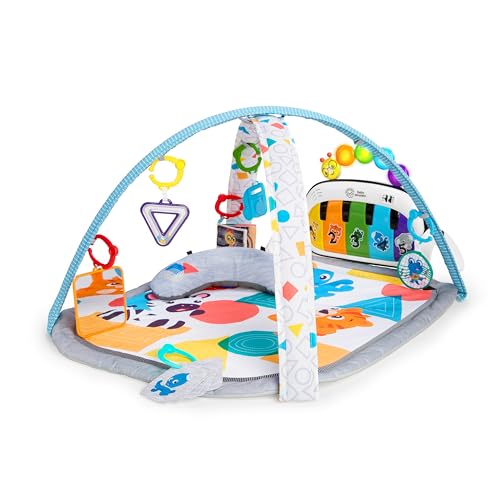
This is not a standalone piano—it’s a complete sensory gym with a detachable kick piano at its core. Babies activate the piano through kicking or pressing, which teaches cause and effect through gross motor movement rather than fine finger control. The gym includes seven sensory toys (a crinkle medallion, triangle rattle, BPA-free textured note, flash cards, a self-discovery mirror, a tummy time pillow, and the piano itself) that support visual, auditory, and tactile development.
The piano plays 25 minutes of continuous lights and music, and it teaches colors, shapes, and numbers in four languages (English, Spanish, French, German). That multilingual exposure is rare in this category and adds genuine educational value. The mat is machine-washable, and the toy bars can be rearranged for lay-and-play, tummy time, seated play, or on-the-go use, so it grows with your child from newborn to 36 months.
Some parents note that the piano’s touch sensor isn’t always clearly linked to the kicking motion, and the continuous music setting can feel repetitive to adults. The gym itself is compact—some families with larger babies might find the mat smaller than expected. But for a single toy that supports motor development, language exposure, and musical discovery from day one, this is the most well-rounded option available.
Why it’s great
- Grows from lay-and-play to seated and on-the-go use up to 36 months
- Multilingual learning in 4 languages with lights and melodies
- Machine-washable mat and easy-to-clean toys
Good to know
- Touch sensor can feel disconnected from kicking action for some babies
- Mat is compact; larger babies may outgrow the physical space early
- Continuous music mode may feel repetitive to caregivers
2. SUNLIN 6 ft. Floor Piano Mat

The SUNLIN floor mat transforms music play into whole-body movement—24 touch-sensitive keys span six feet, so kids must step, hop, and jump to play songs. Unlike tabletop pianos that encourage only finger presses, this mat builds gross motor coordination, balance, and spatial awareness while rewarding movement with immediate audio feedback. The vinyl surface is stain-resistant and wipes clean easily, and the anti-slip back pattern keeps the mat safe on hardwood or tile.
It ships with 10 built-in songs including “Jingle Bells” and “Happy Birthday,” plus a color-coded and numbered song booklet that teaches reading and sequencing. The record and playback feature lets kids create their own melodies—a huge confidence builder for 3–7 year olds. The material is toxin-free and complies with CPSIA and ASTM standards, so it’s safe even if kids lie down on it during play.
Some families feel the mat could use more than 10 songs to stay fresh after months of play, and the touch sensitivity can occasionally be unreliable if a child steps too lightly on a key edge. It’s also not recommended for children under 3 because the electronic components are not enclosed. But for a gift that gets kids moving and making music at the same time, this mat delivers reliable fun.
Why it’s great
- Full-body movement activity improves gross motor coordination
- Record and playback function encourages creativity
- Color-coded song booklet teaches reading and sequencing
Good to know
- Only 10 built-in songs; some families want more variety
- Touch sensitivity can miss very light steps on key edges
- Not recommended for children under 3 years old
3. Play22 6 ft. Floor Piano Mat for Toddlers

This giant vinyl keyboard mat gives kids ages 3–10 a six-foot canvas to stomp out music on 24 touch-sensitive keys. It features eight instrument sounds (piano, saxophone, violin, clarinet, trumpet, banjo, xylophone, guitar) so children can explore different timbres without needing a separate toy. The record and playback mode allows kids to capture their own compositions, which adds a layer of creative expression.
The mat is made from durable, strong vinyl that holds up to daily jumping and dancing—multiple parent reviews confirm it works well even a year after purchase. It meets all US safety requirements and includes an adjustable volume control so caregivers can keep the noise level comfortable. Setup is instant: unroll, insert 4 AA batteries, and start playing.
A few users mention the sound is “minimal”—just a few octaves of notes without full song complexity. The songs are also fairly limited. For a child who wants to play recognizable tunes, the built-in demo songs won’t go far. But as an active toy that burns energy while introducing musical concepts, it consistently receives high marks from families.
Why it’s great
- Large 6-foot surface encourages active whole-body play
- 8 instrument sounds provide variety beyond standard piano
- Durable vinyl build survives heavy daily use
Good to know
- Built-in songs are limited and may not feel educational
- Sound quality is toy-grade; lacks depth for older music lovers
- Requires 4 AA batteries (not included)
4. Marstone 3-in-1 Musical Set

This set bundles three instruments—a piano keyboard, an electronic xylophone, and a drum pad—plus a whack-a-mole game, all in one ABS plastic unit. The piano keyboard alone has five modes: piano tone, solmization (scale notes), trumpet, guitar, and color mode (that plays different colors when keys are pressed). The xylophone has glockenspiel, xylophone, animal sounds, and number modes, so a 1-year-old can match animal noises to keys while learning counting.
The drum pad offers three play modes (Jazz drum, Djembe, music mode with 9 songs and 3 beats), and the whack-a-mole game has five difficulty levels that challenge fine motor timing as the child grows. That’s an extraordinary amount of variety for a single toy—parents consistently report that their 1-year-olds stay engaged for 20–30 minute sessions, which is a lifetime in toddler attention spans.
Assembly is required (the drum set attaches to the main unit), and the drumsticks are not recommended for children under 2 years old due to choking hazard. Some users note the screen and buttons feel slightly plasticky compared to pure wood options. But for a child who loves switching between instruments and needs a central toy station, the variety here is unmatched.
Why it’s great
- 3 instruments plus whack-a-mole in a single compact unit
- 5 modes on the piano keyboard including trumpet and guitar sounds
- Multiple difficulty levels extend the toy’s lifespan
Good to know
- Requires assembly of the drum attachment
- Drumsticks pose a choking hazard for children under 2
- Material feels less premium than wood alternatives
5. Baby Einstein and Hape Magic Touch Piano
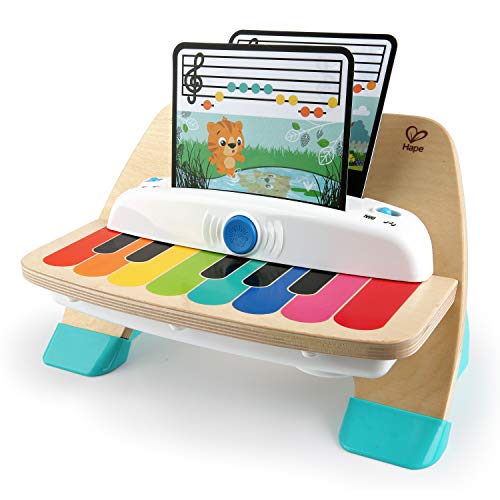
This wooden piano uses “magic touch” capacitive sensors—a baby doesn’t need to press a key; a light tap on any of the eight colored keys triggers the note. For infants who haven’t yet developed the finger strength to press plastic keys, this makes independent music-making possible as early as 6 months. The piano comes with 3 sheets of color-coded sheet music (6 songs total), so older toddlers can follow along and learn note-color matching.
The construction is wood, not plastic, which gives it a premium feel and greater durability against drops. It has two volume settings (low and high), and the speaker delivers clearer sound than most plastic alternatives in this tier—parents consistently note the “beautiful” sound quality. The compact dimensions (8.9″ x 11.7″ x 7.0″) make it portable for car rides or visits to grandparents.
Some parents wish the speaker were louder for group play or noisier environments, and the song complexity is modest—older toddlers may lose interest once they’ve mastered the six songs. It also requires 3 AA batteries (not included). But for a first piano that feels more like a real instrument than a plastic toy, the magic touch technology and wood frame are hard to beat.
Why it’s great
- Touch sensor allows 6-month-olds to make music without pressing
- Durable wood construction feels premium and survives drops
- Color-coded sheet music teaches note matching as baby grows
Good to know
- Speaker may be too quiet for louder families or group play
- Six songs feel limited after the first few months
- Requires 3 AA batteries not included
6. LeapFrog Learn and Groove Rainbow Lights Piano

Pressing the keys lights up a cloud rainbow and introduces numbers 1–8 and color names in both English and Spanish—making this the best bilingual option in the budget-friendly tier. The piano has a twistable dial that switches between instrument sounds (piano, violin, saxophone, etc.) and two game modes where babies hunt for colors or numbers. Turning the music page triggers two learning songs, and the main music button cycles through 17 kid’s songs and classical pieces with a light show.
The unit is lightweight (1.46 pounds) and compact (12.6 x 9.84 inches), making it easy to move from the playroom to the car. The two volume settings include a low option that is genuinely quiet—useful for parents who want to avoid auditory overload. The rainbow lights are bright and visually engaging, helping to maintain attention during tummy time or seated play.
The biggest complaint from parents is fragility: the rainbow arch on top tends to break off with repeated toddler use, requiring superglue repairs. The song quality is also described as “good value” rather than musically impressive—the classical pieces sound toy-grade. For a first piano that teaches bilingual colors and numbers for a modest investment, this works well, but it may not survive heavy-handed play past 18 months.
Why it’s great
- Teaches colors and numbers bilingually in English and Spanish
- 17 songs plus classical pieces with light show
- Two volume settings including a genuinely quiet low mode
Good to know
- Rainbow arch is fragile and breaks off under toddler play
- Song quality is toy-grade; classical pieces sound thin
- May need superglue repairs within the first few months
7. Fat Brain Toys Rock ‘N Roller Piano

This is not an electronic keyboard—it’s a classic wooden xylophone paired with roller bells. Babies spin the two colorful wheels to hear the bells chime, or they strike the metal keys with the included mallet. The two-play-method design (spinning versus striking) targets two different fine motor skills: wrist rotation and arm control. The mallet stores neatly in a slot on the back, preventing the dreaded lost-stick problem.
The toy is extremely durable (reviewers confirm it handles two under two just fine), and it encourages cause-effect learning without batteries or screens. The metal keys produce a bright, bell-like tone that delights most babies—though musically trained parents will notice the tuning is imperfect, with some notes sounding slightly off-key. The size is compact (11 x 7 x 2.5 inches), so it travels easily and stores flat.
If you or your child has perfect pitch, the off-key tones may be genuinely grating. Multiple reviewers with musical backgrounds specifically warn about this flaw. But for a baby who just loves making noise and spinning things, this remains a top cause-effect toy. It’s more of a sensory motor tool than a musical instrument, and it excels in that role.
Why it’s great
- Two play modes (spin wheels + strike keys) target different motor skills
- Battery-free operation teaches cause and effect naturally
- Bulit-in mallet storage prevents lost pieces
Good to know
- Metal notes are audibly out of tune; painful for musical families
- Plastic body feels lightweight despite durable construction
- Limited to bell-like tones only; no instrument variety
FAQ
At what age should I introduce a baby piano?
Should I choose a wooden or a plastic baby piano?
How do I clean a baby piano between uses?
What does the light show on a baby piano teach?
Final Thoughts: The Verdict
For most families, the baby piano winner is the Baby Einstein 4-in-1 Kickin’ Tunes Gym because it combines a detachable touch piano with a full sensory gym that grows from newborn tummy time to toddler seated play. If you want a wood-first tactile experience with magic touch technology, grab the Baby Einstein and Hape Magic Touch Piano. And for an active, whole-body musical experience that burns energy while teaching cause and effect, nothing beats the SUNLIN 6 ft. Floor Piano Mat.