
Our readers keep the lights on and the weekend projects moving. As an Amazon Associate, I earn from qualifying purchases.
A USB-C audio interface is the nerve center of a modern home studio, converting your microphone and instrument signals into high-resolution digital audio your computer can work with. Choosing the right one means sorting through preamp quality, driver stability, latency specs, and I/O counts that directly affect every track you record.
I’m Rikta — the founder and writer behind FitlyFast. I spend my time dissecting audio interface specifications, comparing converter chip sets and preamp designs across dozens of models to find what actually delivers clean, usable recordings for musicians, podcasters, and content creators.
Whether you are laying down vocals, tracking an acoustic guitar, or building a streaming rig, picking the wrong box can introduce noise, latency, or routing limitations that kill your flow. This guide walks through the nine top contenders to help you find the best usb-c audio interface for your specific recording needs.
How To Choose The Best USB-C Audio Interface
Buying an audio interface is a multi-year decision, not a quick toss in the cart. A weak preamp or buggy driver will frustrate you on every session. Focus on the specs that actually shape your recordings and workflow — the channel count, preamp design, converter resolution, and connectivity options.
Channel Count and I/O Requirements
Match the number of inputs and outputs to your recording scenarios. A solo singer-songwriter can thrive on a 2-in/2-out unit like the IK Multimedia AXE I/O One. A podcaster recording two guests simultaneously needs at least 4 inputs. If you plan to track a full band or expand later, look for ADAT optical input so you can add eight more channels without buying a new interface.
Preamps – The Heart of Your Signal Chain
Preamps boost the weak signal from a dynamic or condenser microphone to line level. High-quality preamps deliver low noise, high gain without hiss, and a clean or colored sound depending on your taste. The Audient iD24 uses the same discrete Class-A circuit as the company’s ASP8024-HE console. The MOTU M6 achieves -129 dBu EIN on its preamps. Low Equivalent Input Noise (EIN) means you capture more signal and less floor hiss.
Latency and Driver Stability
Round-trip latency is the time it takes for your input signal to travel through the interface, into your DAW, and back to your headphones. For real-time monitoring without a distracting delay, look for interfaces offering sub-5 ms round-trip latency at a 32 or 64 sample buffer. Windows users especially should verify that the manufacturer provides dedicated ASIO drivers, not generic ones, to keep latency low and glitch-free.
Converter Quality and Maximum Sample Rate
Converters translate analog audio to digital and back again. A 24-bit / 192 kHz spec is standard now, but the quality of the actual converter chip varies. The MOTU M6 uses ESS Sabre32 Ultra DAC technology, delivering 120 dB dynamic range on line outputs. Better converters preserve subtle details, making your mix decisions more accurate. The Audient iD24 uses 32-bit DAC technology with 126 dB dynamic range.
Additional Features – Loopback, Software Bundle, and Form Factor
Loopback routing lets you grab computer audio (browser, game, DAW playback) and stream it alongside your mic input — essential for podcasters and streamers. Nearly every interface includes a software bundle with DAWs, amp simulators, and effects. IK Multimedia AXE I/O One ships with AmpliTube 5 SE and TONEX SE for 16,000 guitar tones. Also consider physical build: plastic is lighter and reduces interference but feels less rugged than metal. If you gig or carry your kit often, a metal chassis with metal jacks is worth the extra weight.
Quick Comparison
On smaller screens, swipe sideways to see the full table.
| Model | Category | Best For | Key Spec | Amazon |
|---|---|---|---|---|
| Focusrite Clarett+ 4Pre | Premium | Pro home studio recording | 4 preamps, ISA 110 Air mode, 192 kHz | Amazon |
| MOTU M6 | Premium | Large track count & expandability | 4 preamps, ESS Sabre32 DAC, 120 dB | Amazon |
| Audient iD24 | Premium | Outboard gear integration | 2 preamps, 126 dB DAC, 32-bit | Amazon |
| Focusrite Scarlett 4i4 (4th Gen) | Mid-Range | Studio-quality recording & MIDI | 2 preamps, Auto Gain, 120 dB dynamic range | Amazon |
| MOTU M4 | Mid-Range | Windows users & critical monitoring | 2 preamps, LCD meters, loopback | Amazon |
| Zoom AMS-44 | Mid-Range | 4-input streaming & podcasting | 4 preamps, loopback, 96 kHz | Amazon |
| Universal Audio Volt 2 | Mid-Range | Classic UA preamp character | 2 preamps, Vintage 610 mode, 192 kHz | Amazon |
| M-AUDIO AIR192x4 VSPro | Value | All-in-one starter bundle | 2-in/2-out, 2.59 ms latency, 192 kHz | Amazon |
| IK Multimedia AXE I/O One | Value | Guitarists using amp sims | 1 preamp, Z-Tone, 192 kHz | Amazon |
In‑Depth Reviews
1. Focusrite Clarett+ 4Pre
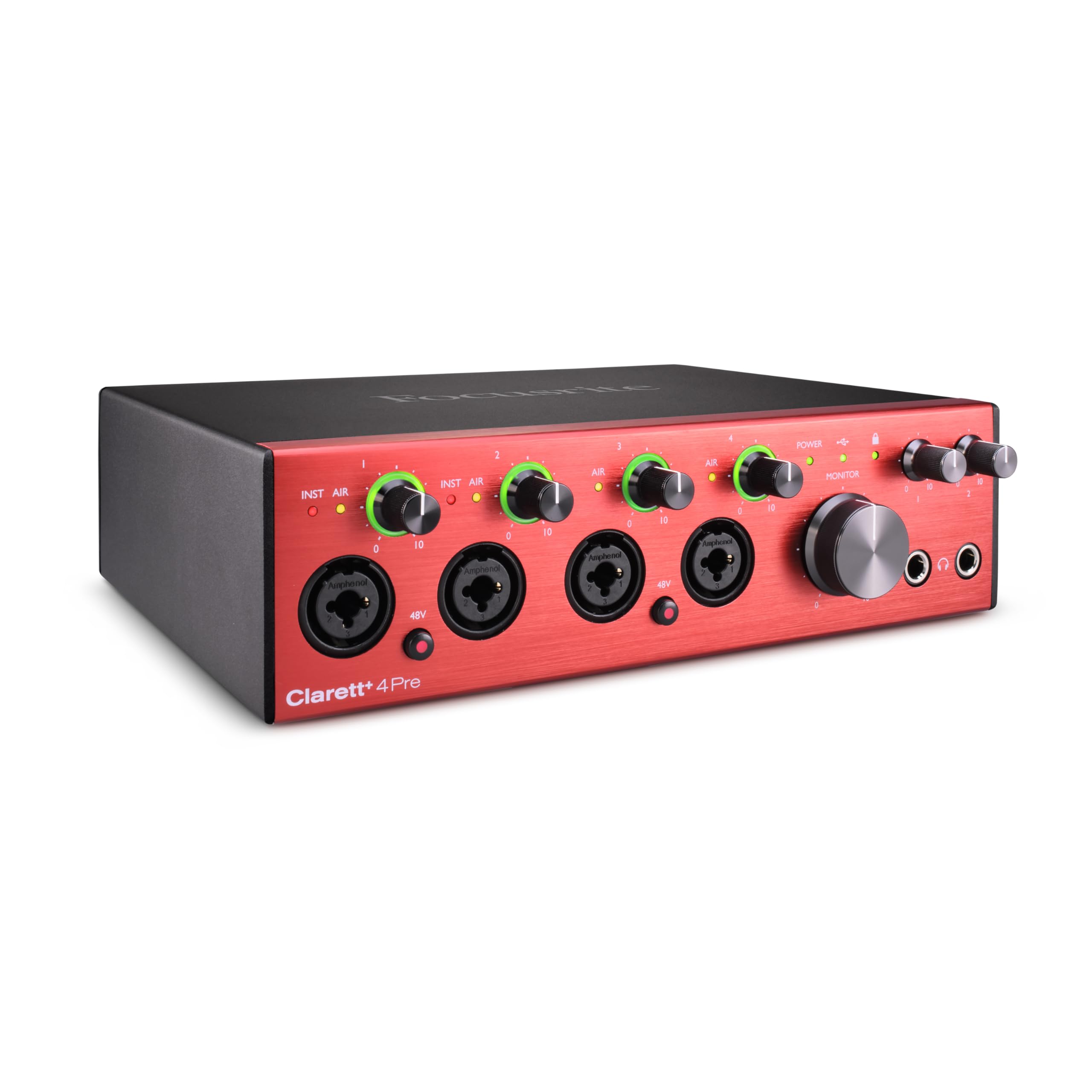
The Clarett+ 4Pre sits at the top of Focusrite’s mid-tier lineup for good reason — its four mic preamps use relay-controlled analogue circuitry that emulates the classic ISA 110, delivering a 4 dB high-frequency boost that makes vocals and acoustic instruments cut through a mix without sounding brittle. Each preamp operates independently, and the distortion and noise floor stay remarkably low even at high gain settings, which is exactly what you want when tracking quiet sources like fingerpicked guitar or spoken word.
Two JFET instrument inputs with ultra-high impedance preserve the natural character of electric guitars and basses, replicating the input stage of a traditional tube amp. The A-D and D-A converters are independent on this unit, meaning the capture path and playback path each get dedicated hardware rather than sharing resources, which keeps jitter down and stereo imaging tight. The ADAT optical input lets you expand to 18 total inputs if you connect a Clarett OctoPre down the road.
Build quality is heavy and reassuring — the metal chassis and metal jack sockets can survive studio rack life and mobile sessions. Both headphone outputs are powerful enough to drive high-impedance monitoring headphones cleanly. The Focusrite Control software gives you full routing flexibility for creating separate monitor mixes.
Why it’s great
- ISA 110 Air mode adds usable presence without harshness
- JFET instrument inputs preserve guitar tone
- Expandable to 18 inputs via ADAT
Good to know
- External power supply required
- Premium price compared to Scarlett line
2. MOTU M6

The MOTU M6 brings ESS Sabre32 Ultra DAC technology — the same converter chip set used in interfaces costing several thousand dollars — into a compact metal chassis with four mic preamps and a full-color LCD for metering each input and output. The dynamic range on the line outputs measures an honest 120 dB, giving you headroom to work with hot mix levels without digital clipping. Its preamp EIN rating of -129 dBu means hiss is essentially absent even when you push gain on a dynamic microphone like an SM7B.
Round-trip latency clocks in at 2.5 ms at 32 samples and 96 kHz, which makes it one of the fastest USB interfaces available for live monitoring through DAW plugins. A unique A/B monitor switch lets you toggle between two pairs of studio monitors instantly to check mix translation without reaching behind your desk. Both headphone outputs are driven by the ESS DAC and have independent volume controls, plus the second output can monitor a separate mix from Line Outs 3-4.
Loopback channels are built into the driver at no extra cost, making live streaming and podcast routing straightforward. The USB-C bus can power the unit, but for stand-alone operation the included DC adapter keeps it running without a computer. Metal extrusion construction feels solid, and the precision-knurled knobs offer smooth, tactile control.
Why it’s great
- ESS Sabre32 DAC rivals high-end converters
- A/B monitor switching saves time during mixing
- Ultra-low 2.5 ms round-trip latency
Good to know
- Higher price point in the MOTU line
- External power adapter for full operation
3. Audient iD24

The Audient iD24 stands apart because its two mic preamps use the exact same discrete Class-A circuit as the company’s ASP8024-HE recording console — that means the same ultra-low noise and subtle analog warmth you would get from a console channel in a pro studio, now in a desktop box. The 32-bit DAC converter technology delivers 126 dB of dynamic range on the monitor outputs, revealing mix details that cheaper converters mask.
What really sets the iD24 apart from almost every interface in this price range is its two fully balanced insert points. You can patch external hardware compressors, equalizers, or preamps directly into the A-D conversion path without first passing through the internal preamp circuit. This makes it a surprisingly powerful hub for engineers who own outboard gear and want to keep their signal path pure. ADAT and SPDIF optical I/O adds expandability up to 10 channels.
Three programmable function buttons let you assign speaker switching, talkback, polarity invert, or mono sum — the sort of workflow shortcuts that speed up session mixing. Build quality is solid, though the unit draws enough power that a USB 2.0 port may be insufficient; stick to a USB-C or powered hub connection to avoid dropouts.
Why it’s great
- Class-A Audient console preamps
- Balanced insert points for outboard gear
- 32-bit DAC with 126 dB dynamic range
Good to know
- Power hungry — skip USB 2.0 ports
- Runs warm during operation
4. Focusrite Scarlett 4i4 (4th Gen)
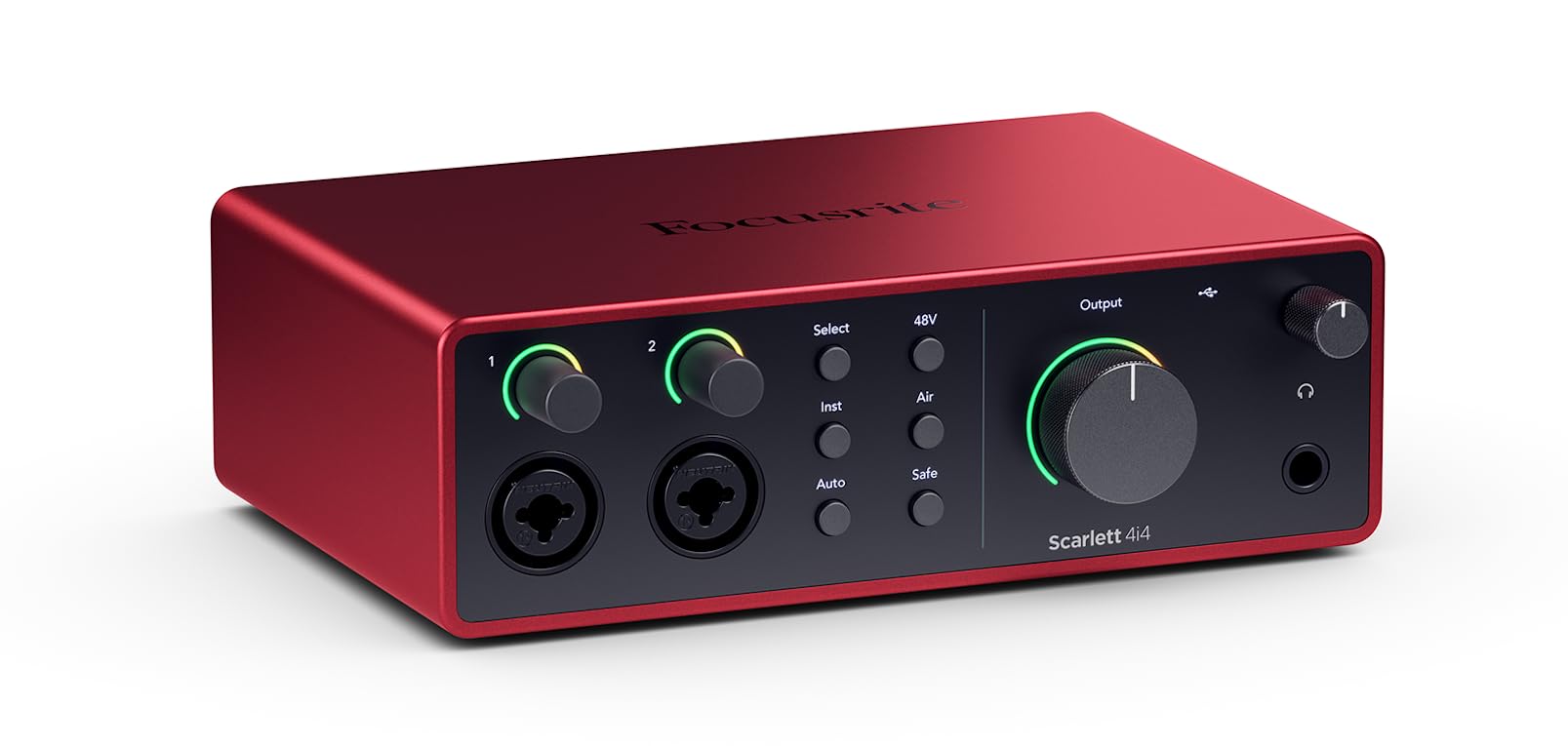
Focusrite’s fourth-generation Scarlett 4i4 brings 120 dB dynamic range, matching the converters used in the company’s flagship Red interfaces that sit in pro studios worldwide. The two mic preamps feature Air mode that lifts vocals and acoustic guitars in the mix with a touch of high-frequency presence, and the new Auto Gain function sets your recording level automatically so you never have to guess. Clip Safe then monitors the signal mid-take and catches any transient spikes before they distort — a genuine safety net for live recording sessions.
Two Hi-Z instrument inputs, four line outputs, and MIDI I/O make this interface ready for a multi-synth setup or pedalboard integration. The dedicated power supply input means you can plug into a USB hub or KVM switcher without worrying about bus power limitations. Latency performance with Focusrite’s ASIO drivers is consistently low across both macOS and Windows.
The bundled software is generous: Pro Tools Intro+, Ableton Live Lite, Cubase LE, plus the Hitmaker Expansion with effects, instruments, and mastering tools. The metal chassis is compact enough for a backpack but heavy enough to feel substantial on a desktop. Firmware updates are delivered regularly through the Focusrite Control app, which also manages routing and monitor mixing.
Why it’s great
- Auto Gain and Clip Safe prevent recording errors
- 120 dB dynamic range with flagship converters
- MIDI I/O for synth integration
Good to know
- External power supply included for stable operation
- Drivers can conflict with some gaming software
5. MOTU M4

The MOTU M4 delivers a transparent, uncolored signal path that makes it a favorite among engineers who want to hear exactly what their microphones capture without any added character. Its preamps measure exceptionally low noise and distortion, and the ESS Sabre32 DAC technology inside (shared with the M6) produces a clean stereo image with reliable separation between channels. An LCD screen provides real-time metering for all inputs and outputs, which helps you dial in gain without guessing.
Windows users especially benefit from MOTU’s rock-solid ASIO drivers — the M4 runs at 96 kHz with a 256-sample buffer without glitches, and the round-trip latency stays low enough for comfortable software monitoring. The front-panel direct monitoring mix lets you blend your input with DAW playback using a physical knob, no software needed. Loopback channels are built into the driver for streaming and podcast routing.
The built-in on/off switch saves you from having to unplug USB to reset the interface, a small convenience that daily users appreciate. Physical build is metal and durable, with quality knobs that offer smooth resistance. The headphone amp is adequate for common studio headphones, though very high-impedance cans may benefit from an external amp.
Why it’s great
- Transparent preamps with low noise floor
- Rock-solid ASIO drivers on Windows
- Physical direct monitoring knob
Good to know
- Headphone amp is bus-power limited
- No ADAT expandability
6. Zoom AMS-44

The Zoom AMS-44 packs four XLR/TRS combo inputs with four individual low-noise preamps and 48V phantom power into a chassis that is genuinely tiny — you can hold it in one palm. This makes it one of the most compact four-input USB-C audio interfaces available, ideal for mobile podcasters or musicians who need multiple mics without a bulky rack. A toggle switch lets you flip between Music mode (independent DAW routing) and Streaming mode (all inputs merged into a single feed), which simplifies live broadcast setup.
Direct monitoring and loopback switching are handled by physical slide switches on the top panel — no software required. The unit powers over USB-C or two AA batteries, making it genuinely portable for field recording or tablet-based sessions. Build is plastic rather than metal, which keeps weight down to 320 grams but may raise durability concerns for heavy travel. Some users report that the loopback slide switch is small and easy to bump accidentally during a session.
Audio quality earns praise for its lack of floor noise. The preamps stay clean even at higher gain settings, and the 24-bit / 96 kHz conversion is sufficient for podcasting and most music demo work. The AMS-44 supports all major DAWs and streaming platforms like OBS, Twitch, and YouTube.
Why it’s great
- Four combo inputs in a pocket-sized design
- AA battery power for true portability
- No floor noise at high gain
Good to know
- Plastic build, no tripod mount
- Loopback switch is easy to bump
7. Universal Audio Volt 2

Universal Audio built the Volt 2 around a trick borrowed from their famous 610 vacuum tube preamp: a Vintage mode that engages an analog circuit emulation of that classic UA sound, adding harmonic richness and warmth to vocals and instruments without software plugins. The effect is subtle but real — a slight saturation in the midrange that gives an instant “record-ready” quality to tracks. The converters handle up to 24-bit / 192 kHz with crystal clarity.
The unit is USB bus-powered, which means you can connect it directly to a laptop or iPad (iOS 14+ with a Camera Adapter) for mobile recording sessions. Included software includes the LUNA DAW, which recreates the workflow of a tape-based analog studio, plus a bundle of UAD plugins that are typically sold separately on their DSP platform. Build quality is above average for this tier — metal chassis, sturdy knobs, and satisfying button action.
Latency performance is solid for both Mac and PC, and the headphone output delivers enough power for common studio monitoring headphones. The Volt 2’s two inputs (combo XLR and instrument) are enough for solo singer-songwriters or vocalists, but limited for multi-mic setups.
Why it’s great
- Vintage 610 mode adds analog warmth
- Bus-powered and portable for mobile recording
- Includes LUNA DAW and UAD plugins
Good to know
- Only two inputs, no expandability
- Requires external power supply for iPad use
8. M-AUDIO AIR192x4 VSPro

The M-AUDIO AIR192x4 VSPro is an all-in-one starter package that bundles the AIR 192|4 audio interface with a Nova Black condenser microphone, shock mount, XLR cable, and HDH40 studio headphones. For someone buying their first recording setup, this eliminates the hassle of sourcing separate components — everything arrives ready to plug in and record. The interface itself delivers 24-bit / 192 kHz conversion and claims a class-leading round-trip latency of 2.59 ms under ideal conditions.
The single XLR+¼” TRS combo input and one ¼” instrument input cover basic solo tracking for vocals and guitar. Crystal preamps provide clean gain, and the headphone output has its own level control independent of the main monitor outputs. The included software bundle — MPC Beats, Ableton Live Lite, Touch Loops, Xpand!2, Mini Grand, and Revalver — gives you plenty of sounds and tools to start creating immediately.
Customer feedback is split between users who love the convenience and sound quality of the bundle and those who experienced hardware failures within months, though M-Audio’s warranty support has replaced entire units when needed. The Nova microphone and HDH40 headphones are functional but entry-level; most users upgrade those first as they grow.
Why it’s great
- Complete recording kit includes mic and headphones
- Very low 2.59 ms round-trip latency
- Generous software bundle for beginners
Good to know
- Reliability issues reported by some users
- Bundled mic and headphones are entry-level
9. IK Multimedia AXE I/O One

The AXE I/O One is not a general-purpose audio interface — it is a guitar-first interface designed specifically for players who work heavily with amp sims and modeling software. Its Z-Tone impedance-adapting circuit lets you match the input impedance to either active or passive pickups, preventing the high-frequency dullness and artifacts that many standard interfaces introduce when DI-ing a guitar. An Active/Passive pickup selector further optimizes the signal path to preserve your instrument’s natural character.
The single input means this interface is strictly for solo guitarists or vocalists who record one track at a time. What you lose in channel count you gain in bundled tone software: AmpliTube 5 SE and TONEX SE give you access to over 16,000 guitar and bass tones, plus the ability to capture your own amp profiles. Ableton Live Lite is also included for basic recording and arranging. The plastic housing is lighter than metal alternatives but non-conductive, which actually reduces electromagnetic interference in the signal path.
Setup requires registering the product and downloading software from multiple pages, which is a minor friction point. Once installed, users report that the AXE I/O One solves the “Scarlett guitar sound” issue — that brittle, noisy DI sound that Focusrite and other general-purpose interfaces sometimes produce with electric guitars. The Z-Tone circuit is the key differentiator here, and it works well with passive pickups (active pickup users should keep the Z-Tone knob at zero).
Why it’s great
- Z-Tone impedance circuit improves DI guitar tone
- AmpliTube 5 SE and TONEX SE included
- Non-conductive plastic housing reduces noise
Good to know
- Single input — limited to solo recording
- Software activation requires multiple web steps
FAQ
What is the difference between USB-C and USB-A audio interfaces?
Can I use a USB-C audio interface with an iPad or iPhone?
How many inputs do I need for podcasting vs music production?
Should I get an interface with MIDI I/O for my synthesizer setup?
Does a higher maximum sample rate like 192 kHz automatically sound better?
Final Thoughts: The Verdict
For most users, the best usb-c audio interface winner is Focusrite Scarlett 4i4 (4th Gen) because it combines studio-quality 120 dB dynamic range, Auto Gain and Clip Safe features for foolproof recording, MIDI I/O, and a generous software bundle at a price that fits serious home studios. If you want console-grade preamps and the ability to integrate outboard hardware compressors or EQs, grab the Audient iD24. And for dedicated guitarists who live inside amp sims and want the cleanest DI tone possible, nothing beats the IK Multimedia AXE I/O One with its Z-Tone impedance matching circuit.