
Our readers keep the lights on and the weekend projects moving. As an Amazon Associate, I earn from qualifying purchases.
Every gadget in your home runs on the same quiet hunger: TV remotes, wireless mice, game controllers, kids’ toys, and kitchen scales all drain cylindrical cells at their own pace. A smart charger that reads each battery’s chemistry and stops the moment it’s full saves you from the landfill-bound cycle of disposable alkalines. The right unit doesn’t just fill your batteries — it protects them with individual slot monitoring, temperature cutoffs, and trickle maintenance that extends service life far beyond a simple dumb dock.
I’m Rikta — the founder and writer behind FitlyFast. I spend my research hours parsing charge-rate specs, UL certifications, and real-user longevity reports across the entire NiMH ecosystem.
After sifting through dozens of models, I’ve built a focused guide to the battery charger for rechargeable batteries that actually deliver on their promise of consistent power without overcharging.
How To Choose The Best Battery Charger For Rechargeable Batteries
Not all chargers treat your cells the same. A basic unit might push a fixed current into every slot regardless of battery state, cooking older cells or leaving newer ones underfilled. The key is finding one that adapts to each battery’s needs.
Independent Slot Monitoring
Chargers that share one circuit across all bays force you to pair batteries of identical age and capacity. An independent-slot model treats each cell as its own charging zone, so you can mix a well-used AA with a fresh AAA without one overcharging. Look for the term “individual charging” or “isolated circuits” in the spec sheet — it’s the single biggest differentiator between a smart charger and a dumb one.
Delta-V Detection
NiMH batteries signal a full state by a slight voltage dip, called -Delta-V. A quality charger detects this dip and cuts power immediately. Cheaper models rely on a fixed timer that guesses when a battery is full — they can undercharge a high-capacity cell or overcharge a nearly full one. If you see “Delta-V” or “-dV” in the description, the charger is reading the battery rather than just counting minutes.
Charge Rate Selection
Standard NiMH cells tolerate around 0.5C (half their capacity in milliamps). A 2000mAh AA charged at 1000mA will heat up more and may degrade faster than one charged at 500mA. Many premium chargers let you adjust the rate, while mid-range units set a safe conservative speed. Fast charging is convenient, but a slower trickle extends total cycle life significantly.
Quick Comparison
On smaller screens, swipe sideways to see the full table.
| Model | Category | Best For | Key Spec | Amazon |
|---|---|---|---|---|
| Panasonic BQ-CC65 | Premium | Eneloop users & advanced monitoring | Per-slot LCD voltage & mAh readout | Amazon |
| Tenergy TN162 | Mid-Range | High-volume 8-bay charging | LCD display with Delta-V cutoff | Amazon |
| Tenergy TN486U | Mid-Range | Charging C, D, and 9V sizes | 5-slot universal USB-powered charger | Amazon |
| BEVIGOR 8-Bay | Value | Budget-friendly kit with batteries | 8 isolated circuits, Type-C input | Amazon |
| Amazon Basics 8-Bay | Value | Complete starter bundle in bulk | USB-C powered, 16 batteries included | Amazon |
| HiQuick C Kit | Mid-Range | C-cell users with LCD status | Built-in USB cable, 4 C batteries | Amazon |
| Bonai 16-Bay | Budget | Large households & high drain | 16-slot AA/AAA, 2800mAh cells | Amazon |
In‑Depth Reviews
1. Panasonic BQ-CC65AKBBA

The flagship Eneloop charger lives up to its reputation through per-slot intelligence. Each of the four bays independently monitors voltage, discharge capacity in mAh, and charge duration on the LCD panel, so you can watch exactly how much energy a cell accepts. The refresh cycle applies a controlled discharge-charge sequence that can resurrect older NiMH cells that have developed voltage memory.
It charges four AA Eneloop Pro cells in about four hours or two of them in two hours, and a built-in USB-A output (5V/1A) lets you top up a phone or earbuds while the batteries charge. The Delta-V detection stops each slot the moment its cell peaks, preventing the heat buildup that shortens battery life. The compact footprint and clean black finish match a desk or kitchen drawer equally well.
This charger is optimized for Eneloop and Eneloop Pro cells, and while it will work with other NiMH batteries, the full diagnostic features shine brightest with Panasonic’s own chemistry. The USB port maxes out at 1A, which is sufficient for small devices but won’t fast-charge a modern tablet. For users who want the deepest cycle-by-cycle data and the longest cell lifespan from their investment, this is the reference standard.
Why it’s great
- Per-slot LCD shows voltage, mAh, and charge time for each cell independently
- Refresh mode reconditions tired batteries instead of discarding them
- Integrated USB output charges phones or accessories concurrently
Good to know
- Best performance achieved with Eneloop or Eneloop Pro cells
- USB port rated 5V/1A only — not for high-power tablets
2. Tenergy TN162 8-Bay Smart LCD Charger

Eight independent slots make the TN162 a logical centerpiece for households that burn through AA and AAA cells in bulk. The LCD screen cycles through each bay’s status — charging, full, or defective — so you can spot a dead cell at a glance. The default charge rate of 500mA for AA and 250mA for AAA is conservative enough to avoid excessive heat while still completing a full 2000mAh charge in roughly four hours.
Delta-V termination and overheat protection are standard here, meaning the charger reads the voltage curve of each cell rather than running a fixed timer. It includes both an AC wall adapter and a 12V car port adapter, making it practical for road trips or off-grid use. The pulsed DC charging method is gentler on cell internals than a constant-current brute-force approach.
The charge rates are not adjustable, so you cannot manually speed up a high-capacity cell if you are in a hurry. The bright blue indicator LEDs stay lit during operation, which some users find distracting in a dark bedroom — easier to turn the unit on its side than to dim the lights. For sheer bay count with genuine per-slot safety, this is the most reliable eight-slot option in its range.
Why it’s great
- Eight fully independent bays with individual Delta-V cutoff
- Includes 12V car adapter for mobile charging
- Pulsed DC gentle on battery chemistry
Good to know
- Charge rates are fixed at 500mA/250mA — no speed adjustment
- Bright blue LEDs may be noticeable in dark rooms
3. Tenergy TN486U 5-Bay Universal Charger

Most chargers stop at AA and AAA, but the TN486U bridges into C, D, and 9V NiMH/NiCD territory — a huge advantage if you own radio-controlled cars, lanterns, smoke detectors, or musical equipment that uses those larger formats. The five bays are flexible: you can charge one 9V alongside four AA cells, or load up five mixed sizes, and the LCD shows each slot’s individual progress.
Power comes from any standard USB source via either micro-USB or USB-C, so you can run it from a laptop, power bank, or wall adapter you already own. The max charge rate of 600mA is well-suited to the larger C and D cells, which would otherwise take over a day on a low-current charger. Users report that four D cells finish in under twenty hours, which is competitive for this form factor.
The charger does not include a power adapter — you supply your own USB brick — and the lack of a discharge mode means you cannot condition cells that have developed voltage depression. The sliding contacts for C/D batteries require a bit of manual fitting but hold securely once adjusted. If your battery drawer contains more than just AA and AAA, this is the most compact multi-size solution available.
Why it’s great
- Charges AA, AAA, C, D, and 9V cells in one unit
- USB-C and micro-USB dual input for on-the-go power
- LCD display shows per-slot charging status
Good to know
- No AC adapter included — must supply your own USB brick
- No discharge or refresh function for conditioning old cells
4. BEVIGOR Rechargeable AA/AAA Kit with 8-Bay Charger
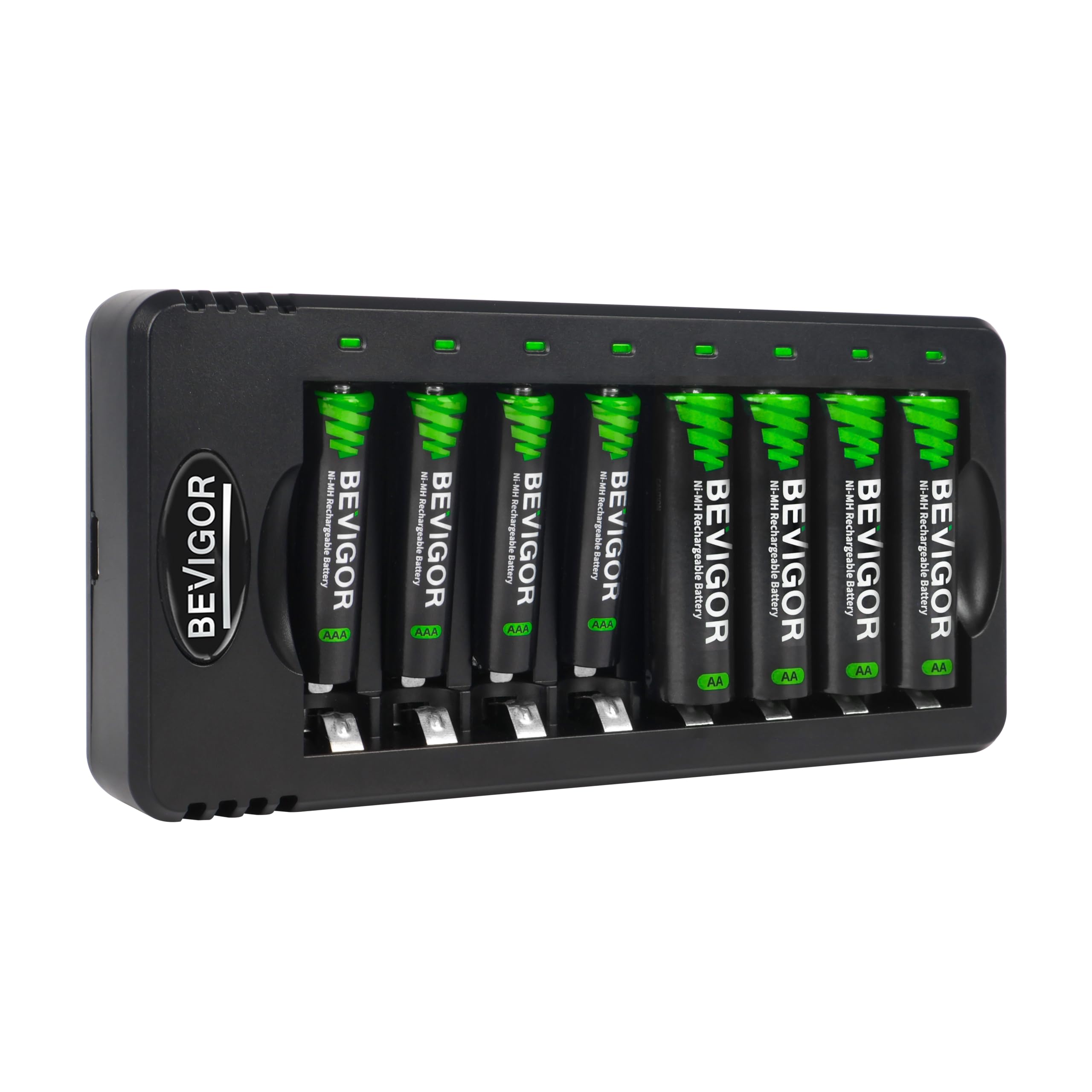
This all-in-one bundle pairs an eight-bay smart charger with four AA 2800mAh and four AAA 1100mAh pre-charged cells, making it a zero-friction entry to rechargeable power. The charger uses eight isolated circuits so you can charge any combination of AA and AAA simultaneously, and the red/green LED indicators give quick visual feedback on each slot’s state. The cells feature low self-discharge that retains 80% capacity after three years of storage.
A Type-C input cable — included in the box — means you can power the charger from any modern phone brick or laptop, eliminating the need for a dedicated wall wart. The trickle-charge mode kicks in after the main charge cycle finishes, maintaining full capacity without the cycling stress that can occur with a hard shutoff. FCC and UL certifications provide baseline safety assurance.
The charge time is rated at roughly four hours for a full set, which is average for this class. The included batteries, at 2800mAh and 1100mAh, fall in the mid-high capacity range and handle moderate drain devices well, but users with exceptionally high-drain gear like professional camera flashes may prefer a separate purchase of premium cells. For the price of a few packs of disposables, you get a completely functional ecosystem.
Why it’s great
- Comprehensive starter kit with 4 AA + 4 AAA pre-charged batteries
- Type-C input eliminates proprietary power adapters
- Eight fully isolated charging circuits for mixed loads
Good to know
- Four-hour charge time is standard but not rapid
- Included battery capacity adequate for moderate-drain use
5. HiQuick Rechargeable C Batteries with 4-Bay LCD Charger
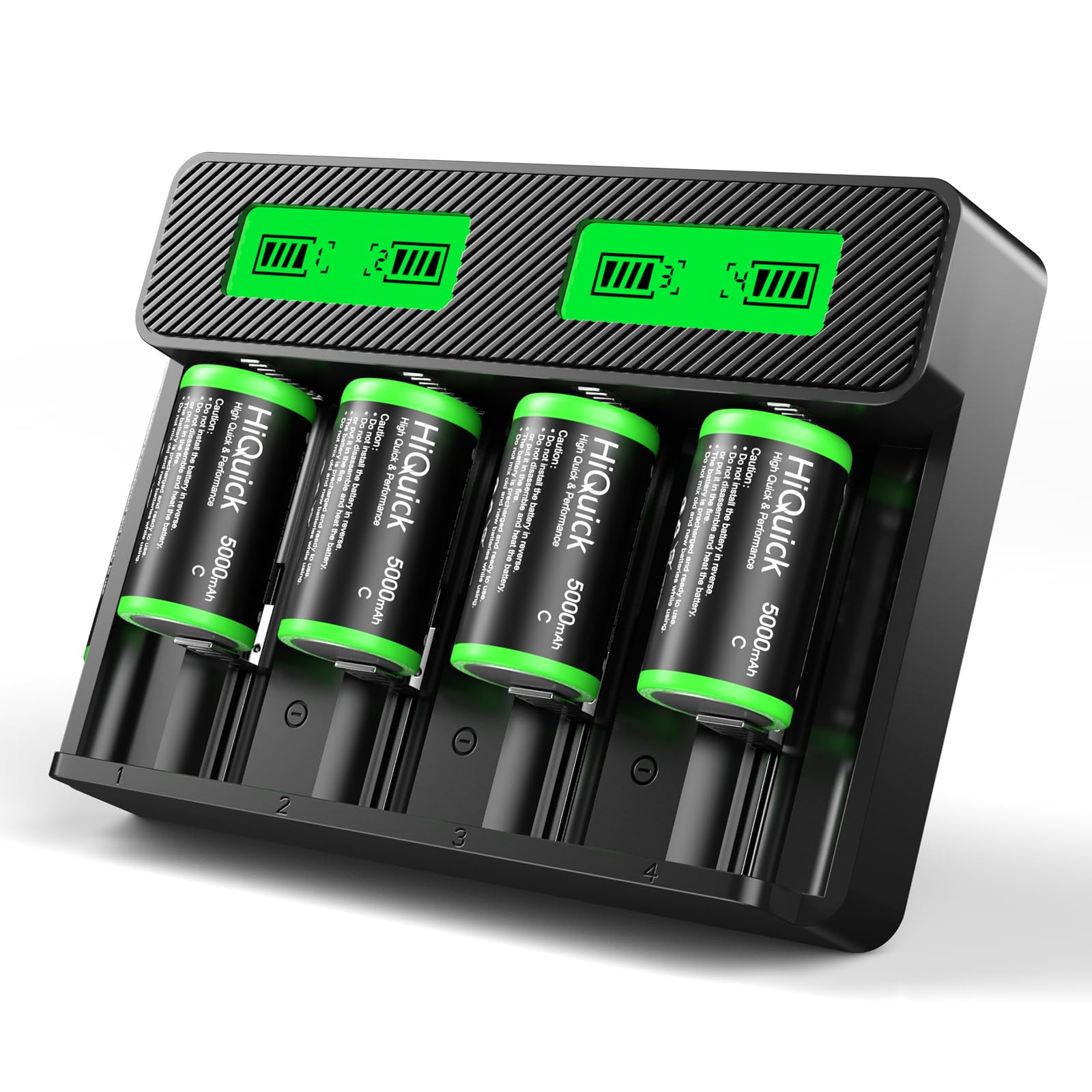
If your household uses C-cell devices — lanterns, boom boxes, baby swings, or floor-mop toys — this kit delivers both the batteries and the charger in one efficient package. The four included C cells pack 5000mAh each at 1.2V, which translates to roughly three times the runtime of standard alkaline C batteries in the same devices. The four-bay charger also accepts AA and AAA sizes, making it a multi-format hub rather than a single-task accessory.
The charger integrates a captive USB cable and a separate Type-C port, so there is no separate cord to lose. UL certification and the usual set of protections — overcharge, overcurrent, reverse polarity, and short circuit — are baked into the smart chip. The LCD display cycles through each bay, showing charging progress at a glance without requiring you to interpret color-coded LEDs.
Note that the charger does not fit flat-top button cells; it is designed exclusively for NiMH and NiCD cells with a standard raised positive terminal. The kit requires a 2.0A USB adapter (not supplied) to reach full charging speed. If C batteries are a regular expense in your home, this bundle eliminates that recurring cost after roughly the first recharge cycle.
Why it’s great
- Includes four 5000mAh C cells with high-cycle rating
- Built-in USB cable and Type-C port for easy power
- LCD screen gives clear per-slot status feedback
Good to know
- Incompatible with flat-top rechargeable cells
- Requires a 2.0A USB adapter (not included) for full speed
6. Amazon Basics Rechargeable NiMH 8-Bay Charger Kit
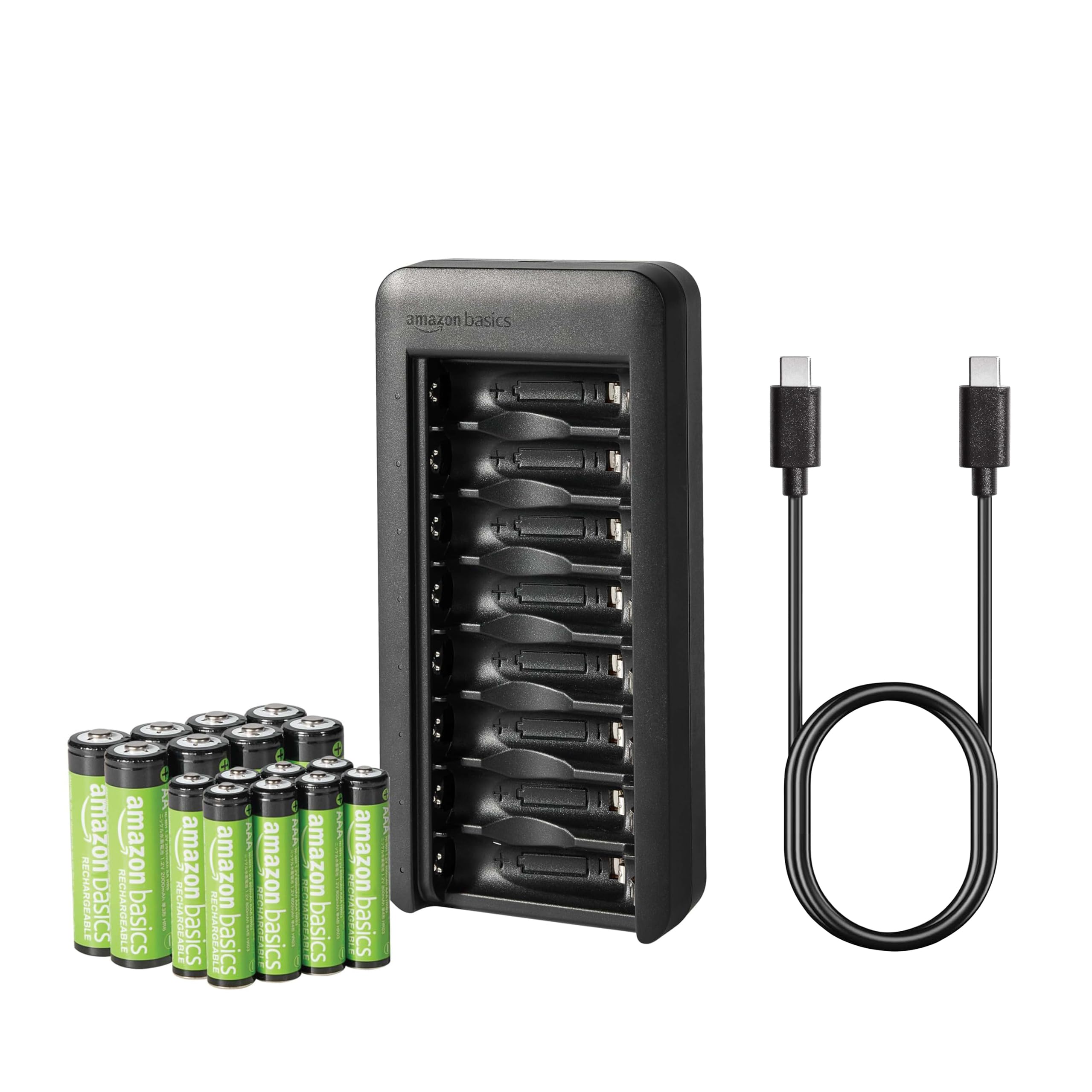
This kit solves the single biggest friction of switching to rechargeables: not having enough cells to replace every device at once. You get eight AA 2000mAh and eight AAA 800mAh batteries plus an eight-bay charger, which is enough to power multiple controllers, remotes, clocks, and toys simultaneously. The batteries are pre-charged and rated for up to 1000 recharge cycles with 80% capacity retention after twelve months in storage.
The charger relies on USB-C for input, which aligns with modern phone and laptop bricks, but no AC adapter is included — you must supply your own 5V/2A USB power source. LED indicators use a color-and-frequency system: slow blinking for charging, solid white for full, fast blinking for error. Some users note that charging eight AA cells simultaneously can take close to ten hours, so planning ahead is advisable.
Independent bay monitoring is present, but unlike higher-end models, there is no LCD to show voltage or capacity — only the charging/blinking lights. A small number of users have reported that inserting more than two AA cells can trigger false error lights on certain units, though this appears to be an intermittent batch issue. For the sheer volume of batteries included at the entry-level price point, the value proposition is difficult to ignore.
Why it’s great
- Massive 16-battery bundle covers an entire household in one purchase
- USB-C universal input works with modern chargers
- Individual bay detection protects against overcharging
Good to know
- No AC adapter supplied; expects user to provide 5V/2A brick
- Full 8-AA charge cycle approaches ten hours
- LED-only indicators — no voltage or capacity display
7. Bonai Rechargeable AA Batteries with 16-Bay Charger
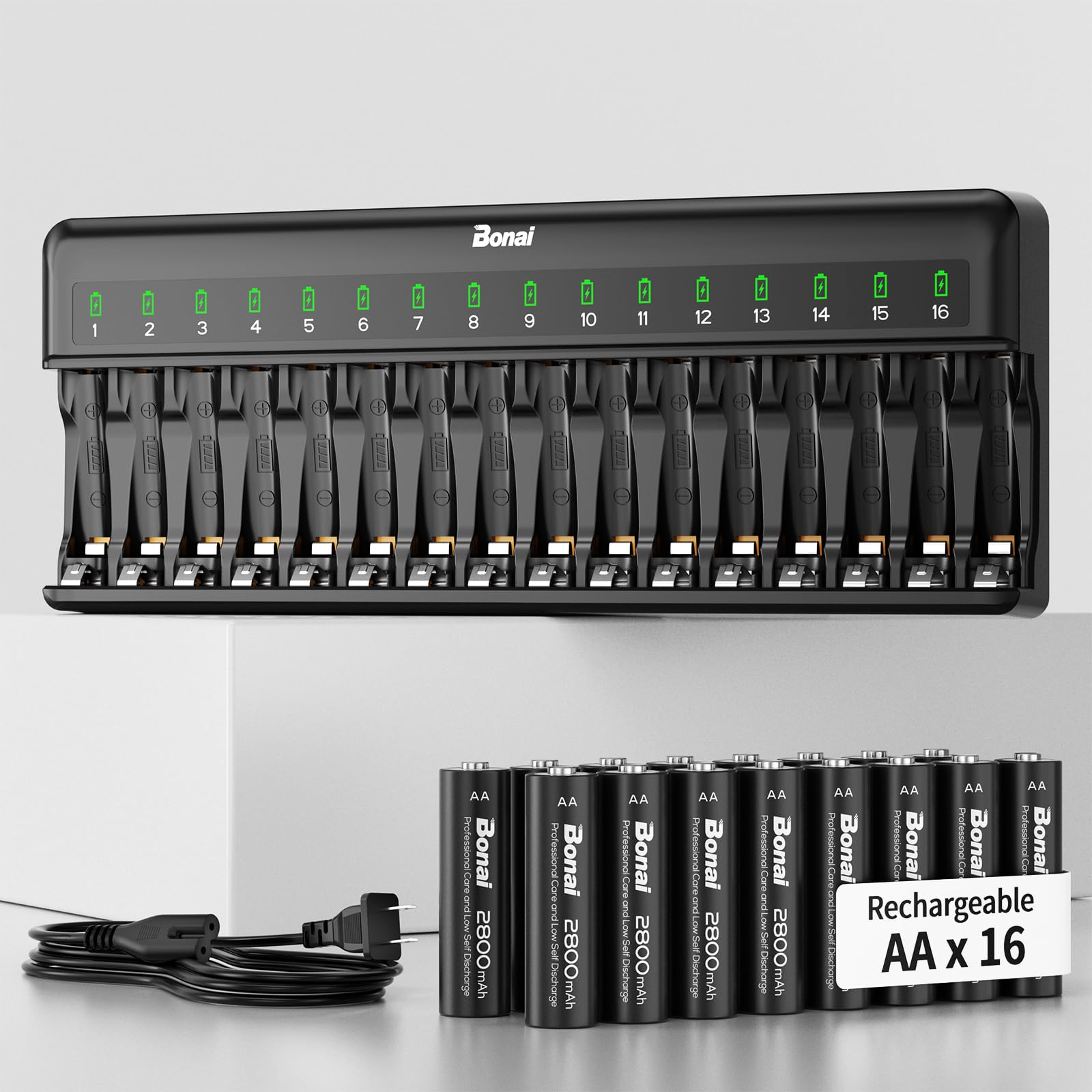
When your device roster runs into the dozens, a 16-slot charger eliminates the bottleneck of waiting for bays to free up. This Bonai unit charges up to sixteen AA or AAA NiMH cells at once, and the slots operate independently so you can mix sizes and capacities without slot-matching. The included batteries are rated at 2800mAh with a 1200-cycle lifespan, placing them slightly above the industry standard in both capacity and longevity.
The charger uses straightforward red/green LED logic — red means charging, green means full, flashing red signals a defective or non-rechargeable cell. An AC wall plug is included in the box, so there is no need to hunt for a separate adapter. Users report that a full 16-battery charge completes in roughly two to three hours, which is quick given the volume. The 1.2V output matches standard NiMH chemistry, though the cells run at a slightly lower voltage than alkaline 1.5V, which can cause dimmer output in purely voltage-sensitive devices like certain LED candles.
The 2800mAh batteries come pre-charged and use a low self-discharge formulation that holds 80% charge after one year of storage. Some users note that the charger’s large footprint (9.8 inches wide) demands dedicated shelf space. If you manage a household full of gaming controllers, wireless microphones, or flashlights that drain cells daily, the 16-bay format saves more time than any other spec on the sheet.
Why it’s great
- Sixteen independent slots charge a massive inventory at once
- 2800mAh AA batteries exceed standard capacity benchmarks
- Comes with AC wall adapter — no separate purchase needed
Good to know
- Wide footprint requires dedicated counter or shelf space
- NiMH 1.2V output may dim devices built for 1.5V alkalines
- LED indicator only — no numeric voltage or capacity data
FAQ
Can I charge regular alkaline batteries in a NiMH charger?
Does a higher mAh rating always mean better battery life?
What does low self‑discharge mean for rechargeable batteries?
Final Thoughts: The Verdict
For most users, the battery charger for rechargeable batteries winner is the Panasonic BQ-CC65 because it delivers per-slot diagnostic data, a refresh mode that extends cell life, and a USB output — all in a compact package that earns its place as the reference charger for NiMH users. If you want a high-volume workhorse that handles eight slots with true Delta-V cutoff, grab the Tenergy TN162. And for universal size support spanning C, D, and 9V cells, nothing beats the Tenergy TN486U.