
Our readers keep the lights on and the weekend projects moving. As an Amazon Associate, I earn from qualifying purchases.
A 5G modem is the quietest home upgrade you will ever make. You plug in a SIM card and suddenly your entire property — the basement office, the RV, the rural cabin — gets the kind of low-latency connection that urban offices brag about. There is no cable company hold, no fiber trench in your yard, just a slab of silicon pulling the fastest signal out of thin air.
I’m Rikta — the founder and writer behind FitlyFast. I have spent the better part of three years mapping the hardware inside the 5G modem segment, from the Qualcomm X62 and X65 chipsets to dual-SIM failover logic and carrier aggregation tables that most manuals gloss over.
Whether you are outfitting a permanent home or a temporary field station, the payoff for finding the right 5g modem is a massive jump in throughput, a safety net when the primary line drops, and the quiet satisfaction of owning your network.
How To Choose The Best 5G Modem
Every 5G modem on the shelf does the same basic job — it translates cellular radio waves into wired Ethernet or WiFi — but the gap between a budget hotspot and a premium CPE is enormous once you look at chipset generation, antenna count, and software flexibility. These are the criteria that matter.
Chipset Generation & Carrier Aggregation
The Qualcomm Snapdragon X62, X65, and SDX62 are the engines powering virtually every serious modem. The X62 supports 3GPP Release 16 and up to 3 Gbps downlink, while the X65 climbs to 10 Gbps and handles mmWave + Sub-6 simultaneously. Higher-tier chipsets also unlock carrier aggregation, letting the modem bond multiple frequency bands into one fat pipe. If you are in a weak-signal area, carrier aggregation is the single spec that turns a frustrating connection into a usable one.
Dual-SIM Topology
Most modems advertise “dual-SIM” but that label hides a critical distinction. Single-standby dual-SIM means only one SIM is active at a time — the modem switches over when it detects a failure. True dual-active dual-SIM (found only in premium business-class models) runs both connections simultaneously, giving you true load-balancing. For a home office that absolutely cannot drop a Zoom call, spend the extra money on a dual-active unit.
WiFi Generation & Port Configuration
A 5G modem with a 2.5 Gbps Ethernet port and WiFi 6 (AX3000 or higher) ensures the cellular speed is not bottlenecked inside your own property. If the modem caps out at gigabit Ethernet, it will choke on a 1.5 Gbps cellular feed. Similarly, WiFi 6E’s 6 GHz band adds a third lane that keeps interference down in dense neighborhoods. For RV or industrial use, look for modems with external antenna ports (TS-9 or SMA) so you can attach a rooftop antenna and pull signal from towers miles away.
Quick Comparison
On smaller screens, swipe sideways to see the full table.
| Model | Category | Best For | Key Spec | Amazon |
|---|---|---|---|---|
| GL.iNet GL-XE3000 | Premium CPE | Business continuity | Built-in 6400 mAh battery | Amazon |
| MOFINETWORK MOFI6500 | Rugged CPE | Durable RV / rural | Rugged metal case | Amazon |
| Cudy P5 | Advanced CPE | Band lock / TTL control | SDX62 chipset | Amazon |
| GL.iNet GL-X3000 | Mid-range CPE | RV / remote work | Dual-SIM failover | Amazon |
| TP-Link M8550 | Premium Hotspot | Travel & home backup | Tri-band WiFi 6E | Amazon |
| GlocalMe Numen Air | Global Traveler | International roaming | CloudSIM + physical SIM | Amazon |
| UOTEK 5G CPE | Budget CPE | Rural home internet | 8 external antennas | Amazon |
| RoamWiFi 5G Pro | Bundle Hotspot | US/MX/CA travel | 10GB US data included | Amazon |
| NETGEAR Nighthawk M6 Pro | Refurbished Hotspot | Low-cost mmWave | Qualcomm X65 chipset | Amazon |
In‑Depth Reviews
1. GL.iNet GL-XE3000 (Puli AX)
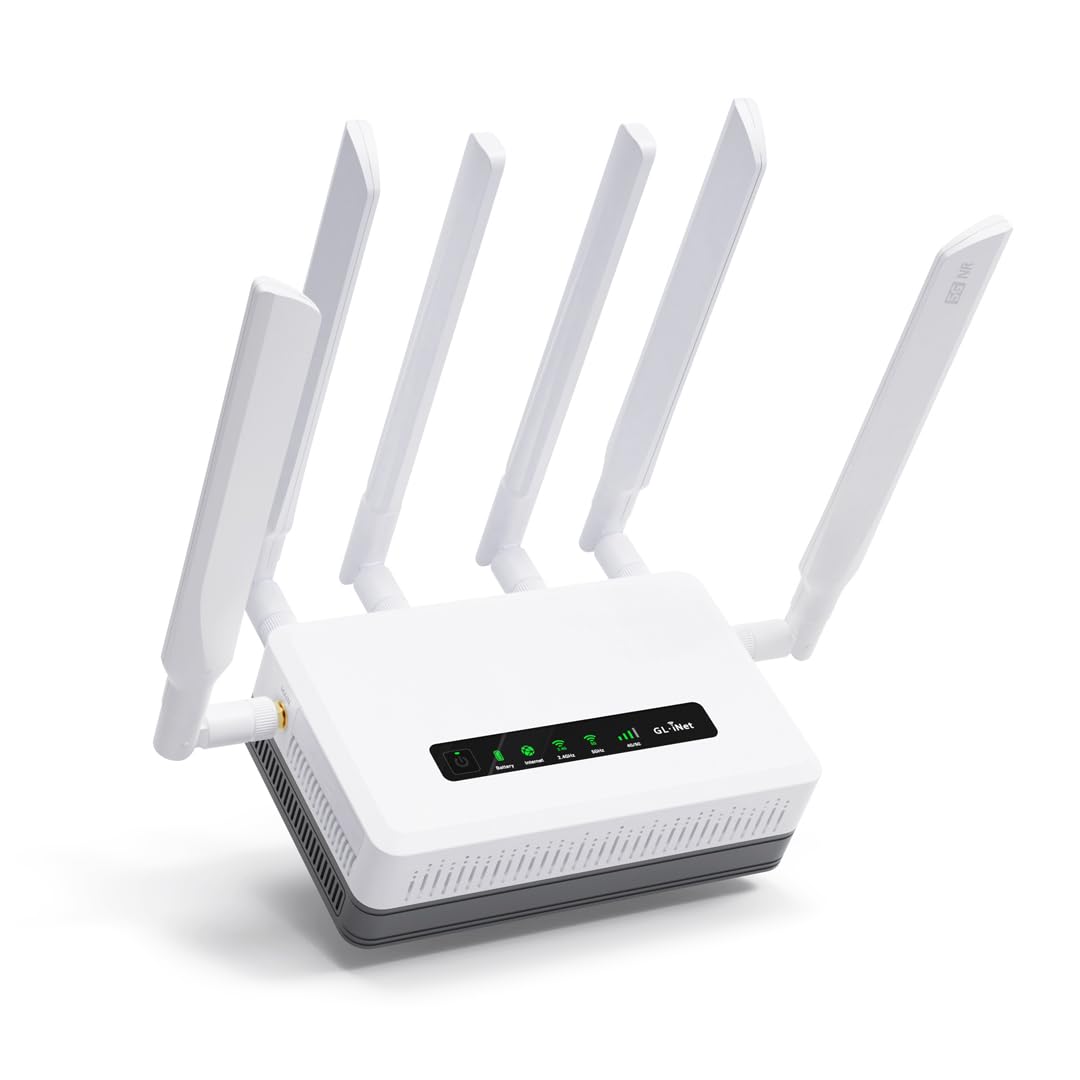
The Puli AX is the rare 5G CPE that can serve as both a home office gateway and a portable emergency router. Its built-in 6400 mAh battery delivers up to 8 hours of runtime, so when the power fails your internet stays live. The dual-SIM slot supports automatic failover, and the OpenWrt-based admin panel opens access to over 5,000 plugins for advanced routing.
Under the hood, the chipset handles both NSA and SA 5G modes, and the detachable antennas give you the option to mount a high-gain rooftop unit. Real-world throughput in fringe rural areas hits 120 Mbps, which is often double what carrier-provided gateways manage. The wall-mount kit and compact white chassis make it blend in rather than dominate the shelf.
The catch is that the dual-SIM is single-standby, not dual-active, so you cannot load-balance two carriers simultaneously. Also, the initial setup may require a few power cycles to wake the SIM detection. Once running, however, the Puli AX is among the most reliable 5G modems you can own for business continuity and field work.
Why it’s great
- Built-in battery keeps the network live during power outages.
- Full OpenWrt with thousands of plugins for custom networking.
- Excellent support for external rooftop antennas.
Good to know
- Dual-SIM is single-standby, not load-balancing.
- Initial SIM detection can be finicky.
2. MOFINETWORK MOFI6500-5GXeLTE-RM520-HP
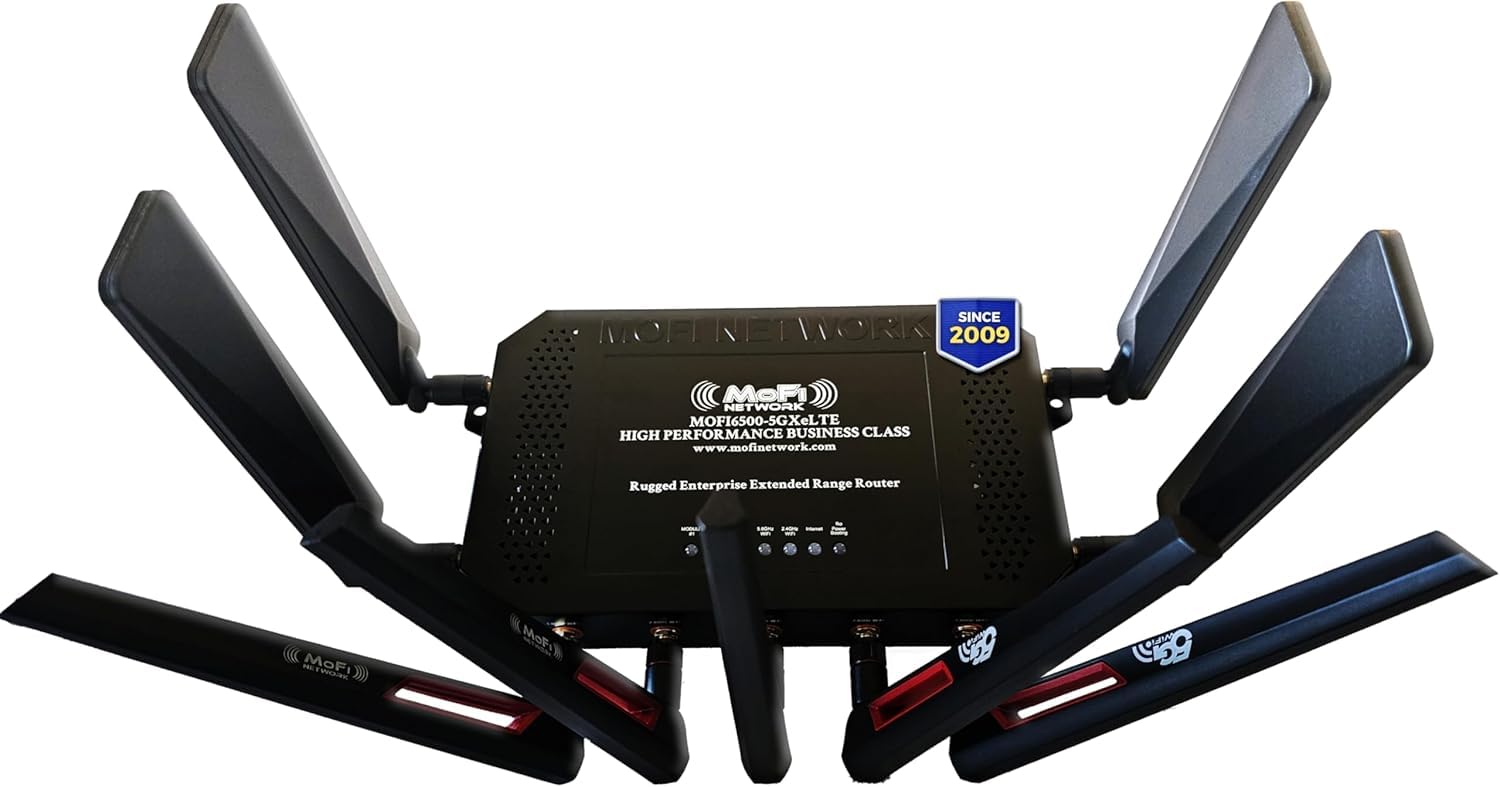
The MOFI6500 is built for environments where plastic casings fail — full-time RV use, construction sites, and rural homes with extreme temperature swings. The all-metal chassis dissipates heat efficiently and holds four detachable 5G antennas plus five WiFi antennas, giving you signal-grabbing muscle that few competitors match.
Business-class features include IP passthrough, band locking, VPN compatibility, and Zerotier certification. Users report replacing carrier-issued hotspots with the MOFI6500 and immediately seeing one or two additional bars of signal strength. The dual-SIM slot offers automatic failover, though the company also sells a true dual-active model (the DUAL) for those who need simultaneous connections.
The main trade-off is the learning curve. The detailed interface is a dream for technical owners but overwhelming for beginners. Support is responsive via phone, which helps, but you should budget time for initial configuration. Once locked in, the MOFI6500 stays stable for weeks without a reboot.
Why it’s great
- Rugged metal case with superior heat dissipation.
- Nine total antennas for maximum cellular and WiFi coverage.
- Advanced band-lock and failover controls.
Good to know
- Setup is not plug-and-play for non-technical users.
- Dual-SIM (standard) is failover-only; dual-active costs extra.
3. Cudy P5

The Cudy P5 is the go-to 5G modem for users who need to adjust TTL values, lock bands manually, or run custom VPNs. Powered by the Qualcomm SDX62 chipset, it supports 5G NR download speeds up to 3.4 Gbps (NSA) and 2.4 Gbps (SA). The WiFi 6 dual-band (AX3000) output ensures connected devices see minimal latency.
Advanced features like band locking let you force the modem onto a specific frequency band — critical when a carrier throws your connection onto a congested sub-band. The dual-SIM slot with WAN failover adds reliability. Cudy also includes built-in support for PPTP, L2TP, OpenVPN, WireGuard, IPsec, and Zerotier, making the P5 a powerful remote-office router straight out of the box.
T-Mobile SIMs are not compatible due to band restrictions, which narrows the carrier pool to AT&T and Verizon primarily. The unit runs warm under load, so ventilation matters. For power users who appreciate fine-grained control, the P5 delivers capabilities typically found in routers costing significantly more.
Why it’s great
- TTL adjustment and band locking for carrier optimization.
- SDX62 chipset with up to 3.4 Gbps theoretical downlink.
- Broad VPN client support including WireGuard and Zerotier.
Good to know
- Not compatible with T-Mobile SIMs.
- Runs hot during sustained high throughput.
4. GL.iNet GL-X3000 (Spitz AX)

The Spitz AX is the younger sibling of the Puli AX, stripped of the internal battery but otherwise retaining the same OpenWrt-based firmware and dual-SIM failover capability. It is designed for permanent or semi-permanent installation in RVs, where the router can be wired directly to the vehicle’s 12V system via USB-C.
The 6 detachable antennas give you flexibility to position the modem for best reception. Users report stable 5G UC connections even when the device is stowed under a floor panel, averaging 150 Mbps in suburban conditions. The multi-WAN configuration supports Ethernet, repeater, cellular, and tethering with load-balancing.
The biggest limitation is the lack of a battery. If the vehicle power cuts, the router goes dark. Also, the OpenWrt interface, while powerful, requires a moderate comfort level with router configuration. For road warriors who want carrier flexibility and VPN support without paying for a battery they do not need, the Spitz AX is the ideal pick.
Why it’s great
- Full OpenWrt with dual-SIM and multi-WAN failover.
- Detachable antennas for custom placement.
- Compact, no-battery design perfect for vehicle installs.
Good to know
- No internal battery — requires external power.
- Software interface has a learning curve.
5. TP-Link M8550
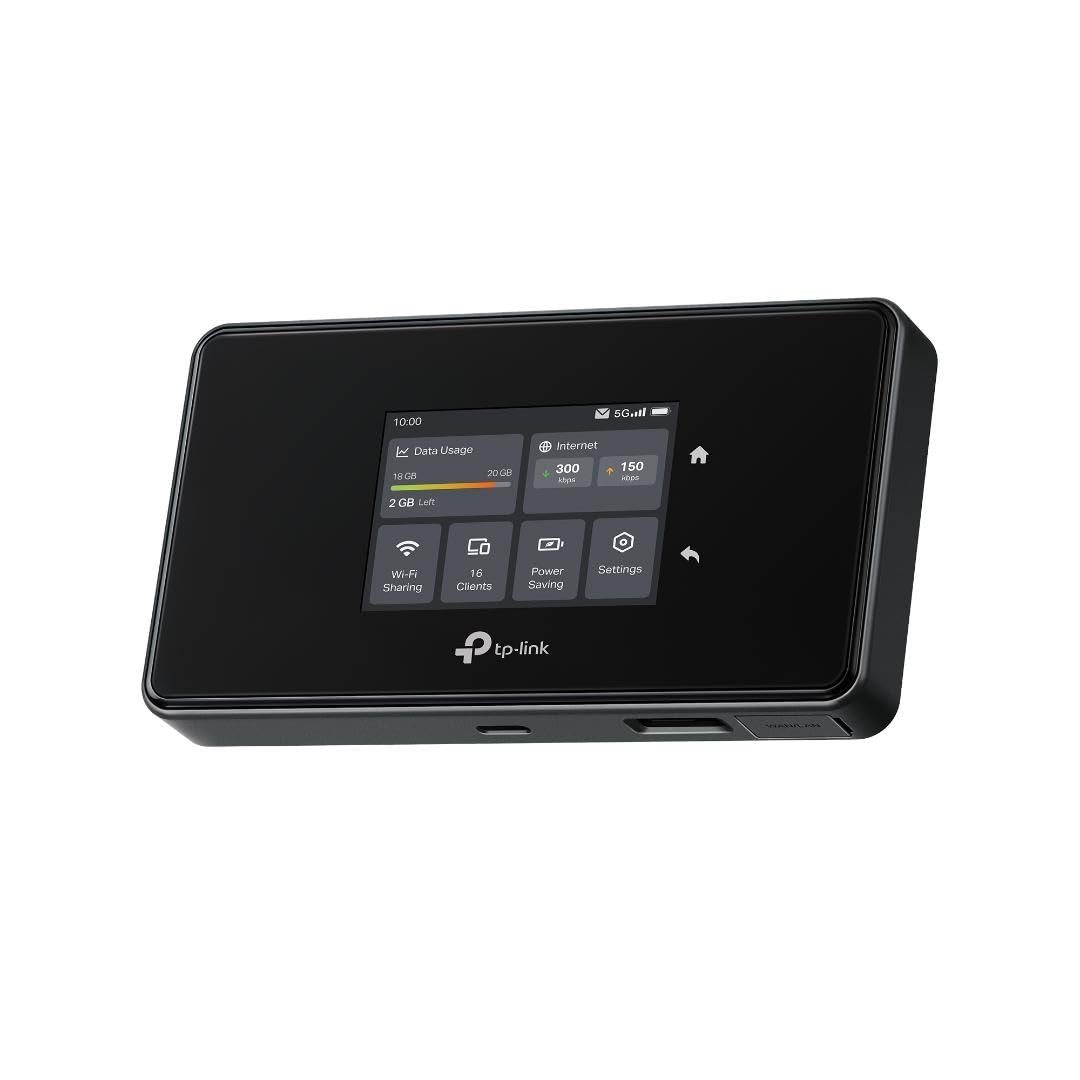
TP-Link’s M8550 is one of the few 5G mobile hotspots that integrates tri-band WiFi 6E, unlocking the uncongested 6 GHz band for backhaul-grade wireless performance. The AXE3600 class means theoretical speeds reach 2,880 Mbps on the 6 GHz band alone. It supports up to 32 devices simultaneously and runs for up to 14 hours on the 4680 mAh battery.
The unit works in two modes: Cellular Mode, where it acts as a 5G hotspot via nano SIM, and Ethernet Mode, where it becomes a WiFi router for a wired connection. The dual TS-9 external antenna ports let you attach high-gain antennas for rural campsites. Users consistently note fast, stable 5G speeds and easy SIM-based setup across AT&T, T-Mobile, and Verizon.
No eSIM support is a minor inconvenience for international travelers who prefer soft profiles. The unit also gets noticeably warm under heavy loads. Still, the M8550 delivers exceptional portable performance for remote work, streaming, and light gaming on the road.
Why it’s great
- Tri-band WiFi 6E eliminates 5 GHz congestion.
- Long battery life (14 hours) with fast USB-C charging.
- External antenna ports for weak-signal areas.
Good to know
- No eSIM support — nano SIM only.
- Gets warm during extended high-throughput use.
6. GlocalMe Red Numen Air
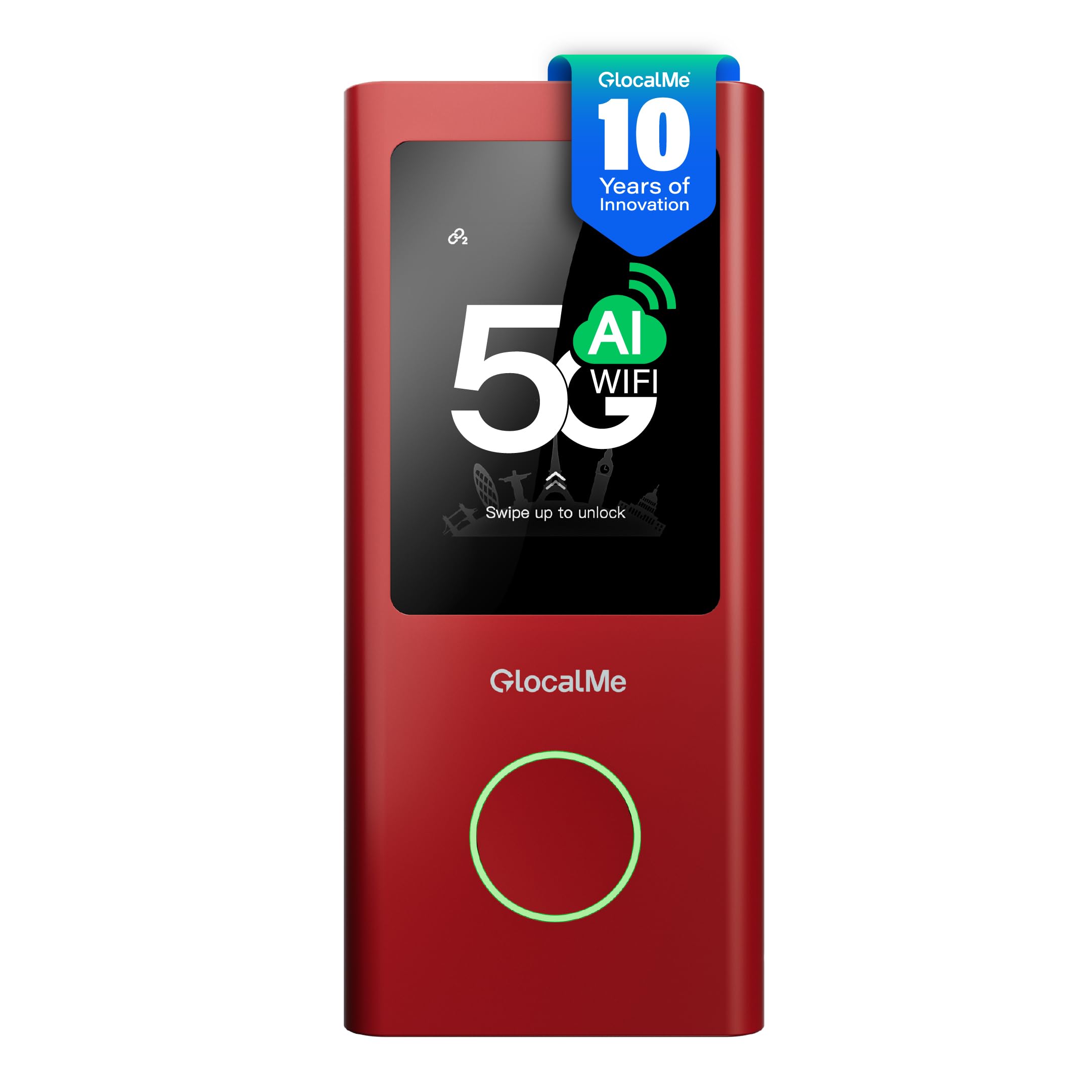
The GlocalMe Numen Air uses a patented CloudSIM architecture that virtually eliminates the need to swap physical SIMs between countries. The device automatically selects the strongest local network across 200+ countries, and you can buy regional or global data packages directly from the app. This is the ideal 5G modem for frequent international travelers who hate researching local carrier SIMs.
Speed tops out at 2.5 Gbps, and the 2.4-inch LCD touchscreen gives you real-time data usage, signal strength, and connected device counts. The unit supports up to 16 devices and can double as a power bank for phones. When reception is strong, users see 80-110 Mbps outdoors, matching phone-side 5G performance.
Reliability reports are mixed: some units fail after 11 months with battery or charging issues, and support can be difficult to reach. The data packages are also pricier than local prepaid SIMs over the long haul. For short-term international travel where convenience outweighs cost, the Numen Air is a strong choice.
Why it’s great
- CloudSIM works globally without manual SIM swaps.
- Pay-as-you-go data packages with no contracts.
- Built-in LCD touchscreen for live monitoring.
Good to know
- Some units report battery failure within a year.
- Data packages are more expensive than local SIMs long-term.
7. UOTEK 5G CPE

If you need a 5G modem for a fixed rural home but do not want to spend premium money, the UOTEK CPE delivers solid throughput with an 8-antenna design (4x4G + 4x5G). The Qualcomm X62 chipset supports both NSA and SA modes, and users consistently report speeds around 200 Mbps with T-Mobile SIMs — noticeably faster than carrier-provided gateways like the Arcadyan or Sagecomm.
The device is effectively a naked CPE: two RJ45 LAN ports, WiFi 6 with 1800 Mbps aggregate throughput, and a straightforward web interface. Advanced users can flash custom firmware like Rooter Goldenorb, which unlocks sophisticated controls. The 8 physical antennas give it excellent positional sensitivity, meaning a few inches of movement can drastically improve signal.
Software is basic out of the box. Instructions are sparse, and the mesh networking feature is not functional in the current firmware. The unit also needs good positioning to maintain signal on a second story. For the price, however, it is an effective gateway for rural homes that just need fast internet without the carrier-rental fees.
Why it’s great
- 8 physical antennas for strong signal capture.
- Works with custom firmware (Rooter Goldenorb).
- Consistent 200 Mbps throughput with good carrier compatibility.
Good to know
- Sparse documentation and basic stock software.
- Mesh networking feature is non-functional.
8. RoamWiFi 5G Pro

RoamWiFi takes the friction out of first-time 5G hotspot ownership by bundling 10GB of US/Canada/Mexico data plus 1GB of global roaming (usable in 170+ countries) directly in the box. No SIM card purchase, no contract, no activation — just turn it on and connect. The 5000 mAh battery provides up to 20 hours of moderate use or 30 hours of standby.
The hardware is built around a 4nm Qualcomm 8-core processor and a 4th-gen 5G modem supporting 3GPP Release 16. Speets top out at 2.4 Gbps over WiFi 6, and the USB 3.1 port supports direct tethered connections for desktop PCs. Users consistently praise the reliable stability and compact size.
The bundled data is on the lower side for heavy streaming — the 10GB can disappear in a few days. Additional top-up data is available through the app, but costs add up. If you prefer a no-hassle introduction to 5G hotspots for short trips or light use, the RoamWiFi package is a well-designed entry point.
Why it’s great
- 10GB US/CA/MX data included out of the box.
- No SIM or contract needed — ready to use immediately.
- 5000 mAh battery with 20-hour runtime.
Good to know
- Bundled data is limited for heavy streaming.
- Top-up data packages can be expensive.
9. NETGEAR Nighthawk M6 Pro (Renewed)

The Nighthawk M6 Pro packs a Qualcomm X65 chipset that supports both mmWave (n260) and Sub-6 bands, giving it theoretical throughput of 8 Gbps. The 2.8-inch color touch LCD panel provides real-time network status, and the 2.5G Ethernet port ensures the wired backhaul does not bottleneck the cellular feed. It supports up to 32 simultaneous devices.
As a refurbished unit, the M6 Pro offers premium hardware at a budget-friendly price point. Users report achieving around 100 Mbps in typical suburban conditions and good performance for gaming when the signal is strong. The AT&T unlocked version works with most GSM and CDMA carriers, including Verizon and T-Mobile.
Refurbished quality varies. Some units arrive locked or with APN errors requiring manual configuration. The WiFi range is mediocre compared to full-size CPE routers, and the device runs hot in high-power mode — NETGEAR recommends removing the battery when using the 2.5G port. If you can accept the gamble of refurb condition, the M6 Pro delivers flagship-level 5G speed for a fraction of the new price.
Why it’s great
- X65 chipset with full mmWave and Sub-6 support.
- 2.5G Ethernet port for high-speed wired connections.
- Color touch LCD for live device monitoring.
Good to know
- Refurbished quality varies — some units arrive defective.
- WiFi range is modest for a hotspot.
FAQ
Will a 5G modem work with every US carrier?
How important is an external antenna for rural areas?
Can I use a 5G modem without a data plan?
Final Thoughts: The Verdict
For most users, the 5g modem winner is the GL.iNet GL-XE3000 (Puli AX) because it combines the essential business features — dual-SIM failover, internal battery backup, full OpenWrt customization — into a compact package that works equally well for home offices and RVs. If you prioritize raw throughput and carrier flexibility in a travel-friendly form factor, grab the TP-Link M8550. And for rugged, permanent installation in rural or industrial environments where signal strength is marginal, nothing beats the MOFINETWORK MOFI6500 with its nine antennas and metal chassis.