
Our readers keep the lights on and the weekend projects moving. As an Amazon Associate, I earn from qualifying purchases.
Ditching cable and mounting an antenna in your attic is one of the smartest moves for free, crystal-clear local TV, but the wrong choice means pixelated football games and constant signal dropouts. Navigating the specs—range claims, VHF vs. UHF performance, and whether you need amplification—separates a seamless setup from a frustrating weekend project.
I’m Rikta — the founder and writer behind FitlyFast. I’ve spent years analyzing broadcast specifications and consumer feedback to decode which antenna designs actually deliver on their distance promises, especially when installed through a layer of roofing materials.
This guide offers sharp, data-backed reviews of the best attic antennas on the market, covering Yagi designs, smart preamps, and multi-directional options to help you find the best attic antenna for your home.
How To Choose The Best Attic Antenna
Selecting an attic antenna isn’t about chasing the highest mile claim on the box. It requires understanding how signal frequencies behave, what your roof is made of, and how to match antenna directivity to your local tower layout. Get these factors right, and you’ll enjoy a robust, cable-free signal for years.
Frequency Band Focus: UHF vs. VHF
Most broadcast channels are now UHF (channels 14-36), but many critical local stations, like PBS and some NBC affiliates, still broadcast on high-VHF (channels 7-13). Many budget antennas are all but deaf to VHF. For an attic installation, you need a Yagi-style or purpose-built antenna with long, full-length VHF elements, not just a stub. Ignoring VHF performance is the single most common mistake that leads to a missing channel after a rescan.
Attenuation from Building Materials
An attic installation places a non-conductive but signal-robbing barrier between you and the broadcast towers. Standard asphalt shingles and plywood sheathing typically reduce signal strength by 25-50%. Concrete or clay tile roofs, radiant barriers, and metal roofing can cut signal by 50-75% or more. If your house has a tile or metal roof, you must budget for a higher-gain antenna or a model with intelligent amplification to overcome this loss.
Directional vs. Multi-Directional
If all your local broadcast towers are clustered in one direction (a common scenario), a high-gain directional Yagi antenna is your best choice. It will reject noise from the sides and rear, pulling in a cleaner signal. If towers surround your home, a multi-directional design like the ClearStream MAX-V may be better, but it will trade raw gain for convenience. For many, a correctly aimed Yagi provides the most reliable reception.
Quick Comparison
On smaller screens, swipe sideways to see the full table.
| Model | Category | Best For | Key Spec | Amazon |
|---|---|---|---|---|
| Televes DAT BOSS Mix LR | Premium | Extreme fringe & rural areas | 46 dBi UHF Gain / 100 mi Range | Amazon |
| Televes DiNova Boss Mix | Premium | Smart preamp & compact attic use | Auto Gain Control (TForce) | Amazon |
| Antennas Direct ClearStream MAX-V | Mid-Range | Multi-directional performance | Multi-Directional 60+ mi range | Amazon |
| Five Star Outdoor HDTV Antenna | Mid-Range | Budget-friendly long range claims | 200 mi range / Extended elements | Amazon |
| GE Pro Outdoor Yagi | Mid-Range | Trusted brand & reliable reception | 80 mi range / ATSC 3.0 Ready | Amazon |
| CeKay Outdoor Yagi | Budget | Entry-level solid build | All-metal / 70 mi range | Amazon |
| McDuory Yagi Outdoor Antenna | Budget | Great low-price VHF pickup | Passive / 150 mi range claim | Amazon |
In‑Depth Reviews
1. Televes DAT BOSS Mix LR 149884
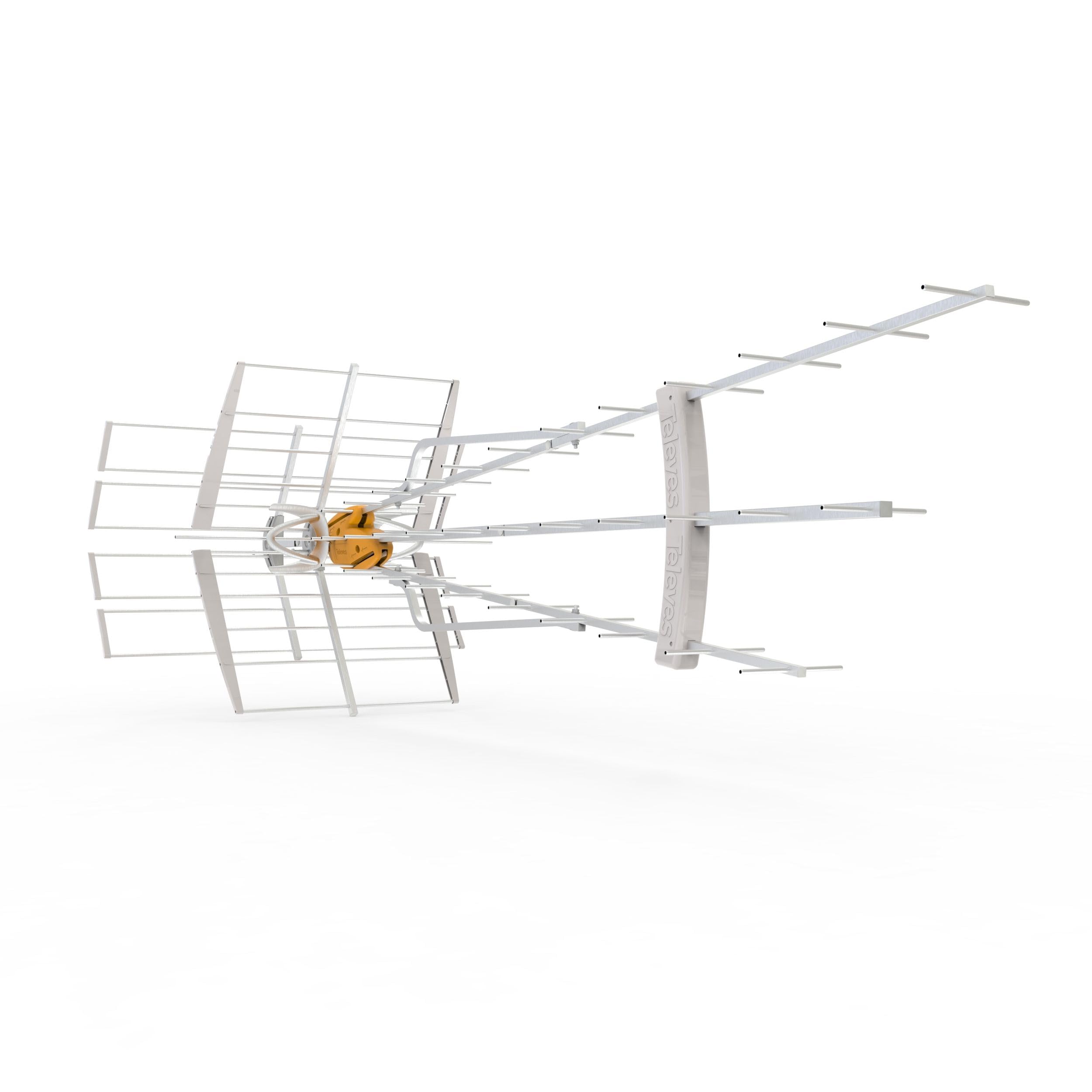
This is the undisputed heavyweight champion for attic installations in fringe areas. The Televes DAT BOSS Mix LR uses a stacked triple-boom design with a staggering 46 dBi of UHF gain, specifically engineered to punch through signal-robbing roofing materials and bring in distant stations that lesser antennas miss. Its built-in TForce amplifier automatically adjusts gain per band to prevent overload from strong local stations while boosting weak ones.
Real-world reviews confirm its dominance: users in rural Wisconsin 70 miles from towers reported 37 usable channels, and a Seattle-area user in an extreme fringe location eliminated pixelation that plagued previous antennas. The integrated FM, LTE, 4G, and 5G filtering is a critical forward-thinking feature for anyone worried about future cellular interference degrading their OTA signal.
Assembly is more involved due to the size (over 84 inches long), and the premium price reflects its professional-grade performance and European engineering. For anyone with a concrete tile roof or living 50+ miles from the transmitters, this antenna is the definitive solution for reliable, free TV.
Why it’s great
- Unmatched 46 dBi UHF gain for fringe reception
- Intelligent TForce amplification prevents overload
- Advanced LTE/5G filtering protects future signal quality
- Professional-grade build quality with heavy all-metal construction
Good to know
- Very large size (84″) may be tough for small attics
- Significant investment compared to budget options
- Assembly requires careful attention to instructions
2. Televes DiNova Boss Mix 144286

If the DAT BOSS LR is a long-range missile, the DiNova Boss Mix is a precision multi-tool. This 31-inch antenna comes fully assembled in a weather-resistant radome, making it a dream for a tidy, low-fuss attic installation. Its claim to fame is the TForce intelligent gain control, which dynamically adjusts amplification to eliminate the “cliff effect” where signals suddenly drop out—a common problem with fixed-gain amplifiers in strong signal areas.
User feedback repeatedly highlights how well it pulls in channels from 30 to 50 miles away, even in hilly terrain and through heavy obstructions. One reviewer mounted it indoors and still picked up a CBS affiliate 90 miles away, a testament to its sensitive amplifier. The integrated filtering for FM, 4G, and 5G is identical to its big brother, providing peace of mind against interference.
The trade-off is a maximum range of about 60 miles and a focus on High-VHF and UHF, meaning it won’t match the raw distance of the larger DAT BOSS LR. For most suburban and light-rural homes wanting a compact, high-performance solution with minimal assembly, this is the smarter choice.
Why it’s great
- No assembly required, installs in minutes
- Smart TForce auto-gain prevents signal overload
- Compact, low-profile design fits easily in attics
- Excellent filtering eliminates cellular interference
Good to know
- Lower max range (50-60 miles) than larger models
- Does not handle Hi-VHF as strongly as dedicated Yagis
- Premium price reflective of its smart electronics
3. Antennas Direct ClearStream MAX-V
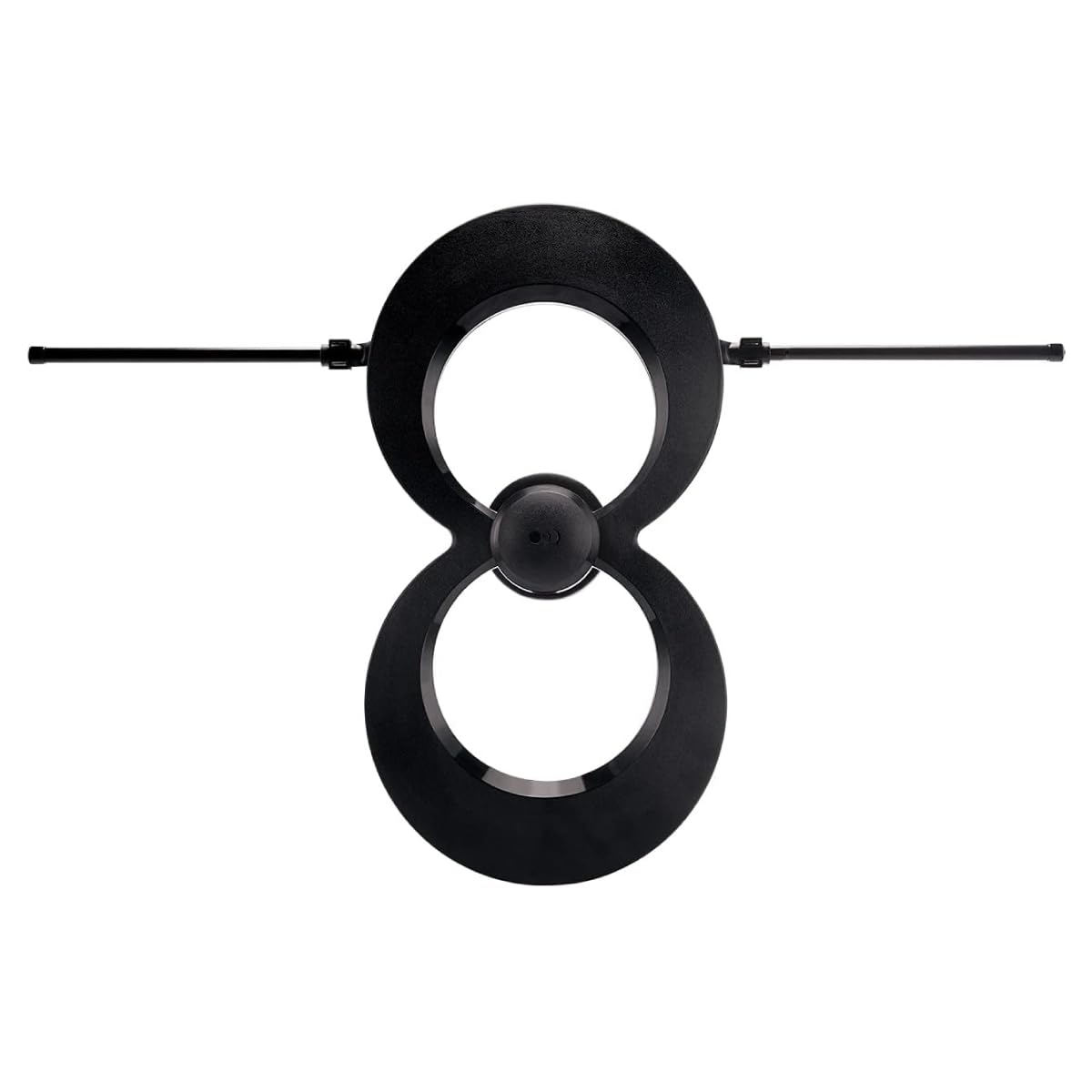
The ClearStream MAX-V is a standout choice for any situation where your broadcast towers are not all in one direction. Its unique double-loop design provides a 65-degree beam angle, which is wider than a traditional Yagi, allowing it to pull in signals from the front and sides more effectively. This makes it ideal for homes located in the middle of a city ring of towers or for those who don’t want to aim a single-direction antenna perfectly.
Reviews are exceptionally strong, with one user declaring it the best antenna he tested out of ten different models. In an attic installation in New Jersey, it pulled in 85 channels from the NYC market 28 miles away, reliably capturing VHF stations (like WABC) that other antennas failed to lock onto. The included steel wall bracket is a nice touch for a clean, low-profile install on a rafter or wall.
For users with towers within 50 miles and a need to cover multiple broadcast clusters, this is a highly effective and well-built option.
Why it’s great
- Excellent multi-directional reception for diverse tower layouts
- Surprisingly strong VHF performance for its compact size
- Simple assembly and solid steel wall bracket included
- Lifetime manufacturer warranty adds peace of mind
Good to know
- Max range of 60 miles is lower than top-tier Yagis
- May require an amplifier for long cable runs
- Not as directional, so it can pick up more noise
4. Five Star Outdoor HDTV Antenna

The Five Star antenna makes a bold 200-mile range claim, and while real-world performance is typically less, it does offer extended receiving elements that are physically longer than standard budget Yagis. This extra length helps with VHF and UHF capture, giving it a solid edge over many cheap alternatives for users 30 to 60 miles from towers. The package includes a J-pole mount and 40 feet of RG6 coax, which is a welcome inclusion for a quick attic setup.
Buyer experiences are mixed but generally positive for medium-range use. A user in Detroit at 20 miles reported flawless, clear reception, while another in Arizona has had it on their roof for four years, getting around 70 channels. However, some users note the construction feels a bit flimsy, and a few have reported issues with the coaxial connector.
For a mid-range price, you get a long antenna that has the physical potential to grab distant signals. Be prepared for tighter assembly (the rods can require significant force to seat properly), and treat it as a 40-60 mile antenna in an attic, not a 200-mile marvel. It is ATSC 3.0 ready for future NextGen TV broadcasts.
Why it’s great
- Extended receiving elements help capture weak signals
- Includes J-pole mount and 40ft RG6 cable
- Works well for many users in the 20-60 mile range
- ATSC 3.0 compatible for future-proofing
Good to know
- Build quality feels less rugged than premium options
- Coaxial connector can be a point of failure
- Real-world range is far less than the 200-mile claim
5. GE Pro Outdoor Yagi 33685

GE is America’s #1 antenna brand for a reason: they deliver consistent, reliable performance without gimmicks. The GE Pro Outdoor Yagi is a classic long-range design rated for up to 80 miles, and it performs admirably in attic installations. It’s an ideal choice for the cable cutter who wants a straightforward, no-nonsense antenna from a company that stands behind its product with a limited-lifetime replacement pledge and free U.S.-based tech support.
User experiences are very strong across the board. One reviewer successfully installed it in a Florida attic under a concrete tile roof at 35 miles from the towers and reported better signal than cable, with no pixelation. Another user in Colorado was pulling in 93 stations from Nebraska, a testament to its raw sensitivity. The main trade-off is that assembly is required, and the manual is not the clearest, but the build quality is considered reliable.
It comes with a weather-resistant J-mount and is designed for outdoor use, meaning it will handle the temperature swings and humidity of an attic with ease. If you want a dependable, well-supported antenna from a household name and don’t need smart amplification, this is a top-tier choice.
Why it’s great
- Excellent long-range reception (up to 80 miles)
- Backed by a US brand with lifetime replacement pledge
- Sturdy build designed to withstand harsh weather
- ATSC 3.0 compatible for next-gen broadcasts
Good to know
- Assembly is required and instructions could be better
- Large size may be cumbersome for small attics
- No built-in amplification for weak signal areas
6. CeKay Outdoor Yagi HD Antenna

The CeKay Yagi is a fantastic entry-level antenna that punches above its price point. Its all-metal construction is a clear step up in durability from the plastic-heavy budget options, and the inclusion of a 40-foot RG6 coaxial cable and J-mount means you have everything you need for a complete attic installation right out of the box. It is rated for UHF, VHF, and is even ATSC 3.0 compatible, making it a future-proof choice for the budget-conscious cord cutter.
User reviews are overwhelmingly positive, with many praising its performance in attic installations. One user with a concrete tile roof was shocked to pick up 51 local channels. Another reviewer noted it provided 100% signal metrics on channels that were previously unreliable with a cheap amplified flat antenna. The main criticism is that the rods fit extremely tightly and may require a hammer to fully seat them, which can be a minor hassle during assembly.
Consider that for the low price, the metal elements are thinner than premium models, and the instruction manual is basic. It also does not include a preamplifier, so if you have a long cable run from the attic to your TV, you may need to buy one separately. For short to medium range (10-50 miles), this is a remarkable value that delivers solid performance.
Why it’s great
- All-metal build is durable for the price point
- Includes a long 40ft RG6 coax cable and J-mount
- Very effective for attic installations at 10-50 miles
- ATSC 3.0 compatible for future broadcasts
Good to know
- Rods require significant force to assemble
- No preamplifier for long cable runs
- Metal elements are thinner than premium competitors
7. McDuory Yagi Outdoor Antenna

The McDuory Yagi proves that a simple, passive design can be exceptionally effective, especially for VHF reception. Many users have reported that this antenna successfully pulled in high-VHF channels (like 8 and 19) that other, more expensive options failed to detect. Its 150-mile range claim is optimistic, but for users within 30-50 miles of the towers, it delivers a sharp, stable picture with a low, entry-level investment.
The construction is a mix of metal elements and plastic sockets, and while this keeps the weight down for easy handling, it does require careful assembly. One savvy user used pop rivets to secure the long elements in the plastic sockets for a more permanent feel. The lightweight materials also mean it lacks the robust, heavy-duty feel of the Televes or GE models. It is a completely passive antenna, so you will need a separate amplifier for very long cable runs.
For the budget price, this is an incredibly capable antenna for its primary use case: getting free local channels in a strong-signal suburban area. Its VHF performance is a standout feature at this price point. If you need a simple, effective antenna and are willing to spend a few minutes on careful assembly, this is a reliable and affordable starting point.
Why it’s great
- Exceptional VHF reception for a budget antenna
- Low investment to start cutting the cord
- Lightweight and easy to handle during installation
- Produces a stable picture within 30-50 miles of towers
Good to know
- Plastic element sockets may require reinforcement
- No preamplifier or cable included
- Build quality feels less substantial than metal-only designs
FAQ
Will an attic antenna work through a metal roof?
Should I use an amplifier with my attic antenna?
How do I know if my tower is VHF or UHF?
Final Thoughts: The Verdict
For most users, the best attic antenna winner is the Televes DAT BOSS Mix LR because its professional-grade gain and intelligent filtering can punch through any roofing material and lock in distant signals reliably. If you want a compact, no-assembly solution with smart auto-gain for a suburban setting, grab the Televes DiNova Boss Mix. And for a budget-friendly entry point that doesn’t compromise on VHF performance, nothing beats the value of the McDuory Yagi.