
Our readers keep the lights on and the weekend projects moving. As an Amazon Associate, I earn from qualifying purchases.
A motion-activated box that barks like a 90-pound guard dog without the food bill, vet visits, or indoor accidents is the straightest path to keeping raccoons off your chicken coop and deer out of your tomatoes. These units use a passive infrared sensor to detect movement, then blast a canine warning that tells trespassing wildlife the territory is claimed.
I’m Rikta — the founder and writer behind FitlyFast. I’ve spent thousands of hours cross-referencing outdoor deterrent specs, from solar panel wattages to PIR sensor angles, so you don’t end up with a unit that falses on every blowing leaf.
These alarm modules differ wildly in battery capacity, recording flexibility, and false-alarm logic, so choosing the wrong one means either a silent yard or a neighbor complaint. This guide breaks down the spec-to-spec tradeoffs of every leading barking dog alarm currently on the market so you can match the right hardware to your exact pest pressure.
How To Choose The Best Barking Dog Alarm
Wild animals habituate quickly. A unit that plays one sound at one volume will stop working inside two weeks, so the critical buying decision is how many deterrent tools — sounds, volume levels, strobe frequencies, and enhanced modes — the box has to stay ahead of a raccoon’s learning curve.
PIR Sensor Quality and Range
The passive infrared sensor is the brain. A cheap analog sensor picks up every warm body within 26 feet but can’t distinguish a deer from a 130-degree driveway heat pocket, causing constant false alarms. Premium units use digital probes or multi-zone detection logic that require a larger thermal signature (roughly cat-size or bigger) before triggering, drastically cutting nuisance activations from wind-blown branches or small birds.
Sound Variety and Volume Control
A single barking dog sound loses its scare factor within days. Alarms offering 10 to 13 different sounds — including gunshots, eagle screeches, and enhanced-frequency tones — let you rotate the auditory threat so animals never fully adapt. Adjustable volume is equally crucial: 130 dB might be right for a rural farm but will get you evicted from a suburban lot, so a unit with 3 or 4 levels of loudness gives you control over your social situation.
Solar Panel Efficiency and Battery Capacity
All solar alarms are not equal. Many budget units pack small 600 mAh batteries that drain in two overcast days, while premium builds use 2000 mAh cells paired with monocrystalline panels that trickle-charge even in cloudy weather. If your alarm sits under a porch awning or in a shaded garden, a USB backup charging port is the safety net that keeps the barking going through a week of rain.
Quick Comparison
On smaller screens, swipe sideways to see the full table.
| Model | Category | Best For | Key Spec | Amazon |
|---|---|---|---|---|
| Wuloo D102P | Premium | Long-term habituation prevention | 2000 mAh battery / digital probe | Amazon |
| ChunHee 2-Pack | Premium | Multi-zone coverage (2-pack) | 125° detection angle / IP65 | Amazon |
| HULPPRE Solar | Mid-Range | Budget-conscious sound variety | 13 sounds / 26 ft range | Amazon |
| ROYELLE 911N | Mid-Range | Custom recording + remote silence | 20 sec recording / 3 volume levels | Amazon |
| SENKEFEI SS | Mid-Range | Timer mode for night-only use | 130 dB / USB+solar dual charge | Amazon |
| ChunHee SL16 | Mid-Range | Stronger intruder deterrence | 110° sensing / 20 sec recording | Amazon |
| SUNYOU Generic | Budget | Indoor or covered entry alert | 1000 ft wireless / no solar | Amazon |
In‑Depth Reviews
1. Wuloo D102P Upgraded Solar Motion Sensor Noise Maker
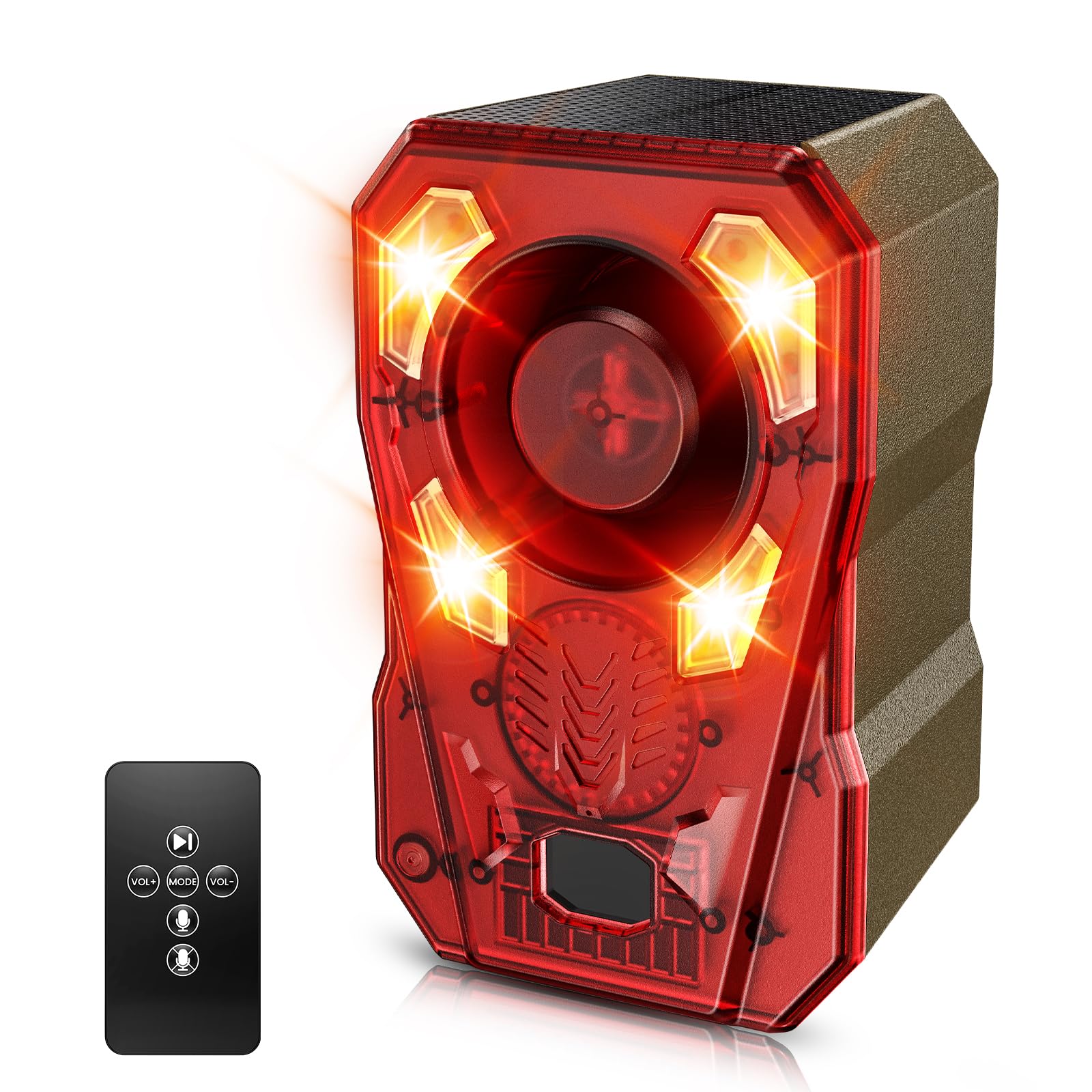
The Wuloo D102P is the only unit here using a digital probe instead of a traditional analog PIR sensor, which makes it dramatically better at ignoring small animals, heat shimmer, and wind-triggered false alarms. Its massive 2000 mAh battery — roughly triple what most competitors pack — delivers up to 12 months of night-only operation on a full charge, so you aren’t climbing a fence post every two weeks to reset a dead alarm.
It offers 10 different ringtones plus a custom recording slot, four volume levels including a silent strobe-only mode, and two enhanced-frequency modes that emit a high-pitched tone alongside the regular alarm for especially stubborn deer or raccoons. The IP65 seal uses waterproof glue on every mounting connection, and the buttons sit under a rubber cover on the bottom — design choices that explain why customers report these lasting through storms that killed cheaper units in weeks.
A few users noted that the non-siren sounds (barking dog, gunshot) come through thin and slightly distorted compared to the siren and eagle-screech options, and the plastic mounting bracket is brittle if overtightened. But for the buyer who values false-alarm rejection above all else, the digital probe alone justifies the position at the top of the list.
Why it’s great
- Digital probe virtually eliminates false triggers from small animals and wind.
- 2000 mAh battery runs months in night-only mode.
- Fully waterproof construction with sealed buttons.
- Enhanced frequency mode for habituated pests.
Good to know
- Barking dog and gunshot audio tracks sound a bit artificial.
- Plastic mounting hardware can crack if over-tightened.
- Requires clear southern sun exposure for optimal charging.
2. ChunHee Solar Motion Sensor Alarm 2-Pack (SL23)
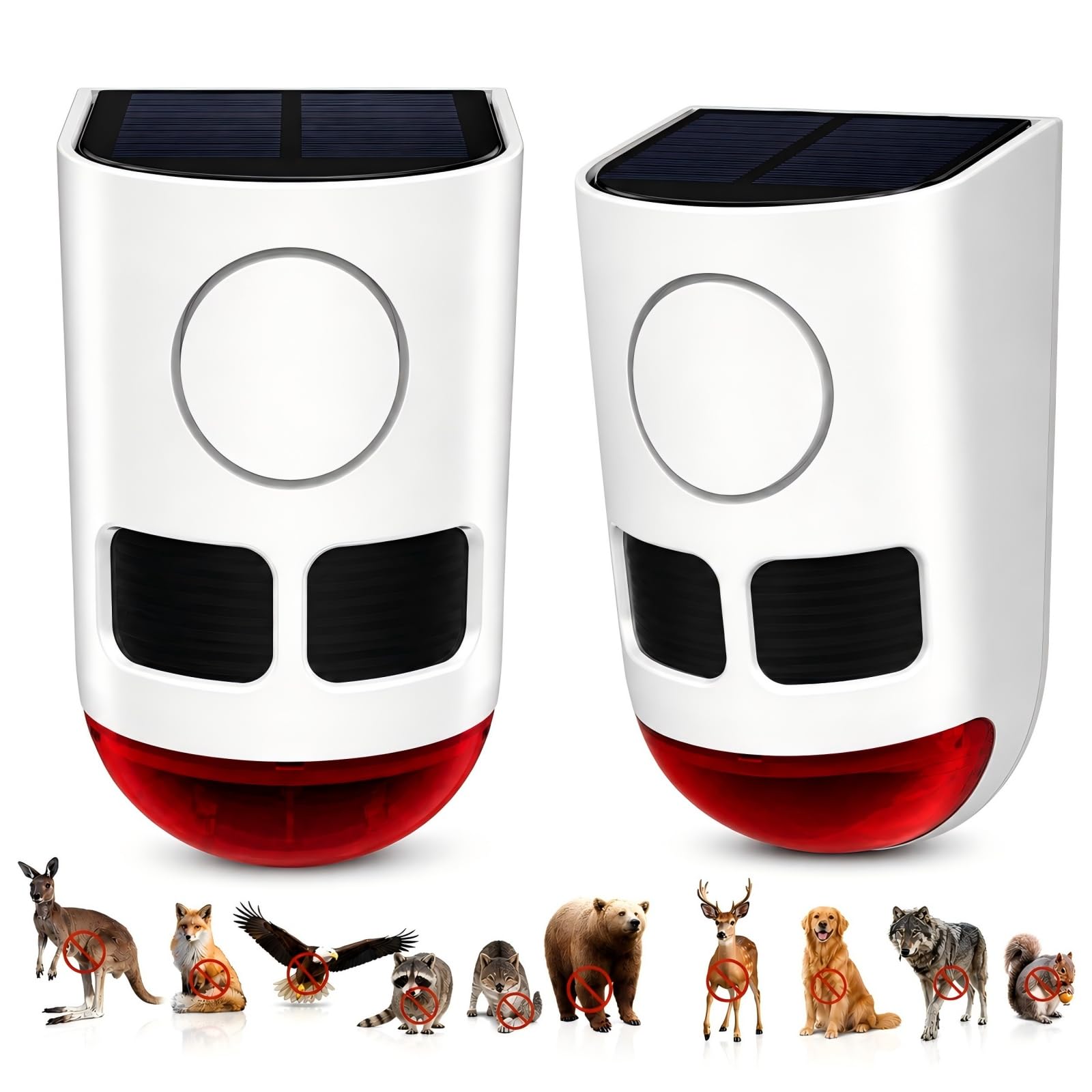
The ChunHee 2-pack costs the same as many single units, making it the obvious choice for buyers who need to cover a chicken coop perimeter, garden grid, or a driveway with two entries. Each unit sweeps a 125-degree field with a 129 dB siren backed by six bright LED strobe lights, giving you genuine multi-angle coverage for a medium-sized property without buying separate chargers or solar panels.
It runs four working modes — 24-hour sound, night-only sound, silent strobe, and a daytime-only mode — so you can run strobe-only on the unit facing the street to avoid walking false alarms while keeping full audio on the coop side. The IP65 seal handles rain and snow, and the USB backup port keeps the bark alive through extended overcast spells when the solar panel can’t fully recharge.
Some user reports mention the control button becomes inaccessible once the unit is mounted flush in the bracket, so you’ll want to set your mode before final installation. A small number of units also had overly sensitive sensors that triggered on sunlight reflection, though this appears isolated rather than a design flaw.
Why it’s great
- Two alarms for the price of one premium single unit.
- 125-degree PIR covers wide zones without overlap gaps.
- Strobe-only mode prevents neighbor complaints at night.
- USB backup ensures operation during cloudy weeks.
Good to know
- Barking dog preset sounds artificial compared to real recordings.
- Control button is hard to reach after bracket mounting.
- Some units experience false triggers from sun glare.
3. HULPPRE Solar Outdoor Motion Sensor Alarm

The HULPPRE stands out for its 13 built-in sounds that cycle automatically with each motion trigger, which directly addresses the habituation problem that plagues single-sound alarms. A raccoon that dodges one bark gets a gunshot the next time, then a siren, then a different bark — the rotation keeps the threat unpredictable far longer than a fixed loop.
It offers four working modes including a pure night-only option that pairs the sound with red and blue flashing strobes, so you can run sound during dark hours when pests are active and stay silent during the day to conserve battery. The solar panel keeps it charged in direct sun, and the included mounting hardware allows fence, wall, or ground-stake installation in about 10 minutes.
A consistent note from buyers is that the unit lacks any volume control — at 130 dB it is genuinely loud, which works for farmers but causes problems in suburban lots. The activation duration was also reported to run long (up to an hour), meaning a single passing possum can trigger barking for a full minute, which may irritate neighbors.
Why it’s great
- 13 rotating sounds prevent animal habituation effectively.
- Four modes including red/blue strobe-only for night coverage.
- Fast 10-minute installation with included stake and screws.
- Solar powered with no additional battery purchase needed.
Good to know
- No volume adjustment — full 130 dB at all times.
- Alarm activation duration is quite long per trigger.
- Too loud for dense suburban use near neighbor windows.
4. ROYELLE 911N Solar Outdoor Motion Sensor Alarm

The ROYELLE 911N brings a feature rarely seen at this tier: a 20-second custom recording function plus three adjustable volume levels, so you can record your actual dog barking or your own voice and play it back at a volume that fits your property size. This is especially useful if your real dog is indoors at night and you need a convincing audio stand-in on the patio.
It includes a remote control that lets you silence the alarm from the house during storms or false triggers without walking outside, and the IP55 waterproof housing keeps the electronics safe through rain and snow. The solar panel handles the primary charging, while the included DC cable acts as a backup during long stretches without sun exposure.
Buyers report it works extremely well for keeping deer off landscaping and raccoons away from trash cans, but the 10-20 foot detection range is shorter than some competitors, and the unit needs recharging every 12-15 days under heavy activity. The AAA battery backup is included but primarily serves as a buffer rather than a primary power source.
Why it’s great
- Record your own dog or voice for truly convincing deterrence.
- Remote control silences false alarms from inside the house.
- Three adjustable volume levels fit different property types.
- IP55 rating plus USB backup charging for cloudy weather.
Good to know
- Detection range limited to 10-20 feet.
- Battery holds charge roughly 12-15 days with heavy triggering.
- PIR can be tripped by windblown plants near the sensor.
5. SENKEFEI SS Solar Outdoor Motion Sensor Alarm

The SENKEFEI SS adds a timer mode to the standard 24-hour and night-only options, letting you schedule the alarm to run only during specific windows — useful if you know raccoons hit the garden between midnight and 4 AM but don’t want barking at every 6 PM delivery truck. It also packs dual USB and solar charging, so a completely dead battery can be topped up via a wall plug in a couple of hours.
The default sound is a loud gunshot immediately followed by barking dogs, which testers describe as “SWAT-like” in its intimidation factor. The three volume levels range from barely audible indoors to full 130 dB outdoors, and the recording function allows you to overlay a calmer sound if the default is too aggressive for your setting.
Long-term users report the unit suffers from the same false-trigger problem as most analog PIR alarms — wind, fog, and rain can set it off — and the lack of sensitivity adjustment means you can’t tune it to ignore small animals. A few units reverted to the default loud recording after the custom sound was set, requiring a factory reset.
Why it’s great
- Timer mode limits alarm to specific hours for neighbor sanity.
- Dual USB and solar charging prevents complete dead-battery failure.
- Gunshot-plus-bark sequence is highly effective initial deterrent.
- Survives reported use in -20°F winter conditions.
Good to know
- Frequent false triggers from wind, rain, and fog.
- No sensitivity adjustment to filter small animals.
- Custom recording sometimes reverts to factory default.
6. ChunHee SL16 Solar Motion Sensor Alarm Outdoor
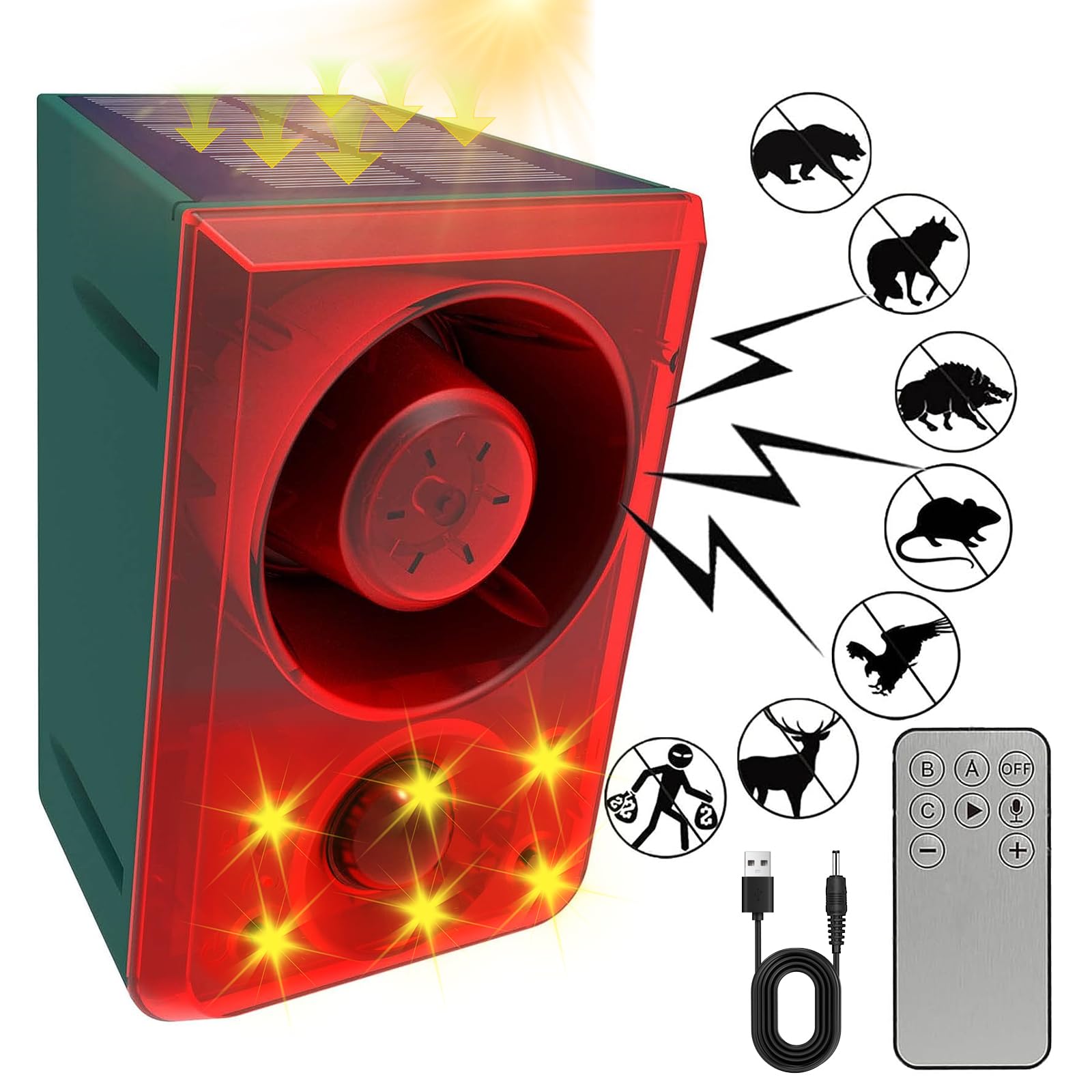
The ChunHee SL16 is a near-twin to the SENKEFEI but with a slightly wider 110-degree sensing angle and a maximum detection range of 8 meters, giving you an extra couple of feet of warning before an animal reaches your garden border. Its 20-second recording function also captures custom sounds, and the three-mode operation (24-hour, night-only, timer) mirrors the best feature set in the mid-range category.
Owners consistently report it as “loud and effective” against coyotes, raccoons, deer, and even bears when mounted at the right height. The IP65 waterproofing survives snow and extreme heat, and the solar panel is robust enough that after an initial one-day charge, the units maintain power through normal use without battery swaps.
The main gripe is that the motion sensor is extremely sensitive — buyers facing public sidewalks or busy streets report constant false alarms from pedestrians and passing cars. The instruction manual’s recommendation to charge for a full day before first use is mandatory, and users who skipped it thought the unit was defective out of the box.
Why it’s great
- 8-meter PIR detection range is best in its price bracket.
- Custom 20-second recording for tailored audio deterrence.
- IP65 build handles snow, rain, and direct sun exposure.
- Large solar panel maintains charge after initial 24-hour top-up.
Good to know
- Extremely sensitive sensor triggers on pedestrians and cars.
- Requires a full day of sun charging before first use.
- Timer mode instructions could be clearer in the manual.
7. SUNYOU Generic Dog Barking Alarm Motion Detector

The SUNYOU breaks the solar-powered mold entirely — it runs on four AA batteries in the sensor and plugs into a wall outlet for the receiver, making it the only unit here that works reliably in shaded garages, enclosed patios, or indoor entryways where solar panels are useless. The wireless transmission range of 1000 feet means the sensor can sit at the far end of a driveway while the alarm box inside the house barks, which is a fundamentally different architecture from the all-in-one solar units.
It ships with 6 realistic dog bark sounds — no gunshots, no sirens — and four volume levels that max out at 110 dB. The receiver also has extra chime options (Welcome, Ding Dong, Melody) so you can use it as a regular door chime during the day and switch to barking dog mode at night for security.
The tradeoff is that the sensor’s PIR is overly sensitive — buyers report it triggers on flying birds, falling leaves, and even large insects — and the 110 dB max volume sounds adequate indoors but struggles to carry in an open yard. It’s best viewed as an entry alert or indoor deterrent, not a true wildlife repellent for a remote garden.
Why it’s great
- 1000-foot wireless range separates sensor from receiver for flexible placement.
- 6 dog bark sounds without gunshots for family-friendly deterrence.
- No solar requirement means reliable operation in full shade.
- Receiver doubles as a door chime during daytime hours.
Good to know
- PIR sensor triggers on leaves, birds, and insects easily.
- 110 dB max volume is weak for large outdoor open spaces.
- Uses disposable AA batteries — no built-in recharging.
FAQ
Will a barking dog alarm work on raccoons that have been raiding my trash for months?
How do I stop the alarm from triggering on every passing car or pedestrian?
What is the difference between 110 dB and 130 dB in practical outdoor use?
Final Thoughts: The Verdict
For most users, the barking dog alarm winner is the Wuloo D102P because its digital probe virtually eliminates the false-alarm frustration that makes people throw cheap units in the trash, and the 2000 mAh battery runs for months without intervention. If you need multi-zone coverage at a reasonable price, grab the ChunHee 2-Pack. And for indoor or fully shaded locations where solar is useless, nothing beats the SUNYOU wireless system with its 1000-foot range.