
Our readers keep the lights on and the weekend projects moving. As an Amazon Associate, I earn from qualifying purchases.
Finding a black spray paint that actually bonds to metal without peeling or promoting rust regrowth is harder than it sounds. Many standard enamels lack the chemical bite needed for ferrous surfaces, leading to chipped finishes and corrosion blooms that ruin weeks of prep work.
I’m Rikta — the founder and writer behind FitlyFast. I’ve spent years analyzing aerosol coatings, evaluating resin content, rust-inhibitor additives, and spray nozzle geometry to separate true protectants from shelf-filler cans.
This guide breaks down the formulations, adhesion mechanisms, and real-world durability of the market’s leading options to help you pick the right black spray paint for metal without wasted money or double coats.
How To Choose The Best Black Spray Paint For Metal
Not every can labeled “black” offers the adhesion and chemical resistance that metal surfaces demand. The resin base, rust-inhibitor technology, and finish type determine whether your project lasts a season or a decade.
Rust Converter vs. Rust-Inhibitive Enamel
A rust converter chemically reacts with iron oxide to create a stable, paintable black layer. These products are ideal for surfaces with moderate rust you cannot fully remove. Rust-inhibitive enamels, by contrast, form a barrier that prevents oxygen and moisture from reaching clean metal. Choose a converter for restoration work; choose an enamel for new or fully stripped surfaces.
Resin Technology: Epoxy vs. Acrylic vs. Oil-Based
Epoxy-based aerosols deliver the hardest, most chemically resistant film, often approaching powder-coat durability. Acrylic enamels dry faster and offer better UV stability, but they lack impact resistance. Oil-based formulations penetrate surface rust better but require significantly longer drying times and stronger solvents for cleanup.
Coverage and Nozzle Quality
Most 11- to 14-ounce cans claim between 8 and 25 square feet of coverage, but real-world yield depends heavily on spray technique and surface texture. A can with a fan-pattern nozzle applies a more uniform film than a cone-pattern nozzle, reducing overspray and the number of coats needed. Check whether the brand offers 360-degree spray or a standard upright-only valve if you plan to paint vertical surfaces.
Quick Comparison
On smaller screens, swipe sideways to see the full table.
| Model | Category | Best For | Key Spec | Amazon |
|---|---|---|---|---|
| Eastwood Extreme Chassis Black Satin | Epoxy Satin | Frame & chassis restoration | 25-35% gloss, 8 sq. ft. coverage | Amazon |
| VHT All-Weather Epoxy SP652 | Epoxy Satin | High-wear parts & fixtures | 550°F intermittent heat tolerance | Amazon |
| Seymour 16-45 Rust Converter | Rust Converter | Rust neutralization & priming | 16 oz, penetrates rust chemically | Amazon |
| VHT Roll Bar & Chassis SP671 | Epoxy Satin | Roll bars & chassis coatings | 250°F intermittent, no primer needed | Amazon |
| Krylon Rust Protector Enamel | Rust-Inhibitive Enamel | Quick decorative touch-ups | 12 oz, dries in 8 minutes | Amazon |
| Rust-Oleum Stops Rust Gloss Black | Oil-Based Enamel | Multi-surface corrosion barrier | 6-pack, 12 oz each | Amazon |
| Polar Direct To Rust Gloss Black | Direct-to-Rust Enamel | Entry-level rust restoration | 13.5 oz per can, pack of 2 | Amazon |
In‑Depth Reviews
1. Eastwood Extreme Chassis Black Satin Aerosol

The Eastwood Extreme Chassis Black sits at the top of the list for a straightforward reason: it uses a dense, epoxy-heavy aerosol formulation that lays down a thick, chip-resistant film in fewer coats than most competitors. The satin finish lands between 25 and 35 percent gloss, exactly the look of OEM frame and underbody coatings, and the paint resists lifting even when applied over a previously painted surface. Users consistently report that this product hardens into a finish that resists brake fluid, road salt, and stone chips better than any other rattle can in the category.
Coverage comes in at roughly 8 square feet per can, which is lower than standard enamel cans due to the higher solids content. That trade-off is intentional — more solids means more film build per pass and fewer total coats to achieve full hide. The nozzle delivers a wide, fan-shaped spray pattern that mimics a paint gun, reducing the learning curve for beginners and cutting overspray waste for experienced restorers. The 36-hour full-cure window is longer than some alternatives, but the resulting hardness justifies the wait.
This is the go-to choice for frame-off restorations, roll-cage coating, and any metal surface that will see physical abrasion or chemical exposure. If you value long-term adhesion and a factory-satin look over fast drying, this can earns its place as the top pick.
Why it’s great
- Thick epoxy film resists chips and scratches far better than standard enamels
- Wide fan-spray pattern reduces runs and overspray
- Matches OEM satin chassis finish exactly
Good to know
- Low coverage of 8 sq. ft. per can means larger projects need multiple units
- Full cure takes 36 hours in temperate conditions
2. VHT All-Weather Epoxy Paint SP652 Satin Black

The VHT All-Weather Epoxy SP652 builds on the same chassis-grade DNA as the roll-bar formulation but adds an extra layer of thermal stability, withstanding intermittent temperatures up to 550°F. This makes it uniquely suited for engine components, brake calipers, exhaust brackets, and any metal part that fluctuates between ambient and hot operating temperatures. The satin black finish is chemically resistant enough to hold up against gasoline, oil, and degreasers without softening or blistering.
Application technique matters more here than with some other VHT products — the paint is finicky about ambient temperature. Users report best results when spraying between 65°F and 80°F, with multiple light coats applied 10 minutes apart. The nozzle produces a consistent cone pattern that works well for small parts like bolts, brackets, and washers, but the narrower spray angle means larger panels require more passes and patience to avoid tiger-striping. One can covered four car wheels with two light coats and one wet coat.
For restoration work on engine bays or painted suspension components where heat cycles degrade standard enamel, the SP652 delivers a satin finish that stays hard and doesn’t yellow. It’s a premium formulation for a specific use case, and it executes that use case better than any aerosol in its class.
Why it’s great
- Exceptional heat tolerance up to 550°F for engine-bay parts
- Durable film that resists chemicals and solvents
- Matches powder-coat appearance on small brackets and fasteners
Good to know
- Temperature-sensitive application window can cause inconsistent results
- Narrow spray pattern is less efficient on large flat surfaces
3. Seymour 16-45 Rust Converter, Black

The Seymour 16-45 is not a paint in the traditional sense — it is a chemical rust converter that turns iron oxide into a stable black polymeric coating. When applied to rusted metal, the formula penetrates the corrosion layer and reacts with the iron to create an inert, paintable surface that stops further oxidation. This is the right product when you cannot mechanically remove all the rust and need a chemically bonded barrier instead of just a cover-up.
Users consistently praise the way this spray bonds to surfaces that would cause standard enamel to flake within weeks. It dries to a matte black finish that can serve as a final coat in low-visibility areas or as a primer for a topcoat in visible zones. The 16-ounce can provides good coverage on trailers, fence sections, mower decks, and vehicle frames with moderate rust. Customer feedback highlights its performance on outdoor grills and zero-turn mowers where heat and humidity accelerate normal paint failure.
The main limitation is that this product only works on surfaces that already have rust — it will not adhere well to clean, bare metal. If you are painting new steel, you need a different product. But for restoration projects where rust is the enemy, the Seymour 16-45 delivers the most reliable conversion mechanism in this lineup.
Why it’s great
- Chemically neutralizes rust instead of just covering it
- Creates a stable black coating ready for topcoat or use as final finish
- Reduces manual sanding and wire-brushing time significantly
Good to know
- Only effective on rusted metal — will not bond to clean surfaces
- Matte finish may require topcoat for high-visibility projects
4. VHT Roll Bar & Chassis Paint SP671 Satin Black

The VHT SP671 is a purpose-built epoxy coating for roll bars, trailers, truck frames, and equipment racks. It cures to a satin finish that looks deliberately baked-on, and it carries a 250°F intermittent heat rating that covers everything under a vehicle body. The standout feature is the no-primer formulation — VHT engineered this paint to bite directly into clean or lightly sanded steel, cutting project time by skipping the primer step.
Customer experiences confirm that this paint holds up for years under off-road conditions, including mud, salt spray, and brush abrasion. Users report applying three to four coats over wire-brushed and acetone-cleaned frames, then seeing zero peeling or corrosion after two years in Texas heat and winter salt. The aerosol dries to the touch in 30 minutes and fully hardens overnight, making it practical for one-day restoration schedules. The only documented downside is an occasional defective nozzle that sprays erratically, though this appears to be a batch-specific issue rather than a design flaw.
If your project involves exposed underbody metal that needs a fast, durable, corrosion-resistant satin finish without primer complexity, the SP671 is the most efficient solution in this review.
Why it’s great
- No primer needed — direct application saves prep time
- Fast drying at 30 minutes to touch, overnight to full cure
- Extremely durable satin finish tested in off-road environments
Good to know
- Occasional nozzle issues reported in some production batches
- 11 oz can has lower coverage than 14 oz alternatives
5. Krylon Rust Protector Enamel, Satin Black

Krylon’s Rust Protector Enamel brings the brand’s household accessibility into the metal-paint category. The formulation includes rust-inhibitive additives that help shield the paint film from undercut corrosion, and the 360-degree continuous spray valve lets you paint at any angle without losing pressure. Dry-to-touch in roughly 8 minutes makes this the fastest-drying option in the roundup, an advantage for projects that need multiple coats in a single afternoon.
The enamel lays down an even satin finish on clean metal, wood, and masonry, and the 12-ounce can covers up to 25 square feet per coat — more than double the coverage of the epoxy-heavy chassis paints. This is an edge for large decorative projects like metal shelving, light fixtures, or furniture where extreme impact resistance is less critical than speed and uniformity. Users note that the white plastic insert in the nozzle cap is a spray-control limiter; removing it increases flow but makes the pattern harder to manage.
For light-duty metal painting where budget and drying speed matter more than chemical resistance or chip protection, the Krylon delivers reliable performance. It is not a restoration-grade coating, but for routine maintenance and cosmetic refreshes it punches well above its tier.
Why it’s great
- Exceptionally fast drying at 8 minutes to touch
- Wide coverage of 25 sq. ft. per can reduces total cost for big projects
- 360-degree nozzle works at any angle for tight access spots
Good to know
- Less impact and chemical resistance than epoxy-based paints
- Requires clean, rust-free metal for best adhesion
6. Rust-Oleum Stops Rust Gloss Black 6-Pack

Rust-Oleum’s Stops Rust series has been a household name for decades, and the Gloss Black 6-pack is the volume play for anyone tackling multiple projects or large surfaces. The oil-based formula cures into a hard gloss shell that resists abrasion, fading, and chipping, with a 2-to-4-hour dry-to-touch window that is slower than the Krylon but yields a thicker final film. Coverage is rated at 15 to 25 square feet per can, and the gloss finish provides a high-shine look that works on metal furniture, tools, gates, and outdoor fixtures.
The 6-pack configuration brings the per-can cost down significantly, making this the most economical option when you need consistent color across a fence, railing, or set of chairs. Reviews highlight the paint’s ability to refresh 15-year-old patio furniture to near-original appearance, and the oil base flows well enough to minimize brush marks and roller stipple even when applied with a tool instead of spray. The downside is that the nozzle design has been revised in recent years — some users find the new spray head clogs more frequently and the can top is difficult to remove by hand.
This is the best pick for bulk applications where consistency across multiple items matters and where a high-gloss look is desired. For deep rust protection, the included rust-inhibitive additives are effective on clean surfaces, but this is not a direct-to-rust formulation.
Why it’s great
- High per-unit value with 6 cans in one order
- Gloss finish with strong abrasion and fade resistance
- Oil-based formula yields a thick, durable film
Good to know
- Newer nozzle design prone to clogging
- Slower drying time than acrylic or epoxy alternatives
7. Polar Direct To Rust Gloss Black 2-Pack
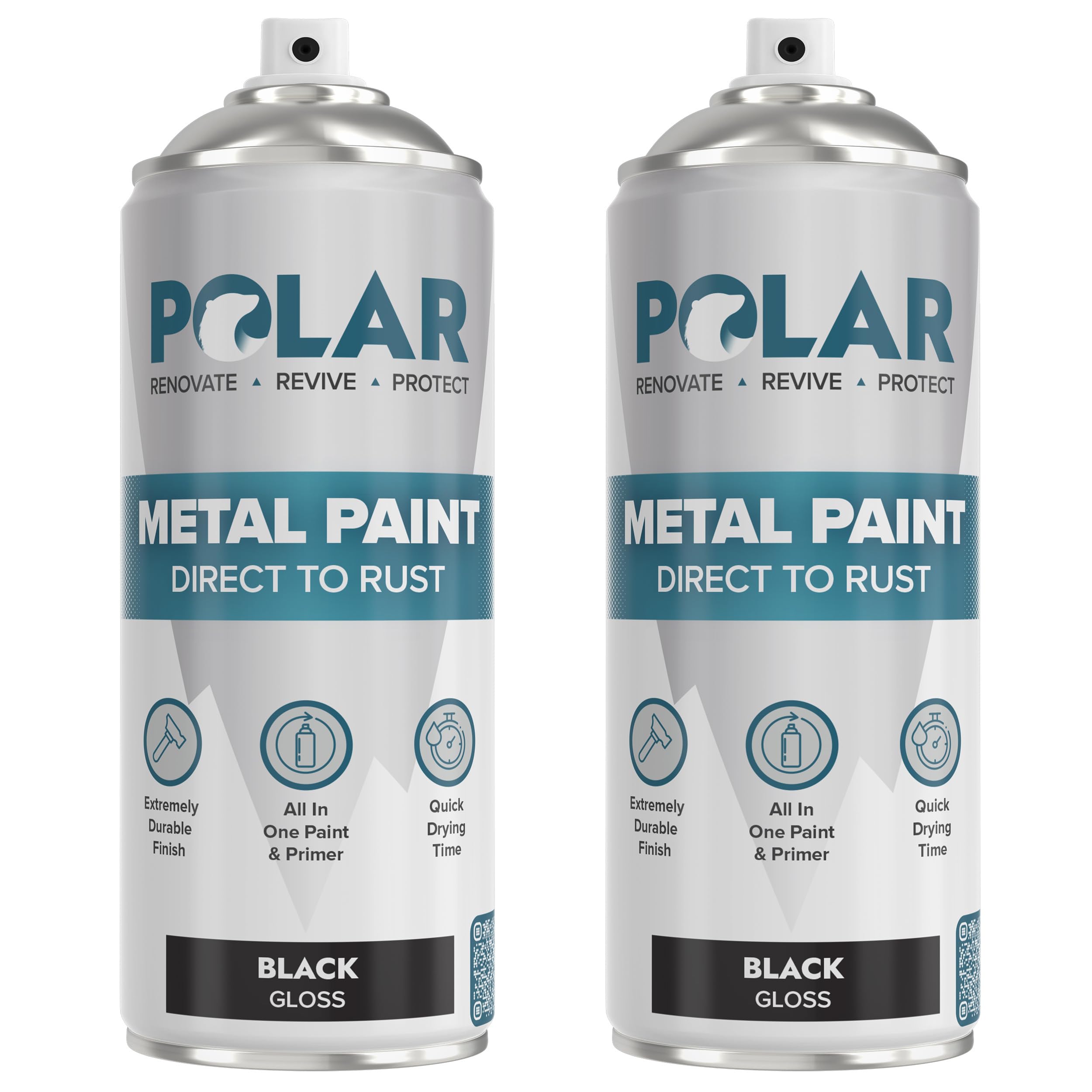
Polar’s Direct To Rust Gloss Black enters the market as an accessible option for first-time restorers and small-project DIYers. The 2-pack provides a total of 27 fluid ounces of gloss black enamel formulated to act as primer, undercoat, and topcoat in one application. The can claims a quick-dry time of 20 minutes between coats, and the gloss finish offers a bright, reflective surface that works well on bike frames, garden furniture, and metal gates.
Customer experiences reveal a split identity. Positive reviews note good coverage on trailer restoration after wire-wheel prep, while negative feedback points to peeling on poorly prepared surfaces and reports of cans arriving with low propellant or defective valves. The relatively high number of adhesion complaints suggests this paint demands more surface prep than the epoxy alternatives — the direct-to-rust marketing is accurate for light surface rust but does not compensate for loose scale, oil, or moisture on the substrate.
The Polar 2-pack fits best for low-stakes decorative projects where budget is a primary concern and where the user is willing to do thorough sanding and cleaning. For critical structural metal or high-visibility automotive restoration, the epoxy formulations from VHT or Eastwood are safer investments.
Why it’s great
- Three-in-one primer, undercoat, and topcoat simplifies the process
- Two-pack provides good volume for small restoration projects
- Gloss finish gives a fresh, bright appearance on renovated items
Good to know
- Adhesion is weaker than epoxy paints — requires meticulous surface prep
- Some quality-control issues with can pressure and nozzle function
FAQ
Can I spray black paint directly over rust without sanding it first?
What is the difference between a rust converter and rust-inhibitive paint?
How many coats of black spray paint are needed for outdoor metal furniture?
Final Thoughts: The Verdict
For most users, the black spray paint for metal winner is the Eastwood Extreme Chassis Black Satin Aerosol because it delivers the highest film hardness and chip resistance of any rattle can, with a satin finish that matches factory chassis coatings. If you want excellent heat resistance for engine-bay parts, grab the VHT All-Weather Epoxy Paint SP652. And for chemically neutralizing rust with minimal prep, nothing beats the Seymour 16-45 Rust Converter.