
Our readers keep the lights on and the weekend projects moving. As an Amazon Associate, I earn from qualifying purchases.
Sweating through a summer night parked at a rest stop or trailhead is the fastest way to kill the romance of van life. The right air conditioner for your rig is the difference between a restful sleep and a restless, miserable evening. It’s not just about raw BTUs; it’s about balancing cooling power with your electrical system’s limits, your roof’s structural integrity, and the ever-present need for quiet operation.
I’m Rikta — the founder and writer behind FitlyFast. I’ve spent years dissecting portable and rooftop RV AC specs, cross-referencing manufacturer claims with real-world owner feedback to separate marketing fluff from functional hardware.
This guide breaks down the critical specs and installation realities you need to know before buying a new air conditioner for van life. You will learn exactly which features matter most for off-grid performance and daily comfort.
How To Choose The Best Air Conditioner For Van Life
Selecting the right AC for your van is a balancing act between cooling capacity, power consumption, physical size, and installation effort. You can’t just grab the cheapest or most powerful unit and expect it to work. You need to match the unit to your vehicle’s electrical system, roof design, and how you intend to use it — whether that’s full-time living or weekend trips.
Power Source and Efficiency: 115V AC vs. 12V DC vs. Battery Powered
The single biggest decision is whether your AC runs on standard 115V shore power or your van’s 12V battery bank. Standard RV rooftop units (115V AC) deliver massive cooling but require a hefty generator or shore power connection. True 12V DC units are the gold standard for off-grid van life because they run directly from your battery and solar system without a power-hungry inverter in between. Look for inverter-driven compressors that vary speed based on demand — they consume significantly less energy than fixed-speed models, which cycle on and off at full power.
Cooling Capacity (BTU) vs. Space
BTU (British Thermal Unit) measures raw cooling power. A typical van is around 80 to 150 square feet, but insulation quality, window size, and ceiling height affect the real load. For a well-insulated van, 10,000 to 13,500 BTU is usually sufficient. Oversizing can lead to short-cycling, where the unit turns off before dehumidifying the air, leaving you clammy. For a larger Class C or a poorly insulated van, 15,000 to 16,000 BTU provides a faster cooldown and better recovery on hot days.
Installation Complexity and Roof Compatibility
Rooftop units are the most common choice for van life, but they require a 14.25” x 14.25” roof cutout — the standard RV vent opening. You must assess your roof thickness and whether you have the structural support for a unit that weighs 65 to 85 pounds. Non-ducted units are simpler to install than ducted systems but may not distribute air as evenly across long or partitioned vans. Portable units are simpler to place but take up valuable floor or counterspace and require a window vent kit. Mini-splits offer excellent efficiency and quiet operation but involve more complex routing of refrigerant lines.
Noise Levels and Inverter Technology
A noisy AC can ruin the tranquility of your campsite. Look for units rated at or below 55 dB for acceptable sleep. The quietest models hover around 43 dB, which is barely louder than a whisper. Inverter-driven compressors (variable speed) not only use less power but also run continuously at a lower speed, avoiding the harsh on-off cycling that makes fixed-speed units so audible. This technology is a premium feature worth the extra investment for a good night’s sleep.
Quick Comparison
On smaller screens, swipe sideways to see the full table.
| Model | Category | Best For | Key Spec | Amazon |
|---|---|---|---|---|
| OutEquipPro 12V 10000 BTU | 12V Rooftop | Off-grid van life | 960W power draw | Amazon |
| Countrymod 12V 10000 BTU | 12V Rooftop | Ultra-quiet boondocking | 45-55 dB variable speed | Amazon |
| TOSOT 16000 BTU | Rooftop with Heat Pump | All-weather comfort | 43 dB ultra-quiet | Amazon |
| FOGATTI InstaCool Ultra 16K | Rooftop with Heat Pump | Fast cool-down + heating | EER 11.8 efficiency | Amazon |
| Dometic FreshJet 3 13.5K | Rooftop | Lightweight upgrade | 64 lbs, e-coated coils | Amazon |
| TURBRO 15000 BTU | Rooftop with Heat Pump | Year-round RV use | 52 dB + atmosphere lamp | Amazon |
| FOGATTI InstaCool 13500BTU | Rooftop | Quiet cooling, easy install | 59 dB, 77.8 lbs | Amazon |
| VEVOR 15000 BTU | Rooftop | Large RV cooling | EPP insulated shell | Amazon |
| OutEquipPro 12V 10000 BTU w/ Heater | 12V Rooftop w/ Heat | Off-grid plus mild heat | 4,500 BTU PTC heater | Amazon |
| Dometic Penguin II 13.5K | Rooftop (Ducted/Non) | Proven durability | R410A refrigerant | Amazon |
| HoneyNov 16000 BTU Portable | Portable | Rental vans / temporary | 40 dB sleep mode | Amazon |
In‑Depth Reviews
1. OutEquipPro 12V 10000 BTU Rooftop AC

The OutEquipPro is the benchmark for off-grid van life AC because it runs directly on 12V DC, bypassing the heavy power loss of an inverter. Its variable-speed inverter compressor draws around 55 amps on high but drops to roughly 20 amps in ECO mode, making it genuinely compatible with a 400-600Ah lithium battery bank and 500W solar setup. This unit can cool a standard van from 89°F to 79°F in about 25 minutes, proving that 10,000 BTU is plenty when the compressor runs efficiently.
Weighing only 45 pounds and standing low-profile, it is significantly lighter than typical 115V rooftop units, which makes solo installation far more manageable. The package includes a remote control and a Bluetooth app that lets you monitor temperature and change modes from your sleeping bag. Multiple owners report running the unit for 8 to 10 hours overnight on a 480Ah or 600Ah battery bank without needing shore power or a generator.
The brushed copper motor fans and spring-supported mounts keep noise around 54 dB in ECO mode — quiet enough for undisturbed sleep. While the unit is designed for standard 14” x 14” roof vents, you should carefully seal the condenser area to prevent water ingress during heavy rain. This is the most practical, energy-sipping solution for anyone living in their van full-time.
Why it’s great
- Runs directly on 12V battery, no inverter needed
- Extremely low power draw on ECO mode (approx. 20A)
- Lightweight at just 45 lbs for easy solo installation
Good to know
- Wiring instructions could be clearer for first-time installers
- Condenser area must be carefully sealed to avoid water leaks
2. Countrymod 12V 10000 BTU Rooftop AC
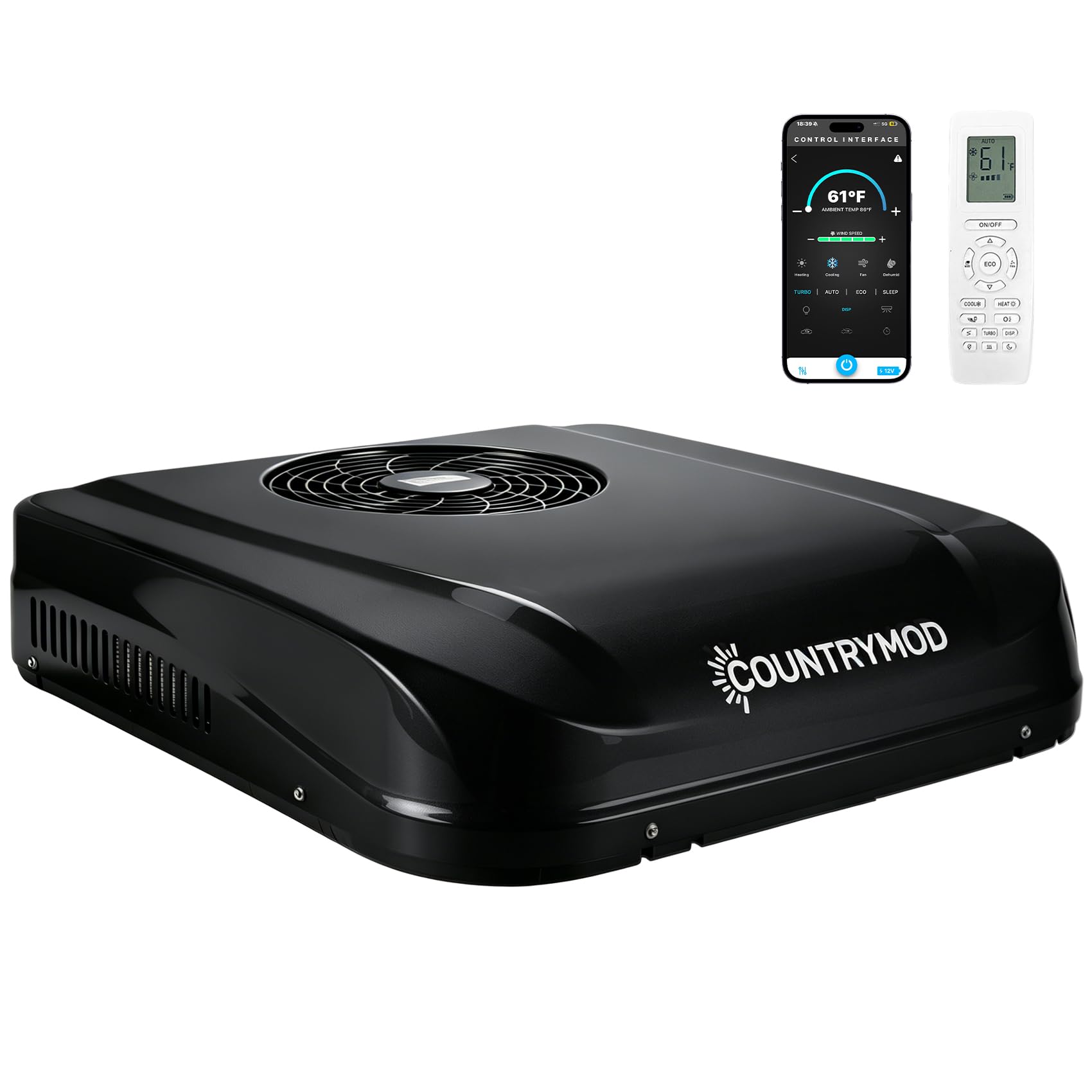
The Countrymod 12V unit sets the standard for whisper-quiet operation, with many users rating it nearly silent. Its variable-frequency inverter compressor operates between 45 and 55 decibels depending on load, which is quieter than a library. At an average consumption of 0.3 kWh per hour, it is roughly five times more efficient than a standard 115V rooftop unit, making it a top contender for extended dry camping sessions where every watt counts.
Owners report impressive results even in extreme heat, with one user recording a temperature drop from 113°F to 80°F during the day and 72°F at night in a roughly 100 sq ft space. The unit draws roughly 260 watts on ECO mode and 590 watts on Turbo, allowing a 300Ah battery bank to deliver 12 hours of cooling on ECO. Customers praise the responsive customer support, noting that a faulty remote was replaced in three days without hassle.
The horizontal compressor design lowers the unit’s center of gravity, reducing vibration and road shock. That said, the installation instructions are sparse and the unit may require longer all-thread rods (7-8 inches) for roofs thicker than the standard 2 inches. The inner duct gap also needs insulation tape to prevent air leaks. For the price, this is the best choice for sleep-focused van-lifers who prioritize absolute quiet over maximum raw BTU.
Why it’s great
- Remarkably quiet at 45-55 dB across its operating range
- Only consumes roughly 0.3 kWh per hour on ECO mode
- Excellent customer service from the manufacturer
Good to know
- Installation manual is minimal; YouTube guidance is helpful
- May need longer bolts for thicker or arched roofs
3. TOSOT 16000 BTU Rooftop AC with Heat Pump

The TOSOT is a powerhouse for larger vans and travel trailers, delivering 16,000 BTU of cooling and a 12,500 BTU heat pump that works in ambient temperatures from 23°F to 115°F. Its standout feature is the 43 dB noise level — one of the quietest non-inverter results on the market. This makes it a viable option for light sleepers who need powerful cooling without the roar of traditional RV ACs.
Wi-Fi connectivity via the Gree+ app allows you to pre-cool your van from a hiking trail, and the non-ducted design fits standard 14.25” x 14.25” roof vents with a straightforward DIY process. Real-world feedback shows the TOSOT keeps a trailer at 70°F during 105°F heat, outperforming the Dometic 13.5K it replaced in both noise and cooling speed. The heat pump eliminates the need to run a propane furnace on chilly spring and fall mornings.
The unit ships in two separate packages, so you must verify both have arrived before scheduling installation. A few owners have reported long-term reliability concerns with the brand’s support network, specifically regarding a rooftop seal leak after a year of use. Still, for its cooling power, low noise, and built-in heat pump, the TOSOT offers tremendous value for the money.
Why it’s great
- Ultra-quiet 43 dB operation despite high 16K BTU output
- Built-in 12,500 BTU heat pump for year-round climate control
- Wi-Fi control for pre-cooling convenience via smartphone
Good to know
- Shipped in two packages; confirm both arrive before install
- Customer service response can be inconsistent for warranty claims
4. FOGATTI InstaCool Ultra 16K BTU
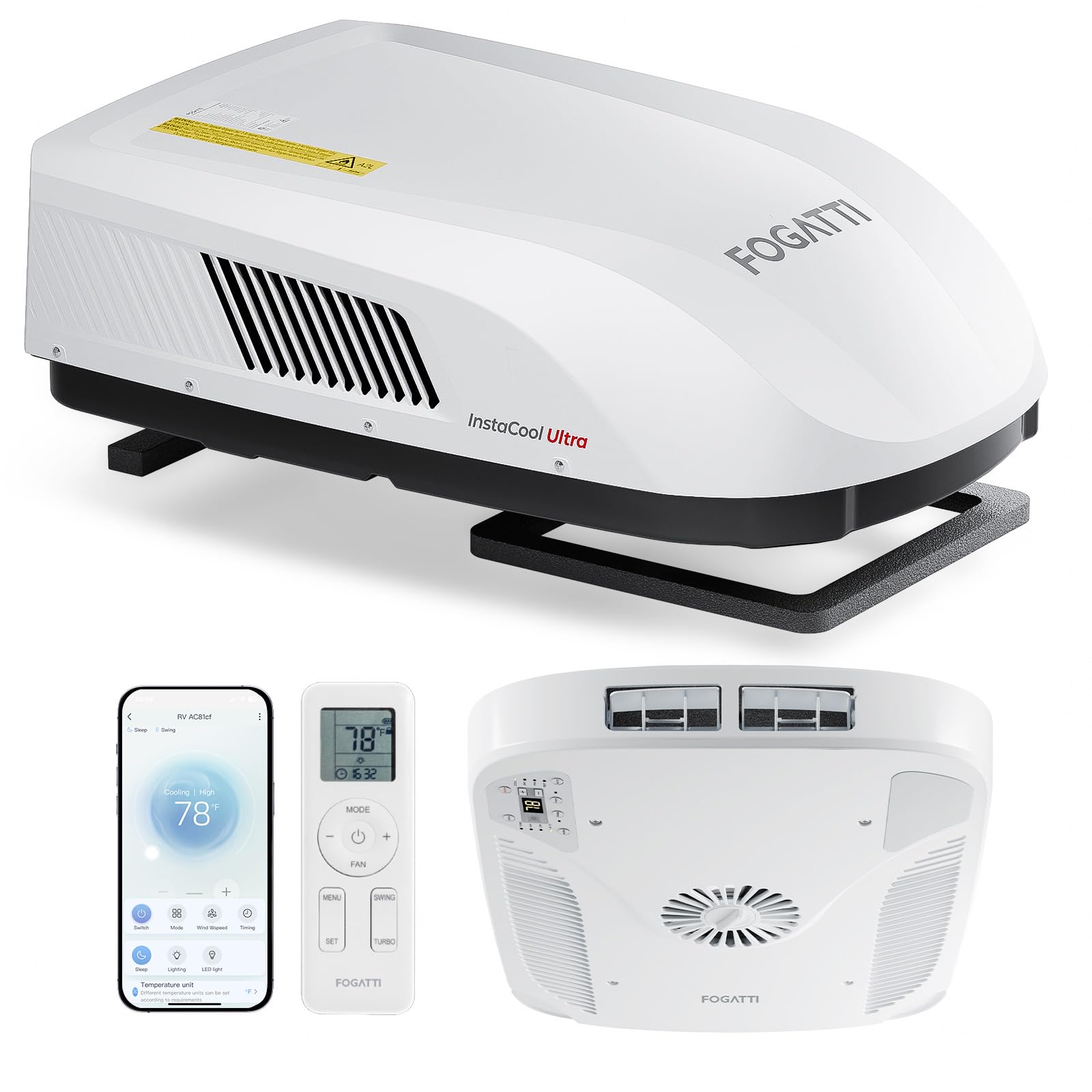
FOGATTI’s InstaCool Ultra packs a serious punch with an EER rating of 11.8, meaning it converts a higher percentage of electricity into cooling than most similarly sized rooftop units. The dual-motor, triple-fan system pushes 418 CFM of airflow, dropping the temperature in a 42-foot toy hauler by a measurable 8°F at the vent within minutes. At 12.2 inches tall, it is also one of the lowest-profile units, reducing wind noise and clearance issues on the road.
Noise levels are pegged at 43 dB, matching the TOSOT for silence. The unit ships with a remote, a touchscreen ADB panel, and Wi-Fi app control — giving you three ways to dial in the temperature without getting out of your seat. Reviewers consistently report that the cooling and heating performance beats name-brand competitors like Dometic, especially for the price. The unit is made in Italy and feels solidly built.
One nuance: the non-ducted design can be modified to work with ducting kits and a wall thermostat, but this requires additional effort. The unit requires a 15 or 20-amp time-delay fuse or breaker. While some users found the initial setup straightforward, others noted that removing a center vent piece improves airflow. For those who want top-tier efficiency and a low profile, the InstaCool Ultra is a compelling choice.
Why it’s great
- High EER 11.8 for efficient power consumption
- Very low profile at only 12.2 inches tall
- Triple control methods: remote, touch panel, and Wi-Fi
Good to know
- Non-ducted; modifying for ducted use requires extra work
- Requires a dedicated 15 or 20-amp circuit
5. Dometic FreshJet 3 Series 13.5K BTU

Dometic’s FreshJet 3 is a premium drop-in replacement for older Dometic units, offering 13% more cooling capacity and 15% more airflow than previous generations while weighing only 64 pounds — 14% lighter than the company’s own lightest model. The e-coated evaporator coils resist corrosion far better than standard coils, making this a durable choice for vans exposed to road salt and humid environments.
Noise is reduced by 4 dB compared to earlier Dometic units, and owners frequently describe it as “much quieter” than the Briskair II it replaced. Installation took one reviewer just 1.5 hours as a plug-and-play swap. Cooling performance is strong, with a 30-45 minute cooldown from 80°F to 64°F. The unit draws around 2000W on startup, then settles to roughly 1600-1700W while running, with the fan pulling about 450W — figures that work well with a 3000W or larger generator.
The FreshJet 3 is backwards compatible with existing ADB (air distribution box) units, which simplifies the swap for non-ducted setups. However, some units have arrived with damaged mounting tabs due to insufficient packaging, so inspect the box carefully upon delivery. The polished, modern look is a bonus, but the unit does not come with a pre-installed control box or trim, so factor that into your budget.
Why it’s great
- Very light at 64 pounds for a rooftop AC
- E-coated coils offer exceptional corrosion resistance
- Plug-and-play compatible with older Dometic ADB units
Good to know
- Some units arrive with packaging-related damage; inspect immediately
- Control box and trim are not included and sold separately
6. TURBRO 15000 BTU Rooftop AC with Heat Pump

The TURBRO delivers 15,000 BTU of cooling power and a 1,500W electric heater, giving you year-round climate control in a single rooftop unit. Its 9.6 EER rating is respectable, and the 52 dB noise level is quieter than many standard RV ACs. The ceiling assembly includes an atmosphere lamp with blue, yellow, or white lighting, adding a touch of ambiance to your camper’s interior.
Wi-Fi and remote control mean you can manage the temperature from your phone, and the non-ducted design fits standard 14.25” x 14.25” roof openings. One customer reported cooling their RV from 97°F down to 75°F over a day, replacing a less effective portable unit. The unit is compatible with all RVs and campers with the correct roof cutout, and the recessed side handles make lifting and positioning easier.
There have been isolated reports of units arriving damaged or with long-term reliability issues, including a compressor failure after six months. TURBRO recommends pairing the unit with a soft starter (like the TURBRO S15 Plus) if you plan to run it off a smaller generator (e.g., a Honda 2200W). The bright LED display cannot be dimmed, which may be a minor annoyance for some sleepers.
Why it’s great
- Heat pump provides supplemental warmth in cool weather
- Wi-Fi and remote control for easy temperature management
- Atmosphere lamp adds a unique visual feature inside the van
Good to know
- Bright LED display cannot be dimmed at night
- Some units arrive with cosmetic or functional damage
7. FOGATTI InstaCool 13500BTU Rooftop AC
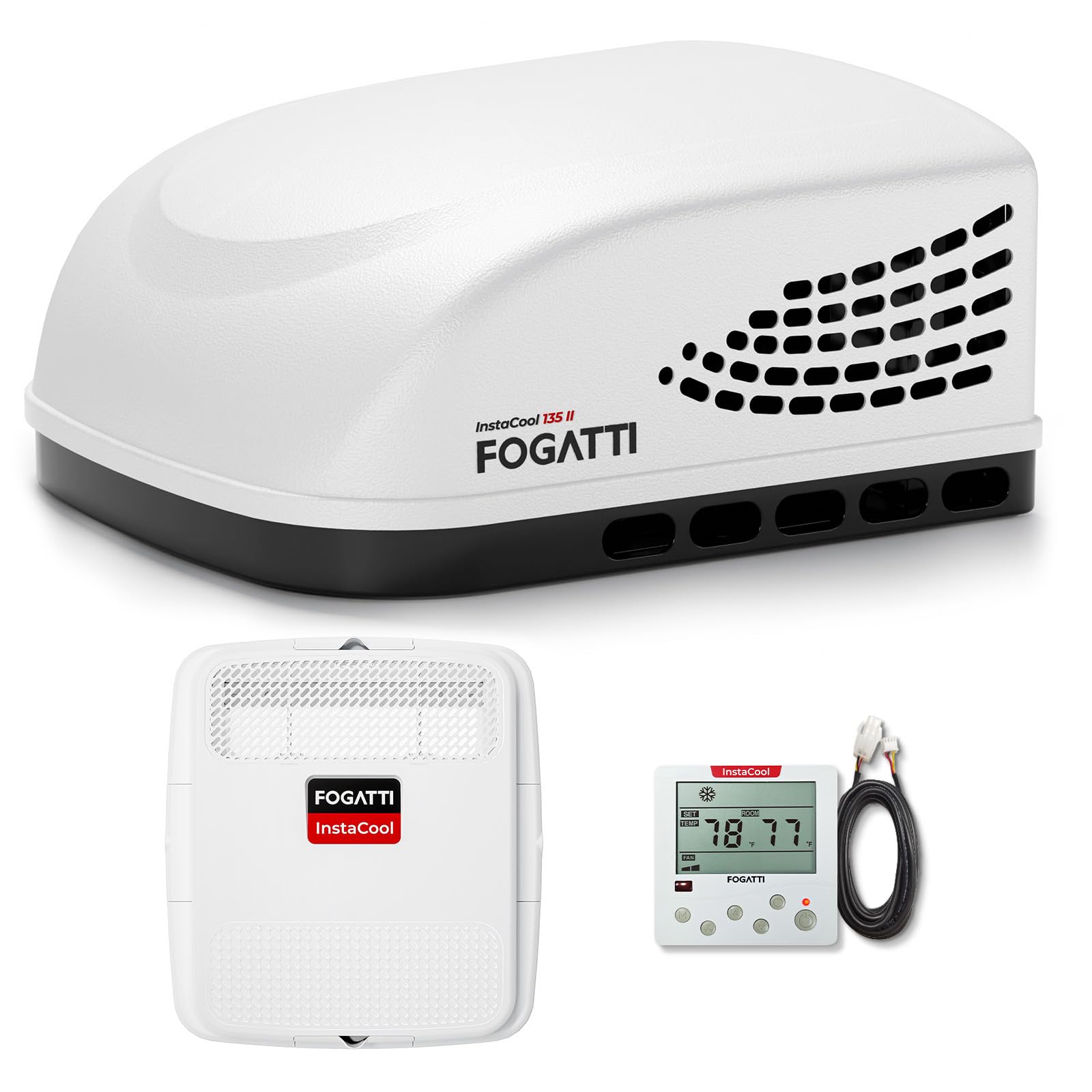
The FOGATTI InstaCool packs dual high-efficiency compressors into a 13,500 BTU package that uses eco-friendly R32 refrigerant. At 59 dB, it is not the quietest unit on this list, but owners consistently describe it as “very quiet” and “a beast” for its cooling speed. It fits standard 14.25” x 14.25” rooftop vents and includes a detailed installation guide and video.
Weighing 77.8 pounds, it is on the heavier side, but its high-strength HIPS shell resists UV and impact damage. Owners of 28-foot RVs and food trucks report that it cools down quickly and maintains comfortable temperatures even in the Texas heat. The unit is designed for 115V AC power and runs smoothly on generator or campsite hookups, but it is not compatible with ducted RV systems without modifications.
A few users noted the unit is physically large, so measure your roof dimensions carefully before purchasing. The company’s customer support has been praised for being responsive. For van-lifers who need a reliable, straightforward rooftop unit without the complexity of inverter technology, this is a solid, no-fuss choice.
Why it’s great
- Uses eco-friendly R32 refrigerant
- Strong and durable HIPS shell resists UV and impacts
- Rapid cooling performance according to customer reports
Good to know
- Heavier than average at 77.8 pounds
- Not designed for ducted RV systems
8. VEVOR 15000 BTU Non-Ducted Rooftop AC
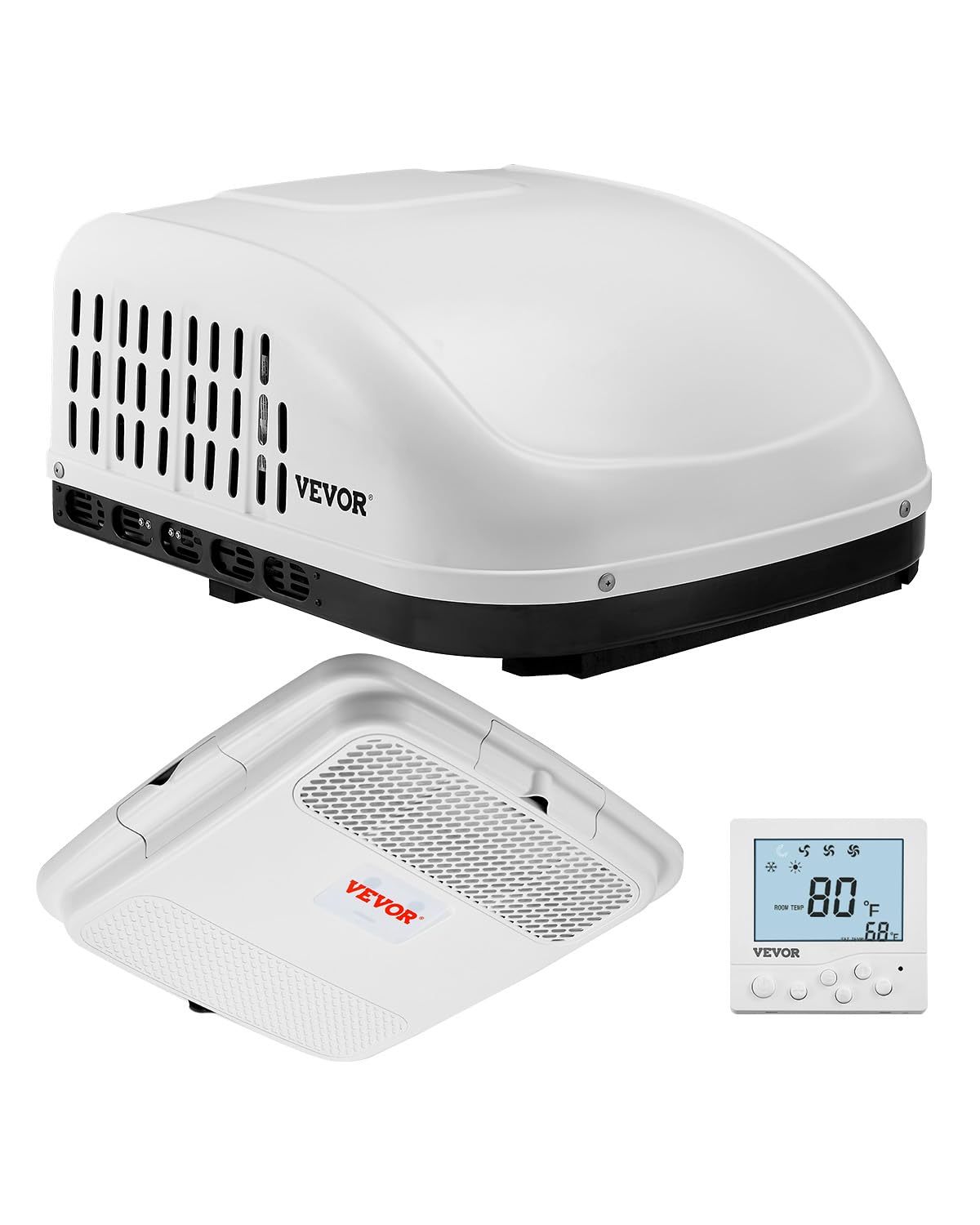
The VEVOR 15000 BTU unit offers a compelling price-to-BTU ratio for budget-conscious van dwellers. Its EPP (expanded polypropylene) shell provides excellent insulation, helping maintain internal temperatures and reduce energy loss. The unit features three modes — Auto, Cooling, and 3-Speed Fan — with an intuitive control panel that makes operation simple.
Rated at 65 dB, it is not the quietest option, but it is acceptable for daytime use. Some customers report powerful cooling performance, maintaining temperatures well below the thermostat setting. The installation is straightforward, fitting standard 14.25” x 14.25” roof openings, and the air distribution box is included for even airflow.
However, there are sharp divisions in owner feedback. While many praise its cooling speed and value, one customer described the unit as a total failure, noting that it cycled on and off every 2-3 minutes once it reached the set temperature. Quality control may vary, so buying from a retailer with a generous return policy is advisable. For the price, it is a gamble that can pay off if you get a well-built unit.
Why it’s great
- EPP shell offers excellent thermal insulation
- Includes air distribution box for even cooling
- Very competitive price for 15,000 BTU output
Good to know
- Noise level at 65 dB is noticeable for nighttime use
- Quality control can be inconsistent between units
9. OutEquipPro 12V 10000 BTU w/ Heater
This version of the OutEquipPro adds a 4,500 BTU PTC heater to the same efficient 12V platform as the base model. This is perfect for van-lifers who want a single unit to handle both cooling and supplemental heating on chilly evenings. The variable-speed inverter compressor sips power at roughly 200-300 watts in ECO mode, making it one of the most off-grid-friendly ACs available.
Owners consistently praise the low 40 dB noise level, which is virtually inaudible inside a van. The unit weighs around 43 pounds, making it easy for one person to lift onto the roof. The included remote control and multiple modes (ECO, Sleep, Turbo) let you fine-tune performance to match your battery state of charge. One reviewer successfully ran the unit all night on a 600Ah LiFePO4 battery bank with 2200W of solar.
The heater is only suitable for mild conditions; do not rely on it as a primary heat source in freezing temperatures. The installation process is similar to the cooling-only version, but the wiring for the heat pump adds a small layer of complexity. Overall, this is the ideal solution for those who want a single, low-profile, highly efficient unit for year-round, off-grid van living.
Why it’s great
- 12V DC operation with extremely low power draw (200-300W ECO)
- Integrated PTC heater takes the chill off spring and fall mornings
- Ultra-light at 43 lbs for a simple solo rooftop installation
Good to know
- PTC heater is not a primary heat source for freezing conditions
- Wiring for the heater function adds slight installation complexity
10. Dometic Penguin II 13.5K BTU

The Dometic Penguin II is the industry standard for RV air conditioning, offering a proven design that works with both ducted and non-ducted applications. Its low-profile, aerodynamic shell reduces wind resistance and road noise while driving. The EPP foam housing reduces weight without sacrificing structural integrity, and the rib-reinforced base pan ensures durability over rough terrain.
Using R410A refrigerant, it is more environmentally friendly than older R22 units and provides efficient cooling. The unit is compatible with both CCC2 and CT thermostats (sold separately), giving you flexibility in how you control it. Owners report it cools a 32-foot trailer effectively even in 90°F heat, and installation is straightforward for those with moderate mechanical skills.
On the downside, the blower noise is noticeable — some users describe it as “noisy just like I like,” but light sleepers may find it intrusive. The unit has a higher average power consumption of about 1.7 kW, making it less suitable for off-grid battery use without a substantial generator. There have been reports of units arriving with cosmetic damage from shipping, so inspect yours immediately. For reliability and parts availability, the Penguin II remains a safe bet.
Why it’s great
- Industry-proven design with excellent parts and service support
- Low-profile aerodynamic shell reduces drag while driving
- Compatible with both ducted and non-ducted RV systems
Good to know
- Blower noise is noticeable; not ideal for light sleepers
- Requires separate purchase of a thermostat for full operation
11. HoneyNov 16000 BTU Portable AC

The HoneyNov is a portable 115V AC unit that offers an alternative to permanent rooftop installation. Its 16,000 BTU rating is powerful enough for large spaces, and the 40 dB sleep mode is genuinely quiet. The unit includes a 5-in-1 functionality: cooling, fan, dehumidifier, sleep mode, and a 24-hour timer. It is best suited for rental vans, temporary setups, or as a backup AC that can be stored away when not in use.
The WiFi app control and long-range remote allow you to pre-cool the van before you arrive. The included window kit fits sliding and double-hung windows from 20 to 49 inches, and the 360° swivel casters make it easy to move around. Setup is tool-free and can be done in about 10 minutes. The unit is lightweight enough to be carried by one person.
The major downsides for van life are that it takes up valuable floor space and requires a window opening for the exhaust hose. It will not cool effectively if the exhaust hose is not properly sealed. One reviewer noted it is a great personal cooler for a desk or bedside, but not a whole-room solution — though this seems to contradict other verified reports of powerful cooling. For the price, it is a flexible, entry-level solution for those who cannot or do not want to cut a hole in their roof.
Why it’s great
- No roof modifications required; uses a window vent kit
- Very quiet on sleep mode at 40 dB
- WiFi app control for convenient scheduling and pre-cooling
Good to know
- Consumes valuable interior floor space
- Exhaust hose must be properly sealed for effective cooling
FAQ
Can I run a standard 115V RV rooftop AC off my van’s battery bank without a generator?
How many BTUs do I really need for a standard short wheelbase van?
What does “non-ducted” mean and does it matter for my van?
Is a roof-mounted AC always better than a portable unit for van life?
How important is an inverter compressor for an off-grid van AC?
Final Thoughts: The Verdict
For most van-dwellers, the air conditioner for van life winner is the OutEquipPro 12V 10000 BTU because it offers the best balance of off-grid power efficiency, quiet operation, and a lightweight, low-profile design that is easy to install solo. If you prefer a powerful rooftop unit with a heat pump for shoulder-season warmth, grab the TOSOT 16000 BTU for its remarkably quiet 43 dB operation and app control. And for those who cannot or do not want to cut into their roof, the HoneyNov 16000 BTU Portable AC provides a flexible, no-modification entry point into van life cooling.