
Our readers keep the lights on and the weekend projects moving. As an Amazon Associate, I earn from qualifying purchases.
The difference between hearing scattered chatter and catching the full story often comes down to what sits above your scanner. A stock rubber ducky antenna is a compromise, trading performance for portability. If you are serious about monitoring public safety bands, the right antenna turns a frustratingly quiet scanner into a receiver that pulls in distant dispatches, fireground command, and trunked system traffic with clarity you did not know your radio had.
I’m Rikta — the founder and writer behind FitlyFast. I analyze market trends and hardware specifications across the scanner antenna category, focusing on how gain, frequency coverage, and connector type translate into real-world reception performance.
Every antenna in this list has been selected for its ability to improve signal capture across the bands that matter most to public safety monitoring. This guide breaks down the top options to help you find the ideal antenna for police scanner that matches your radio, your environment, and your listening goals.
How To Choose The Best Antenna For Police Scanner
Picking the right antenna is not about buying the most expensive model. You need to match the antenna’s frequency response to the bands your local agencies use, the connector type to your scanner’s port, and the form factor to your listening location. Here are the three factors that matter most.
Frequency Range and Band Priority
Police and emergency services have largely moved to 700–900 MHz (UHF) trunked systems, though many fire and EMS channels still operate on VHF high-band (150–174 MHz) and UHF (450–470 MHz). A wideband antenna covering 25–1300 MHz gives you flexibility, but if your area uses a specific system, an antenna tuned for that band with higher gain (6+ dB) will pull in weak signals far better than a generic one.
Connector Type: BNC vs. SMA
Uniden handhelds like the SDS100 use an SMA connector, while models like the BC125AT use BNC. Whistler scanners vary as well. The wrong connector will not physically attach to your radio without an adapter, which can introduce signal loss. Always check your scanner’s port before purchasing. Some antennas ship with a BNC-to-SMA adapter, but a direct-fit connection is mechanically and electrically superior.
Base Station vs. Mobile vs. Handheld
If you listen from a fixed location, a discone base antenna mounted in the attic or on a mast provides the widest coverage and strongest gain, but it requires space and a mast. A mobile glass-mount antenna is ideal for scanning from a vehicle, but installation on tinted windows or near defroster elements can kill performance. For portable use, a flexible whip that replaces the stock antenna offers the simplest upgrade, though indoor reception will always be capped by building construction.
Quick Comparison
On smaller screens, swipe sideways to see the full table.
| Model | Category | Best For | Key Spec | Amazon |
|---|---|---|---|---|
| Remtronix 920S | Handheld Whip | Uniden SDS100 boost | 6+ dB gain at 800 MHz | Amazon |
| Taurus Desktop Discone | Base Discone | Indoor base station | 25–2000 MHz coverage | Amazon |
| Remtronix 800B | Handheld Whip | BNC scanner upgrade | 6+ dB gain at 800 MHz | Amazon |
| AEcreative Wideband | Handheld Whip | Versatile wideband use | 50–1200 MHz range | Amazon |
| Tram 1199 | Mobile Glass-Mount | Vehicle installation | 25–1300 MHz coverage | Amazon |
| Tram Discone 1411 | Base Discone | Multi-band transmit/receive | 25–1300 MHz, 300W | Amazon |
| SIGNALPLUS D3000N | Discone Base | Ultra-wide monitoring | 25–3000 MHz coverage | Amazon |
In‑Depth Reviews
1. Remtronix 920S

The Remtronix 920S is purpose-built for the Uniden SDS100 and BCD436HP, and it delivers the most dramatic improvement we saw for modern trunked-system monitoring. With a rated 6+ dB gain in the 700–900 MHz UHF digital band, this 9-inch flexible whip turns garbled P25 simulcast distortion into readable voice traffic. Users consistently report hearing clear communications from neighboring counties that were entirely absent with the stock antenna.
This is not a general-purpose wideband antenna. It is optimized for the specific frequencies where most public safety agencies now operate, so VHF-Low or air band reception will see less improvement. The SMA connector is a direct fit for the SDS100, eliminating adapter loss. Build quality is excellent, with a tough, flexible rubber coating that survives daily pocket carry and incidental drops without breaking the internal coil.
The only real trade-off is cost and specificity. If you own a scanner with a BNC port or listen primarily to VHF frequencies, this antenna is not the right shape for your needs. But for SDS100 owners frustrated by missed calls on the stock whip, the 920S is the single best purchase you can make.
Why it’s great
- Noticeable 25-100%+ gain on 700-900 MHz trunked systems
- Direct SMA fit for SDS100 and BCD436HP
- Durable flexible whip for portable use
Good to know
- Less effective for VHF-Low or air band frequencies
- Higher price than generic wideband alternatives
2. Taurus Desktop 25-2000 MHz

The Taurus Desktop antenna is a discone design that fits comfortably on a desk or shelf while delivering reception that rivals full-sized outdoor antennas. Covering 25 to 2000 MHz, it handles everything from CB and air band to 700/800 MHz trunked systems. The heavy-duty magnetic base holds it steady, and the 4-meter RG58 mil-spec cable with a BNC connector gives you flexible placement away from the scanner.
Real-world performance is impressive. Users report pulling in transmissions from over 50 miles away, with significantly clearer signals than any handheld whip can provide when used indoors. The discone design offers omnidirectional coverage with low angle radiation, which means you hear more simulcasts without rotating the antenna. Assembly takes minutes and requires no tuning.
The trade-off is portability. This is not an antenna you throw in a bag for travel. It is roughly 18 inches in diameter and requires a stable surface. Also, it is a receive-only antenna, so you cannot transmit through it. For a dedicated indoor base station, however, it is difficult to beat at this performance level without going to a full roof-mounted mast.
Why it’s great
- Indoor design pulls in signals from 50+ miles away
- Covers 25-2000 MHz for universal monitoring
- Heavy magnetic base ensures stability
Good to know
- Bulkier than expected for desktop placement
- Requires SMA-to-BNC adapter for some handheld scanners
3. Remtronix 800B

The Remtronix 800B is the BNC-native sibling of the 920S, optimized for scanners like the Uniden BC125AT, BC75XLT, BCD325P2, and Whistler TRX-1. It focuses its 6+ dB gain on the 700–900 MHz UHF band, where most modern police and fire trunked systems live. Users report a solid 40% improvement in reception clarity on these frequencies, with fewer cutouts and garbled transmissions.
The 7-inch flexible whip is shorter than the 920S, making it even more pocket-friendly for on-the-go monitoring. The BNC connection is secure and easy to swap. Build quality matches the 920S, with a durable rubber coating that stands up to daily handling. For analog fire and EMS dispatches on the 800 MHz band, users report significantly clearer audio compared to the stock antenna that shipped with their scanner.
Like its sibling, this antenna sacrifices performance outside its tuned band. VHF reception is only marginally better than stock. If you need wideband coverage across VHF and UHF, a generic whip may serve you better. But if your primary listening targets are 700–900 MHz public safety channels, the 800B is the optimal BNC upgrade.
Why it’s great
- Significant gain on 700-900 MHz public safety band
- Compact 7-inch profile for portability
- Direct BNC fit for popular Whistler and Uniden models
Good to know
- VHF improvement is minimal
- Not compatible with SMA-only scanners like the SDS100
4. AEcreative Wide-Band Scanner Antenna

The AEcreative wide-band antenna is the budget-friendly entry point that still delivers legitimate performance improvements across a broad frequency range. Rated from 50 MHz to 1200 MHz, it provides excellent VHF and UHF reception on air band, ham, and public safety channels. Users report seeing more stations appear on their scanner immediately after swapping out the stock antenna.
The flexible 17-inch whip is notably long, which helps with signal capture but also makes it awkward for tight spaces. It comes with a BNC-to-SMA adapter, making it compatible with nearly every handheld scanner on the market. Build quality is decent for the price, with a bendable design that survives being stuffed in a bag. Adhesion for windshield mounting is strong, but metallic window tints will block signals.
The main downside is that it is not tuned for maximum gain on any specific band. It is a jack-of-all-trades whip that improves reception across the board but will not match the focused 6+ dB gain of the Remtronix antennas on 800 MHz. If you listen to a mix of VHF, UHF, and 800 MHz traffic and want a simple, affordable upgrade, this is the right call.
Why it’s great
- Broad frequency coverage improves VHF and UHF alike
- Includes BNC/SMA adapter for universal fit
- Very affordable entry-level upgrade
Good to know
- Long whip can be cumbersome in portable use
- No band-specific gain; generic performance
5. Tram 1199 Glass-Mount Antenna
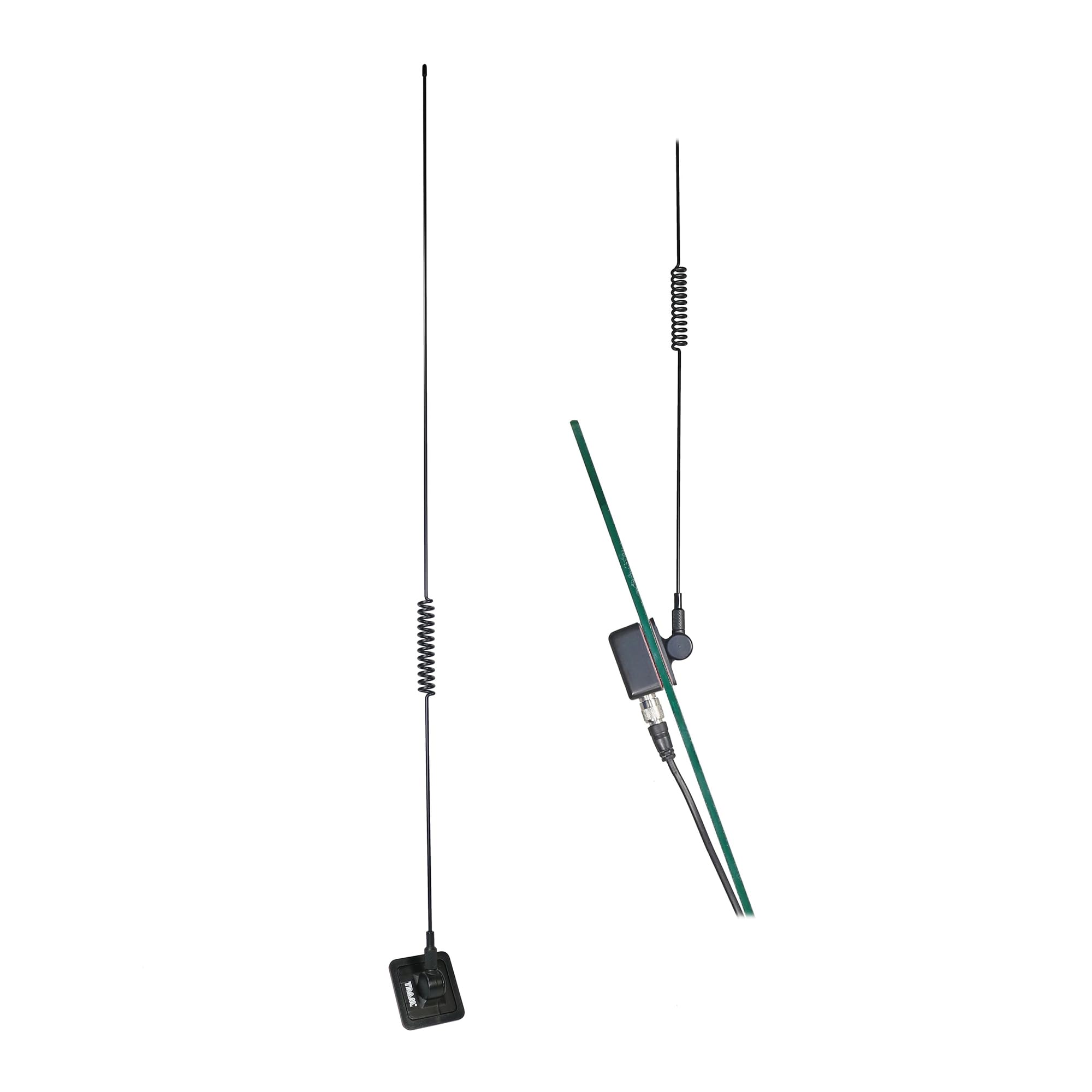
The Tram 1199 is the go-to choice for vehicle-based scanning. Its center-loaded design and 28-inch whip provide superior gain and bandwidth compared to typical magnetic or trunk-lip mounts. The glass-mount hardware uses strong adhesive to secure the coupling box to the window, and the 17-foot RG58/U cable is long enough to route cleanly to any scanner location inside the cabin.
Performance is a clear step up from inside-car antennas. Users report receiving signals from over 20 miles away, with the external placement eliminating the electrical noise pickup that plagues handheld antennas used inside a vehicle. The wide 25–1300 MHz range covers all public safety bands, and the center-loading improves efficiency on VHF-high and UHF frequencies where most police activity happens.
Installation requires care. The coupling box must be placed at least 1.5 inches from the edge of the glass, away from defroster elements and metallic tints. Adhesion is strong if you follow the instructions, but on long highway trips, wind resistance can stress the mount. Some users reported units arriving with damaged adhesive pads, so inspect the packaging immediately upon receipt.
Why it’s great
- External mount eliminates vehicle electrical noise
- Wide 25–1300 MHz coverage with center-loaded gain
- Long 17-foot cable for flexible routing
Good to know
- Adhesive quality can be inconsistent out of the box
- Not effective on tinted or metallic-filmed windows
6. Tram 1411 Super Discone
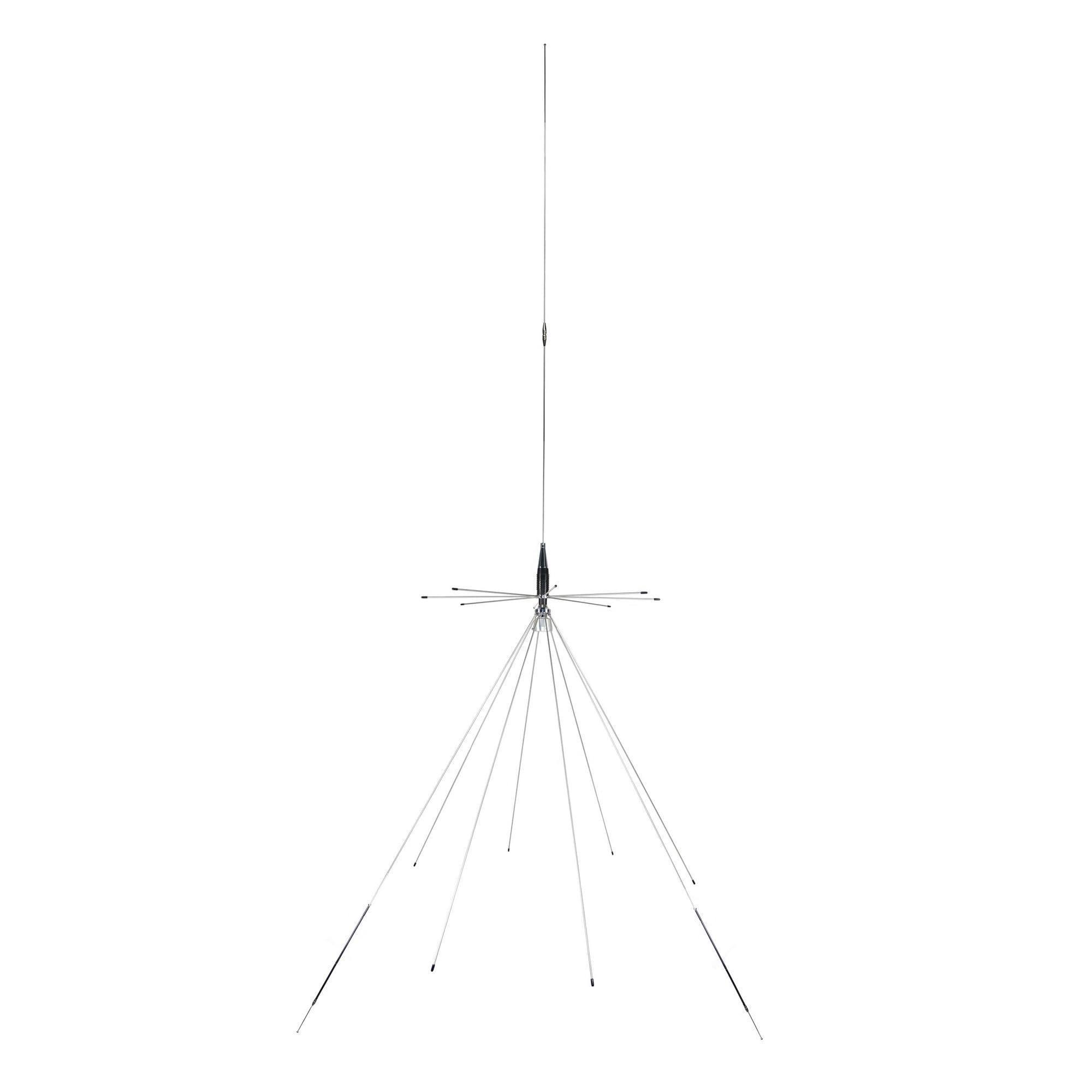
The Tram 1411 is a full-sized outdoor discone antenna built for the serious monitor. The entirely stainless steel structure is rust-free and rugged, with 6 lower radials, 2 adjustable lower radials, and 8 upper radials that create a wide capture area. It covers from 25 MHz to 1300 MHz and can handle up to 300 watts on receive and select transmit bands like 2m and 70cm.
SWR readings around 1.1:1 on CB channels 19 indicate excellent impedance matching, and users report skip contacts spanning hundreds of miles on HF. For scanner use, the discone design provides omnidirectional reception with low-angle sensitivity that pulls in distant trunked systems. Assembly is straightforward, though the set screws can come loose in transit, so a quick check before mounting is wise.
The size is the main consideration. The top whip alone is 55 inches, and the full assembly requires mast space and a sturdy mount. The SO-239 connector lacks a notch for PL-259 spike locks, which some users find irritating. If you have the outdoor space to mount it properly, this antenna delivers reception that no indoor or mobile antenna can match.
Why it’s great
- Rugged all-stainless construction for outdoor longevity
- Excellent CB and 2m/70cm SWR performance
- Low-angle reception for long-distance trunked monitoring
Good to know
- Very large footprint requires substantial mast space
- SO-239 connector design may not lock PL-259 plugs securely
7. SIGNALPLUS D3000N Discone

The SIGNALPLUS D3000N pushes the frequency ceiling to 3000 MHz, making it one of the widest-coverage discone antennas available. This gives you access to not only standard public safety and ham bands but also aircraft ADSB at 1090 MHz, 978 MHz UAT, and even experimental SDR projects in the 2.4 GHz range. The kit includes 10 meters of RG58 cable with a pre-installed PL-259 connector, plus SMA and BNC adapters.
Build quality feels robust, with users reporting signals from over 100 miles away coming in loud and clear. The top loading coil can be removed if you do not need reception below 50 MHz, shortening the antenna and reducing wind load. Assembly takes under 30 minutes, and the antenna is designed for balcony railings, roof masts, or tower mounts.
The catch is the premium price and the physical footprint. This is a large, permanent installation antenna, not something you move around easily. If you only monitor standard police and fire bands up to 900 MHz, the extra range above 1.3 GHz is wasted. But for the SDR enthusiast or the monitor who wants to cast the widest possible net, the D3000N delivers unmatched coverage.
Why it’s great
- Industry-leading 25–3000 MHz coverage span
- Complete kit with cable, adapters, and mounting hardware
- Easy assembly with option to remove top coil for compactness
Good to know
- Overkill if you only monitor standard police/fire bands
- Large size requires permanent outdoor installation
FAQ
Will a discone antenna improve reception on my handheld scanner indoors?
Do I need an adapter for the Tram 1199 glass-mount antenna?
Can I transmit through a police scanner antenna?
Why does my police scanner antenna not work well on the 800 MHz band?
Final Thoughts: The Verdict
For most users, the antenna for police scanner winner is the Remtronix 920S because it delivers the largest real-world improvement for the most popular modern scanners, specifically targeting the 700–900 MHz band where trunked police systems operate. If you need a powerful indoor base solution, grab the Taurus Desktop Discone. And for vehicle-based monitoring, nothing beats the Tram 1199 Glass-Mount for clean, noise-free reception on the move.