
Our readers keep the lights on and the weekend projects moving. As an Amazon Associate, I earn from qualifying purchases.
Mold spores don’t announce themselves. They settle into drywall, crawl behind baseboards, and hide in the damp corners of basements and bathrooms, slowly degrading your indoor air quality while your sinuses take the blame. A standard air quality monitor that only tracks CO₂ or PM2.5 won’t catch the specific humidity spikes and particulate patterns that signal a hidden mold issue. You need a device that watches for the exact conditions mold thrives on—elevated relative humidity, stagnant air, and fine particulate matter below 10 microns.
I’m Rikta — the founder and writer behind FitlyFast. I’ve spent months cross-referencing sensor specifications, battery life claims, and real-world calibration data from hundreds of user experiences to separate the units that genuinely detect mold-friendly environments from those that just flash green numbers.
Whether you’re managing a humid crawl space, a finished basement, or a coastal home with persistent moisture concerns, finding the right air quality monitor for mold means prioritizing humidity sensing precision, particulate matter detection down to PM1.0, and reliable TVOC or formaldehyde measurement to catch the volatile compounds mold releases as it colonizes.
How To Choose The Best Air Quality Monitor For Mold
Mold detection isn’t about a single sensor. Effective monitoring requires a device that cross-references at least four environmental inputs simultaneously. Here’s what separates a useful tool from a decorative screen.
Particulate Matter Sensitivity (PM1.0, PM2.5, PM10)
Mold spores range from 1 to 30 microns. A monitor that only reports PM2.5 and PM10 misses the smallest spores and fragments that remain airborne longest. Look for a unit that explicitly measures PM1.0 alongside PM2.5 and PM10. Laser-based particle counters are more reliable for this size range than lower-cost optical sensors that average readings crudely.
Relative Humidity Tracking With Temperature Correlation
Mold requires relative humidity above 60% for more than 48 hours to start colonizing. A monitor that tracks humidity alone is incomplete. The device must display temperature simultaneously so you can calculate dew point and understand whether surface condensation is likely on walls, windows, or ductwork. Units that log this data over time are far more useful than those showing only a live reading.
TVOC and Formaldehyde (HCHO) Sensors
Active mold colonies release microbial volatile organic compounds (mVOCs) — the musty smell you associate with mold. A monitor with a TVOC sensor detects these chemical signatures, though it cannot distinguish mold-specific VOCs from cleaning products or paint fumes. Formaldehyde sensors add a second layer because many mold species produce HCHO as a metabolic byproduct. Pairing both sensors improves your chances of catching an outbreak early.
Battery Life and Portability
Mold issues are rarely confined to one room. You need a monitor that runs cordlessly for at least 8 hours so you can move it from basement to bathroom to attic on a single charge. Units with 2500 mAh batteries or larger typically deliver 8 to 12 hours. AC-powered models are fine for permanent placement but limit your ability to investigate multiple zones in one session.
Quick Comparison
On smaller screens, swipe sideways to see the full table.
| Model | Category | Best For | Key Spec | Amazon |
|---|---|---|---|---|
| BREATHE Airmonitor Plus | Premium | App-based mold tracking | PM1, PM2.5, PM10, TVOC, HCHO | Amazon |
| KDWKD AK23CA | Premium | Comprehensive home air insight | PM0.3 to PM10, HCHO, TVOC | Amazon |
| YNAK AK22A 16-in-1 Extended | Mid-Range | All-day multi-room sweeps | 12-hour battery, 7-inch display | Amazon |
| YNAK AK22A 16-in-1 | Mid-Range | Large-display visibility | 7-inch screen, 2500 mAh battery | Amazon |
| GoveeLife H5140 | Mid-Range | Smart home integration | SCD4x CO₂ sensor, app control | Amazon |
| VEVOR DM197 | Mid-Range | Rapid particulate scanning | 3000 mAh, 1.5-second refresh | Amazon |
| LifeBasis 11-in-1 | Budget | Entry-level mold screening | 2500 mAh, NDIR CO₂ sensor | Amazon |
In‑Depth Reviews
1. BREATHE Airmonitor Plus
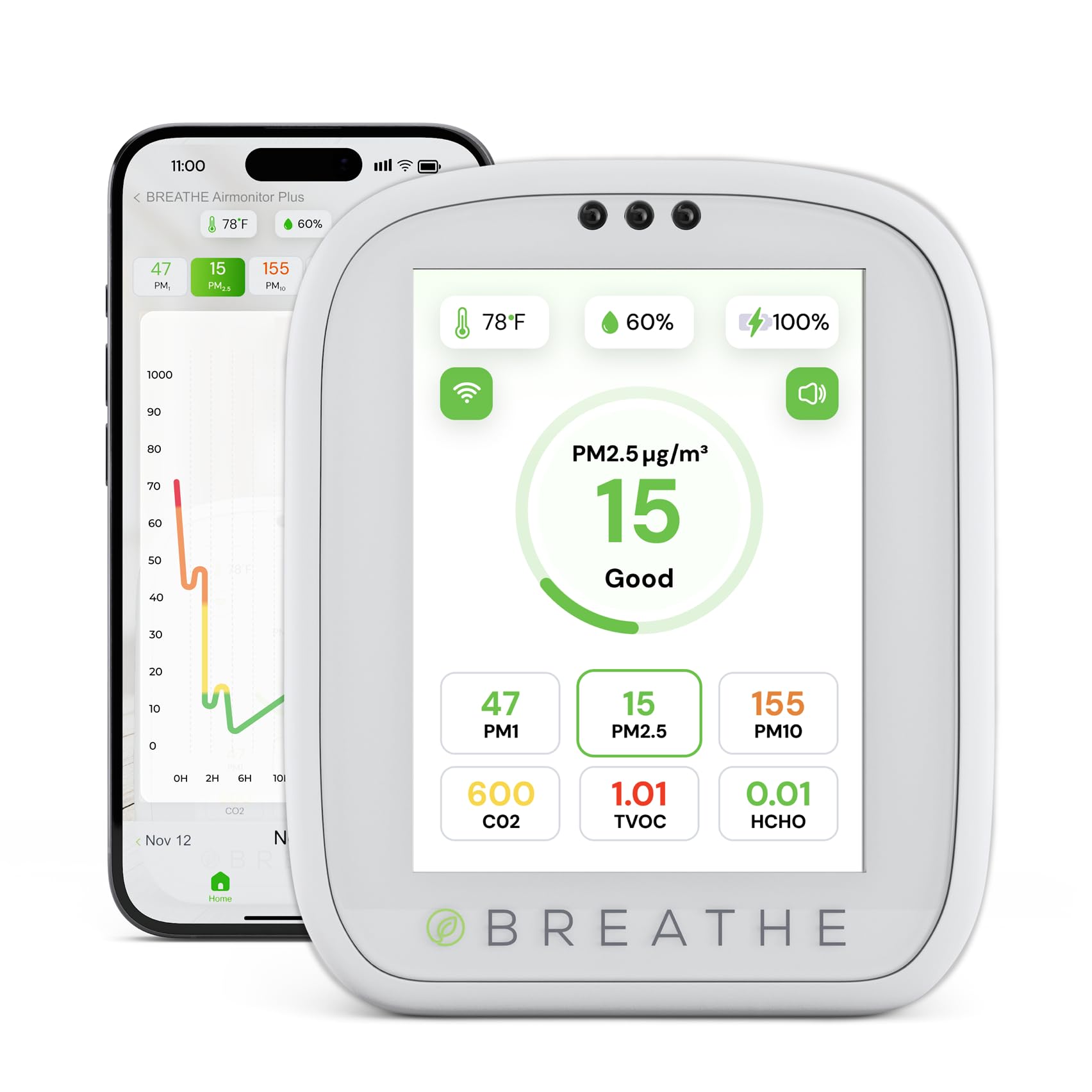
The BREATHE Airmonitor Plus is the only unit in this lineup that directly markets itself for mold detection, and the sensor array backs up the claim. It tracks PM1, PM2.5, and PM10 simultaneously alongside TVOC and formaldehyde — the full chemical and particulate profile that active mold colonies produce. The compact white enclosure fits unobtrusively on a nightstand or basement shelf, and the companion app logs 30 days of historical data so you can spot when humidity and particulate levels trend into dangerous territory.
Setup takes under 30 seconds via Bluetooth, and the real-time display updates fast enough to catch cooking smoke or a humidifier spike. Users report CO₂ readings as high as 4500 ppm in poorly ventilated rooms, which confirms the NDIR sensor is legitimately sensitive. The 2-year manufacturer warranty provides meaningful backing for a device that will run continuously in a potentially damp environment.
The biggest operational caveat is automatic recalibration, which can silently lower CO₂ readings over time unless you manually recalibrate with fresh outdoor air. Some users find the display too bright at night, and the proximity sensor meant to dim the screen doesn’t always engage. Battery life is shorter than competitors — expect to keep it plugged in for 24/7 monitoring.
Why it’s great
- Comprehensive sensor suite specifically targeting mold conditions
- 30-day data history in the app reveals long-term humidity and particulate trends
- 2-year manufacturer warranty exceeds typical coverage
Good to know
- Automatic CO₂ recalibration can underreport levels without manual intervention
- Display brightness cannot be adjusted to low enough for dark bedrooms
- Battery life is short; best used as a corded device
2. KDWKD AK23CA Indoor Air Quality Monitor
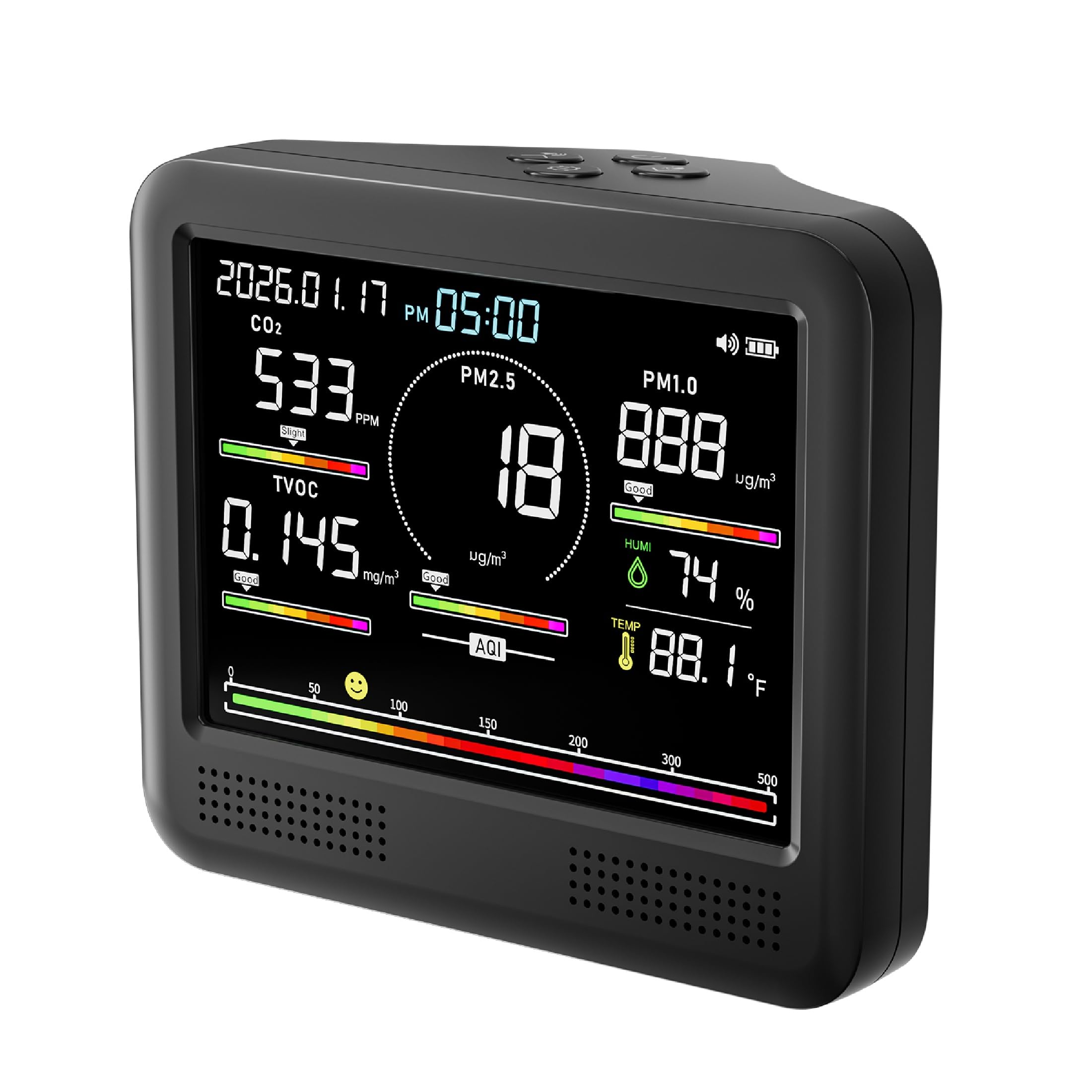
The KDWKD AK23CA expands particulate detection down to PM0.3 — the sub-micron range where ultrafine mold fragments and bacterial particles live. That extra sensitivity matters when you’re trying to catch early-stage mold activity before it becomes visible. The 7-level AQI display with color-coded feedback is intuitive enough for daily use, and the optional audible alarm provides an immediate trigger when any parameter crosses into unhealthy territory.
The built-in rechargeable battery delivers up to 9 hours of operation, which is enough to move the monitor through three or four rooms in a single afternoon. It measures CO₂, PM0.3 through PM10, HCHO, TVOC, temperature, and humidity — more sensor types than most mid-range units include. The compact ABS body is light enough to toss into a bag for testing hotel rooms or vacation rentals, which is exactly the scenario where hidden mold issues get overlooked.
No Wi-Fi or app connectivity means all data stays on the device, which some users prefer for privacy but others find limiting. A few reviewers noted that the screen can be hard to read at extreme angles due to the LCD type. The instruction manual is minimal, so expect some trial and error when interpreting less common metrics like formaldehyde concentration.
Why it’s great
- Detects particles as small as PM0.3 for ultra-fine spore fragment tracking
- Portable 9-hour battery allows multi-room mold inspections
- No app required — all data displayed live on the color screen
Good to know
- No Wi-Fi or Bluetooth connectivity for remote monitoring
- Display visibility drops at wider viewing angles
- Instruction manual lacks depth for interpreting formaldehyde readings
3. YNAK AK22A 16-in-1 Extended Battery
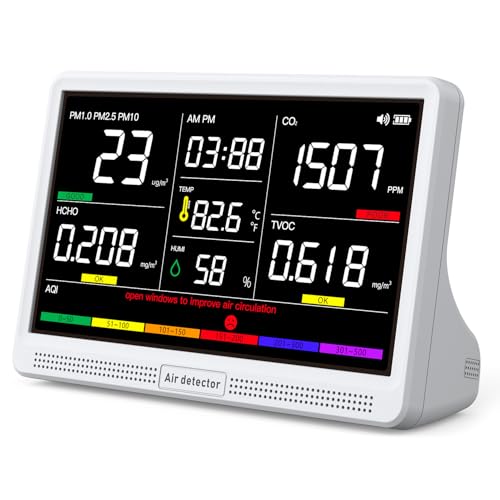
This is the updated version of the standard YNAK AK22A with a 3500 mAh battery that extends runtime to 12 hours — enough for a full day of investigating every corner of a house without once reaching for a charger. The 7-inch LED display is the largest in this roundup, showing CO₂, PM2.5, PM1.0, PM10, HCHO, TVOC, temperature, humidity, AQI, and time simultaneously without any menu-switching. The external high-precision sensors claim 0.001-unit accuracy, which is meaningful when detecting trace-level formaldehyde near new furniture or moisture-damaged drywall.
Real-world users confirm the monitor picks up rapid changes from cooking, candles, and hairspray within 3 to 7 seconds, and the audible alarm with mute button gives you control over notifications. The simple horizontal AQI line — green smiley face at low levels, dark red at 150 to 500 — makes it easy for older family members or non-technical users to understand at a glance whether the room is safe or needs ventilation.
Some buyers reported that initial readings stayed green even after spraying strong chemical cleaners nearby, which raises questions about the TVOC and HCHO sensor thresholds. The WiFi and mirror screen features are not well documented, and a few units arrived with undocumented setup steps. The included adapter and cable are branded specifically — using a third-party charger may affect charging performance.
Why it’s great
- 12-hour battery supports full-home single-charge inspections
- Massive 7-inch display shows all metrics at once with color-coded AQI
- Fast sensor response captures transient mold-related particulate spikes
Good to know
- TVOC and HCHO sensors may not register low-level chemical changes immediately
- WiFi and mirror features lack clear setup documentation
- Only works optimally with the included proprietary adapter and cable
4. YNAK AK22A 16-in-1 Standard
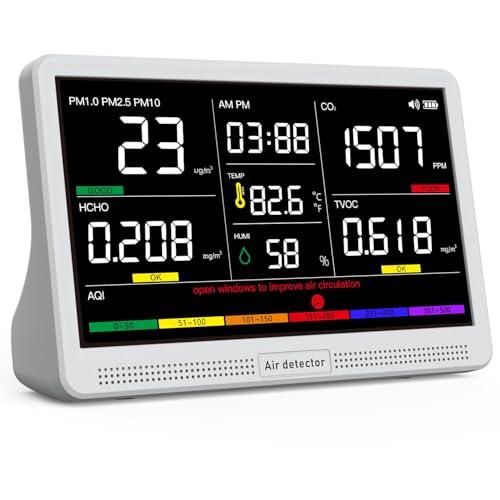
The standard YNAK AK22A delivers the same 7-inch display and sensor configuration as the extended battery version but with a 2500 mAh battery that provides about 8 hours of cordless operation. For homeowners who plan to keep the monitor plugged in most of the time and only occasionally move it between rooms, this is the more practical entry point into the same measurement capabilities. It still tracks CO₂, PM2.5, PM1.0, PM10, HCHO, TVOC, temperature, humidity, and AQI, and the 7-inch display makes it easy to read from across a room.
Users report that the monitor boots up quickly and responds instantly to visible pollutants — one reviewer noted PM and TVOC readings changed within seconds of using a vape, UV printer, or isopropyl alcohol in the same room. That responsiveness is critical for mold detection because it means the laser particle counter is actually sampling fast enough to catch intermittent spore releases from a hidden colony. The three brightness settings help reduce light pollution in bedrooms.
The same sensor accuracy concerns from the extended model apply here — strong chemical exposures may not trigger the TVOC or HCHO readings immediately in all units. The audible alarm system includes 7 distinct alert buzzer types, but the manual doesn’t clearly explain what each tone means. The product dimensions on the listing are also contradictory, so measure your intended shelf space carefully before purchasing.
Why it’s great
- Large 7-inch display at a more accessible entry price than the extended model
- Rapid sensor response catches transient particulate events reliably
- Three brightness settings prevent nighttime light disturbance
Good to know
- 8-hour battery may not cover a full day of multi-room sweeps
- TVOC and HCHO sensitivity thresholds vary between units
- Alarm buzzer tones are not explained in the user manual
5. GoveeLife H5140
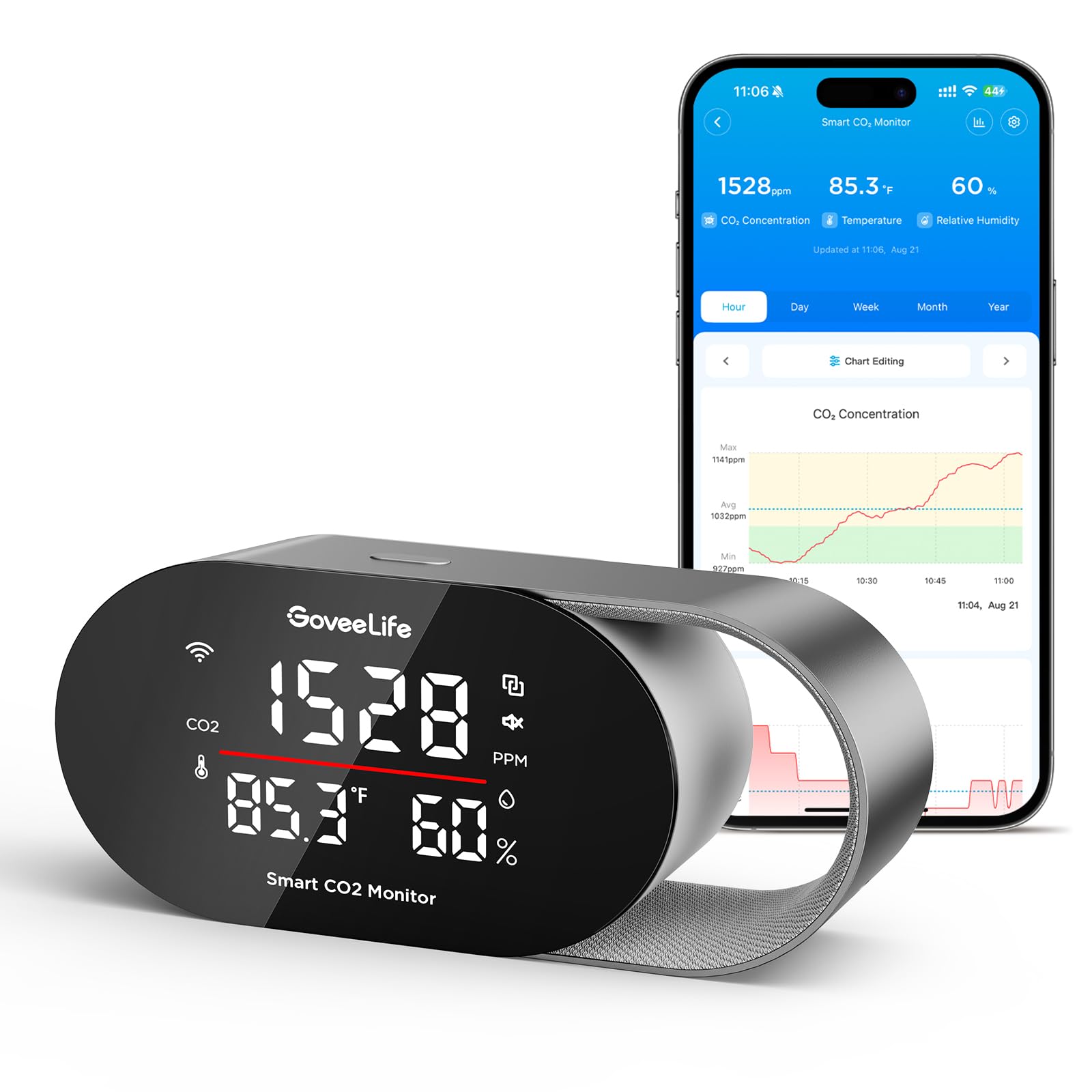
The GoveeLife H5140 takes a different approach from the other units here — it focuses primarily on CO₂ monitoring with an SCD4x photoacoustic NDIR sensor, alongside temperature, humidity, and dew point calculation. It does not measure particulate matter at all, which means it cannot detect mold spores directly. However, it excels at tracking the ventilation patterns and humidity levels that allow mold to take hold. If CO₂ levels stay high during occupancy, it’s a strong signal that air exchange is inadequate, which in a damp home creates perfect mold conditions.
The triple alert system — built-in buzzer, app notifications, and email reports — is the most comprehensive notification setup in this comparison. You can set custom thresholds for CO₂, temperature, and humidity, and the unit links to Alexa and Google Assistant for voice queries. The app stores up to two years of historical data with exportable CSV reports, which is valuable for tracking seasonal humidity trends across winter condensation months and summer dampness.
The H5140 is AC-powered only, with no battery backup, so a power outage wipes monitoring continuity. It also lacks any particulate sensor, so it won’t catch mold spores or dust mites directly — it can only infer mold risk through high humidity and poor ventilation. A few users experienced intermittent WiFi connectivity when the monitor was placed far from the router.
Why it’s great
- Best-in-class CO₂ sensor for detecting ventilation-driven mold conditions
- App stores 2 years of data with CSV export for trend analysis
- Links to smart home ecosystem for automated humidifier and fan control
Good to know
- No particulate sensor — cannot detect actual mold spores
- AC powered only; monitoring stops during power outages
- WiFi connectivity can drop if unit is placed far from the router
6. VEVOR DM197
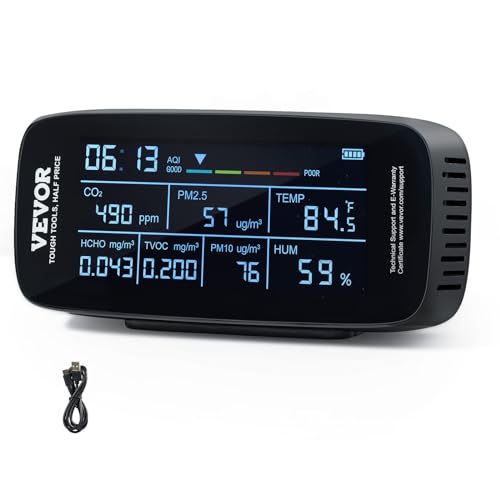
The VEVOR DM197 prioritizes speed. Its 1.5-second refresh rate updates every parameter — CO₂, AQI, PM1.0, PM2.5, PM10, TVOC, HCHO, humidity, and temperature — faster than most competitors, which matters when you’re moving through a house and want immediate feedback on each zone. The 5.7-inch HD display shows all values simultaneously without requiring screen toggles, and the 3000 mAh battery sustains up to 9 hours of continuous operation. The multi-color health index changes in real time, giving you a visual shorthand for room-by-room comparisons.
Multiple independent sensors — semiconductor, laser scattering, and NDIR infrared — work together with an advanced algorithm to reduce cross-sensitivity between pollutants. One user reported that using the monitor near a wood stove showed particulate readings drop from 5-7 PPM during loading to about 3 PPM with the door closed, which demonstrates the laser particle counter’s ability to distinguish between normal combustion and sustained pollution. The audible alarm triggers when CO₂ exceeds 1000 PPM, which is useful for detecting occupancy-driven ventilation failure.
The most common issue reported is a loose battery rattling inside the unit, which can trigger a constant false alarm. Some buyers received a unit with this defect and had to request a replacement. The alarm cannot be permanently silenced without turning it off entirely, which defeats the purpose of a warning system. A few users also noted the device auto-shuts down after a period of inactivity, which interrupts long-term trend monitoring.
Why it’s great
- 1.5-second refresh is the fastest for real-time mold zone mapping
- 3000 mAh battery covers 9 hours of multi-room investigation
- Multi-sensor array reduces cross-sensitivity between pollutant types
Good to know
- Loose battery defect reported in some units causing false alarms
- Alarm cannot stay active while silenced — it’s an all-or-nothing toggle
- Auto-shutdown feature can interrupt long-term monitoring sessions
7. LifeBasis 11-in-1 Air Quality Monitor

The LifeBasis 11-in-1 packs an NDIR CO₂ sensor, laser particle counter, semiconductor TVOC sensor, photoelectric sensor, and temperature/humidity sensor into a package that weighs only 6.1 ounces. For budget-conscious homeowners who suspect mold but aren’t ready to spend substantially on monitoring, this unit provides the core sensors needed to identify high-risk conditions without the smart home features or large display. The 2500 mAh battery delivers 11-12 hours of use, which is the best runtime-to-weight ratio in this comparison.
User reports confirm the PM2.5 readings correlate closely with PurpleAir reference monitors, and the manual CO₂ calibration feature is rare at this price point — most entry-level units rely on automatic calibration that can drift over time. The portable flat design fits easily in a pocket, making it practical for moving through crawl spaces, attics, and basements. One reviewer even used it as a “flatulence alerter” in a manufacturing facility, which, while humorous, confirms the TVOC sensor is sensitive enough to detect biological gas emissions.
The LCD screen is smaller and less vibrant than the 7-inch displays on the YNAK models, and there is no Wi-Fi, Bluetooth, or app integration — all data is displayed on the device only. Some users wish it measured carbon monoxide, which is a different hazard but often confused with general air quality. The audible alert uses a ticking sound rather than a voice or tone, which some find less informative during sleep or work.
Why it’s great
- Exceptional 11-12 hour battery life in a 6.1-ounce package
- PM2.5 readings verified against reference-grade PurpleAir monitors
- Manual CO₂ calibration prevents long-term sensor drift
Good to know
- No Wi-Fi, Bluetooth, or app — data stays on the screen only
- LCD is smaller and less detailed than larger display competitors
- Audible tick alert is less informative than multi-tone or voice alarms
FAQ
Can an air quality monitor detect mold directly?
What humidity level triggers a mold warning on these monitors?
Should I get a monitor with a formaldehyde sensor for mold detection?
Why do some monitors have external sensors and others have internal ones?
Final Thoughts: The Verdict
For most users, the air quality monitor for mold winner is the BREATHE Airmonitor Plus because it combines the most complete sensor suite for mold-specific tracking — PM1, PM2.5, PM10, TVOC, and formaldehyde — with a smart app that logs 30 days of trend data, all backed by a 2-year warranty. If you want the largest display and longest cordless runtime for sweeping through an entire house, grab the YNAK AK22A Extended Battery. And for smart home users who already have Govee devices and want CO₂-driven ventilation alerts to prevent the stagnant conditions that feed mold, nothing beats the GoveeLife H5140.