
Our readers keep the lights on and the weekend projects moving. As an Amazon Associate, I earn from qualifying purchases.
Bed bugs don’t care about your cleaning schedule or the neighborhood you live in. They hitch rides on luggage, secondhand furniture, and visitors, turning a relaxing bedroom into a nightly battleground. The market is flooded with watered-down sprays, dusty powders that take weeks to work, and expensive heater units that promise total annihilation — and most people waste money on the wrong approach first.
I’m Rikta — the founder and writer behind FitlyFast. My deep market research focuses on analyzing the actual chemical formulations, residual duration claims, and real-world kill rates reported by thousands of buyers who have faced down an infestation.
After combing through hundreds of verified reviews and comparing every active ingredient, application method, and long-term control strategy, I’ve narrowed the market down to the seven most effective treatments. This guide identifies the genuine best bed bug killer for every type of infestation, from a stray hitchhiker to a full-blown multi-room invasion.
How To Choose The Best Bed Bug Killer
The right killer depends entirely on whether you’re treating a minor sighting or a chronic infestation. A spray that works on a single bug will fail against a nest of eggs, and a dust that takes days to work won’t satisfy someone who needs to sleep tonight. These are the four factors that separate a smart purchase from a wasted one.
Active Ingredient and Resistance Profile
Many common bed bug sprays rely on pyrethroids, a class of insecticide that bed bugs in many regions have developed strong resistance to. If you use a pyrethroid-based spray on resistant bugs, you’re essentially misting them with water. Silica dust (like Cimexa) and certain concentrates (like Crossfire) use non-repellent modes of action that bugs cannot develop resistance against. Check the active ingredient before you buy — if it’s primarily pyrethrin or pyrethroid, you need a backup strategy.
Residual Duration
A spray that kills on contact is helpful, but it becomes useless after it dries unless it leaves a residual layer. The best bed bug killers provide up to 30 days of residual protection on treated surfaces. That means the bug that crawls through the spray zone five days later still dies. Powders like Cimexa last up to 10 years in undisturbed voids — making them ideal for wall cavities and behind baseboards — while sprays typically last weeks and require reapplication.
Application Method and Safety
Sprays are the easiest for spot-treating mattresses and furniture, but they require spraying every visible bug and every potential hiding spot. Dusts require a puffer tool or a brush to apply a thin, barely visible layer — too much dust and bugs will avoid it. Heaters are the most hands-off method: you load infested items inside, set the timer, and let 120+ degrees do the work for eight hours. Consider your own tolerance for chemical use and whether you have pets or children, as some formulas require keeping animals away until the surface dries.
Quick Comparison
On smaller screens, swipe sideways to see the full table.
| Model | Category | Best For | Key Spec | Amazon |
|---|---|---|---|---|
| Crossfire Liquid Concentrate | Liquid Concentrate | Residual control on mattresses | 13 oz concentrate (makes 1 gal) | Amazon |
| ThermalStrike Ranger Heater | Heat Device | Chemical-free luggage/items | Reaches 140°F+ interior temp | Amazon |
| Cimexa Insecticide Dust | Silica Dust | Long-term wall void protection | 100% silica, 10-year kill layer | Amazon |
| Harris 5 Minute Kill Spray | Aerosol Spray | Fast contact kill on furniture | 5-min kill, 30-day residual | Amazon |
| Bedlam Spray (2-pack) | Aerosol Spray | Professional-grade dual treatment | 17 oz cans, non-staining formula | Amazon |
| JT Eaton Gallon Spray | Water-based Spray | Large area coverage (1 gal) | 128 oz with integrated sprayer | Amazon |
| Tempo Dust | Insecticide Powder | Carpenter bees & wasp nests | 1% Cyfluthrin, 1.25 lb jar | Amazon |
In‑Depth Reviews
1. Crossfire Liquid Concentrate 13 oz

Crossfire is the formulation pest control professionals reach for when standard over-the-counter sprays fail. Its patented non-repellent technology means bed bugs walk right through the treated area without sensing danger, picking up a lethal dose that kills them within minutes. The 13-ounce concentrate mixes with water to make a full gallon of ready-to-use spray, making it the most cost-efficient premium option on this list for treating an entire bedroom.
What sets Crossfire apart is its dual-action approach: rapid knockdown on contact plus a residual layer that continues killing for weeks after the initial application. Customers report that it wipes out pyrethroid-resistant bed bugs that survived other treatments, and the formula is gentle enough to spray directly onto mattresses and box springs without staining. The included protective gloves are a welcome touch, but you’ll want a separate pump sprayer for best coverage.
User reviews consistently mention that Crossfire eliminated infestations that had persisted for months, often with just two treatments spaced 10 days apart to catch newly hatched eggs. The downside is the preparation involved — you must mix the concentrate yourself, and the 13-ounce bottle covers roughly 500 square feet, so larger homes may require two bottles for a full treatment.
Why it’s great
- Kills pyrethroid-resistant bed bugs that survive other sprays
- Non-repellent formula ensures bugs don’t avoid treated zones
- Approved for direct application on mattresses and upholstery
Good to know
- Requires mixing with water and a separate sprayer
- Large infestations may need two bottles for full coverage
2. ThermalStrike Ranger Bed Bug Heater

The ThermalStrike Ranger offers a zero-chemical alternative that uses heat to kill bed bugs and their eggs on contact. Its six-sided heating system surrounds items with temperatures exceeding 120 degrees, penetrating deep into luggage, clothing, shoes, and even electronics. The patented design eliminates cold spots by heating from all sides without moving air or fans, so you can load the unit like a laundry hamper and walk away.
For travelers, pet owners, or anyone who wants to avoid spraying pesticides on their belongings, this is the safest long-term solution. The built-in timer offers two, four, and eight-hour cycles, and the external thermometer lets you verify that the interior reached lethal temperatures. Users report that a single eight-hour cycle kills every life stage, including eggs, and the unit folds down for easy storage when not in use.
Customer reviews highlight how the Ranger handles large items — it fits a 29-inch suitcase with room to spare — but warn that heat can deform sensitive materials. Meltable cosmetics, cheap plastics, and some electronics (especially older devices) should be removed or heat-tested at lower temperatures first. The unit draws standard household current and doesn’t trip breakers, but the exterior gets very hot during operation.
Why it’s great
- 100% chemical-free — safe for use on clothing, bedding, and electronics
- Eliminates eggs and adults in a single eight-hour cycle
- Folds flat for easy storage; no assembly tools required
Good to know
- Premium price point — a significant upfront investment
- Heat can damage some meltable items and sensitive electronics
3. Rockwell Labs Cimexa Insecticide Dust (4 oz)

Cimexa is not your standard diatomaceous earth — it’s a synthetic amorphous silica dust that works by absorbing the waxy protective layer from a bed bug’s exoskeleton, causing the insect to dehydrate and die within 24 to 48 hours. The key advantage over DE is its electrostatic charge: Cimexa clings to vertical surfaces and stays put inside wall voids, baseboards, and crevices without clumping. A single application can remain effective for up to 10 years in undisturbed areas.
This dust is the best weapon for preventative barrier treatment and for treating hidden nest locations that sprays cannot reach. It’s odorless, non-staining, and safe around pets once the dust settles — but the fine particles become airborne during application, so a mask and gloves are essential. Users report that a light dusting inside mattress encasements and along baseboards stopped infestations cold, with many noting that bugs became “crunchy” and died within days.
Customer feedback is overwhelmingly positive, but there’s a learning curve. The dust must be applied in a thin, barely visible layer — too thick and bed bugs will simply walk around it. The included puffer tool works for small cracks but a bellows duster gives better control for larger areas. Several users noted that Cimexa outperformed every spray they tried, especially on pyrethroid-resistant bugs that had survived earlier treatments.
Why it’s great
- Proven 100% mortality rate on resistant bed bug strains
- Up to 10 years of protection in undisturbed voids
- Odorless, non-staining, and safe for pets after dust settles
Good to know
- Requires a duster tool for effective application
- Takes 24-48 hours to kill — not an instant solution
4. Harris 5 Minute Kill Time Bed Bug Killer Spray (32 oz)

Harris delivers exactly what the name promises: a fast-acting aerosol that kills bed bugs within five minutes of direct contact. The water-based formula is odorless and dries clear, making it safe for mattresses, upholstery, and fabrics without leaving visible residue or a chemical smell. For someone who spotted a single bug and wants immediate peace of mind, this is the fastest chemical option on the list.
The true value of Harris lies in its 30-day residual protection. After the spray dries, it leaves an invisible barrier that continues to kill bed bugs and newly hatched nymphs that cross the treated surface. Users tackling moderate infestations report that consistent application over three to four weeks eliminated the problem entirely, saving them thousands of dollars in professional exterminator fees. The EPA-registered formulation is safe for use in bedrooms, hotels, and apartments.
Where Harris falls short is against heavy infestations. The residual claim of 30 days doesn’t always hold up when bugs are coming from neighboring units or deep inside walls. Some users in multi-unit housing report bites returning within days of treatment, suggesting the spray needs to be combined with a dust like Cimexa for wall voids and baseboards. It’s also pricier per ounce than concentrate options, making it a better choice for spot treatment than whole-home saturation.
Why it’s great
- Kills visible bed bugs within five minutes on contact
- Odorless and non-staining — safe for most fabrics
- Provides up to 30 days of residual protection
Good to know
- Less effective against severe, multi-unit infestations alone
- Requires reapplication more often than silica dusts
5. MGK Bedlam Bed Bugs Spray (2-Pack, 17 oz each)

Bedlam is the same product many professional exterminators carry on their trucks. Unlike consumer-grade sprays that rely on a single active ingredient, Bedlam uses a synergistic formula that kills on contact and leaves a residual layer that continues killing for up to four weeks. The water-based aerosol is non-irritating and won’t stain water-safe fabrics, making it one of the safest choices for spraying directly on bed linens and upholstered furniture.
The two-pack provides 34 total ounces of active spray — enough to treat a queen-sized bed, box spring, frame, and surrounding baseboards with some left over for a follow-up application. Customers who used Bedlam as part of a multi-stage elimination plan (encasements, heat treatment of fabrics, and dust in wall voids) reported complete eradication within two to three weeks. The spray doesn’t kill instantly — bugs take several minutes to die — but it contaminates nesting areas and pathways, killing bugs that return to the nest after treatment.
Several experienced users note that the standard Bedlam formula works well for mild to moderate infestations, but the Bedlam Plus variant (with an additional active ingredient) performs better on resistant bugs. If you’re dealing with bugs that have survived other treatments, the Plus version is worth the extra investment. The spray is safe for cats when used as directed, but the aerosol can has a finite range, so deep crevices require a crack-and-crevice tip for effective application.
Why it’s great
- Professional-grade formula trusted by exterminators
- Non-staining and safe for most fabrics and bedding
- Residual control lasts up to four weeks on treated surfaces
Good to know
- Standard version may not kill highly resistant bugs
- Aerosol cans have limited reach into deep cracks
6. JT Eaton 209-W1G Bed Bug Spray (Gallon with Sprayer)
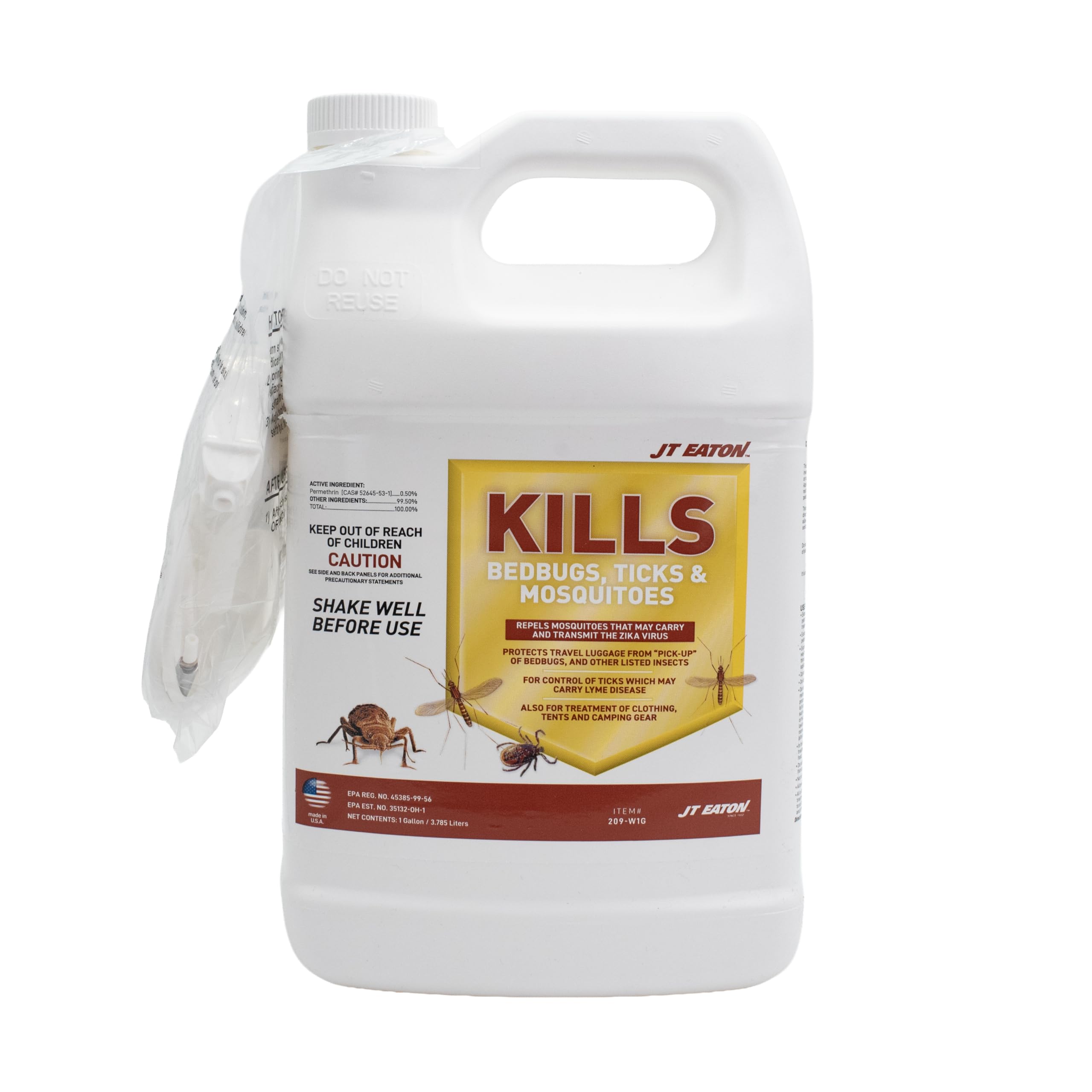
JT Eaton’s gallon jug is the volume champion of this list. With 128 fluid ounces of water-based insecticide and an included sprayer attachment, you can treat multiple rooms without running out halfway through a baseboard. The formula kills bed bugs, ticks, and mosquitoes on contact and leaves a residual that lasts up to six weeks on treated surfaces. For campers, hikers, and homeowners with tick concerns, this dual-use feature adds genuine value.
The water-based formula is odorless when dry and safe for use on mattresses, tents, clothing, and camping gear. Users who treat their clothing and dog gear before heading into wooded areas report zero tick encounters for weeks after application. Against bed bugs specifically, customers have success spraying carpets, curtains, couches, and baseboards — with reports of adult bugs dying within an hour of contact. The sheer volume makes this the most cost-efficient option for treating a whole house.
Where JT Eaton loses ground to more specialized products is in speed and specificity. The kill time is slower than Harris or Bedlam, and the formula is a non-selective insecticide that can harm bees if sprayed on flowering plants. It’s also toxic to cats when wet, so you must keep pets away until the spray dries completely. The included sprayer works well but the bottle is heavy when full, so you’ll need a separate pump sprayer for ceiling-level applications.
Why it’s great
- Gallon size covers multiple rooms in a single purchase
- Effective against ticks and mosquitoes outdoors as well
- Odorless when dry; safe for mattresses and clothing
Good to know
- Slower kill time than dedicated bed bug aerosols
- Toxic to cats when wet; requires pet-free drying period
7. Tempo Dust Insecticide Powder (1.25 lb)
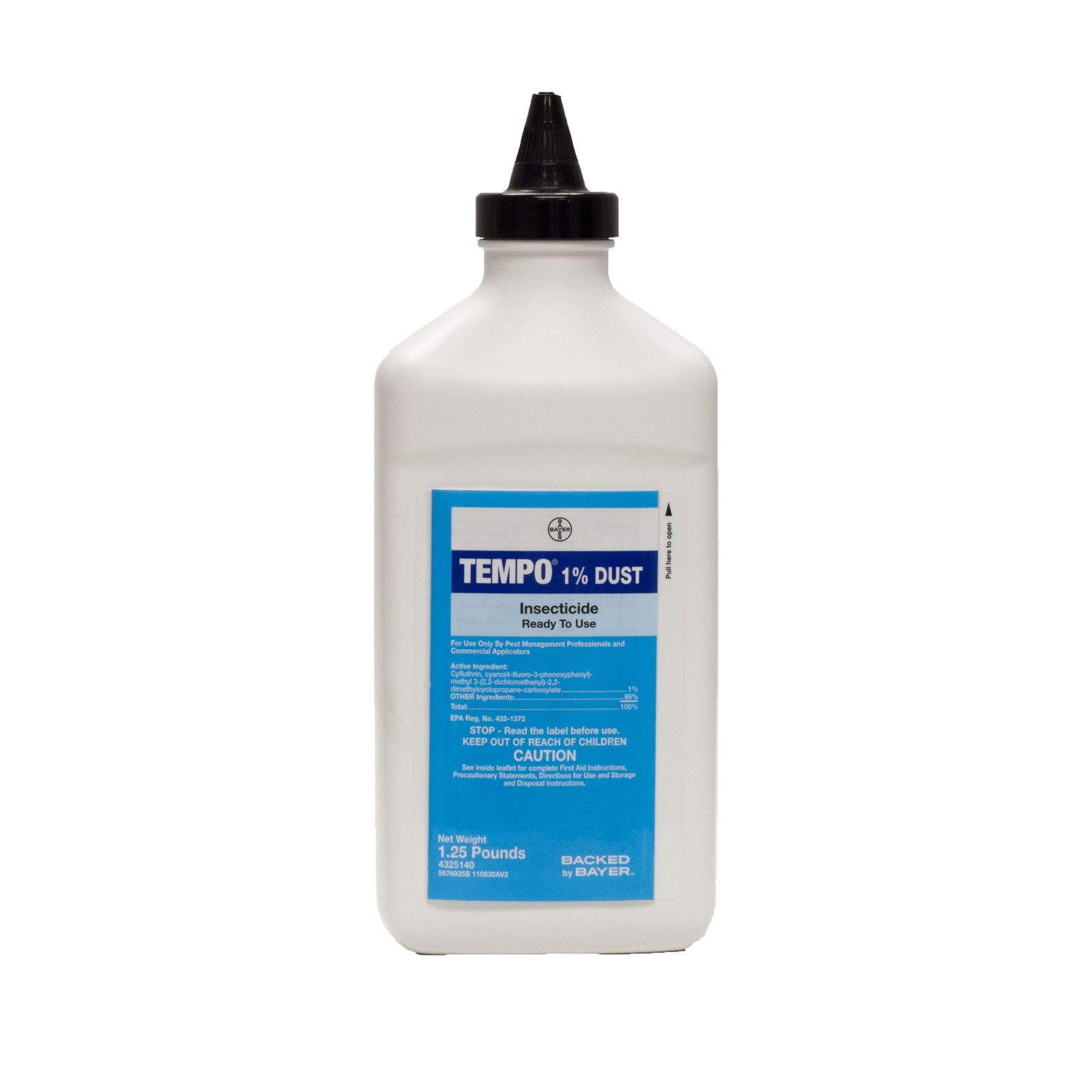
Tempo Dust brings a synthetic pyrethroid (Cyfluthrin 1%) to the powder category, making it a fundamentally different tool from the silica-based Cimexa. While Cimexa works by physical desiccation, Tempo works as a nerve poison that kills insects within hours of contact. Each pound covers 1,000 square feet, so a single 1.25-pound jar treats an entire home’s worth of wall voids, attic spaces, and crawlspaces.
The strongest reviews for Tempo come from users targeting wood-boring insects rather than bed bugs. Customers battling carpenter bees, ground wasps, and yellow jacket nests report that a single generous dusting eliminates the problem within days. For bed bug control, Tempo is best used as a supplemental treatment in areas where moisture or dust makes silica less effective — but it’s not the first-line choice for mattress or furniture treatment because the powder is synthetic and requires careful handling.
Several caveats limit Tempo’s usefulness as a dedicated bed bug solution. It’s not approved for sale in California, New York, South Carolina, or Connecticut. Users report that the dust doesn’t cling to vertical surfaces as well as Cimexa, and it must be kept away from food preparation areas. If your primary concern is bed bugs inside a bedroom, a silica dust or liquid concentrate is a better fit — but for outdoor nests and structural pest control, Tempo is unmatched in speed and range.
Why it’s great
- Covers massive areas — 1 pound treats 1,000 square feet
- Fast kill time for wasps, carpenter bees, and ground nests
- Effective in moist environments where silica dust clumps
Good to know
- Not available in CA, NY, SC, or CT
- Primarily a structural/outdoor tool, not ideal for mattresses
FAQ
Can I use Cimexa directly on my mattress?
How long does Crossfire take to kill bed bugs?
Will the ThermalStrike heater damage my electronics?
What kills bed bug eggs that sprays miss?
Is Tempo dust safe to use indoors for bed bugs?
Final Thoughts: The Verdict
For most users, the best bed bug killer winner is the Crossfire Liquid Concentrate because it kills resistant strains, leaves a long residual, and is approved for direct mattress application — making it the most versatile chemical option for any home. If you want a chemical-free solution that protects luggage and prevents re-infestation, grab the ThermalStrike Ranger Heater. And for long-term barrier protection in wall voids and baseboards, nothing beats the Cimexa Insecticide Dust.