
Our readers keep the lights on and the weekend projects moving. As an Amazon Associate, I earn from qualifying purchases.
Choosing a first multimeter often means navigating a maze of specs—counts, TRMS, CAT ratings, and auto-ranging—that can overwhelm a beginner before the first probe even touches a circuit. The wrong pick leads to frustrating continuity beeps, inaccurate voltage readings, or a dead meter after a single drop.
I’m Rikta — the founder and writer behind FitlyFast. I’ve spent years analyzing entry-level test gear, cross-referencing user reports with real technical specs to separate the meters that teach from those that just frustrate.
After comparing seven models built for the learning curve, I’ve narrowed down the strongest options. This guide ranks the most practical, durable, and accurate picks for anyone shopping for the best beginner multimeter for home, auto, or workshop use.
How To Choose The Best Beginner Multimeter
A first multimeter should prioritize clarity, safety, and forgiveness over raw feature count. Beginners often fall into the trap of buying the cheapest unit with the highest count number, only to find a confusing interface, flimsy leads, or an unrated safety category. Here’s what actually matters.
Auto-Ranging vs. Manual-Ranging
Auto-ranging meters automatically select the correct measurement scale, so you don’t need to guess whether a voltage is in the 2V, 20V, or 200V range. This eliminates a common source of beginner error and blown fuses. Manual-ranging meters require you to dial in the expected range, which can teach fundamentals but slows down troubleshooting and risks overload if set too low.
Count Resolution and True RMS
Counts indicate how many digits the display can show: a 2000-count meter maxes out at 2.000V, while a 6000-count meter reads 6.000V. Higher counts give better precision for low-voltage electronics work. True RMS (Root Mean Square) matters if you measure non-sinewave AC signals, common in modern dimmers, motor drives, and switching power supplies. For pure battery and household AC checks, a non-TRMS meter still works fine.
Safety Ratings and Overload Protection
Look for at least a CAT II 600V or CAT III 300V rating — this tells you the meter can handle typical household surges without arcing. Ceramic fuses (rated for 600V or higher) provide actual arc-fault protection, unlike glass fuses used in bargain-bin meters. A missing fuse or an unrated input jack is a hard pass.
Lead Quality and Accessories
The supplied test leads are the weakest link on nearly every budget meter. Silicone-insulated leads stay flexible in cold garages and resist heat, while PVC leads stiffen and crack over time. A meter that ships with alligator clips, a temperature probe, and a storage case adds immediate utility without extra trips to the hardware store.
Quick Comparison
On smaller screens, swipe sideways to see the full table.
| Model | Category | Best For | Key Spec | Amazon |
|---|---|---|---|---|
| AstroAI Digital Multimeter TRMS 4000 | Mid-Range | Hobbyists and students needing TRMS | 4000 counts TRMS | Amazon |
| KLEIN TOOLS MM325 | Mid-Range | DIYers wanting pro brand durability | Manual-ranging 600V AC/DC | Amazon |
| KAIWEETS HT118A | Premium | Automotive and home diagnostics | 6000 counts TRMS | Amazon |
| KAIWEETS KIT01 | Premium | Electricians wanting a complete kit | 3-tool kit with NCV & GFCI | Amazon |
| Crenova 890Z | Budget | Value seekers wanting extras included | 6000 counts TRMS | Amazon |
| Proster Autoranging 6000 | Budget | Entry-level low-voltage work | 6000 counts TRMS | Amazon |
| Proster Magnetic TRMS | Budget | Hands-free operation on metal surfaces | 6000 counts TRMS | Amazon |
In‑Depth Reviews
1. AstroAI Digital Multimeter, TRMS 4000 Counts

The AstroAI TRMS 4000 hits the sweet spot between feature depth and beginner usability. Auto-ranging eliminates guesswork, while True RMS provides accurate AC measurements on the non-sinewave signals found in modern dimmers and motor controls. The 4000-count display offers enough resolution for nearly every home, automotive, and hobby task without overwhelming a new user with digits.
Build quality stands out at this tier: two ceramic fuses rated at 600V replace the glass fuses common on cheaper meters, and the rubber holster absorbs everyday drops. The large backlit LCD, data hold, and kickstand make bench work comfortable. Reviewers consistently note the meter survives falls and still reads within spec, a durability benchmark that budget units struggle to match.
Drawbacks center on the included test leads, which some users found needed light sanding for stable continuity contact. The leads are functional but not premium-grade silicone. For a first meter that teaches proper technique without punishing mistakes, this is the strongest all-around choice for students, hobbyists, and home DIYers.
Why it’s great
- True RMS and auto-ranging simplify complex AC measurements for beginners
- Dual ceramic fuses provide real overload protection, not glass-fuse theater
- Large backlit display with kickstand makes bench use comfortable
Good to know
- Test leads may need light sanding for reliable continuity contact
- No magnetic mount for hands-free operation on metal panels
2. Klein Tools MM325 Multimeter, Manual-Ranging 600V
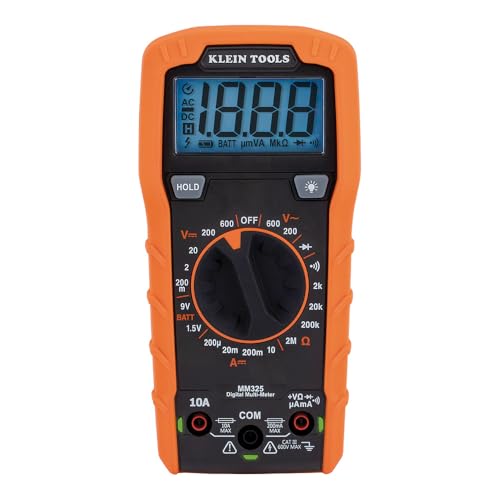
Klein Tools brings professional-grade build to the MM325 without the professional-grade price. This is a manual-ranging meter, meaning you select the expected voltage or resistance range yourself—a deliberate design that forces beginners to understand the scale they’re measuring. The trade-off is a steeper learning curve, but the payoff is a deeper grasp of electrical fundamentals.
The standout feature is the drop rating: the MM325 survives a 6.6-foot fall, backed by a rubberized holster and reinforced case. LED indicators on the jacks light up to confirm correct test lead placement, a safety net that catches incorrect connections before you probe a live circuit. The backlit LCD is bright and readable in dim garages or dark breaker panels.
Limitations include no auto-ranging, no True RMS, and a missing carrying case at this price point. The continuity tone can be finicky, and the included leads are adequate but not premium. For the DIYer or apprentice who primarily checks household AC voltage, battery health, and basic continuity, this is a tough, trusty tool that will outlast cheaper plastic meters.
Why it’s great
- 6.6-foot drop survival makes it nearly indestructible for daily carry
- LED lead-placement indicators prevent beginner probe misconnections
- Compact size fits in standard tool pouch without crowding
Good to know
- Manual-ranging requires understanding expected measurement range
- No True RMS—fine for sinewave AC but limited for modern electronics
3. KAIWEETS Digital Multimeter TRMS 6000 Counts HT118A
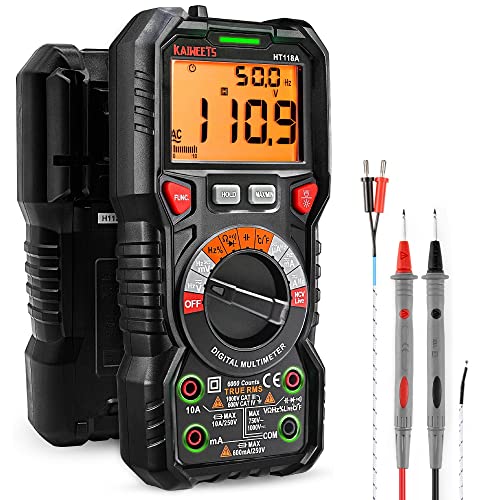
The KAIWEETS HT118A delivers premium specs—6000-count resolution, True RMS, auto-ranging, and a CAT III 1000V safety rating—in a package that costs a fraction of a Fluke equivalent. The 6000-count display reads down to 1mV steps, essential for automotive sensor testing and low-voltage electronics where a 2000-count meter would show zeros.
Feature density is high: non-contact voltage detection with sound and light alarm, Min/Max/Average recording for signal fluctuation analysis, a rear flashlight for dim work areas, and temperature measurement via included K-type thermocouple. The LED light ring around the input jacks illuminates the correct jacks when you rotate the dial, a thoughtful touch that speeds up lead changes in low light.
The weak spot is the test leads. Multiple reviews report PVC leads failing open within six months, and the included temperature probe reads off by 10–13°F. The manual also contains translation errors. If you plan to replace the leads with silicone alternatives immediately, this meter offers exceptional measurement capability for automotive, HVAC, and home diagnostics.
Why it’s great
- 6000-count TRMS with 1mV resolution catches low-voltage sensor signals
- LED jack ring and rear flashlight make night work practical
- Min/Max/Average recording helps diagnose intermittent electrical faults
Good to know
- Included PVC test leads often fail within months—budget for silicone replacements
- Temperature probe reading is inaccurate by 10–13°F out of the box
4. KAIWEETS Electrical Test Kit KIT01

The KAIWEETS KIT01 bundles a digital multimeter, a non-contact voltage pen, and a GFCI outlet tester into a single zippered case—a setup that eliminates the “wrong tool” frustration for home electrical diagnostics. The multimeter itself is a straightforward 600V AC/DC manual-ranging meter with continuity, diode, and battery test modes, adequate for most household and light automotive troubleshooting.
The NCV pen sets this kit apart: it displays live voltage percentage on an LCD and beeps at two sensitivity ranges (12–1000V and 70–1000V), allowing safe confirmation of live wires before probing. The GFCI tester freezes its results for five minutes, so you can read the fault code without needing to crane your neck behind an outlet. All three tools run on included AAA batteries, and the case keeps everything organized.
The trade-off is that the multimeter lacks auto-ranging, True RMS, and high-resolution counts—it’s a basic meter designed for speed, not precision. The kit is ideal for homeowners and DIYers who want one box for diagnosing outlets, checking dryer breakers, and verifying dead circuits, but it won’t satisfy electronics hobbyists needing microvolt resolution.
Why it’s great
- Three diagnostic tools in one case cover the most common home electrical checks
- NCV pen shows live voltage percentage, not just a beep
- GFCI tester freezes results for five minutes—no awkward craning
Good to know
- Multimeter is basic manual-ranging with no True RMS or high counts
- Not suitable for electronics or sensor-level low-voltage work
5. Crenova 890Z Digital Multimeter 6000 Counts TRMS

The Crenova 890Z packs an astonishing feature set—6000-count TRMS, auto-ranging, NCV detection, temperature probe, transistor (hFE) testing, and even alligator clip leads—at a price that undercuts many basic 2000-count meters. The orange silicone holster and included storage case make it feel more substantial than its entry-level price suggests.
Testing accuracy holds up well for general-purpose work. Users report the auto-ranging responds quickly, the backlit LCD is clear in dim conditions, and the included K-type thermocouple works out of the box for HVAC checks. The NCV detection beeps reliably near live AC wires, adding a safety layer for beginners tracing circuits behind drywall.
The main compromises are build refinement and long-term durability. The case is not heavily ruggedized, and some users note the auto-ranging cannot be disabled for repeat measurements on the same value. The instruction manual is minimal, requiring a beginner to look up more detailed operation guides online. For a budget-first shopper who wants the broadest measurement capability, this is hard to beat.
Why it’s great
- 6000-count TRMS with extras like hFE and temperature at a budget price
- Includes alligator clip leads and carrying case for immediate field use
- NCV detection adds safety for tracing live wires behind walls
Good to know
- Cannot disable auto-ranging for repeat measurements on the same value
- Instruction manual is minimal—beginners may need online resources
6. Proster Autoranging Multimeter 6000 Count

The Proster Autoranging 6000 Count meter emphasizes speed and simplicity. Its auto-ranging routine resolves ohms and low DC voltage about four times faster than a competing mid-range meter, according to user reports—a genuine time-saver when probing multiple points on a circuit board or wiring harness. The rubber boot and built-in kickstand provide solid bench stability.
The kit includes alligator clip leads and a K-type thermocouple alongside standard probe leads, covering continuity checks and temperature measurement without extra purchases. The 6000-count display with backlight offers good readability, and the NCV function provides contactless voltage detection for quick live-wire identification. The dial action is tight and clicky, reinforcing the impression of a well-assembled meter.
Limitations include gummy push-button feel on the function keys and a lack of inclusion of a storage case with a carabiner clip. Some users note the protective probe caps must be removed before use with standard test points—a minor annoyance. For reliable entry-level performance at a low cost, this meter is a strong contender, especially for low-voltage residential and automotive diagnostics.
Why it’s great
- Auto-ranging resolves ohms and low DC voltage noticeably faster than peers
- Includes alligator clip leads and K-type thermocouple for expanded use
- Rubber holster and tight dial action feel more premium than price suggests
Good to know
- Push-button function keys feel gummy and less precise than the dial
- No storage case or carabiner clip included for tool-bag carry
7. Proster Digital Multimeter TRMS with Magnetic Back
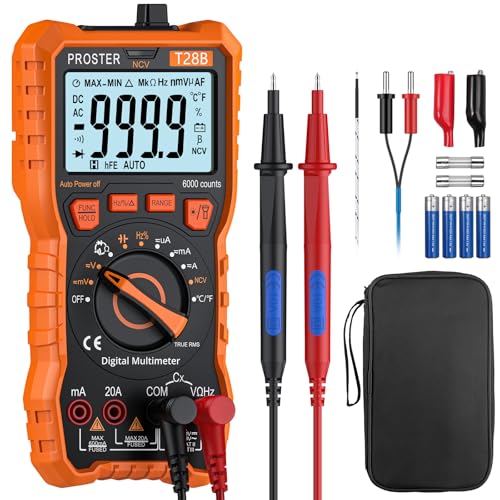
The Proster T28B differentiates itself with a built-in magnetic back that sticks securely to ferrous metal surfaces—breaker panels, car chassis, AC unit frames—freeing both hands for probing. Combined with the kickstand and rear probe storage slots, this meter offers the most hands-free flexibility in the budget tier. The 6000-count TRMS auto-ranging engine delivers reliable readings across AC/DC voltage, current, capacitance, frequency, and temperature.
The kit goes beyond the norm: a soft carrying bag, spare fuses, a screwdriver for fuse access, and alligator clips are included alongside the standard probes. The flashlight and bright backlight improve usability in dark crawlspaces and dim basements. CE and UL certification for CAT III 600V / CAT II 1000V provides genuine safety assurance, not just marketing copy.
Durability concerns appear in long-term reviews. The COM port on some units becomes intermittent after a few months of light use, and the included temperature probe feels flimsy. The manual is tiny and inadequate for true beginners. If the magnetic mount solves a specific workflow problem (automotive, electrical panel work), it’s a uniquely capable tool, but general-purpose beginners might prefer the more proven AstroAI or KAIWEETS options.
Why it’s great
- Built-in magnetic back enables true hands-free operation on metal surfaces
- Comprehensive kit includes bag, spare fuses, screwdriver, and alligator clips
- CE and UL rated for CAT III 600V with genuine safety certs
Good to know
- COM port reported as intermittent on some units after months of use
- Manual is too small and sparse for beginners learning the basics
FAQ
Can I use a beginner multimeter on household 120V outlets?
What does the continuity beep actually tell me?
Do I need True RMS as a beginner?
How often should I replace the test leads?
What does the diode test function do?
Final Thoughts: The Verdict
For most users, the beginner multimeter winner is the AstroAI Digital Multimeter TRMS 4000 because it balances True RMS accuracy, auto-ranging convenience, ceramic fuse safety, and everyday durability at a price that undercuts comparable options. If you want a compact, nearly indestructible meter for basic home and automotive checks, grab the Klein Tools MM325. And for the most complete diagnostic solution including GFCI and voltage pen right out of the box, nothing beats the KAIWEETS KIT01.