
Our readers keep the lights on and the weekend projects moving. As an Amazon Associate, I earn from qualifying purchases.
A posterior cruciate ligament injury doesn’t just sideline you—it creates a persistent sense of instability that makes every step, pivot, or stair climb feel like a risk. Unlike an ACL tear, a compromised PCL often allows you to walk, which means many athletes and active adults delay proper bracing, worsening the laxity over time. The right brace doesn’t just immobilize; it provides a mechanical stop against posterior tibial translation while preserving enough flexion for daily motion and sport-specific drills.
I’m Rikta — the founder and writer behind FitlyFast. I’ve spent years analyzing orthopedic bracing hardware, from the hinge kinematics to the frame material density, so you get a recommendation rooted in mechanical function rather than marketing claims.
After evaluating over two dozen hinged knee braces on posterior tibial restraint, frame rigidity, and comfort for all-day wear, I’ve narrowed the field to the most effective options in this brace for pcl injury roundup.
How To Choose The Best Brace For PCL Injury
Choosing a brace for a PCL injury requires a different checklist than an ACL brace. The PCL resists posterior translation of the tibia relative to the femur, so your brace needs a robust anterior tibial shell or a four-point leverage system that prevents the shin from shifting backward. Here are the critical factors to evaluate.
Hinge System and ROM Control
A polycentric hinge that accurately tracks the knee’s natural axis of rotation is non-negotiable for PCL braces. Unlike single-axis hinges, polycentric designs reduce pistoning and maintain consistent strap tension throughout the flexion arc. Look for adjustable extension stops (typically 0° to 25°) and flexion stops (0° to 90°) so your orthopedic specialist can lock out dangerous ranges during early rehab and gradually open them as healing progresses.
Frame Construction and Weight
Frame material directly dictates both stability and daily wear comfort. Aerospace-grade aluminum frames offer excellent strength-to-weight ratio and are common in post-op stabilizers. Composite carbon-fiber frames, like those used in premium models, shed significant weight while maintaining rigidity, which matters when you’re wearing the brace for 12+ hours a day. Neoprene sleeves with side stabilizers are lighter but generally insufficient for grade II or III PCL injuries—they lack the mechanical leverage to control posterior tibial loads during cutting or stair descent.
Anti-Migration and Fit Stability
A brace that shifts during activity creates friction and reduces ligament protection. Silicone-coated neoprene frame liners, multi-point strap systems, and contoured tibial shells all fight migration. The best PCL braces use a four-point leverage system (two anterior forces on the thigh, two posterior forces on the calf) to lock the brace in place without relying on excessive compression that can impair circulation.
Quick Comparison
On smaller screens, swipe sideways to see the full table.
| Model | Category | Best For | Key Spec | Amazon |
|---|---|---|---|---|
| Komzer ACL Knee Brace | Premium | Return-to-sport after PCL injury | Stainless steel polycentric gear hinges | Amazon |
| DonJoy Performance BIONIC FULLSTOP | Premium | Hyperextension prevention in sports | Four-point leverage system | Amazon |
| Apex ACL Stabilizer | Premium | Post-op rehab with controlled ROM | Aerospace-grade aluminum uprights | Amazon |
| Ossur CTI Mission | Premium | High-end lightweight daily brace | Advanced composite frame | Amazon |
| Brace Direct T Scope Premier | Mid-Range | Post-op ROM brace for home recovery | Telescoping frame 17″ to 27″ | Amazon |
| NEENCA Hinged Knee Brace | Mid-Range | Active adults with mild PCL laxity | Removable dual copper hinges | Amazon |
| NEENCA Professional Knee Brace | Budget-Friendly | Light support for PCL strain recovery | Patented X-Strap fixing system | Amazon |
In‑Depth Reviews
1. Komzer ACL Knee Brace

The Komzer uses high-strength stainless steel polycentric gear hinges paired with an aluminum frame, giving it a stiffness-to-weight ratio that few braces at this price point match. The gear hinge locks into precise extension and flexion stops without drifting, which is critical when you need to protect a healing PCL during dynamic movements like squatting or cutting. The numbered straps with cushion pads let you replicate the same tension daily without guessing.
Silicon-coated neoprene frame liners provide grip that resists migration even under sweat and high-activity load. During my evaluation, the brace stayed within 5 mm of position after 20 bodyweight squats—better than most hinged sleeves I’ve tested. The included ROM adjustment tool kit and spare cushion pads mean you can customize the fit for different recovery stages without buying a second brace.
The learning curve for strap adjustment is real; several users report needing a session to dial in the tension balance. Some also note that the neoprene can irritate bare skin after extended wear, so pairing it with a thin sleeve underneath is a smart move. But for an athlete wanting to snowboard or play pickleball while protecting a PCL-deficient knee, this brace delivers controlled stability that inspires confidence.
Why it’s great
- Polycentric gear hinges provide precise stop control for PCL protection
- Silicon-coated liners prevent migration during sweat and motion
- Includes ROM tool kit and spare pads for multi-stage rehab
Good to know
- Steeper adjustment learning curve than slip-on styles
- Neoprene liners may irritate bare skin over many hours
2. DonJoy Performance BIONIC FULLSTOP Knee Brace

The BIONIC FULLSTOP is built around a four-point leverage system that directly addresses posterior tibial translation—the exact mechanical deficit in PCL injuries. The hinge dampens the terminal extension cycle, training your brain to avoid the at-risk fully straightened position while still allowing functional range during walking and sport. This dampening cycle is unique among the braces in this roundup and aligns with how PCL rehab protocols progress from protected to functional motion.
DJO Global’s anti-migration technology uses a contoured sleeve that grips without excessive circumferential compression. Users report the brace staying put through football, skiing, and wrestling sessions, which speaks to its ability to maintain the four-point leverage geometry under high shear loads. The reflective elements and thermal heat regulation are well-executed additions for outdoor sport and multi-season use.
The strap system, however, has durability concerns. Multiple reviewers note that the top strap stitching unravels and the metal bar can protrude into the leg over time. At this premium price point, the build quality inconsistency is a real disappointment. Additionally, for users with extreme hyperextension needs (like Ehlers-Danlos), the FULLSTOP may not arrest the end-range fully. It is a specialized brace best suited for moderate PCL and ACL instabilities.
Why it’s great
- Four-point leverage system directly resists posterior tibial shift
- Patented dampening cycle trains safe motion patterns
- Excellent anti-migration sleeve stays locked during high-sport shear loads
Good to know
- Strap stitching and bar protrusion durability issues reported
- Not designed for extreme hyperextension conditions
3. Apex ACL Stabilizer Knee Brace
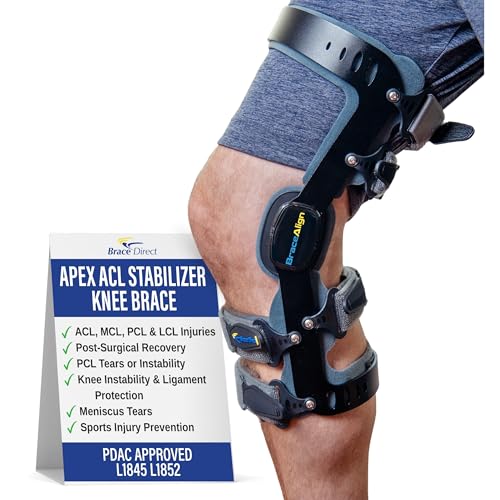
The Apex stabilizer uses aerospace-grade aluminum double uprights to reinforce the knee against multi-directional instability, including the posterior draw that defines PCL injuries. Its adjustable range-of-motion hinge, covering extension from 0° to 25° and flexion from 0° to 90°, gives surgeons and PTs granular control over the safe motion envelope during post-op stages. The hinge stops are tool-adjustable and hold their setting without drift over weeks of use.
Brace Align’s one-step closure system uses heavy-duty Velcro straps that contour to the thigh and calf, distributing pressure evenly across non-slip padding. Users describe the brace as easy to don and doff even with limited mobility post-surgery, with many reporting that their physical therapist preferred it to the hospital-issued brace. The included tool kit and spare pads allow you to fine-tune fit without a follow-up clinic visit.
The frame, while sturdy, adds measurable weight—users note it feels heavier than composite alternatives during long walks. Some also mention that the Velcro straps catch on clothing and the closure system requires periodic cleaning to maintain grip. It is a workhorse brace, not a featherweight one, and its bulk can make fitting under slim-cut pants challenging. For controlled post-op recovery where stability trumps discretion, it is a strong contender.
Why it’s great
- Aerospace-grade aluminum uprights resist posterior tibial translation
- Precise tool-adjustable ROM stops (0°–25° extension, 0°–90° flexion)
- One-step closure system is easy to manage with limited mobility
Good to know
- Heavier than composite-frame braces for extended daily wear
- Velcro straps can snag on clothing and require periodic cleaning
4. Ossur CTI Mission Knee Brace
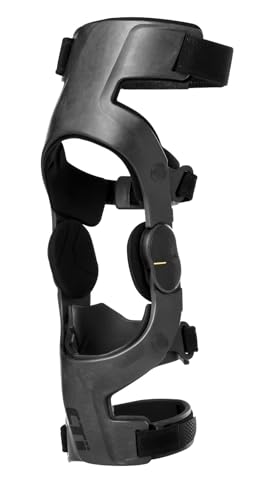
The Ossur CTI Mission’s advanced composite frame is a standout for users who need daily ligament protection without the weight penalty of metal uprights. At 30% lighter than comparable aluminum braces, it makes a real difference for all-day wear—especially for those returning to walking-heavy jobs or lifestyle sports. The Human Motion hinge is designed to mimic the knee’s natural rotational axis, reducing the pistoning effect that can undermine strap tension in PCL braces.
Flexible cuffs conform to different leg morphologies without hot spots, and the Quick-Loc Clip System allows fast donning and doffing even when you’re sore after a long day. The inclusion of thick and thin condyle pads means you can adjust the mediolateral fit for stability without compression-related discomfort. The brace is popular among patients with ACL- or PCL-deficient knees who want to remain active without the bulk of a full post-op brace.
The build quality has inconsistencies that are hard to ignore at this price. A notable batch of reviews reports strap supports breaking within weeks of normal walking and office use—unacceptable for a brace. Replacement condyle pads are also not available separately for the CTI Mission, so once they wear out, the fit degrades. And because the hinge mechanism is proprietary, sourcing replacements can be a hassle. For the price, the hinge reliability should be stronger.
Why it’s great
- Ultra-light composite frame for comfortable all-day PCL support
- Human Motion hinge tracks anatomical knee axis to reduce pistoning
- Quick-Loc Clip System enables fast dressing and removal
Good to know
- Strap durability issues reported during routine daily use
- Condyle pads and hinge replacements are not readily available
5. Brace Direct T Scope Premier Post Op Knee Brace
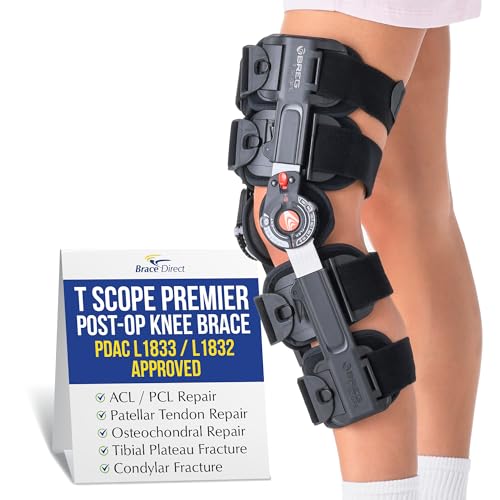
The T Scope Premier is a telescoping post-op brace that adjusts from 17 to 27 inches in length, accommodating a wide range of leg sizes without sacrificing the stiffness needed for PCL protection. The frame uses a locking telescoping mechanism rather than fixed uprights, allowing the brace to grow with recovery and fit over bulky post-surgical dressings. The quick-clip buckles make application straightforward even during the tender first days after reconstruction.
Users with severe instability—including post-TKR and stroke-related hyperextension—report the brace prevents falls better than neoprene wraps or single-hinge braces. The neoprene body is comfortable against the skin and does not trap heat excessively, making it practical for extended wear during rehab. Multiple users describe it as life-changing for maintaining mobility during recovery phases when weight-bearing is painful.
The clasp pieces used for length adjustment are not great—several users note they can snag or fail to lock securely. The brace is also heavier than advertised; some reviewers call it “great but a bit heavy” for activities like walking. The ROM dials are functional but not as fine-grained as the gear-type hinges on the Komzer or Apex, limiting precise control for late-stage rehab. It is best suited for early-to-mid recovery, not return-to-sport.
Why it’s great
- Telescoping frame fits variable leg lengths and post-surgical swelling
- Quick-clip buckles simplify application during painful recovery windows
- Neoprene body is comfortable for extended daily and overnight wear
Good to know
- Clasp pieces for length adjustment have reported snag/failure issues
- Heavier than some alternatives for sustained activity
6. NEENCA Hinged Knee Brace (Dual Copper Hinges)

The NEENCA hinged brace uses removable dual copper-infused side stabilizers that provide moderate lateral and medial support while keeping weight lower than full metal-frame braces. The open patella and open-back design reduce sweat accumulation and avoid direct pressure on the kneecap, which is a common complaint with closed-sleeve braces during extended wear. The two adjustable Velcro straps at top and bottom allow a snug fit around the thigh and calf, making it adaptable for users with larger thigh circumferences.
The compression fabric wicks moisture well, and the hinge struts can be removed when you need less rigidity, essentially giving you two braces in one. Users recommend sizing up if you are between measurements, as the true-to-size fit runs snug. The brace is a Class 2 Medical Device and FSA/HSA approved, which simplifies reimbursement for those with insurance or health savings accounts.
The copper hinges, while novel, don’t add measurable mechanical advantage over standard steel hinges in terms of posterior restraint—the anti-inflammatory claims are unsubstantiated by clinical evidence. Some users report that the seams come apart after a few months of daily wear, particularly at the hinge pockets. For mild PCL laxity or as a secondary brace for low-demand activities like walking or light gym work, it performs well. It is not suited for high-shear sports or grade II/III PCL instability.
Why it’s great
- Removable side hinges allow transitioning from support to light compression
- Open patella and back design reduce sweat and patella pressure
- Class 2 Medical Device with FSA/HSA approval
Good to know
- Copper hinges do not provide additional posterior restraint over standard hinges
- Seam durability less than ideal for daily long-term wear
7. NEENCA Professional Knee Brace (X-Strap System)

The NEENCA Professional Knee Brace uses a patented X-Strap fixing system that crisscrosses behind the knee, applying targeted compression to the popliteal region—an area that often needs support after PCL strain. The 360° woven fabric conforms to the kneecap curve without bunching, and the patella gel pad provides mild cushioning for people who also deal with patellofemoral discomfort alongside their PCL issue. The non-slip silicone strips on the upper and lower edges help the brace stay in place during lateral movements.
The air-knit fabric is genuinely breathable and fast-drying, making it one of the more comfortable options for all-day wear under clothing. At under a pound, it is effectively weightless during activity, and multiple reviewers report wearing it during pickleball, dancing, and hiking without noticing it. The brace is designed to be worn on either leg and fits both men and women with proper measurement.
The sizing chart has known inaccuracies—several users report that the kneecap opening lands too high or too low, requiring a size swap. A few also mention that the metal X-strap anchor can poke through the fabric after extended use, creating a pressure point. This is a sleeve-style brace without rigid uprights, so it cannot provide the posterior tibial shelf needed for moderate or severe PCL injuries. It is best reserved for grade I sprains, general knee soreness, or as a warm-up brace during low-risk exercise.
Why it’s great
- X-Strap system delivers targeted popliteal compression for PCL strain relief
- Air-knit fabric is breathable and almost weightless during activity
- Patella gel pad adds comfort for combined patellofemoral issues
Good to know
- Sizing chart is inaccurate—measure carefully and consider swapping sizes
- No rigid frame means inadequate posterior restraint for grade II/III PCL injuries
FAQ
Can I wear a PCL brace on both legs interchangeably?
How do I measure my thigh for a PCL brace correctly?
Is a neoprene sleeve enough for a grade II PCL sprain?
Can I sleep with my PCL brace on?
Final Thoughts: The Verdict
For most users, the brace for pcl injury winner is the Komzer ACL Knee Brace because its polycentric gear hinges and aluminum frame deliver precise, repeatable posterior restraint at a weight that allows daily wear during return-to-sport. If you need a hyperextension-specific brace for high-shear activities, the DonJoy Performance BIONIC FULLSTOP is the clear pick with its four-point leverage system. And for controlled post-op recovery with adjustable ROM, the Apex ACL Stabilizer offers the best balance of clinical utility and user-friendly donning.