
Our readers keep the lights on and the weekend projects moving. As an Amazon Associate, I earn from qualifying purchases.
Finding a sleeping bag that balances a low weight on the scale with a low number on the price tag often feels like a compromise on warmth or durability. The real challenge is sorting through insulation types, temperature ratings, and packed sizes to find a bag that actually performs on the trail without breaking your budget.
I’m Rikta — the founder and writer behind FitlyFast. I’ve spent years analyzing outdoor gear specifications, comparing fill powers and fabric deniers, to separate marketing hype from real-world performance.
This guide breaks down seven top contenders to help you confidently choose the right affordable backpacking sleeping bag without sacrificing critical features for your next trip.
How To Choose The Best Affordable Backpacking Sleeping Bag
Selecting the right bag for backpacking on a budget means looking beyond the price tag. You need to weigh the fill type, temperature rating, weight, and packed size against your typical camping conditions. Here’s what to focus on.
Insulation Type: Down vs. Synthetic
Down insulation offers the best warmth-to-weight ratio and packs down smaller than synthetic fills, making it ideal for multi-day trips. However, down loses nearly all insulating ability when wet. Synthetic fills like Spirafil or Cirroloft retain warmth even when damp, are easier to clean, and cost less, but they are heavier and bulkier for the same warmth rating. Your local climate dictates the right choice.
Temperature Ratings Are Not Absolute
Many budget bags use a single “comfort” or “extreme” number. The industry standard ISO rating provides a comfort limit (for cold sleepers) and a lower limit (for survival). Affordable bags often omit these, so a 32°F bag might only keep you warm down to 40°F or 50°F for a cold sleeper. Always add a margin of 10-15°F to the rating for comfort, and consider using a sleeping bag liner.
Shape: Mummy vs. Envelope
Mummy bags are tapered to reduce dead air space, making them lighter and warmer per ounce of fill. Envelope or rectangular bags offer more room to move but are significantly heavier and less thermally efficient. For backpacking, a mummy or semi-rectangular shape with a generous footbox is the best balance of comfort and performance.
Weight and Packed Volume
Every ounce matters when you’re carrying it uphill. An affordable backpacking bag should ideally weigh under 3 pounds and compress into a stuff sack no larger than a small watermelon (roughly 12 x 7 inches). Check the shell fabric denier — a 20D nylon shell is light but less durable than a 50D fabric, which is heavier but more abrasion-resistant.
Quick Comparison
On smaller screens, swipe sideways to see the full table.
| Model | Category | Best For | Key Spec | Amazon |
|---|---|---|---|---|
| Kelty Cosmic 20 Down | Premium Down | Best all-around down bag | 2.4 lbs / 550 FP Down | Amazon |
| Kelty Cosmic Synthetic 20 | Premium Synthetic | Damp-weather reliability | 2 lbs 13 oz / Cirroloft Fill | Amazon |
| TETON Sports ALTOS | Mid-Range Mummy | Roomy mummy comfort | 3.5 lbs / Water-resistant | Amazon |
| Naturehike Ultralight Down | Value Down | Ultralight on a budget | 1.3 lbs / 650 FP Down | Amazon |
| ZOOOBELIVES Alplive T400 | Value Down | Convertible quilt/bag design | 1.7 lbs / 650 FP Down | Amazon |
| Teton LEEF Mummy | Budget Synthetic | Warmth for colder nights | 3.5 lbs / Micro Fibre Fill | Amazon |
| MARMOT Voyager 55° | Budget Synthetic | Light summer/kids bag | 1.5 lbs / Spirafil Fill | Amazon |
In‑Depth Reviews
1. Kelty Cosmic 20 Down Mummy Sleeping Bag

This is the classic down bag that redefined value in the backpacking world. With 550-fill-power duck down and RDS certification, the Cosmic 20 offers a genuine 20°F ISO limit rating (21°F limit) while weighing just 2.4 pounds — a benchmark that budget synthetics can’t touch. The recycled nylon shell features a PFAS-free DWR finish that shrugs off light condensation.
On the trail, the down lofts quickly and the draft collar seals warmth effectively at the neck. The dual-direction zipper allows venting from the footbox, and the bag compresses into a compact 13 x 7-inch stuff sack that fits easily inside a 50-liter pack. Users consistently note it is warm down to the high 20s with a base layer, making it a true three-season workhorse.
The mummy cut is snug, especially in the shoulders, which may feel restrictive for broad-shouldered or larger sleepers. Some side sleepers report the shape forces them to sleep on their back. For the weight, warmth, and premium feel at this price tier, it is the clear front-runner for serious backpackers.
Why it’s great
- Real 20°F ISO limit rating at only 2.4 lbs
- RDS certified down with PFAS-free DWR shell
- Excellent compression to 13 x 7 inches
Good to know
- Snug shoulder fit for broad or muscular users
- Mummy shape not ideal for restless side sleepers
2. Kelty Cosmic Synthetic Fill 20 Degree Bag

When the forecast calls for rain or high humidity, synthetic insulation is the safer bet. The Kelty Cosmic Synthetic 20 uses Cirroloft fill — a continuous-filament polyester that retains loft and warmth even when damp. The regular size weighs 2 pounds 13 ounces, which is heavier than the down version, but the integrated compression stuff sack reduces packed volume to about the size of a small watermelon.
The bag features a spacious footbox that provides toe wiggle room and a handy external stash pocket for a phone or headlamp inside the tent. The two-way zipper operates smoothly, backed by a nylon anti-snag strip that prevents fabric catch. Users report that it feels warm and lofty down to the mid-30s, and the leg-vent zipper on the footbox helps regulate temperature on milder nights.
It’s worth noting that the mummy fit feels trim, especially around the hips for larger bodies. The shell is a durable 380T nylon taffeta that feels substantial but doesn’t compress as well as a premium down bag. For those camping in consistently damp environments, this is the most reliable synthetic option at a mid-range price.
Why it’s great
- Cirroloft synthetic fill retains warmth when wet
- Durable 380T nylon shell resists abrasion
- Footbox vent zipper for temperature regulation
Good to know
- Heavier and bulkier than down counterparts
- Mummy cut feels tight for broad hips
3. TETON Sports ALTOS 20 Degree Sleeping Bag

The TETON Sports ALTOS earns its spot by addressing the biggest complaint about budget mummy bags — cramped space. With 32 inches of shoulder girth and a built-out footbox, this bag provides noticeably more room than standard mummy cuts. The synthetic fill and water-resistant nylon shell make it a solid choice for three-season backpacking where weight is secondary to comfort.
Weighing 3.5 pounds, the ALTOS is not ultralight, but the trade-off is a plush interior that feels warmer than its rating suggests. The included compression sack reduces the packed size significantly, and users report staying warm in the 30s with just a base layer. The dual-layer construction with offset quilting minimizes cold spots, a common flaw in budget synthetics.
One caveat is that the temperature rating is optimistic for cold sleepers — many users find the 20°F limit more comfortable at around 30-35°F. The footbox, while roomy, can feel tight for size 13 feet. For hikers who prioritize space over pack weight and want a durable bag that handles condensation well, this is a smart pick.
Why it’s great
- Extra-wide 32-inch shoulder girth for roomy feel
- Water-resistant shell handles tent condensation
- Compression sack packs smaller than expected for 3.5 lbs
Good to know
- 3.5 lbs is heavy for ultralight backpacking
- 20°F rating performs closer to 30°F for cold sleepers
4. Naturehike Ultralight RDS Down Sleeping Bag

At just 1.3 pounds, the Naturehike Ultralight is the lightest bag on this list and approaches ultralight territory normally reserved for bags costing three times as much. It uses 650-fill-power RDS-certified duck down in individual channel construction, meaning the down stays put rather than shifting to one side. The comfortably rating sits around 42-52°F, making this a warm-weather specialist for summer trips and hut-to-hut treks.
The 20D nylon shell has a water-repellent finish that handles light moisture, and the YKK two-way zipper is anti-snag. The bag can be fully unzipped to act as a quilt, which adds versatility on warmer nights. Users praise the soft, quiet fabric and the fact that it packs down to just 4.7 x 10.2 inches, freeing up space in your pack for other essentials.
The key limitation is the drawstring closure, which some users report has a weak stitching design that can fail under tension. Also, the 42-52°F comfort range means this bag is strictly for summer backpackers or as an overbag in colder conditions. For anyone chasing a lightweight kit on a tight budget, this is an exceptional starting point.
Why it’s great
- Ultralight at 1.3 lbs for serious weight savings
- 650 FP RDS down with individual channel design
- Opens fully to use as a quilt on warm nights
Good to know
- 42-52°F comfort rating is too cold for shoulder seasons
- Drawstring closure has reported stitching weakness
5. ZOOOBELIVES Alplive T400 Down Sleeping Bag

The ZOOOBELIVES Alplive T400 is built around versatility, offering a semi-rectangular cut that feels more like a bag you’d use at home than a tight mummy. It uses 650-fill-power duck down in a 20D nylon shell with DWR finishing. The bag weighs 1.7 pounds and includes a two-way YKK zipper that allows full unzipping into a flat quilt — a feature that adds major utility for warm-weather campers.
Two of these bags can be zipped together to form a double sleeping bag, ideal for couples. The bottom zipper also acts as a foot vent, giving you precise control over temperature. Users report the down is odorless and lofts quickly, though the simple tube baffle construction means the down can shift more than in a box-baffled design, creating potential cold spots.
Real-world comfort seems to top out around 50-55°F, and many users found it cold below 50°F without a liner. The fabric has a slightly plasticky or rustly feel initially, but it breaks in with use. For hikers who want a bag that doubles as a camp quilt and prefer a roomier shape, this is a solid mid-range option with excellent feature density.
Why it’s great
- Fully unzips into a rectangular quilt
- Two bags zip together for couples camping
- Light 1.7 lbs with 650 FP down fill
Good to know
- Comfort rating is closer to 50°F than 32°F
- Tube baffles allow down to shift, risking cold spots
- Shell fabric feels plasticky when new
6. Teton LEEF Lightweight Mummy Sleeping Bag
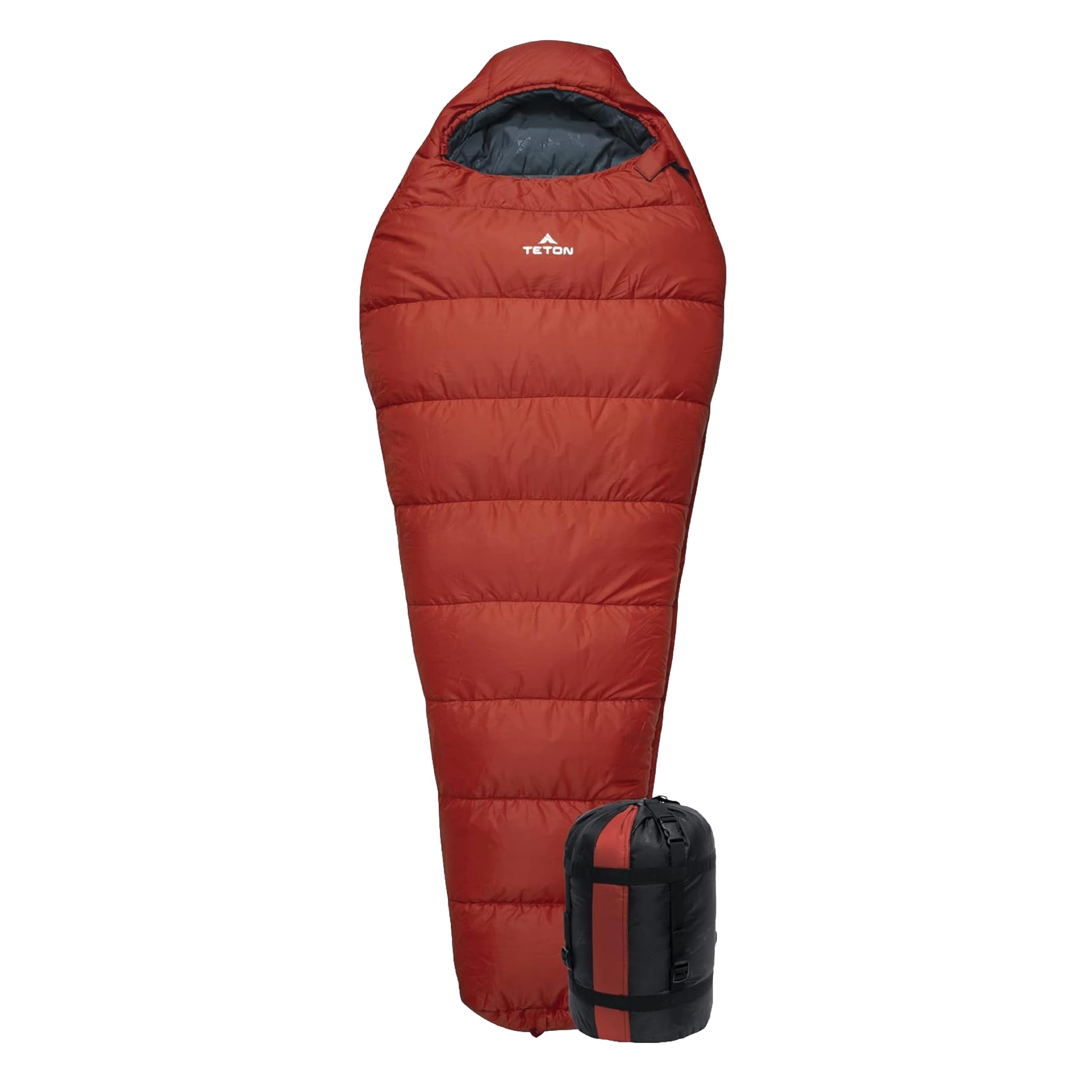
The Teton LEEF series is built for campers who need real cold-weather performance without spending premium money. The 20°F model uses a micro-fiber synthetic fill in a roomier mummy cut with an extended footbox. The ripstop polyester shell is tough and has shown durability over years of use — one reviewer logged over 60 nights and reported no loss of loft or zipper failure.
Weighing 3.5 pounds, this is not a bag for ultralight purists, but it packs down to about a quarter of its original size using the included compression sack. Users consistently praise its warmth, reporting comfort down to 10-15°F with proper clothing and a pad. The anti-snag zipper and Velcro hood lock work reliably even after repeated compression cycles.
The main downsides are the difficulty of repacking it into the compression sack and the fact that it is not machine washable per the manufacturer’s instructions. Also, the mummy cut, while roomier than some, still feels tight for larger users. For budget-conscious backpackers facing genuinely cold nights, the LEEF provides exceptional warmth-per-dollar value.
Why it’s great
- Proven warmth down to 10-15°F with proper layering
- Durable ripstop polyester shell lasts multiple seasons
- Excellent warmth-per-dollar ratio for cold camps
Good to know
- 3.5 lbs is heavy for long-distance backpacking
- Difficult to repack into compression sack
- Not machine washable
7. MARMOT Voyager 55° Mummy Sleeping Bag

Sometimes the lightest, most packable option is all you need for warm-weather trips. The MARMOT Voyager 55° is designed specifically for summer backpacking and sleepovers, using Spirafil high-loft synthetic insulation. At just 1.5 pounds and packing down to a 12 x 6-inch bundle, it takes up very little room in your pack while providing reliable warmth down to around 50-55°F.
The 50D polyester shell is both durable and PFAS-free, and the full-length locking YKK zipper is easy to operate. The mummy shape is trim, which helps with heat retention but also restricts movement — larger users will find the regular size tight at 84 inches long and 60 inches around. Users highlight how easy it is to wash and dry compared to down bags.
The biggest limitation is the temperature ceiling: this bag is not suitable for chilly spring or fall nights. Many users note that its comfort rating aligns with 50-60°F, making it best for summer camping, cabin stays, or as a backup for ultralight kits. For those who need a dedicated warm-weather bag that is light, affordable, and easy to care for, the Voyager is a smart choice.
Why it’s great
- Ultralight at 1.5 lbs for summer backpacking
- PFAS-free construction and easy to wash
- Packs down very small for a synthetic bag
Good to know
- Only suitable for 50°F+ nights
- Tight mummy cut for larger adults
FAQ
What does 650 fill power mean in a down sleeping bag?
Is a synthetic or down sleeping bag better for backpacking in wet climates?
How can I tell if a budget sleeping bag’s temperature rating is accurate?
Can two affordable backpacking sleeping bags be zipped together for couples?
Final Thoughts: The Verdict
For most users, the affordable backpacking sleeping bag winner is the Kelty Cosmic 20 Down because it delivers a genuine 20°F ISO rating at just 2.4 pounds with certified down, outperforming every other bag in its price bracket. If you need reliable warmth in damp conditions, grab the Kelty Cosmic Synthetic 20. And for an ultralight summer kit at a fraction of the cost, nothing beats the Naturehike Ultralight Down at 1.3 pounds.