
Our readers keep the lights on and the weekend projects moving. As an Amazon Associate, I earn from qualifying purchases.
The search for a reliable backup power source often ends with the deafening roar of a gas generator or the worry of storing volatile fuel. A battery generator changes that equation entirely, offering silent, fume-free electricity on demand. Whether you are preparing for grid outages, powering a remote work site, or equipping an RV for off-grid living, the decision comes down to your appetite for lithium chemistry and inverter technology over a carburetor and a gas can.
I’m Rikta — the founder and writer behind FitlyFast. My analysis focuses on the electrochemical performance and real-world load-testing data that separates a weekend camping companion from a serious home backup tool.
Choosing the right model means understanding watt-hours versus surge watts and battery cycle life instead of horsepower. This guide breaks down the key metrics and trade-offs to help you find the best battery generator for your specific power needs.
How To Choose The Best Battery Generator
Selecting the right unit starts by matching its electrical output to the appliances you plan to run, then verifying the battery chemistry will survive years of use. Three specs dominate the decision: capacity, inverter rating, and cycle life.
Capacity vs. Output Power
Capacity, measured in watt-hours (Wh), tells you how long your devices can run. A 1000Wh unit powers a 100W TV for about 10 hours. Output power, measured in watts, tells you what you can start. A refrigerator compressor might draw 800W running but needs 1600W to start. Overlooking surge-to-continuous power ratio is the most common mistake first-time buyers make.
Battery Chemistry: LiFePO4 vs. Older Lithium
Lithium Iron Phosphate (LiFePO4 or LFP) cells provide 3000 to 4000 charge cycles before capacity degrades to 80%, compared to roughly 500 cycles from standard lithium-ion. LFP chemistry also handles higher operating temperatures without thermal runaway, making it the safe choice for indoor backup and extended storage.
Recharge Path Flexibility
A true battery generator should accept AC wall power, solar panels via an MPPT controller, and 12V vehicle charging. The maximum solar input voltage and amperage directly determine how fast you can replenish off-grid. Units with 500W+ MPPT capabilities significantly reduce downtime compared to models limited to 200W.
Quick Comparison
On smaller screens, swipe sideways to see the full table.
| Model | Category | Best For | Key Spec | Amazon |
|---|---|---|---|---|
| BLUETTI AC70 | Mid-Range | Tailgating & small essentials | 768Wh, 1000W Inverter | Amazon |
| BLUETTI Elite 100 V2 | Mid-Range | Mobile office & RV essentials | 1024Wh, 1800W Inverter | Amazon |
| GRECELL Acc2400 | Mid-Range | Whole-home appliance backup | 1843Wh, 2400W Inverter | Amazon |
| Jackery Explorer 2000 v2 | Mid-Range | Lightweight 2kWh camping | 2042Wh, 2200W Inverter | Amazon |
| DABBSSON 2000L | Premium | Safety-focused home backup | 2048Wh, 2200W Inverter | Amazon |
| EF ECOFLOW DELTA 3 Max | Premium | High-demand workshop tools | 2048Wh, 3400W X-Boost | Amazon |
| Anker SOLIX C2000 Gen 2 | Premium | Long fridge runtime & expandability | 2048Wh, 2400W Inverter | Amazon |
| AFERIY 3840Wh | Premium | Whole-home extended backup | 3840Wh, 3600W Inverter | Amazon |
| Jackery HomePower 3000 | Premium | RV full-timer & heavy home loads | 3072Wh, 3600W Inverter | Amazon |
| ABOK Ark3600 | Premium | High-capacity job site + home | 3840Wh, 3600W Inverter | Amazon |
| EGO POWER+ PST3040 | Budget | EGO tool system owners | 2000W Continuous (battery not incl.) | Amazon |
In‑Depth Reviews
1. BLUETTI AC70 Portable Power Station

The BLUETTI AC70 hits the sweet spot for users who need enough capacity for a weekend of tailgating or a one-day home outage without paying for excess bulk. Its 768Wh LiFePO4 battery provides a solid runtime for a mini-fridge, phone charging, and a laptop, while the 1000W pure sine wave inverter handles small appliances with ease. The 2000W power lifting mode means it can briefly start a 1500W space heater or a small pump motor.
Recharge speed is a standout feature here. The AC input fills the battery from 0% to 80% in roughly 45 minutes and reaches full in about 90 minutes using a single simple cable. This reduces downtime significantly compared to older units that required large power bricks. Solar input up to 500W via the robust XT-60 connector offers solid off-grid replenishment without an adapter.
Real-world users consistently praise the AC70 for its efficiency and quiet operation. One musician noted it powered a 100W guitar amp and pedals for eight hours while only dropping to 59% charge. The UPS feature kicks in under 20ms, which is fast enough to keep a desktop computer running through a brief grid flicker. The main trade-off is the modest 768Wh capacity — it lacks the stamina for multi-day heavy loads.
Why it’s great
- Exceptionally fast AC recharge for its class (45 min to 80%)
- Lightweight at 22.5 lbs for easy portability
- 500W MPPT solar input supports large panel arrays
Good to know
- 768Wh capacity may not cover full-day heavy appliances
- No app control in early firmware versions
2. BLUETTI Elite 100 V2
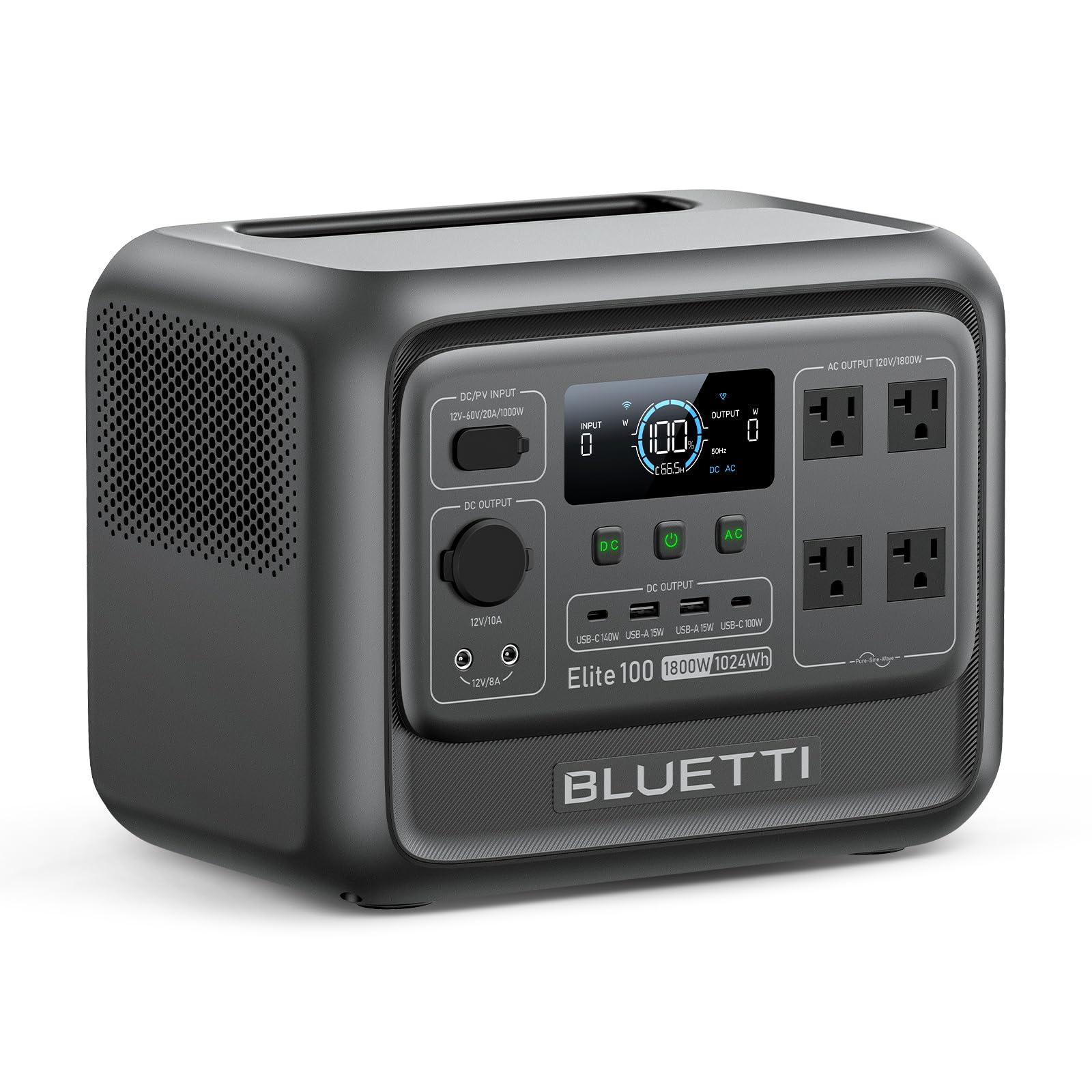
The BLUETTI Elite 100 V2 upgrades the formula with a larger 1024Wh battery and a 1800W inverter in a package that is 35% smaller than the previous generation. At just 25 lbs, it strikes a strong balance between portability and usable runtime for a weekend camping trip or a home office backup. The 3600W surge capability handles the startup draw of a refrigerator or a sump pump.
This model supports a fast 70-minute full recharge via its 1200W TurboBoost AC input, while the solar input can accept up to 1000W for rapid solar top-ups when paired with sufficient panel wattage. The UPS switchover happens in under 10ms, making it safe for sensitive electronics like a Wi-Fi router and a PC during an outage. The forward-facing accessible ports make cable management straightforward.
Owners report that the Elite 100 V2 runs a mini fridge, guitar amp, and basic power tools without introducing electrical noise. The hidden handle makes one-handed carry practical. Some users note that the companion app can feel clunky for basic operations, and the unit lacks a built-in light or wireless charging pad. The 4000-cycle LiFePO4 battery and robust build quality make this a long-term investment for the mid-range bracket.
Why it’s great
- 35% smaller than previous gen without sacrificing capacity
- Fast 70-minute full AC recharge
- 4000+ cycle LiFePO4 battery for long-term reliability
Good to know
- App can be clunky for remote control
- No built-in light or wireless charging pad
3. GRECELL Acc2400 Portable Power Station
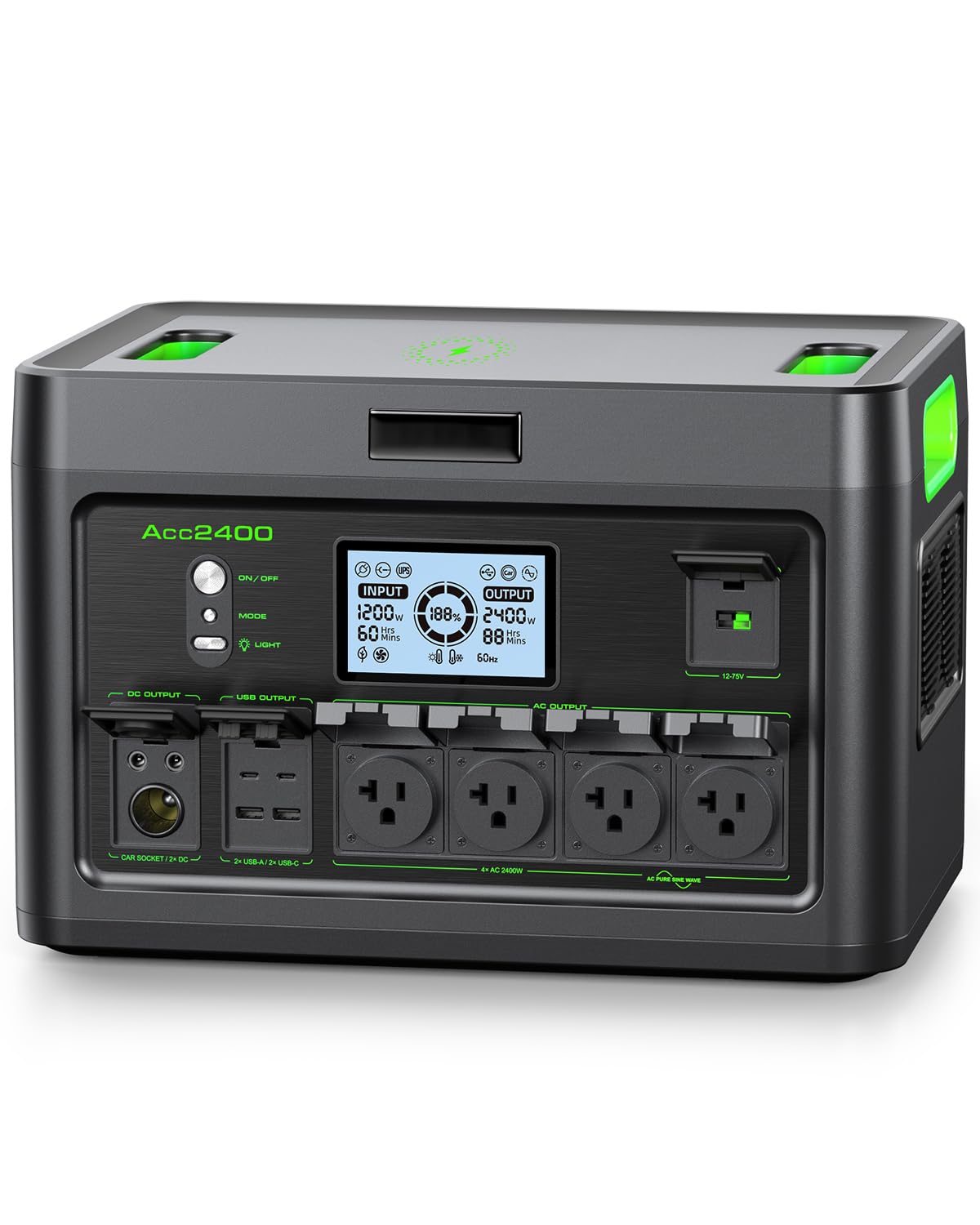
The GRECELL Acc2400 delivers a massive 1843.2Wh capacity and a 2400W pure sine wave inverter at a price point that undercuts many competitors with similar specs. This unit is designed for whole-home appliance backup — it can run refrigerators, window AC units, microwaves, and CPAP machines simultaneously thanks to its 12 output ports and 3500+ cycle LiFePO4 battery. The 2400W continuous output covers 99% of household devices.
Recharge versatility is a key strength. The bidirectional inverter technology allows a full AC charge in roughly 2 hours, and combining 800W MPPT solar input with AC charging can top it off in as little as 1.8 hours. The built-in LCD screen provides real-time data on power consumption and battery level, while the four-mode LED light serves as emergency illumination. The UPS switchover at 0.1 seconds protects desktop computers and network equipment.
User feedback highlights the value proposition — the Acc2400 offers features typically found in units costing significantly more. However, the all-plastic casing exposes ports directly without weather sealing, which means outdoor users need a dry enclosure. Some owners report that the charge controller prioritizes AC over solar, limiting off-grid solar efficiency in hybrid mode. At 55.5 lbs, it is not a lightweight carry.
Why it’s great
- High capacity and output at a very competitive price point
- 3500+ cycle LiFePO4 battery with intelligent BMS
- Fast hybrid AC+Solar recharge in roughly 1.8 hours
Good to know
- Ports lack weather-sealing for outdoor use
- Heavy at over 55 lbs; no wheeled cart included
4. DABBSSON 2000L Semi-Solid LiFePO4
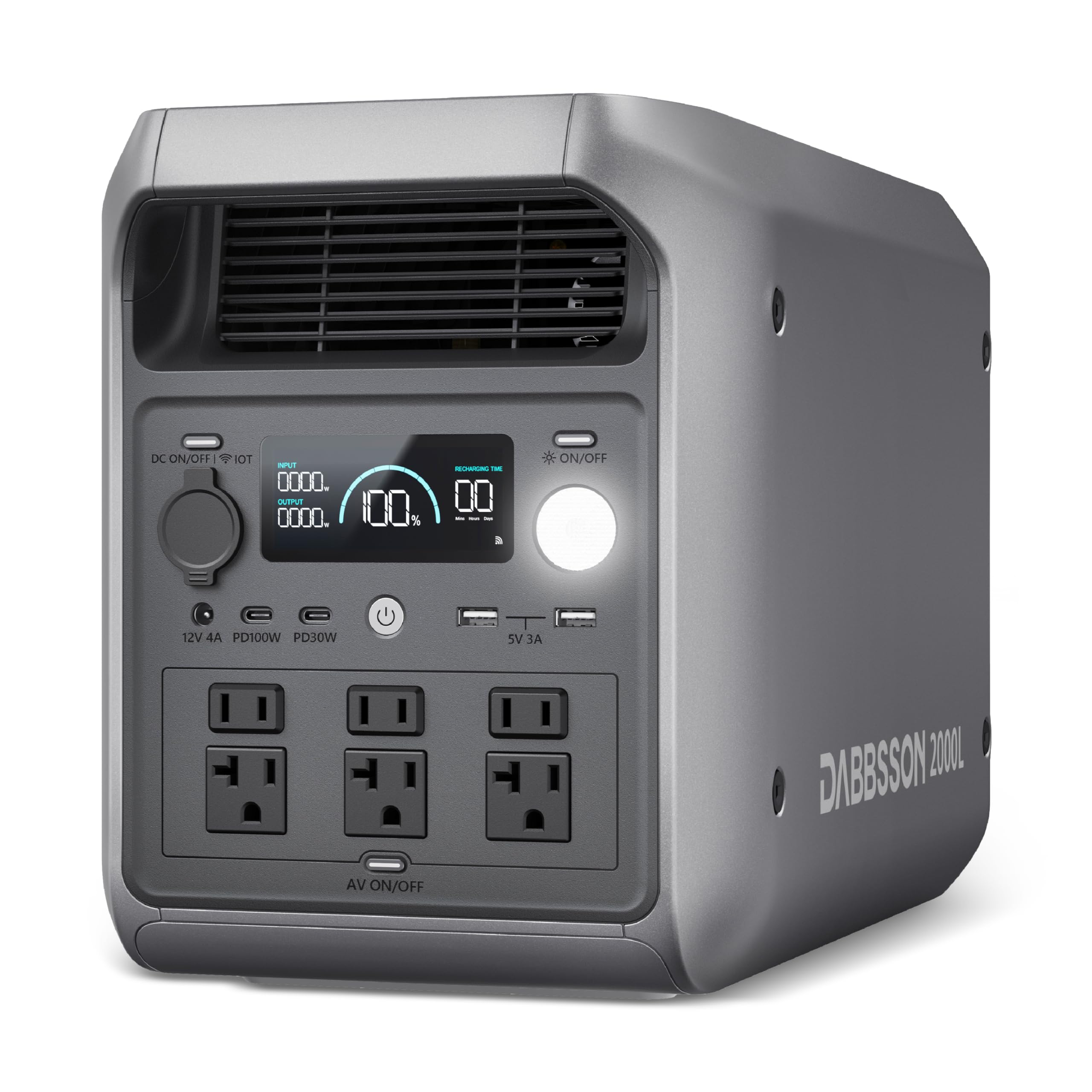
The DABBSSON 2000L introduces semi-solid LiFePO4 cells, a technology that increases energy density and thermal stability beyond standard LFP chemistry. With 2048Wh capacity and a 2200W continuous output (3300W surge), this unit provides 1.3 times longer runtime than comparable 2048Wh stations from competitors. The 41 lb weight makes it lighter than most high-capacity alternatives.
Safety features are pushed to the forefront. The UL94-V0 flame-retardant housing and advanced BMS protect against overcharge, overheating, and short circuits. The 4000+ deep cycles at 80% capacity translate to more than 10 years of daily use. Recharge speed is remarkable for this class — a full AC charge takes only about one hour, while 800W MPPT solar input provides flexible off-grid replenishment.
Owners highlight the compact form factor and the seamlessly integrated carrying handle. The app provides remote monitoring and scheduling. The EPS switch at under 15ms keeps computers and NAS drives safe during grid transitions. Some users note a slightly plastic feel to the housing, but overall build quality is praised. The 5-year warranty adds confidence for this level of investment.
Why it’s great
- Semi-solid LiFePO4 for enhanced safety and energy density
- Extremely fast full AC recharge in about 1 hour
- Lightweight for its capacity at 41 lbs
Good to know
- Housing feels slightly less premium than metal alternatives
- Brand has shorter track record than established competitors
5. Jackery Explorer 2000 v2

The Jackery Explorer 2000 v2 uses Cell-to-Body (CTB) technology borrowed from EV manufacturing to pack 2042Wh into a compact 39.5 lb frame. This makes it 41% lighter and 34% smaller than typical 2kWh LiFePO4 stations. Despite the compact size, it retains a 2200W continuous inverter (peak at 4400W) and a 20ms UPS switchover, certified to UL1778 for uninterruptible power systems.
Charging options include AC fast charging that reaches 80% in 66 minutes, and an emergency super charging mode via the app that completes a full charge in 102 minutes. The silent charging mode operates at under 30dB, making it suitable for overnight use in a bedroom or RV. The 400W solar input can top the unit off in about 6 hours of direct sun. The built-in flashlight with low, high, and SOS modes adds a practical touch.
Reviewers consistently note the excellent balance of portability and power. One user reported powering a full-size refrigerator for over 21 hours on a single charge. The handle design makes the 40 lb unit reasonably manageable. Some users report that charging with a single 200W panel is slow, and the app-based super charging mode feels slightly hidden. The price sits at a moderate premium over direct competitors.
Why it’s great
- Class-leading weight-to-capacity ratio with CTB technology
- UL1778 certified UPS with 20ms switchover
- Silent charging mode under 30dB for sleep-friendly use
Good to know
- Solar input limited to 400W, slower than some competitors
- Premium price relative to raw capacity
6. EF ECOFLOW DELTA 3 Max
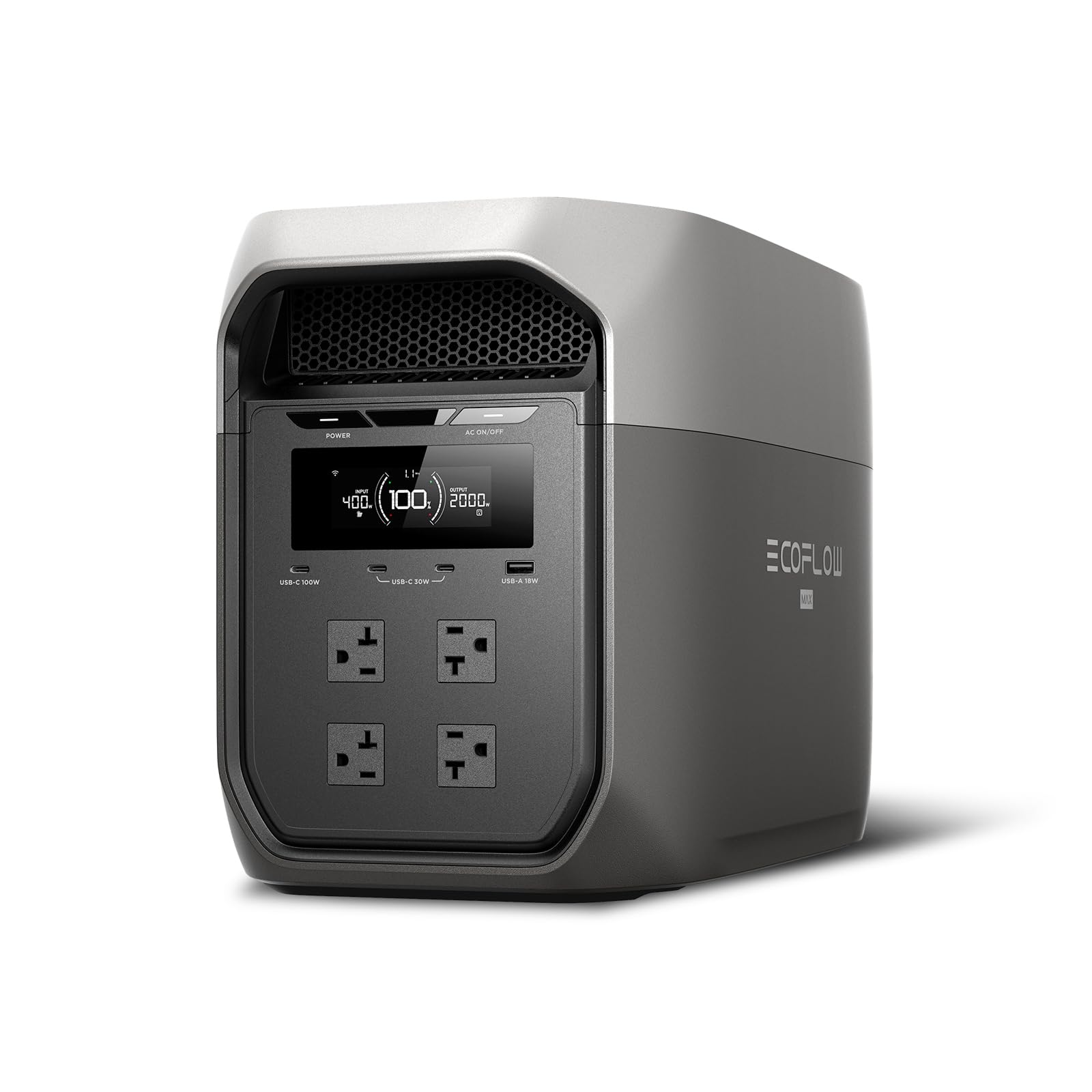
The EF ECOFLOW DELTA 3 Max is built for users who need to run high-draw appliances. Its 2400W continuous inverter expands to 3400W using X-Boost technology, allowing it to handle a microwave, refrigerator, and power tools simultaneously. The 2048Wh LiFePO4 battery supports 4000+ cycles and comes with a 5-year service term. The unit weighs roughly 55 lbs and includes dual handles for car-to-campsite movement.
X-Stream technology enables ultra-fast AC charging from 0% to 80% in just 1.13 hours, which is among the fastest in the 2kWh class. The UPS switchover happens in under 10ms, protecting sensitive electronics. The EcoFlow app provides detailed monitoring of individual outlet power draw, storm-triggered charging schedules, and time-of-use settings. The XT60i solar input cable supports fast solar charging when panels are available.
Film production teams and RV owners praise the DELTA 3 Max for its quiet, reliable power on location. One filmmaker noted it replaced a gas generator for powering cameras and monitors. The app’s storm tracking feature automatically charges the battery to 100% before predicted outages. A minor downside is the lack of a 240V outlet, which means it cannot power a well pump or a large central air conditioner. The idle discharge rate of about 1% per day is reasonable for this capacity.
Why it’s great
- 3400W X-Boost handles heavy appliances and tools
- Extremely fast AC recharge to 80% in 1.13 hours
- Intelligent app with storm-triggered auto-charge
Good to know
- No 240V output for large appliances
- Idle discharge of 1% per day requires periodic top-up
7. Anker SOLIX C2000 Gen 2

The Anker SOLIX C2000 Gen 2 differentiates itself with an ultra-efficient standby mode that draws only 9W. This translates to up to 32 hours of runtime powering a dual-door refrigerator on a single charge, and with the optional expansion battery bringing total capacity to 4kWh, that extends to 64 hours. The 2400W rated inverter (4000W peak) can start most window and RV air conditioners without tripping.
Full AC recharge takes just 58 minutes, making it one of the fastest options at this capacity level. The 800W ultra-fast alternator charging enables a full top-up from a vehicle in about 3 hours, which is eight times faster than a standard 12V socket. At 41.7 lbs, the C2000 Gen 2 is 25% lighter and 29% smaller than comparable models, improving mobility. The metal and plastic hybrid build feels robust.
Users consistently confirm the long fridge runtime in real-world conditions. One camper reported running a 30-quart fridge for five to seven days on a single charge. The time-of-use feature in the app helps save on electricity costs by charging during off-peak hours. Some reviewers note that the unit is still slightly heavy for one-handed carry over longer distances, and the expansion battery is sold separately, adding to the total cost of building a full backup system.
Why it’s great
- Ultra-low 9W standby for extended fridge runtime
- Expandable to 4kWh for multi-day backup
- 58-minute full AC recharge with 800W alternator charging
Good to know
- Expansion battery sold separately at additional cost
- Heavy enough to require two hands for longer carries
8. AFERIY 3840Wh Portable Power Station

The AFERIY 3840Wh station targets the serious home backup user. With 3840Wh of LiFePO4 capacity expandable to 11.5kWh, a 3600W inverter (7200W peak), and 15 output ports, it can run a refrigerator, freezer, Wi-Fi router, lights, and medical devices for a full day or longer. The UPS transfers in under 10ms, ensuring seamless protection for computers and security systems.
Recharge speed is a strong point for this capacity class. AC input can fill the battery in as fast as 1.5 hours, and the hybrid AC-plus-solar mode reduces that further. The app allows remote monitoring and scheduling. The unit includes a pull handle and wheels for transport, which is essential given its 80+ lb weight. The 7-year support period provides long-term assurance.
Owners praise the build quality and the ability to run an entire RV (except air conditioning) comfortably. The 30% federal tax credit eligibility on qualified solar purchases is a notable benefit. A small number of users reported display issues or charging failures, though the manufacturer’s customer support responded with replacement or repair offers. The physical size requires dedicated storage space.
Why it’s great
- Massive 3840Wh capacity expandable to 11.5kWh
- Fast 1.5-hour AC recharge with <10ms UPS
- 7-year support period and potential tax credit eligibility
Good to know
- Over 80 lbs; requires wheels and storage space
- A few reports of initial unit defects need attention
9. Jackery HomePower 3000
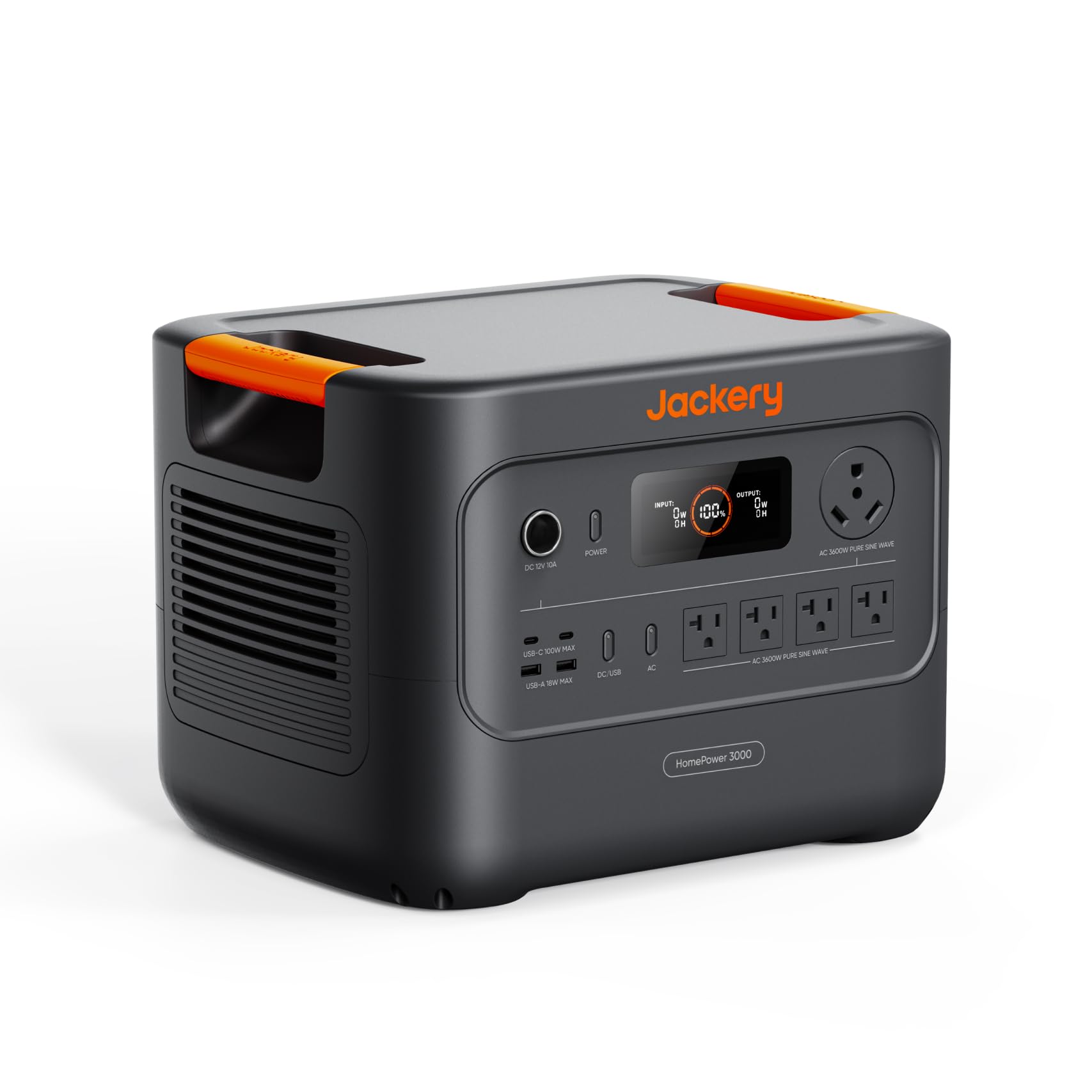
The Jackery HomePower 3000 packs 3072Wh of LFP capacity and a 3600W inverter (7200W surge) into a chassis that is 47% smaller and 43% lighter than comparable 3kWh models. Its CTB (Cell-to-Body) technology integrates the cells directly into the structural frame, improving space efficiency by 14%. At 59.5 lbs, it is among the lightest high-capacity options available.
The unit features dual 100W USB-C PD ports, a built-in TT-30 RV port for direct camper hookup, and ChargeShield 2.0 AI algorithms that optimize charging speed while extending battery lifespan to 4000 cycles at 70% capacity retention. The UPS switches in under 20ms, and the unit fully recharges in 2.2 hours via AC or 1.7 hours via combined AC and DC input. The app provides full control and monitoring.
Dry campers report running a 30-foot travel trailer for three or more days without air conditioning, including microwaves, TVs, and Starlink terminals. The weight is manageable enough for one person to load into a vehicle. A critical caveat is that Jackery’s warranty policy requires direct purchases from the manufacturer — units bought through third-party sellers may not be covered. The physical size, while compact for 3kWh, still occupies significant floor space.
Why it’s great
- Industry-leading power-to-weight ratio for a 3kWh station
- Built-in TT-30 RV port for direct camper hookup
- ChargeShield 2.0 AI extends battery life to 4000 cycles
Good to know
- Warranty only honored for direct manufacturer purchases
- UPS switch at 20ms, slower than some competitors
10. ABOK Ark3600 with 200W Solar Panel
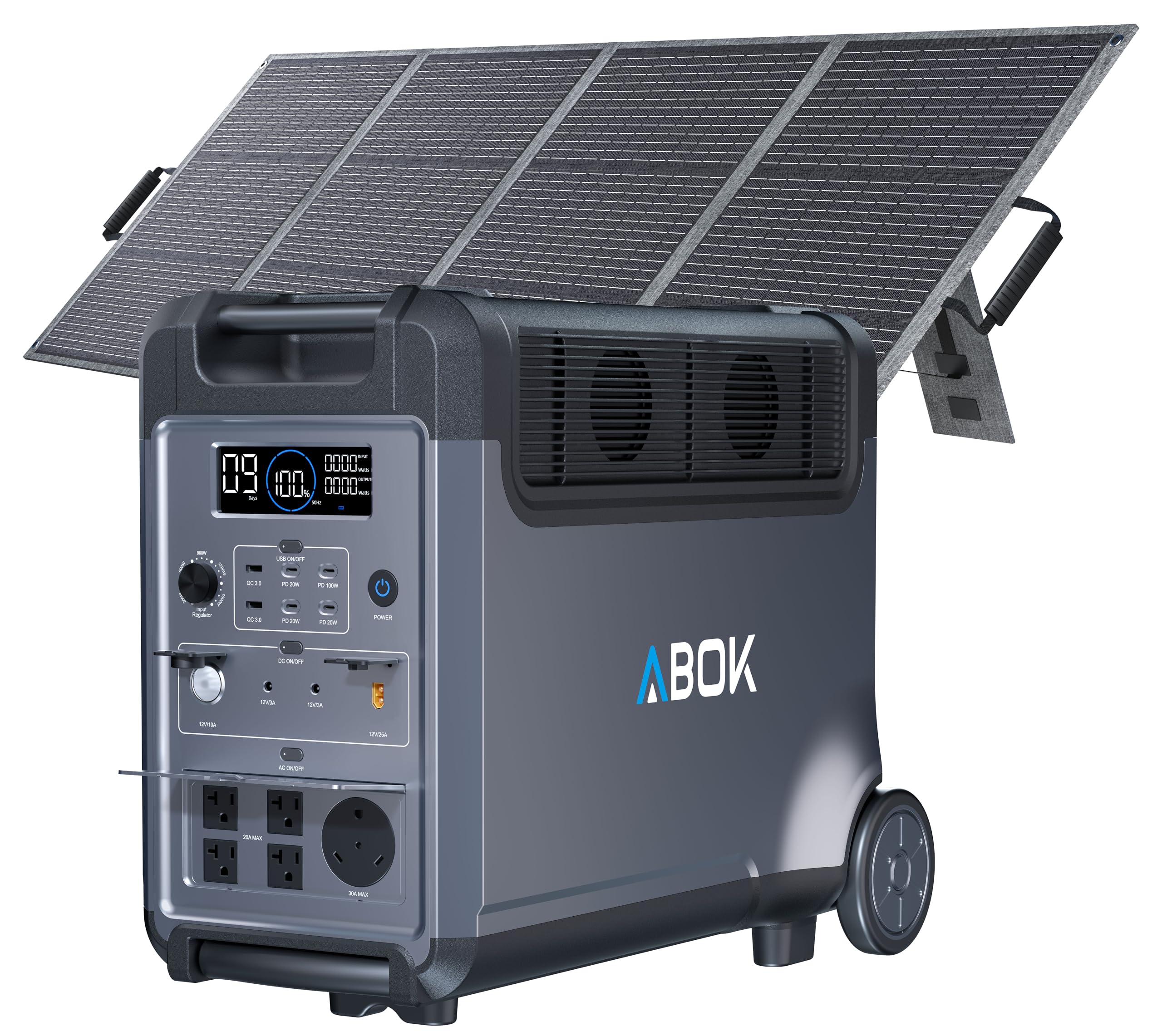
The ABOK Ark3600 comes with a 200W solar panel in the box, making it a true turnkey solar generator. Its 3840Wh LiFePO4 core is expandable up to 11520Wh, while the 3600W inverter (4500W peak) covers 99% of household appliances. The 15 output ports include a 30A AC outlet, dual USB-C PD ports (one at 100W), and standard DC outlets. The telescoping handle and durable wheels make the 92 lb unit manageable to roll.
Full AC recharge takes about 3 hours, but combining AC with 2000W solar input reduces that to roughly 1.29 hours. The EV-grade LiFePO4 cells support over 4000 cycles and a 10-year service life. The Bluetooth app provides remote monitoring and control. Users report running a wet vacuum, heat gun, and an SDS-Max drill simultaneously without issues, with the battery showing only 22% discharge after a full workday.
The included 200W solar panel adds immediate value for off-grid use, though it is relatively slow for topping off the massive 3840Wh battery. The cooling fan operates only when needed, keeping noise low under typical loads. A small number of users experienced defective units that refused to charge, and the return process for a heavy item can be costly due to shipping weight. The 2+3 year service plan (when registered) provides reasonable coverage.
Why it’s great
- Includes 200W solar panel for immediate off-grid use
- Massive expandable capacity and 4500W peak power
- Wheeled design makes the 92 lb unit transportable
Good to know
- Heavy; shipping for returns can be expensive
- Included panel charges the 3840Wh battery slowly
11. EGO POWER+ PST3040 Nexus

The EGO POWER+ PST3040 is a unique entry that uses the EGO battery platform, meaning it has no internal battery and relies entirely on EGO 56V Arc-Lithium batteries (sold separately). This design makes it an excellent choice for homeowners who already own EGO lawn tools and want a backup power station without maintaining a separate battery chemistry. The 3000W peak (2000W continuous) inverter powers standard appliances and tools.
Because it uses external batteries, runtime is directly proportional to the battery capacity you own. A set of four 10Ah EGO batteries can run a refrigerator for about 12 hours. The unit includes three 120V AC outlets, four USB ports, and a clear LCD display. It operates silently with no emissions, making it safe for indoor use. The ability to hot-swap depleted batteries for freshly charged ones extends runtime indefinitely.
EGO tool owners appreciate the unified battery system. However, the PST3040 cannot charge batteries while it is inverting — you need a separate EGO charger. The sequential battery charger built into the unit charges one battery at a time, which is slower than using a dedicated multi-port charger. The solar input requires an optional adapter that limits input to 180W, making solar recharge slow. Bluetooth and app functionality have been reported as non-functional by some users.
Why it’s great
- Seamless integration with EGO 56V battery ecosystem
- Silent, fume-free operation for indoor use
- Hot-swap batteries for unlimited runtime potential
Good to know
- Batteries and charger sold separately (significant added cost)
- Cannot charge and output power simultaneously
- Solar input limited to 180W via optional adapter
FAQ
Can a battery generator power a refrigerator or freezer?
How long does a battery generator last on a single charge?
What is the difference between LiFePO4 and standard lithium-ion batteries?
Can I use a battery generator indoors or in an RV?
Final Thoughts: The Verdict
For most users, the best battery generator winner is the BLUETTI AC70 because it delivers the ideal balance of portability, fast recharge, and reliable 768Wh capacity for weekend trips and short-term backup. If you want higher capacity for all-day appliance backup without breaking the bank, grab the Jackery Explorer 2000 v2. And for a whole-home, expandable backup solution capable of running an RV or powering through multi-day outages, nothing beats the AFERIY 3840Wh.