
Our readers keep the lights on and the weekend projects moving. As an Amazon Associate, I earn from qualifying purchases.
The right blade separates a clean, gap-free laminate floor installation from a project littered with chipped edges, melted plastic, and wasted planks. Standard wood-cutting blades generate too much heat and tear-out, ruining the wear layer and producing jagged seams that catch light and debris. A dedicated blade for laminate flooring uses specific tooth geometry, carbide or diamond tips, and a thin kerf to shear through the dense HDF core and aluminum oxide top coat without burning or fracturing the surface.
I’m Rikta — the founder and writer behind FitlyFast. I evaluate tool specifications for cutting performance, blade material composition, and tooth count to identify which blades deliver repeatable, splinter-free results across different saw types and project scales.
After analyzing seven leading options, I’ve ranked the models that consistently produce clean edges on laminate, engineered wood, and LVP. This guide explains what makes a blade for cutting laminate flooring effective and which design trade-offs matter most for your specific saw and material.
How To Choose The Best Blade For Cutting Laminate Flooring
Laminate flooring is abrasive. The surface is a baked-on layer of aluminum oxide, the core is high-density fiberboard (HDF), and the backing is melamine. A blade must cut through this composite sandwich without chipping the surface or melting the core. Success comes down to four factors: tooth material, tooth count, kerf thickness, and hook angle.
Tooth Material: Carbide vs. Polycrystalline Diamond (PCD)
Standard carbide-tipped blades handle occasional laminate cuts, but the aluminum oxide layer dulls them rapidly. PCD-tipped blades last 50 to 75 times longer because the diamond composite resists abrasion. For a single room project, a quality carbide blade like the Diablo D0652TSL delivers enough sharpness. For anything over 500 linear feet or repeated professional use, a PCD blade such as the Diablo D1012LF PergoBlade is the correct investment — the up-front cost is higher, but the cost per cut is lower.
Tooth Count and Grind Geometry
Low tooth counts (4 to 12 teeth) work well for laminate because they clear waste material quickly and reduce heat buildup. High tooth counts (40 to 80 teeth) produce a finer finish on plywood and melamine but can burn laminate if the feed rate is too slow. The best geometry for laminate is an Alternate Top Bevel (ATB) grind or a Triple Chip Grind (TCG), both of which shear the surface rather than tear it. A Hi-ATB grind, found on the Freud LU80R010, is particularly effective for chip-free crosscuts on laminate.
Kerf Thickness and Hook Angle
A thin kerf blade (1.8 mm or less) removes less material per cut, reduces strain on the saw motor, and produces less friction, which translates to less melting on the laminate edge. Hook angle measures how aggressively the tooth bites into the material. Laminate requires a negative or low positive hook angle (0° to 10°) to prevent the blade from grabbing and chipping the top layer. A high hook angle blade designed for ripping solid wood will lift and fracture laminate.
Quick Comparison
On smaller screens, swipe sideways to see the full table.
| Model | Category | Best For | Key Spec | Amazon |
|---|---|---|---|---|
| Diablo D1012LF PergoBlade | Premium PCD | Large laminate projects, pro installers | 10″ diameter, 12 teeth, PCD tip | Amazon |
| Freud LU80R010 | Premium Hi-ATB | Splinter-free crosscuts on laminate & plywood | 10″ diameter, 80 teeth, Hi-ATB grind | Amazon |
| Diablo D0652TSL | Mid-Range Track Saw | Track saw users, MDF & PVC cuts | 6.5″ diameter, 52 teeth, TiCo carbide | Amazon |
| WEN BL0704 | Budget PCD | Laminate and fiber cement on circular saw | 7.25″ diameter, 4 teeth, PCD tip | Amazon |
| Bosch DCB740 | Value Carbide | General crosscuts on wood and plywood | 7.25″ diameter, 40 teeth, ATB grind | Amazon |
| Makita T-01410 | Mid-Range Carbide | Cordless saw use on laminate flooring | 6.5″ diameter, 40 teeth, thin kerf | Amazon |
In‑Depth Reviews
1. Diablo D1012LF PergoBlade 10″ PCD
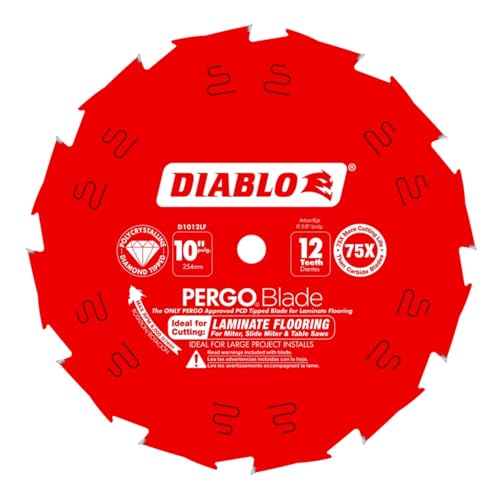
The Diablo PergoBlade is purpose-built for laminate flooring, and its polycrystalline diamond (PCD) teeth are the defining feature. PCD resists the aluminum oxide wear layer far longer than any carbide tip — Diablo claims up to 75 times the life of standard carbide. The 10-inch diameter and 12-tooth count are intentionally low: fewer teeth mean faster chip evacuation and less friction heat, which prevents the HDF core from discoloring or melting during long cuts.
On both miter saw and table saw setups, the blade produces a sheared, burn-free edge on Pergo, Nucore rigid-core LVP, and engineered hardwood. The anti-kickback shoulder reinforcement and laser-cut anti-vibration slots keep the cut true even when feeding material at a moderate pace. Users report cutting through 500 to 1,100 square feet of material before noticing any degradation in performance.
The trade-off is the blade’s weight and the aggressive feed feel — 12 teeth remove material fast, so you need to control the feed rate to avoid a slightly rough edge on very thin laminate. The non-stick Perma-Shield coating helps, but this blade thrives on a consistent, firm push. It is a long-term investment for anyone installing flooring across multiple rooms or as a professional.
Why it’s great
- PCD tips last through thousands of cuts on laminate without dulling
- Low tooth count prevents heat buildup and melting on HDF core
- Anti-vibration slots deliver straight, chatter-free edges on miter and table saws
Good to know
- Premium investment; only justified for large projects or pro-level work
- Requires controlled feed speed to avoid a slightly rough finish on thin materials
2. Freud LU80R010 10″ 80T Ultimate Plywood & Melamine Blade

The Freud LU80R010 is the blade that crosscuts laminate with laboratory-level precision. The 80 teeth use a High Alternate Top Bevel (Hi-ATB) grind, which creates a shearing action that slices through the aluminum oxide layer rather than pounding through it. On laminate planks up to 12 mm thick, this blade leaves a glass-smooth edge that requires no sanding or filing before clicking the next plank into place.
It is built on a laser-cut plate with anti-vibration slots — critical when running 80 teeth at high RPM, because any resonance transfers directly to the cut face. The TiCo Hi-Density carbide holds its edge well on engineered wood and melamine, and the Perma-Shield coating prevents pitch from building up between the teeth. This blade is recommended for 10-inch miter saws and table saws.
The limitation is that this blade is optimized for crosscuts, not ripping. The low 2° positive hook angle prevents the blade from grabbing, but it also means slower ripping passes through solid wood. It also sparks noticeably when cutting through the abrasive laminate layer, which is harmless but noticeable. This is the blade to choose if your laminate project involves mostly crosscuts and you demand zero chip-out.
Why it’s great
- Hi-ATB grind produces virtually zero chip-out on laminate and melamine
- Anti-vibration laser slots keep the blade stable for precise crosscuts
- Non-stick coating reduces friction and prevents resin buildup
Good to know
- Not designed for aggressive ripping; feed rate must be moderate
- Sparks when contacting the abrasive laminate top layer
3. Diablo D0652TSL 6.5″ 52T Track Saw Laminate Blade
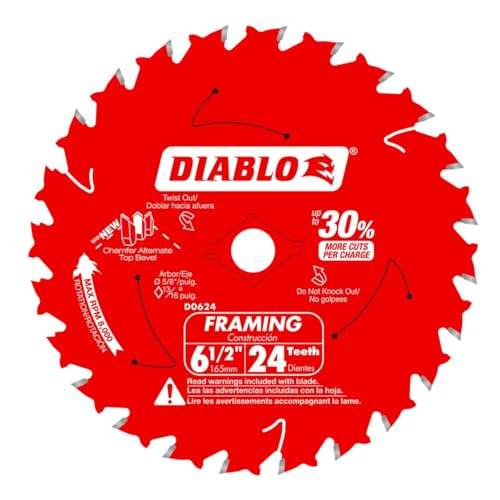
The Diablo D0652TSL is engineered specifically for track saws, with a 6.5-inch diameter and 52 teeth in a Triple Chip Grind (TCG) geometry. TCG alternates a chamfered tooth with a flat tooth, which is ideal for laminate because the chamfered tooth breaks the brittle surface while the flat tooth removes the core material cleanly. This prevents the chipping that standard ATB blades can produce on the hard aluminum oxide top layer.
It fits track saws from Bosch, DeWalt, Makita, Milwaukee, and Ryobi via the included 20 mm to 5/8-inch bushing. The 1.8 mm laser-cut kerf provides rigidity without adding weight, and the stabilizer vents reduce vibration during plunge cuts. On MDF, PVC composite decking, and laminate, this blade delivers straight, bevel-ready edges with minimal tear-out on the exit side.
The 52-tooth count is a middle-ground compromise — it produces a finer finish than a low-tooth rip blade but requires a more deliberate feed rate than a 12-tooth PCD blade. It is slightly heavier on the motor during deep cuts, so cordless track saw users may notice fewer cuts per charge. For track saw owners who work with both laminate and composite materials, this is the most versatile single-blade solution.
Why it’s great
- TCG tooth geometry prevents chipping on laminate’s aluminum oxide surface
- Fits all major track saw brands with included arbor bushing
- Stabilizer vents reduce vibration for clean plunge and bevel cuts
Good to know
- Higher tooth count generates more drag than a low-tooth PCD blade
- Not as fast-cutting on thick laminate as a dedicated PCD flooring blade
4. WEN BL0704 7.25″ 4T PCD Laminate Blade

The WEN BL0704 is the most affordable entry point into PCD (polycrystalline diamond) cutting technology for laminate. With only four diamond-tipped teeth and an ultra-thin 1.8 mm kerf, this blade is designed to remove material quickly while generating minimal heat. On laminate flooring up to 12 mm thick, it cuts through the HDF core and wear layer without burning, chipping, or creating excessive dust.
It is compatible with most 7.25-inch circular saws, tile saws, and track saws. Users report straight, smooth cuts on Pergo, LVT, and fiber cement board. The 4-tooth design makes the blade feel aggressive — it cuts fast, but the finish on the cut edge is slightly less polished than what a higher-tooth-count blade provides. This is fine for cuts that will be covered by baseboards or transition strips.
The primary drawback is longevity. While the PCD tips are significantly harder than carbide, the 4-tooth layout means each tooth carries a heavy load. On large projects (over 800 square feet), the blade may need to be replaced before the job finishes. For smaller laminate installations or occasional DIY use, this blade delivers PCD-level performance at a fraction of the cost of premium options.
Why it’s great
- PCD tips outlast carbide blades on abrasive laminate material
- Thin kerf reduces motor strain and minimizes friction heat
- Very low price for a diamond-tipped blade
Good to know
- 4-tooth design can produce a slightly rough edge compared to higher tooth counts
- Not ideal for very large projects; teeth wear faster under heavy use
5. Bosch DCB740 7.25″ 40T Carbide Circular Saw Blade

The Bosch DCB740 is a general-purpose 40-tooth carbide blade with an Alternate Top Bevel (ATB) grind, designed for fine crosscuts and ripping in wood and engineered materials. On laminate flooring, it performs adequately for small to medium projects — the ATB grind shears the aluminum oxide layer cleanly when the blade is sharp, and the Speed Coat anti-friction finish reduces the burning that plagues uncoated blades on thin materials.
The blade body is made from extra-hard steel that resists deflection, and the Brute Carbide formulation (a micro-grain blend) provides better impact resistance than standard C3 carbide. It is a good upgrade from the stock blade on a 7.25-inch circular saw or miter saw. Users consistently note that it cuts wood and plywood much cleaner than budget blades, and it can handle several rooms of laminate before dulling noticeably.
Because this blade is not specifically designed for laminate, the carbide tips will dull faster on the aluminum oxide layer than a dedicated PCD or specialized carbide laminate blade. It is best suited for DIYers who need a one-blade solution for a mix of materials. If your project is exclusively laminate, a blade with a lower tooth count or PCD tips will last longer and produce cleaner results.
Why it’s great
- Cost-effective general-purpose blade that handles laminate for small jobs
- Speed Coat reduces friction and minimizes burning on dense materials
- Extra-hard steel body resists bending for truer cuts
Good to know
- Not a dedicated laminate blade; carbide dulls faster on aluminum oxide
- 40-tooth count generates more heat than a low-tooth PCD blade
6. Makita T-01410 6.5″ 40T Carbide Circular Saw Blade
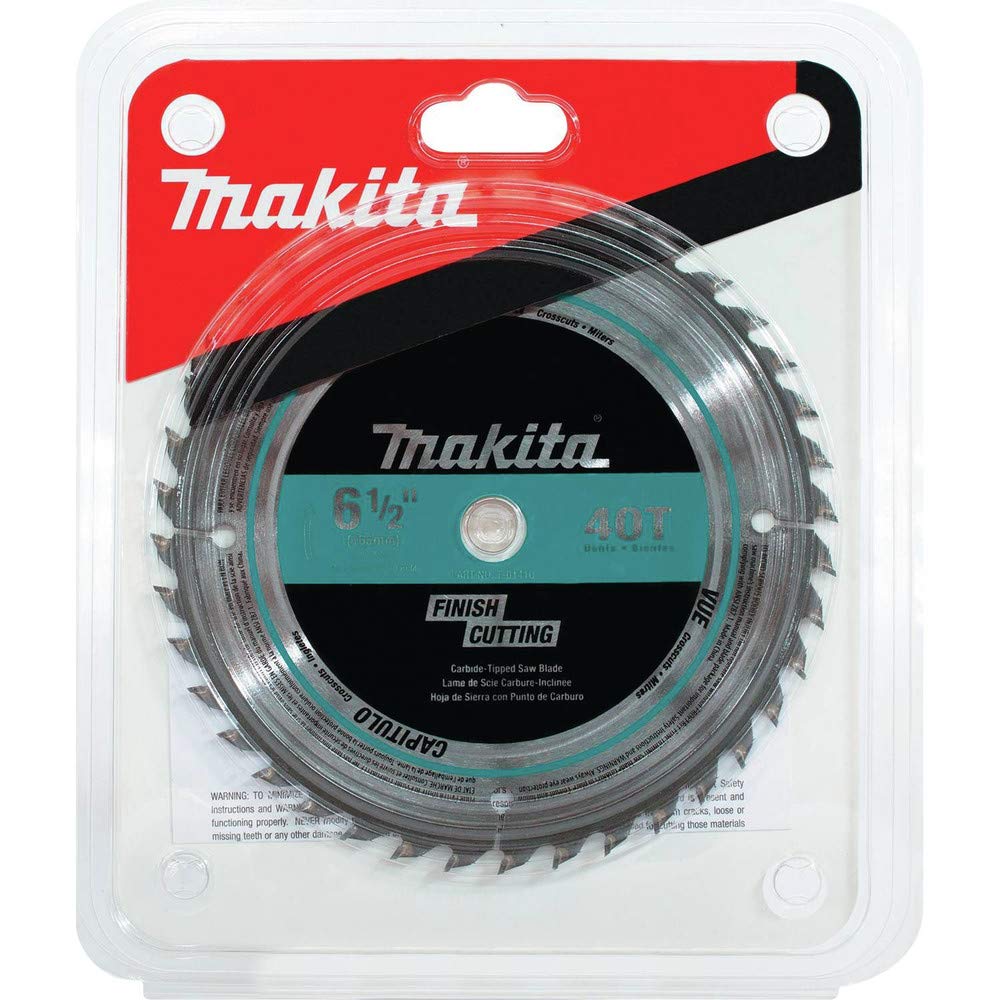
The Makita T-01410 is a 40-tooth carbide-tipped blade designed specifically for 6.5-inch cordless circular saws. Its ultra-thin kerf reduces drag on the motor, which is critical for cordless tools because less resistance means more cuts per battery charge. On 12 mm laminate flooring, users report clean cuts with no chipping on the aluminum oxide layer, making it a solid choice for on-site installation where running a cord is impractical.
The blade features hand-tensioned steel plates that remain true under load, important for avoiding drifting cuts when working freehand. The carbide tips are sharpened for fine crosscutting, and the thin kerf removes less material per pass, producing tighter waste and less dust. Multiple reviews confirm it outperforms stock blades and some aftermarket options from DeWalt and Diablo on cordless saws.
The 6.5-inch diameter limits the depth of cut, so it will not work on thicker engineered planks or for cutting stacked material. The blade is also optimized for crosscuts rather than ripping; attempting to rip long planks may cause the thin kerf to deflect. For a cordless circular saw used primarily for crosscutting laminate planks, this blade is a precise, battery-efficient match.
Why it’s great
- Thin kerf reduces motor load, extending battery life on cordless saws
- Produces chip-free cuts on laminate up to 12 mm thick
- Hand-tensioned steel plate stays true for accurate freehand cuts
Good to know
- 6.5-inch size limits depth of cut on thicker materials
- Not designed for aggressive ripping; thin kerf can deflect under side load
7. CUTTEREX 13″ 360° Vinyl Floor Cutter

The CUTTEREX 13-inch floor cutter is not a saw blade in the traditional sense — it is a manual scoring and snapping tool designed for vinyl plank flooring (VCT, LVT, PVC). It operates without electricity, producing zero dust and virtually no noise. The 360° rotating head allows cuts at any angle, including L-cuts and lengthwise cuts, which are typically difficult for standard saws to execute cleanly.
The adjustable blade height lets you score at the optimal depth for different vinyl thicknesses (up to 6 mm), and the stop fence with an angle gauge improves repeatability. Users report that the cutter saves significant time on straight cuts compared to measuring, marking, and sawing each plank. The sturdy steel and aluminum construction keeps the platform stable during repetitive cuts.
The critical limitation is that this tool is explicitly designed for vinyl plank flooring only — the manufacturer warns against cutting laminate, hardwood, or any rigid material. Laminate flooring will fracture and crack under the snapping pressure because it lacks the flexibility of LVP. If your material is vinyl (LVP or LVT), this cutter is efficient and clean. For laminate flooring, this tool is not a valid option and you must choose one of the saw blades from the previous reviews.
Why it’s great
- Fully dust-free and silent operation for clean work environments
- 360° rotation allows angle cuts, L-cuts, and lengthwise cuts in one tool
- Sturdy aluminum base with adjustable stop fence for repeat cuts
Good to know
- NOT compatible with laminate flooring — designed exclusively for vinyl
- Can crack or fracture stone-plastic composite planks
FAQ
Can I use a standard wood-cutting blade for laminate flooring?
What is the best tooth count for cutting laminate flooring?
What does PCD mean in a saw blade and do I need it?
Why does my blade burn the edge of the laminate plank?
Can I use a track saw blade on a regular circular saw?
Final Thoughts: The Verdict
For most users, the blade for cutting laminate flooring winner is the Diablo D1012LF PergoBlade because its PCD tips outlast carbide by a wide margin and the 12-tooth design prevents burning on long cuts. If you need chip-free crosscuts on a miter saw, grab the Freud LU80R010 for its Hi-ATB grind and near-zero tear-out. And for a budget-friendly entry into diamond-tipped cutting, nothing beats the WEN BL0704 for small to medium laminate installations.