
Our readers keep the lights on and the weekend projects moving. As an Amazon Associate, I earn from qualifying purchases.
A single congested port is all it takes to turn a fast home network into a buffering nightmare, especially when streaming 4K video, running a NAS, or hosting a LAN game. That’s why a dedicated, high-performance switch is a critical upgrade over relying solely on your router’s limited ports.
I’m Rikta — the founder and writer behind FitlyFast. I’ve spent years analyzing networking hardware specs, comparing switching capacities, and testing real-world throughput to identify which switches actually deliver on their promises without introducing hidden bottlenecks.
After evaluating dozens of models on latency, heat management, build quality, and feature sets, I’ve compiled a focused list of the top-performing units to help you find the best 5 port network switch for your specific setup.
How To Choose The Best 5 Port Network Switch
A 5-port switch seems simple, but the wrong choice can limit your network speed or fail under sustained load. Here are the three most critical factors to consider before you buy.
Gigabit vs. 2.5 Gigabit Speed
The most important decision is speed tier. A standard Gigabit switch (1,000 Mbps) is fine for basic internet browsing and streaming on a single device. However, if you have a fiber-optic plan over 1 Gbps, a multi-gigabit NAS, a high-end gaming PC, or a Wi-Fi 6/7 access point, you need a 2.5 Gigabit switch. These switches transfer data 2.5 times faster than Gigabit, preventing your local network from becoming a bottleneck. Always check that your router, network cards, and cables (Cat5e or higher) support the speed you choose.
Build Quality and Thermal Management
Switches run 24/7, so the build material directly affects longevity and stability. All-metal housings act as a heatsink, dissipating heat far better than plastic enclosures. A fanless design is essential for quiet operation in a home office or living room, but it requires good internal ventilation. Look for a metal chassis with ventilation slots, as these models maintain cooler internal temperatures under heavy traffic loads, directly reducing the risk of packet loss or port failure over time.
Advanced Features for Traffic Prioritization
Not all unmanaged switches are equal. Features like 802.1p/DSCP Quality of Service (QoS) and IGMP Snooping are valuable. QoS prioritizes time-sensitive traffic like video calls and online gaming over large file downloads, reducing lag. IGMP Snooping optimizes multicast streams, which is crucial for IPTV and network video systems that send the same data to multiple devices. These features ensure your network performs reliably during peak usage.
Quick Comparison
On smaller screens, swipe sideways to see the full table.
| Model | Category | Best For | Key Spec | Amazon |
|---|---|---|---|---|
| D-Link DMS-105 | 2.5GbE | Wi-Fi 6/7 networks | 25Gbps switching capacity | Amazon |
| TRENDnet TEG-S351 | 2.5GbE | Government/office use | 4.5W fanless operation | Amazon |
| BrosTrend 2.5G Switch | 2.5GbE | Value 2.5G upgrade | Plain RJ45 only | Amazon |
| UGREEN CM953 | 2.5GbE | NAS + PC integration | Ventilated plastic chassis | Amazon |
| Real HD SW5-25G | 2.5GbE | Budget multi-gig | Includes 10G SFP+ | Amazon |
| NETGEAR MS305 | 2.5GbE | Premium home setup | 3-year hardware warranty | Amazon |
| TP-Link TL-SG105S | Gigabit | Basic wired expansion | 1Gbps per port | Amazon |
In‑Depth Reviews
1. D-Link DMS-105
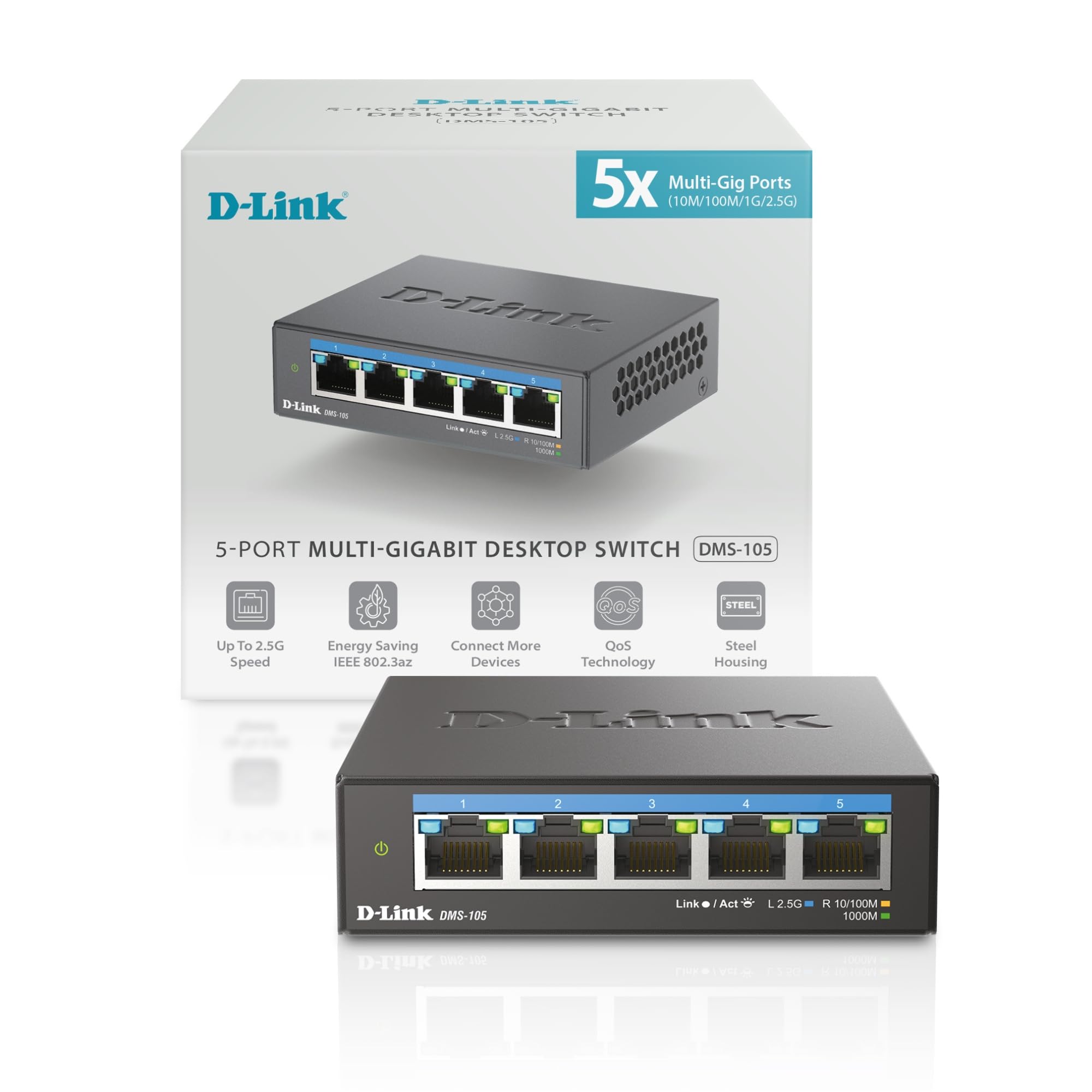
The D-Link DMS-105 sets the standard for a premium 2.5G unmanaged switch. Its all-metal chassis acts as a passive heatsink, keeping the unit running cool even with all five ports saturated. The fanless design ensures dead-quiet operation, and the 25Gbps switching capacity means there’s no internal bottleneck, even when transferring massive files between a NAS and a gaming PC simultaneously.
This switch comes equipped with 802.1p QoS and IGMP Snooping, which are rare features for an unmanaged model. QoS automatically prioritizes voice and video traffic to prevent lag during calls or streams, while IGMP Snooping optimizes multicast traffic for IPTV setups. The backward compatibility with Cat5 and Cat6 cables means you don’t need to rewire your existing home network to get full 2.5Gbps speeds on devices that support it.
The D-Link DMS-105 is also energy-efficient, complying with IEEE 802.3az Energy-Efficient Ethernet standards, which reduces power draw during low traffic periods. The compact footprint and rubber feet make it easy to tuck into a media center or on a desk. For users who need reliable multi-gig performance with traffic management, this is the definitive choice.
Why it’s great
- Full 25Gbps switching capacity prevents internal bottlenecks.
- QoS and IGMP Snooping optimize latency-sensitive and multicast traffic.
- Metal housing provides excellent passive cooling for 24/7 operation.
Good to know
- Does not support 10GbE uplinks, limiting future multi-gig expansion.
- Higher upfront cost compared to budget-friendly 2.5G alternatives.
2. TRENDnet TEG-S351
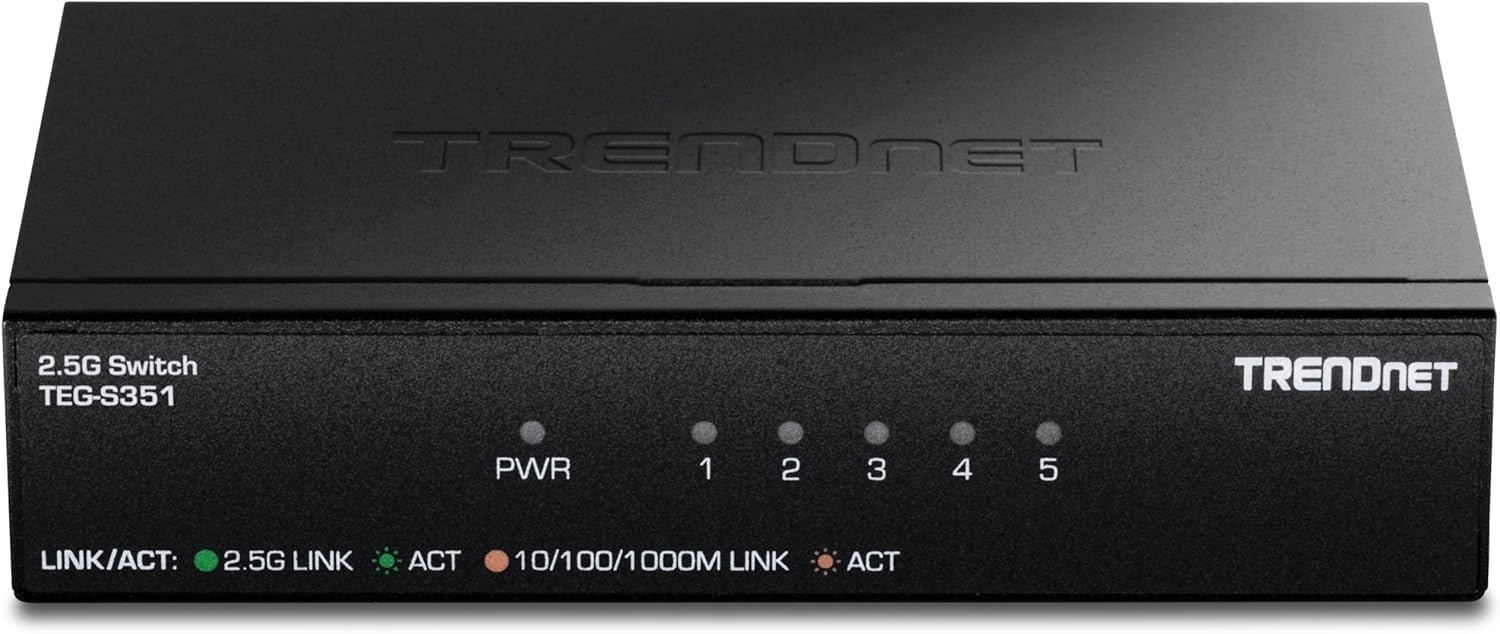
The TRENDnet TEG-S351 is specifically designed for environments where security compliance matters, featuring NDAA and TAA certification. This makes it one of the few 2.5G switches suitable for government, educational, and enterprise installations without triggering compliance audits. Beyond its certifications, the metal casing is robust and wall-mountable, and the front-facing LEDs with rear-facing ports enable clean cable management in server racks or behind desks.
Power consumption is remarkably low at a maximum of 4.5 Watts, thanks to an efficient chipset and a fanless design. The switch auto-negotiates speeds between 100Mbps, 1Gbps, and 2.5Gbps, and includes LED indicators that clearly differentiate 2.5G connectivity from slower speeds. This visual feedback is useful for troubleshooting connection issues without needing a network diagnostic tool.
TRENDnet backs this unit with a lifetime manufacturer protection plan, signaling confidence in the hardware’s longevity. The included mounting hardware and rubber feet offer flexible placement. The only minor complaint among users is the brightness of the status LEDs, which can be distracting in a dark room, but this is easily remedied with dimming stickers.
Why it’s great
- NDAA and TAA compliant, making it suitable for government and institutional use.
- Ports on the rear with LEDs on the front allow for tidy cable management.
- Lifetime manufacturer protection provides peace of mind for long-term use.
Good to know
- Front LEDs are very bright and may require stickers to dim in low-light environments.
- Does not include QoS or IGMP Snooping features found on some competitors.
3. BrosTrend 2.5G Switch

The BrosTrend 2.5G Switch is a clear winner for users seeking an affordable entry into multi-gig networking without sacrificing performance. It features five 2.5Gbps RJ45 ports with a total switching capacity of 25Gbps. Unlike some budget switches that use a single shared bus, BrosTrend’s non-blocking architecture ensures each port can saturate its 2.5Gbps link simultaneously.
The unit is constructed from durable white plastic, which keeps weight low but also means it relies on ventilation slots rather than a metal chassis for cooling. In real-world usage, however, the switch runs warm but not hot even under 24/7 load, and the fanless design keeps it completely silent. The lack of an SFP+ port keeps costs down and simplifies the setup for users who only need copper RJ45 connections.
Setup is truly plug-and-play — no configuration, no software. The compact design allows for desktop or wall-mount installation. The included power adapter is small enough to not block adjacent outlets. For anyone on a gigabit plan looking to double or triple their local file transfer speeds without breaking the bank, this switch is the ideal starting point.
Why it’s great
- Offers full 2.5Gbps speed on all five ports at a mid-range cost.
- Non-blocking switching architecture supports simultaneous full-speed connections.
- Compact, lightweight white design blends into modern home decor.
Good to know
- Plastic chassis is less effective at heat dissipation than metal alternatives.
- No SFP+ port for fiber uplinks or daisy-chaining to higher-speed networks.
4. UGREEN CM953
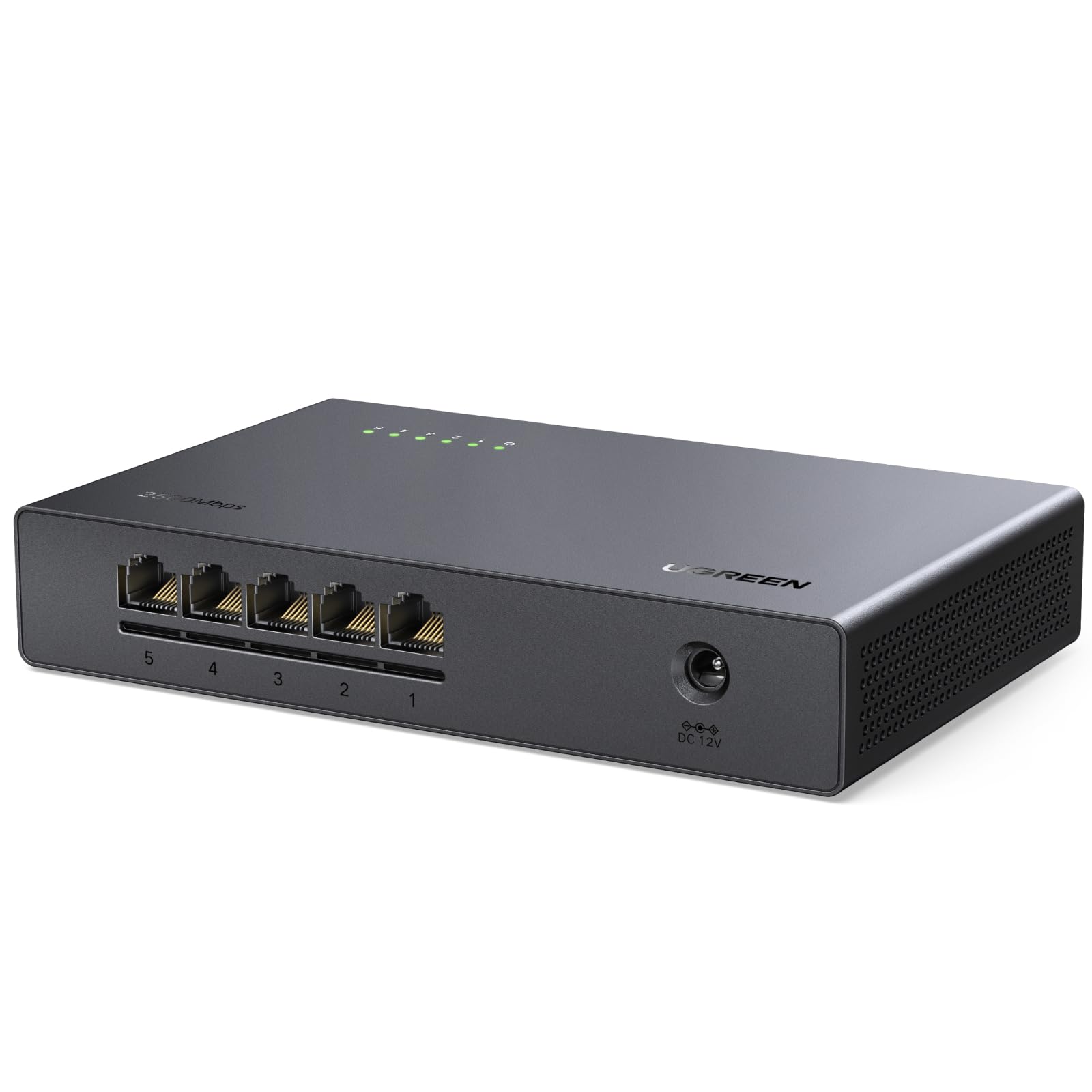
The UGREEN CM953 is a 2.5G switch designed with home media and NAS enthusiasts in mind. Its black plastic chassis features ventilation slots on the bottom and sides, allowing for passive airflow that keeps the internal chipset cool without a fan. Users transferring large media libraries from a NAS to a PC consistently report snappy transfer speeds and stable connections without drops or overheating.
This switch is fully plug-and-play and backward compatible with 1Gbps and 100Mbps devices, making it a seamless upgrade for existing networks. The LEDs are clean and informative without being distracting, which is a design win over overly bright competitors. The non-slip rubber feet and lightweight build make it easy to place on a desk or inside a media cabinet.
A notable quirk is that the switch can double DHCP leases for connected devices, which may affect networks with strict lease pools, but this is an edge case. The biggest trade-off is the plastic build; while functionally adequate, it feels less premium than metal units and does not dissipate heat as efficiently under extreme load. For normal home use, however, it performs reliably.
Why it’s great
- Ventilated plastic chassis stays cool without generating fan noise.
- Reliable 2.5Gbps performance for NAS and gaming setups.
- Compact, lightweight design with non-slip feet for flexible placement.
Good to know
- Plastic case feels less durable and dissipates heat less effectively than metal.
- Reported DHCP lease duplication issue on some network configurations.
5. Real HD SW5-25G
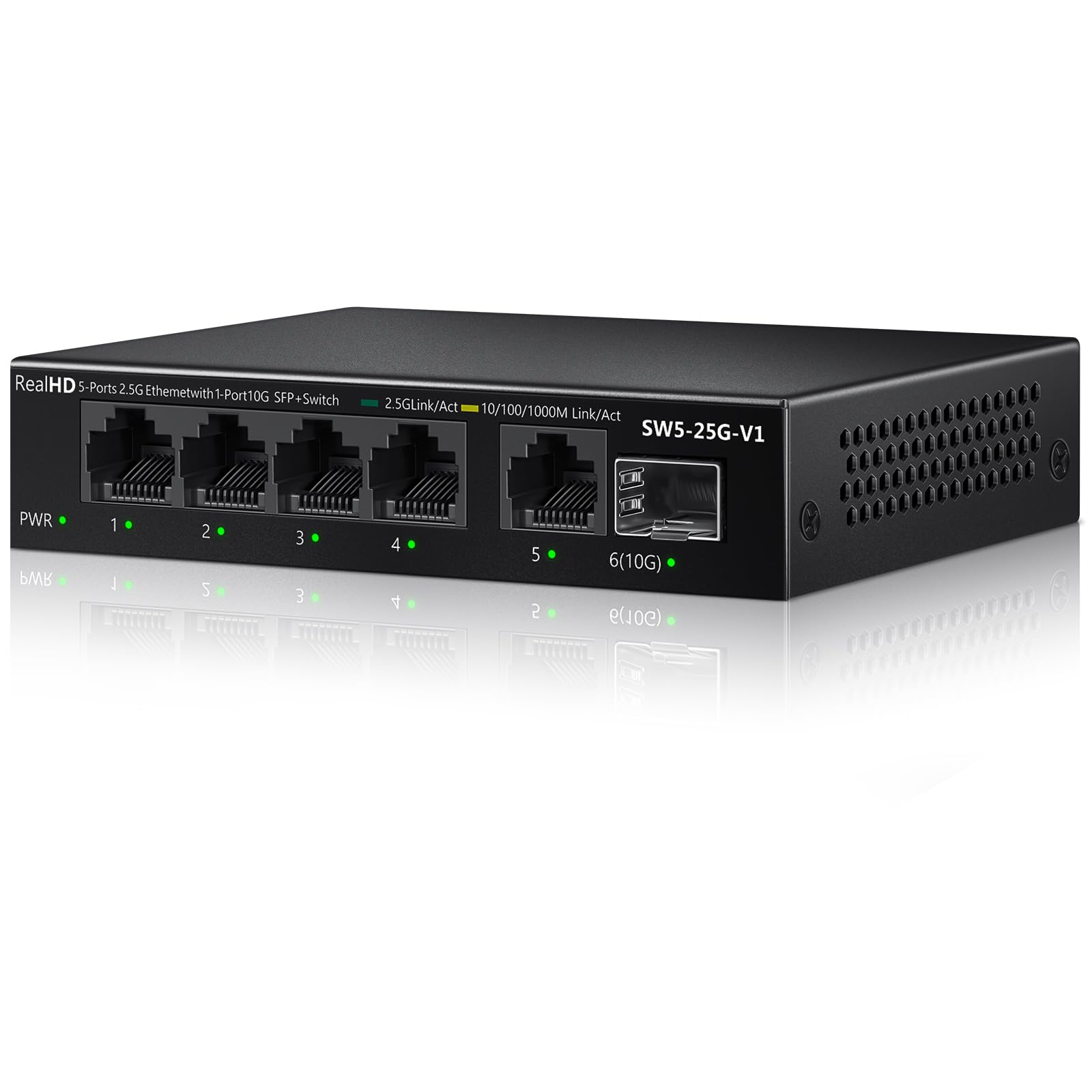
The Real HD SW5-25G stands out by pairing five 2.5G RJ45 ports with a dedicated 10G SFP+ port, giving it a unique advantage for future-proofing and high-speed uplinks. This allows users to connect a 10G NAS, server, or a fiber backbone directly, bypassing the 2.5G bottleneck when aggregated traffic exceeds the switch’s total capacity. The switching capacity is 45Gbps, which is higher than most 5-port models.
The metal housing includes 6KV lightning protection, a welcome safety feature for areas prone to electrical storms or running long outdoor Ethernet runs. The fanless operation and wide operating temperature range (-20℃ to 50℃) make it suitable for garages, basements, or industrial environments. The chassis is compact but dense, weighing 0.4 kilograms, reflecting its all-metal construction.
Setup is simple, but Real HD provides US-based tech support (Chicago) 9am-5pm CST, which is rare at this price point. A word of caution: customers note that the 10G SFP+ port may have compatibility issues with certain Cisco or Ubiquiti transceivers, so checking brand compatibility before purchase is advised. For users who need one ultra-fast uplink without jumping to a full 10G switch, this is a smart, cost-effective bridge.
Why it’s great
- Includes a 10G SFP+ port for high-speed uplinks or NAS connections.
- Metal housing with 6KV surge protection offers durability against electrical spikes.
- Wide operating temperature range suits non-climate-controlled locations.
Good to know
- SFP+ port may have compatibility issues with some third-party transceivers.
- Not a major brand; customer support may be less extensive than NETGEAR or D-Link.
6. NETGEAR MS305

The NETGEAR MS305 is a premium choice for users who want the reliability of a major brand combined with light web management capabilities. It features five 2.5Gbps ports in a fanless metal shell that doubles as a heatsink. The build quality is excellent, with a sleek, low-profile design that feels dense and durable. The included wall-mount kit and rubber feet make installation flexible.
While marketed as unmanaged, the MS305 offers a web-based interface for basic VLAN configuration and QoS settings, providing more control than a typical plug-and-play switch. This makes it ideal for power users who want to segment traffic or prioritize specific device traffic without moving to a full managed switch. The auto-negotiation works seamlessly with Cat5e or Cat6 cables.
Energy-efficient Ethernet (EEE) support reduces power draw during idle periods, and the 3-year limited hardware warranty from NETGEAR provides strong after-purchase protection. The main drawback is the cost — it sits at the top of the price range for 5-port 2.5G switches. For users who prioritize brand trust, build quality, and basic management features, it justifies the premium.
Why it’s great
- Web management interface offers VLAN and QoS configuration for advanced control.
- Premium metal construction with excellent passive cooling and durability.
- NETGEAR’s 3-year warranty and well-established customer support network.
Good to know
- Higher price point compared to other 2.5G switches with similar port counts.
- Management features are basic; not a replacement for a fully managed switch.
7. TP-Link TL-SG105S

The TP-Link TL-SG105S is the quintessential Gigabit switch for basic network expansion. If your internet plan is under 1 Gbps and you simply need to add more wired ports for a smart TV, console, or desktop, this unit delivers reliable performance at a budget-friendly price. Its durable metal casing provides better heat dissipation than plastic alternatives, and the fanless design means silent operation.
Despite its low cost, it supports 802.1p/DSCP QoS and IGMP Snooping — features typically reserved for more expensive switches. QoS automatically prioritizes streaming and gaming traffic, reducing stutter, while IGMP Snooping optimizes multicast streams for IPTV. This makes it a surprisingly capable choice for a media-rich home network on a Gigabit plan. The 3-year manufacturer warranty is a strong bonus.
The compact footprint (3.94” x 3.86” x 0.98”) and included wall-mount kit make it easy to install in tight spaces. The power adapter is small and unobtrusive. The only real limitation is the 1Gbps speed cap per port; it will bottleneck any device or network plan that exceeds 1 Gbps. For pure value and rock-solid gigabit performance, it remains a top contender.
Why it’s great
- Sturdy metal casing with fanless design ensures reliable, quiet operation.
- Includes QoS and IGMP Snooping despite being a budget-friendly model.
- Backed by a 3-year manufacturer warranty, rare at this price point.
Good to know
- Only Gigabit speed (1Gbps) — will bottleneck multi-gig internet plans or NAS transfers.
- Plastic components are limited to the front panel; metal casing is the main structure.
FAQ
Do I need a 2.5G switch if my internet plan is only 1 Gbps?
Will a metal switch run cooler than a plastic one?
Can I mix 1Gbps and 2.5Gbps devices on the same switch?
Final Thoughts: The Verdict
For most users, the best 5 port network switch winner is the D-Link DMS-105 because it delivers a perfect balance of 2.5G speeds, essential traffic management features like QoS and IGMP Snooping, and a durable metal chassis that keeps noise and heat to a minimum. If you want the ultimate value for a multi-gig upgrade without spending top dollar, grab the BrosTrend 2.5G Switch. And for a simple, reliable Gigabit expansion that prioritizes rock-solid fundamentals and a three-year warranty, nothing beats the TP-Link TL-SG105S.