
Our readers keep the lights on and the weekend projects moving. As an Amazon Associate, I earn from qualifying purchases.
A blade swap is the single fastest upgrade you can make to a circular saw. The stock blade that ships with most saws is a compromise—it cuts, but it burns, wanders, and leaves a ragged edge. Choosing the right 7 1/4-inch blade means the difference between fighting your material and gliding through it.
I’m Rikta — the founder and writer behind FitlyFast. I’ve spent years analyzing the mechanical engineering, carbide formulations, and tooth geometries that define performance in wood-cutting tooling, so you can match the blade to the exact cut you’re making.
Whether you are framing a deck, trimming plywood for cabinets, or cutting laminate shelving, the 7 1/4 circular saw blade you choose directly controls cut quality, battery life, and how much sanding you will have to do later.
How To Choose The Best 7 1/4 Circular Saw Blade
A 7 1/4-inch blade is the most common size in portable circular saws, miter saws, and some table saws. The market offers options ranging from 14 to 60 teeth, different carbide grades, and various kerf thicknesses. Matching the blade to your specific material and cutting style is the fastest way to improve your results without buying a new saw.
Tooth Count Determines Cut Character
Blades with 24 teeth rip through dimensional lumber fast but leave a rougher edge. A 40-tooth blade balances speed and finish for general crosscuts. The 60-tooth options produce near-splinter-free edges on plywood and melamine but cut slower and require more saw power. For a framing crew, 24T is the daily driver. For cabinet work, 40T or 60T is non-negotiable.
Carbide Quality and Grind Geometry
High-density tungsten carbide with micrograin C3 or C4 formulations holds an edge longer than standard carbide. The grind matters: Alternating Top Bevel (ATB) shears wood fibers for clean crosscuts, while Triple Chip Grind (TCG) handles abrasive materials like particle board and non-ferrous metals. A blade with a negative hook angle reduces self-feeding on miter saws for safer cuts in thin stock.
Kerf Width Affects Battery Life and Waste
A thin kerf blade (under 0.08 inches) removes less material, which means less load on the motor and longer runtime on cordless saws. The trade-off is a slightly narrower cutting path and potential deflection under heavy feed pressure. Standard kerf blades are stiffer but consume more power. For cordless saws, thin kerf is a significant advantage.
Quick Comparison
On smaller screens, swipe sideways to see the full table.
| Model | Category | Best For | Key Spec | Amazon |
|---|---|---|---|---|
| DEWALT DWA171440 | 40T General | Smooth crosscuts on lumber | 0.071″ Thin Kerf | Amazon |
| Diablo D0724VPX 2-Pack | 24T Framing | Ripping pressure-treated lumber | TiCo Carbide Blend | Amazon |
| Janchi 3-Pack Combo | 3-Blade Set | Varied cuts from rip to finish | 0.06″ Thin Kerf | Amazon |
| Bosch DCB760 | 60T Finish | Extra-fine finish on plywood | Brute C3/C4 Carbide | Amazon |
| DEWALT DWA1714243 3-Pack | 24T Multi-pack | High-volume framing work | ToughTrack Tooth Design | Amazon |
| Diablo D0748CF Steel Demon | 48T Metal | Cutting steel and alloys | Cermet II TCG Grind | Amazon |
| Freud LU79R007 | 60T Laminate | Splinter-free melamine cuts | Hi-ATB / 0.063″ Plate | Amazon |
In‑Depth Reviews
1. DEWALT DWA171440

The DEWALT DWA171440 uses high-density tungsten carbide that resists wear better than standard carbide blends. The 40-tooth configuration works as a true generalist—fast enough for ripping dimensional lumber yet fine enough for clean crosscuts on framing timber. The Tough Coat anti-stick layer keeps pitch from building up between teeth, which is the main reason blades start burning after extended cuts in pine or cedar.
At a thin kerf of 0.071 inches, this blade reduces motor load noticeably on cordless saws, extending runtime by a measurable margin compared to thicker standard-kerf blades. The reinforced shoulder adds impact resistance when you hit a buried nail—a common risk in renovation work that snaps lesser blades. Users consistently report smooth, sharp cuts out of the box with no wobble on Ridgid and DEWALT saws.
One caveat: the thin plate flexes during heavy rip cuts through dense hardwood like oak or hickory, so maintain steady feed pressure to avoid deflection. For general construction, crosscutting, and trim work, this blade hits the sweet spot where performance meets durability without pushing into premium pricing territory.
Why it’s great
- High-density tungsten carbide stays sharp through heavy use
- Tough Coat anti-stick layer reduces gumming and heat buildup
- Thin kerf improves battery life on cordless circular saws
Good to know
- Flexes slightly during aggressive rips in hardwoods
- 40T is not fine enough for tearout-free plywood cuts
2. Diablo D0724VPX 2-Pack

Diablo’s Tracking Point technology uses laser-cut stabilizer vents that reduce vibration and noise during aggressive ripping. The 24-tooth design with TiCo high-density carbide handles pressure-treated 5/4 x 6 yellow pine deck boards with no noticeable dulling after 50 cuts, as confirmed by field reports. The Perma-SHIELD non-stick coating resists both corrosion and the sticky resin that oozes from wet treated lumber.
The two-pack format gives framers and deck builders a spare on the job site without a separate purchase. Each blade cuts 2x lumber, plywood, and hardwood efficiently—the 24-tooth count clears chips fast, preventing the binding and burning that occurs when a fine-tooth blade gets loaded with sawdust. Users switching from cheaper blades report night-and-day improvement in cut cleanliness and cutting speed.
The blades come with a standard 5/8-inch arbor and fit most corded and cordless circular saws including DEWALT and Milwaukee models. While 24 teeth produce a rougher edge than a 40T or 60T blade, the smoothness is still superior to any stock blade included with a job-site saw. For pure ripping speed in framing lumber, this is the most efficient option in the mid-range tier.
Why it’s great
- Two blades included for the price of one premium single
- TiCo carbide holds sharpness through dozens of pressure-treated cuts
- Stabilizer vents reduce vibration noticeably during ripping
Good to know
- 24-tooth finish is too rough for final trim work
- Not designed for sheet goods or melamine
3. Janchi 3-Pack Combo (24T, 40T, 60T)
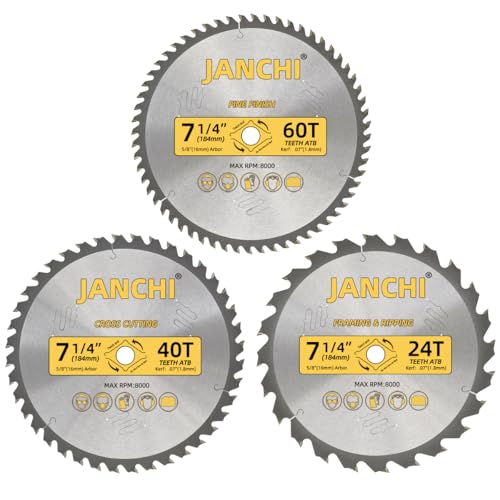
The Janchi 3-pack covers the three essential tooth counts for woodworking in one purchase: 24 teeth for fast ripping and framing, 40 teeth for general crosscuts, and 60 teeth for fine finish cuts on plywood and laminates. Each blade uses a 0.06-inch thin kerf and Alternating Top Bevel grind, which is the correct geometry for clean shearing of wood fibers across the grain. The all-tungsten-carbide tips are hardened to resist dulling on softwoods and hardwoods alike.
The ultra-thin kerf makes these blades ideal for battery-powered circular saws and trim saws. Users fitting them to DEWALT cordless saws and Dremel saws report effortless cuts through 1/4-inch plywood glued to drywall, with the blades staying sharp after multiple uses. The 60T blade produces a noticeably cleaner edge than typical stock blades, reducing the need for sanding on visible joints.
The trade-off for the thin kerf is reduced lateral stiffness—these blades are not meant for heavy demolition or nail-embedded wood. The set works best for DIY enthusiasts, furniture builders, and homeowners who need one blade for each common task without buying three separate premium blades. For the price of a single premium blade, you get a full range of cut qualities.
Why it’s great
- Three tooth counts cover ripping, crosscutting, and finishing
- 0.06-inch thin kerf improves battery runtime on cordless saws
- ATB grind delivers clean cuts across softwood and hardwood
Good to know
- Thin kerf flexes under heavy feed pressure
- Not recommended for nail-embedded or demolition work
4. Bosch DCB760

The Bosch DCB760 is built around Brute carbide, an upgraded C3/C4 micrograin formulation that resists impact damage better than standard carbide. The 60-tooth ATB geometry makes this a dedicated finish blade—it produces extra-fine surfaces on crosscuts, trim, and plywood with minimal tearout. The Speecoat antifriction finish prevents burning even during slower feed rates, which is the most common cause of scorched edges on hardwoods.
The thinner kerf combined with an extra-hard steel body gives the blade a balance of speed and accuracy that suits both miter saws and circular saws. Users mounting it on Bosch cordless miter saws report distinctly cleaner cuts compared to the stock blade that ships with the saw. The blade also fits table saws with a 5/8-inch arbor, making it a versatile upgrade for finish work across multiple tools.
Ripping performance is not the strength here—60 teeth clear chips slower than 24T or 40T blades, so you feel resistance on deep rip cuts through thick lumber. This blade is optimized for crosscutting dimension stock and breaking down sheet goods where edge quality matters more than speed. If your work involves cabinet-grade plywood, melamine, or hardwoods, the DCB760 delivers the cleanest cut in this list.
Why it’s great
- C3/C4 micrograin carbide resists chipping on impact
- Speecoat eliminates burning on slow feed cuts
- Extra-hard steel body resists deflection for true cuts
Good to know
- Ripping speed is slower due to 60 teeth
- Higher price point for a single blade
5. DEWALT DWA1714243 3-Pack

The DEWALT DWA1714243 3-pack targets high-volume users who wear out 24-tooth blades quickly. Each blade features the patent-pending ToughTrack tooth design, which maintains accurate tracking over the blade’s entire life rather than wandering after the first sharpening pass. High-density tungsten carbide tips resist wear through pressure-treated lumber and nail-embedded wood, while the Tough Coat anti-stick coating prevents resin buildup that causes burning.
The thin kerf and reinforced shoulder allow these blades to handle full-depth cuts in hardwood tree trunks without slowing down, as reported by users running 13-amp Skilsaw and Porta-Cable saws. The three-blade format gives framers and roofers a cost-effective way to keep a fresh blade on the saw without frequent trips to the supplier—swap in a new blade when the current one starts dragging.
Quality control has been an issue in isolated batches—some units have shipped with missing teeth. While this appears to be an exception rather than the rule, it is worth inspecting each blade before installation. When the blades are intact, the cutting performance matches or exceeds single-pack premium options at a lower per-blade cost. For crews burning through blades weekly, this pack offers the best operating economy.
Why it’s great
- Three blades reduce per-unit cost for frequent replacements
- ToughTrack tooth design maintains cutting accuracy over time
- Reinforced shoulder handles nail impacts
Good to know
- Occasional quality issues with missing teeth
- 24-tooth finish not suitable for trim or sheet goods
6. Diablo D0748CF Steel Demon

The Diablo Steel Demon is engineered with Cermet II carbide—a ceramic-metal composite that withstands the heat and abrasion of cutting ferrous metals. The 48-tooth Triple Chip Grind (TCG) geometry is specifically designed to handle steel, iron, and alloys without chipping the carbide tips. Users report cutting through 1/8-inch Corten steel plate and 3-inch schedule 40 galvanized pipe with minimal sparks and surprisingly cool metal edges post-cut.
Laser-cut stabilizer vents serve a dual purpose: they reduce the high-frequency vibration typical of metal cutting and help dissipate heat so the blade runs cooler. The Perma-Shield coating adds another layer of heat resistance and prevents galling, which is common when cutting softer metals like aluminum. Fitting a 5/8-inch arbor, this blade works in standard circular saws but requires a saw with sufficient torque—corded saws are preferred for thick steel.
The blade wears faster on thin sheet steel (1/8-inch and below) compared to thick plate because the teeth impact the material differently. Users cutting 1/16-inch steel report 24 cuts before noticeable dulling, while thicker material extends blade life significantly. A single tooth can break if the blade jams, so controlled feed rate is critical. For anyone who needs to cut steel, angle iron, or aluminum rails with a circular saw, this is the purpose-built solution.
Why it’s great
- Cermet II grade handles ferrous metals without chipping
- TCG grind provides clean edges on steel and alloys
- Stabilizer vents reduce vibration and keep the blade cool
Good to know
- Wears quicker on thin sheet metal than on thick plate
- Requires controlled feed to prevent tooth breakage
7. Freud LU79R007
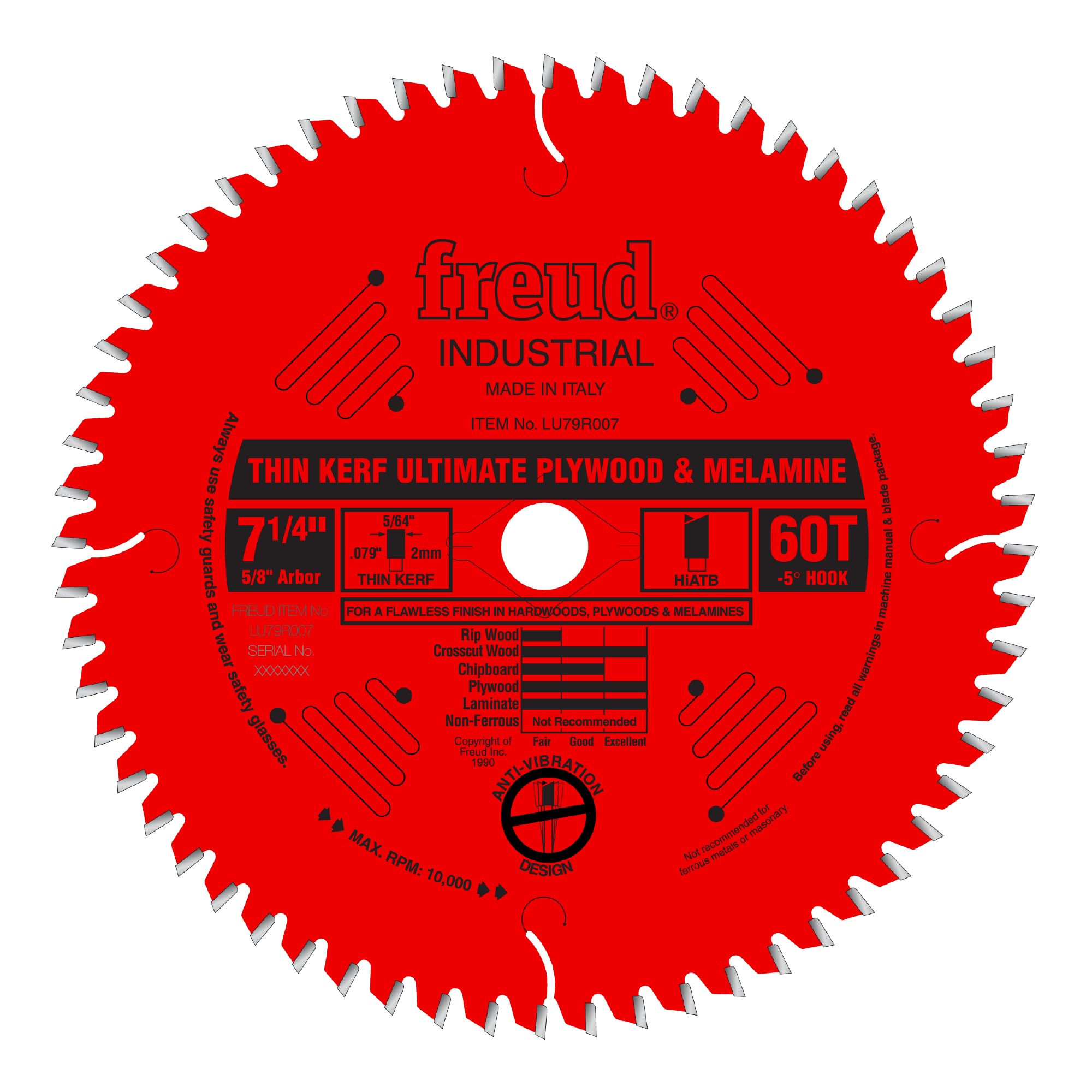
The Freud LU79R007 is the gold standard for cutting melamine, plywood, and laminate without tearout. The High Alternate Top Bevel (Hi-ATB) grind shears the surface layer before the main cut, virtually eliminating the chipping that ruins visible edges on melamine shelving and Formica countertops. The TiCo high-density carbide blend combines titanium and cobalt for a tougher bond that resists the abrasive glue lines in engineered wood.
The 60-tooth count with a thin kerf of 0.079 inches and a plate thickness of 0.063 inches makes this blade fast enough for production work while maintaining a finish that often requires no sanding. Users cutting RTA melamine shelving report factory-like edges using a double-cut method—scoring to depth, then completing the pass. The Perma-Shield non-stick coating prevents the heat buildup that melts thermoplastic coatings on melamine.
The negative hook angle (-5 degrees) is a deliberate choice that reduces self-feeding, making the blade safer on miter saws and slider saws where accidental grab can occur. This also means the blade requires a bit more forward pressure on circular saws compared to general-purpose blades. For cabinet shops, woodworkers, and countertop fabricators who prioritize edge quality over ripping speed, the LU79R007 justifies its premium tier through consistently flawless cuts.
Why it’s great
- Hi-ATB grind produces splinter-free edges on melamine and laminate
- TiCo carbide blend resists wear from abrasive engineered materials
- Negative hook angle improves safety on slider and miter saws
Good to know
- Requires more forward pressure on handheld circular saws
- Premium price is a barrier for casual users
FAQ
Can I use a 7 1/4-inch blade on a table saw with a 5/8-inch arbor?
What tooth count should I use for general-purpose cutting?
Why does my blade burn the wood during crosscuts?
Final Thoughts: The Verdict
For most users, the 7 1/4 circular saw blade winner is the DEWALT DWA171440 because its 40-tooth count, thin kerf, and anti-stick coating handle the widest range of everyday cuts without burning or dulling early. If you want a finish so clean you skip sanding, grab the Freud LU79R007. And for cutting steel or non-ferrous metals with a standard circular saw, nothing beats the Diablo D0748CF Steel Demon.