
Our readers keep the lights on and the weekend projects moving. As an Amazon Associate, I earn from qualifying purchases.
Recording a drum kit places demands on an audio interface that no other instrument does. You need multiple simultaneous microphone channels, phantom power for condenser overheads, low-noise preamps that don’t amplify bleed, and a sample rate high enough to capture transient snap without aliasing. A two-channel interface forces session re-takes; a flimsy preamp section turns a tight performance into a muddy mess.
I’m Rikta — the founder and writer behind FitlyFast. I’ve spent years analyzing preamp circuit designs, converter specs, and channel-count requirements specific to recording full drum kits in both home studios and professional session rooms.
This guide breaks down every meaningful spec, port, and workflow consideration so you can confidently choose the right audio interface for recording drums that actually fits your kit size and recording goal.
How To Choose The Best Audio Interface For Recording Drums
Drum recording boils down to three non-negotiable hardware specs: enough simultaneous mic inputs, preamps that stay clean under high gain, and converters that capture the full transient range of sticks on metal and skins. Overlooking any one of these turns a promising session into a salvage job.
Channel Count and Input Type
A basic four-mic drum setup (kick, snare, two overheads) requires four XLR inputs with individual phantom power switches. A full 5-piece kit with stereo overheads and room mics pushes you to eight simultaneous channels. Look for models that offer at least four combo XLR/TRS jacks and will scale via ADAT when your mic locker grows.
Preamps and Dynamic Range
Drums generate enormous transient peaks. A preamp with a low Equivalent Input Noise (EIN) value preserves the attack of a kick beater without introducing hiss during the quiet decay between hits. A dynamic range above 110 dB on the input side ensures you capture ghost notes on the snare without the overheads distorting on rim shots.
Latency and Monitoring
Zero-latency direct monitoring is critical when tracking live drums — a delay between stick impact and headphone playback destroys a drummer’s feel. Interfaces with onboard DSP mixer engines let you blend the direct input with the computer return so the player hears a polished mix without CPU buffer lag.
Expandability and Connectivity
Most drummers outgrow the base channel count within a year. An interface with ADAT optical I/O lets you add eight more preamps without swapping the core unit. USB 2.0 at 24-bit/48 kHz handles sixteen simultaneous channels fine; USB 3.0 or Thunderbolt becomes necessary only at 192 kHz with high track counts.
Quick Comparison
On smaller screens, swipe sideways to see the full table.
| Model | Category | Best For | Key Spec | Amazon |
|---|---|---|---|---|
| Focusrite Scarlett 18i20 4th Gen | Premium Rack | Full 8-mic drum tracking with ADAT room for expansion | 8 mic preamps, 69dB gain, 192kHz | Amazon |
| MOTU UltraLite-mk5 | Premium Compact | Mobile drum rig with pro-grade AD/DA | 18 x 22 USB, 125dB dynamic range | Amazon |
| Zoom F6 | Field/Studio Hybrid | Location drum recording without clipping | 32-bit float, 6 XLR, timecode | Amazon |
| Audient iD24 | Console-Grade | 2-mic drum capture with insert FX routing | 2 console preamps, ADAT expandable | Amazon |
| Behringer X AIR XR18 | Digital Mixer | Live drum recording with 16 MIDAS preamps | 18-ch digital mixer, 16 MIDAS preamps | Amazon |
| Zoom LiveTrak L-8 | Portable Mixer | Standalone drum recording without a computer | 6 combo inputs, SD recording, battery power | Amazon |
| Tascam US-16×08 | Value Workhorse | Budget 8-mic drum input without breaking the bank | 8 XLR inputs, 56dB gain, 16 simultaneous | Amazon |
| Behringer U-PHORIA UMC1820 | Budget Expandable | High input count at the lowest entry cost | 8 MIDAS preamps, ADAT expandable, 96kHz | Amazon |
| Valeton GP-200 | Multi-FX/Interface | Hybrid guitar/drum workflow with drum machine | USB-C interface, 100 drum rhythms | Amazon |
In‑Depth Reviews
1. Focusrite Scarlett 18i20 4th Gen
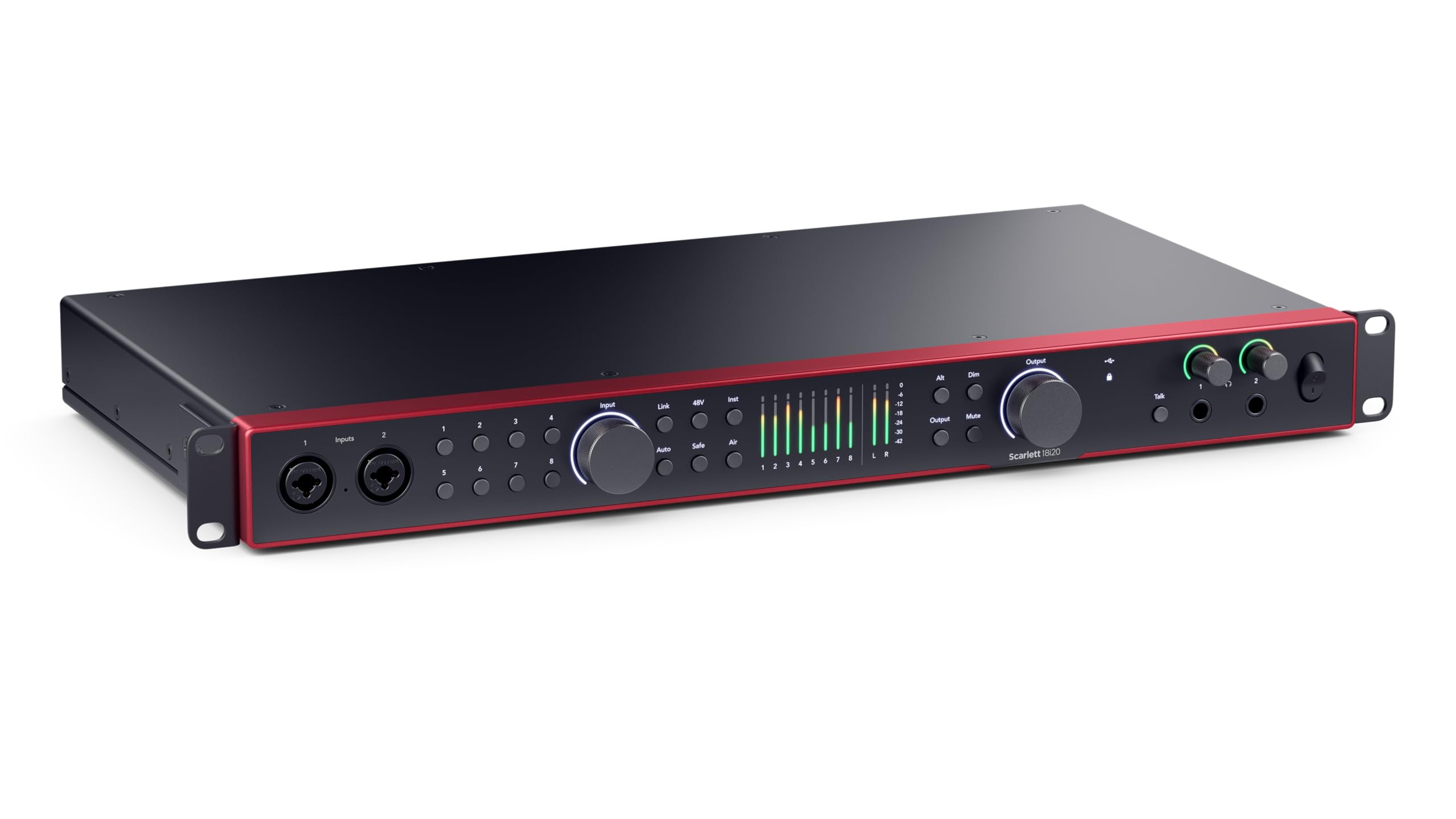
The fourth-generation Scarlett 18i20 delivers eight mic preamps with 69dB of gain — enough headroom to drive a ribbon mic on a room sound without an external booster. The converters are lifted from Focusrite’s RedNet line, offering 122dB of dynamic range that preserves the full transient attack of a snare rim shot and the low-end thump of a kick drum equally well.
Two Air modes add presence and harmonic drive, replicating the character of classic console preamps. Auto Gain and Clip Safe work together to set optimal recording levels and prevent digital clipping in real time — particularly useful when a drummer hits harder during a take. The 18-input/20-output topology includes ADAT, S/PDIF, MIDI I/O, and Word Clock for integration with external converters.
The included software bundle — Pro Tools Intro, Ableton Live Lite, Cubase LE, and the Hitmaker Expansion suite — gets a new drum session off the ground without additional cost. Focusrite Control provides straightforward routing for separate headphone mixes for each performer.
Why it’s great
- Eight simultaneous mic preamps with generous 69dB gain
- RedNet-derived converters deliver 122dB dynamic range
- Auto Gain and Clip Safe prevent blown takes mid-session
Good to know
- Rackmount form factor requires studio desk or rack shelf
- Steeper learning curve for beginners compared to 2i2 series
2. MOTU UltraLite-mk5

MOTU’s UltraLite-mk5 packs 18 inputs and 22 outputs into a half-rack chassis that fits in a laptop bag. The analog outputs measure 125dB dynamic range, translating to exceptionally clean playback for monitoring drum bus compressions in real time. Two combo XLR/TRS mic inputs plus additional line inputs let you cover a 4-mic kit immediately, while 8-channel ADAT expands the full count for larger setups.
The onboard CueMix 5 DSP mixer applies reverb, 4-band parametric EQ, compression, and gating to each input before the DAW, allowing zero-latency monitoring with processed foldback for the drummer. The OLED display shows metering for all analog I/O at a glance, which helps spot a hot input before it clips during a take. The unit retains its mixer settings in standalone mode, so it doubles as a live stage mixer between recording sessions.
At a sample rate of 192kHz, the UltraLite-mk5 sustains 22 channels of simultaneous I/O, though most drummers will work at 48kHz for maximum channel count. The USB 2.0 connection runs audio-class-compliant on Mac and iOS, with MOTU’s driver offering industry-leading low latency on Windows.
Why it’s great
- Half-rack form factor with full ADAT expandability
- 125dB dynamic range on analog outputs
- Onboard DSP with reverb, EQ, compression for zero-latency monitoring
Good to know
- Only two dedicated combo mic/line inputs; additional inputs are line-only
- OLED screen compact for detailed level checking at distance
3. Zoom F6

The Zoom F6 solves the single most common drum recording nightmare: clipping. Its 32-bit float recording system uses dual AD converters to capture a dynamic range so wide that no practical stick hit can clip the input. You can set gain conservatively for a loud rock verse and still have full resolution for a whisper-quiet brush section without adjusting levels mid-session.
Six XLR inputs with professional preamps deliver a noise floor low enough for multi-mic setups in untreated rooms. The unit functions as a standalone recorder to SD card or as a USB audio interface — or both simultaneously. Timecode I/O provides frame-accurate sync for video workflows, making the F6 a dual-purpose tool for drummers who also shoot performance content.
Portability matters here: the F6 runs on four AA batteries or an L-type battery, so a remote kit recording in a rehearsal space or live room doesn’t need a power outlet. The Bluetooth remote control lets a single engineer start and stop recording from behind the kit. The menu system requires a careful read of the manual, but the payoff is field-recording fidelity in a package the size of a paperback.
Why it’s great
- 32-bit float recording eliminates input clipping entirely
- Standalone and USB interface modes for flexible session workflows
- Timecode I/O for video sync and location recording
Good to know
- Menu navigation requires upfront study; not plug-and-play
- 6 XLR inputs may be limiting for full 8-mic setups
4. Audient iD24

The Audient iD24 brings the console mic preamp circuit from the ASP8024-HE console into a desktop interface. Those two Class-A preamps deliver ultra-low noise and low distortion with the analogue warmth that makes a kick drum’s fundamental frequency sound punchy and present. For drummers who track with just a kick and overhead pair, this preamp quality directly translates to less time EQing in the mix.
32-bit DAC technology provides 126dB of dynamic range on the monitoring side, revealing subtle room reflections and cymbal decay that cheaper converters smear. The ADAT input expands the iD24 to 10 channels, accommodating a full drum kit when paired with an 8-channel preamp. Two fully balanced insert points allow external compressors or EQs to be patched in before conversion — a rare feature at this price tier that lets you print compressed drum room mics without adding latency.
The three assignable function buttons speed up monitor switching and talkback, which shortens setup time between takes. The unit does run warm and draws significant power from the USB bus, so a powered USB hub is recommended for stable operation during long sessions.
Why it’s great
- Console-grade Audient preamps with genuine analogue warmth
- Balanced insert points for external outboard integration
- 126dB dynamic range on monitoring output
Good to know
- Only 2 built-in mic preamps; needs ADAT expansion for full kit
- Runs hot during operation; powered hub recommended
5. Behringer X AIR XR18

The X AIR XR18 is a digital mixer that functions as a 16-MIDAS-preamps audio interface. Those preamps are the same circuit design found in Behringer’s X32 console — clean, high-headroom, and capable of handling the transient peaks of a full drum kit across 18 channels. The 18 x 18 USB interface streams every input directly to your DAW while the internal DSP handles zero-latency monitoring, compression, gate, parametric EQ, and effects.
Control is via iPad or Android tablet using the free app. The mixer rack-mounts in 3U, making it a permanent fixture in a studio rack or a tour-ready front-of-house and recording rig. Six XLR aux outputs plus main L/R XLR outputs provide flexible headphone mixes for every musician. The built-in Tri-mode Wi-Fi module allows direct connection without an external router, though wired Ethernet is more reliable for critical live recording events.
The Dugan-style auto-mixing feature manages gain sharing across multiple microphones, which is useful when recording drum group discussions or live band rehearsals. The absence of AES50 connectivity limits expansion, but the 16 onboard preamps handle the largest common drum mic count without needing external gear.
Why it’s great
- 16 MIDAS preamps for full drum kit capture with no expansion needed
- Digital mixer functionality with DSP-driven monitoring and effects
- Compact 3U rackmount design for studio and tour use
Good to know
- Requires iPad/Android tablet for control; no local knobs
- Built-in Wi-Fi can be flaky in crowded RF environments
6. Zoom LiveTrak L-8

The Zoom LiveTrak L-8 functions as a standalone digital mixer/recorder and a USB audio interface, making it ideal for drummers who want to capture rehearsals without booting a computer. Six combo XLR/TRS inputs with -121dBu noise floor preamps and +54dB of gain handle dynamic mics on toms and a kick comfortably. The unit records 12 tracks simultaneously at 24-bit/96kHz directly to an SD card.
Four headphone outputs with three independent monitor mixes let every band member dial their own cue mix — the drummer can hear a click track while the bassist hears more kick. The built-in effects and 3-band EQ per channel allow sound shaping before the signal hits the DAW. Battery power via six AAs provides full portable operation for location recording.
The global phantom power switch is worth noting: all six XLR channels receive phantom power simultaneously, so you cannot individually switch condenser and dynamic mics on separate channels. The micro USB connection for computer interface duty is outdated compared to modern USB-C models, and driver installation is required for Windows use.
Why it’s great
- Standalone SD card recording means no computer needed for basic tracking
- Four headphone outs with three independent monitor mixes for band recording
- Portable and battery-powered for rehearsal room capture
Good to know
- Global phantom power prevents mixing condenser and dynamic channels
- Micro USB port feels dated for computer interface use
7. Tascam US-16×08

The Tascam US-16×08 provides eight Ultra-HDDA microphone preamps delivering up to 56dB of gain with a noise floor low enough for multi-mic drum sessions. An additional eight line inputs bring the total analog count to 16, allowing simultaneous recording of a drum kit plus DI-connected bass and guitar. The hardware interface connects via USB 2.0 and captures all 16 channels at 24-bit/96kHz without dropouts.
The built-in DSP mixer applies 4-band EQ and compression to each channel for polished monitor mixes with zero-latency monitoring. The rugged metal build has survived years in home studios with consistent reliability. Two of the line inputs are switchable to instrument level, enabling direct guitar or bass recording without a separate DI box.
Initial setup can be finicky: conflicting driver versions on Tascam’s website and an outdated printed manual lead to installation frustration. Once the correct driver is loaded and the unit restarted, the US-16×08 operates as a plug-and-play workhorse in Reaper, Ableton Live, and other major DAWs. The small gain knobs are closely spaced, which makes fine adjustments during a fast take slightly cumbersome.
Why it’s great
- Eight XLR mic preamps with 56dB gain for budget-friendly drum capture
- 16 simultaneous analog inputs record kit plus DI instruments
- Onboard DSP mixer with EQ and compression for monitoring
Good to know
- Driver installation process can be frustrating for non-technical users
- Gain knobs are small and tightly packed for quick adjustments
8. Behringer U-PHORIA UMC1820

The Behringer UMC1820 delivers eight MIDAS-designed mic preamps at a price point that undercuts most competitors by a wide margin. Each preamp provides enough clean gain for dynamic microphones on snare and rack toms without introducing audible hiss in the quiet sections between hits. The 18 x 20 I/O topology includes ADAT optical input, allowing you to add another 8-channel preamp later without swapping the interface.
Zero-latency direct monitoring through the analog mix knob lets the drummer hear a combined blend of the live inputs and the computer playback without any buffer delay. Drivers on Windows are lightweight and stable, and the unit routes S/PDIF coaxial and optical ADAT signals simultaneously. The 24-bit/96kHz converters capture the transient detail of a cymbal crash and the low-frequency thump of a kick drum accurately for the price tier.
The preamps do not have enough output level for a passive guitar pickup plugged directly in — a DI box is required for instrument inputs. The unit’s plastic chassis feels less substantial than metal competitors, but for a home studio on a tight budget, the UMC1820 provides a genuine 8-channel drum recording path that scales via ADAT.
Why it’s great
- Eight MIDAS preamps at the lowest entry point in this class
- ADAT expandability future-proofs your channel count
- Lightweight drivers with stable performance on Windows
Good to know
- Guitar input requires external DI box for adequate level
- Chassis is plastic rather than metal
9. Valeton GP-200

The Valeton GP-200 is primarily a multi-effects processor and amp modeler, but its USB-C audio interface with stereo streaming makes it a functional drum recording tool for a specific scenario — electronic drum kits and hybrid setups. The 100 built-in drum rhythms provide practice patterns and song frameworks that can be routed directly into a DAW via USB, useful for demoing drum parts when a live kit isn’t available.
When paired with an electronic drum module, the GP-200 acts as a stereo interface that captures the module’s left and right mix. The unit supports OTG connection to iOS and Android devices, allowing mobile recording directly into a tablet or phone without a laptop. The 4.3-inch TFT color screen makes navigation intuitive, and the eight customizable footswitches can control transport functions during recording.
The GP-200 does not replace a multi-input audio interface for acoustic drum recording. Its stereo input limitation means you cannot record individual drum mics simultaneously. For drummers who also play guitar or bass, the amp models and IR cab simulations offer a complete recording chain in one pedalboard-sized unit.
Why it’s great
- USB-C audio interface with stereo streaming for electronic kits
- 100 built-in drum rhythms for practice and demo recording
- OTG support for direct mobile device recording
Good to know
- Stereo input only; cannot record multiple acoustic drum mics
- Primarily a guitar processor; drum features are practice tools
FAQ
How many inputs do I need to record a full drum kit?
Will a USB 2.0 interface handle 8 simultaneous drum channels?
What is the advantage of ADAT expandability for drum recording?
Final Thoughts: The Verdict
For most drummers, the audio interface for recording drums winner is the Focusrite Scarlett 18i20 4th Gen because it provides eight genuine mic preamps, RedNet-derived converters, and ADAT expandability in a proven rackmount format. If you need mobile field recording without any clipping risk, grab the Zoom F6. And for the tightest budget that still delivers eight MIDAS preamps and ADAT scaling, nothing beats the Behringer UMC1820.