
Our readers keep the lights on and the weekend projects moving. As an Amazon Associate, I earn from qualifying purchases.
A true black oxide finish on steel isn’t a coat of paint — it’s a chemical conversion that turns the surface layer of the metal itself into a deep, protective magnetite (Fe₃O₄) structure. This changes how your steel parts look, how they resist corrosion, and how they take subsequent sealants. Whether you are restoring a vintage firearm, blackening hardware for a furniture build, or treating an industrial component, the difference between a durable, uniform black and a patchy, flaking mess comes down to the specific formulation you choose and the surface preparation you perform.
I’m Rikta — the founder and writer behind FitlyFast. I’ve spent years analyzing chemical metal finishing products, studying user reports from machinists, gunsmiths, and restorers to understand which blackening solutions actually deliver consistent, deep color without requiring expensive hot-tank equipment.
This guide breaks down the top-rated formulas available for direct application, comparing cold blackening concentrates, gel systems, and 2-in-1 rust converters to help you match the right product to your project. Here is everything you need to find the best black oxide finish for steel parts available today.
How To Choose The Best Black Oxide Finish For Steel Parts
Selecting a blackening formula involves balancing chemical strength, application method, and the specific condition of your steel. Unlike paint, a black oxide finish requires a chemically clean surface and an immediate post-treatment seal.
Application Method: Immersion vs. Brush-on vs. Gel
Immersion delivers the most uniform, streak-free finish because the entire part contacts the solution simultaneously. Brush-on concentrates, like the Birchwood Presto Black, work well for larger assembled items or touch-ups but require careful overlapping to avoid lap marks. Gel systems are designed for vertical surfaces or spot repairs, keeping the chemical in place on a localized area without dripping.
Alloy Compatibility
Most cold blackening products are formulated for standard carbon steel, iron, and cast iron. They will not blacken stainless steel, aluminum, or most non-ferrous alloys. If you are working on a stainless component, you need a specialized black oxide system or a chemical patina designed for that specific metal. Always verify the product’s alloy range before purchasing.
Sealing Requirements
A true black oxide layer is porous and offers minimal corrosion resistance on its own — it must be sealed immediately with oil, wax, or a clear lacquer. Some 2-in-1 rust converter products combine the conversion and sealant steps into a single paint-like coating, which simplifies the process but produces a thicker, textured surface finish rather than the thin, matte conversion layer of a straight black oxide.
Quick Comparison
On smaller screens, swipe sideways to see the full table.
| Model | Category | Best For | Key Spec | Amazon |
|---|---|---|---|---|
| Birchwood Presto Black PC9 | Cold Blackening | Touch-ups & small projects | 8 oz concentrate, 50/50 mix | Amazon |
| JAX Iron, Steel, & Nickel Blackener | Cold Blackening | Immersive finishing of parts | 16 oz pint, water-based | Amazon |
| TredNot Steel Blackening | Cold Bluing | Gun parts & tools | 4 oz concentrate, 9:1 mix | Amazon |
| Caswell Black Oxide Gel Kit | Gel Blackening | Spot repairs & vertical surfaces | Gel formula, 1-3 min dwell | Amazon |
| Meuvcol 2-in-1 Rust Converter | Rust Reformer | Rusted frames & trailers | 35 oz, water clean-up | Amazon |
| cocomfix Rust Reformer Paint | Rust Reformer | High-heat applications | 35 oz, heat-stable to 350°F | Amazon |
| MuzeFansi 2-in-1 Rust Converter | Rust Reformer | Large-scale coverage projects | 101.5 oz, low VOC formula | Amazon |
In‑Depth Reviews
1. Birchwood Technologies Presto Black STEEL PC9

This is the standard-bearer for cold black oxide. Birchwood has been making metal finishing chemistry since 1948, and the Presto Black PC9 concentrate reflects that depth of experience. Unlike paint, this is a true chemical conversion coating — it reacts with the iron in the steel to form a black patina on a molecular level. The concentrate mixes at 50/50 with water for brush-on applications or at 10% for immersion, giving you control over reaction speed based on the alloy you are treating.
User reports consistently highlight the “black starts developing instantly” aspect, with a deep blue-black tone that feels integral to the metal rather than layered on top. The finish matches traditional hot bluing on a 1911 grip safety with only a slight tonal difference, which speaks to its authenticity. However, multiple buyers emphasize that any grease or oil on the surface will completely stop the reaction — isopropyl alcohol cleaning is mandatory, not optional.
The most critical caveat, stated plainly in the item description and echoed in reviews: this coating provides zero inherent rust protection. You must seal it immediately with oil, wax, or clear lacquer to prevent flash rusting, especially in humid conditions. Used properly with a sealer, users report a durable architectural and artistic finish that holds up well on sculptures and detailed steel work.
Why it’s great
- True room-temperature chemical conversion creates a deep blue-black patina, not a paint layer.
- Highly concentrated formula provides excellent value for multiple small projects.
- Flexible application methods (immersion, swab, spray) suit various part geometries.
Good to know
- Requires scrupulously clean, oil-free steel surfaces — any residue stops the reaction.
- Provides no corrosion resistance on its own; immediate sealing with a topcoat is non-negotiable.
- Does not blacken stainless steel, aluminum, or non-ferrous metals.
2. JAX Iron, Steel, & Nickel Blackener
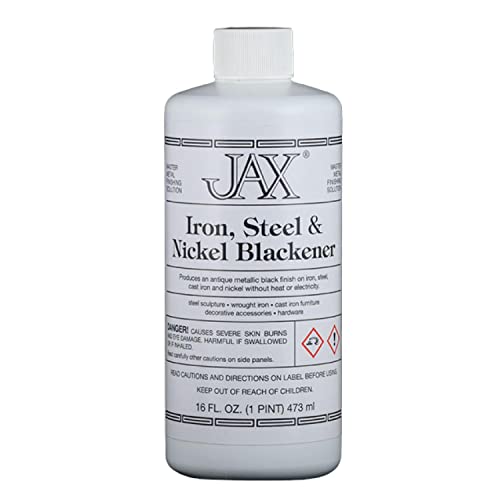
JAX has been a trusted name in metal finishing chemicals for over 25 years, and this pint-sized blackener is a go-to for gunsmiths and artists who need a quick, controllable dark patina on steel, iron, and even nickel. The water-based solution is fast-acting — users report visible darkening within seconds of application — and can be diluted with water to slow the reaction and achieve finer control over the final shade.
The key differentiator here is its ease of control. The solution can be brushed on for a distressed, antique look or used for full immersion. One reviewer who blackened steel furniture components successfully achieved an even dark finish by immersing parts for about 30 minutes, noting that simply painting the solution on was less effective. The solution has no strong odor, which makes it more pleasant to use in a home workshop than solvent-based patinas.
That said, results can be inconsistent depending on the exact alloy and surface prep. One user reported zero color change on a powder-coated coffee table, likely because the metal surface was not adequately exposed or cleaned. For bare carbon steel parts that are degreased and free of scale, this product delivers reliably. JAX products reportedly never expire when stored properly, adding long-term value for occasional users.
Why it’s great
- Water-based formula with minimal odor — safe for indoor use with simple ventilation.
- Dilutable for precise control over reaction speed and darkness level.
- Works on nickel in addition to standard steel and iron.
Good to know
- Best results achieved through full immersion rather than brush-on application.
- May not react with certain surface treatments or alloys — test on a hidden area first.
- Still requires a sealant topcoat to prevent corrosion on the blackened layer.
3. TredNot 4 oz Steel Blackening Concentrate

This small-bottle concentrate from TredNot punches above its size. Mixed at a 9:1 ratio with water (4 oz makes 2.5 pints of working solution), it is specifically engineered for the cold bluing of carbon steel — a process familiar to anyone restoring gun parts, tools, or hardware. Users consistently report a 2 to 6-minute dwell time to achieve a deep black, with the ability to re-dunk for even darker results.
The devil here is in the prep work. Reviews are emphatic that the metal must be completely free of rust, old bluing, and oil. Using denatured alcohol or acetone for the final wipe, wearing rubber gloves to avoid transferring skin oils, and agitating the parts in the solution are all cited as crucial steps. One user who initially skipped the polishing step saw the black patina peel off — a reminder that this is a reactive layer, not a coating.
The concentrate can be stored and reused for multiple projects, with one reviewer successfully cold-bluing an entire rifle receiver using only about 380 ml of working solution. The final finish requires a gun oil seal to hold the tone. This is a niche product best suited for small steel parts and firearm restoration where a thin, authentic blued finish is the goal — not a heavy-duty protective layer.
Why it’s great
- High-concentration mix yields ample working solution for many small parts.
- Fast 2-6 minute reaction time for efficient project workflow.
- Works well on carbon steel gun parts when surface prep is meticulous.
Good to know
- Surface prep is extremely demanding — any oil, rust, or old finish causes failure.
- Does not blacken stainless steel, aluminum, lead, or copper.
- USA shipping only; not available internationally.
4. Caswell Black Oxide Gel Kit

Caswell’s Black Oxide Gel Kit solves a specific problem: how to apply a black oxide finish exclusively where you want it, without dripping onto surrounding areas. The gel sits on horizontal or vertical surfaces without running, making it ideal for spot repairs on steel parts that are still assembled. The application is straightforward — brush the gel onto the clean part, let it dwell for 1-3 minutes, rinse off with water, and then seal.
Practical feedback from users is mixed but useful. One bicycle restorer used it to refurbish small components and achieved a finish that matched the original look, choosing not to use the included acrylic sealer for a flat, non-reflective result. Another user who had been using a torch-and-oil method for blackening screw heads switched to this gel and called it a “win-win” for time and consistency. The gel format is genuinely convenient for targeted touch-ups on visible hardware.
The downsides are notable. The resulting black layer is reported to be less robust than a full immersion black oxide — one user described it as “sturdier than paint but poor rust protection” without the sealer. On stainless steel gun parts, the gel had zero effect, which aligns with the product’s stated alloy compatibility. The kit includes the gel and sealer, but the sealer is a clear paint-like layer that adds to the film thickness, altering the feel of the final surface.
Why it’s great
- Thixotropic gel stays in place on vertical surfaces — no dripping during spot repairs.
- Quick 1-3 minute dwell time keeps small jobs moving fast.
- Includes a clear sealer designed specifically for after the blackening step.
Good to know
- Does not work on stainless steel at all — strictly for alloy steel and iron.
- The black layer offers minimal corrosion resistance without the included sealer.
- Sealer adds a noticeable film thickness, which may not suit all applications.
5. Meuvcol 2-in-1 Rust Converter & Metal Primer
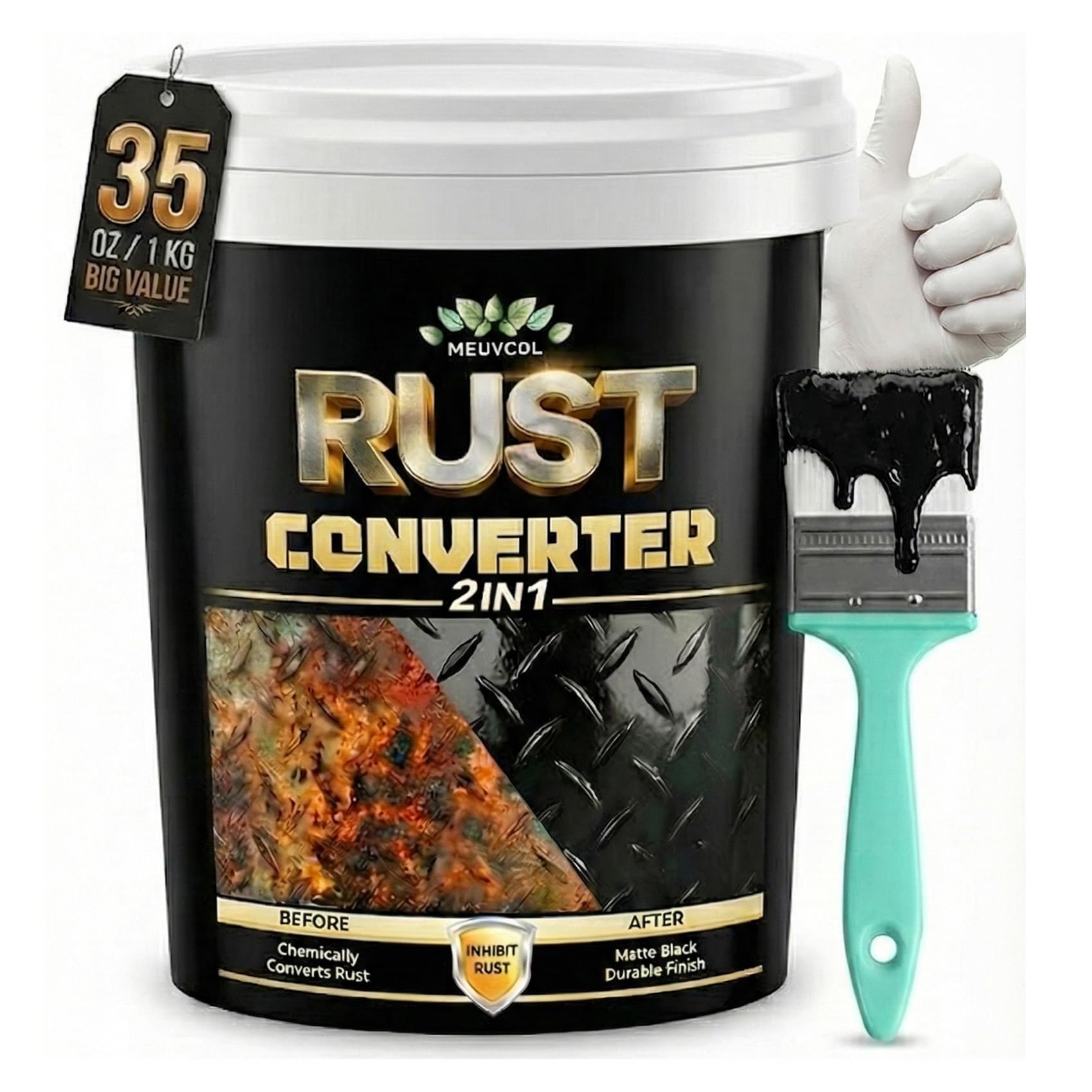
Meuvcol’s formula takes a fundamentally different approach from the true chemical blackeners above: it is a reactive primer paint that chemically converts rust into a stable black compound while simultaneously forming a protective film. This is not a black oxide finish in the traditional sense, but for steel parts that already have surface rust, it is a more practical solution than stripping to bare metal and then blackening.
The 35-ounce can provides generous coverage, and the included brush and gloves make it a ready-to-use kit. Users report that it brushes on smoothly, dries to a matte-satin black, and effectively stops further oxidation on surfaces like antique metal statues, pool walls, and truck frames. The water-based formula cleans up with soap and water, which simplifies the process compared to solvent-based rust treatments.
The trade-off is that the finish is a thick, paint-like coating rather than the thin conversion layer of true black oxide. It will fill in fine details and threads, so it is not suitable for precision parts where dimensional tolerances matter. The drying time is significant — a full 24 hours before the protective film is fully formed. Several users noted a strong smell during application and recommended working with good ventilation despite the water base.
Why it’s great
- Chemically converts existing rust into a stable, protective black coating without sandblasting.
- Large 35 oz can with included application gear offers strong value for covering frames and panels.
- Water cleanup simplifies post-application and reduces solvent use.
Good to know
- Creates a thick paint layer — not suitable for parts where thin film or tight tolerances are needed.
- Strong odor requires good ventilation during and after application.
- Requires 24 hours of dry time for full protective film development.
6. cocomfix Ultra 2-in-1 Rust Converter Paint
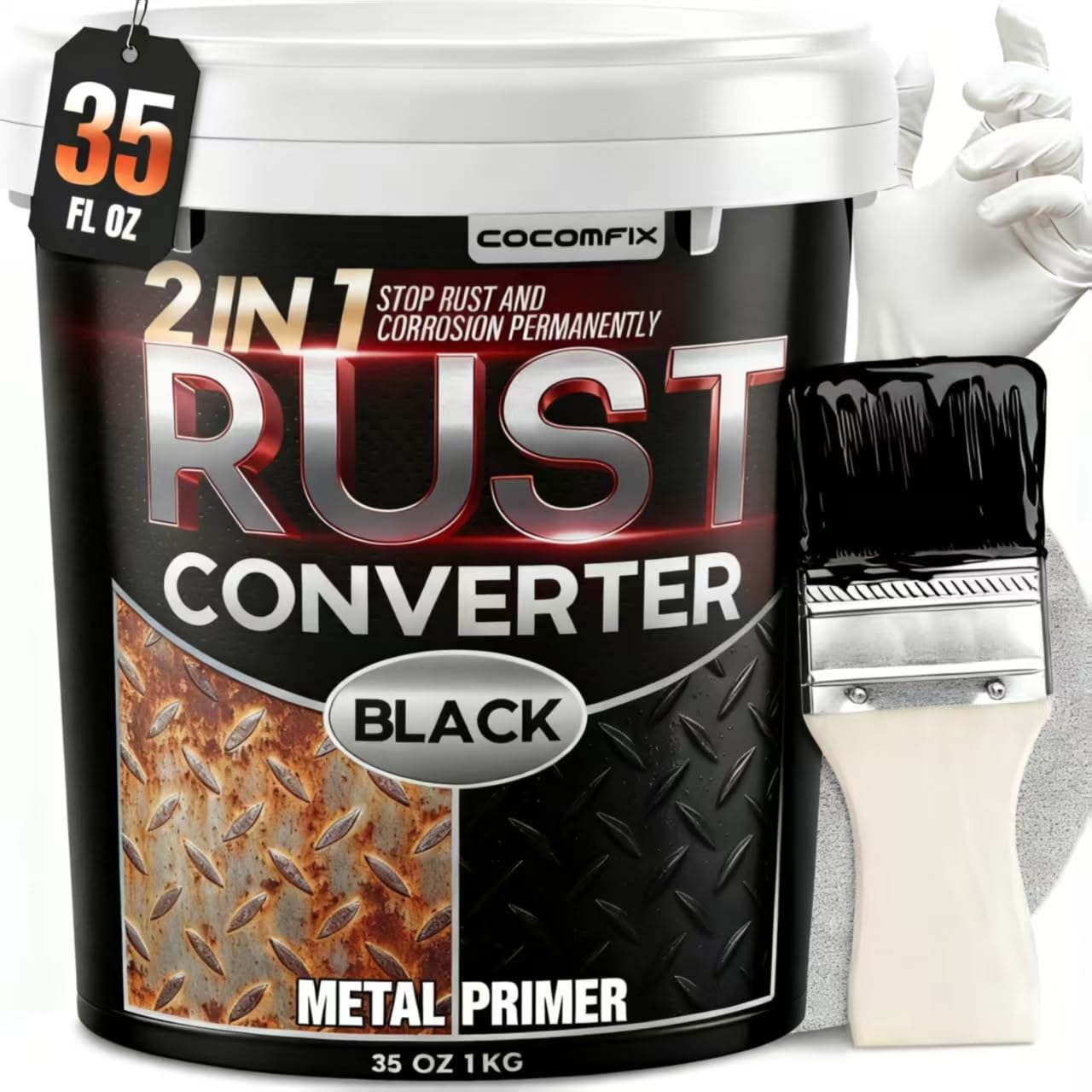
cocomfix’s rust reformer is engineered to handle conditions that would degrade standard blackening or paint: the X-Weather formulation is rated for continuous heat exposure up to 350°F, making it a strong candidate for exhaust components, brake parts, engine bay elements, and fire pits. Like the Meuvcol, it is a reactive paint that converts rust and seals simultaneously, but it adds a specific thermal stability claim that sets it apart for hot applications.
Buyer experiences confirm its thick consistency and strong bonding. One user restored an old firepit to a like-new appearance with a single coat, and another covered over half a Dodge truck frame using multiple coats, noting the paint “goes far” and dries to a uniform matte black. The included sandpapers and gloves make this a complete starter package. The direct-to-rust claim is validated by reports of successful application over tightly adhering rust scale.
There is an important curing nuance: even when the paint feels dry to the touch, it is not fully cured for several days. One user exposed their project to rain after 48 hours and found the coating turned gray on contact, indicating it was still vulnerable. The material conversion layer is genuinely tough once fully cured, but you need to plan for a multi-day indoor drying window. This is not a same-day finishing solution for outdoor equipment that must return to service immediately.
Why it’s great
- Heat-stable to 350°F — suitable for automotive engine bay and exhaust areas.
- Can be applied directly over rust with no separate primer or topcoat needed.
- Excellent coverage reported — one can stretches across a full truck frame with multiple coats.
Good to know
- Extended cure time required before exposure to moisture — plan for several days indoors.
- Heavy paint-like texture not suitable for precise or thin-film applications.
- Curing window is longer than typical paint; premature rain exposure damages the finish.
7. MuzeFansi 2-in-1 Rust Converter & Metal Primer
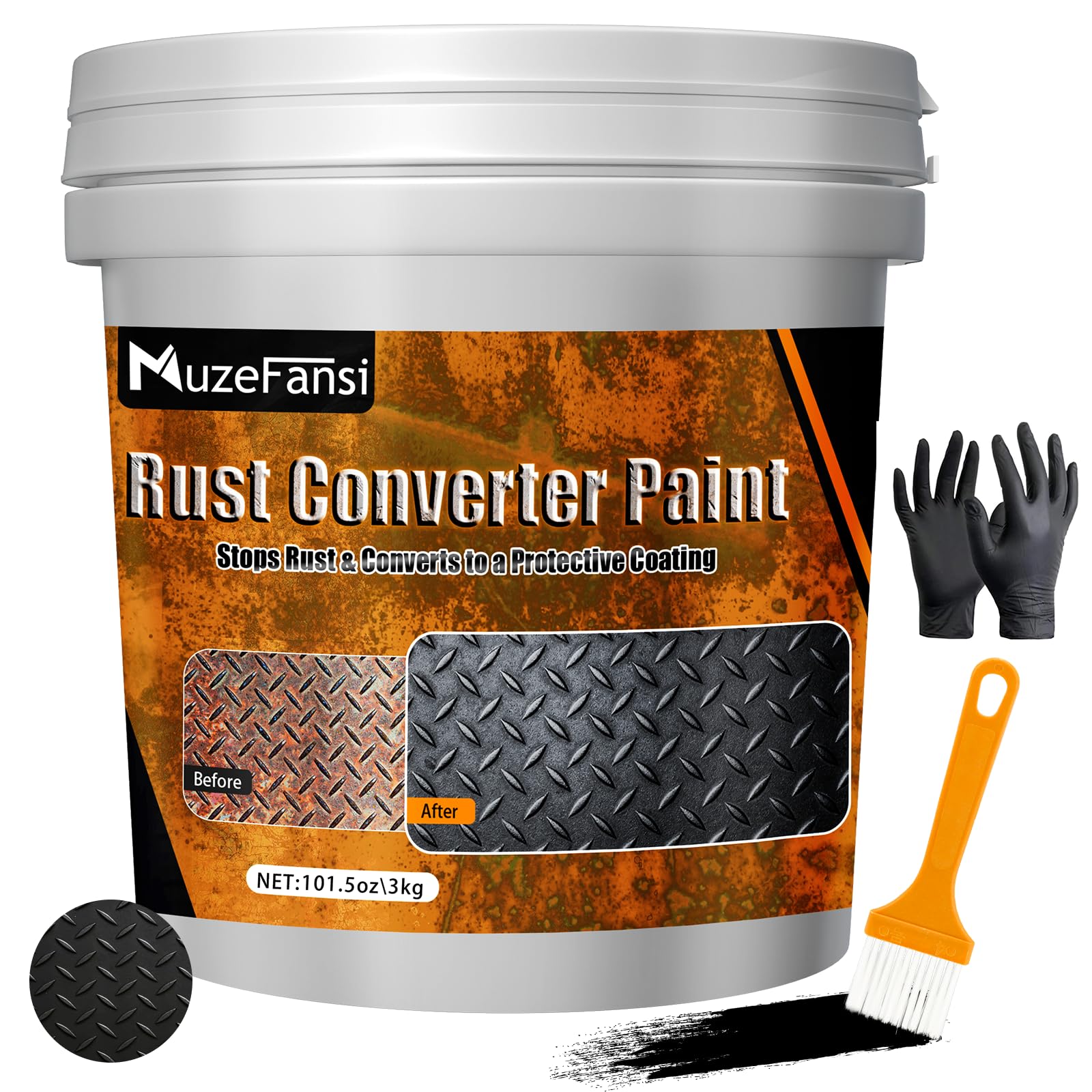
MuzeFansi offers the largest volume option in this guide at 101.5 fluid ounces — roughly three times the size of a standard quart can. This is a heavy-duty rust converter paint designed for large-scale projects like trailer frames, farm equipment, fencing, boat trailers, and industrial steel structures. The chemical formula converts rust into a black stable layer while simultaneously priming the surface, and it is rated for heat resistance up to 350°F.
User feedback across multiple large projects is uniformly positive. One user prepped a truck frame with a wire wheel to remove heavy flaky rust and old paint, applied this converter, and reported excellent coverage and adhesion with a flat black finish. Another called it “hard as nails” after coating a trailer frame. The water-based, low-VOC formulation (<1% VOC) is a significant safety advantage for users working in enclosed spaces or who are sensitive to chemical fumes.
For lighter rust, the product works with minimal prep — simply removing loose scale is enough. For heavier oxidation, multiple coats are advised, and some users noted that rust spots could occasionally poke through a single coat, requiring a touch-up. The extended dry time (24 hours for full cure) is typical for this category. The sheer volume of this can makes it the most efficient choice per square foot of coverage, but it is overkill for anyone working on small parts or detailed restoration projects.
Why it’s great
- Massive 101.5 oz container provides the best coverage-per-dollar for frames and large structures.
- Low-VOC, water-based formula reduces health risk during extended application sessions.
- Heat-resistant to 350°F and chemical-resistant for demanding automotive and industrial use.
Good to know
- Oversized container is impractical for small or detailed steel part projects.
- Heavy rust may require multiple coats; single coat may not fully suppress all corrosion spots.
- Full 24-hour cure time needed before the coating reaches maximum durability.
FAQ
Can I use a black oxide solution on stainless steel parts?
Do I need a topcoat after using a rust converter paint?
How do I prevent flash rusting after blackening?
Why did my black oxide finish turn brown or come off when wiped?
Final Thoughts: The Verdict
For most users, the best black oxide finish for steel parts is the Birchwood Technologies Presto Black PC9 because it delivers a true chemical conversion coating in a flexible concentrate format that works for immersion and brush-on applications at a reasonable entry point. If you need a heat-stable, direct-to-rust coating for a truck frame or fire pit, grab the cocomfix Rust Reformer Paint. And for large-scale projects like trailers or industrial equipment where maximum coverage per dollar matters, nothing beats the MuzeFansi 101.5 oz Rust Converter.