
Our readers keep the lights on and the weekend projects moving. As an Amazon Associate, I earn from qualifying purchases.
The right board game for a preschooler isn’t about complex rules or long playtimes—it’s about capturing a short attention span with a single, compelling action: catching a bouncing bug, hiding a wooden bear, or matching a colorful carrot. The best games for this age group turn fundamental developmental skills like color recognition, fine motor control, and turn-taking into a game so fun they don’t realize they’re learning.
I’m Rikta — the founder and writer behind FitlyFast. After analyzing hundreds of preschool game listings and cross-referencing play patterns, material safety, and real parent feedback, I’ve separated the games that actually hold a 3-year-old’s focus from those that end up collecting dust on a shelf.
This guide breaks down seven carefully vetted options to help you find the perfect board games for preschoolers that balance educational value with genuine replayability, so family game night is actually fun for everyone.
How To Choose The Best Board Games For Preschoolers
Preschool games live in a narrow window where the rulebook must be almost invisible. You are looking for a single core action—stacking, hiding, matching, or catching—that the child can master within the first two minutes. Anything more complex and the adult will be playing alone while the child wanders off.
Prioritize Physical Interaction Over Abstract Rules
A 3-year-old learns through touch and movement. Games that involve a motorized bed that vibrates, a squeezer tool to pick up carrots, or nesting boxes to hide a bear engage multiple senses and make the learning stick. A game that relies solely on moving a piece along a track and reading a card will lose a preschooler’s attention by the second turn.
Check the Age Rating, Then Adjust for Your Child
The manufacturer’s age range is a starting point, not a rule. A game marked “4+” might work for a mature 3-year-old who already understands turn-taking, while a “2+” game might bore a 4-year-old who craves more challenge. Look closely at the core mechanic: if it requires letter recognition, it’s for an older preschooler; if it’s purely about color matching or stacking, it fits a younger crowd. Read real parent reviews about their child’s age to calibrate.
Evaluate Durability for Real-World Play
Preschoolers drop things, throw things, and occasionally bite game pieces. Cardboard pieces will not survive the first week. Look for solid wood components, thick plastic that won’t crack, and fabric storage bags that keep everything together. A game that requires careful handling is a game that will cause frustration—look for items explicitly described as “tear resistant” or made from “solid basswood.”
Quick Comparison
On smaller screens, swipe sideways to see the full table.
| Model | Category | Best For | Key Spec | Amazon |
|---|---|---|---|---|
| Bed Bugs Game | Action | High-energy play & hand-eye coordination | Motorized vibrating gameboard | Amazon |
| Where’s Bear? | Hide & Seek | Object permanence & language development | 6 nesting boxes & wooden bear | Amazon |
| Wooden Matching Game | Memory | Durable solo & group memory play | 36 solid basswood cards | Amazon |
| Race to Pattern Palace | Educational | Pattern recognition & Numberblocks fans | 40 pattern cards (2 levels) | Amazon |
| Hoppy Floppy’s Happy Hunt | Fine Motor | Fine motor skills & color matching | Hoppy Floppy squeezer tool | Amazon |
| Wooden Stick Tower | Strategy | Logical thinking & patience | 42 colorful wooden sticks | Amazon |
| Frida’s Fruit Fiesta | Letter Recognition | Alphabet learning & Bingo-style play | 26 fruit bowls with letters | Amazon |
In‑Depth Reviews
1. Bed Bugs Board Game
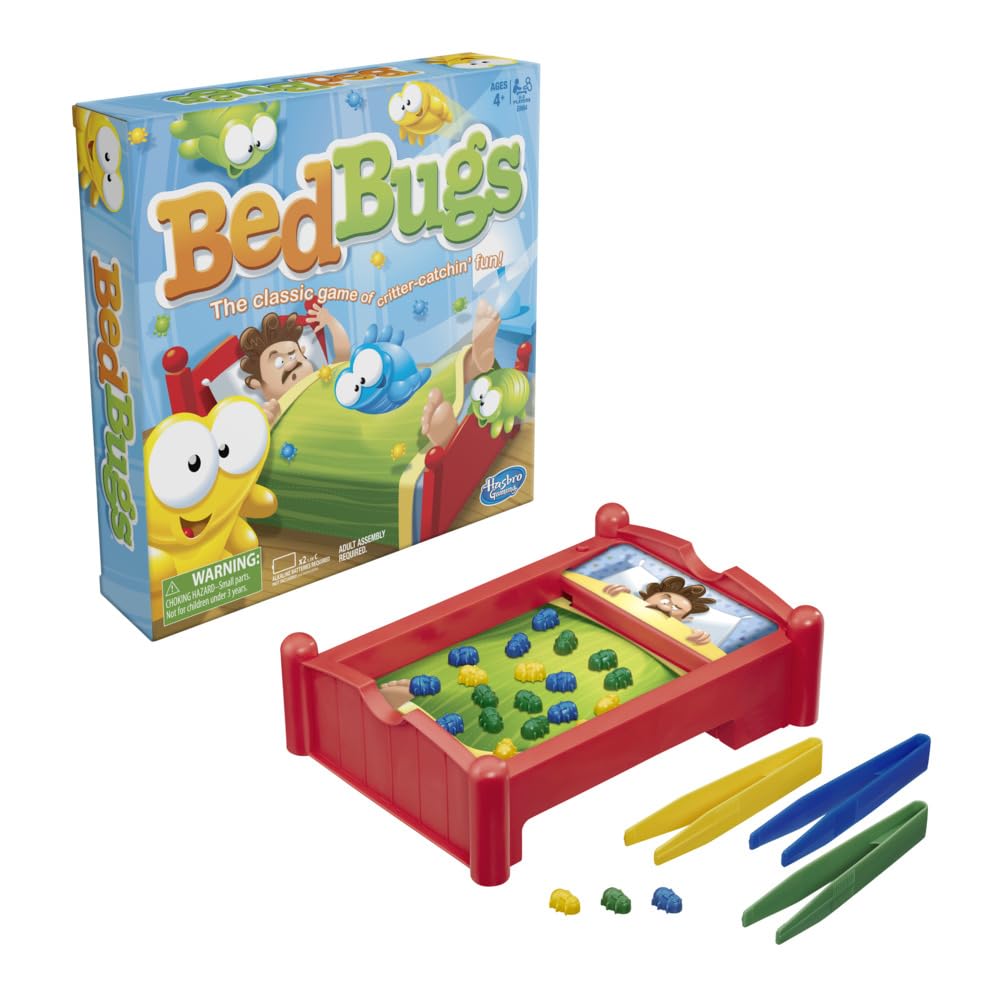
The Bed Bugs game turns a classic carnival-style challenge into a preschool-friendly competition. A motorized gameboard “bed” vibrates, sending 36 plastic bugs bouncing in every direction, and players use color-coded tongs to catch bugs that match their assigned color. The chaos is the point—it’s hilarious, fast-paced, and requires no reading or counting, which means a 4-year-old can jump in and play immediately without any explanation beyond “catch the bugs that match your tongs.”
Real parent feedback confirms what the design suggests: this game is a hit with siblings across a wide age range, with one reviewer noting her granddaughters aged 4 and 6 both love it and use it to practice counting and comparing. The game plays in about 20 minutes, which is the sweet spot for preschool attention spans. The assembly is minimal—just insert the cardboard playing surface into the plastic bed frame—and the included tongs are the right size for small hands to practice pincer grip.
The only notable drawback is that pressing too hard on the gameboard can cause the vibration to stop, a detail multiple reviewers flagged. The game is also limited to 2 or 3 players, which means larger families or playdates may need to take turns. However, for its sheer replayability and the guaranteed laughter it produces, this is the strongest all-around pick for the preschool crowd.
Why it’s great
- Motorized action keeps kids fully engaged without needing an adult to “run” the game.
- Develops hand-eye coordination and color recognition through active play, not passive sitting.
- Durable plastic construction holds up to enthusiastic play and occasional drops.
Good to know
- Limited to 2–3 players, which may exclude some siblings during family game night.
- Pressing too firmly on the bed surface can stall the vibration motor.
2. Peaceable Kingdom Where’s Bear?

Where’s Bear takes a completely different approach—instead of frantic action, it offers a calm, repetitive hide-and-seek game built around six nesting boxes and a single wooden bear figurine. The boxes are illustrated to show rooms in Bear’s house, and players take turns hiding the bear under a box while the other player guesses which box. It’s incredibly simple, but the genius is in the open-ended play: parents can introduce positional language (“Is Bear under the blue box?”), memory challenges, or simple stacking and nesting practice.
Early childhood educators consistently rate this game highly. One reviewer, an early childhood special education teacher, noted it’s “great for language skills” and “open ended” enough to be modified for different ability levels. The wooden construction is a major durability upgrade over cardboard alternatives, and the nesting boxes are exactly the right size for small hands to manipulate. For a 2-year-old who isn’t ready for competitive games, this is an ideal first board game experience that builds foundational cognitive skills.
The primary limitation is that it’s a single-player or parent-child game—there’s no multi-player competitive element. Older siblings may lose interest quickly because there aren’t winners or losers in the traditional sense. Also, the boxes are sturdy but the printed paper surface can peel if a child chews on the edges. For the youngest end of the preschool spectrum (18 months to 2.5 years), this is a premium choice, but it has a shorter shelf life as the child grows.
Why it’s great
- Teaches object permanence, spatial concepts, and turn-taking without competitive pressure.
- Solid wooden pieces are safer and more durable than plastic alternatives.
- Five quick game variations keep the play fresh without overwhelming a toddler.
Good to know
- Best suited for ages 2–3; children much older than 3 may find it too simple.
- Printed graphics on the boxes can peel if exposed to moisture or chewing.
3. Cottify Wooden Matching Game

This matching game replaces the flimsy cardboard cards found in standard memory games with 36 solid basswood discs, each 2.2 inches in diameter and coated with a scratch-resistant silk paint. The thickness (0.12 inches) makes them easy for small fingers to pick up and turn over without bending or tearing. The set includes 18 pairs of animal illustrations, each on a different colored background to help younger children make matches by color before they master the animal shapes.
Parent feedback consistently praises the durability. One reviewer noted the wooden pieces “will hopefully hold up to many hours of play,” while another mentioned using it with an 18-month-old who happily plays by laying the pieces face-up and finding matches. The included drawstring pouch is a practical touch—it keeps all 36 discs contained and makes the game portable for car rides or restaurant outings. The open-ended design means you can play traditional memory, use the cards as flash cards for first words, or simply sort by color or animal type.
The main complaint is that the back of each card features three small animal heads rather than a uniform pattern, which can confuse younger toddlers who are trying to sort by the back design. A consistent back pattern would have been a cleaner design choice. Additionally, at 2.2 inches diameter, the discs are slightly smaller than some competing wooden games, though still large enough to not be a choking hazard for children over 3. For families who want a screen-free, natural-material game that will survive multiple children, this is a solid investment.
Why it’s great
- Solid basswood construction is tear-resistant and built to survive multiple children.
- Color-coded backgrounds help younger preschoolers match before they identify animals.
- Compact drawstring bag makes storage and travel simple.
Good to know
- Back design with animal heads can confuse younger toddlers learning to match.
- Discs are 2.2 inches; slightly smaller than some competing wooden memory games.
4. Numberblocks Race to Pattern Palace

For families who have a Numberblocks devotee at home, this game is an instant win. The game board is a winding path to Pattern Palace, and players move their Numberblocks pawns (One through Four) by building patterns with colored bridge tiles. The included dice popper adds a satisfying tactile element—kids love pressing down on the dome to launch the die. The pattern cards come in two levels: an introductory deck and a challenge deck, which means the game grows with the child.
Reviewers consistently rate this a 5-star game for its high-quality components and genuine educational value. One parent noted it “teaches pattern recognition, counting, and turn-taking” with a “vibrant, sturdy board” and “chunky pieces.” The short playtime keeps it from dragging, and the connection to the TV show gives children a sense of ownership over the game. Even the Six’s Tricks cards add a mild strategic layer without being punishing—a thoughtful design choice for this age group.
The main limitation is that the appeal is heavily tied to the Numberblocks IP. A child who hasn’t watched the show may not be as engaged by the characters. The game also requires an adult to set up the bridge tiles and explain the pattern-matching mechanic, so it’s not something a child can play independently on day one. For preschool classrooms or homes where the show is already beloved, this is one of the best educational board games available.
Why it’s great
- Two levels of play (introductory and challenge) extend the game’s lifespan from age 3 to 6.
- Chunky pawns and dice popper are perfectly sized for small hands.
- Directly reinforces pattern recognition, a key pre-math skill for kindergarten readiness.
Good to know
- Heavily reliant on the Numberblocks IP; less engaging for children unfamiliar with the show.
- Setup requires adult involvement to arrange bridge tiles and explain rules.
5. Educational Insights Hoppy Floppy’s Happy Hunt

Hoppy Floppy’s Happy Hunt uses the same squeezer mechanic that made Sneaky Snacky Squirrel a classic, but swaps the acorns for carrots and the squirrel for a bunny squeezer. The goal is simple: spin the spinner, use the Hoppy Floppy squeezer to pick up a carrot of the matching color, and place it in your basket. The first player to collect one of each color wins. The egg-shaped game board doubles as the storage box, which makes cleanup nearly effortless—a feature that matters more to parents than any game mechanic.
The squeezer tool is the star here. Speech therapists and occupational therapists frequently use this game to develop the pincer grip that prepares children for writing. One reviewer, a speech therapist working with children aged 4 to 9, noted that the bunny squeezer is easier for small hands to use than the squirrel version. The negative spaces on the spinner (“Steal a Carrot” and “Lose All Carrots”) add a layer of strategic thinking, though some parents modify the spinner to remove these for younger or more sensitive players.
The durability has a catch: the basket handles are known to break under rough play, as one reviewer documented after gluing a snapped handle back together. The assembly requirement noted in the specs is minimal (attaching the spinner), but the fragile handle is a design weak point. For a preschool game that lives in a calm playroom rather than a boisterous daycare, this is an excellent fine-motor tool with strong replayability.
Why it’s great
- Bunny squeezer builds fine motor skills and pincer grip better than most alternatives.
- Quick, engaging rounds (under 15 minutes) fit perfectly into short attention spans.
- Game board doubles as the storage box for easy cleanup and portability.
Good to know
- Basket handles are fragile and may break under rough play.
- “Steal” and “Lose All” spinner spaces can frustrate younger or more sensitive children.
6. Centtechi Wooden Stick Tower Game

This stick-pulling tower game is a preschool-safe adaptation of the classic “don’t let the marbles fall” challenge. Players place a net of 42 colorful wooden sticks over a wooden tower base, set 6 balls on top, then take turns rolling a die and pulling out the stick of the matching color. The goal is to remove sticks without letting the balls drop. It sounds simple, but the tension builds naturally as the tower becomes more unstable—a fantastic way to teach patience, cause-and-effect, and fine motor control.
The Montessori-inspired design uses solid beech wood with safe soluble paint and a smooth, burr-free surface. The sticks are color-coded, which means even a 3-year-old who can’t read numbers can participate by matching the die color to the stick color. Parents report that children aged 3, 5, and 7 all enjoy playing together, with different skill levels naturally emerging. The game accommodates up to 6 players, making it one of the few options on this list that works for larger family gatherings or preschool playdates.
The primary drawback is setup time: inserting 42 sticks into the tower takes 5+ minutes, and one reviewer noted the tower is “smaller than advertised” due to photoshopped product images. Some sticks may be tight enough to require extra force to insert, which can frustrate younger children if an adult isn’t helping. The lack of a proper storage bag is also a missed opportunity—the pieces are small enough to lose easily. For families who don’t mind a longer setup, this game offers exceptional replay value and skill development.
Why it’s great
- Teaches patience, cause-and-effect reasoning, and hand-eye coordination through suspenseful play.
- Color-coded sticks and dice make it accessible for non-readers as young as 3.
- Supports up to 6 players, ideal for preschool groups and larger families.
Good to know
- Setup takes 5+ minutes to insert all 42 sticks into the tower.
- Lacks a proper storage bag; pieces are small and easy to misplace.
7. Educational Insights Frida’s Fruit Fiesta

Frida’s Fruit Fiesta is the most academically focused game on this list, designed specifically for letter recognition practice disguised as a Bingo-style competition. The game includes a triple spinner that spins three letters at once, 26 fruit bowls each marked with a letter, and the Frida Squeezer—a toucan-themed tool that children use to pick up the fruit bowls. The goal is to be the first to collect four letters in a row on your nest card, matching the letters spun on the spinner.
The triple spinner is a clever design touch: it gives children three choices per turn, reducing the frustration of spinning a letter they don’t need while still demanding they recognize the letters to make their selection. The Frida Squeezer adds a fine motor challenge that reinforces the pincer grip, similar to the Hoppy Floppy game but with a different hand angle. Reviewers consistently praise the vibrant colors and the way the game box doubles as the game board, making storage and setup almost instant.
The age recommendation of 4+ is firm here—a 3-year-old who hasn’t started letter recognition will struggle with this game. The “steal” mechanic (borrowing a letter from another player’s nest card) adds a strategic layer that some younger preschoolers find frustrating. The game is also limited to 4 players, which is fine for most families but tight for larger playdates. For parents focused on kindergarten readiness and alphabet mastery, this is a uniquely effective tool that makes rote memorization feel like a party.
Why it’s great
- Triple spinner reduces wait time and gives children more control over their turn.
- Combines letter recognition with fine motor practice in a single engaging activity.
- Box doubles as the game board, making setup and storage seamless.
Good to know
- Best for children age 4 and up who already have some letter familiarity.
- “Steal” mechanic and Bingo-style play may frustrate younger or less competitive children.
FAQ
At what age should I introduce my child to board games?
How long should a preschool board game last?
Should I buy a game based on a TV show my child watches?
Final Thoughts: The Verdict
For most users, the board games for preschoolers winner is the Bed Bugs Board Game because its motorized action creates genuine excitement without requiring reading, counting, or complex strategy—it simply works for ages 4 and up and delivers consistent engagement. If you want a calmer, language-building experience for the youngest preschooler (ages 2–3), grab the Peaceable Kingdom Where’s Bear. And for high-energy fine motor development with classroom-friendly durability, nothing beats the Educational Insights Hoppy Floppy’s Happy Hunt.