
Our readers keep the lights on and the weekend projects moving. As an Amazon Associate, I earn from qualifying purchases.
Your vintage Marantz receiver or passive bookshelf speakers still deliver room-filling sound, but the aux cord tethering you to your phone or laptop kills the freedom. A dedicated Bluetooth receiver for home stereo cuts that wire loose without sacrificing the detail your system was built to reproduce — if you pick one with the right DAC and codec support.
I’m Rikta — the co-founder and writer behind FitlyFast. I’ve spent years analyzing the hardware inside Bluetooth audio adapters, from the AKM and ESS DAC chips that define sound quality to the Bluetooth antenna designs that determine range and connection stability in a typical home environment.
The right bluetooth receiver for home stereo upgrades your listening experience, not your entire system, making it easy to stream lossless audio from your phone to vintage speakers without noticeable latency.
How To Choose The Best Bluetooth Receiver For Home Stereo
Not all Bluetooth receivers sound the same. The wrong choice injects digital harshness into your warm analog setup. Here are the three specs that separate a worthwhile upgrade from a noisy toy.
DAC Chip Quality Defines Your Sound
The digital-to-analog converter inside the receiver is what actually turns ones and zeros into voltage your amplifier understands. A receiver with a premium DAC (like the ESS SABRE or AKM AK4396) will deliver cleaner soundstage, better separation, and less background hiss than one that relies on the generic chip built into the Bluetooth module itself.
High-Resolution Codec Support Matters More Than Bluetooth Version
A Bluetooth 5.3 receiver with only SBC codec support will sound worse than a Bluetooth 4.2 receiver with LDAC. Look for LDAC (Sony phones, some Android devices) or aptX HD (Qualcomm-based phones) if you value detail. For iPhone users, AAC is the ceiling — so prioritize DAC quality over codec variety.
Output Type Determines Compatibility
RCA analog output is universal, but feeding a receiver’s own DAC via optical or coaxial digital output often yields better sound. If your stereo has a digital input, skip the receiver’s DAC entirely and use a Bluetooth receiver with optical output for the cleanest signal path.
Quick Comparison
On smaller screens, swipe sideways to see the full table.
| Model | Category | Best For | Key Spec | Amazon |
|---|---|---|---|---|
| Audioengine B1 | Premium Receiver | Audiophile upgrading vintage stereo | AKM AK4396 24-bit DAC | Amazon |
| WiiM Pro | WiFi Streamer | Multiroom & high-res streaming | 24-bit/192kHz digital out | Amazon |
| YMOO DS200Plus | Audiophile Receiver | LDAC/aptX HD purist | ESS SABRE ES9018K2M DAC | Amazon |
| 1Mii DS220 | OLED Display | Visual feedback & EQ tweaking | Dual antennas for 100ft range | Amazon |
| Fosi Audio BT20A | Integrated Amp | Powering passive speakers directly | 100W x 2 Class D amplifier | Amazon |
| Romicta 4 Channel | Multi-Zone Amp | 4-speaker setups & karaoke | 50W x 4 RMS, microphone input | Amazon |
| Facmogu AK-3116 | Budget Amp | Compact desktop or garage system | 2x TPA3116 amplifier IC | Amazon |
In‑Depth Reviews
1. Audioengine B1 Bluetooth Receiver

The Audioengine B1 sits at the top because it solves the core problem of Bluetooth audio: preserving sound quality. Inside is an AKM AK4396 24-bit DAC that actively upsamples incoming audio, giving your stereo a cleaner, more detailed signal than the vast majority of budget receivers can produce. Paired with aptX decoding and a 100-foot range that punches through walls, this is a set-it-and-forget-it upgrade for anyone with a decent pair of passive speakers or a vintage integrated amp.
Setup is genuinely instantaneous — pair with your phone, and the B1 remembers up to six devices. The optical output is the real star for purists, letting you bypass the receiver’s analog stage and feed a cleaner digital signal directly into your home theater or stereo receiver. The housing feels dense and premium, which matters when you’re paying a premium for audio fidelity rather than plastic convenience.
The only catch is the price, which is undeniably an investment compared to entry-level adapters. Some users report a bright blue power LED that can be distracting in a dark listening room, and on rare occasions the analog output may need a quick power cycle after a power outage. But for those chasing transparency and reliability, the B1 is the reference standard in this category.
Why it’s great
- AKM AK4396 24-bit DAC delivers genuinely improved audio quality over cheaper receivers
- Optical output allows bypassing receiver’s DAC for cleaner signal path
- Rock-solid 100-foot range with no dropouts, even through floors
Good to know
- Premium price point compared to entry-level Bluetooth adapters
- Bright power LED can be distracting in dark listening environments
2. WiiM Pro

The WiiM Pro is not a Bluetooth receiver in the traditional sense — it is a WiFi streaming hub with Bluetooth fallback, which makes it the most versatile option for anyone with a need for multiroom audio or high-resolution streaming. It supports AirPlay 2, Google Cast, and Spotify Connect natively, letting you stream 24-bit/192 kHz audio directly from Tidal, Qobuz, or Amazon Music Ultra HD without compressing it through Bluetooth’s limited bandwidth.
Setting up the WiiM Pro takes less than five minutes through the WiiM Home app. Once running, you can group it with other AirPlay 2 or Google Cast speakers around your home for synchronized playback — something no pure Bluetooth receiver can do. The digital optical and coaxial outputs feed your existing DAC or AV receiver directly, preserving bit-perfect audio from source to speaker.
The tradeoff is that this is a network-dependent device; if your WiFi drops, your music drops. The app interface is functional but less polished than Sonos, and the remote control is a simple infrared unit rather than a full-featured controller. However, for anyone looking to bridge a turntable or CD player into a multiroom setup, the WiiM Pro’s line-in input and low-latency grouping make it the smartest choice available.
Why it’s great
- Native AirPlay 2, Google Cast, and Spotify Connect for lossless streaming
- Multiroom grouping with other WiFi speakers and WiiM units
- Digital optical/coaxial output for bit-perfect 24-bit/192 kHz audio
Good to know
- Requires stable WiFi network; no music without internet connection
- Infrared remote is basic; app control is the primary interface
3. YMOO DS200Plus
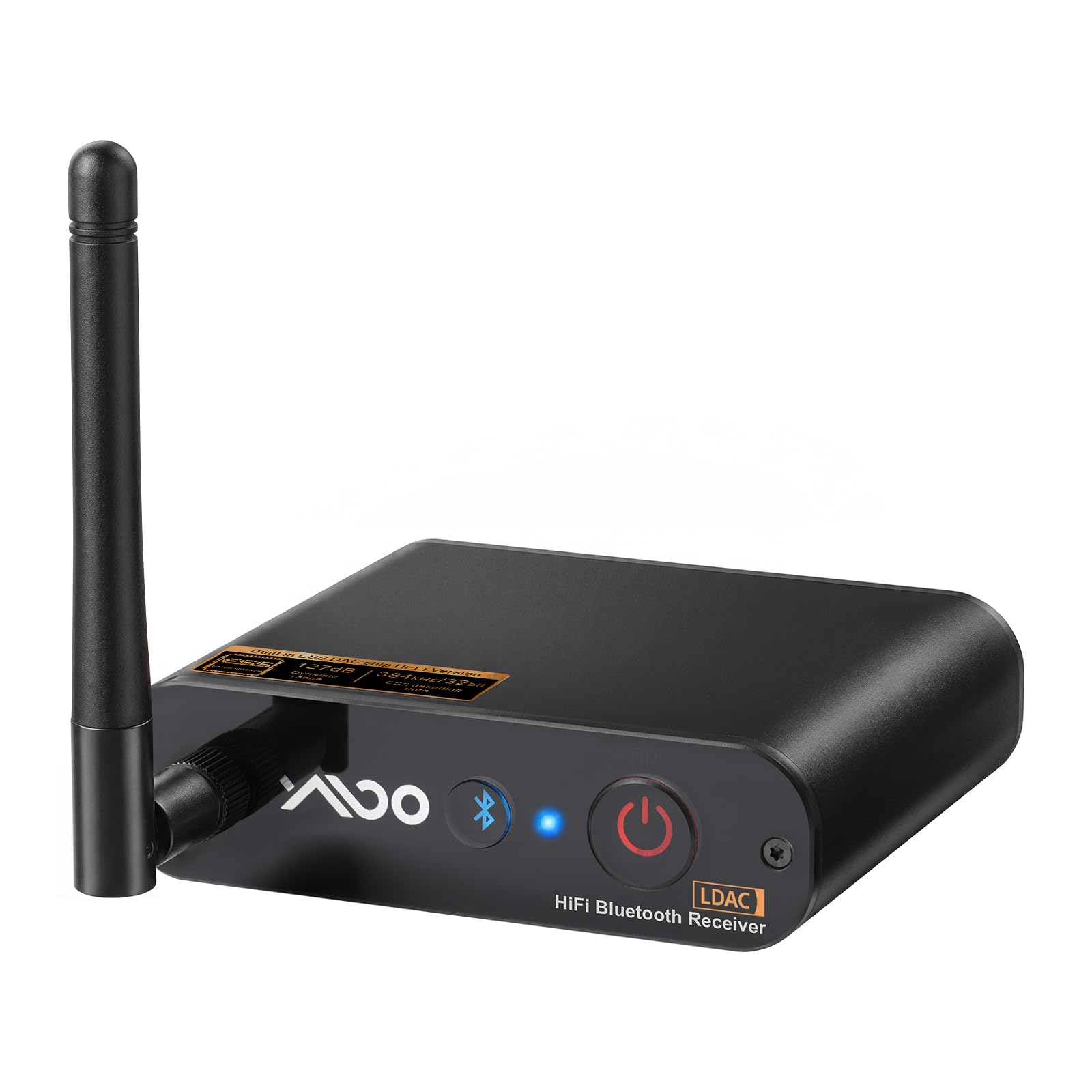
The YMOO DS200Plus is built around the ESS SABRE ES9018K2M DAC, a chip more commonly found in dedicated headphone amplifiers and mid-range DACs. Combined with LDAC and aptX HD codec support, this receiver delivers near-wireless transparency for anyone streaming from a compatible Android device. The 100-foot range (30 meters) is genuinely usable through multiple walls, and the connection holds steady even with the source device in a different room.
Output flexibility is another strong point: RCA, optical, and coaxial outputs let you choose your preferred signal path. The dual-device pairing feature is practical for shared listening spaces — two phones can be connected simultaneously, though only one streams at a time. The build quality is solid, and the included cables (optical, RCA, and 3.5mm to RCA) mean you can plug it straight into most stereo systems without hunting for accessories.
The DS200Plus does require external USB power — there is no internal battery for portable use. Some users note the lack of an on-device display makes checking the active codec less intuitive, though the documentation is clear enough. Overall, this is the best pure Bluetooth receiver for the LDAC crowd, offering DAC performance that punches above its tier.
Why it’s great
- ESS SABRE ES9018K2M DAC delivers exceptional clarity and soundstage
- LDAC and aptX HD support for high-resolution wireless audio
- RCA, optical, and coaxial outputs provide flexible connectivity
Good to know
- Requires USB power supply; no internal battery for portable use
- No on-device screen to show active Bluetooth codec
4. 1Mii DS220

The 1Mii DS220 stands out by offering an OLED display and seven EQ modes in a compact chassis, giving you visual feedback on codec, volume, and connection status — rare features in this category. Dual antennas and Bluetooth 5.3 provide a stable 100-foot range even in homes with thick walls or metal obstacles. The display is bright enough to read from a listening chair but dims automatically to avoid being distracting during critical listening.
Codec support is comprehensive, covering LDAC and aptX HD, and the built-in DAC handles high-resolution streams cleanly. The seven EQ presets (Bass, Jazz, Classical, Rock, Pop, plus two neutral profiles) are genuinely useful for tailoring sound to different genres or room acoustics. The device auto-reconnects to the last paired source on power-up, which removes the need to re-pair each listening session.
Potential negatives include a 30-minute auto-shutdown if no device is connected, which can be annoying if you leave your source paused too long. The touch controls on the top panel are sensitive enough that brushing against them by accident may change settings. But for the feature density and the clarity of the OLED readout, the DS220 is a strong mid-range contender.
Why it’s great
- OLED display shows codec, volume, and connection status clearly
- Seven EQ modes allow genre-specific sound tuning
- Dual antennas and Bluetooth 5.3 for long-range stability
Good to know
- Auto-shutdown after 30 minutes if no device is connected
- Touch controls can be triggered accidentally
5. Fosi Audio BT20A

The Fosi Audio BT20A is not a standalone Bluetooth receiver — it is a Class D amplifier with Bluetooth built in, designed to power passive speakers directly. If your home stereo consists of standalone bookshelf speakers without a separate amplifier, this is the most straightforward way to add wireless streaming and amplification in one box. The 100W x 2 output (into 4 ohms) is enough to drive most bookshelf and small tower speakers to satisfying listening levels.
Setup is refreshingly simple: connect speaker wires to the binding posts, plug in the 24V power supply, and pair your phone via Bluetooth. Dedicated bass and treble knobs let you compensate for room acoustics or speaker voicing without needing a graphic equalizer. The compact aluminum chassis fits on a bookshelf, desktop, or even inside a media cabinet without heat issues.
The BT20A lacks digital inputs (no optical or coaxial) and does not support high-resolution codecs like LDAC or aptX HD. Sound quality is good for the category but won’t rival a system with a separate DAC. Some listeners note a slight midrange bias in the default voicing, though the tone controls can compensate. For a quick, affordable Bluetooth amp upgrade, this is a proven workhorse.
Why it’s great
- Combines Bluetooth receiver and amplifier in one compact unit
- 100W x 2 output drives most bookshelf speakers easily
- Dedicated bass and treble controls for room tuning
Good to know
- No digital inputs (optical/coaxial) for connecting to external DAC
- Bluetooth codec limited to SBC/AAC; no LDAC or aptX HD
6. Romicta 4 Channel Bluetooth Amplifier

The Romicta 4 Channel Amplifier is the right choice when you need to power four passive speakers simultaneously — whether for a home theater, a karaoke setup, or a multi-zone garage system. Each of the four channels delivers 50W RMS (1200W peak total), which is more than enough for most listening spaces. The inclusion of a dedicated microphone input with its own volume control makes this a practical all-in-one for parties or family events.
Bluetooth 5.0 provides a solid wireless connection up to 33 feet, and the unit also accepts USB and SD card media, plus FM radio via the included antenna. The LED display shows connection status and input source clearly. The aluminum casing feels more durable than the price suggests, and the remote control gives you volume, bass, and treble adjustments from across the room.
Purists will note the 0.04% THD rating, which is fine for casual listening but not truly audiophile-grade. The Bluetooth codec is SBC, not LDAC or aptX HD. Some users report that the amplifier feels less powerful than the peak rating suggests, especially with 8-ohm speakers. For its intended role — powering a whole-room or whole-garage sound system on a budget — it performs admirably.
Why it’s great
- Four channels of 50W RMS power for multi-speaker setups
- Microphone input with independent volume for karaoke use
- USB/SD/FM playback adds offline versatility
Good to know
- Bluetooth codec limited to SBC; no high-resolution wireless audio
- Rated power output feels conservative with 8-ohm speakers
7. Facmogu AK-3116

The Facmogu AK-3116 is a compact Class D amplifier built around the Texas Instruments TPA3116 chip, a proven design known for efficient power delivery and low distortion. Rated at 200W peak (100W x 2 RMS), it is aimed at powering small to medium bookshelf speakers in a desktop, garage, or secondary room setup. Bluetooth 5.3 provides a range of up to 60 feet, which is generous for the price tier.
Input options go beyond the basics: AUX, RCA, USB flash drive (up to 64GB), FM radio, and optical input for connecting a TV or set-top box. The included RCA subwoofer output lets you build a 2.1 system by connecting an active sub. Bass and treble knobs give you tone shaping flexibility that many budget amps omit. The remote control works for basic volume and input switching.
Potential downsides center on power delivery at higher volumes — some users report the amplifier cuts out when pushed hard with demanding speakers, likely due to the 24V power supply being undersized for the peak rating. The remote only controls the Bluetooth/USB input volume, not the master volume, which limits integration with TV setups. For quiet-to-moderate listening levels and the price, the AK-3116 is an impressive value.
Why it’s great
- Bluetooth 5.3 with 60-foot range at a budget-friendly price
- Optical input and RCA subwoofer output for flexible system building
- Compact aluminum body fits small spaces cleanly
Good to know
- Remote only controls Bluetooth/USB volume, not master volume
- May cut out at high volume; 24V power supply limits peak output
FAQ
Can I use a Bluetooth receiver with my old amplifier that has no Bluetooth?
How much audio delay should I expect with a Bluetooth receiver for TV?
Will a Bluetooth receiver reduce my stereo sound quality?
Final Thoughts: The Verdict
For most users, the bluetooth receiver for home stereo winner is the Audioengine B1 because its AKM DAC and optical output deliver genuinely improved sound on any system. If you want a multiroom streaming hub with lossless WiFi capability, grab the WiiM Pro. And for the LDAC enthusiast chasing the highest wireless resolution without breaking the bank, nothing beats the YMOO DS200Plus.