
Our readers keep the lights on and the weekend projects moving. As an Amazon Associate, I earn from qualifying purchases.
That gripping ache just below the elbow doesn’t stop you from swinging a racket or gripping a tool, but the fear of making it worse does. A targeted counterforce strap can reduce the peak force transmitted to the tendon insertion by up to 50%, allowing you to stay active while the tissue heals.
I’m Rikta — the co-founder and writer behind FitlyFast. I’ve spent years analyzing muscle and joint support gear, parsing clinical data on compression thresholds, and comparing how different pad geometries affect load distribution on the common extensor tendon.
This guide breaks down the best designs, materials, and compression features to look for when you need a reliable brace for forearm tendonitis that actually stays put and delivers measurable relief.
How To Choose The Best Brace For Forearm Tendonitis
Forearm tendonitis braces operate on the counterforce principle — they apply external compression to the muscle belly just below the elbow, which changes the angle of pull on the tendon and offloads the painful attachment point. The wrong brace can create pressure points, cut circulation, or slide down, so you need to match three key variables to your anatomy and activity level.
Pad Type and Placement
The pad is the active part of the brace. Gel pads conform to the forearm contour and absorb vibration well, while silicone pads provide firmer, more targeted pressure. A dual-pad system (two separate pressure points) delivers more even load distribution than a single monolithic pad. Look for a removable or adjustable pad so you can center it directly over the tender spot.
Strap Width and Closure System
Wider straps (2 inches or more) distribute compression over a larger surface area, reducing the risk of the brace digging in. Hook-and-loop closures let you dial in tension precisely, while a D-ring or metal buckle helps you achieve the same tension every time. Avoid closures that require two hands — they are frustrating to adjust when one arm already hurts.
Fabric and Breathability
Moisture-wicking double-knit fabric or medical-grade neoprene alternatives reduce sweat buildup during activity. Hypoallergenic and latex-free materials are critical if you have sensitive skin, since extended wear can otherwise trigger contact dermatitis under the pad. Measure your forearm circumference at the widest point to find the correct size — a brace that is too loose will migrate, and one that is too tight will impair circulation.
Quick Comparison
On smaller screens, swipe sideways to see the full table.
| Model | Category | Best For | Key Spec | Amazon |
|---|---|---|---|---|
| Med Spec EpiGel | Counterforce Strap | Dual gel pad precision | Two adjustable gel pads | Amazon |
| BioSkin Elbow Brace | Counterforce Strap | Sensitive skin all-day wear | Hypoallergenic, ultra-thin fabric | Amazon |
| Gviipk Elbow Brace | Counterforce Strap | Massage + pressure feedback | 5-point silicone massage pad | Amazon |
| Kunto Fitness Sleeve | Compression Sleeve | Full sleeve support without strap | 70% nylon / 15% spandex | Amazon |
| Soloever Copper Sleeve | Compression Sleeve + Strap | Copper-infused breathable support | Adjustable strap over sleeve | Amazon |
| Mueller Tennis Elbow Support | Counterforce Strap | Budget-friendly gel pad option | Moisture-wicking double-knit | Amazon |
| BraceAbility Epicondylitis Brace | Counterforce Strap | Smaller arms, one-handed adjust | Metal D-ring, fits up to 15″ | Amazon |
In‑Depth Reviews
1. Med Spec EpiGel Tennis Elbow Brace
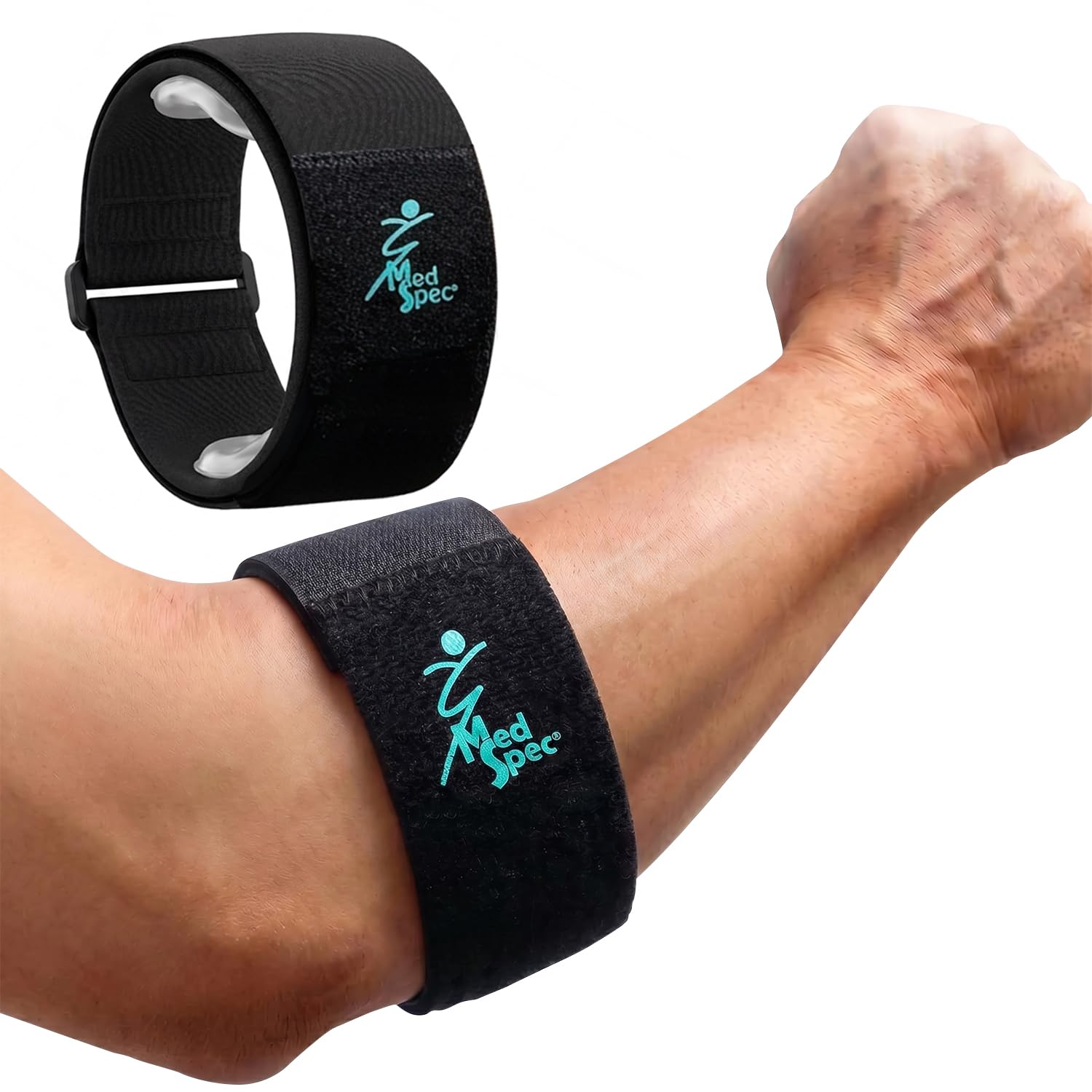
The Med Spec EpiGel stands out because it uses two separate gel pads that you can slide and position independently over the extensor and flexor muscle bellies. Most straps offer only a single fixed pad, which means you cannot fine-tune the pressure point for your exact tendon irritation. The dual-pad design offloads the common extensor tendon more evenly than any single-pad competitor I have seen at this tier.
The gel material itself is tacky enough to grip skin without slipping, even during a full golf swing or pickleball rally, but some users find it causes a mild rash after eight hours of continuous wear. A thin cotton layer placed between the gel and skin resolves that friction issue without reducing compression effectiveness. The strap width is a generous 2 inches, which helps prevent the band from digging into the muscle belly.
For anyone dealing with tennis elbow or medial epicondylitis who wants to stay on the court or in the gym, this is the most mechanically sound option available. The dual-pad system isolates the vibration that radiates through the forearm, and that direct vibration absorption is what makes the difference between tolerable discomfort and sharp pain during a backhand or bicep curl.
Why it’s great
- Two independently adjustable gel pads for pinpoint compression
- Low-profile shape fits under long sleeves without bulk
- Secure hook-and-loop closure holds position through vigorous activity
Good to know
- Gel can cause minor skin irritation during extended daily wear
- Instructions for pad positioning are not very detailed
2. BioSkin Elbow Brace

BioSkin builds this brace for people who need to wear it all day and cannot tolerate the itch of standard neoprene or the rough edge of untreated velcro. The fabric is ultra-thin, breathable, and hypoallergenic — qualities that matter when you keep the brace on through an eight-hour work shift plus a post-work workout. The silicone pad is longer than most, which distributes compression over a greater surface area and reduces the likelihood of a pressure ridge forming on the muscle.
Sizing is the most critical detail here. The manufacturer provides a detailed chart based on forearm circumference, and if you land between sizes, going up is recommended. A too-small BioSkin will cut into the brachialis muscle and defeat the comfort advantage. The strap closure is wide and uses a strong hook material that does not degrade after multiple wash cycles, and the one-handed adjustability is genuinely useful when your injured arm cannot grip firmly.
Professional athletes wear BioSkin for a reason — the compression layer stays stable under dynamic movement, and the material wicks sweat better than cotton-mix alternatives. If you prioritize non-reactive skin contact and are willing to measure carefully, this is the most comfortable counterforce strap for prolonged daily wear.
Why it’s great
- Hypoallergenic, latex-free, neoprene-free for sensitive skin
- Extra-long silicone pad spreads compression over larger area
- Ultra-thin breathable fabric wicks moisture and stays cool
Good to know
- Premium-tier investment relative to basic straps
- Requires careful measurement and may need size up for proper fit
3. Gviipk 2026 Elbow Brace
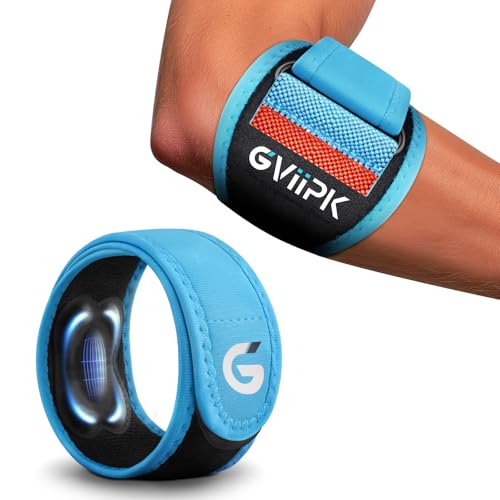
The Gviipk brace introduces a feature rarely seen on counterforce straps: a pressure warning indicator built into the elastic fabric. When the strap is too tight, a red zone appears on the surface, giving you immediate visual feedback to loosen the fit. That alone makes it safer for beginners who tend to overtighten in the hope of more relief — overtightening can compress the radial nerve and cause more problems.
The removable silicone pad has five small massage points that press into the muscle belly, providing a mild massaging effect during movement. The pad contour is high-density and does not deform after repeated compression. The metal buckle closure allows quick tension adjustments with one hand, and the combination of felt and lycra fabric is breathable enough for summer outdoor sports. Users report that the brace stays in place during tennis serves and weightlifting without riding up toward the elbow crease.
For the mid-range tier, this strap delivers the most thought-through engineering. The pressure warning system is not a gimmick — it addresses the most common mistake people make with tendonitis braces. Combine that with the massaging pad geometry, and you get a brace that actively manages both compression comfort and pain feedback.
Why it’s great
- Visual pressure warning indicator prevents overtightening
- Removable silicone pad with massage points reduces muscle fatigue
- Secure metal buckle for easy one-handed adjustment
Good to know
- Felt outer layer may absorb sweat and require more frequent washing
- Pad stiffness may feel firm for those used to gel cushions
4. Kunto Fitness Elbow Brace Compression Sleeve

Unlike the counterforce straps above, the Kunto sleeve is a full compression sleeve that wraps the entire elbow joint rather than pinching one spot. This is best for people whose tendonitis pain radiates into the upper forearm or who experience joint stiffness alongside tendon soreness. The knit blend of nylon and spandex provides a graduated compression effect that improves proprioception — you simply feel more aware of your elbow position, which helps avoid hyperextensions and awkward loads.
The weave is designed to stay put without silicone grippers, and it manages that well for most arm shapes. However, the sleeve can ride up at the bicep end during overhead pressing or extended reaching, which means it performs better for gym work and sports than for industrial or construction tasks. Machine washing does not degrade the compression, and the fabric avoids the itch that neoprene sleeves cause.
If you prefer the feeling of uniform pressure rather than a focused strap, this sleeve is the best alternative in the mid-range. It also works well as a recovery aid worn after activity, since the compression supports blood flow without restricting the tendon insertion point the way a counterforce strap does.
Why it’s great
- Full-coverage graduated compression improves joint awareness
- Machine-washable nylon-spandex blend resists wear
- Lightweight and breathable, no neoprene itch
Good to know
- May ride up at bicep during overhead or reaching motions
- Does not provide the focused counterforce of a strap-style brace
5. Soloever Copper Elbow Compression Sleeve
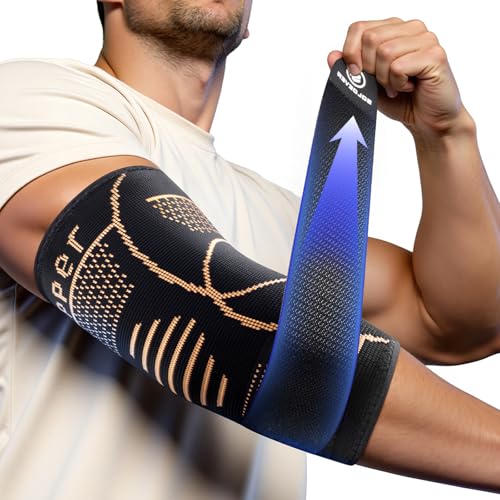
The Soloever sleeve combines a full-coverage compression base with an adjustable strap that sits over the tendon area, giving you the best of both worlds — uniform proprioceptive wrap plus targeted counterforce when you need it. The copper-infused knit is not a therapeutic miracle, but the fibers do help manage odor and keep the sleeve fresher longer between washes, which matters if you wear it for twelve-hour factory shifts.
Reinforced anti-slip strips inside the sleeve prevent the migration problem that affects many hybrid designs. The strap itself has a firm silicone pad that presses directly over the extensor muscle origin. Users working heavy-lifting jobs report that the sleeve stays in place all day and reduces pain flare-ups without constant readjustment. The sizing is straightforward, but you need to measure four inches above the elbow, not around the joint itself, to get the correct fit.
This is the best choice for manual laborers and warehouse workers who need a bracelet that handles continuous wear. The sleeve absorbs sweat, the strap adds adjustable pressure, and the copper infusion keeps the fabric from smelling like a gym bag after a week of daily use.
Why it’s great
- Hybrid sleeve-plus-strap design offers adjustable compression
- Anti-slip strips prevent migration during active work
- Copper-infused fabric controls odor during extended wear
Good to know
- Hand wash only to maintain elasticity of copper fibers
- Sleeve may feel warm in hot environments due to full coverage
6. Mueller Tennis Elbow Support with Gel Pad

Mueller’s classic strap is the entry-level benchmark that other budget-priced braces are measured against. The gel pad is integrated into a double-knit fabric band that wicks moisture away from the skin, and the hook-and-loop closure lets you dial in tension quickly.
The limitation is that the gel pad is fixed in one position — you cannot slide it to accommodate medial versus lateral epicondyle pain. The plastic ring enclosures at the strap ends also allow the brace to migrate down the forearm over time, especially if you wear it loosely. Some users in customer reviews note that the gel needs occasional repositioning inside its pocket. Three to four hours of continuous wear is the comfort limit for most arm sizes before the edges start to press into the skin.
If you are unsure whether a counterforce brace will help your specific forearm pain pattern, this Mueller strap is the lowest-risk entry point. It does the fundamental job of offloading the tendon without unnecessary complexity, and the 60-year Mueller reputation means the materials are consistent and reliable across units.
Why it’s great
- Proven gel pad design relieves pain quickly for most users
- Moisture-wicking double-knit fabric reduces sweat irritation
- Affordable entry point to test counterforce therapy
Good to know
- Fixed pad position cannot be shifted for different pain zones
- May migrate downward during extended or active wear
7. BraceAbility Epicondylitis Brace

The BraceAbility strap uses a double-ring closure system with a metal D-ring that makes one-handed adjustment genuinely easy — you pull the strap through the ring and the tension locks when you release. This is a real advantage if your injured arm has weak grip strength or limited pronation. The compression tube embedded in the band is firmer than a typical gel pad, providing a more aggressive pressure sensation that some users prefer for deep tendonitis pain.
The trade-off is that the hard circular pad underneath the strap is less comfortable than a flexible gel cushion. Reviewers with smaller forearm circumferences praise the slim fit and the fact that the strap does not slip, but users with larger arms note that the nylon velcro edge can fray against clothing and cause minor skin irritation. Hand washing is recommended, and the pad maintains its shape better than foam-based alternatives.
For people with smaller arms who have struggled to find a counterforce strap that fits snugly without bunching, this BraceAbility model is the best fit-focused option. The D-ring mechanism and compact pad profile keep the brace low-profile under a dress shirt or jersey while still delivering effective compression for medial or lateral epicondylitis.
Why it’s great
- Metal D-ring allows reliable one-handed tensioning
- Slim profile works well for smaller forearm circumferences
- Embedded compression tube provides firm, targeted pressure
Good to know
- Hard circular pad less comfortable than flexible gel for long wear
- Velcro edges may fray and irritate adjacent clothing or skin
FAQ
How tight should I wear my forearm tendonitis brace?
Can I wear a counterforce brace while sleeping?
How do I clean my brace to maintain its compression?
Will a brace cure my tendonitis or just mask the pain?
Final Thoughts: The Verdict
For most users, the brace for forearm tendonitis winner is the Med Spec EpiGel because its dual adjustable gel pads deliver the best balance of targeted pressure, vibration absorption, and fit stability for both tennis and golfer’s elbow. If you need a hypoallergenic strap for sensitive skin, grab the BioSkin Elbow Brace. And for heavy industrial use where the brace must stay on for twelve-hour shifts without slipping, nothing beats the Soloever Copper Sleeve.