
Our readers keep the lights on and the weekend projects moving. As an Amazon Associate, I earn from qualifying purchases.
Getting consistent, glass-smooth thickness on rough lumber is the difference between a project that looks professional and one that screams “weekend warrior.” A bench planer is the workhorse that flattens, dimensions, and finishes stock, but choosing the wrong one means fighting tear-out, snipe at every board end, and blades that dull after a single project.
I’m Rikta — the co-founder and writer behind FitlyFast. I’ve spent years analyzing woodworking tool specs, comparing cutterhead designs, and parsing real user data to separate the machines that deliver from those that just take up bench space.
Whether you are dimensioning rough-sawn walnut for a live-edge table or reclaiming pallet oak for a shop project, choosing the right best bench planer ensures clean edges, consistent thickness, and far less time sanding.
How To Choose The Best Bench Planer
A bench planer is a significant investment, even at the entry level. Focusing on a few core specs will prevent you from buying a machine that leaves more tear-out than smooth boards.
Cutterhead Design: Straight vs. Spiral vs. Helical
Straight-knife heads (two or three blades) are common on budget-friendly and mid-range models. They are effective but produce more noise and require frequent blade changes or rotations. Spiral or helical cutterheads use dozens of small, staggered inserts. These produce a shearing cut that is quieter, leaves a smoother surface, and reduces tear-out on figured woods. Helical heads with carbide inserts last much longer than high-speed steel (HSS).
Motor Power, Feed Rate, and Depth of Cut
Most benchtop planers use 15-amp motors. For hardwoods like oak or maple, look for a motor that maintains cutterhead speed under load. A two-speed gearbox (common on premium models) lets you choose a slower feed rate for a finer finish. Maximum depth of cut is usually around 1/8-inch, but taking lighter passes (1/32-inch) produces cleaner results and puts less strain on the machine. Onboard material removal gauges help you track each pass.
Snipe Prevention and Bed Design
Snipe—the deeper cut at the leading or trailing end of a board—is the most common complaint with benchtop planers. Look for models with automatic carriage locks, four-post designs, or patented snipe minimizers that physically reduce cutterhead deflection. Some users add sacrificial runners as a workaround. A rigid, precision-machined cast iron or cast aluminum bed keeps boards flat during the pass.
Quick Comparison
On smaller screens, swipe sideways to see the full table.
| Model | Category | Best For | Key Spec | Amazon |
|---|---|---|---|---|
| DEWALT DW735X | Benchtop Planer | Heavy workshop use & two-speed finish | 15A, 20,000 RPM, 2-speed gearbox | Amazon |
| JET JWP-13BT | Helical Planer | Quiet operation & minimal tear-out | 2 HP, 26 HSS inserts, 2-speed feed | Amazon |
| Cutech 40700H | Spiral Planer | Professional finish & snipe control | 12.5″ cut, carbide inserts, 10,000 RPM | Amazon |
| WEN PL1326 | Spiral Planer | Value-driven spiral upgrade | 13″ cut, 26 HSS blades, 10,000 RPM | Amazon |
| RYOBI AP1305 | Benchtop Planer | Entry-level use on softwoods | 15A, 12.5″ cut, 1/8″ depth per pass | Amazon |
| VEVOR Thickness Planer | Benchtop Planer | Large budget-friendly capacity | 15A, 13″ cut, 23,500 RPM, cast iron | Amazon |
| WEN PL1252 | Benchtop Planer | Reliable straight-knife planing | 15A, 12.5″ cut, SK5 blades, 26 FPM | Amazon |
| Makita KP0800K | Handheld Planer | Portable trimming & door fitting | 6.5A, 17,000 RPM, 3-1/4″ cut | Amazon |
In‑Depth Reviews
1. DEWALT Thickness Planer DW735X

The DW735X is the gold standard for benchtop planers in serious workshops. Its 15-amp, 20,000 RPM motor is paired with a two-speed gearbox—96 or 179 cuts per inch—so you can dial in finish quality versus speed. The three-knife cutterhead delivers smooth surfaces on hardwoods like ash and cherry with minimal sanding required after the pass.
The fan-assisted chip ejection is powerful enough to clear chips through a dust hose, but it can overwhelm a standard shop vac at high volumes. The 19-3/4-inch cast aluminum base provides rigidity that reduces vibration and helps control snipe. An automatic carriage lock engages without a manual lever, which is a practical design touch that prevents the cutterhead from dipping at board ends.
Blade replacements are straightforward, though some users report that the knives dull faster on dense exotics compared to carbide alternatives. The included infeed and outfeed tables fold for storage. For the hobbyist who works with rough lumber regularly, this planer pays for itself in material savings and surface quality.
Why it’s great
- Two-speed gearbox lets you choose finish quality over speed
- Fan-assisted ejection keeps chip buildup from affecting cut quality
- Automatic carriage lock reduces snipe without manual steps
Good to know
- Heavy unit at over 100 pounds; requires sturdy stand or mobile base
- Blades dull faster on exotic hardwoods vs. carbide alternatives
2. JET 13-Inch Benchtop Thickness Planer JWP-13BT

JET’s JWP-13BT uses a helical-style cutterhead with six rows of 26 individual HSS inserts. This design produces a shearing cut that reduces noise significantly compared to straight-knife planers and virtually eliminates grain tear-out on figured woods like curly maple or quartersawn oak. Users consistently report that boards need far less sanding after a pass.
The 2-horsepower, 15-amp motor is paired with a two-speed feed system (18 or 26 feet per minute), giving you control over surface finish. The precision-machined cast iron bed and four-post design keep the cutterhead stable, which reduces snipe on longer boards. Folding infeed and outfeed tables level with the bed and save floor space when not in use.
HSS inserts are replaceable individually, but they can dull faster on dense tropical hardwoods than carbide. Some users plan to upgrade to carbide inserts for longevity. Dust collection is excellent with a 4-inch hose. At 75 pounds, this planer is manageable for a benchtop setup and delivers floor-model quality in a compact footprint.
Why it’s great
- Helical head delivers whisper-quiet operation and glass-smooth finish
- Two-speed feed adapts to hardwood or finish-pass requirements
- Four-post frame minimizes snipe and maintains board flatness
Good to know
- HSS inserts dull faster on dense exotics like teak or ipe
- Replacing all 26 inserts is time-consuming
3. Cutech 40700H 12½-Inch Spiral Cutterhead Planer
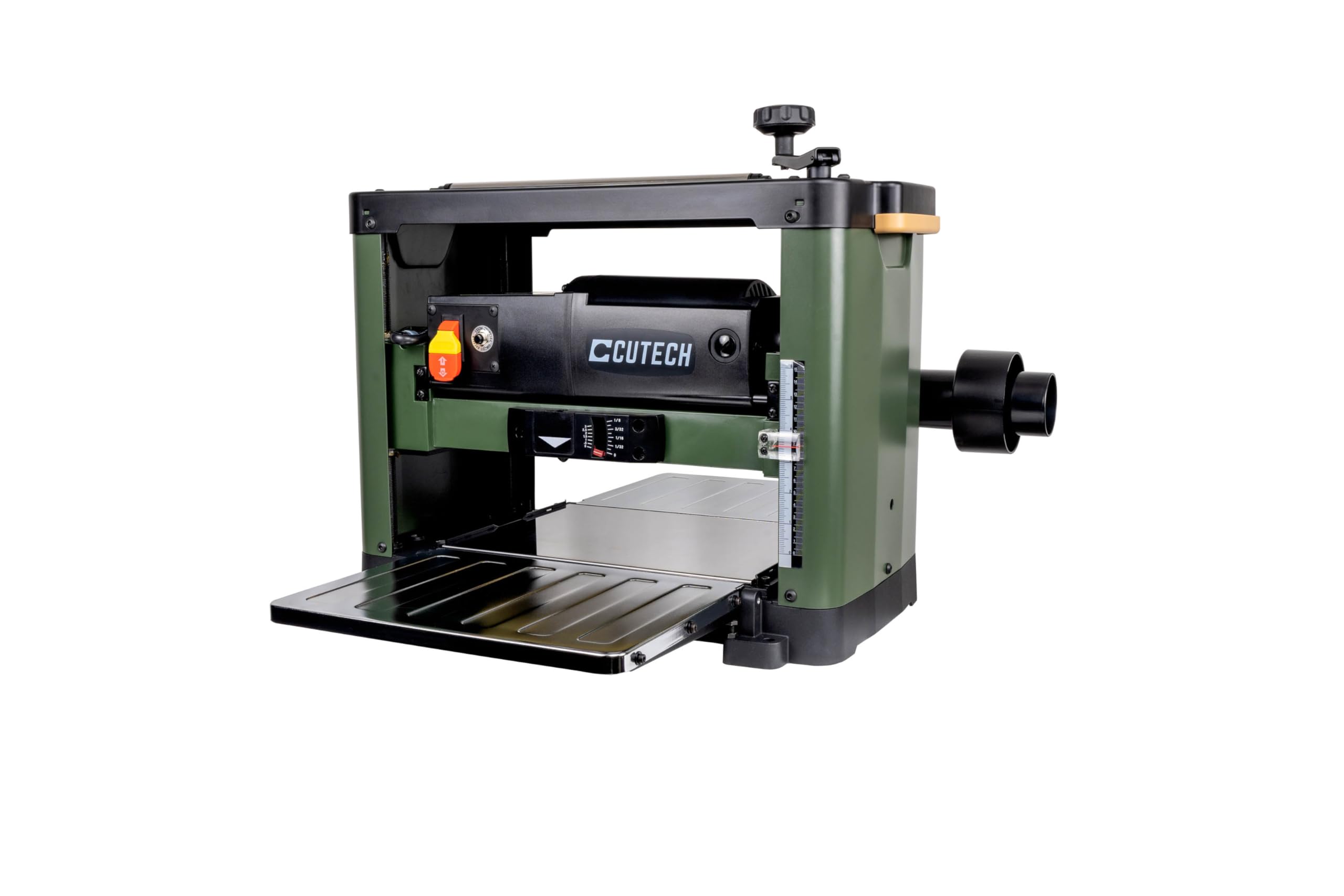
Cutech’s 40700H is a benchtop planer built around a spiral cutterhead with staggered tungsten carbide inserts. Carbide outlasts HSS by a wide margin, making this an excellent choice for anyone planing abrasive reclaimed lumber or dense hardwoods. The spiral design produces a smooth surface while drawing lower amperage than many competitors.
The standout feature is Cutech’s patented snipe minimizer: four lead screws and a coupling design automatically reduce cutterhead deflection at board entry and exit. Users report minimal to no snipe without needing to lock a carriage or add sacrificial boards. Board return rollers on top let you feed the next pass quickly without walking around the machine.
The depth of cut indicator on the front gives clear feedback for each pass. Single-speed operation at 10,000 RPM is adequate for most work, though some users wish for a two-speed option for ultra-fine finishes on hardwoods. Dust collection is decent with a shop vac connected. Overall, this machine combines professional cutterhead technology with smart ergonomics at a price point well below the premium segment.
Why it’s great
- Carbide inserts last far longer than steel blades
- Patented snipe minimizer works without manual engagement
- Board return rollers speed up multi-pass work
Good to know
- Single-speed limits fine-finish optimization on hardwoods
- Dust collection may require an adapter for some vac hoses
4. WEN PL1326 13-Inch Spiral Benchtop Planer

The WEN PL1326 is one of the most budget-conscious ways to get a spiral cutterhead in a benchtop planer. It uses 26 staggered HSS blades that can be rotated individually, extending blade life significantly compared to a two-knife straight head. The 15-amp motor spins at 10,000 RPM with a 26 feet per minute feed rate.
Tested on air-dried red oak and black walnut, the PL1326 produces a surface that requires minimal sanding. Snipe is present but less pronounced than on straight-knife models; sacrificial runners help compensate. The onboard material removal gauge is a practical addition that helps you track depth without stopping to measure.
At roughly 80 pounds, this is a solid benchtop machine. Dust collection requires a shop vac or dedicated dust collector to keep the table clean. A few users report that the plastic dust port can crack, but WEN’s US-based customer service replaces it quickly. For the weekend woodworker who wants spiral smoothness without spending at the premium level, this is your pick.
Why it’s great
- Spiral cutterhead at a fraction of typical spiral-planer cost
- Rotatable HSS blades extend useful life before replacement
- Material removal gauge tracks depth without manual measuring
Good to know
- HSS inserts may wear faster on dense hardwoods than carbide
- Snipe still present; users may need sacrificial runners
5. RYOBI 15 Amp 12-1/2 in. Corded Thickness Planer AP1305

Ryobi’s AP1305 is a straight-knife benchtop planer designed for budget-conscious DIYers working primarily with pine, poplar, and softwoods. The 15-amp motor drives a two-blade cutter head with a 1/8-inch depth-of-cut capacity per pass. The cast iron bed provides decent stability for light to moderate use.
Users report that the planer works well on pine boards for shelving and basic projects, but it struggles with precision on hardwoods. Some note that the thin blades can deflect on denser stock, leading to gouging or uneven surfaces. Snipe is more pronounced than on spiral models—some users have found success using sacrificial scrap boards to mitigate it.
Chip ejection requires a vacuum for most shavings, as the dust port is not as effective as premium models. The AP1305 is a functional planer for the price, but it is best suited for occasional use rather than heavy or production-level work. If your projects are primarily softwoods, this planer will get the job done without a large investment.
Why it’s great
- Cast iron bed provides a stable planing surface
- 15-amp motor offers enough power for softwood planing
- Budget-friendly entry point for occasional DIY projects
Good to know
- Blades can deflect on hardwoods, causing uneven cuts
- Snipe is more noticeable than on premium or spiral models
6. VEVOR Thickness Planer 13-Inch Benchtop Planer

VEVOR’s benchtop planer offers a 13-inch cutting width and a 15-amp motor that spins at 23,500 RPM. The cast iron worktable and steel plate construction provide a rigid foundation for planing boards up to 6 inches thick. The two-knife cutter head uses hardened steel blades rated to HRC55-60, promising extended edge retention.
The extended infeed and outfeed tables supply 35 inches of total support, which is helpful for longer stock. Users report excellent results on hardwoods like oak pallet stock, with virtually no snipe when planing material above 7/16 inch. A built-in 20-amp over-current protector adds safety in case of motor overload during heavy passes.
Some users note that the motor requires cool-down breaks during extended sessions to avoid bogging and a chemical smell from overheating. Dust collection works with a standard vacuum hose but is not as efficient as higher-end models. For the money, this planer gives you large capacity and solid cast iron build that punches above its weight class.
Why it’s great
- 13-inch width handles wide boards at a budget-friendly price
- Cast iron bed delivers stability and flatness for consistent cuts
- Over-current protector adds safety for heavy planing sessions
Good to know
- Motor bogs on aggressive passes; light cuts and breaks needed
- Dust collection is mediocre; a dedicated vac and adapter help
7. WEN PL1252 12.5-Inch Benchtop Thickness Planer

The WEN PL1252 is a straightforward, no-frills benchtop planer that planes boards up to 12.5 inches wide and 6 inches thick. Its 15-amp motor drives a two-blade SK5 steel cutter head at 20,000 cuts per minute and a 26 feet per minute feed rate. The reversible blades can be rotated once dull to extend service life before replacement.
Users praise the PL1252 for being ready out of the box and requiring less than 30 minutes to set up. It produces smooth finishes on both softwoods and hardwoods, including end-grain cutting boards when using very light passes. The cast iron base and benchtop design make it easy to move and store in a small shop.
Snipe is present at roughly 2 inches on both infeed and outfeed sides. This is not adjustable, but users have solved the problem by hot-gluing 1/4-inch sacrificial runners that extend beyond the workpiece. The blade set is reasonably priced for replacement. For a simple, reliable straight-knife planer at a moderate price, the PL1252 delivers consistent results.
Why it’s great
- Set up in under 30 minutes with minimal learning curve
- Cast iron base provides rigid support and vibration dampening
- Reversible blades extend useful life between replacements
Good to know
- Snipe is fixed at 2 inches; requires sacrificial runners to compensate
- Not ideal for heavy production planing of exotic hardwoods
8. Makita KP0800K 3-1/4″ Planer

The Makita KP0800K is a handheld electric planer, not a benchtop thickness planer. It is included here because many woodworkers use a handheld planer for trimming doors, beveling edges, and light surfacing work that a benchtop unit cannot handle. Its 6.5-amp motor spins a two-blade cutter head at 17,000 RPM and planes up to 3-1/4 inches wide in a single pass.
The aluminum base is precision-machined for flatness. A spring-loaded stand elevates the base when not in use to protect the blades and the workpiece surface. The easy blade setting system allows for fast blade installation without guesswork. Users report excellent accuracy and a solid feel, with no digging at the start or end of cuts.
This planer does not come with a dust bag or hose adapter, which is a common complaint. A third-party bag adapter solves the issue inexpensively. The corded power delivery is consistent for shop use, although the cable routing in the case can cause wear over time. For portable planing tasks where a benchtop unit is impractical, the KP0800K is a reliable companion.
Why it’s great
- Precision aluminum base stays flat for accurate surfacing
- Easy blade-setting system reduces setup time
- Spring-loaded stand protects blades and workpiece
Good to know
- Does not include dust bag or shop vac adapter
- Cable routing in the case may lead to cord wear over time
FAQ
What is snipe and how can I prevent it on a benchtop planer?
Should I buy a straight-knife planer or a spiral cutterhead planer?
What is the maximum depth of cut I should take per pass?
Final Thoughts: The Verdict
For most users, the best bench planer winner is the DEWALT DW735X because its two-speed gearbox, automatic snipe reduction, and powerful fan-assisted chip ejection make it the most capable all-around benchtop planer for serious woodworkers. If you want a whisper-quiet helical head with minimal tear-out, grab the JET JWP-13BT. And for a premium spiral cutterhead with carbide inserts at a mid-range price, nothing beats the Cutech 40700H.