
Our readers keep the lights on and the weekend projects moving. As an Amazon Associate, I earn from qualifying purchases.
Carpenter ants don’t just march across your counter for a crumb — they tunnel through the structural wood of your home, silently hollowing out beams, window frames, and porch supports. Unlike their sugar-seeking cousins, these wood-destroying pests require a targeted approach that combines contact kill with colony elimination, or you’re just treating the symptom while the queen keeps reproducing.
I’m Rikta — the co-founder and writer behind FitlyFast. After analyzing lab data, active ingredient sheets, and application methods across dozens of pest control formulations, I’m breaking down which products actually stop carpenter ants at the source versus those that just scatter the workers temporarily.
This guide evaluates spray concentrates, ready-to-use foams, gel baits, and granular formulas to find the true best ant killer for carpenter ants that delivers both immediate knockdown and residual colony destruction.
How To Choose The Best Ant Killer For Carpenter Ants
Choosing the right carpenter ant killer depends on the stage of infestation, the location of the nests, and whether you’re treating a satellite colony inside a wall or the parent colony in the yard. Here’s what separates effective products from the rest.
Target the Colony, Not Just the Workers
Carpenter ants are social insects that send out foragers while the queen and brood remain hidden in a nest. Contact-kill sprays stop visible ants immediately, but if the queen survives, the colony rebuilds. Gel baits with slow-acting active ingredients like indoxacarb let foragers carry poison back to the nest, killing the entire colony through food sharing. Granular baits with abamectin work similarly — ants carry granules to the nest where the delayed toxicity eliminates the population.
Active Ingredient Matters: Non-Repellent vs. Repellent
Repellent active ingredients (like pyrethroids) kill on contact but alert surviving ants, causing them to avoid the treated area entirely. Non-repellent active ingredients (like indoxacarb, abamectin, and tetraperm) are undetectable to ants — they walk through treated zones, pick up a lethal dose, and carry it back to the colony. For carpenter ants that nest deep inside wood or soil, non-repellent formulas consistently deliver better long-term results.
Application Method: Barrier, Bait, or Direct Injection
Ready-to-use spray formulas with extended wands or tube attachments let you inject foam directly into carpenter ant kick-out holes, cracks, and crevices where nests form. Liquid concentrates mixed in a tank sprayer create a perimeter barrier around the foundation. Gel baits and granular baits work best when applied along ant trails, near windows, or around moisture-prone wood. For active infestations inside walls, foam injection is the most effective method because it expands to fill voids and coats the nest from within.
Quick Comparison
On smaller screens, swipe sideways to see the full table.
| Model | Category | Best For | Key Spec | Amazon |
|---|---|---|---|---|
| Syngenta Advion Ant Gel Bait | Gel Bait | Colony elimination via food sharing | 0.05% Indoxacarb (non-repellent) | Amazon |
| BASF Advance Carpenter Ant Bait Granules | Granules | Long-term outdoor colony control | Abamectin 0.011% (delayed action) | Amazon |
| Bonide Termite & Carpenter Ant Killer Concentrate | Concentrate | Perimeter barrier treatment | 5+ year soil barrier | Amazon |
| Revenge Termite & Carpenter Ant Killer Concentrate | Concentrate | Foundation and yard treatment | 5 year outdoor residual | Amazon |
| Spectracide Terminate Spray | Spray | Fast indoor/outdoor knockdown | Lambda-Cyhalothrin + wand | Amazon |
| Revenge RTU Spray | RTU Spray | Large area coverage | 128 oz ready-to-use | Amazon |
| Bonide Termite & Carpenter Ant Spray | Foam Spray | Nest injection in voids | Tetraperm + tube attachment | Amazon |
In‑Depth Reviews
1. Syngenta Advion Ant Gel Bait
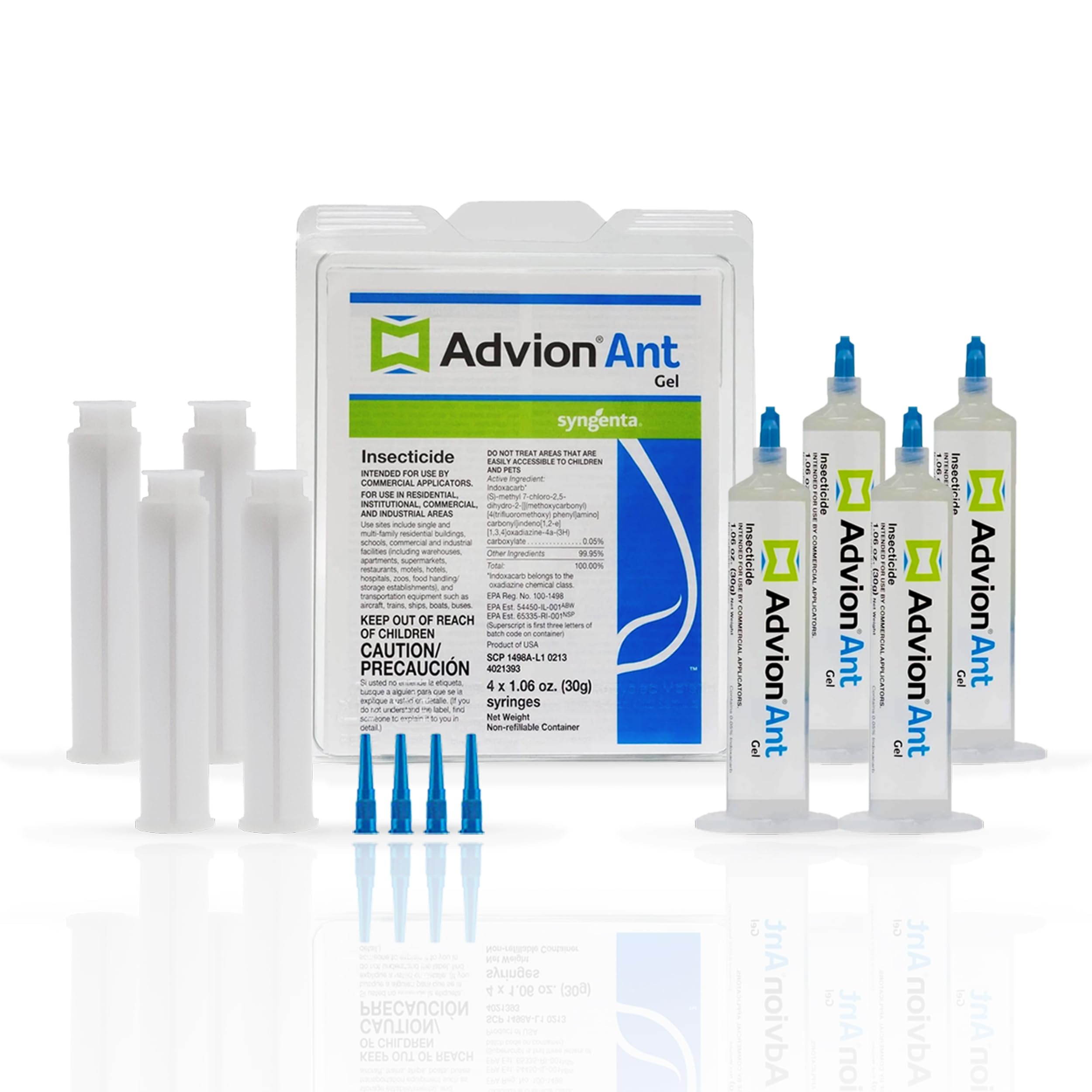
The Syngenta Advion Ant Gel Bait is the standard that other bait products struggle to match. It uses 0.05% indoxacarb, a non-repellent active ingredient that foraging carpenter ants cannot detect, so they confidently feed on the gel and carry it back to the nest. The MetaActive effect differentiates target insects from non-target organisms, making it unlikely to harm people or pets when applied correctly. This four-tube kit includes plungers and tips for precise placement along ant trails, in cracks, or beneath appliances.
Customers consistently report that Advion outperforms standard liquid baits like Terro, with many noting complete colony elimination within 48 to 72 hours of application. Former exterminators specifically cite this product as their go-to for persistent carpenter ant issues. The gel stays fresh for weeks in the syringe, so a single purchase can cover multiple seasons of treatment. Users find that just a tiny dab attracts dozens of ants, and the delayed toxicity ensures the poison circulates through the colony before any ant dies.
The main practical consideration is placement — the gel must be applied where ants are actively trailing, not randomly scattered. Keep it out of reach of children and pets during the treatment period. One 30-gram tube goes a long way, and the four-pack provides ample material for both indoor and outdoor use. For those dealing with a hidden wall nest, combine Advion with a foam spray for the most complete approach.
Why it’s great
- Non-repellent indoxacarb ensures colony-wide elimination through food sharing
- Works within 2-3 days for most infestations
- Four tubes provide long-term supply for multiple treatments
Good to know
- Requires strategic placement where ants are actively trailing
- Must be kept away from children and pets during treatment
- Best used in combination with spray for severe infestations
2. BASF Advance Carpenter Ant Bait Granules

BASF Advance Carpenter Ant Bait Granules take a different strategic approach — instead of spraying a barrier, you deploy bait granules that worker ants physically pick up and carry back to the nest. The 0.011% abamectin active ingredient works on a delayed action schedule, which is critical for colony elimination: ants must survive long enough to travel from the bait site to the nest and share the poisoned food with the queen and brood. The larger grit size is specifically formulated so carpenter ants can grasp and transport it easily.
Customers report seeing ants actively grabbing granules within minutes of application, with no visible ants by the next morning in many cases. The delayed-action design means the colony collapses from within rather than just losing its foragers. Users note that the granules remain effective even after rain, unlike spray treatments that wash away. The 8-ounce bottle covers a substantial area and is ready to use — no mixing, no measuring, no sprayer required.
Some users report that ants initially show no interest in certain placements, suggesting that bait station location matters significantly. The granules have a fishy smell that may attract pets, so secure placement is important. A small subset of customers needed to reapply after a few weeks for complete elimination. For outdoor parent colonies and persistent infestations, these granules are a top-tier tool for lasting control.
Why it’s great
- Delayed-action abamectin ensures colony elimination via food sharing
- Rain-resistant formula stays effective after weather exposure
- Ready-to-use granules require no mixing or equipment
Good to know
- Some placements show low initial ant interest
- Fishy smell may attract pets
- May require reapplication for complete colony removal
3. Bonide Termite & Carpenter Ant Killer Concentrate

Bonide’s concentrate formulation provides a dual-action defense: contact kill on direct spray and residual activity that eliminates insects returning to treated areas for up to 5 years in soil trenching applications. The non-repellent nature of the active ingredient means carpenter ants walk through treated zones without detecting the danger, picking up a lethal dose that spreads through the colony. This concentrate targets subterranean termites, carpenter ants, carpenter bees, and a broad spectrum of wood-infesting beetles.
Customers report that one application around the home foundation eliminated heavy carpenter ant infestations that previous treatments failed to control. Annual spring applications at a wooded cabin provided year-long control of both black ants and termites for over 15 years. The concentrate mixes with water and applies through a sprinkler can, hand sprayer, or low-pressure sprayer, making it practical for large perimeter treatments. Users specifically praise its effectiveness against carpenter ants that baiting alone couldn’t stop.
Some users note that a single treatment may not completely eliminate heavy infestations — a second application or combination with baiting may be necessary. The concentrate requires careful reading of label directions for proper mixing ratios. It’s designed for outdoor use on lawns, flower gardens, and building surfaces, not for direct indoor application. For homeowners looking to establish a durable barrier that keeps carpenter ants out season after season, this concentrate delivers proven long-term results.
Why it’s great
- Up to 5-year residual activity in soil trenching applications
- Non-repellent formula for effective colony treatment
- Concentrate makes multiple gallons for large perimeter coverage
Good to know
- Heavy infestations may require a second application
- Must be mixed per label directions for correct concentration
- Outdoor use only — not for direct indoor application
4. Revenge Termite & Carpenter Ant Killer Concentrate

Revenge Termite & Carpenter Ant Killer Concentrate from Bonide offers a similar non-repellent approach to the standard Bonide concentrate but at a competitive per-gallon price point. The 32-ounce bottle mixes with water to create a soil barrier that lasts up to 5 years against subterranean termites, and customers report it performs equally well against carpenter ants. The dual-action defense delivers immediate contact kill when sprayed directly and residual activity that continues working long after application.
Customers report eliminating carpenter ants after just one year of using this product as a perimeter treatment. One user sprayed infested landscape rocks and found all ants gone by the next morning. Multiple reviews call it a cheaper DIY alternative to professional-grade treatments like Termidor or Taurus, with no noticeable difference in carpenter ant control. The concentrate targets a wide spectrum of pests beyond carpenter ants, including crickets, earwigs, fleas, fire ants, mosquitoes, ticks, and wasps.
The concentrate requires a hose-end sprayer or tank sprayer for proper application, and soaking the soil around the foundation is critical for barrier effectiveness. Some users note that the 5-year claim applies only to soil trenching applications against termites — surface spray for carpenter ants has a shorter residual. The product works best when applied as part of a comprehensive perimeter defense rather than standalone spot treatment. For homeowners on a budget seeking professional-grade results, this concentrate is a strong mid-range option.
Why it’s great
- Comparable performance to professional Termidor treatments at a lower cost
- 5-year soil barrier eliminates long-term reinfestation risk
- Broad spectrum control covers 12+ pest species
Good to know
- Requires tank or hose-end sprayer for application
- Surface spray residual is shorter than soil trenching claim
- Best as part of comprehensive perimeter defense
5. Spectracide Terminate Termite & Carpenter Ant Killer

Spectracide Terminate combines a powerful lambda-cyhalothrin active ingredient with a continuous-power AccuShot sprayer that includes an extendable wand and two-finger trigger to reduce hand fatigue during large applications. The 1.33-gallon ready-to-use formula kills carpenter ants, termites, carpenter bees, and other listed insects on contact, with residual control lasting up to 9 months indoors against carpenter ants. The clear, non-staining formula leaves no odor, making it practical for indoor use around living areas.
Customers consistently rate this as the most effective over-the-counter product for carpenter ant elimination they’ve tried. One user reported eliminating carpenter ants from their patio and nearby trees within a single day — outperforming previous professional treatments. Another customer noted visible results the next morning, with no termite droppings after a double application spaced 30 minutes apart. The sprayer’s extendable wand reaches into soffits, eaves, and other high-reach areas where carpenter ant nests commonly form.
A recurring issue is that the sprayer mechanism can fail after extended use, with some customers reporting the nozzle stops working before the product runs out. The sprayer requires a specific grip orientation to maintain continuous pressure, which isn’t immediately obvious. While the lambda-cyhalothrin kills on contact, it is a repellent active ingredient — surviving ants may avoid the area, potentially pushing the colony to a different location. For spot treatment of visible activity, it’s fast and effective, but colony elimination may require bait supplementation.
Why it’s great
- Fast contact kill with results visible within 24 hours
- Extendable wand reaches high eaves and soffits
- Non-staining, odorless formula for indoor use
Good to know
- Sprayer mechanism can fail after extended use
- Repellent active ingredient may push colony to new location
- Requires specific sprayer grip for continuous pressure
6. Revenge Termite & Carpenter Ant Killer Ready-to-Use

The Revenge RTU spray delivers the same dual-action formula as the concentrate but in a ready-to-use gallon that requires no mixing. It kills carpenter ants, termites, wasps, hornets, yellow jackets, bees, and carpenter bees on contact, with residual killing power lasting 2 to 4 weeks after application. The formula works better than bait and trap systems for immediate knockdown and is designed for use around apartments, boats, cabins, campers, garages, and home foundations.
Customers report that spraying around the home foundation, doors, and windows kept all ground-based ants and insects out of the house for 9 months. One user noted that the gallon with sprayer lasts roughly three applications, each covering about 90 days of protection. Another customer described the product as eliminating carpenter ants that had made their way into the garage — killing them “really dead, not just merely dead.” The coverage area for a gallon is substantial, making it practical for larger properties.
Some units shipped without the sprayer attachment despite being advertised as a complete ready-to-use system, which is frustrating for buyers expecting immediate deployment. The 2-to-4-week residual is shorter than concentrate formulations applied via soil trenching, so reapplication is needed for ongoing perimeter protection. For users who prefer the convenience of a premixed solution with no measuring or dilution, this gallon spray provides solid knockdown and reasonable residual coverage without any setup time.
Why it’s great
- No mixing required — spray directly from the gallon
- Coverage lasts up to 3 months per application
- Effective against multiple wood-destroying insects
Good to know
- Sprayer attachment may not be included in some units
- Residual lasts 2-4 weeks, shorter than concentrate barriers
- Requires reapplication for continuous perimeter protection
7. Bonide Termite & Carpenter Ant Spray
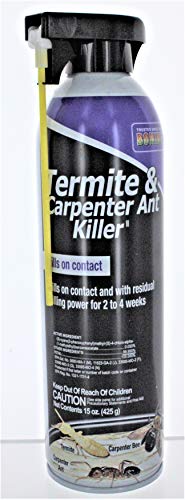
Bonide’s 15-ounce Termite & Carpenter Ant Spray is the go-to tool for injecting poison directly into carpenter ant nesting voids. The included spray tube attachment lets you insert the nozzle deep into kick-out holes, cracks, crevices, and wall voids where the colony resides. The tetraperm active ingredient provides instant knockdown on contact with residual killing power lasting 2 to 4 weeks, ensuring that ants emerging after treatment also receive a lethal dose.
Customers praise this product for its ability to reach crevices that other sprays cannot access. The pinpoint nozzle attachment allows users to target the exact entry point of carpenter bee holes and carpenter ant nests, delivering poison directly where the insects live. Users report effective ongoing prevention in small areas after the initial treatment. One customer noted that it “kills them DEAD” when used to treat local termite infestations after locating the kick-out hole.
The 15-ounce can is a limited quantity per treatment — for large infestations or extensive perimeter barriers, you’ll need multiple cans. The foam expands upon application, which is excellent for filling voids but can be messy if overapplied in tight spaces. This spray is most effective as a spot treatment for known nesting sites rather than as a general perimeter barrier. For homeowners who have identified specific carpenter ant entry points or kick-out holes, this tube-attached spray provides precise, high-impact delivery directly into the nest.
Why it’s great
- Tube attachment reaches deep into nesting voids
- Instant knockdown with 2-4 week residual
- Foam expands to coat nest surfaces inside voids
Good to know
- 15 oz can is small for large perimeter applications
- Foam expansion can be messy in tight spaces
- Best for spot treatment of known nesting sites
FAQ
How do I know if I have carpenter ants instead of termites?
Should I use a bait or a spray for carpenter ants?
How long does it take to eliminate a carpenter ant colony?
Can I use carpenter ant killer indoors safely?
Why do carpenter ants keep coming back after I spray?
Final Thoughts: The Verdict
For most users, the best ant killer for carpenter ants winner is the Syngenta Advion Ant Gel Bait because its non-repellent indoxacarb formula delivers colony-wide elimination through food sharing, stopping the infestation at its source. If you want a durable outdoor perimeter barrier that lasts for seasons, grab the Bonide Termite & Carpenter Ant Killer Concentrate. And for spotting and injecting hollow-sounding trim where carpenter ants have tunneled, nothing beats the Bonide Termite & Carpenter Ant Spray with tube attachment for direct nest injection.