
Our readers keep the lights on and the weekend projects moving. As an Amazon Associate, I earn from qualifying purchases.
Cutting the cord on cable or satellite TV starts with one decision that determines everything: the antenna anchoring your setup. A poorly chosen model leaves you scanning for channels that never appear, while the right one pulls in crisp HD broadcasts from towers miles away without constant adjustment. The difference comes down to understanding range claims, frequency support, and your local terrain.
I’m Rikta — the co-founder and writer behind FitlyFast. Over the years I’ve analyzed dozens of digital TV antennas across different price tiers by cross-referencing real user reception reports with the technical specs that actually matter for over-the-air (OTA) performance.
Whether you live in a downtown apartment or a rural fringe zone, finding the right antenna for digital tv means matching your location’s signal challenges to a specific design that handles both VHF and UHF frequencies without unnecessary amplification.
How To Choose An Antenna For Digital TV
Selecting the right antenna starts with your address, not the price tag. Every market has unique tower locations, terrain, and building materials that affect signal penetration. Understanding three core factors will prevent wasted purchases and endless repositioning.
Range vs. Reality
Manufacturers love to advertise “200-mile” range, but those numbers assume perfect line-of-sight on a flat plain with no interference. In practice, most suburban homes get reliable signals from 30 to 60 miles away. Trees, hills, dense construction, and even metal roofs reduce effective range significantly. Focus on antennas that deliver consistent performance within your actual distance to broadcast towers — check the FCC’s DTV reception maps first.
VHF and UHF Support
Digital TV broadcasts use two frequency bands: VHF (channels 2–13) and UHF (channels 14–36). Many budget indoor antennas are optimized for UHF only and struggle with VHF stations, which often include major networks like ABC, NBC, and CBS. Look for antennas explicitly marked for both VHF and UHF reception, especially if your local towers broadcast key channels on VHF.
Active vs. Passive Amplification
Amplifiers boost weak signals, but they also amplify noise and interference. In urban areas close to towers, an amplified antenna can overload the TV tuner, causing pixelation or channel loss. Pre-amplifiers mounted at the antenna are generally better than in-line amplifiers placed near the TV because they boost the signal before it travels down the coax cable. For short cable runs under 20 feet in strong signal zones, a passive unamplified antenna often works better.
Quick Comparison
On smaller screens, swipe sideways to see the full table.
| Model | Category | Best For | Key Spec | Amazon |
|---|---|---|---|---|
| Antennas Direct ClearStream 2V | Premium | Suburban & rural multi-directional | 60+ mile range, UHF + Hi-VHF | Amazon |
| Five Star HDTV Antenna (Upgraded) | Premium | Long-range with included coax | 200 mile range, ATSC 3.0 | Amazon |
| Five Star Outdoor HDTV Antenna | Premium | Deep fringe & attic installation | 200 mile range, 4K UHD | Amazon |
| 1byone Outdoor TV Antenna | Mid-Range | Omni-directional, no aiming needed | 360° reception, built-in pre-amp | Amazon |
| PIBIDI Outdoor TV Antenna | Mid-Range | Budget outdoor with wide elements | 200 mile range, extended length | Amazon |
| Mohu Leaf Amplified | Mid-Range | Indoor urban with amplifier toggle | 60 mile range, Jolt Switch control | Amazon |
| Winegard FL5500A FlatWave | Mid-Range | Urban indoor with slim profile | 50 mile range, dual-color design | Amazon |
In‑Depth Reviews
1. Antennas Direct ClearStream 2V
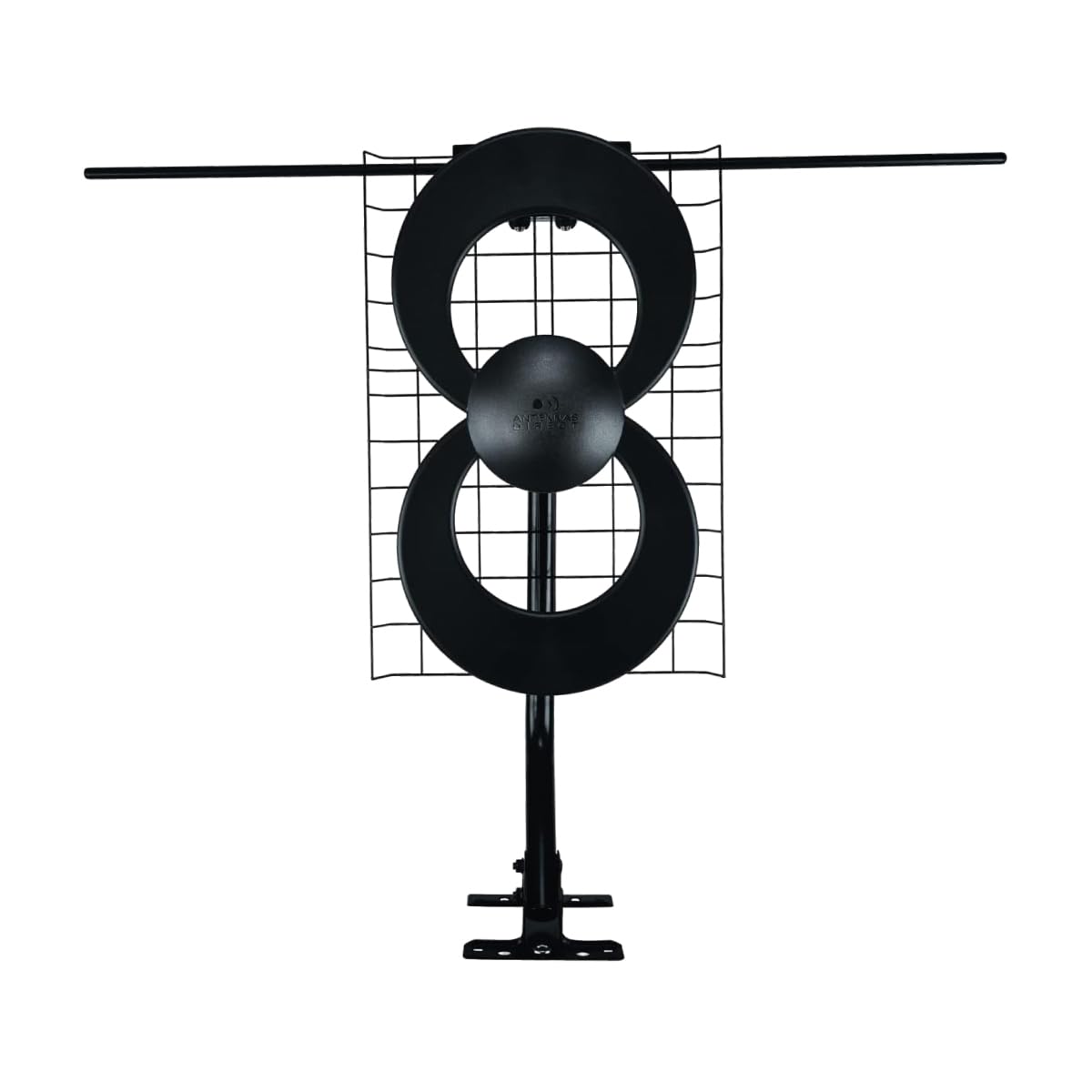
The ClearStream 2V uses a double-loop design combined with a signal reflector to pull in UHF and Hi-VHF stations from over 60 miles away. That reflector adds forward gain and reduces back-end interference, which is vital in suburban areas where trees and buildings degrade weaker signals. Real users report 60–70 crystal-clear channels from 30–40 miles out, often exceeding the claimed range.
This antenna handles both indoor and outdoor mounting thanks to the included 20-inch mast with pivoting base. The assembly involves attaching the reflector and elements, but no tools are required. The lifetime warranty on the antenna itself — with a separate 90-day accessory warranty — adds long-term confidence absent from most mid-range competitors.
The key trade-off is the lack of a built-in amplifier, and the coax cable is not included in the box. Users in deep fringe areas may need to add a separate pre-amplifier and purchase a quality RG6 cable, raising the total investment. Still, for consistent multi-directional reception in challenging environments, this design strikes the best balance of gain and reliability.
Why it’s great
- Reflector design adds gain and minimizes interference for suburban/rural use
- Lifetime antenna warranty signals confidence in build quality
- True multi-directional reception without a rotator
Good to know
- Coax cable not included — you’ll need to buy one separately
- No built-in amplifier; fringe users should budget for a pre-amp
2. Five Star HDTV Antenna Upgraded Version

The upgraded Five Star antenna uses a Yagi-style directional array with extended elements designed to capture both VHF and UHF signals at long distances. Claiming up to 200 miles, it reliably pulls in stations from 40–70 miles in practice, especially when mounted on a roof or high on the side of a house. The 40-foot RG6 coaxial cable included in the box saves a trip to the hardware store and simplifies the install.
This model supports ATSC 3.0 (NextGen TV) and true 4K UHD broadcasts, so it won’t need replacing as broadcast standards evolve. The silver-aluminum construction keeps the antenna lightweight for roof mounting but sturdy enough to withstand wind. Assembly is straightforward with the included bracket and J-pole, and the splitter support allows connection to multiple TVs.
Some users note that the directional nature requires careful aiming toward broadcast towers, and the 200-mile claim is optimistic for most terrain. The pre-assembled elements reduce setup time, but the antenna lacks a built-in amplifier. If you are within 50 miles and have a clear line of sight, this package delivers excellent value with the coax included.
Why it’s great
- Includes 40ft RG6 coax cable and mounting hardware — everything to get started
- ATSC 3.0 compatible for future-proof NextGen TV reception
- Lightweight aluminum build for easy roof or eave installation
Good to know
- Directional design requires precise aiming toward towers
- No amplifier; fringe areas may need additional signal boost
3. Five Star Outdoor HDTV Antenna

This earlier Five Star model shares the Yagi directional design but uses longer and larger receiving elements than standard compact antennas. That extra surface area translates to better off-axis reception for deep fringe areas where towers sit at different angles relative to the home. Real-world reports from users in wooded and hilly locations confirm 25–40 stable channels at distances of 25–50 miles.
The antenna includes a mounting bracket and J-pole designed for roof, attic, chimney, or eave placement. It performs well in attics because the large elements still capture UHF signals that struggle to penetrate metal roofs or foil-backed insulation. The passive design means no electronics to fail over time, and several users report clean picture quality that rivals their previous cable feed.
Assembly is tool-free for the main elements, but the mounting pole feels lighter than premium options — some users replace the included hardware for extreme wind conditions. Without a coax cable included, you will need to supply your own RG6 cable and potentially a separate amplifier if the cable run exceeds 50 feet.
Why it’s great
- Extended elements improve off-axis reception in fringe locations
- Passive design with no electronics means long-term reliability
- Performs well in attic installations avoiding weather exposure
Good to know
- Mounting hardware feels lightweight for heavy wind areas
- Coax cable not included in the package
4. 1byone Outdoor TV Antenna 360°

The 1byone antenna solves a common frustration: the need to climb up and rotate a directional antenna every time you want a different station. Its 360° omni-directional pattern receives signals from every direction simultaneously, so you install it once in a central spot and scan for channels. The built-in Smart Pass pre-amplifier boosts the signal right at the antenna before it travels down the 32-foot RG6 cable, making up for attenuation over longer runs.
This unit is designed exclusively for one TV — adding a splitter can weaken the signal enough that some channels drop out. The moisture-proof and flame-retardant housing holds up well outdoors, though some long-term users report water ingress after two years in harsh climates like Reno. The 2-year warranty offers some peace of mind, but gold-plated RF connectors would extend reliability further.
Performance varies significantly by location. Manhattan users report 60 channels from a south-facing window, while users 20 miles from downtown LA saw 70–124 channels with careful placement. This is not the best choice for extreme fringe areas where directional gain matters, but for suburban and urban homes with towers scattered around, the convenience of no aiming is a real time-saver.
Why it’s great
- True 360° omni-directional reception eliminates the need for a rotator
- Built-in pre-amp compensates for signal loss over long cable runs
- Compact housing works for outdoor, attic, or RV placement
Good to know
- Supports only one TV — splitters may drop weak channels
- Sealant quality varies; some units show water damage after extended outdoor use
5. PIBIDI Outdoor TV Antenna UHD-8903

The PIBIDI UHD-8903 uses an extended Yagi-style design with longer elements than typical compact antennas, aiming to capture weak signals at the edge of coverage areas. While the 200-mile range claim is best-case, users consistently report pulling in 40–86 channels from 40–100 miles when mounted high enough. The assembly is mostly pre-assembled — just snap on a few remaining elements with no tools required.
This antenna works well for suburban and rural homes that have a clear line of sight in one direction. The lightning-protected construction and weather-resistant materials handle rain and snow without performance loss. A built-in 4G LTE filter reduces interference from cellular towers, a common issue in built-up areas that can wipe out weak VHF channels.
Some users note that without a built-in rotator, adjusting the direction requires climbing up multiple times to fine-tune reception for different stations. The included mounting hardware is basic, and the lack of a coax cable means you need to supply your own RG6. For the price, this offers solid construction and strong UHF reception, but consider a rotator if you need channels from opposite directions.
Why it’s great
- Longer elements improve weak-signal capture at range
- 4G LTE filter helps prevent cellular interference on VHF bands
- Quick tool-free assembly of the main elements
Good to know
- No integrated rotator — manual aiming required for multiple tower directions
- Coax cable not included; factor in the cost of a quality RG6 run
6. Mohu Leaf Amplified

The Mohu Leaf Amplified brings an unusual feature to the indoor antenna category: a physical Jolt Switch on the in-line amplifier that lets you toggle the signal boost on or off in real time. This is genuinely useful for users within 20 miles of towers who suffer from overload — flipping the switch off can clean up pixelated channels that the amplifier was actually drowning in noise. The multi-directional UHF and Hi-VHF elements pick up signals from both the front and back of the panel.
At 0.04 inches thick, this antenna vanishes against a wall or window. The warm grey color blends better than stark black or white panels. The included 12-foot high-performance coax and 6-foot USB power cable for the amplifier mean you can place the antenna high on a wall without an outlet right there. Users in brick homes report pulling in around 60 channels with minor pixelation during storms.
The amplifier’s USB connection draws power from the TV’s USB port, so no separate wall adapter is needed — but that also means the antenna stops working when the TV is off, so you cannot scan for channels overnight. A few users report worse performance than a simple passive antenna, particularly those in strong signal zones where the amplifier introduces artifacts. The 1-year warranty is shorter than some competitors offer on their indoor models.
Why it’s great
- Jolt Switch lets you disable the amplifier when signal is too strong
- Ultra-thin, low-profile design blends into any room decor
- USB-powered from the TV — no extra outlet needed
Good to know
- Amplifier depends on TV USB power; no channel scan when TV is off
- Performance can degrade in strong signal areas due to overload
7. Winegard FL5500A FlatWave
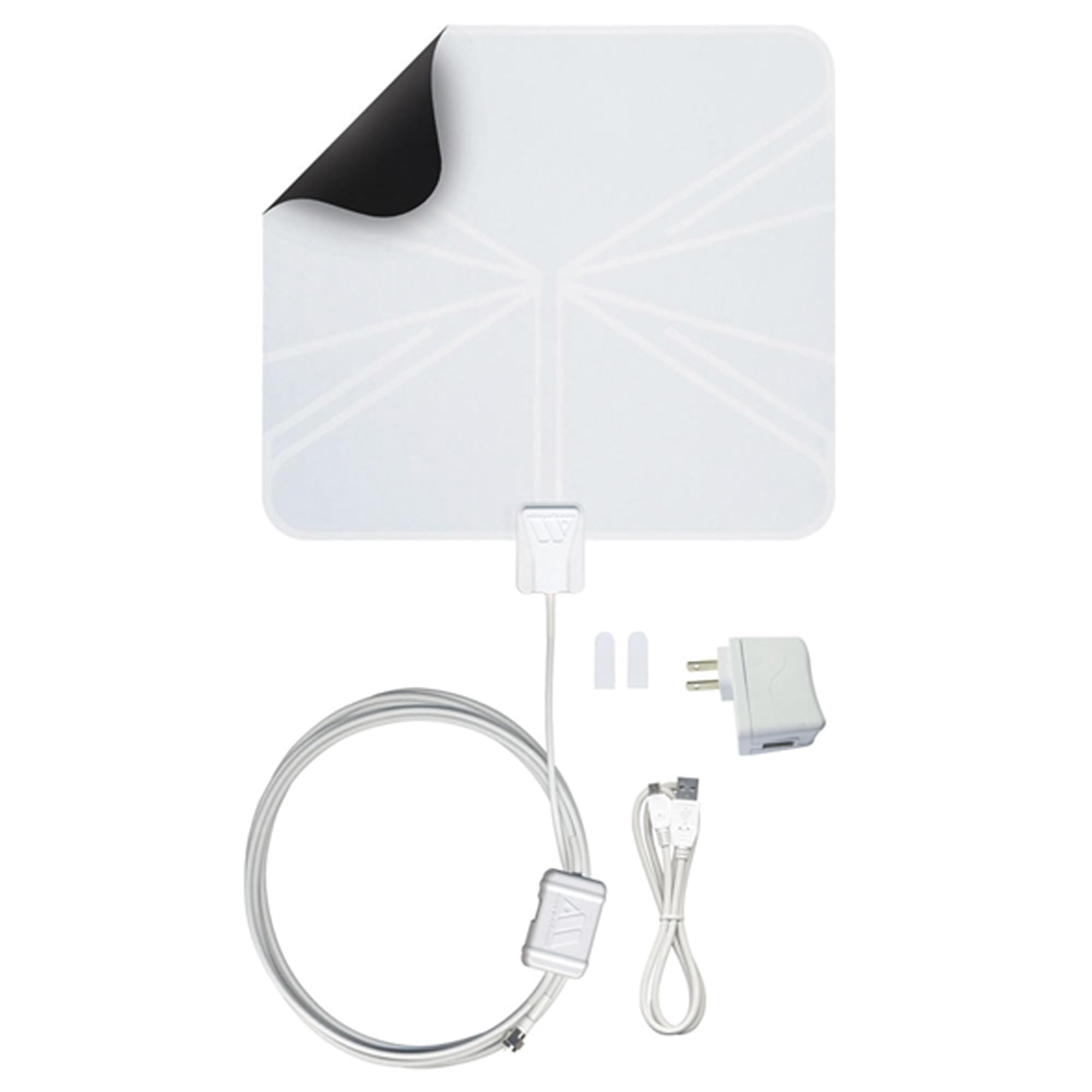
The Winegard FlatWave combines a slim 0.6-inch panel with a built-in amplifier tuned for urban and suburban environments up to 50 miles. The dual-color design — black on one side, white on the other — lets you flip the panel to match your wall or window frame. Winegard includes a proprietary setup app that guides you through aiming by showing relative tower positions and signal strength.
This antenna picks up both VHF and UHF signals, an important distinction for areas where major networks broadcast on VHF channels. Users 10–15 miles from towers in cities like Philadelphia report 22–40 channels with the amplifier engaged. The amplifier power supply uses a short 3-foot cord, which can be restrictive for high-wall placement unless you use a USB extension. The 18.5-foot attached coax is permanently fixed, so there is no option to swap for a longer cable without an F-connector extension.
Reception consistency depends heavily on window orientation — the black side must face the towers for optimal performance. Some users report that moving the antenna just one inch on the vertical or horizontal axis changes which channels lock in. While the Winegard brand carries decades of RF engineering credibility, the permanently attached coax and short power cord limit placement flexibility compared to modular alternatives.
Why it’s great
- Trusted Winegard engineering with decades of broadcast antenna experience
- Dual-color panel blends with both light and dark walls
- Setup app provides real-time tower alignment guidance
Good to know
- Coax cable permanently attached and limited to 18.5 feet
- Amplifier power cord is short at around 3 feet
FAQ
What is the real difference between a 60-mile and a 200-mile antenna?
Do I need a coaxial cable with a specific rating for digital TV antennas?
Will a digital TV antenna work through metal siding or foil-backed insulation?
Final Thoughts: The Verdict
For most users, the antenna for digital tv winner is the Antennas Direct ClearStream 2V because its reflector-enhanced multi-directional design delivers consistent channel counts in suburban and rural settings without needing a rotator. If you want the convenience of no aiming at all, grab the 1byone Outdoor 360° and let its omni-directional pattern handle towers scattered around your home. And for an indoor-first setup with real-time amplifier control, nothing beats the Mohu Leaf Amplified and its Jolt Switch.