
Our readers keep the lights on and the weekend projects moving. As an Amazon Associate, I earn from qualifying purchases.
Reading channel markers in a heavy chop or identifying a drifting buoy at dusk demands optics engineered specifically for the marine environment — where fog, spray, and a rocking deck ruin standard binoculars. The wrong choice leaves you with blurry images and a useless paperweight the moment salt air hits the lenses.
I’m Rikta — the co-founder and writer behind FitlyFast. My research focuses on marine-grade build tolerances, prism alignment stability under vibration, and the optical coatings that actually deliver light transmission in low-light on-water conditions.
After analyzing seven top-tier models built for wet, unstable environments, the following guide delivers the clearest path to finding the absolute best boating binoculars for your specific vessel and visibility needs.
How To Choose The Best Boating Binoculars
Selecting marine binoculars isn’t about picking the highest magnification. The entire design philosophy shifts when you view from a moving platform surrounded by moisture, salt, and vibration. Here are the concrete factors that determine whether your binoculars survive the season or fail the first time a wave hits the gunwale.
Magnification and Objective Lens: The 7×50 Rule
7x magnification paired with a 50mm objective lens is the maritime standard for a reason. The 7x power keeps the image steady without your arms fighting the motion of the boat — higher magnification like 10x or 12x amplifies every pitch and roll, turning the view into a shaky mess. The 50mm lens gathers enough light to keep the image bright in overcast conditions, dusk, or morning fog. This specific combination delivers a large 7.1mm exit pupil, which is wider than your pupil in daylight, meaning you don’t lose brightness even if the binoculars shift slightly in your hands.
Waterproofing and Fogproofing: Beyond the IP Rating
Not all “waterproof” binoculars can handle salt spray. Look for O-ring sealed models with dry nitrogen purging — this prevents internal fogging when the temperature drops suddenly, a common scenario when moving from a hot cabin into a cool offshore breeze. A model that claims to float is a separate category: floatable binoculars use sealed air chambers that add bulk but save your gear if it goes overboard. Decide whether floating capability matters more than a slimmer, more pourable profile.
Prism Type and Lens Coatings
Porro prism designs offer a wider field of view and better depth perception, which is critical for judging distance on the water. BAK-4 glass is non-negotiable — it eliminates stray light and sharpens the image edge-to-edge. Fully multi-coated optics (every lens surface coated) versus fully coated (only outer surfaces) makes a noticeable difference in glare reduction and color fidelity when the sun reflects off the water’s surface. Green or blue coatings are common; what matters is the number of coated surfaces, not the color.
Quick Comparison
On smaller screens, swipe sideways to see the full table.
| Model | Category | Best For | Key Spec | Amazon |
|---|---|---|---|---|
| Steiner Military-Marine 7×50 | Premium | Rugged offshore use | Floating Prism, 11G shock | Amazon |
| Fujifilm Fujinon Mariner 7×50 | Premium | Optical clarity & compass | 7.1mm exit pupil | Amazon |
| Bushnell Marine 7×50 | Mid-Range | Coast Guard recommended | BaK-4, fully multi-coated | Amazon |
| Steiner Marine 7×50 | Mid-Range | Sports Auto-Focus ease | 20 yard-infinity focus | Amazon |
| USCAMEL 10×50 Marine | Mid-Range | Integrated compass & reticle | Floating, 396ft FOV | Amazon |
| Bushnell H2O 10×42 | Value | Compact travel & light use | IPX7 waterproof | Amazon |
| Barska Floatmaster 7×50 | Budget | Floating design, low cost | Fully multi-coated | Amazon |
In‑Depth Reviews
1. Steiner Military-Marine 7x50mm Binoculars

The Steiner Military-Marine is the most over-engineered option in this roundup, built on a Makrolon polycarbonate chassis rated to withstand 11 Gs of impact. The NBR Long Life rubber armoring resists oil, salt, and extreme temperatures, making this the set you trust when you are miles offshore and the weather turns. The Sports-Auto-Focus system lets you calibrate each eyepiece once, then hold a sharp image from 20 yards to infinity without touching the focus wheel — critical when you need to keep one hand on the helm.
The optical performance is exceptional: edge-to-edge sharpness with minimal chromatic aberration, and the 7.1mm exit pupil delivers a brilliant image in twilight and fog. Field of view measures 387 feet at 1000 yards, which is competitive but slightly narrower than some porro prism designs. The unit is heavy at just over 2 pounds, but that mass contributes to steady holding in wind and chop.
The Heritage Warranty is a lifetime “no questions asked” repair or replace policy — a rare guarantee at this tier. The floating prism system uses flexible silicone lens mounts that absorb severe shock without losing collimation. If you only buy one pair of binoculars for serious marine use, this is the one that survives the season.
Why it’s great
- Military-grade impact resistance with 11G-rated chassis
- Sports-Auto-Focus eliminates constant refocusing on moving water
- Lifetime transferable warranty with no questions asked
Good to know
- Heavy construction at over 2 pounds adds to arm fatigue on long watches
- Rear objective lens caps feel less secure than the front covers
2. Fujifilm Fujinon Mariner 7×50 WPC-XL Porro Prism Binocular

Fujinon optics carry a deserved reputation in marine circles for delivering glass quality that competes with models costing three times as much. The Mariner 7×50 uses a porro prism design with fully coated optics and a large 7.14mm exit pupil that absolutely shines in low-light conditions — think pre-dawn departures or post-sunset returns through a narrow channel. The 7-degree apparent angle of view translates to 367 feet at 1000 yards, giving you solid situational awareness without excessive scanning.
The world compass is illuminated and accurate for taking bearings on buoys and landmarks. Individual focus means you set each eyepiece once for your vision, then everything from 20 feet to infinity stays crisp — no fumbling with a center wheel while bracing against a roll. The unit floats when used with the provided strap, a critical safety net for small boat operators. Build quality is light at just over 1.5 pounds, though the plastic housing feels less ruggedized than rubber-armored competitors.
Customer reviews spanning nearly two decades consistently praise the optical clarity as equal to much pricier European glass. The trade-off is a less armored feel — drop these on a hard deck and you may test the limits of the polycarbonate shell. But for pure optical performance at this price point, the Mariner is unmatched.
Why it’s great
- Optical clarity rivals binoculars at double the price point
- Large 7.14mm exit pupil for superior low-light performance
- Floats with strap and includes illuminated compass for bearing-taking
Good to know
- Plastic housing feels less rugged than fully rubber-armored alternatives
- Individual focus requires initial calibration for each user
3. Bushnell Marine 7×50 Waterproof Binocular

The Bushnell Marine 7×50 carries the Coast Guard recommendation and it earns that badge through straightforward, no-nonsense engineering. The porro prism system with BaK-4 glass and fully multi-coated optics delivers a bright, wide field of view at 7.5 degrees (393 feet at 1000 yards) — one of the widest in this comparison. The 7.1mm exit pupil pairs with UV-protected coatings to cut glare from the water’s surface while maintaining color fidelity.
The rubber armor is non-slip and non-skid, with a tactile texture that stays grippy even when wet from spray. It is hermetically sealed and nitrogen-purged, so fogging is not a concern when moving from a warm cabin into cool offshore air. The individual focus system — set each eyepiece once — works well for marine use where you spend most of your time scanning distances beyond 50 yards. At roughly 2.2 pounds, it is not lightweight, but that heft translates to a steadier image on a rocking deck.
Bushnell backs this with a limited lifetime warranty, which adds peace of mind for a piece of gear that takes regular salt exposure. Customer feedback from Alaska cruises and coastal fishing trips consistently praises the clarity and ease of use. This is the set for the boater who wants proven reliability without overpaying for niche features they will not use.
Why it’s great
- Coast Guard recommended with proven marine-grade construction
- Wide 7.5-degree field of view for situational awareness
- Non-slip rubber armor stays grippy in wet conditions
Good to know
- Bulky and heavy at over 2 pounds for extended handheld use
- Does not float — requires a tether if used near the rail
4. Steiner Marine 7×50 Binoculars

The Steiner Marine 7×50 brings the German brand’s Sports Auto-Focus technology to a more accessible price point than the Military-Marine variant. After calibrating each eyepiece to your vision, the focus system delivers a sharp image from 20 yards to infinity with no further adjustments — ideal for the boater who needs to grab and glass without fiddling. The high-contrast optics produce true-to-life color reproduction that cuts through haze better than budget coated systems.
The floating prism system uses flexible silicone lens mounts to absorb shock and maintain collimation after drops or impacts. At 7.14mm exit pupil, low-light performance is excellent for reading channel markers at dusk. The rubber armor is ergonomically ribbed for a secure grip when wet, though the 2.2-pound weight is substantial for extended glassing sessions. Field of view is 356 feet at 1000 yards — a bit narrower than the porro prism alternatives but still adequate for scanning.
The Heritage Warranty is a lifetime repair or replace policy, though it does not cover damage, loss, or theft. Customers consistently note that the clarity surpasses mid-range Nikons and Bushnells they have owned previously. If you prioritize fast target acquisition and shock resistance over the widest possible field of view, this Steiner is a strong contender.
Why it’s great
- Sports Auto-Focus keeps everything sharp from 20 yards to infinity
- Floating prism system protects optics from shock and drops
- Excellent low-light performance with true-to-life color reproduction
Good to know
- Heavy construction at over 2 pounds causes fatigue on long watches
- Narrower field of view compared to porro prism competitors
5. USCAMEL 10×50 Marine Binoculars

The USCAMEL 10×50 steps away from the 7×50 standard by offering higher magnification with an integrated illuminated compass and reticle rangefinder built directly into the left eyepiece. The field of view measures 396 feet at 1000 yards, which is generous for a 10x configuration. The BaK-4 prisms and green FMC (fully multi-coated) lenses suppress stray light effectively, delivering 99.99% stated color reproduction and bright images even in overcast conditions.
The nitrogen-purged, O-ring sealed body is fully waterproof and floats if dropped overboard — a practical feature for kayak fishermen and small boat operators. The rubberized enclosure feels solid at 3 pounds, though that weight is noticeable. The compass is illuminated by a button and works without a battery in daylight, while the reticle allows distance estimation when you know a target’s approximate size. Individual focus means no center wheel to fumble with, but it does require initial per-eye setup.
Customers report the optics are clear and sharp from 20 yards to infinity without refocusing, and the compass is accurate for navigation. The included floating neck strap and carrying case add value.
Why it’s great
- Integrated illuminated compass and reticle rangefinder for navigation
- Floating design with nitrogen-purged waterproof construction
- Excellent light gathering with BaK-4 prisms and FMC coatings
Good to know
- 10x magnification is unstable on rough water compared to 7x models
- Heavy at 3 pounds — one of the heaviest options in this comparison
6. Bushnell H2O Xtreme 10×42 Binoculars

The Bushnell H2O Xtreme takes a different approach to marine optics: a compact roof prism design paired with IPX7 waterproofing and fully multi-coated glass. The 10x magnification and 42mm objective lens create a smaller exit pupil at 4.2mm, which means you lose light gathering ability compared to 7×50 models. However, the trade-off is a significantly more portable form factor that packs easily into a glovebox or dry bag without the bulk of porro prism binoculars.
The O-ring sealed, nitrogen-purged construction prevents internal fogging, and the rubberized armor provides a non-slip grip. The 17mm eye relief is comfortable for eyeglass wearers, and the center focus wheel allows rapid adjustments. Field of view is 6.8 degrees (approximately 357 feet at 1000 yards), which is adequate but not as immersive as wider porro designs. The binocular lacks a tripod adapter socket, a notable omission for extended stationary viewing.
Customers consistently praise the optical clarity as a substantial upgrade over budget binoculars, with bright images and minimal glare. The H2O Xtreme is best suited for the boater who prioritizes portability and packability over ultimate low-light performance. If your primary use is daytime cruising in calm conditions, this is a lightweight, reliable companion that won’t take up half your gear bag.
Why it’s great
- Compact roof prism design packs easily into small spaces
- IPX7 waterproof with nitrogen purging for fog-free operation
- Excellent optical clarity at a budget-friendly entry point
Good to know
- 42mm objective lens limits low-light performance compared to 50mm models
- No tripod adapter socket for extended stationary use
7. Barska Floatmaster 7×50 Marine Binoculars
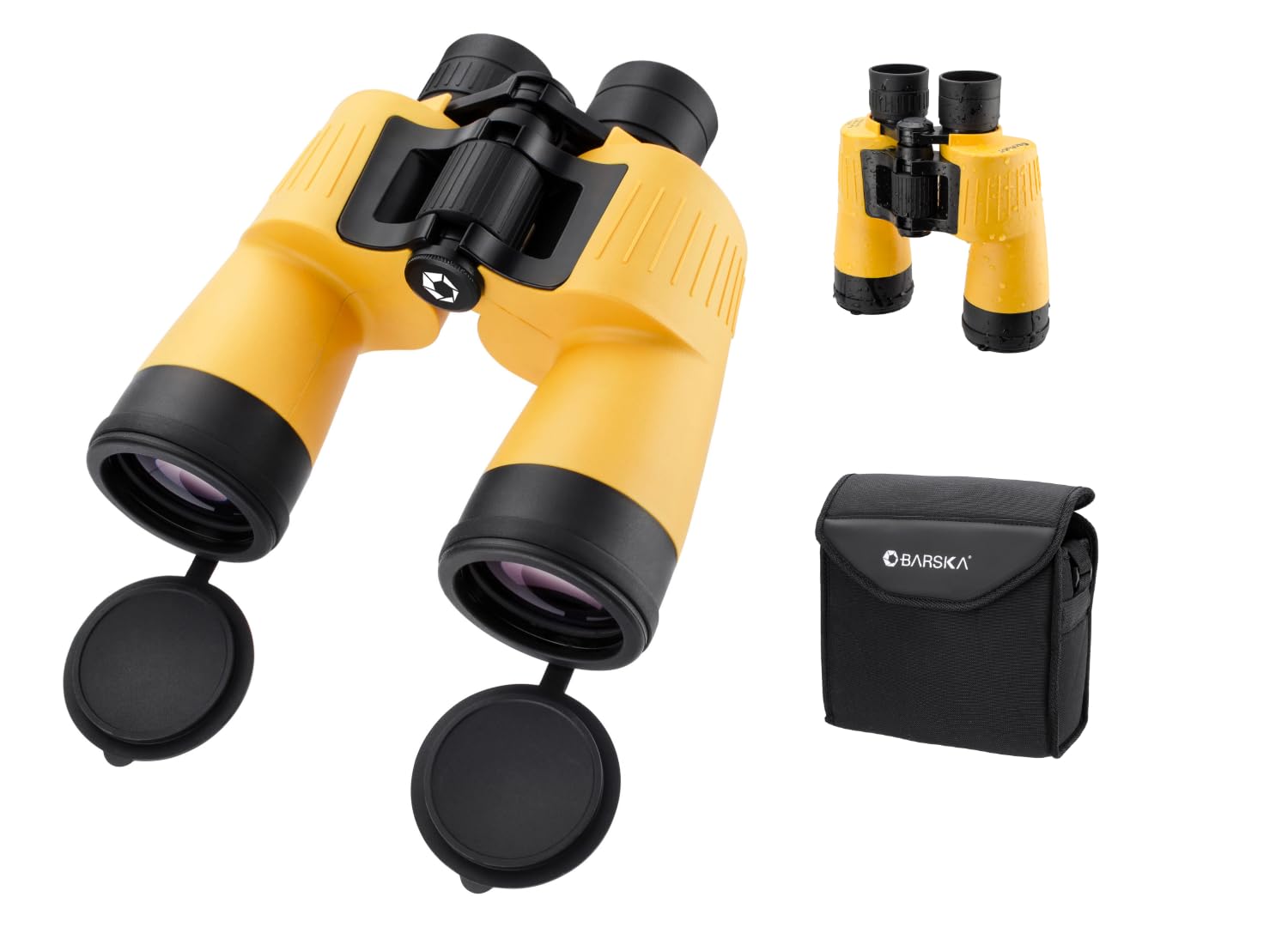
The Barska Floatmaster 7×50 is the most affordable truly marine-specific binocular in this lineup, and it earns its place by doing one thing well: floating. The compact, buoyant body is dry nitrogen-purged and sealed against water, fog, and shock. At 7×50 with fully multi-coated optics and BaK-4 prisms, the optical formula is identical to models costing several times more. The yellow rubber armor is highly visible if it goes overboard, and the floating design means you can actually retrieve it.
The eye relief is a generous 23mm, making this one of the most comfortable options for eyeglass wearers — you can keep your glasses on and still see the full field of view. The field of view is 367 feet at 1000 yards, which is solid for a 7×50 porro design. The center focus wheel is functional but can feel stiff, with some customers noting it requires two fingers to turn. Minimum focus distance is approximately 75 feet, so close-up inspection of gear or charts is not feasible.
Customers report the optical quality punches above its price class, with clear views and excellent brightness. The included carrying case, neck strap, and lens covers add value. The stiff focus mechanism and lack of a compass or rangefinder reflect the budget positioning. If you need a set of binoculars that can survive a dunking without breaking the bank, the Floatmaster is the practical choice.
Why it’s great
- Floating design ensures retrieval if dropped overboard
- Exceptional 23mm eye relief for comfortable use with glasses
- Fully multi-coated optics with BaK-4 prisms at a budget price
Good to know
- Focus mechanism is stiff and may require two hands to adjust
- Minimum focus distance of 75 feet limits close-up viewing
FAQ
Is 10x magnification too shaky for use on a boat?
Do I need floating binoculars if I never drop things overboard?
What does the illuminated compass in marine binoculars actually do?
Final Thoughts: The Verdict
For most boaters, the best boating binoculars winner is the Steiner Military-Marine 7×50 because it combines military-grade impact resistance with Sports-Auto-Focus technology and a lifetime warranty that covers the harshest marine conditions. If you want optical clarity that rivals three-times-the-price Japanese glass, grab the Fujifilm Fujinon Mariner 7×50. And for a proven, budget-conscious choice backed by the Coast Guard recommendation, nothing beats the Bushnell Marine 7×50.