
Our readers keep the lights on and the weekend projects moving. As an Amazon Associate, I earn from qualifying purchases.
Box-store soundbars promise cinematic audio, yet most deliver a thin, hollow sound that collapses during an action scene. A real audio system demands a subwoofer that shakes the floor, dialogue so crisp you never hit rewind, and a soundstage wide enough to place every footstep, whisper, and explosion with surgical precision. This guide cuts through the marketing noise to find the nine systems that actually deliver on that promise.
I’m Rikta — the co-founder and writer behind FitlyFast. My research focuses on analyzing audio specifications, decoding Dolby Atmos implementations, and identifying which acoustic architectures provide measurable improvements over standard TV speakers.
Whether you are building a dedicated home theater or upgrading your living room setup, the best audio system must balance channel count, power output, and dialogue clarity without demanding a second mortgage.
How To Choose The Best Audio System
Selecting an audio system is about matching your listening habits with the right channel configuration, amplifier power, and connectivity. A system built for blockbuster movies has different requirements than one optimized for vinyl records and acoustic music.
Channel Configuration Matters
The first number in a system’s specification (5.1, 7.1, 9.1.4) defines how many discrete audio channels are available. A 5.1 system provides left, center, right, two surround channels, and a subwoofer. The center channel is the most important for dialogue — skip systems that rely on virtual center processing unless you only watch with subtitles.
Subwoofer Size and Power
The subwoofer driver size directly correlates with bass depth and room-filling capability. An 8-inch subwoofer works well in smaller rooms, while a 10-inch driver delivers the chest-thumping low end that makes action movies immersive. Wireless subwoofers simplify placement but check for latency specifications — anything above 30ms can cause audible lag.
HDMI eARC and Codec Support
HDMI eARC is the only connection that guarantees lossless Dolby Atmos from streaming services and Blu-ray players. Optical cables cannot carry Atmos metadata. Verify the system supports Dolby Atmos, DTS:X, and Dolby Vision passthrough if you own a 4K HDR TV or gaming console.
Quick Comparison
On smaller screens, swipe sideways to see the full table.
| Model | Category | Best For | Key Spec | Amazon |
|---|---|---|---|---|
| ULTIMEA Skywave X50 | Soundbar System | Full immersive surround | 5.1.4ch / 760W / 8″ sub | Amazon |
| Sonos Arc Ultra | Soundbar | Multi-room + spatial audio | 9.1.4ch / Dolby Atmos / 4 woofers | Amazon |
| JBL Bar 700MK2 | Soundbar System | True wireless surrounds | 7.1ch / 780W / 10″ sub | Amazon |
| JBL Bar 500MK2 | Soundbar System | Powerful bass in mid-size rooms | 5.1ch / 750W / 10″ sub | Amazon |
| Bose Dolby Atmos Soundbar | Soundbar | Compact design, AI dialogue | 5 transducers / A.I. Dialogue Mode | Amazon |
| Sony BRAVIA Theater System 6 | Soundbar System | BRAVIA TV pairing | 5.1ch / DTS:X / Voice Zoom 3 | Amazon |
| Yamaha YHT-5960U | AV Receiver System | Customizable home theater | 5.1ch / 80W per ch / 8K HDMI | Amazon |
| Polk Audio Signature Elite ES20 | Bookshelf Speakers | Audiophile stereo listening | 6.5″ woofer / Power Port / 1″ tweeter | Amazon |
| Amazon Fire TV Soundbar Plus | Soundbar System | Budget-friendly 5.1 setup | 5.1ch / Dolby Atmos / DTS:X | Amazon |
In‑Depth Reviews
1. ULTIMEA Skywave X50
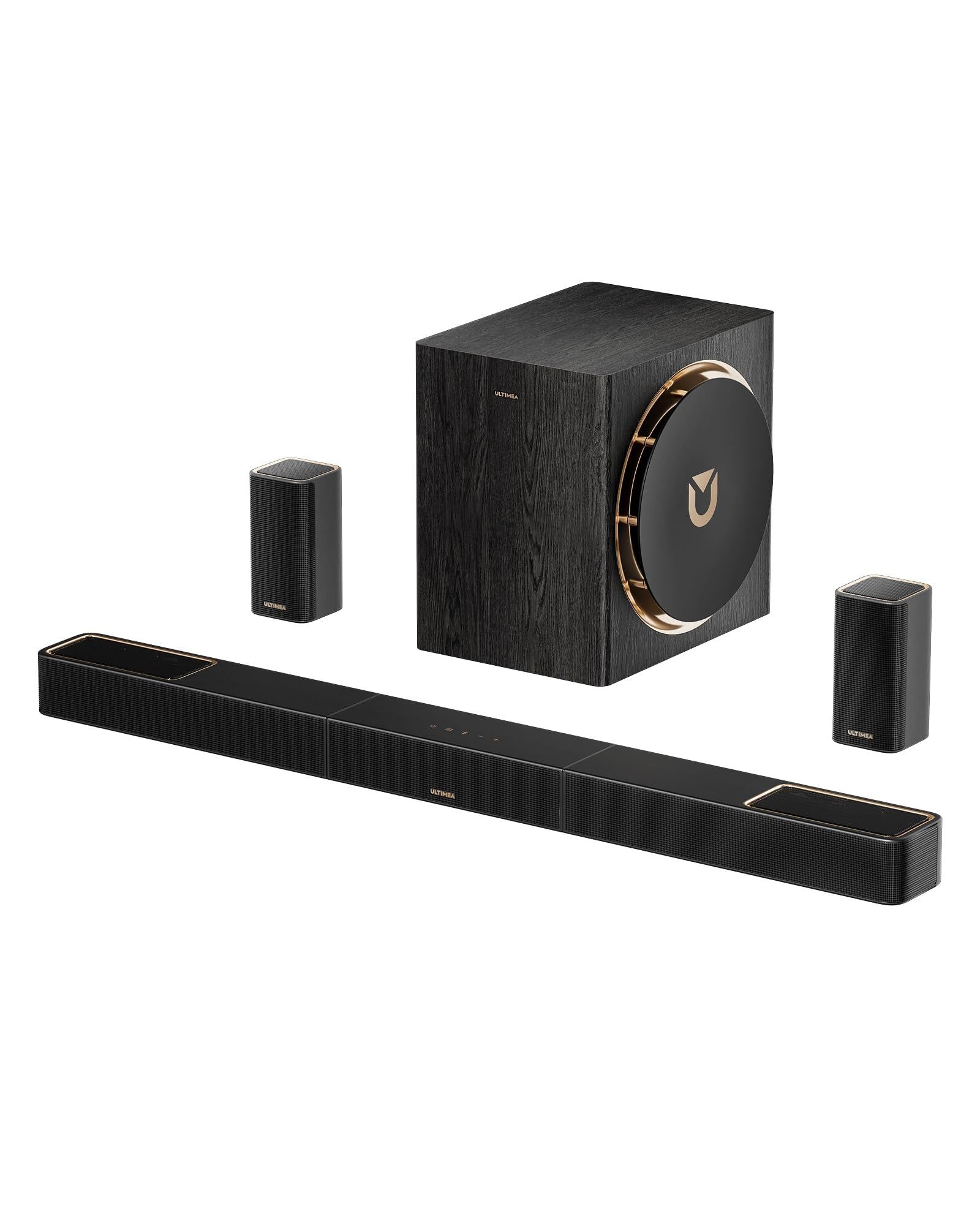
The ULTIMEA Skywave X50 delivers a 5.1.4-channel configuration with two wireless surround speakers that include upfiring drivers for height effects — a rarity at its price tier. The 8-inch subwoofer, paired with Gravus Ultra-Linear Bass Technology, produces clean, room-shaking low frequencies down to 28Hz without the muddy distortion that plagues cheaper designs. The GaN amplifier provides 760W of peak power with 98% efficiency, keeping the unit cool even during extended movie marathons.
Setup is genuinely plug-and-play: the soundbar, subwoofer, and rear speakers auto-sync via dual 5GHz wireless transmission. The NEURACORE multi-channel audio engine, driven by a triple-core DSP, processes 24-bit/192kHz audio with under 0.5% distortion. Dialogue remains anchored to the center channel, while the upfiring rears create a convincing overhead bubble during Atmos content. The wood-crafted subwoofer cabinet and metal grille with rose gold accents add premium visual weight.
This system punches well above its price class, rivaling soundbars that cost double. The wireless rear speakers require power outlets but no audio cables, and the 4K HDR passthrough ensures no signal degradation. For buyers seeking authentic 5.1.4 surround without the hassle of wired satellites or a separate receiver, the Skywave X50 is the definitive choice.
Why it’s great
- True wireless surround with upfiring Atmos speakers
- GaN amplifier delivers distortion-free 760W peak power
- Deep, clean sub-bass down to 28Hz
Good to know
- Rear speakers require a nearby power outlet
- App-based EQ lacks granular mid-range control
2. Sonos Arc Ultra Soundbar

The Sonos Arc Ultra is a 9.1.4-channel soundbar that uses Sound Motion technology — a proprietary acoustic architecture that packs 14 drivers into a single enclosure to create spatial audio without physical rear speakers. The Dolby Atmos performance is genuinely immersive: helicopters pan overhead with convincing height, and the soundstage extends well beyond the bar’s physical width. The AI-powered Speech Enhancement detects human voices and clarifies dialogue even during loud action sequences.
Setup takes minutes via the Sonos app and a single HDMI eARC connection. Trueplay tuning uses the microphone on your iOS device to analyze your room’s acoustics and calibrate the sound profile automatically. The Arc Ultra supports WiFi, Bluetooth, AirPlay 2, and Spotify Connect, and can be expanded with a Sonos Sub and Era 300 rears for a full 7.1.4 system. The elegant metal grille and low-profile design blend into most living rooms without dominating the space.
The tradeoff is the ecosystem cost. Without the Sub, the bass is adequate for small rooms but lacks the visceral punch of a dedicated subwoofer. The Arc Ultra is best for buyers who prioritize a sleek, single-bar footprint, multi-room audio, and future expandability. If you want instant wall-shaking bass, budget for the Sub.
Why it’s great
- Extraordinary 9.1.4 spatial audio from a single bar
- AI-driven Speech Enhancement clarifies every whisper
- Seamless multi-room integration with Sonos ecosystem
Good to know
- Bass performance benefits from optional Sonos Sub
- Requires WiFi for full feature set
3. JBL Bar 700MK2

The JBL Bar 700MK2 solves the biggest pain point of surround sound: speaker wire management. The two detachable surround speakers lift off the soundbar with one hand and run on internal rechargeable batteries for hours, allowing you to place them anywhere in the room — no power outlets required. When the movie ends, snap them back onto the main bar to charge overnight. The 10-inch wireless subwoofer delivers 780W of chest-thumping bass that fills medium to large rooms.
MultiBeam 3.0 technology creates a wide cinema-like soundstage even from the soundbar alone, and PureVoice 2.0 automatically adjusts dialogue clarity based on ambient scene noise and volume level. The system supports Dolby Atmos, DTS:X, and includes HDMI eARC with 4K passthrough. Night listening mode mutes the soundbar and subwoofer while routing audio exclusively through the detachable speakers placed near your listening position — perfect for late-night viewing.
The rechargeable surrounds are a genuine innovation, but their battery life requires you to remember to dock them. At louder volumes, the simulated Atmos height effects are less convincing than dedicated upfiring speakers. For anyone who wants true wireless rear channels without sacrificing bass or room aesthetics, this is the most practical solution available.
Why it’s great
- Battery-powered detachable surrounds eliminate wire clutter
- 10-inch subwoofer delivers deep, distortion-free bass
- Night listening mode for late-night use
Good to know
- Surround speakers require regular charging
- Height effects are simulated, not true upfiring
4. JBL Bar 500MK2
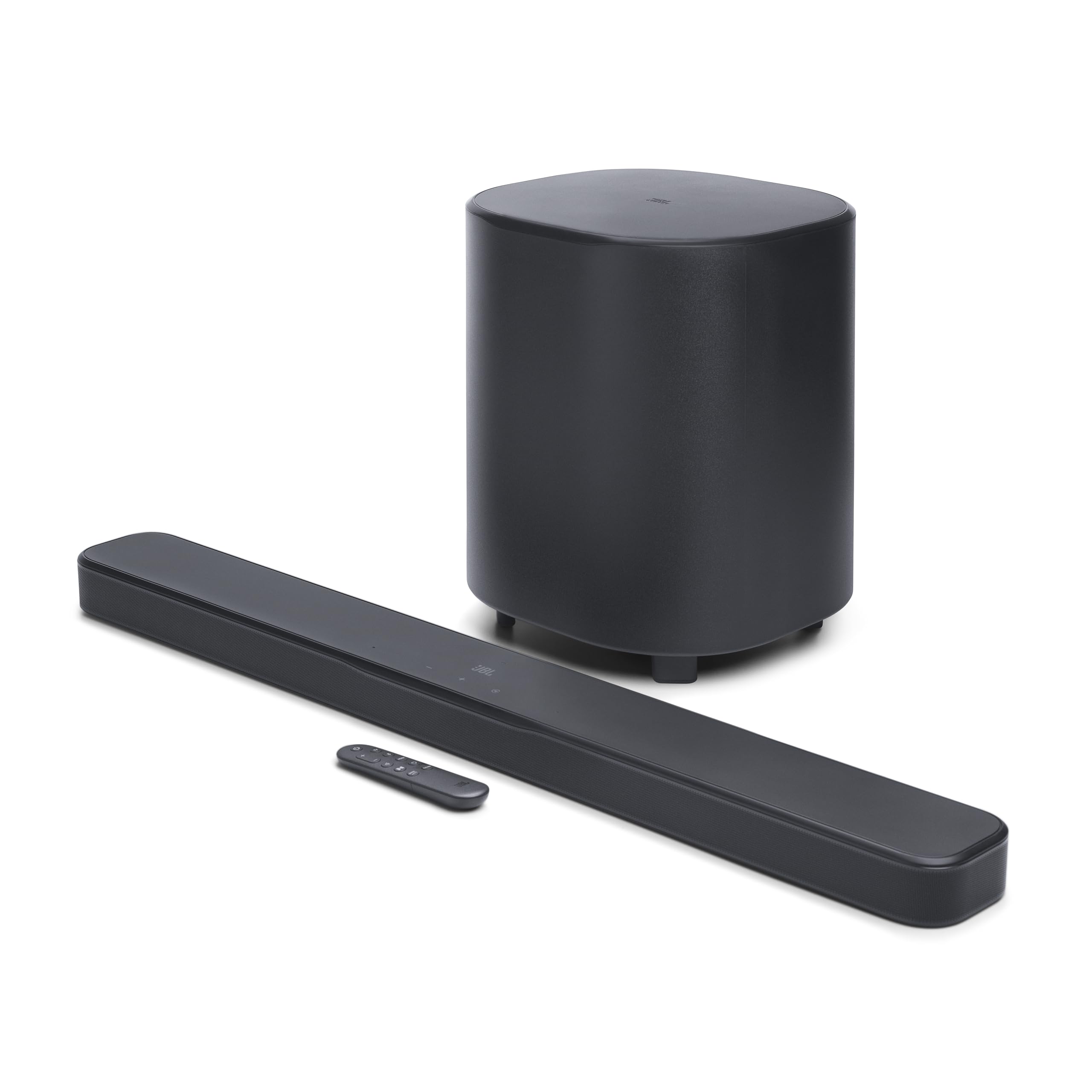
The JBL Bar 500MK2 packs a 10-inch wireless subwoofer and 750W of total power into a 5.1-channel soundbar system that outperforms many older dedicated receivers. The 10-inch driver produces bass that you feel in your chest during explosions and deep electronic music, while the soundbar’s MultiBeam 3.0 array creates a surprisingly wide soundstage without physical rear speakers. PureVoice 2.0 automatically lifts dialogue above the mix, making it a strong choice for dialogue-heavy content.
Setup is straightforward via HDMI eARC, and the JBL ONE app provides a basic EQ for adjusting bass and treble. The room calibration feature analyzes how sound reflects off your walls to optimize the surround effects. SmartDetails technology preserves subtle audio cues — creaking doors, distant footsteps — that cheaper soundbars bury. Bluetooth, AirPlay, Google Cast, and Spotify Connect cover all streaming needs.
The system lacks physical surround speakers, so the height effects are simulated rather than discrete. The app’s EQ is limited compared to more expensive systems, and some users report the sound is best at higher volumes. For a mid-size living room where wiring rear speakers is impractical, the Bar 500MK2 delivers massive bass and clear dialogue without the complexity of a full 5.1 setup.
Why it’s great
- 10-inch subwoofer provides room-filling bass
- PureVoice 2.0 delivers consistent dialogue clarity
- MultiBeam 3.0 creates wide soundstage without rears
Good to know
- No physical surround speakers included
- EQ customization is limited in the app
5. Bose Smart Dolby Atmos Soundbar

The Bose Smart Dolby Atmos Soundbar crams five transducers — including two upward-firing drivers — into a chassis that measures just over two inches tall. TrueSpace technology analyzes non-Atmos signals (stereo, 5.1) and upmixes them to create a convincing multi-channel experience, so even older content benefits from spatial processing. The A.I. Dialogue Mode uses machine learning to separate vocal frequencies from background effects, producing the clearest voice reproduction in this list without sounding artificial.
Built-in Amazon Alexa and Bose Voice4Video integration let you control the soundbar, your TV, and connected cable boxes with voice commands. Streaming options include Bluetooth, AirPlay 2, Spotify Connect, and Chromecast. The soundbar’s acoustic architecture is designed to work with Bose Ultra Open Earbuds as rear surround channels, though that requires an additional purchase. Setup via the Bose Music app is smooth, though some users report initial firmware updates take multiple attempts.
The bass is adequate for a bar of this size but will not satisfy subwoofer enthusiasts without adding the Bose Bass Module 500 or 700. The soundstage is impressively wide for a single unit, but content without spatial metadata sounds less immersive than a dedicated 5.1 system. This is the right choice for buyers who insist on premium build quality, a tiny footprint, and the absolute best dialogue processing available.
Why it’s great
- Industry-leading A.I. Dialogue Mode for vocal clarity
- Ultra-compact design with upward-firing Atmos drivers
- TrueSpace upmixing enhances non-Atmos content
Good to know
- Bass requires optional subwoofer for impact
- App setup can require multiple attempts
6. Sony BRAVIA Theater System 6

The Sony BRAVIA Theater System 6 provides a genuine 5.1-channel layout with three front-firing drivers, two compact rear speakers, and a wired subwoofer. The dedicated center channel speaker ensures dialogue stays locked to the screen, and support for Dolby Atmos and DTS:X provides flexibility across streaming platforms. Voice Zoom 3, exclusive to BRAVIA TV pairings, analyzes real-time audio to enhance speech without affecting background effects.
The rear speakers are small and unobtrusive, connecting wirelessly to a separate amp box that requires a wired connection to the soundbar. The subwoofer produces clean, powerful bass that shakes the room at moderate volumes, though it must connect to the TV via HDMI or optical — not a true wireless sub. The BRAVIA Connect app offers granular control over sound profiles and volume, and the Multi Stereo mode plays identical audio from all speakers for music listening.
The stiff speaker cables and small keyhole wall mounts complicate installation compared to fully wireless systems. The soundbar’s glossy finish reflects TV content, which can be distracting in bright rooms. For Sony TV owners who want system-level integration and a true 5.1 layout with physical rears, this package offers strong value and reliable performance.
Why it’s great
- True 5.1 with dedicated center channel for dialogue
- Voice Zoom 3 integrates with BRAVIA TVs
- Powerful bass from the included subwoofer
Good to know
- Subwoofer requires wired connection to TV
- Rear speakers have small, stiff keyhole mounts
7. Yamaha YHT-5960U

The Yamaha YHT-5960U is a 5.1-channel home theater system built around the RX-V4A AV receiver, offering four HDMI 2.1 inputs with 8K60 and 4K120 passthrough, variable refresh rate (VRR), and auto low-latency mode (ALLM) for gaming. The 80-watt-per-channel amplifier drives the included four speakers and 8-inch subwoofer with YPAO automatic room calibration to optimize sound for your specific space. The MusicCast multi-room platform enables streaming across compatible Yamaha speakers.
The included speakers are acceptable for a starter system, but critical listeners will want to upgrade the front pair to entry-level bookshelf units. The 8-inch subwoofer, while adequate for small to medium rooms, lacks the low-end extension of larger subs. The YPAO calibration does a respectable job of taming room modes, but the MusicCast app setup process can be frustrating, requiring multiple applications to access all streaming services.
This system is designed for buyers who want the flexibility of a traditional AV receiver — the ability to swap speakers, add channels, and connect multiple 4K/8K sources. The non-powered subwoofer output allows for upgrading to a larger sub without replacing the receiver. If you plan to build a system over time rather than buy a sealed package, the YHT-5960U provides a solid foundation.
Why it’s great
- 8K HDMI 2.1 with VRR and ALLM for gaming
- YPAO room calibration optimizes sound for your space
- Upgradeable speaker and subwoofer paths
Good to know
- Included speakers are entry-level quality
- MusicCast app setup can be convoluted
8. Polk Audio Signature Elite ES20

The Polk Audio Signature Elite ES20 is a passive bookshelf speaker pair, not a soundbar — it requires a separate amplifier or AV receiver. The 1-inch Terylene tweeter and 6.5-inch dynamic balance woofer deliver a bright-neutral sound signature with high sensitivity, making them easy to drive even with modest amplification. Polk’s patented Power Port technology extends down to 44Hz, producing bass that is 3dB louder than conventional ported designs while minimizing port turbulence and distortion.
The ES20 speakers are larger than typical bookshelf models — nearly 14 inches deep — so they demand substantial stands or shelf space. The walnut vinyl wrap looks good from a distance but reveals its faux-wood nature up close. They are timbre-matched to the Signature Elite series, allowing seamless blending with the ES60 towers and ES35 center channel for a complete 5.1 system. For serious listening, pairing these with a quality subwoofer like an RSL Speedwoofer transforms their performance.
These are not for casual listeners who want a one-box solution. The ES20 rewards careful placement, proper amplification, and a good source. The treble can sound bright before the drivers break in, but it smooths out after 20-30 hours of use. For stereo music lovers building a dedicated listening room, these offer performance that rivals speakers costing double.
Why it’s great
- Power Port delivers deep, distortion-free bass
- High sensitivity pairs well with modest amplifiers
- Timbre-matched for seamless surround expansion
Good to know
- Deep cabinet requires ample shelf space
- Requires external amplification and subwoofer
9. Amazon Fire TV Soundbar Plus

The Amazon Fire TV Soundbar Plus delivers a complete 5.1-channel package — soundbar, wireless subwoofer, and two wireless surround speakers — at a price that undercuts most competitor soundbars alone. The dedicated center dialogue channel sharpens conversations, and the system supports both Dolby Atmos and DTS:X decoding. Movie, Music, Sports, and Night modes optimize the audio profile based on content, and Bluetooth streaming lets you play music from your phone.
Setup is exceptionally simple: the subwoofer and surround speakers auto-pair with the soundbar when powered on, eliminating manual pairing steps. The system works with any TV via HDMI-ARC or optical, not just Fire TV devices, and the included remote controls basic functions. The bass is crisp and punchy for the price, though the surround speakers must be placed within 20 feet of the soundbar for stable wireless connectivity.
Build quality is decent but not premium — the plastic enclosures feel light compared to higher-end competitors. The subwoofer requires at least 12 inches of clearance from walls to avoid boomy bass. For budget-conscious buyers who want a true multi-channel experience with physical rear speakers and a subwoofer, this system provides a genuine upgrade over TV speakers without breaking the bank. It is best paired with Fire TV devices for unified control.
Why it’s great
- Complete 5.1 setup with wireless surrounds and sub
- Dedicated center channel for dialogue clarity
- Simple plug-and-play setup, no manual pairing
Good to know
- Plastic build feels less premium than competitors
- Subwoofer needs 12-inch clearance from walls
FAQ
Do I need physical rear speakers for good surround sound?
What is the difference between HDMI ARC and eARC?
Final Thoughts: The Verdict
For most users, the best audio system winner is the ULTIMEA Skywave X50 because its 5.1.4-channel configuration with true wireless Atmos-enabled rear speakers delivers the most immersive surround experience without the clutter of wires or the cost of a separate receiver. If you want a multi-room ecosystem with a single, sleek soundbar, grab the Sonos Arc Ultra. And for a budget-friendly true 5.1 setup that outperforms its price class, nothing beats the Amazon Fire TV Soundbar Plus.