
Our readers keep the lights on and the weekend projects moving. As an Amazon Associate, I earn from qualifying purchases.
Orthostatic hypotension triggers a rapid drop in blood pressure upon standing, and an abdominal binder counters this by compressing the splanchnic vascular bed — the largest blood reservoir in your body — to maintain central venous return. Without this mechanical compression, blood pools in your gut and legs, leaving you dizzy, vision-tunneling, or even syncopal within seconds of rising. The right abdominal binder for orthostatic hypotension delivers sustained, evenly-distributed compression that stays effective throughout the day without riding up or rolling at the edges.
I’m Rikta — the co-founder and writer behind FitlyFast. I’ve spent years analyzing vascular compression devices and their physiological mechanisms, cross-referencing clinical trial parameters against consumer-grade products to identify which construction specs actually translate to symptomatic relief for orthostatic hypotension patients.
If you or your cardiologist have recommended counter-pressure therapy, finding the right tool is critical. This guide systematically evaluates the best abdominal binder for orthostatic hypotension based on compression uniformity, material breathability, adjustability range, and edge stability during positional changes.
How To Choose The Best Abdominal Binder For Orthostatic Hypotension
Selecting an abdominal binder for orthostatic hypotension means prioritizing continuous, even compression across the entire abdomen without compromising comfort during meals, bending, or transitions from sitting to standing. Beginners tend to over-index on simple wrap designs, but the real differentiators lie in material composition, closure architecture, and vertical panel height.
Compression Uniformity and Width
For orthostatic hypotension, wider is generally better. A 9-inch to 12-inch vertical panel distributes pressure across the entire splanchnic region, preventing blood pooling both above and below the navel. Look for designs with multiple independent tension panels — these allow different compression zones across the upper and lower abdomen. Single-wrap binders often create a tight band at one spot while leaving adjacent areas under-compressed, which defeats the hemodynamic purpose.
Closure System and Adjustability
Hook-and-loop closures with multi-strap or 360-degree attachment provide fine-grained tension control. You may need to increase compression after a large meal or loosen it during seated rest. Binders with only two Velcro tabs at a single angle tend to cause pressure points at the lateral edges. Prioritize models with side cinching straps or criss-cross fasteners that let you isolate tightness on the upper versus lower abdomen, mimicking the graduated compression used in clinical studies.
Material Stack and Skin Interface
Neoprene-free, latex-free constructions with a soft cotton or bamboo-derived fiber layer against the skin reduce irritation during all-day wear. Mesh-weave structures with ventilation holes prevent moisture buildup, which is critical if you sweat during orthostatic challenges. Memory-foam or polyether compression pads inside removable pockets can add focal pressure without constricting the ribcage — the ideal setup for patients who require both diffuse splanchnic compression and targeted support at the lower abdomen.
Quick Comparison
On smaller screens, swipe sideways to see the full table.
| Model | Category | Best For | Key Spec | Amazon |
|---|---|---|---|---|
| Paskyee L/XL | Mid-Range | Postural dizziness & back support | Three removable support stays | Amazon |
| Mamaway SSnugFit M | Premium | All-day sweat-free wear | Bamboo charcoal fiber blend | Amazon |
| Armstrong America S/M | Premium | High firmness compression | Tri-blend (polyester/spandex/nylon) | Amazon |
| Vive 4-Panel | Mid-Range | Easy self-application | Cotton blend with hand loop | Amazon |
| DOREIPA L | Mid-Range | POTS-related dizziness | Bamboo charcoal polyester | Amazon |
| Velpeau L | Budget | Focal hernia support | Medical-grade polyether pad | Amazon |
| Armstrong America XXXL | Budget | Plus-size compression | 9.5-inch width, removable pad | Amazon |
In‑Depth Reviews
1. Paskyee Postpartum Belly Band L/XL
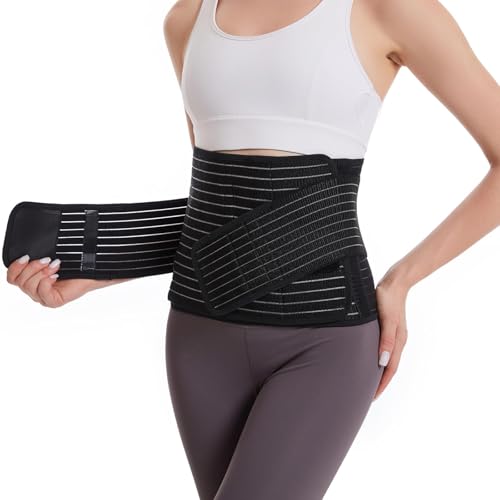
The Paskyee belt uses three removable support stays that let you dial in structural rigidity — a unique feature for orthostatic hypotension binders where positional stability is essential during the sit-to-stand transition. The stays prevent edge curling, maintaining consistent splanchnic compression even as you twist or bend. At 9 inches wide, the L/XL covers the entire abdominal reservoir without digging into the lower ribs.
Buyers report using it to assist uterine contraction and reduce postural effort after multiple abdominal surgeries, but the real value for hypotension comes from the dual-strap outer Velcro system. You can independently tension the upper band for diastasis support and the lower band for pelvic compression, effectively creating two pressure zones. The mesh weave exterior keeps airflow high, which matters during symptom-triggering heat exposure.
The stretchable belt construction does not rely on a single wrap — the two side straps overlap at any point, accommodating variable abdominal circumference throughout the day. This is critical for orthostatic hypotension management because postprandial splanchnic dilation often requires mid-day re-tightening. The Paskyee handles this without the band bunching or losing purchase on the loop surface.
Why it’s great
- Three removable stays prevent edge roll better than any foam-only binder
- Independent upper and lower tension straps mimic graduated compression
- Mesh weave construction stays breathable during extended wear
Good to know
- Runs slightly short in vertical height for very tall torsos
- Only two sizes available — limited granularity for fine-tuning fit
2. Mamaway SSnugFit Postpartum Belly Band M

The Mamaway band is the only option in this lineup built from a bamboo charcoal fiber blend (52% nylon, 34% polyester derived from bamboo charcoal, with rubber and spandex for elasticity). This material is significantly more breathable and sweat-wicking than standard nylon or polyester wraps, a real advantage for orthostatic hypotension patients who experience temperature dysregulation during blood pressure drops. The bone-free design allows comfortable side-sleeping, which matters for 24/7 counter-pressure protocols.
Its criss-crossing side Velcro tabs create a wide overlap region — users who order one size up actually get more compression surface because the extra material stacks. This is the opposite of most binders, where sizing up creates loose spots. The fabric resists rolling, shrinking, and slipping even after repeated hand washing, which directly supports the long-term consistency of splanchnic compression required for symptomatic control.
Reviewers consistently mention that the Mamaway outlasts hospital-issued binders by months. The pull-on style with dual side cinches makes donning easier than overhead wraps, especially for patients with limited standing tolerance. The main trade-off is the single size per unit — you cannot independently tension the upper and lower halves, so pressure distribution depends entirely on the initial fit selection.
Why it’s great
- Bamboo charcoal polyester offers superior breathability over standard synthetics
- Bone-free construction allows comfortable side-sleeping
- Wide overlap area provides consistent compression even if you size up
Good to know
- No independent upper/lower tension zones
- Slightly expensive for a single-size band
3. Armstrong America Abdominal Binder S/M
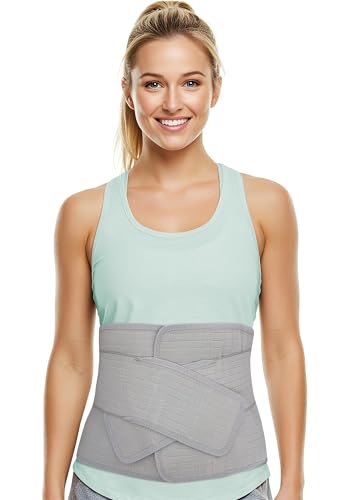
The Armstrong America S/M binder uses a 50% polyester, 30% spandex, 20% nylon tri-blend that provides noticeably higher compression firmness than single-material wraps. The spandex component gives it a shape-memory quality — it conforms to female curves and male torsos equally without bagging at the waist. Multiple post-hernia repair users confirm it held a cantaloupe-sized abdominal protrusion pre-operatively, which speaks directly to its ability to generate the 15-20 mmHg compression range that counteracts orthostatic pooling.
Its strong hook-and-loop closure across the full panel width prevents the common failure mode where the edge of a binding separates when you lean forward. The fabric does not initiate rolling even after dozens of wear cycles, and the breathable knitted structure prevents heat trapping — a common complaint with firmer binders. Sizing is deceptive, however: the S/M only covers up to approximately 40 inches, so most male patients will need to order one size up from their typical clothing size.
The Light Grey color shows less visible wear than black binders, which lose dye contrast over repeated hand washing. The straight-cut edge design distributes pressure evenly across the abdomen without a focal compression pad, so this works best as a pure splanchnic constriction device rather than a targeted hernia support. For hypotension management, the uniform front compression is actually preferable to pad-based designs that create pressure points.
Why it’s great
- Spandex-enhanced tri-blend provides excellent shape memory and consistent compression
- Full-width Velcro prevents edge separation during movement
- Breathable knit structure minimizes heat buildup
Good to know
- Sizing runs shorter than chart claims — measure carefully
- No removable pad for focal pressure adjustment
4. Vive Abdominal Binder 4-Panel
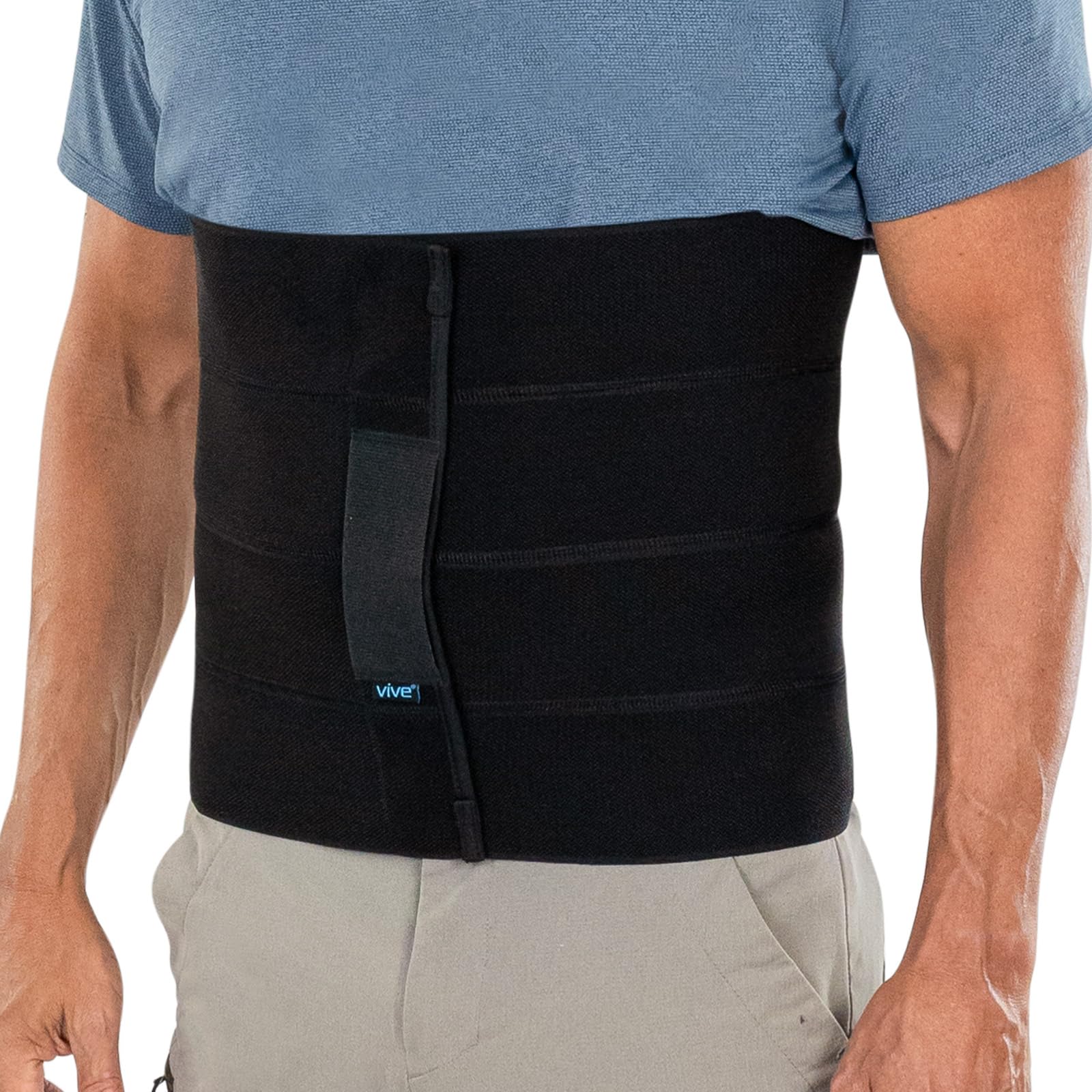
The Vive binder distinguishes itself with a 4-panel construction and an integrated hand loop that simplifies self-application — a genuine advantage when orthostatic symptoms make bending down difficult. The cotton-shell fabric feels significantly softer against sensitive skin than the nylon-dominant alternatives, reducing itching during long sessions. Available from Small to 3XL with both 2-panel (6-inch) and 3-panel (9-inch) width options, it accommodates a broader range of torso lengths than most binders.
The 9-inch width provides enough vertical coverage to compress both the upper and lower splanchnic regions, and the 4-panel design allows independent tensioning across the four quadrants of the abdomen. Users report that the binder stays in place without riding up during prolonged seated work, largely because the hand loop anchors the fabric during the initial positioning step. The hook-and-loop closure spans the full front, distributing tension without singling out the midline.
The cotton blend does have slightly less elastic recovery than the spandex-reinforced options, meaning it may require more frequent re-tightening after several hours. However, for hypotension patients who prioritize skin comfort and easy donning over maximum compression stiffness, the Vive balance of softness and adjustability makes it a strong contender. The 60-day guarantee provides added confidence for first-time abdominal binder users.
Why it’s great
- Cotton shell is noticeably softer against sensitive skin than nylon wraps
- Integrated hand loop makes self-application easier during orthostatic episodes
- Available in 2-panel and 3-panel widths for torsion-specific fit
Good to know
- Cotton blend has slightly less elastic rebound than synthetics
- 4-panel design requires more deliberate strap alignment
5. DOREIPA Abdominal Binder L
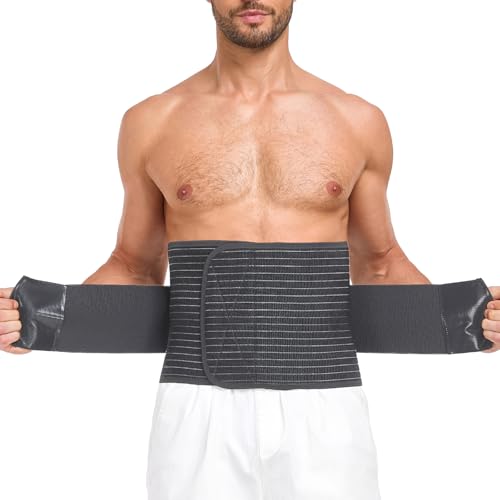
The DOREIPA binder is built from polyester infused with bamboo charcoal fiber, giving it a soft hand feel and natural odor resistance that nylon lacks. Its defining mechanical feature is the extra external belt that cinches over the primary wrap — a second compression layer that you can tighten separately from the main band. This creates graduated pressure where the inner band provides diffuse support and the outer belt focuses tension along the midline, precisely the configuration that helps maintain central venous return after meals.
User reports from POTS (postural orthostatic tachycardia syndrome) patients, which shares the same blood-pooling mechanism as orthostatic hypotension, describe this binder as a “game changer” for eating without triggering dizziness. The Velcro closure allows micro-adjustments throughout the day without removing the binder, and the material softens after the first few wears without losing structural tension. The thin profile wears discreetly under shirts, which supports consistent compliance for hypotension management.
The hook-and-loop surface does attract lint and pet hair more aggressively than smooth-woven options, and the S/M sizing runs snug relative to waist measurements — the size large fits a 38-inch waist well but may constrict users at the upper end of its range. For orthostatic hypotension, where compression needs vary hour-to-hour, the dual-layer system offers flexibility that single-wrap binders cannot match.
Why it’s great
- Dual-layer design provides graduated compression that improves with a second cinch belt
- Bamboo charcoal fiber resists odor and feels soft against skin
- POTS users report noticeable relief in post-meal dizziness
Good to know
- Velcro catches lint and fabric debris easily
- Sizing runs tighter than average — consider ordering one step up
6. Velpeau Umbilical Hernia Belt L

The Velpeau belt comes with a removable medical-grade polyether compression pad that allows focal pressure over the lower abdomen while the mesh fabric provides diffuse support across the broader splanchnic area. The ventilation holes integrated into the pad minimize sweat accumulation, which is relevant for patients who wear the binder during heat-sensitive hypotensive episodes. Made without neoprene or latex, it is one of the most hypoallergenic options in the budget tier.
The breathable mesh nylon/spandex outer layer is thin enough to wear beneath underwear without visible bulk, supporting consistent daily use. The hook-and-loop fastening system allows infinite adjustment across the belt length, so you can tighten it incrementally as your abdomen changes during the day. Users report wearing it for full days without irritation, and several mention it provides lower back support as a secondary benefit — helpful for the postural fatigue that often accompanies orthostatic hypotension.
The trade-off is that the compression is less uniform across the upper abdomen because the pad concentrates force at the navel area. For pure orthostatic hypotension management without a concurrent hernia, the focal compression may feel too specific. The pad is also thinner than standalone foam pads, so it cannot generate high focal pressure. But as a budget entry point to test whether abdominal binding helps your symptoms, the Velpeau offers a low-commitment introduction.
Why it’s great
- Latex-free and neoprene-free construction reduces irritation risk
- Removable polyether pad lets you test focal or diffuse compression
- Mesh fabric keeps the waist area ventilated during full-day wear
Good to know
- Focal pad design provides less upper-abdominal compression
- Largest size may not fit plus-sized torsos without alterations
7. Armstrong America Plus Size Hernia Belt XXXL
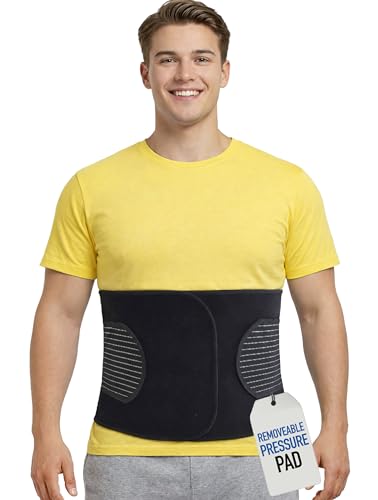
The Armstrong America plus-size belt measures 9.5 inches vertically, providing enough surface area to engage the full splanchnic bed in larger torsos without digging into the hip bones or lower ribs. The removable pressure pad sits inside a fabric pocket over the lower abdomen, allowing you to either use the pad for focused compression or remove it for a flat, uniform wrap — a useful flexibility when managing orthostatic symptoms that fluctuate throughout the day.
The nylon-blend fabric is breathable enough for extended wear, and multiple curvy buyers confirm it stays in place during bending and driving without rolling at the top or bottom edge. The hook-and-loop closure spans the full front width, so you can distribute tension evenly rather than creating a tight band at a single point. The sizing runs small in the plus range — buyers recommend ordering one or two sizes above your standard waist measurement to ensure the wrap achieves full overlap.
The main durability concern is edge curling after multiple washes; the fabric trim can begin to fray if machine-dried despite the hand-wash instructions. For orthostatic hypotension, this binder works best when the pad is removed, providing broad compression that does not create a pressure differential between the lower and middle abdomen. The edge curling reduces the effective surface area over time, which may require earlier replacement than the premium options.
Why it’s great
- 9.5-inch height covers the entire splanchnic region in larger torsos
- Removable pad allows switching between focal and uniform compression
- Breathable nylon blend performs well during active daily use
Good to know
- Edge curling occurs after repeated washing cycles
- Sizing runs small — order one to two sizes larger than your measurement
FAQ
How does splanchnic compression help orthostatic hypotension?
Can I wear an abdominal binder designed for postpartum recovery for orthostatic hypotension?
Should I wear the binder over bare skin or over clothing?
How do I determine the correct compression level for my symptoms?
Final Thoughts: The Verdict
For most users, the best abdominal binder for orthostatic hypotension winner is the Paskyee L/XL because its three removable stays prevent edge rolling during the sit-to-stand transition while the dual-strap system creates graduated upper and lower compression zones. If you prioritize fabric breathability and a bone-free design for 24/7 wear, the Mamaway SSnugFit M delivers unmatched skin comfort through its bamboo charcoal fiber blend. And for a firm, shape-retaining option with high spandex content, the Armstrong America S/M provides the strongest compression uniformity of the lineup.