
Our readers keep the lights on and the weekend projects moving. As an Amazon Associate, I earn from qualifying purchases.
A 10-inch chef’s knife is the workhorse of any serious kitchen, but the sheer range of steels, handle materials, and forging methods makes a bad purchase painfully obvious during a long prep shift. The wrong blade chips on carrots, flexes on butternut squash, or blunts after a single week of heavy use—so picking the right one is not an option, it is a necessity.
I’m Rikta — the co-founder and writer behind FitlyFast. I’ve spent years analyzing blade chemistry, edge retention tests, and ergonomic data to separate legit cutlery from marketing hype in the commercial and home chef space.
To save you from a dull, unbalanced regret, I’ve cut through the noise and assembled the only guide you need for the best 10 inch chef knife that actually earns its spot on your magnetic strip.
How To Choose The Best 10 Inch Chef Knife
A 10-inch blade offers more leverage and slicing real estate than an 8-inch, but it demands careful matching to your grip strength, cutting style, and frequency of use. Focus on three pillars: steel type, handle ergonomics, and construction method.
Steel Hardness & Edge Retention
Rockwell hardness (HRC) tells you how well the blade holds an edge. German stainless knives typically sit at 56-58 HRC, offering a tougher, more forgiving edge that resists chipping. Japanese super steels like AUS-10V push past 60 HRC for longer-lasting sharpness but require careful handling—they chip on bones or frozen food. For a home cook, mid-range German steel is a safer bet; for precision prep, high-HRC steel rewards the disciplined user.
Handle Design & Fatigue
A 10-inch blade places more weight in the tip, so the handle must counterbalance it. Look for full-tang construction where the steel extends through the handle. Materials matter: textured polypropylene or Santoprene offer slip resistance when wet, while metal handles (like Global’s dimpled stainless) are durable but can feel heavy during long sessions. A bolster-less design gives a longer usable blade edge for sharpening over the years.
Forged vs. Stamped Construction
Forged knives are cut from a single bar of steel under high heat and pressure, resulting in a thicker spine, better weight distribution, and superior durability. Stamped blades are cut from a rolled sheet of steel, making them lighter and more affordable but less rigid. For heavy daily prep into dense squash or meat, a forged blade provides the stability you need; for quick light slicing, a quality stamped blade saves money without sacrificing performance.
Quick Comparison
On smaller screens, swipe sideways to see the full table.
| Model | Category | Best For | Key Spec | Amazon |
|---|---|---|---|---|
| Wüsthof Classic IKON 10″ | Premium Forged | All-day comfort & pro heft | 58 HRC, double bolster | Amazon |
| Wüsthof Classic 10″ | Premium Forged | German steel longevity | 10.08 oz, forged tang | Amazon |
| Dalstrong Shogun Elite 10.25″ | Medium Premium | Pixel-perfect presentation cuts | AUS-10V, 62 HRC | Amazon |
| Global G-16 10″ | Mid-Range | Lightweight all-metal option | Moly/vanadium steel, 259g | Amazon |
| Mercer Culinary Genesis 10″ | Mid-Range Forged | Budget-forged workhorse | German steel, 10.08 oz | Amazon |
| Victorinox Fibrox 10″ | Value Stamped | Budget pick for light prep | 9.8 in, 0.22 kg | Amazon |
| Dexter-Russell S145-10PCP 10″ | Entry-Level | Commercial sanitation tasks | 7.84 oz, NSF certified | Amazon |
In‑Depth Reviews
1. Wusthof Classic IKON 10-Inch Chef’s Knife
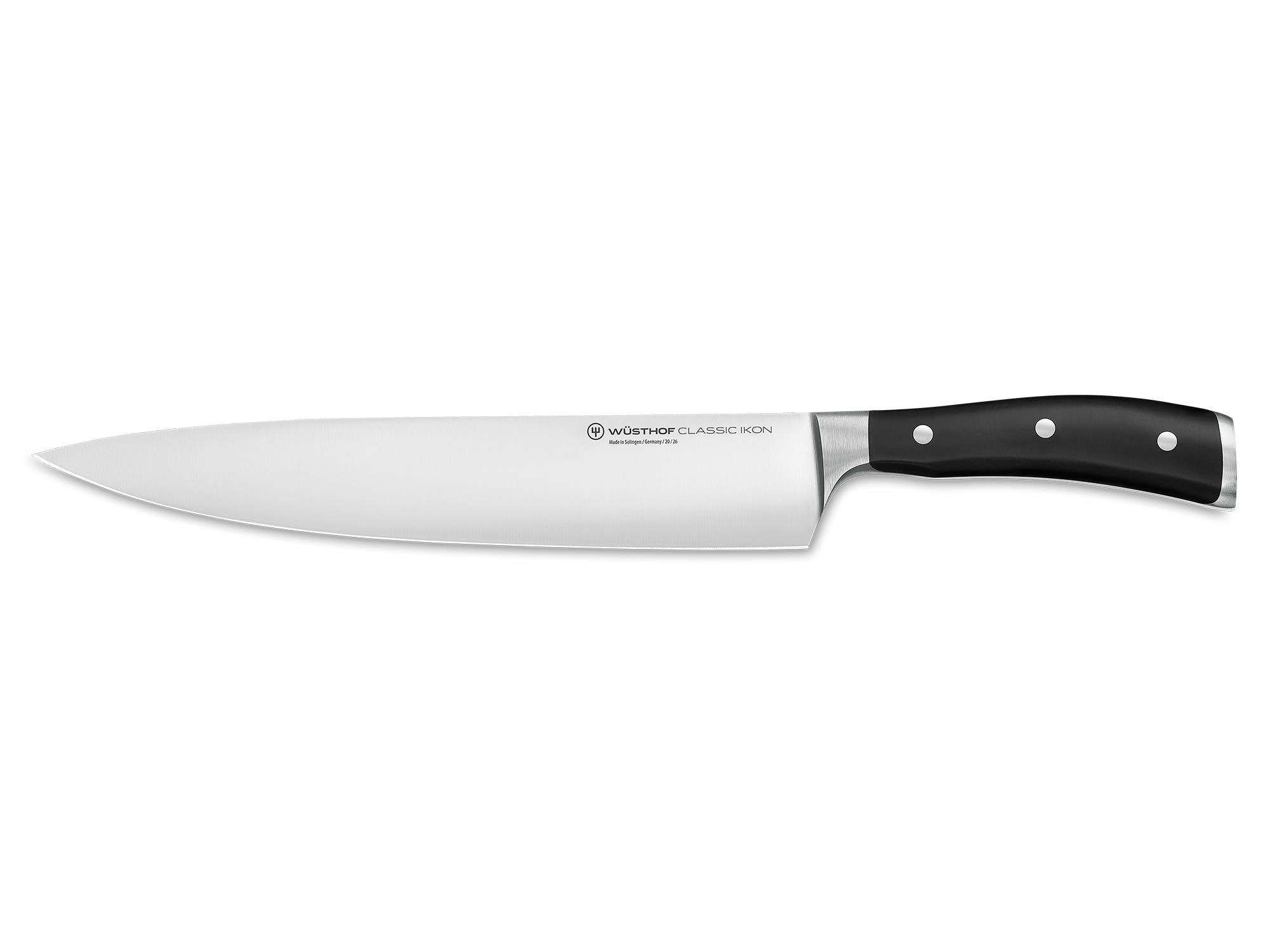
The Wüsthof Classic IKON 10-inch is a precision-forged German blade that delivers exceptional balance thanks to its double bolster design—a rare feature that shifts the knife’s center of gravity directly into the pinch grip. Out-of-box BESS-C sharpness scores rival utility razors, and PEtec edge technology claims 20% sharper edges with twice the retention of older Wüsthof lines. The synthetic handle resists fading and moisture absorption, a crucial spec for cooks who wash between every protein.
At roughly 400 grams, this knife feels authoritative in hand but not cumbersome. Reviews consistently praise its ability to glide through sweet potatoes and raw ribeye roasts with minimal wrist pressure. The full tang and triple rivet construction give it a heft that inspires confidence during heavy chopping tasks like cabbage or squash. The blade is high-carbon stainless steel hardened to 58 HRC, striking the balance between toughness and edge longevity.
The main trade-off is price—it sits firmly in entry-level luxury territory. The double bolster also shortens the usable blade length for future sharpening, though most home cooks will not wear it down for years. If you want a single do-everything knife that feels like it was forged for your hand, this is the benchmark.
Why it’s great
- Dual bolster provides perfect pinch-grip weight
- PEtec edge stays sharp twice as long as standard
- Luxury handle resists fading and staining
Good to know
- Must hand-wash and dry immediately
- Double bolster limits future sharpening area
2. WÜSTHOF Classic 10-Inch Chef’s Knife

The original Wüsthof Classic remains a staple in professional kitchens worldwide for one reason: it simply works. The high-carbon stainless steel blade is forged from a single piece of steel and tempered to 58 HRC, providing a tough edge that resists chipping even when a line cook gets aggressive with herbs or squash. The triple-riveted polypropylene handle is ergonomic and stays secure when wet, although it lacks the visual polish of the IKON’s synthetic handle.
Reviews highlight the knife’s ability to hold an edge for months with only occasional honing—professional chefs report sharpening intervals measured in months, not weeks. The classic bolster provides a safe pinch grip and prevents fingers from slipping onto the blade during repetitive mincing. At 10.08 ounces, the Classic is heavy enough to power through dense produce without feeling like a cleaver.
The biggest shortcoming is the lack of a double bolster, meaning the knife does not have the forward-weighted balance of the IKON series. Some users also note that the full tang lacks a seamless transition to the handle, which can create a small gap where food particles collect. For cooks who want legendary German durability without the luxury surcharge, this is the proven choice.
Why it’s great
- 30-year track record in pro kitchens
- Edge holds for months with honing
- Ergonomic handle stays slip-resistant
Good to know
- No double bolster for forward balance
- Handle-to-tang transition can trap debris
3. Dalstrong Shogun Elite 10.25-Inch Damascus Chef Knife

The Dalstrong Shogun Elite 10.25-inch chef knife is a visual and performance statement. The core is AUS-10V Japanese super steel hardened to 62 HRC, wrapped in 66 layers of Damascus high-carbon stainless for corrosion resistance and a striking tsunami-rose pattern. The blade is hand-finished using the 3-step Honbazuke method to an 8-12 degree angle per side, resulting in an edge that slices through tomatoes and raw meat with almost no resistance.
At 300 grams, this knife is lighter than its German counterparts, which reduces fatigue during long prep sessions. The G-10 handle is a military-grade glass-fiber laminate that is denser than typical synthetics, providing a solid, non-slip grip even when the handle is wet. The hammered (tsuchi) finish on the blade surface reduces food sticking, a practical touch for high-volume slicing of potatoes, carrots, or fish.
The razor-sharp geometry demands caution—users note the blade can chip on dense squash seeds or bone if used carelessly. The deep-etch logo on the blade also creates small crevices that can trap food particles, requiring careful cleaning. This knife rewards a precise, disciplined cutting style and is best suited for the home cook who treats sharpening as a ritual, not a chore.
Why it’s great
- 62 HRC blade stays sharp far longer than German steel
- Hammered finish prevents sticking
- G-10 handle is durable and slip-resistant
Good to know
- Hard edge chips on hard produce or bone
- Damascus etching can trap food particles
4. Global G-16 10-Inch Chef’s Knife
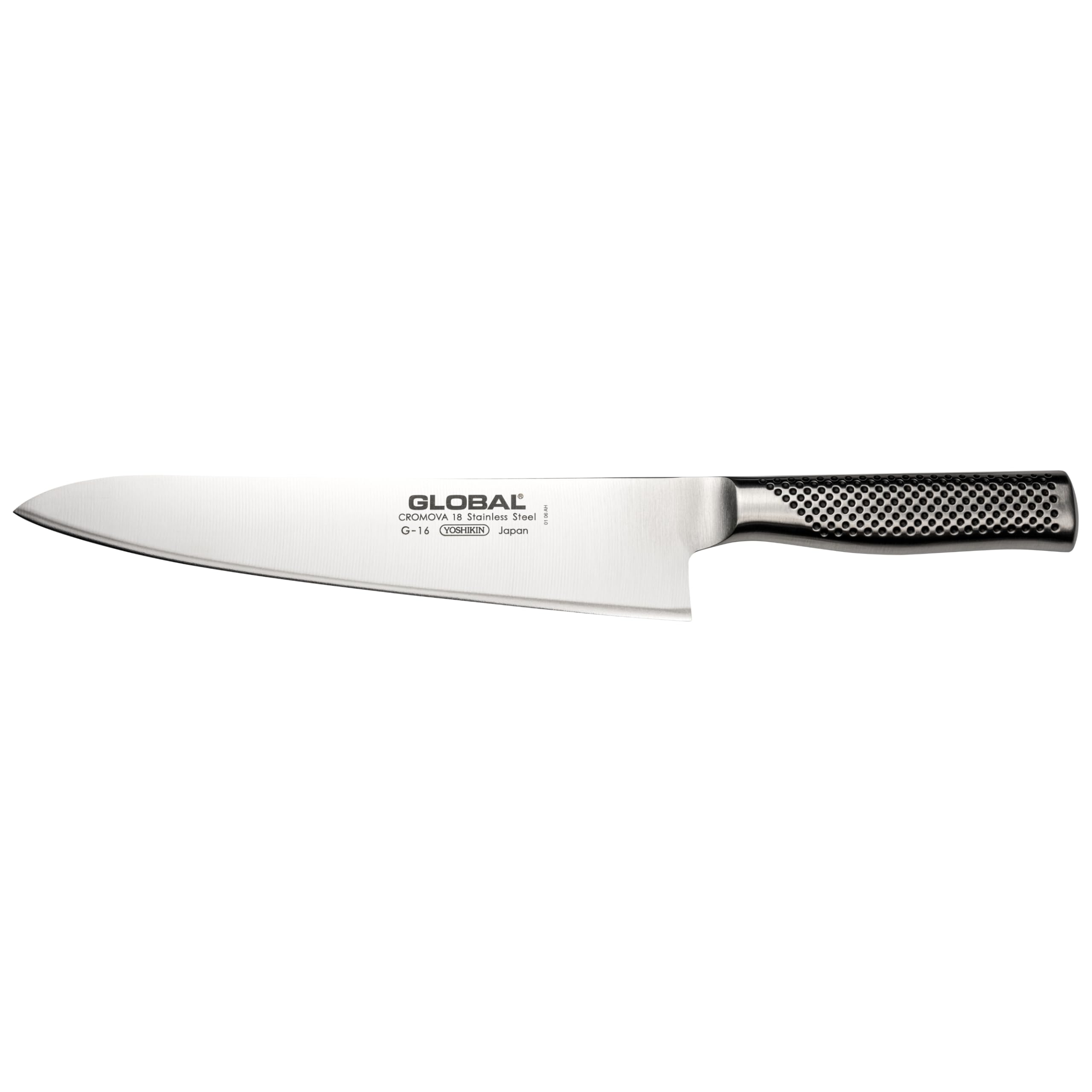
The Global G-16 is a radical departure from German heft. Its one-piece stamped stainless steel construction eliminates any joint between blade and handle, meaning no handle cracking, no rivet loosening, and a completely seamless cleaning surface. The blade is made from molybdenum/vanadium stainless steel—harder than typical German alloys—and holds its edge with only regular honing between proper sharpenings.
At 259 grams, the G-16 is noticeably lighter than any forged German knife, making it ideal for cooks with smaller hands or those who favor speed over raw power. The dimpled stainless handle offers grip without the insulation of synthetic materials, though some users find the metal handle cold initially in air-conditioned kitchens. The 10-inch blade is perfectly balanced for rocking cuts through herbs and soft vegetables.
The trade-off is brittleness. The same hardness that gives exceptional edge retention makes the blade prone to chipping on butternut squash, carrots, or any fibrous food that requires twisting. Reviews also note that the blade is not suitable for cutting through bones or frozen items. The G-16 excels as a precise slicer for raw proteins, soft produce, and herbs—but it demands to be paired with a sturdier knife for rough prep.
Why it’s great
- Seamless one-piece construction for easy cleaning
- Lightweight design reduces hand fatigue
- Factory edge lasts years with honing
Good to know
- Blade chips on dense, fibrous produce
- Metal handle feels cold initially
5. Mercer Culinary Genesis 10-Inch Chef’s Knife

The Mercer Culinary Genesis 10-inch offers forged construction—a thick, durable blade with a full tang—at a fraction of the price of German brands. Forged from high-carbon German steel with a taper-ground edge, it delivers the rigidity and weight of a traditional European chef knife without the three-digit price tag. The Santoprene handle is ergonomically shaped with a non-slip surface that remains secure even when your hands are oily or wet.
Reviews consistently highlight the knife’s surprising edge retention for its tier. Users report it holds an edge well with regular honing, though heavy daily prep (25-50 lbs of vegetables) accelerates blunting, requiring weekly touchups. At 10.08 ounces, the weight is almost identical to the Wüsthof Classic, giving it a substantial feel that helps cut through dense produce with minimal effort.
The main concern is inconsistency in edge sharpness out of the box—some units arrive razor-sharp while others need immediate stropping. The bolster is present but narrower than premium German knives, which is a non-issue for most home cooks. For the price, the Mercer Genesis punches above its weight and is the best entry point for anyone wanting a forged blade without committing to premium pricing.
Why it’s great
- Forged German steel for a premium feel
- Comfortable Santoprene handle grips well when wet
- Excellent value for forged construction
Good to know
- Out-of-box sharpness can be inconsistent
- Edge dulls faster than premium options under heavy use
6. Victorinox Fibrox 10-Inch Chef’s Knife

The Victorinox Fibrox 10-inch is the industry reference for affordable, lightweight cutlery that delivers real cutting performance. The blade is stamped from high-carbon stainless steel with a plain edge, making it lighter and less rigid than forged knives—but also more maneuverable for cooks who prioritize speed over chopping power. The Fibrox handle is textured thermoplastic rubber that remains slip-resistant even when wet, a critical feature for high-volume prep in commercial kitchens.
At only 0.22 kg (roughly 7.76 ounces), this is significantly lighter than forged German knives. This makes it ideal for cooks who suffer from wrist fatigue during long shifts, or for home cooks who only need a large blade occasionally. Reviews consistently praise the knife for punching far above its weight in sharpness—it often outperforms knives costing three times as much in the first few months of use.
The stamped construction means the blade is thinner and more flexible than forged alternatives, which can cause it to flex when cutting through hard squash or thick meat. The edge also dulls faster than premium steel, requiring more frequent sharpening. The Victorinox Fibrox is the smart choice for a backup knife, a starter knife, or any cook who wants a 10-inch blade without the cost of forged steel.
Why it’s great
- Extremely lightweight—reduces wrist fatigue
- Slip-resistant handle performs when wet
- Out-of-box sharpness rivals premium knives
Good to know
- Thinner blade flexes on dense produce
- Edge dulls faster than forged German steel
7. Dexter-Russell S145-10PCP 10-Inch Chef’s Knife
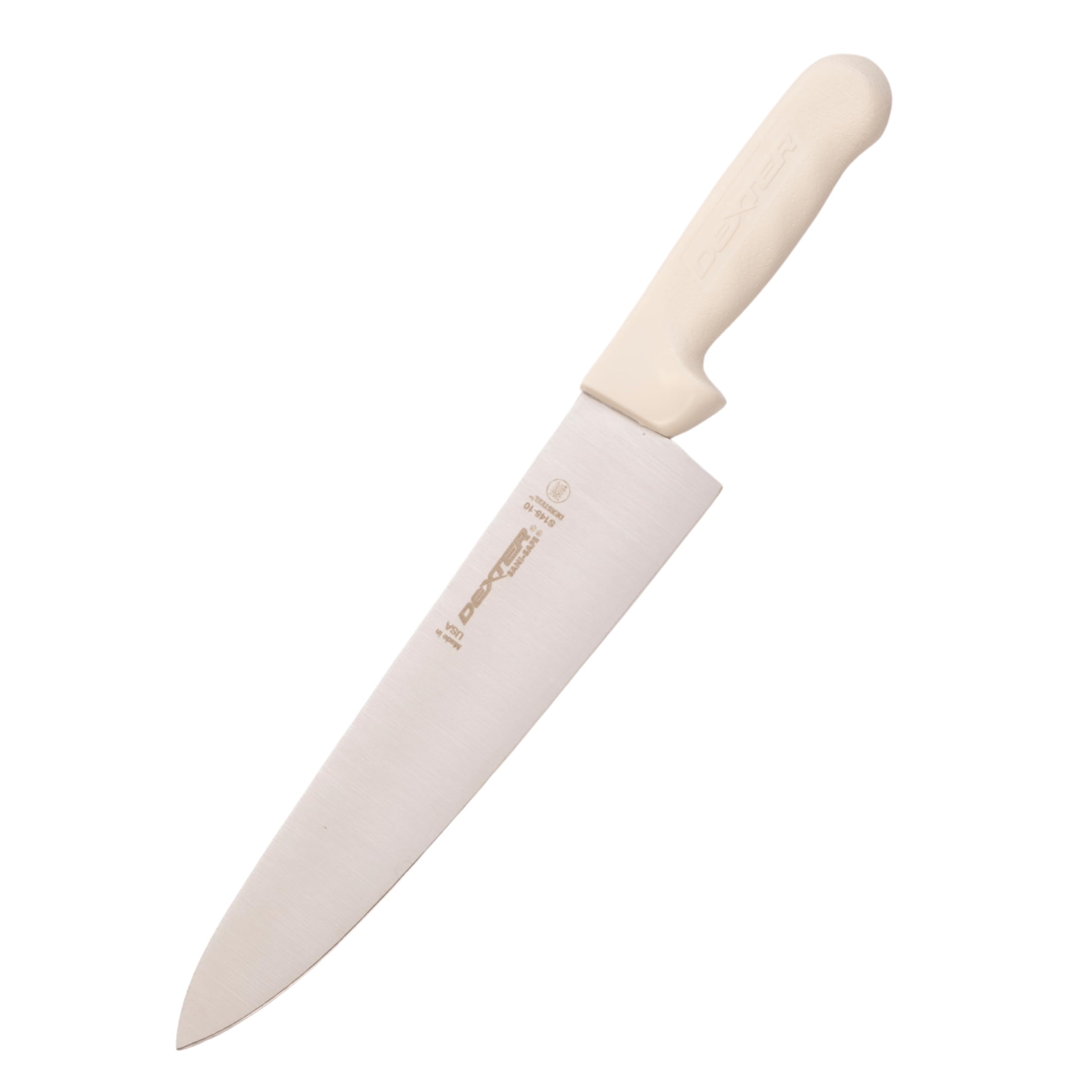
The Dexter-Russell S145-10PCP is built for environments where sanitation regulations dictate equipment choices. The blade is high-carbon DEXSTEEL steel with a hollow edge grind—a feature that creates tiny scallops along the edge to reduce friction and prevent food from sticking during slicing. The white polypropylene handle is NSF certified and designed to withstand commercial sanitizers and high heat without degrading.
Weighing just 7.84 ounces, it is one of the lightest 10-inch stamped knives available. The textured handle provides a secure grip even with wet, soapy hands, and the full tang construction ensures the blade will not separate from the handle during heavy use. Reviews from both professional chefs and home cooks praise the edge retention relative to the price, with many noting it outperforms the Victorinox Fibrox in both sharpness and balance.
As a stamped blade, it lacks the heft and rigidity of forged knives, which can lead to blade flex when cutting dense winter squash or thick blocks of cheese. The hollow edge, while effective in reducing drag, can be difficult to sharpen properly with a standard stone. This knife is the right pick for anyone who prioritizes food safety compliance, needs a lightweight prep knife, or wants a backup that won’t break the bank.
Why it’s great
- NSF certified for commercial sanitation
- Hollow edge reduces food sticking
- Lightweight and comfortable for long prep
Good to know
- Thinner stamped blade flexes on hard produce
- Hollow edge complicates sharpening
FAQ
Is a 10-inch chef knife too big for a home cook?
What does NSF certification mean for a chef knife?
Can a 10-inch chef knife replace a cleaver?
How often should I sharpen a 10-inch chef knife?
Final Thoughts: The Verdict
For most users, the best 10 inch chef knife winner is the Wusthof Classic IKON 10-Inch because it combines German forging durability with a forward-weighted double bolster that reduces wrist strain during long prep. If you want a forged knife that outperforms its price point, grab the Mercer Culinary Genesis 10-Inch. And for lightweight precision work on raw proteins and soft vegetables, nothing beats the Global G-16.