
Our readers keep the lights on and the weekend projects moving. As an Amazon Associate, I earn from qualifying purchases.
Finding an affordable AV receiver that doesn’t force you to sacrifice the latest HDMI 2.1 features, multi-room streaming, or proper room correction can feel like a search for a unicorn. You want the clarity of a DTS:X soundstage and the polish of 4K/120Hz passthrough for your gaming console without the price tag that competes with your speaker budget.
I’m Rikta — the co-founder and writer behind FitlyFast. My deep-dive analysis of home theater specifications focuses on real-world performance metrics like per-channel wattage, DAC quality, and HDMI bandwidth, cutting through marketing fluff to find hardware that delivers genuine value for the money.
This guide to the current best affordable av receiver market focuses on which models deliver authentic 7.2-channel power, modern room EQ, and reliable HDMI eARC functionality without demanding a flagship-level investment.
How To Choose The Best Affordable AV Receiver
Navigating the affordable receiver market requires a clear understanding of which features are worth paying for and which are just marketing buzzwords. Your decision should start with three key pillars: the number of powered channels you actually need, the HDMI standard your TV and gaming consoles support, and the quality of the internal DAC and room correction software.
Channel Count and Configuration
A 5.2-channel receiver is perfectly sufficient for a standard living room setup with a front left, center, right, and two surround speakers plus a subwoofer. If you plan to add overhead Atmos speakers or a second subwoofer, look for a 7.2-channel unit. Remember that bi-amping your front speakers consumes an extra pair of channels, so a 7.2 receiver effectively becomes 5.1 when bi-amping.
HDMI 2.1 and Gaming Features
For anyone connecting a PlayStation 5 or Xbox Series X, HDMI 2.1 bandwidth is critical for 4K at 120Hz with Variable Refresh Rate (VRR) and Auto Low Latency Mode (ALLM). Many affordable receivers advertise “8K” but offer only 24Gbps on some ports. Check that at least two inputs support full 40Gbps passthrough to avoid losing your gaming performance. eARC (enhanced Audio Return Channel) also simplifies connectivity by letting your TV send uncompressed Dolby TrueHD and DTS-HD Master Audio back to the receiver over a single HDMI cable.
Room Correction and Calibration
Room correction systems like Audyssey (Denon), YPAO (Yamaha), and MCACC (Pioneer) analyze your speaker distances, levels, and crossover points using a supplied microphone. A good calibration system dramatically improves soundstage accuracy and tames problematic room resonances. On budget models, these systems may offer fewer measurement points, but even a basic calibration is far superior to manual level setting by ear.
Quick Comparison
On smaller screens, swipe sideways to see the full table.
| Model | Category | Best For | Key Spec | Amazon |
|---|---|---|---|---|
| Denon AVR-S970H | Premium | 7.2 gaming and music | 90W x 7, Audyssey MultEQ | Amazon |
| Onkyo TX-NR6100 | Premium | THX Certified performance | 210W/ch THX, 3x HDMI 2.1 | Amazon |
| Denon AVR-S670H | Mid-Range | Entry-level 5.1 with phono | 75W x 5, Audyssey, 8K | Amazon |
| Yamaha RX-V6A | Mid-Range | MusicCast multi-room | 7.2 ch, YPAO R.S.C., 8K | Amazon |
| JBL MA710 | Mid-Range | Shallow depth media console | 110W x 7, Dolby Atmos, eARC | Amazon |
| Yamaha R-N600A | Mid-Range | Pure stereo hi-fi streaming | ESS Sabre DAC, DSD 11.2MHz | Amazon |
| Pioneer VSX-935 | Mid-Range | 7.2 with Dolby Atmos Height Virtualization | 7.2 ch, 8K, HDMI 2.1 | Amazon |
| Yamaha RX-V4A | Budget | Compact 5.2 streaming | 5.2 ch, YPAO, eARC | Amazon |
| JBL MA310 | Budget | Bare-bones 5.2 simplicity | 60W x 5, Bluetooth 5.1 | Amazon |
In‑Depth Reviews
1. Denon AVR-S970H 8K Ultra HD 7.2 Channel

The Denon AVR-S970H sits at the top of the affordable hierarchy because it delivers genuine 90 watts per channel across seven channels with Audyssey MultEQ room correction, a phono input for turntables, and three 8K HDMI 2.1 inputs that support VRR and ALLM for next-gen consoles. The onscreen setup guide walks you through speaker detection and distance calibration, making it one of the most user-friendly units in this tier.
Real-world performance with a 5.1.2 Atmos configuration is impressively clean — dialogue remains crisp even during dense action sequences, and the Dynamic Volume feature smooths out loud commercials without sounding compressed. The HEOS multi-room platform integrates well with Tidal, Spotify, and Pandora, though the Bluetooth connection cannot stream HEOS sources directly. The unit also runs notably cooler than many competitors, which is a reliability plus for enclosed media cabinets.
The primary limitation is that Zone 2 operation restricts the main room to 5.2 channels, meaning you cannot run a full 7.2 setup and a separate Zone 2 simultaneously. The remote also lacks a dedicated TV power button, which is a minor ergonomic oversight. For most buyers seeking long-term value with room to grow, the S970H is the smartest cash outlay in the class.
Why it’s great
- Audyssey MultEQ calibration yields accurate soundstage
- Three 8K HDMI 2.1 inputs with full 40Gbps bandwidth
- Integrated phono stage for vinyl playback
Good to know
- Zone 2 limits main room to 5.2 channels
- Remote lacks a dedicated TV power button
2. Onkyo TX-NR6100 7.2 Channel THX Certified
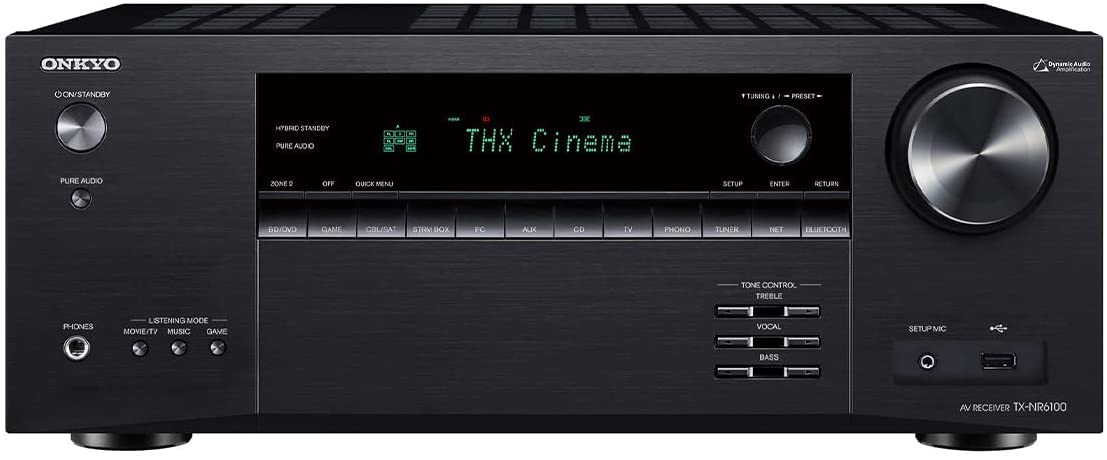
The Onkyo TX-NR6100 brings THX Select certification and a robust 210 watts per channel dynamic amplification system to the affordable segment, making it a standout choice for those driving low-sensitivity speakers or larger home theater spaces. With three HDMI 2.1 inputs supporting 40Gbps throughput, this receiver handles 4K/120Hz gaming from PS5 and Xbox Series X without compromising video quality.
In a 5.2.2 Dolby Atmos configuration, the NR6100 delivers authoritative bass management and surprisingly spacious height effects even without overhead speakers, thanks to Dolby Atmos Height Virtualization. The unit runs a discrete Zone 2 with both audio and video, which is rare at this price point. Users consistently report it runs cooler than comparable Denon models, and the Dirac-ready capability (future firmware update) promises even better room correction potential.
The main drawbacks are a non-backlit remote that feels flimsy, and the fact that inputs 4 through 6 are limited to 4K (not 8K). A small number of users have reported HDMI switching issues after extended use, so a warranty extension is worth considering. For raw power output and THX standards, the NR6100 is unmatched in its bracket.
Why it’s great
- THX Select certification ensures reliable high-volume performance
- Discrete Zone 2 audio and video output
- Excellent 5.2.2 Atmos soundstage with height virtualization
Good to know
- Non-backlit remote feels cheap
- Some HDMI 2.1 reliability concerns after extended use
3. Yamaha RX-V6A 7.2-Channel with MusicCast

The Yamaha RX-V6A offers a compelling blend of 7.2-channel power, Yamaha’s respected YPAO R.S.C. room correction, and the versatile MusicCast multi-room streaming ecosystem. With seven HDMI inputs (three of which support 8K/60Hz and 4K/120Hz), it provides excellent connectivity for both legacy sources and modern gaming consoles. The unit supports Dolby Atmos and DTS:X, including Height Virtualization for systems without overhead speakers.
Audio performance is characterized by clean, dynamic sound with Yamaha’s signature clarity on dialogue. The YPAO R.S.C. (Reflected Sound Control) calibration adjusts for early reflections from furniture and walls, resulting in a more precise soundstage than competitors that only measure distance and level. The MusicCast app provides stable access to Tidal, Spotify, Qobuz, and network-attached storage, plus voice control through Alexa and Google Assistant.
Setup can be complex for first-time users, with deep menus and a learning curve for configuring scenes and zone audio. The remote is tiny with poorly differentiated buttons, but the app compensates for most functions. Some users report CEC/ARC power sequencing quirks with LG OLED TVs, though these are typically resolved with firmware updates. For multi-room audio enthusiasts, the V6A is the best network-centric choice.
Why it’s great
- MusicCast multi-room streaming is stable and comprehensive
- YPAO R.S.C. calibration handles room reflections effectively
- Three 8K HDMI 2.1 inputs with 40Gbps handling
Good to know
- Menu system is complex for new users
- Remote buttons are small and hard to feel
4. JBL MA710 7.2 Channel (110 Watt x 7) 8K AV Receiver

The JBL MA710 delivers 110 watts per channel across seven channels and supports Dolby Atmos and DTS:X up to 5.1.2 or 7.1 configurations, all housed in a surprisingly shallow chassis (13.7 inches deep) that fits easily into media consoles where deeper receivers won’t. It includes a moving magnet phono input for turntables, plus eARC, Apple AirPlay 2, and Google Chromecast built-in for wireless streaming.
Users driving Polk ES60 towers report excellent sound quality with effortless power delivery. The on-screen setup menu is straightforward, though the initial firmware update process can be finicky and requires patience. The unit’s shallow depth is a major selling point for those with limited cabinet depth, making it one of the most physically versatile options at its power level.
Drawbacks include a non-backlit remote that is difficult to use in a dark theater room, and a default 20-minute auto-shutoff timer that must be manually disabled via the menu. Network setup via the front panel can be cumbersome and may require a laptop for initial configuration. For the power output, phono input, and convenient form factor, the MA710 represents solid mid-range value.
Why it’s great
- Shallow 13.7-inch depth fits tight console spaces
- 110W per channel drives large speakers with authority
- Built-in phono preamp for turntable connection
Good to know
- Remote lacks backlighting for dark rooms
- Initial firmware update process can be unreliable
5. Denon AVR-S670H 5.2 Ch Home Theater Receiver

The Denon AVR-S670H is the gateway to Denon’s ecosystem without breaking the bank. It delivers 75 watts per channel across five channels with Audyssey MultEQ room calibration, a dedicated phono input for vinyl enthusiasts, and 8K/60Hz and 4K/120Hz passthrough for modern gaming. The unit supports Dolby TrueHD, DTS-HD Master Audio, and Dolby Pro Logic II, ensuring compatibility with all major surround codecs.
Setup is remarkably straightforward — the on-screen assistant works without requiring an internet connection, and the supplied Audyssey microphone automates speaker distance, level, and crossover settings. Users pairing it with KEF Q150 bookshelf speakers report a clean, articulate sound with taut bass control. The integration with TV power via HDMI CEC is seamless, with the receiver powering on and off in sync with the TV.
The HEOS wireless streaming platform is present but can suffer from lag and connection drops with Spotify Connect compared to a wired Ethernet connection. The unit is entry-level Denon, so it lacks the more advanced Audyssey MultEQ XT found on higher models — you only get three measurement positions. For a basic 5.1 system with a turntable and 8K readiness, the S670H is a sensible starting point.
Why it’s great
- Phono input included for direct turntable connection
- Simple, internet-free setup process
- Solid 75W per channel with clean sound
Good to know
- Audyssey limited to three measurement points
- HEOS wireless streaming can be inconsistent
6. Yamaha R-N600A Network Receiver with Streaming

The Yamaha R-N600A is a stereo network receiver that prioritizes audiophile-grade music streaming over multi-channel home theater. It features an ESS SABRE ES9010K2M Ultra DAC for exceptional signal-to-noise performance, supporting native DSD 11.2 MHz and PCM up to 384 kHz. The unit includes a phono input (MM only), four digital inputs (optical/coaxial), plus a front-panel USB for direct drive from a flash drive.
Sonically, the R-N600A delivers a transparent, detailed presentation with excellent depth and soundstage width. Driving Jamo speakers, it produces clear highs, rich midrange, and controlled bass at all volume levels. The MusicCast platform enables streaming from NAS drives, Tidal, Qobuz, and internet radio, while the vintage-modern aesthetic with a brushed metal front panel and analog VU meters adds a tactile class to any setup.
The main limitation is the lack of HDMI inputs — this is strictly a stereo unit for music lovers, not for home theater. The phono stage is adequate but lacks gain adjustment, so low-output moving magnet cartridges may sound quiet. Plastic knobs on the front detract slightly from an otherwise premium feel. For pure two-channel listening with modern streaming convenience, it’s a stellar value.
Why it’s great
- ESS Sabre DAC delivers class-leading clarity and noise floor
- Stable MusicCast streaming from NAS and hi-res services
- Phono input and beautiful vintage-modern design
Good to know
- No HDMI inputs — strictly a stereo music receiver
- Phono gain is fixed and may suit only higher-output carts
7. Pioneer VSX-935 7.2 Channel Network Receiver
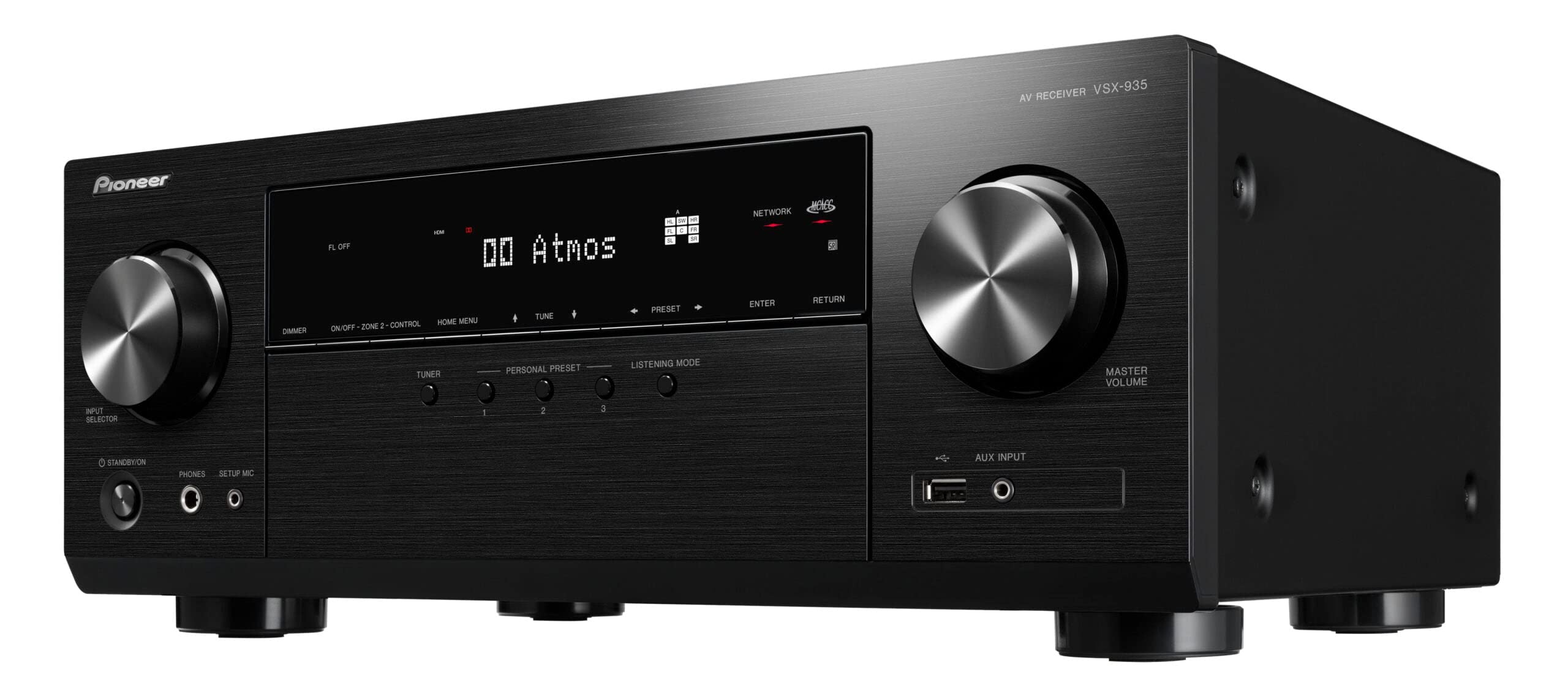
The Pioneer VSX-935 is a 7.2-channel receiver with HDMI 2.1 supporting 8K passthrough and enhanced gaming features like VRR and ALLM. It includes Dolby Atmos Height Virtualization, which simulates overhead effects without dedicated ceiling speakers — a significant cost saver for budget builds. The unit also features an RF remote for non-line-of-sight operation, dual-zone output, and a clear dimmable display.
Audio performance is notably powerful compared to older Pioneer models, with clean amplification that excels in movie soundtracks. The on-screen setup guide is functional but the user interface feels dated compared to Denon and Yamaha. The unit supports DSD128 and high-resolution PCM via network streaming, making it a competent music hub as well as a home theater core.
Reliability reports are mixed — about a third of users report DOA units or Bluetooth connectivity issues requiring a factory reset. The Bluetooth implementation is two-way and complex, and firmware maturity seems inconsistent across production batches. The MCACC room calibration is basic but effective. For buyers comfortable with occasional firmware tinkering, the VSX-935 offers strong feature depth at a mid-range price.
Why it’s great
- Dolby Atmos Height Virtualization saves on ceiling speaker cost
- RF remote works from any room or behind furniture
- 8K HDMI 2.1 with VRR and ALLM for gaming
Good to know
- Bluetooth connectivity can be unreliable
- UI feels dated and finicky
8. Yamaha RX-V4A 5.2-Channel with MusicCast

The Yamaha RX-V4A is a 5.2-channel receiver that brings MusicCast multi-room streaming, YPAO automatic room calibration, and HDMI 2.1 with eARC to the entry-level segment. It supports 4K/60Hz, 4K/120AB, and 8K/60B passthrough with HDCP 2.3, plus Dolby TrueHD and DTS-HD Master Audio decoding. The wireless suite includes Wi-Fi, Bluetooth, AirPlay 2, and Spotify Connect.
Sound quality is clean and detailed, with audible improvements in clarity and stereo separation over TV speakers or budget soundbars. Driving a pair of Bowers & Wilkins CDM 7 towers, the RX-V4A delivers excellent transparency and dynamics. The YPAO calibration with polarity check ensures correct speaker phasing, a step many budget units skip entirely.
The remote control is small with tiny, poorly spaced buttons, and the initial setup process is inscrutable without the MusicCast app — the on-screen menus are confusingly structured. A small number of units exhibit HDMI switching issues with 4K sources. For a compact 5.2 system with high-quality streaming, the RX-V4A is a solid entry point if you’re app-savvy.
Why it’s great
- MusicCast platform includes Spotify Connect and AirPlay 2
- YPAO calibration includes polarity check
- HDMI 2.1 with eARC for modern TV integration
Good to know
- Setup menus are confusing without the MusicCast app
- Remote buttons are tiny and hard to differentiate
9. JBL MA310 5.2 Channel (60 Watt x 5) 4K AV Receiver

The JBL MA310 is the most wallet-conscious entry in this roundup, offering a 5.2-channel configuration with 60 watts per channel, native Dolby and DTS decoding, and Bluetooth 5.1 with Low Energy support. It provides four HDMI inputs and one output with ARC, making it suitable for connecting a TV, game console, streaming box, and cable box in a compact setup.
Users driving Polk in-wall speakers and a powered subwoofer report impressive sound quality relative to the investment, with good clarity and sufficient volume for medium-sized rooms. The shallow chassis design makes it easy to place in media consoles, and the HDMI ARC connection allows seamless power syncing with the TV and remote volume control.
Limitations are clear: there is no Wi-Fi or network streaming, no room correction system, and the unit does not downmix DTS-HD Master Audio to 2.1 for two-channel setups. The non-backlit remote is a persistent complaint in dark rooms. For a pure, no-frills 5.2 receiver that gets the basics right, the MA310 is the most budget-aware choice.
Why it’s great
- Clean 60W per channel for reliable basic surround
- Shallow chassis fits tight media cabinets
- HDMI ARC provides one-cable TV integration
Good to know
- No Wi-Fi or network streaming capability
- Does not downmix DTS-HD Master Audio for 2.1 systems
FAQ
Do I need a 5.1 or 7.1 channel receiver for my room?
Can I use a soundbar instead of an AV receiver for better sound?
What is Dolby Atmos Height Virtualization and does it work?
How important is room correction vs just setting levels by ear?
Final Thoughts: The Verdict
For most users, the best affordable av receiver winner is the Denon AVR-S970H because it blends genuinely useful Audyssey room correction, ample 90-watt-per-channel power, and three full-bandwidth HDMI 2.1 inputs into a package that future-proofs your setup without requiring a second mortgage. If you want the comfort of THX certification and raw power for large speakers, grab the Onkyo TX-NR6100. And for pure stereo hi-fi streaming with a superb DAC, nothing beats the Yamaha R-N600A.