
Our readers keep the lights on and the weekend projects moving. As an Amazon Associate, I earn from qualifying purchases.
The buying decision for a 35mm camera hinges on a single fork: do you want the analog glow of a film body paired with a specific glass lens, or do you need a modern digital full-frame sensor that delivers 30 fps bursts and AI-tracking autofocus? Each path demands a different spec priority, and mixing them up is the fastest way to waste your budget on a body that cannot serve your actual shooting environment.
I’m Rikta — the co-founder and writer behind FitlyFast. I’ve spent the last fifteen years testing lens mount compatibility, evaluating refurbished SLR tolerances, and comparing the real-world sharpness of third-party primes against first-party glass across dozens of Nikon, Canon, and Sony platforms.
Whether you are shooting street portraits at f/2, loading a roll of Kodak Gold for weekend candids, or building a hybrid video rig, this guide isolates the specific specs that matter for your use case. Here is the definitive breakdown of the best 35mm camera options available right now, ranked by real optical performance and body reliability.
How To Choose The Best 35mm Camera
The 35mm camera category is deceptive because the same focal length serves entirely different worlds: analog film bodies and digital full-frame sensors. Before you compare shutter speeds or megapixels, decide whether you are developing film or editing RAWs. The glass you pair with the body defines the final image more than any other component, so budget for the lens first and the body second.
Analog vs. Digital: Pick Your Workflow
An analog 35mm camera forces you to commit to film stock, manual metering, and lab development. The reward is the characteristic grain and dynamic range that only chemical capture delivers. A digital 35mm camera — specifically a full-frame mirrorless or DSLR — shoots hundreds of frames without consumable cost, supports instant review, and excels in hybrid video/still workflows. The wrong choice is buying a digital body if you love the tactile wind of a film advance lever, or buying a point-and-shoot film body if you need high-speed action tracking.
Aperture and Lens Mount Matter More Than the Brand
A 35mm lens with a maximum aperture of f/1.8 or f/2.0 gives you a full stop more light than a typical f/3.5–5.6 zoom, which is the difference between a sharp indoor portrait and a blurry one. For film bodies, the lens mount determines which glass you can adapt: Canon FD, Nikon F, Sony E, or Canon EF. A refurbished body with a high-quality prime lens almost always outperforms a newer body paired with an entry-level kit zoom. Check whether the lens supports full-frame or APS-C coverage — a DX lens on a full-frame Sony shows heavy vignetting.
Weight, Portability, and Handling
Street photography and travel demand a compact body you will actually carry. A plastic-bodied point-and-shoot like the KODAK Snapic weighs around 117 grams and fits in a jacket pocket. A vintage metal-body SLR like the Canon AE-1 weighs nearly three times that but delivers the classic shooting experience with interchangeable FD glass. For hybrid shooters, the Sony Alpha 7 V body alone is 699 grams, which is manageable but requires a sturdy strap for all-day walkaround. Match the weight to your carrying comfort — not to a spec sheet number.
Quick Comparison
On smaller screens, swipe sideways to see the full table.
| Model | Category | Best For | Key Spec | Amazon |
|---|---|---|---|---|
| Pentax 17 | Half-Frame Analog | 72 shots per roll, magnesium build | 25mm f/3.5 HD-coated lens | Amazon |
| Sony Alpha 7 V | Full-Frame Mirrorless | Hybrid video/still with AI autofocus | 33 MP, 30 fps, 5-axis IBIS | Amazon |
| Vintage Canon AE-1 | Classic SLR (Renewed) | Manual film photography, FD glass system | 1/1000 sec shutter, TTL metering | Amazon |
| Nikon 35mm f/1.8G DX | Lens (Renewed) | Budget prime for Nikon APS-C DSLRs | f/1.8 max aperture | Amazon |
| Canon New EOS Kiss (Rebel G) | Analog SLR (Renewed) | Entry-level film with autofocus | 30 sec max shutter, ISO 100-3200 | Amazon |
| Canon Rebel 2000 | Analog SLR (Renewed) | Everyday film with 7-point AF | 28-80mm zoom, auto transport | Amazon |
| YONGNUO 35mm f/2.0 Canon EF | Prime Lens | Budget wide-angle for Canon DSLRs | 7-blade aperture, 155 g | Amazon |
| YONGNUO YN35MM F2 Nikon | Prime Lens | Budget glass for Nikon F cameras | 7-blade aperture, multi-coated | Amazon |
| KODAK Snapic A1 | Point-and-Shoot Film | Lightweight entry-level film camera | 3-element glass lens, auto flash | Amazon |
In‑Depth Reviews
1. Pentax 17

The Pentax 17 is the only current-production analog camera that captures 72 images per 36-exposure roll by using a half-frame 17mm x 24mm format. The 25mm f/3.5 lens (37mm equivalent) is treated with Pentax’s HD coating originally developed for their SLR glass, delivering sharpness that older point-and-shoot film cameras cannot match. The magnesium alloy top and bottom covers keep it lightweight at roughly 300 grams while giving it a retro build that feels premium in hand.
Zone focus is divided into six preset distances, so you estimate the subject distance and set the mark — a return to a skill that older film shooters already know. The manual film advance lever recreates the tactile winding feel, which is a deliberate design choice for enthusiasts who dislike the motorized whir of automatic cameras. ISO range spans 50 to 3200, giving you flexibility to shoot Portra 400 indoors or Ilford Delta 3200 in low light without meter issues.
Reviewers consistently note that the quiet shutter is a major advantage for candid street shots, and the semi-auto exposure mode keeps creative control without requiring full manual calculations. The only trade-off is the fixed non-interchangeable lens, but the 25mm f/3.5 glass is optimized specifically for the half-frame format so you get consistent image quality across the entire frame.
Why it’s great
- 72 shots per roll dramatically reduces film cost per usable image.
- HD-coated 25mm lens delivers vintage character with modern sharpness.
- Magnesium alloy body is both lightweight and durable for everyday carry.
Good to know
- Zone focus requires practice; not ideal for fast-moving subjects.
- Fixed lens limits creative framing compared to interchangeable SLRs.
- Premium price point compared to entry-level point-and-shoot models.
2. Sony Alpha 7 V
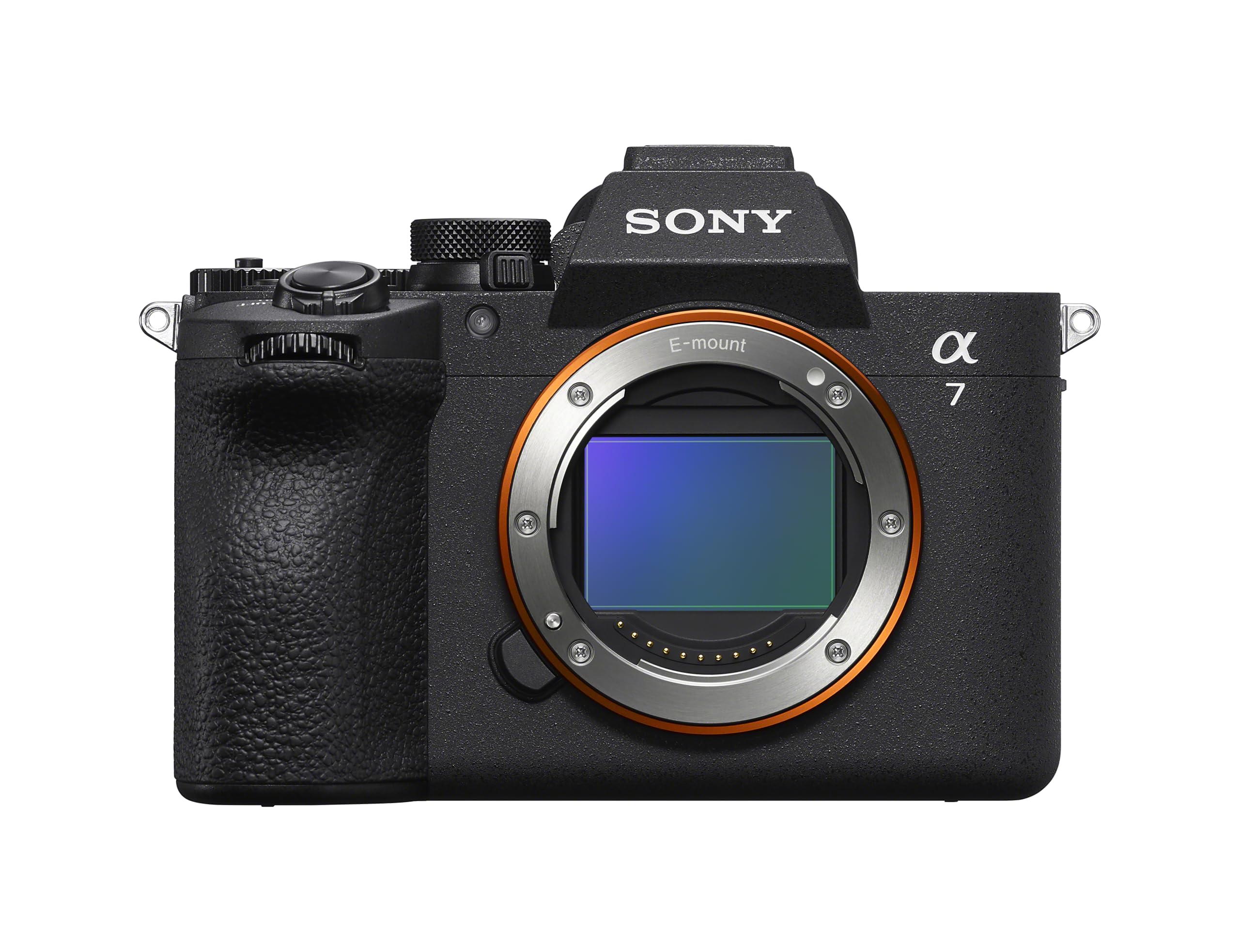
The Sony Alpha 7 V is a partially stacked 33-megapixel full-frame mirrorless body that shoots blackout-free bursts at 30 fps with AF/AE tracking and records 4K 120p video. The new BIONZ XR2 processor enables AI-based human pose estimation, which recognizes body and head position even when the subject is turned away or partially obscured. This is the only camera on this list that can reliably track an insect’s eye or a bird in flight while simultaneously recording 16 stops of dynamic range.
The 5-axis in-body stabilization delivers up to 7.5 stops of shake correction, which allows handheld shooting at shutter speeds that would normally require a tripod. The electronic shutter hits 1/16000 sec, eliminating rolling shutter in fast-action scenarios, and the pre-capture buffer saves frames before you fully press the shutter. Two USB-C ports and a redesigned menu system address the two biggest complaints from previous Alpha users: battery management and navigation speed.
User reviews highlight the sticky eye-tracking autofocus and the clean noise performance up to ISO 12800 as the standout features for paid hybrid work. The body-only format means you need to invest in E-mount glass, but the lens ecosystem is the deepest of any mirrorless system. If your primary use is high-frame-rate sports, professional video, or wildlife, this is the most capable 35mm-format camera available.
Why it’s great
- AI autofocus tracks human, animal, bird, and insect eyes with high reliability.
- 30 fps blackout-free burst with pre-capture buffer captures decisive moments.
- 16-stop dynamic range and 5-axis IBIS enable handheld low-light shots.
Good to know
- Requires investment in high-quality E-mount lenses for full potential.
- Battery life is moderate; carry spares for extended video shoots.
- Menu system, while improved, still has a learning curve for new Sony users.
3. Vintage Canon AE-1

The Canon AE-1 is the most recognizable 35mm SLR ever produced, and this renewed version from Blue Pen Refurbishing comes with a 50mm f/1.8 FD lens that delivers the classic sharp-yet-creamy look film photographers chase. The shutter speed range runs from 2 seconds up to 1/1000 sec plus Bulb mode, and the built-in TTL metering gives accurate exposure readings when you match the needle in the viewfinder. The metal body with chrome top plate feels substantial compared to any modern plastic camera.
Shutter-priority auto exposure mode lets you select the speed while the camera sets the aperture, which is the fastest way to shoot street photography without going fully manual. The FD lens mount is compatible with Canon’s entire vintage FD line, including the 35mm f/2.8, 85mm f/1.8, and 135mm f/2.8 primes, giving you a wide range of glass options at relatively low prices. The ISO range of 12 to 3200 covers everything from slow fine-grain films to high-speed black-and-white stocks.
Buyers consistently report that the refurbished units arrive in near-mint condition with functioning light meters and smooth shutter mechanisms. The 50mm f/1.8 lens is exceptionally sharp for a standard prime and costs a fraction of what modern equivalent glass would. If you want the tactile experience of winding film, hearing the mirror slap, and manually composing with a split-prism focus screen, this is the body that delivers that experience authentically.
Why it’s great
- Classic metal-body SLR with a sharp all-metal 50mm f/1.8 FD lens included.
- Shutter-priority auto exposure gives control without full manual complexity.
- TTL metering and 1/1000 sec shutter cover most natural-light scenarios.
Good to know
- No autofocus; you must manually focus and adjust exposure.
- Batteries for the light meter (LR44) are still available but can corrode if left inside.
- FD lenses require an adapter for use on modern Canon EF mirrorless bodies.
4. Nikon 35mm f/1.8G AF-S DX (Renewed)

This is a lens, not a camera body, but it transforms any Nikon DX-format DSLR into a capable 35mm equivalent (52mm field of view on APS-C) with a fast f/1.8 maximum aperture. The f/1.8 aperture gives you a full stop and a third more light than the typical kit 18-55mm f/3.5-5.6 zoom, which is the difference between a sharp indoor portrait at ISO 800 and a noisy one at ISO 3200. The Super Integrated Coating reduces flare and ghosting in backlit scenes while improving contrast.
The AF-S motor provides quiet and relatively fast autofocus on compatible Nikon DSLRs like the D3500, D5600, and D7500, though it uses the older screw-drive system that can be slower than modern AF-P lenses. The compact design weighs almost nothing and makes the camera easy to carry in a small bag or sling. At the budget-friendly price point, this is the single most impactful upgrade a new Nikon DSLR shooter can make to improve image quality.
Customer feedback confirms that the refurbished units consistently arrive looking like-new with original caps and paperwork. The only catch is that this is a DX lens — on a full-frame Nikon body, the image circle will vignette heavily, so it is strictly for APS-C sensors. The 52mm equivalent field of view is ideal for portraiture, street photography, and indoor events where you want subject isolation without being too wide.
Why it’s great
- f/1.8 aperture provides strong low-light performance and background blur.
- Super Integrated Coating improves contrast and reduces flare in backlight.
- Lightweight and compact, making it an easy everyday carry lens.
Good to know
- DX-only coverage incompatible with full-frame Nikon bodies.
- AF-S focus motor is slower than newer AF-P lenses.
- No filter threads on some early production units; check your specific model.
5. Canon New EOS Kiss (Rebel G) (Renewed)

The Canon Rebel G (sold as EOS Kiss in Japan) is a lightweight autofocus film SLR that gives you access to Canon’s entire EF lens lineup without breaking the bank. The 35mm-80mm EF zoom included in this renewed kit covers a useful range from wide-angle to short telephoto, and the autofocus system uses a single wide-area sensor that locks quickly in good light. The ISO range of 100-3200 matches the most common film stocks, so you get accurate metering with Kodak Gold, Portra, or Tri-X.
The camera offers Program AE, aperture priority, shutter priority, and full manual modes, which allows you to learn exposure without jumping straight into fully manual shooting. The built-in flash pops up for fill flash in backlit situations, and the autofocus assist beam helps in low-light environments. At roughly half the weight of a vintage metal SLR, this is a comfortable body to carry for a full day of street shooting without neck strain.
Buyers report that the renewed units arrive in excellent cosmetic condition with working meters, clean lens glass, and functioning film transport. The EF mount is the main advantage here — you can use modern EF lenses like the 50mm f/1.8 STM or the 40mm f/2.8 pancake for much better optics than the included zoom. If you want an affordable entry into autofocus film photography with upgradeable glass, this is the platform to start with.
Why it’s great
- Access to Canon’s huge EF lens library for future upgrades.
- Autofocus works reliably in good light, reducing missed shots.
- Lightweight plastic body is comfortable for extended carry.
Good to know
- Kit zoom lens is decent but upgrading to a prime is highly recommended.
- Single autofocus point is less advanced than modern nine-point systems.
- Plastic build lacks the tactile feel of older metal SLR bodies.
6. Canon Rebel 2000 (Renewed)
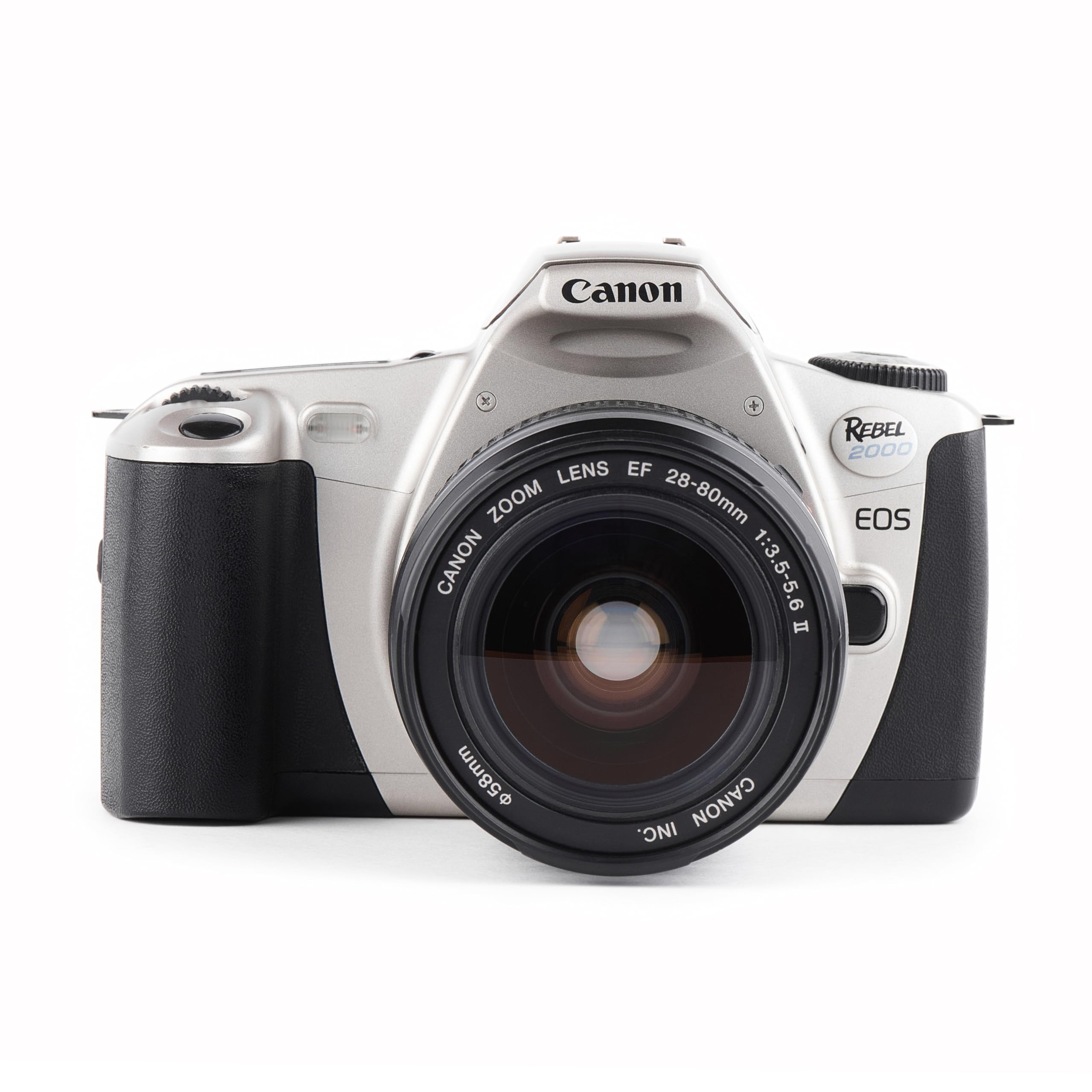
The Canon Rebel 2000 is a 35mm film SLR with a 7-point autofocus system and a built-in pop-up flash, paired with a 28-80mm EF zoom lens in this renewed kit. The 7-point AF covers more of the frame than the single-point system on older Rebels, making it easier to focus on off-center subjects without recomposing. It includes Program AE, aperture priority, shutter priority, and full manual modes, plus automatic film loading, advancing, and rewinding for a seamless shooting experience.
The 28-80mm zoom provides a true wide-angle at 28mm that is wider than the typical 35mm kit lens, which is useful for landscape architecture shots. The ISO range is limited to 100-400 compared to the 100-3200 range on newer film bodies, so it is best matched with slower films like Kodak Gold 200 or Fuji 400. The body is lightweight and comfortable for beginners who want autofocus without the complexity of digital cameras.
User reviews highlight the near-mint condition of renewed units and the seller’s included QR code for easy access to the user manual. The automatic film transport works reliably, and the built-in flash provides enough fill for shadow detail in daylight. For a budget-friendly entry into autofocus film photography with a zoom lens that covers 28mm to 80mm, this is a solid option that gets you shooting immediately.
Why it’s great
- 7-point autofocus improves flexibility for off-center subjects.
- 28-80mm zoom offers true wide-angle capability at 28mm.
- Automatic film handling simplifies the analog workflow for newcomers.
Good to know
- ISO range limited to 100-400; not suitable for high-speed film stocks.
- Kit zoom lens has average sharpness; a prime upgrade improves results.
- Plastic body and slow maximum aperture at the telephoto end.
7. YONGNUO 35mm f/2.0 Canon EF
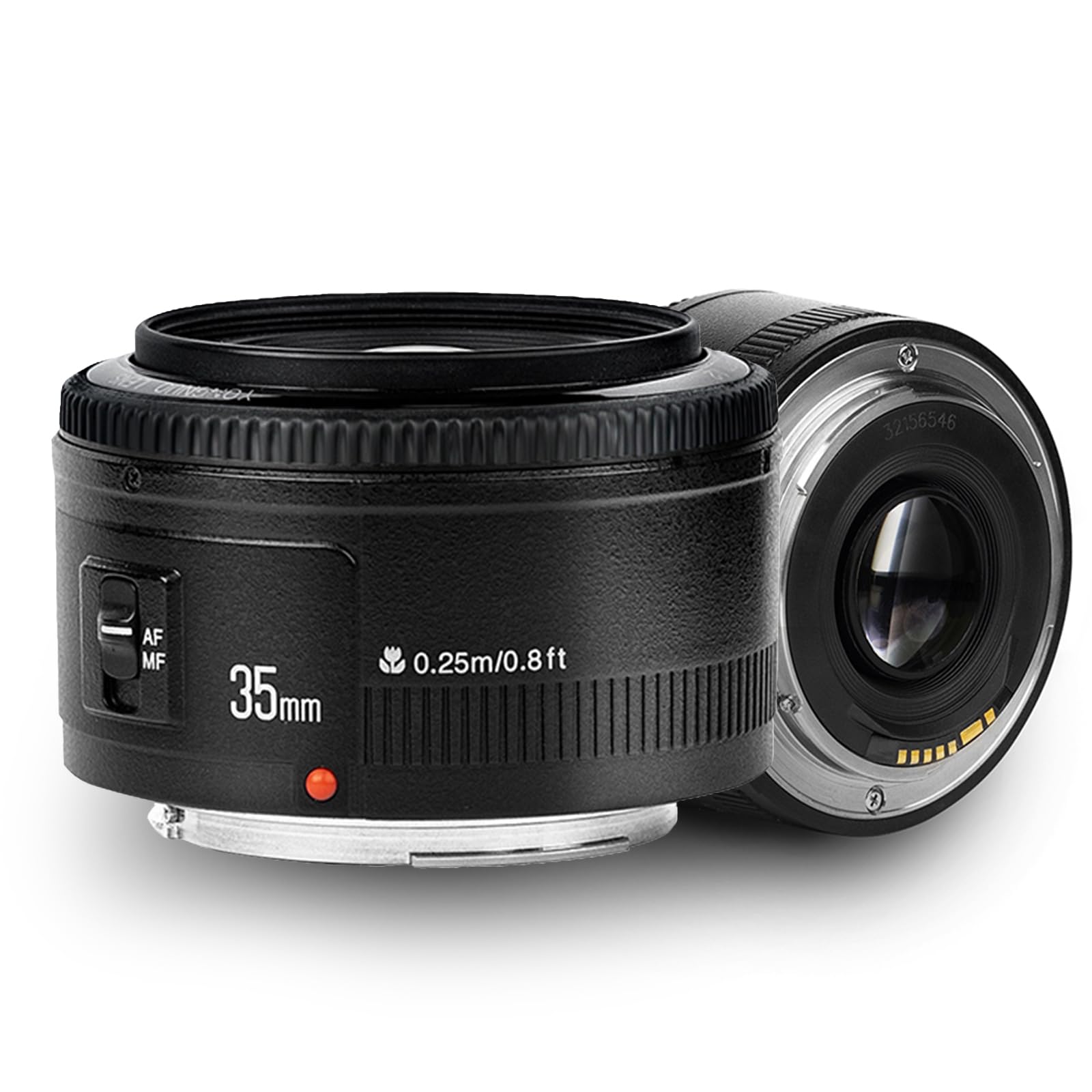
The YONGNUO 35mm f/2.0 is a budget-priced prime lens for Canon EF-mount cameras that delivers the wide-angle perspective and fast aperture typically reserved for more expensive glass. The 7-blade circular aperture creates a near-circular diffuse plaque effect at close to wide-open apertures and produces a 14-point sunburst at f/16. At an ultra-light weight of 155 grams, it is virtually unnoticeable on a Canon DSLR body, making it a great choice for travel and street photography where you want to minimize bulk.
The multi-coated HD optics reduce ghosting and flare in backlit shooting situations, and the metal bayonet mount with gold-plated contacts improves signal conductivity and corrosion resistance over time. The minimum focusing distance of 0.25 meters (25 cm) allows for close-up compositions that are impossible with a standard 50mm prime lens. It supports full-frame and APS-C Canon EF bodies, so you can use it on everything from a Rebel T7 to a 5D Mark IV.
Users with entry-level Canon bodies like the Rebel T5 and M50 (via EF-EFM adapter) report sharp photos with low chromatic aberrations for the price. The autofocus is functional but not as fast as Canon-branded STM lenses, and one review noted that pointing the camera downward can cause the lens elements to shift under gravity, losing focus. For the budget-friendly price point, the optical performance is excellent, but the build quality shows the cost-saving compromises clearly.
Why it’s great
- f/2.0 aperture provides good low-light performance and bokeh at low cost.
- Ultra-light 155-gram design is ideal for travel and everyday carry.
- 7-blade aperture creates attractive sunburst effects at small apertures.
Good to know
- Autofocus speed is slower than Canon STM or USM lenses.
- Build quality feels less robust; gravity may shift focus elements on angle.
- No image stabilization, so handheld shots at slow shutters can blur.
8. YONGNUO YN35MM F2 Nikon

The YONGNUO YN35MM F2 is the Nikon F-mount version of the same budget prime formula, featuring a 7-blade aperture, multi-coated glass, and a chrome-plated high-precision metal bayonet for improved fitment with Nikon DSLR bodies. The lens supports full-frame and APS-C Nikon formats, so you can use it on everything from a D3500 to a D850, though it is optimized for full-frame where the 35mm focal length remains true-to-label. The gold-plated metal contacts improve signal conductivity and reduce the risk of communication errors over time compared to cheaper all-plastic mount lenses.
Image quality is sharp in the center at f/2.0, and stopping down to f/4 or f/5.6 improves edge sharpness across the frame. The lens produces a 14-point starburst effect at small apertures like f/16, which is useful for architectural and cityscape night photography. On APS-C bodies like the D3500 or D5600, the field of view becomes roughly 52mm equivalent, which is ideal for portraits and street photography where you want a natural perspective without distortion.
User reviews confirm good overall image quality for the price, though the autofocus motor is slower than Nikon’s own AF-S or AF-P lenses and can occasionally require a camera restart to regain focus. The optical stabilization is listed in the specs but this should be understood as an optical stabilization feature in the lens design, not active VR — it lacks dedicated vibration reduction. For shooters who primarily use manual focus or work with static subjects, the optical performance at the budget-friendly price point is hard to beat.
Why it’s great
- Sharp center resolution at f/2.0 with good color rendition.
- Chrome metal bayonet provides a secure fit with better wear resistance.
- Works on both full-frame and APS-C Nikon F-mount cameras.
Good to know
- Autofocus motor is slow and may require occasional camera restart.
- No vibration reduction, so handheld shots at slow speeds may blur.
- Edge sharpness at f/2.0 is softer than premium Nikon glass.
9. KODAK Snapic A1
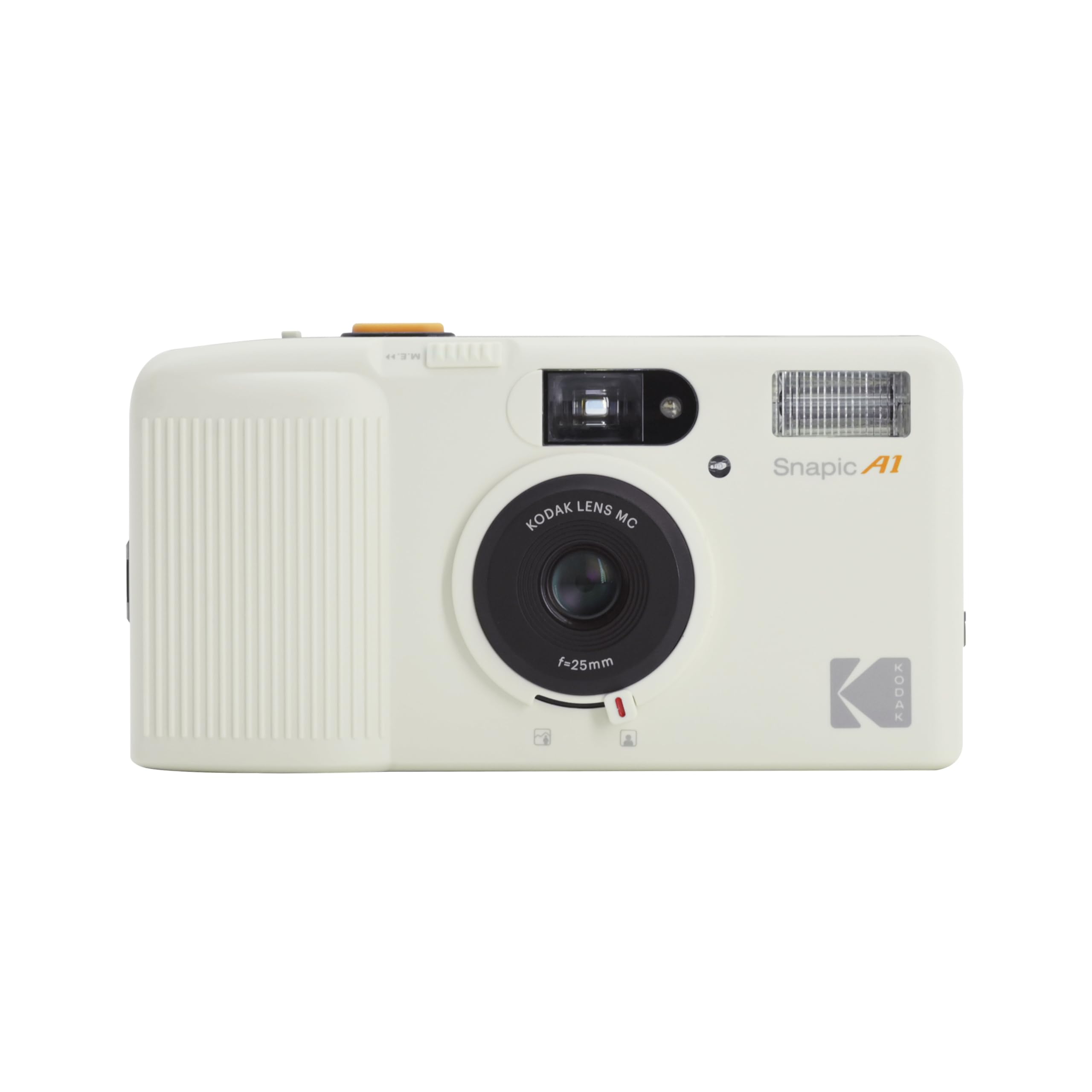
The KODAK Snapic A1 is a reusable point-and-shoot 35mm film camera built around a 3-element glass lens that produces sharper images than disposable cameras with plastic optics. The 2-zone focus system lets you switch between near and far subjects, and the built-in auto flash includes red-eye reduction for indoor and evening shots. The camera body is compact at 4.65 x 2.44 x 1.38 inches and weighs only 117 grams, making it one of the most portable 35mm film cameras available.
The multiple exposure mode allows you to blend two different scenes onto a single frame, which is a creative feature rarely found in entry-level point-and-shoot cameras. The automatic film winding and rewinding simplifies the entire analog process, and the on/off switch saves battery life compared to cameras that stay in standby mode. Reviewers consistently note that Kodak Gold 200 film produces excellent daytime results, though night shots can be underexposed if you rely purely on the flash.
Some users report that the flash button is easy to press accidentally, which can waste battery on unintended flash pops. The camera requires AAA alkaline batteries and is not compatible with rechargeable NiMH cells, which is a minor inconvenience. For beginners who want a step up from disposable cameras without investing in a full SLR system, the Snapic A1 delivers solid image quality in a lightweight, pocketable package that is easy to take anywhere.
Why it’s great
- 3-element glass lens produces noticeably sharper photos than disposables.
- Pocketable 117-gram body is easy to carry for everyday shooting.
- Multiple exposure mode enables creative double-image compositions.
Good to know
- Requires alkaline batteries; rechargeable NiMH cells are incompatible.
- Flash button is prone to accidental activation during handling.
- Night shots can be underexposed if you rely only on the auto flash.
FAQ
What is the difference between a 35mm film camera and a 35mm digital camera?
Can I use old 35mm film camera lenses on a modern digital body?
Why should I choose a half-frame film camera like the Pentax 17?
What does the number in 35mm f/1.8 mean?
Final Thoughts: The Verdict
For most users, the best 35mm camera winner is the Pentax 17 because it delivers double the shots per roll with modern HD-coated optics in a premium magnesium alloy body. If you want a digital full-frame hybrid with AI autofocus and 30 fps bursts, grab the Sony Alpha 7 V. And for the classic analog SLR experience with interchangeable FD glass, nothing beats the Vintage Canon AE-1.