
Our readers keep the lights on and the weekend projects moving. As an Amazon Associate, I earn from qualifying purchases.
Cutting the cord means relying on an antenna that actually pulls in local ABC, CBS, NBC, and Fox without constant pixelation or signal dropouts. The challenge is finding an OTA antenna built for your specific distance to broadcast towers, whether you are in a dense suburb or a rural valley surrounded by trees.
I’m Rikta — the co-founder and writer behind FitlyFast. I’ve spent years analyzing the real-world reception specs, build quality, and installation demands of over-the-air antennas to help you separate marketing range claims from actual performance.
This guide ranks the best options by signal reliability, build durability, and channel count, so you can confidently pick the tv antenna that matches your home and location without wasting time or money.
How To Choose The Best TV Antenna
Selecting the right OTA antenna depends on three fixed variables: your distance from broadcast towers, the obstacles between your home and those towers, and whether you prioritize an indoor aesthetic or maximum reception from an outdoor mount.
Range Reality vs. Marketing Numbers
Manufacturers often advertise 200-mile or even 6000-mile ranges in ideal lab conditions. In real homes with trees, hills, and building materials, a 60-mile antenna may outperform a 150-mile model if it uses better filtering and a properly designed element array. Focus on verified customer reception distances in terrain similar to yours rather than the box spec.
Motorized Rotation vs. Fixed Aim
A motorized rotator lets you reposition the antenna from inside the house to lock onto towers in different directions — critical if your local broadcast towers are scattered. Fixed Yagi or multi-directional antennas require manual adjustment on the roof or in the attic whenever you want to pull channels from a new azimuth.
Build Quality and Included Components
Stamped metal elements, thin plastic housing, and short coax cables often lead to corrosion, wind damage, and limited placement flexibility. Look for antennas with weatherproof construction, a 40-foot or longer RG6 coaxial cable, and a mounting pole or J-pole included in the box to avoid buying extra hardware.
Quick Comparison
On smaller screens, swipe sideways to see the full table.
| Model | Category | Best For | Key Spec | Amazon |
|---|---|---|---|---|
| PBD Amplified Outdoor | Motorized | Scattered tower directions | 360° motorized rotation w/ remote | Amazon |
| Antennas Direct ClearStream 2V | Multi-Directional | Suburban & rural stability | 60+ mile range w/ reflector | Amazon |
| Five Star Yagi Satellite | Yagi | Long-range single direction | 200 miles w/ installation kit | Amazon |
| PIBIDI Outdoor UHD-8903 | Yagi | Extreme rural reception | 200 miles, no rotator needed | Amazon |
| Winegard FL5500A FlatWave | Indoor Flat | Urban apartments | 60-mile ultra-thin amplified | Amazon |
| NGGNGG Digital HD Antenna | Indoor/Outdoor | Budget-friendly entry | 2200 miles w/ 36ft cable | Amazon |
| CUKOKATV 6000+Mile | Indoor/Outdoor | Value-first cord cutters | 360° amp + waterproof coax | Amazon |
In‑Depth Reviews
1. PBD Amplified Outdoor TV Antenna

The PBD Antenna earns the top spot because it solves the single biggest frustration with fixed antennas: you cannot re-aim them without climbing onto the roof. Its 360° motorized rotator controlled by a wireless remote lets you pivot the entire array to lock onto broadcast towers in different directions — a huge advantage when your local stations broadcast from separate azimuths. Users consistently report 60 to 80 channels in suburban settings near Detroit and Philadelphia, with many switching from higher-priced antennas that delivered fewer stations.
Build quality is solid for the price point. The antenna includes a 40-foot RG6 coaxial cable, mounting pole, and dual TV outputs so you can feed two televisions without an external splitter. It supports ATSC 3.0 (NextGen TV) for future-proofing, and the weatherproof housing holds up well against rain and wind. The amplifier is built-in with high-gain and low-noise circuitry, which helps pull weaker UHF signals without amplifying interference.
The only real trade-off is assembly — the antenna arrives mostly disassembled and requires attaching the elements to the boom. Some users snapped lag bolts during install, so pre-drilling with the correct bit is recommended. Still, for the combination of motorized aim, dual-output, and NextGen compatibility, the PBD is the most versatile mid-range option available.
Why it’s great
- Motorized rotation from remote — aim without climbing
- Dual TV outputs standard, no extra splitter needed
- ATSC 3.0 ready for NextGen broadcasts
Good to know
- Full assembly required, add mounting time
- Snapped hardware reported if over-torqued
2. Antennas Direct ClearStream 2V
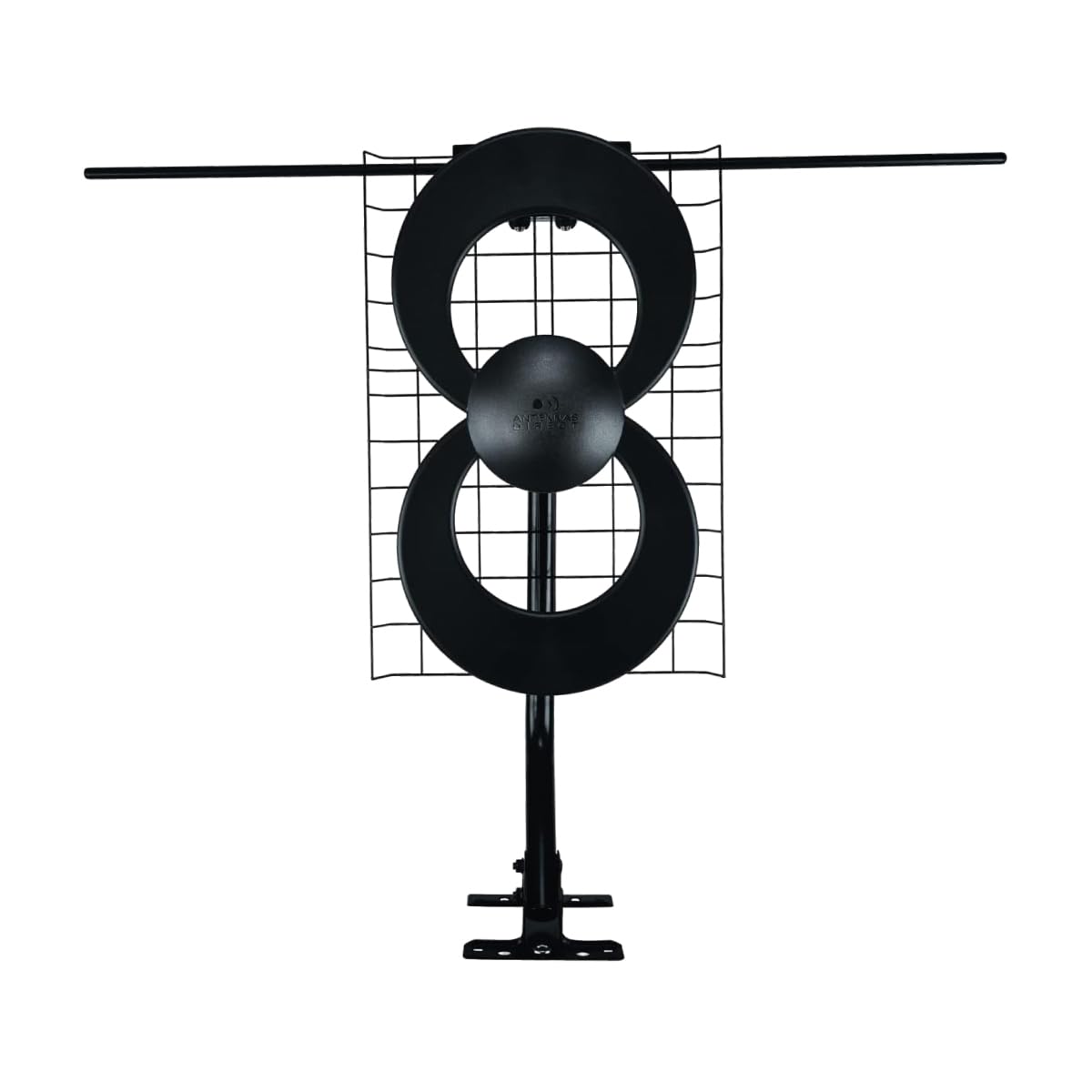
Antennas Direct has a strong reputation in the OTA community for delivering real-world range that matches sticker claims. The ClearStream 2V uses a double-loop UHF element paired with a Hi-VHF dipole and a reflector panel that adds forward gain and rejects interference from behind. In hilly, tree-filled areas, owners report pulling 65 to 70 crystal-clear channels from 38 miles away, with picture quality indistinguishable from cable.
The assembly is straightforward — the reflector snaps on, the mast clamp tightens to a vertical or horizontal surface, and the antenna weighs just 2 pounds, making it easy to install on a J-pole or attic beam. It supports 4K, 8K UHD, and NEXTGEN TV out of the box, and Antennas Direct backs it with a lifetime manufacturer warranty on the antenna itself.
One omission: the antenna does not include a coaxial cable, so you will need to purchase a high-quality RG6 separately. The 20-inch mast with pivoting base gives you solid mounting flexibility, but the lack of a built-in amplifier means fringe-area users may need to add an external preamp. For suburban and rural homes with decent tower proximity, this is one of the most reliable fixed antennas you can buy.
Why it’s great
- Reflector design delivers real forward gain and interference rejection
- Ultra-light at 2 pounds, easy to mount anywhere
- Lifetime warranty from a trusted US-based brand
Good to know
- No coax cable included in the box
- No built-in amplifier — add preamp for fringe areas
3. Five Star Yagi Satellite HD TV Antenna

The Five Star Yagi antenna bundles everything you need for a single-roof install: the antenna itself, a 40-foot RG6 coax cable, a 20-inch mounting J-pole, a 4-way splitter, and cable clips. For anyone who does not want to run to the hardware store for mounting hardware, this kit is a huge time saver. The Yagi design uses longer, larger receiving elements than many competing antennas, which translates to better VHF reception — important if your local station broadcasts on the VHF-Hi band.
Users 45 miles from towers report pulling 40+ channels indoors with perfect picture, and rural installations in hilly terrain have picked up 35 channels with some stations over 50 miles away. The antenna is passive — no built-in amplifier — which some users prefer because it avoids signal overload and does not require a USB power connection. The weatherproof construction includes lightning protection and durable materials designed to withstand heavy rain and wind.
Assembly instructions can be vague, and the antenna feels lighter than some premium Yagi models, which raises minor concerns about long-term durability in high-wind zones. Mounting instructions for the kit are also sparse. Still, for the price and the completeness of the included components, the Five Star kit offers excellent value for a dedicated outdoor Yagi setup.
Why it’s great
- Complete install kit: J-pole, coax, splitter, clips all included
- No amplifier needed — simple passive Yagi design
- Extended elements improve VHF-Hi signal capture
Good to know
- Instructions and documentation are sparse
- Build feels lighter, may flex in strong winds
4. PIBIDI Outdoor TV Antenna UHD-8903

The PIBIDI UHD-8903 is a straightforward Yagi antenna built for users who need raw element surface area to capture weak signals from extreme distances. Unlike the PBD, it does not include a motorized rotator or dual outputs — it focuses purely on reception depth. Owners in rural Oregon pulling stations 40 to 100 miles away report sharp, clear pictures where previous antennas failed entirely, with channel counts jumping from 15 to over 80 in some setups.
Assembly is notably easier than many Yagi designs because most of the elements come pre-attached. You only need to snap on a few remaining pieces and mount the antenna to a mast. The weather-resistant construction includes lightning protection, and the antenna is grounded by design. It works across both UHF (470-860 MHz) and VHF (170-230 MHz) bands, so you are not locked into one frequency range.
The lack of any rotation mechanism means you must physically aim the antenna at the broadcast tower cluster, and if your local towers are spread out, you may lose some stations depending on orientation. A few users also noted that the advertised 200-mile range is optimistic — realistic performance tops out around 100 miles in most terrain. For a single-direction rural install where towers are clustered, this is a reliable, low-hassle option.
Why it’s great
- Pre-assembled elements, very quick to set up
- Excellent deep-reception in rural 40-100 mile zones
- Lightning protected and grounded by design
Good to know
- No rotator — towers must be in one direction
- 200-mile marketing claim is aspirational in real terrain
5. Winegard FL5500A FlatWave
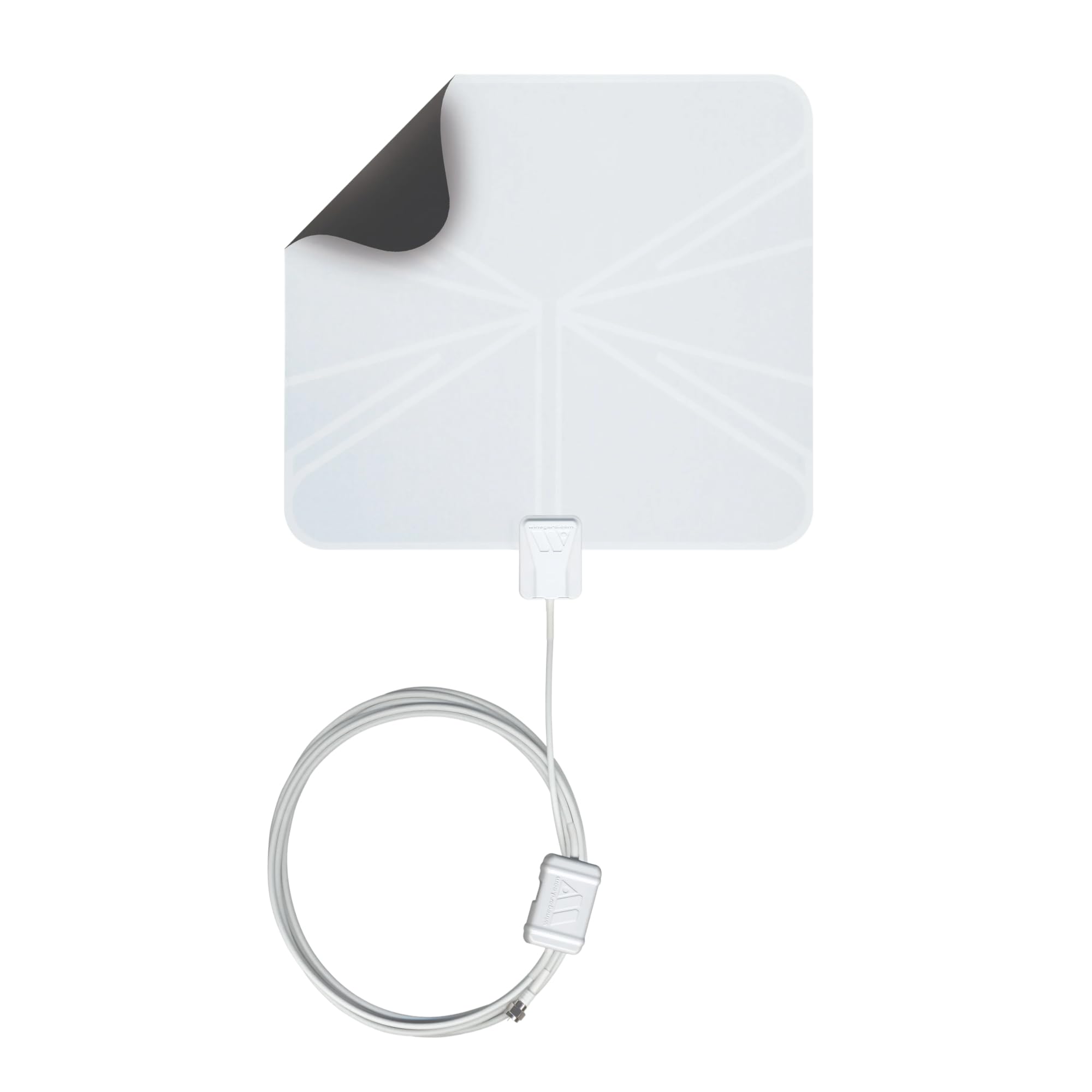
Winegard is a trusted name in OTA antennas, and the FlatWave FL5500A is their solution for urban and suburban dwellers who cannot or will not mount a large Yagi on their roof. At just 0.6 inches thick and weighing 0.34 pounds, this amplified flat panel can be taped to a wall, placed behind a TV, or stuck on a window. The dual-color design (black on one side, white on the other) helps it blend into any room.
Amplification is built-in and powered via a USB connection, so you need an available USB port on your TV or a wall adapter. The Winegard app walks you through aiming — the antenna must have a clear line of sight to broadcast towers, ideally through a window with the black side facing out. Users 15 miles from towers in Philadelphia report 22 channels with the amplifier on, and those 30 miles out can pull 9 to 40 channels depending on obstructions.
The coax cable is permanently attached at 18.5 feet, which limits placement flexibility — you cannot swap it for a longer cable or use a 90-degree adapter without modifying the connection. Reception is also more sensitive to window orientation and building materials than an outdoor antenna. For apartment renters or homeowners who prioritize interior aesthetics and live close to towers, the FlatWave performs well within its intended range.
Why it’s great
- Ultra-thin design disappears into any room
- Built-in amplifier improves weak signal capture
- Winegard app helps find optimal placement
Good to know
- Coax cable permanently attached, no user replacement
- Performance drops significantly without clear line of sight
6. NGGNGG Digital HD Antenna
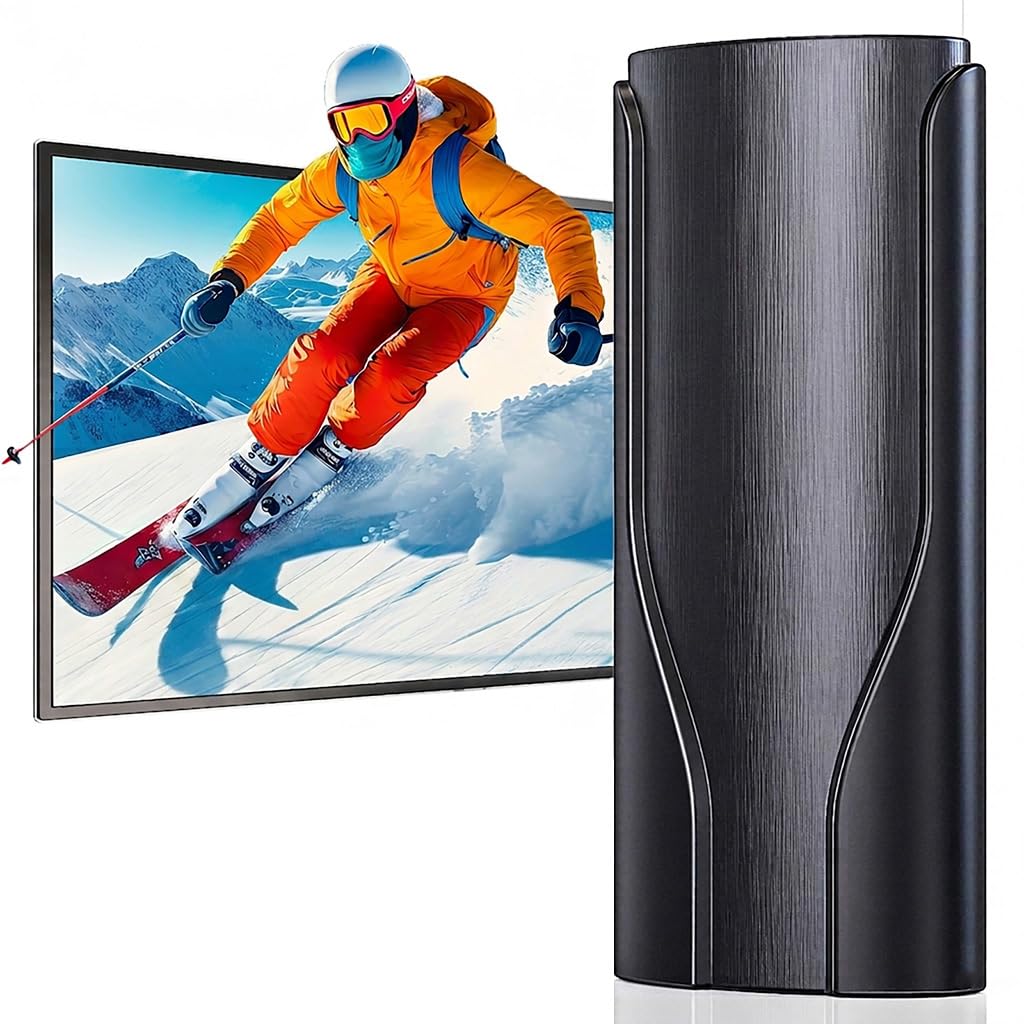
The NGGNGG antenna is an entry-level option that delivers solid results for users within 35 miles of broadcast towers, especially if they pair it with a Tablo or similar DVR. One user reported jumping from 25 to 51 local channels after switching from an older antenna. The 36-foot RG6 coaxial cable gives you flexibility to place the antenna in a window or attic instead of being stuck right next to the TV.
The built-in signal booster supports both short-range and long-range modes, and the weather-resistant housing allows outdoor mounting on a balcony, roof, or RV. It supports 4K and 1080p resolutions, and the kit includes a USB power adapter, mounting hardware, and the coax cable. For the price, you get a lot of physical components including a long cable that budget competitors often omit.
The 2200-mile range claim is pure marketing fiction — no consumer antenna can pull signals from that distance. Real-world reception tops out around 40-60 miles in open terrain with clear line of sight. A few users also noted intermittent signal during bad weather. If you keep expectations realistic and use it within suburban range, the NGGNGG is a functional, affordable starting point.
Why it’s great
- Long 36-foot coaxial cable included for flexible placement
- Short/long range amplifier switch for different distances
- Weather-resistant housing supports outdoor installation
Good to know
- 2200-mile range claim is not realistic
- Signal may drop during heavy rain or snow
7. CUKOKATV 6000+Mile TV Antenna
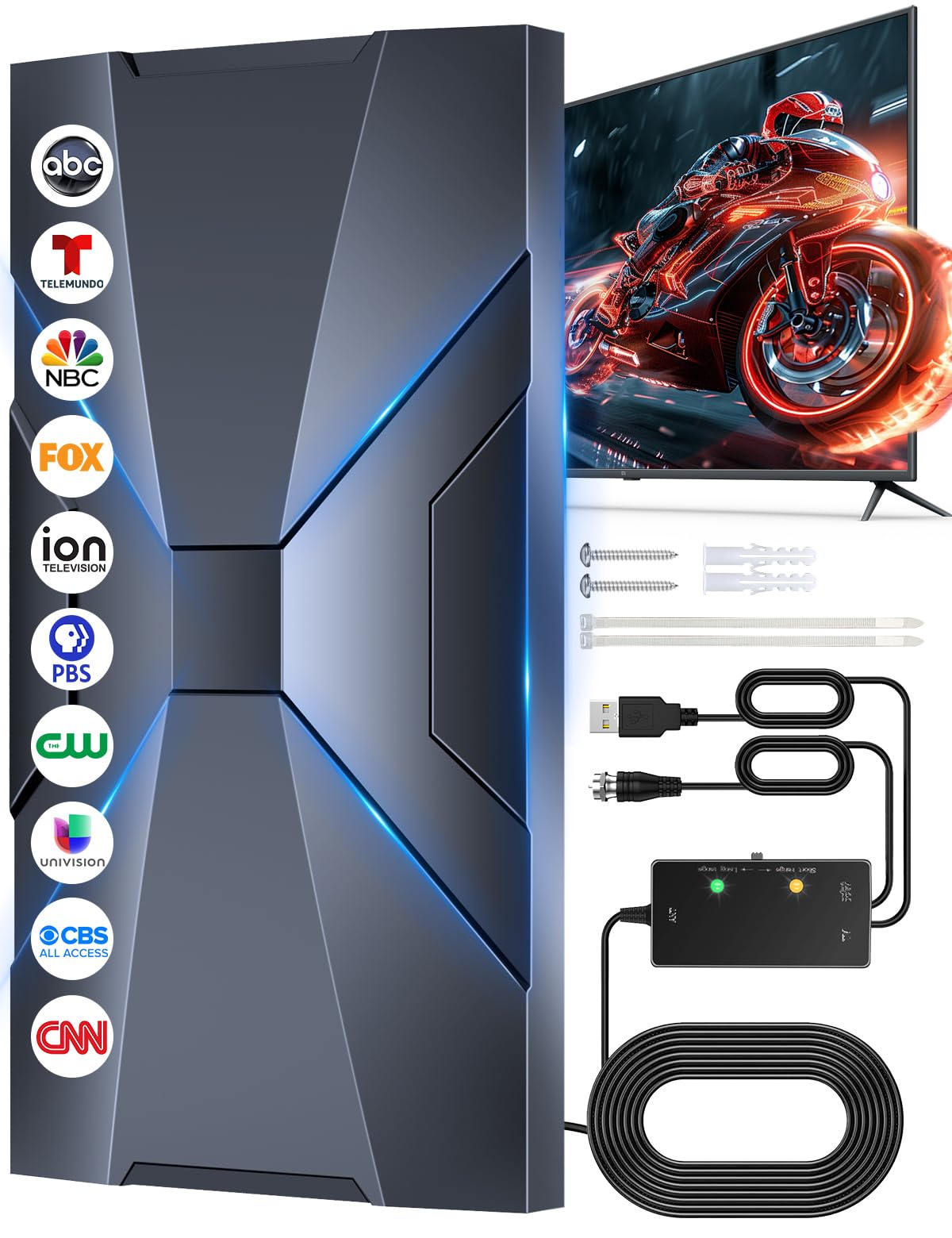
The CUKOKATV antenna targets budget-conscious cord cutters with a compact design that claims indoor, outdoor, and even mobile use in cars or campers. The built-in amplifier includes a short-range mode (yellow light) for users within 35 miles of towers and a long-range mode (green light) for fringe areas. The waterproof coax cable and weather-resistant enclosure mean you can mount it outside without worrying about moisture damage.
Users in suburban locations report receiving 19 to 30 channels after proper placement, with stable reception that does not pixelate during windy conditions. The setup process is genuinely fast — connect the coax to the TV’s antenna input, plug in the USB power, and run a channel scan. The included heavy-duty coax cable and compact form factor make it easy to tuck behind a TV or mount on a balcony railing.
The 6000+ mile claim is the most exaggerated in this roundup, and users in deep rural areas with hills and heavy tree cover report very few channels. The amplifier has a USB-C connection, which is convenient, but the power cord is short at only 3 feet. For urban and suburban homes within 35 miles of towers, this antenna works reliably; for rural fringe areas, look at the PIBIDI or the Five Star Yagi instead.
Why it’s great
- True dual-mode amplifier for short and long range
- Waterproof coax cable and weather-resistant housing
- Compact size fits tight spaces, car, or camper
Good to know
- 6000+ mile range claim is pure marketing
- Short USB power cord limits placement
- Performs poorly in deep rural, obstructed locations
FAQ
Do I need an amplified or passive antenna?
How high should I mount an outdoor TV antenna?
Will a TV antenna work in a metal or concrete building?
Final Thoughts: The Verdict
For most users, the tv antenna winner is the PBD Amplified Outdoor because the motorized rotator eliminates the need to climb onto the roof whenever you want to pull channels from a different direction. If you want a fixed, ultra-reliable antenna for suburban or rural clusters, grab the Antennas Direct ClearStream 2V with its reflector-enhanced gain. And for a complete budget-friendly kit that includes a J-pole, coax, and splitter right out of the box, nothing beats the Five Star Yagi.