
Our readers keep the lights on and the weekend projects moving. As an Amazon Associate, I earn from qualifying purchases.
Hiking for miles with heavy glass swaying from a single thin strap isn’t just uncomfortable — it compresses your spine, digs into your collarbones, and forces your shoulders forward. A proper neck strap re-distributes your binoculars’ weight across your chest, keeps them pressed flat so they don’t swing when you climb or stalk, and puts them at hand-height so you don’t miss a fleeting glimpse.
I’m Rikta — the co-founder and writer behind FitlyFast. I’ve spent months researching load distribution mechanics, shock-cord elasticity, and quick-release hardware across dozens of harness and strap designs so you can trust what goes around your neck.
If you carry optics for more than twenty minutes, you need a design that transfers weight from your cervical vertebrae to your shoulders and core. This guide breaks down the best materials, buckle types, and adjustment systems in the binocular neck strap market so you can buy with confidence.
How To Choose The Best Binocular Neck Strap
Not every strap is built for the same purpose. A birdwatcher who stands still for an hour needs different padding than a backcountry hunter who scrambles over deadfall. Matching the design to your activity prevents frustration, chafing, and dropped glass.
Padding Material and Width
Narrow nylon webbing cuts into skin under the weight of full-size binoculars. A wide neoprene pad spreads the load across a larger surface area on your neck and traps less sweat than polyester. For heavy optics such as 10×42 or 15×56 models, look for straps that use neoprene at least two inches wide and 3mm thick — anything thinner transfers too much pressure during a full day of glassing.
Harness vs. Neck Strap
A standard neck strap hangs the weight off your cervical spine. An X-shaped or Y-shaped harness wraps around both shoulders and joins at the chest, distributing the load through your entire upper body. If you carry binoculars for more than three consecutive hours, a harness design reduces fatigue significantly. Neck straps remain a fine choice for casual use or shorter outings where speed of putting on and taking off matters.
Connector Type and Security
The attachment system that links the strap to your binoculars is the most overlooked failure point. Snap-style Uni-Loop connectors allow quick detachment but can separate if snagged. Swivel hooks and locking carabiners offer more security. For users who employ tripods or change between camera and binocular use, a quick-release system that stays on the strap side saves time.
Quick Comparison
On smaller screens, swipe sideways to see the full table.
| Model | Category | Best For | Key Spec | Amazon |
|---|---|---|---|---|
| Rick Young Outdoors Premium | Premium Harness | Backcountry hunting | Shock cord with elastic memory | Amazon |
| OP/TECH USA Super Classic | Padded Neck Strap | All-day birding | 3mm neoprene with Control-Stretch | Amazon |
| Vortex GlassPak Pro | Chest-Harness System | Multi-day expeditions | DWR-treated Cordura nylon | Amazon |
| Bushnell Binoculars Harness | Mid-Range Harness | Lightweight day hikes | Vented breathable fabric | Amazon |
| OP/TECH USA Bino/Cam Harness | Dual-Purpose Harness | Camera and optics switching | Self-adjusting Uni-Loop connectors | Amazon |
| OUFABE X-Shaped Harness | Budget Harness | Youth and casual birding | Elastic bands with leather back strap | Amazon |
| Trummul Binocular Harness | Entry-Level Harness | Budget-conscious beginners | X-shaped fully elastic design | Amazon |
In‑Depth Reviews
1. Rick Young Outdoors Premium Binocular Harness

The patented shock-cord system sets this harness apart from elastic-webbing alternatives. Traditional straps that rely on woven elastic lose their tension over time — the bungee-style cordage in this Rick Young Outdoors product maintains its elastic memory across multiple hunting seasons. The result is a harness that hugs your binoculars flat against your chest, preventing the sag-to-belt-line bounce that plagues standard X-style straps.
At just over two ounces, it’s one of the lightest full-harness options available. The minimalist design wraps around binoculars when not in use without tangling, and the ability to wear it in five different positions accommodates bowhunting, rifle hunting, or daypack carry. Several backcountry users report it fits seamlessly under a pack hip belt because the yoke sits high on the chest rather than across the abdomen.
Shorter torsos may need to trim the cord length according to the included instructions, and the swivel-hook connectors are secure but not as fast to detach as push-button buckles. For those who hike hard and need their binoculars to stay put without flopping, this is the most balanced solution at this tier.
Why it’s great
- Shock cord maintains elastic tension longer than woven elastic
- Ultralight construction (under 3 ounces) suits long backcountry hikes
- Five wear positions adjust to different hunting and hiking styles
Good to know
- Swivel hooks require more effort to detach than snap-style buckles
- Trimming cord length needed for users with very short torsos
2. OP/TECH USA Super Classic Strap – Pro Loop

This is not a harness; it’s a dedicated neck strap with the most effective padding in this weight class. The 3mm neoprene core is bound with a Comfort-Stretch edge and backed with an internal Control-Stretch membrane that limits how far the strap elongates under load. Users carrying full-frame DSLRs with 70-200mm f/2.8 zoom lenses report that the strap stays on the shoulder without sliding off, thanks to the non-skid neoprene surface.
The Pro Loop version uses fixed loops that attach directly to the camera or binocular eyelets, eliminating the need for split rings or carabiners. This fixed-loop design is more secure when glassing in motion and prevents the connector from falling out of position. Several tall users note that the maximum 43-inch length fits well as a neck strap but feels short for cross-body sling carry — the optional four-inch extender solves that.
One nuance: the closed loops require you to thread the strap through your binocular eyelets rather than clipping on. That takes a bit more effort during installation, but once set, the connection is the most reliable in this roundup. The Pro Loop connectors also integrate cleanly with Arca-Swiss tripod plates, eliminating interference when you mount your gear on a tripod. This is the strap to choose when padding and security matter more than quick-switching between devices.
Why it’s great
- 3mm neoprene padding combined with Control-Stretch provides superior load support
- Non-skid neoprene surface keeps the strap from slipping off a shoulder
- Fixed Pro Loop connectors are more secure than snap attachments
Good to know
- Installation requires threading loops through eyelets — not quick to swap
- Maximum 43-inch length is too short for tall users who prefer a cross-body sling
3. Vortex Optics GlassPak Pro

The GlassPak Pro isn’t just a strap system — it’s a modular chest-mount solution that replaces the need for a chest pouch. The DWR-treated Cordura nylon exterior sheds light rain and morning dew, while the quiet microfiber interior prevents scratch damage to your optics and deadens any rustling sound during still-hunting. The harness itself adjusts through a top-loop system that allows one-handed access to your binoculars, which is critical when you need glass up to your eyes in seconds.
Storage is the defining feature here. Front, side, and rear pockets hold a rangefinder, lens cloth, and spare CR123 batteries without adding a separate pack. The included rangefinder pouch attaches to modular loops, and users report that placing the pouch on the side opposite your dominant hand prevents interference with a rifle stock or bow riser. The large size fits 56mm objective binoculars such as the Vortex Razor UHD 50mm, and the small accepts most 42mm models.
The trade-off for this storage and protection is bulk and weight. At half a pound, this is the heaviest option in the guide, and wearing it under a backpack requires careful adjustment to avoid pressure points. The quick-release buckles are easy to operate even with gloved hands, but the system is more complex to get on and off than a simple neck strap. This is the right choice for multi-day hunters who need their kit carried on their chest, not just their binoculars.
Why it’s great
- Weather-resistant Cordura nylon and DWR protection survive mountain weather
- Multiple integrated pockets eliminate the need for a separate chest pouch
- One-handed top-loop access allows rapid glassing without breaking stride
Good to know
- Heavier and bulkier than all other options — not ideal for minimalist carry
- Rangefinder pouch attachment point is a single snap loop, not a positive lock
4. Bushnell Binoculars Harness
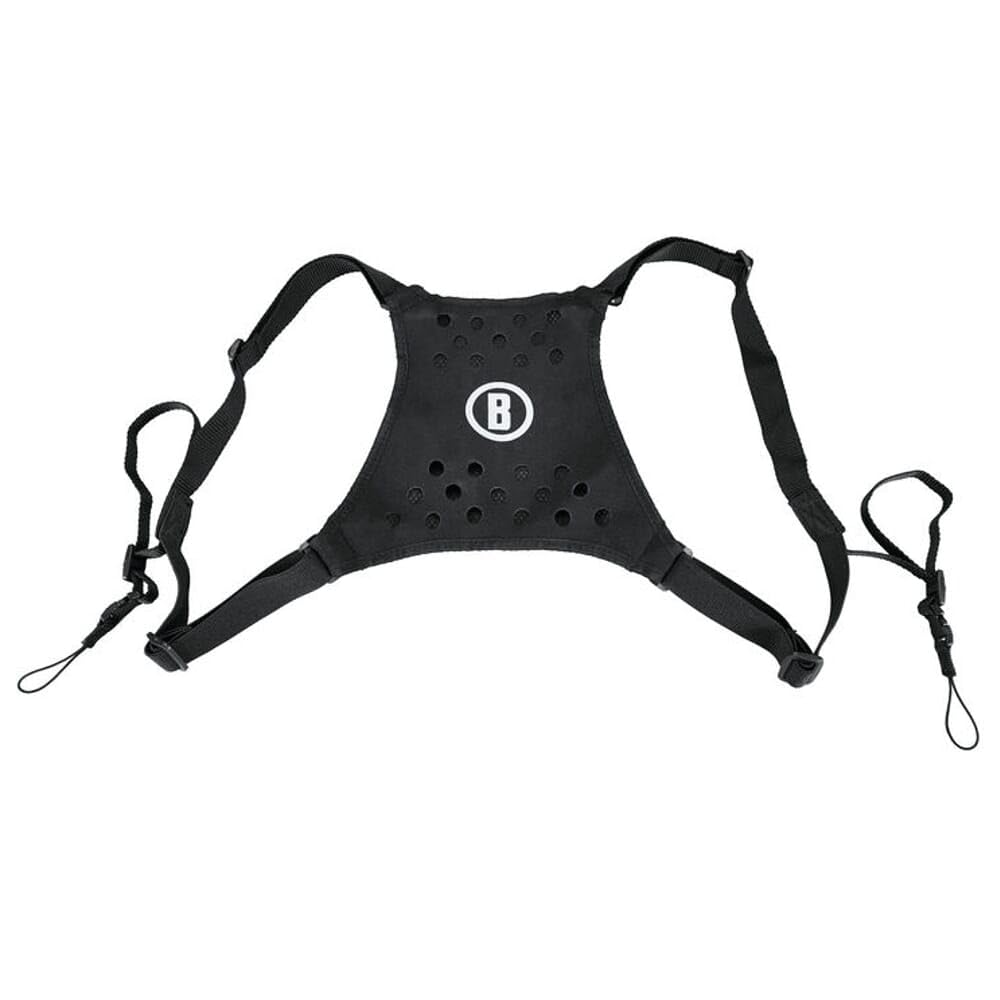
The Bushnell harness sits in a practical middle ground — lighter than a full chest-pack system but more substantial than a basic neck strap. The back panel uses breathable mesh with air vents cut through the padding, making this one of the few harnesses designed specifically to prevent heat buildup during summer hikes. The quick-detach clips at the binocular attachment points use a push-button mechanism that is faster to release than the buckle-and-loop systems on some budget straps.
Multiple adjustment points allow fine-tuning of the chest straps and shoulder straps independently, so the binoculars sit at a consistent height regardless of how many layers you’re wearing. The lightweight fabric enclosure won’t abrade against synthetic jackets or field shirts. Users at six-foot-five report that the adjustment range falls short for taller frames — the harness is sized for average adult builds and lacks the extenders found on premium designs.
The built-in anti-reflective coating on the accessory pouches and UV-protective fabric is a small but clever addition for glassers who lay their harness on stumps or rocks during lunch breaks. The trade-off comes in the connector hardware: the plastic buckles on the attachment clips are durable for casual use but may not withstand the repeated open-close cycles of a professional photographer or serious hunter over several years.
Why it’s great
- Breathable mesh back panel with air vents reduces sweat buildup on warm days
- Quick-detach push-button clips allow rapid attachment and removal of binoculars
- Independent chest and shoulder adjustments let you dial in the perfect fit
Good to know
- Plastic connectors may wear out faster than metal alternatives under heavy use
- Adjustment range at the shoulder straps is limited for very tall users
5. OP/TECH USA Bino/Cam Harness

This is the harness that birders and photographers who switch between camera and binocular use should look at first. The self-adjusting webbing system uses a sliding sternum piece that automatically centers the load when you lean or crouch. It’s one of the few designs in this price range that keeps the gear pressed flat against your sternum rather than swinging away from the body when you’re moving quickly on a trail.
The Uni-Loop connectors are a proprietary OP/TECH USA standard that extends across their entire accessory line. You can buy extra connector sets and leave one on your camera and one on your binoculars, then swap the harness between them in seconds. The webbing is sewn in the USA, and the limited lifetime warranty backs the construction against failures in normal use. Several users report this harness comfortably holds a DSLR plus a 70-200mm f/4 zoom, about four pounds of gear, with negligible bounce on flat terrain.
Portrait-orientation rotation for a camera is limited because the top strap doesn’t provide enough slack, and the shoulder straps can slip out of adjustment after several hours of active walking. Users with a petite frame appreciate that the straps cinch down small enough to fit a lightweight frame, while users over six feet may need to adjust frequently throughout the day. The trade-off between universality and a perfect fit is real — this harness is a solid generalist that excels at nothing specific but never truly fails at anything either.
Why it’s great
- Uni-Loop quick-release system lets you swap between camera and binoculars in seconds
- Self-adjusting sternum piece keeps the load centered and stable during movement
- Made in the USA and backed by a limited lifetime warranty
Good to know
- Portrait-orientation rotation is restricted due to limited strap slack at the top
- Shoulder straps may require periodic readjustment during long outings
6. OUFABE X-Shaped Binocular Harness

This X-shaped harness from OUFABE punches above its tier in one specific area: the leather-like back strap that sits between your shoulder blades. Most budget harnesses rely entirely on elastic webbing that stretches and sags over time, but the leather reinforcement on this model provides a stable anchor point that holds the binoculars in a consistent position on your chest. The elastic bands still provide the flexibility to bring the binoculars to your eyes, but the back strap maintains the overall geometry.
The aesthetic is noticeably cleaner than other straps in its range — black elastic with black stitching and a minimal logo. A user who is 6-foot-2 and 250 pounds reports that the adjustment range accommodates a large frame with room to spare, which is unusual for a budget harness. The plastic quick-release buckles at the binocular attachment points are functional but lack the smooth action of injection-molded connectors on mid-range options.
The most frequent complaint is the strap adjusters: the sliding brackets that shorten or lengthen the shoulder straps are tucked behind the back and require reaching over your shoulder or having someone else adjust them. Once set, they hold position well, but the initial fitting is more fiddly than harnesses with front-adjustable buckles. For those who do not need to adjust frequently and want a simple, functional harness that distributes binocular weight off the neck, this is a competent entry point.
Why it’s great
- Leather back strap provides a stable anchor that elastic-only harnesses lack
- Accommodates large body frames better than most budget-priced harnesses
- Clean black-on-black design looks more expensive than it is
Good to know
- Shoulder adjusters are located behind the back — hard to fine-tune on the fly
- Plastic buckles lack the refined feel of connectors on mid-range harnesses
7. Trummul X-Shaped Chest Harness

The Trummul harness is the most affordable entry point in this roundup, and its design reflects that positioning. The entire strap structure is made from elastic webbing with no rigid components or padding — the weight distribution comes solely from the X-configuration spreading the load across your shoulders rather than concentrating it on your neck. The free-size design uses adjustable sliding brackets that fit all normal adult torso lengths without separate S-M-L sizing.
Several users note that the leather attachment strips on the binocular connectors need to be trimmed to fit certain models, which is an extra step that mid-range harnesses skip. The fast-release buckles on the chest straps work smoothly for putting the harness on and taking it off, but the elastic nature of the whole harness allows some bounce when you walk at a brisk pace. For casual birding or short nature walks where the binoculars stay close to your body most of the time, the movement is barely noticeable.
Users who pair this with heavier full-size binoculars report that the elastic stretches enough to cause a slight sag, requiring occasional upward adjustment. The lightweight construction makes this harness easy to stuff into a daypack or pocket when not in use. It is not built for the abuse of backcountry hunting or professional field work, but for the budget-conscious birder or hiker who wants immediate relief from a stitched nylon neck strap, this removes the sharp pressure without emptying the wallet.
Why it’s great
- Extremely lightweight and packs down small enough to fit in a jacket pocket
- X-configuration design removes weight from the neck at the lowest cost
- Adjustable sliding brackets fit a wide range of adult torso sizes
Good to know
- Full-elastic construction creates bounce with heavier binoculars at a brisk walk
- Leather strips at the connectors may require trimming to fit some binocular models
FAQ
Can I use a binocular neck strap with a camera?
How do I measure the right strap length for my body?
Is a neck strap or a chest harness better for birding?
Will a harness fit my specific binocular model?
Final Thoughts: The Verdict
For most users, the binocular neck strap winner is the Rick Young Outdoors Premium because the shock-cord design outlasts woven elastic and keeps the optics pinned flat at a lower weight. If you want plush neoprene padding for a classic neck-strap feel, grab the OP/TECH USA Super Classic. And for multi-day expeditions that demand storage and weather protection, nothing beats the Vortex GlassPak Pro.