
Our readers keep the lights on and the weekend projects moving. As an Amazon Associate, I earn from qualifying purchases.
A newborn’s brain forms over 1 million new neural connections every second, and the right tactile, visual, and auditory stimulus — delivered through carefully chosen toys — directly shapes those pathways. The challenge is cutting through the noise of flashing plastic gadgets to find the objects that actually target the discrete developmental windows of the first two years.
I’m Rikta — the co-founder and writer behind FitlyFast. I’ve spent years analyzing how physical play materials, from high-contrast cards to wooden shape sorters, map to pediatric occupational therapy milestones like pincer grasp, object permanence, and cross-body coordination.
Whether you are preparing for tummy time or prepping for first steps, this guide examines seven contenders to help you identify the best baby toys for development that deliver genuine, stage-specific learning value without the clutter.
How To Choose The Best Baby Toys For Development
Selecting a developmental toy means matching its sensory demands to your baby’s current neural stage. A 2-month-old cannot benefit from a 24-piece shape sorter, and an 18-month-old will be bored by high-contrast cards. The following criteria help you filter by what actually grows with the child rather than by packaging claims.
Match the Stimulus to the Month Window
Vision in newborns is blurry and black-and-white, so high-contrast patterns (bold stripes, checkerboards) are the only visual input that holds their attention before week 8. Around month 3, color perception kicks in — red, then blue, then green — making saturated stacking toys more effective. By month 6, cause-and-effect toys (spinners, buttons, xylophone keys) build the prefrontal cortex pathways that underlie logical thinking.
Grip Strength and Mouth Safety
Between 4 and 7 months, babies explore every object orally. This means the material must be non-toxic (BPA-free, phthalate-free, lead-free) and the shape must pass the choke tube test — no piece smaller than 1.25 inches in diameter. Textured silicone and smooth, unfinished wood offer the best tactile feedback for developing the palmar grasp, which later refines into the pincer grip around month 9.
Open-Ended vs. Single-Use Play
Toys that serve one function — a button that plays one song — are less valuable than open-ended sets where stacking cups become bath scoops, then tower blocks, then nesting containers. Open-ended play recruits more cortical regions because it requires the baby to invent the use case. Prioritize sets that offer at least three distinct play modes (stacking, sorting, pulling, shaking) to extend the toy’s lifespan across developmental stages.
Quick Comparison
On smaller screens, swipe sideways to see the full table.
| Model | Category | Best For | Key Spec | Amazon |
|---|---|---|---|---|
| Plunack 6-in-1 | Silicone Set | Teething & sensory variety | 27 pieces, food-grade silicone | Amazon |
| VTech Sit-to-Stand Walker | Electronic Walker | First steps & balance | Two-speed control, detachable panel | Amazon |
| WOODMAM Activity Cube | Wooden Cube | 7-in-1 problem-solving | Natural wood, 7 activities | Amazon |
| FEBALHS 5-in-1 Set | Mixed Material | Multi-skill progression | Silicone cups + wood sorter + xylophone | Amazon |
| Joyreal High Contrast Set | Newborn Kit | Newborn visual stimulation | 8 cards, car seat toy, book | Amazon |
| TOYVENTIVE Big Brain Box | Cardboard Set | Letters, numbers, matching | 4 books, flashcards, 2-sided puzzle | Amazon |
| Aliex Musical Instruments | Wooden Music Set | Rhythm & auditory play | Neutral boho finish, 6 instruments | Amazon |
In‑Depth Reviews
1. Plunack 6-in-1 Montessori Baby Toys Set
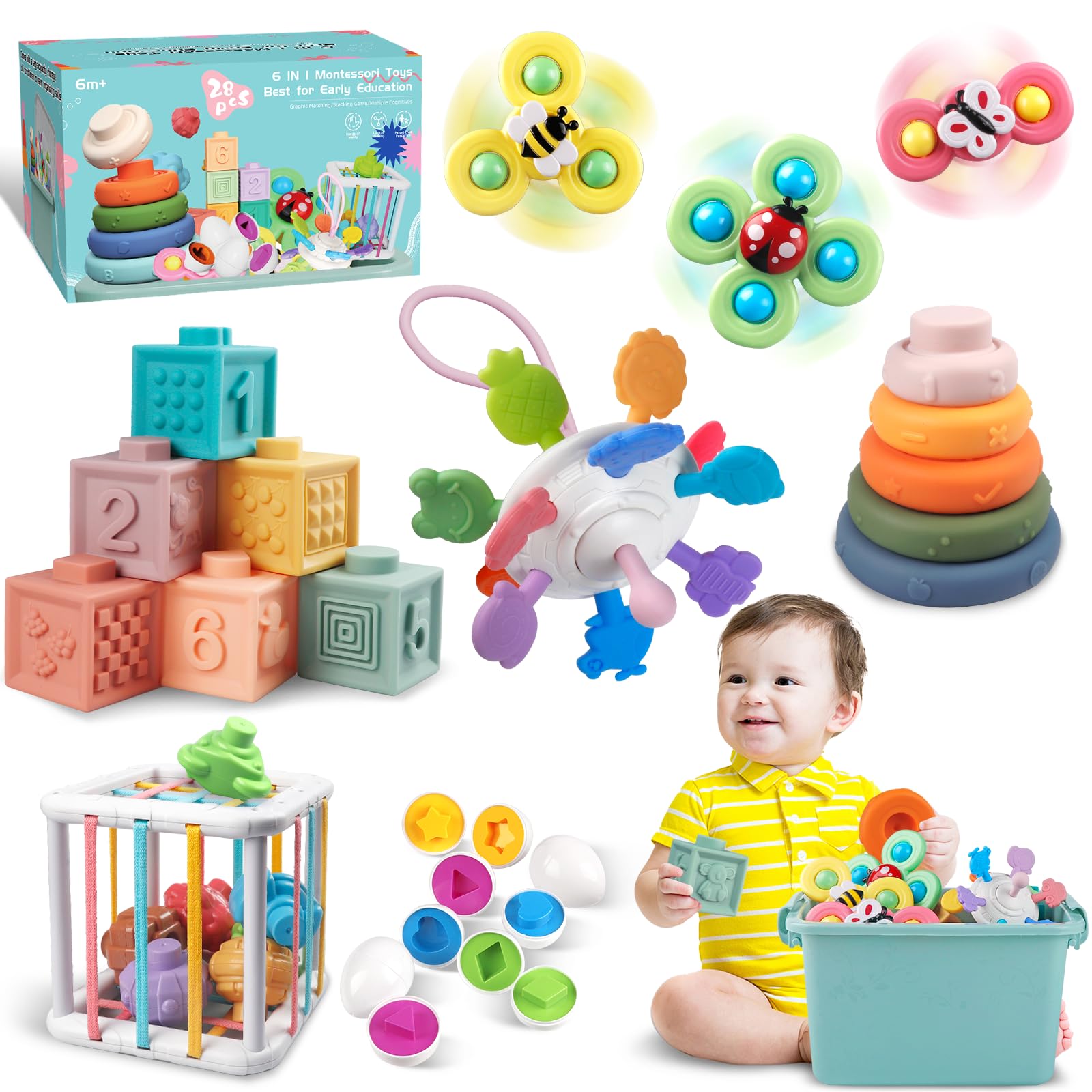
This set packs 27 pieces — 12 matching eggs, 6 soft stacking blocks, 5 rings, 3 suction-cup spinners, a pull-string toy, and a sensory storage bin — into one gift-ready box. The range of textures (smooth silicone, ridged plastic, crinkly fabric) provides the variety needed to keep a 6-month-old’s attention while supporting the shift from palmar grasp to pincer grip around month 9.
The suction-cup spinners are an unsung win: they stick to highchair trays and car windows, turning mealtime and travel into fine-motor practice. All silicone pieces withstand 200°C heat and are dishwasher-safe, a critical feature for the teething stage when everything goes straight to the mouth. Third-party lab reports confirm compliance with CPSIA and ASTM F963 standards, so there is no risk of hidden BPA or phthalates.
Parents report that the included storage bin doubles as a sensory bin for loose-parts play later, extending the set’s relevance past 12 months. The only recurring note is that the texture balls included with some batches feel less engaging than the rest of the kit, but the overall value per piece is unmatched in this price tier.
Why it’s great
- 27 high-value pieces covering stacking, sorting, pulling, and spinning
- Food-grade silicone is teether-safe, heat-resistant, and dishwasher-friendly
- Storage bin doubles as a sensory play container
Good to know
- Some accessory pieces (texture balls) feel less engaging than the core set
- Storage bin is sturdy but not stackable for shelf organization
2. VTech Sit-to-Stand Learning Walker

The VTech Sit-to-Stand remains a benchmark in the walker category because it serves three distinct phases: floor-based play with the detachable activity panel, stationary standing with the walker locked, and finally rolling-assisted steps. The five piano keys, light-up buttons, and telephone handset specifically target auditory and role-play development during the 6- to 12-month window.
What sets it apart from cheaper walkers is the two-speed control switch on the rear wheel, which allows caregivers to slow the pace for wobbly beginners and increase speed as confidence builds. The wide, stable base — 16.5 by 14.2 inches — prevents tipping, and the wheel stopper mechanism keeps the unit from sliding on hardwood floors, a real safety hazard with less-engineered alternatives.
Customer reviews consistently highlight that this walker survives multiple children without structural degradation. The removable tray makes cleanup simple, and the toys (spinning rollers, shape sorters, musical notes) are varied enough that a 7-month-old stays engaged on the floor while an 11-month-old uses it for cruising. The only trade-off is battery dependency for the sound module, but a single set lasts months with moderate use.
Why it’s great
- Three-in-one design: floor toy, stationary stand, rolling walker
- Two-speed wheel control + wheel stopper for safety on hard floors
- Proven durability across multiple children and years of use
Good to know
- Requires batteries for the sound panel; no included rechargeable option
- Detachable top can be pulled off by an eager toddler during walker mode
3. WOODMAM 7-in-1 Activity Cube

The WOODMAM cube packs a bead maze, xylophone, shape sorter, spinning gears, animal slider, learning clock, and a stacking board into a single 7-inch wooden footprint. For families with limited floor space, this consolidation is a major advantage — one cube replaces half a dozen single-purpose toys while still offering the variety that prevents boredom during the 12- to 18-month peak curiosity period.
The natural wood construction with water-based paint and smooth, chamfered edges eliminates splinter risk, and the chunky shape blocks are sized too large to pose a choking hazard. The top bead maze and clock base are detachable, so the cube can split into two separate stations — one for a tabletop and one for floor play — effectively doubling the usable play surface during playdates or sibling sharing.
A minor but honest caveat: the xylophone keys produce a tinny tone rather than a rich musical note, which may disappoint parents hoping for pitch-accurate sound. However, the tactile and visual engagement of the bead maze alone occupies most toddlers for solid 15-minute stretches. The cube’s compact storage footprint and durable build make it a logical choice for grandparents’ houses or travel.
Why it’s great
- Seven distinct activities in one space-saving wooden cube
- Detachable top and base allow two simultaneous play stations
- Chunky blocks and smooth edges prioritize safety
Good to know
- Xylophone sound quality is tinny, not musical
- Smaller overall footprint than most activity cubes (7 inches per side)
4. FEBALHS 5-in-1 Montessori Baby Toys Set
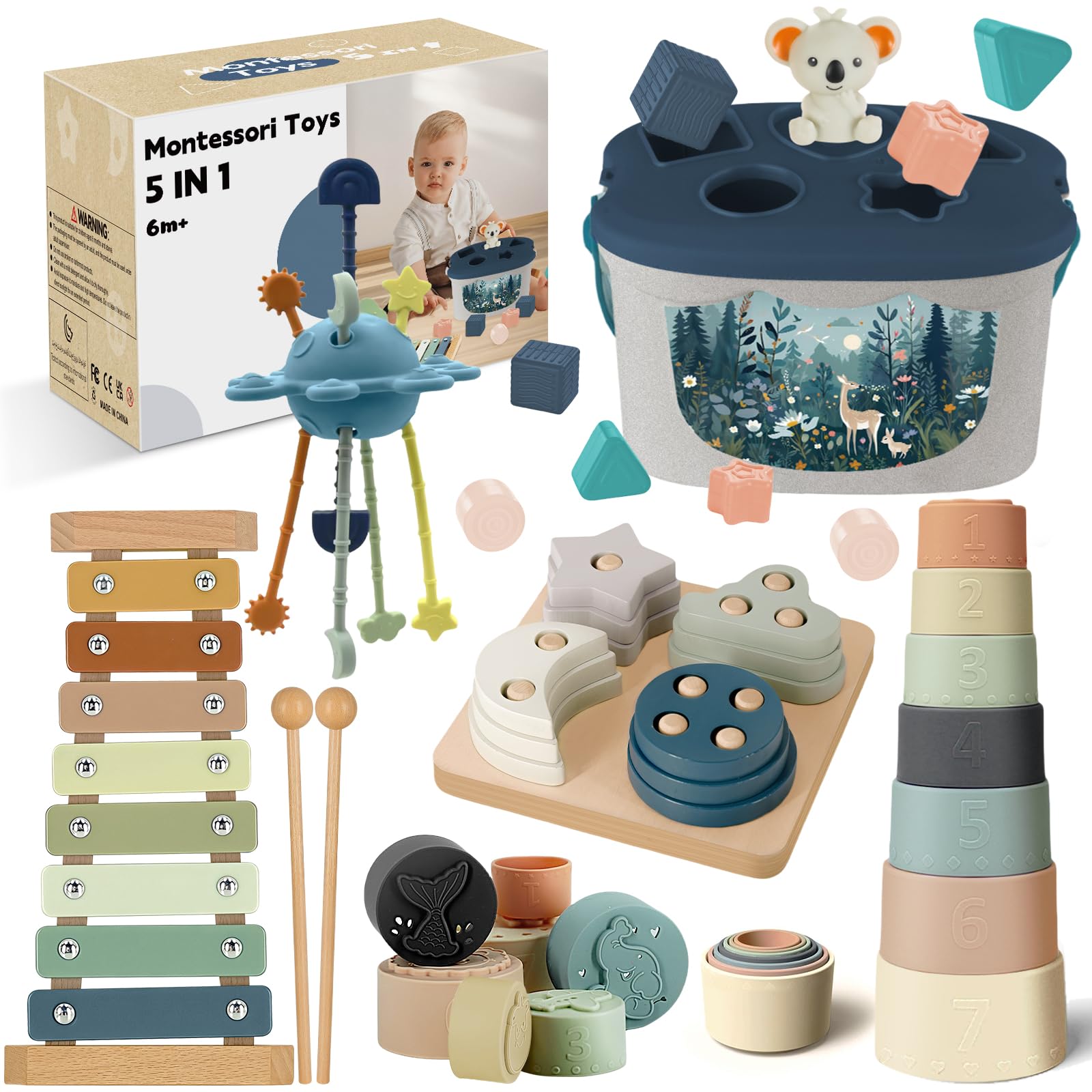
This 5-in-1 set smartly combines food-grade silicone stacking cups — perforated for bath-time water play — with a wooden shape sorter, a xylophone, a pull-string sensory toy, and a color-sorter bucket built into a storage bin. The deliberate mix of materials (soft silicone for teething, solid wood for stacking, ABS plastic for the bucket) gives babies exposure to different textures within the same play session, which supports sensory integration.
The stacking cups are a standout: each of the seven cups features a unique top pattern and a perforated base that creates water streams in the tub, turning bath time into an impromptu lesson in cause and effect. The pull-string toy has reinforced stitching that withstands the aggressive tugs of a 9-month-old, and the wooden sorter’s edges are sanded to a baby-safe smoothness. The bucket’s easy-carry handle makes clean-up portable.
Parents note that the xylophone sticks are best introduced around 8-9 months due to teething-related chewing, but the set overall spans a wide age range — the silicone cups work for a 6-month-old while the 24-piece shape sorter challenges a 20-month-old. The only common critique is that the paper-based instruction manual is thin on activity ideas, but the toys are intuitive enough to figure out.
Why it’s great
- Mixed-material set (silicone, wood, ABS) supports multi-texture exploration
- Perforated stacking cups double as bath toys for water-play learning
- Five distinct modes span 6 to 24 months of development
Good to know
- Xylophone sticks are better suited for supervised use beyond 8 months
- Paper manual lacks detailed activity guidance for caregivers
5. Joyreal High Contrast Baby Toys for Newborns
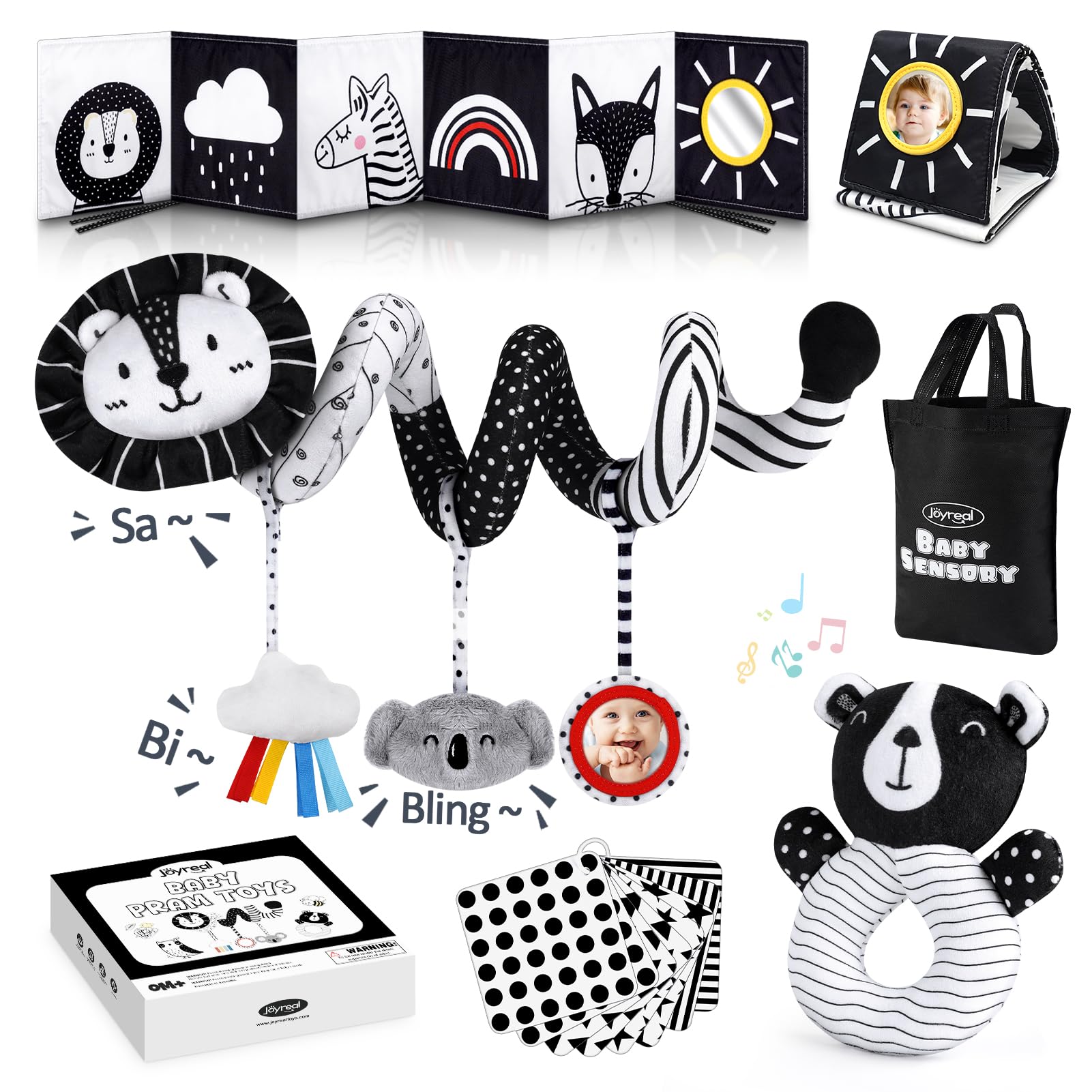
The Joyreal set is hyper-focused on the first 12 weeks of visual development, when a newborn’s retina can only distinguish high-contrast edges — bold black-and-white stripes, checkerboards, and simple face patterns. The kit includes a car seat hanging toy (lion-shaped with a koala shaker, mirror, and cloud squeaker), 8 high-contrast cards, a soft book, and a bear rattle, all stored in a drawstring bag.
The car seat attachment is the hero piece: it clips to the stroller canopy or car seat handle and provides three distinct sensory outputs (mirror for self-awareness, rattle for auditory cause-effect, crinkle fabric for tactile texture). Parents report that the lion toy keeps 2-month-olds engaged during car rides, reducing fussiness by giving them something to focus on. The cards and book are standard but well-printed with sharp, clear patterns that hold a newborn’s gaze.
All fabrics are non-toxic and odorless, with double-stitched seams that survive repeated washing. The only limitation is the narrow age window — once a baby reaches 4 months and begins tracking saturated colors, the black-and-white contrast loses its pull. For the 0-3 month period, however, this set provides exactly the stimulation that supports early optic nerve development.
Why it’s great
- Specifically designed for the newborn high-contrast vision window
- Car seat toy with mirror, rattle, and crinkle textures
- Storage bag keeps all pieces together and portable
Good to know
- Engagement drops sharply after month 4 when color perception develops
- Cards are basic; no additional activity prompts included
6. TOYVENTIVE Big Brain Box

The TOYVENTIVE Big Brain Box focuses squarely on pre-literacy and cognitive skills for the 12-month and up crowd. Inside the compact cardboard box you get four board books (ABC, 123, colors, shapes), two sets of flashcards, a 2-sided puzzle, matching boards, and a pair of play glasses. The books use realistic photographic images rather than cartoons, which helps toddlers generalize object names to real-world items.
The 2-sided puzzle is a clever inclusion: one side offers a simple 4-piece farm animal match, while the reverse presents a more challenging 8-piece scene, allowing the toy to grow with the child’s fine-motor ability. The flashcards are thick and laminated to withstand toddler bending, and the matching boards use Velcro attachments that are satisfying for little hands to press and pull apart.
Some parents feel the set lacks the interactive, sensory variety of a block or stacking set — it is fundamentally a paper-based learning kit, not a tactile toy. However, for families focused on letter and number recognition in the 2-4 age range, the Big Brain Box provides a structured, screen-free alternative to flashcard apps. The cardboard construction is sturdy but not waterproof, so it stays in the playroom rather than the diaper bag.
Why it’s great
- Real-photograph books help toddlers connect words to real objects
- 2-sided puzzle adapts difficulty as motor skills improve
- Compact, organized box reduces clutter compared to loose materials
Good to know
- Primarily paper-based; lacks the tactile/sensory depth of block sets
- Not water-resistant; requires supervision near drinks or drool
7. Aliex Wooden Musical Instruments Set

This set of six wooden percussion instruments — xylophone, maraca, jingle stick, castanet, rainmaker, and guiro — is finished in neutral boho tones (soft beige, sage green, warm wood) that blend into modern nursery decor rather than screaming primary colors. The muted palette is not just aesthetic: lower visual saturation can help babies stay focused on the auditory output without visual overstimulation.
The xylophone keys are accurately tuned to a C major scale, which is a rarity in toddler music toys, and the mallet ends are rounded to prevent eye injury. The rainmaker’s slow, cascading sound provides a gentle cause-and-effect lesson — tilt it one way, hear the beads fall — that holds the attention of 9-month-olds for several minutes. The wood is sanded smooth with no sharp edges, and all paint is water-based, non-toxic, and CPSIA-compliant.
At this price, the set is a solid entry point for early rhythm exploration. The only functional friction is that the wooden construction means no dishwasher-safe parts, and the rainmaker’s end caps can loosen with rough handling. Caregivers should supervise play to ensure pieces aren’t thrown against hard floors. For families who want a screen-free, musical introduction to tempo and pattern, though, this set delivers a clean, attractive package.
Why it’s great
- Accurately tuned xylophone supports pitch awareness development
- Neutral boho colors fit nursery aesthetics without visual overload
- Six distinct instruments offer variety in rhythm and texture
Good to know
- Wood is not dishwasher-safe; requires hand-wiping only
- Rainmaker end caps may loosen with heavy throwing or dropping
FAQ
How many toys does a baby actually need for development from 0-12 months?
What does the choke tube test measure and why is it important for baby toys?
Can electronic toys like the VTech Walker delay walking or speech development?
Final Thoughts: The Verdict
For most users, the baby toys for development winner is the Plunack 6-in-1 Set because its 27 food-grade silicone pieces span teething, stacking, sorting, and pulling across a 9-month developmental arc. If you want motion and balance training, grab the VTech Sit-to-Stand Walker. And for auditory rhythm and pattern recognition, nothing beats the Aliex Wooden Musical Instruments Set.