
Our readers keep the lights on and the weekend projects moving. As an Amazon Associate, I earn from qualifying purchases.
Scanning the ocean from a bluff or shoreline presents a unique optical challenge: distance, glare, humidity, and the constant motion of waves demand binoculars built for clarity and durability, not just magnification. A pair that excels in the field can fail spectacularly when tasked with piercing sea spray and heat shimmer.
I’m Rikta — the co-founder and writer behind FitlyFast. I’ve spent countless hours analyzing optical specifications, marine-grade builds, and customer performance data across hundreds of models to pinpoint the glass that truly works when the target is a distant whale spout or a ship on the horizon.
This guide focuses on binoculars for ocean viewing from land, breaking down the critical specs like exit pupil, prism coatings, and waterproofing that separate a usable seaside tool from a frustrating blur.
How To Choose The Best Binoculars For Ocean Viewing From Land
Selecting binoculars for seaside use means prioritizing light transmission, stability, and environmental sealing. The salt air, bright sun, and constant motion of the target demand specific features that a general-purpose birding binocular might lack. Here is what to focus on.
Magnification and Objective Lens Size
Magnification between 7x and 12x is the sweet spot. Higher power is tempting for spotting distant buoys or wildlife, but it amplifies every hand tremor and heat shimmer over water. A 7×50 setup offers a massive exit pupil for incredibly bright views in fading light, while a 10×42 delivers a great balance of reach and steady handheld use. For maximum detail at range without a tripod, consider a 12x model with image stabilization.
Prism Quality and Lens Coatings
BaK-4 prisms are non-negotiable for marine use. They prevent light from being clipped inside the barrel, yielding a perfectly round exit pupil and brighter images. Fully multi-coated lenses (FMC) maximize light transmission and reduce the internal reflections that wash out contrast in bright coastal light. A phase-correction coating on roof prisms is equally critical for sharp, color-accurate views.
Weather Sealing and Build
Waterproofing and fog-proofing are essential. O-ring seals and nitrogen purging keep internal fog at bay when moving between cool sea breezes and warm land air. Rubber armor protects against drops on rocky shorelines and provides a non-slip grip when your hands are damp. Look for models that explicitly state IPX7 or better for submersion protection.
Quick Comparison
On smaller screens, swipe sideways to see the full table.
| Model | Category | Best For | Key Spec | Amazon |
|---|---|---|---|---|
| Canon 12×36 IS III | Image Stabilization | Eliminating hand-shake at high power | Image stabilization up to 12x | Amazon |
| Leupold BX-4 Pro Guide HD 12×50 | Premium HD | Maximum brightness and clarity at long range | Guard-ion hydrophobic lens coating | Amazon |
| Nikon Action 16×50 EX | High Magnification | Extreme detail on distant stationary targets | 16x magnification with BaK-4 prism | Amazon |
| Steiner Marine 7×50 | Marine Standard | Dependable, bright views in tough marine conditions | 7mm exit pupil for low light | Amazon |
| Nikon PROSTAFF P7 10×42 | Versatile All-Rounder | A great balance of power, weight, and clarity | Dielectric high-reflective prism coating | Amazon |
| Bushnell H2O Xtreme 10×42 | Budget Marine | Reliable waterproof optics at an entry-level price | Fully multi-coated lens surfaces | Amazon |
| Sogries 10-30×50 Zoom | Budget Zoom | Flexible zoom range for variety of distances | Variable 10-30x with 50mm objective | Amazon |
In‑Depth Reviews
1. Canon 12×36 Image Stabilization III

The primary pain point for ocean viewing from land is hand-shake, which turns a potentially crisp 12x view into a queasy, bouncy image. Canon’s 12×36 IS III directly addresses this with its Vari-Angle prism image stabilization, allowing you to pick out a distant buoy or surfacing seal without the tremor that usually plagues high-power handheld optics. The Porro II prism design and doublet field-flattener deliver sharp, nearly distortion-free images from edge to edge, a rare treat at this price tier.
With a 36mm objective, it sacrifices some raw light gathering compared to a 50mm model, but the Super Spectra multi-coating compensates, producing a bright, high-contrast image even under overcast coastal skies. The compact and lightweight body is a significant advantage for a shore walk where you might carry it for hours. Eye relief is adequate for eyeglass wearers at 14.5mm, though some users note the eyepiece caps are not tethered.
The image stabilization button must be held continuously, which is a minor ergonomic concession for the profound stability it provides. Focus is manual and smooth, and the low-reflective exterior design is a thoughtful touch for wildlife observation. If eliminating shake is your top priority for scanning the endless horizon, this is the most effective tool in the list.
Why it’s great
- Image stabilization effectively cancels hand-shake at 12x magnification.
- Compact and lightweight for its feature set, ideal for portability.
- Doublet field-flattener provides edge-to-edge sharpness.
Good to know
- Stabilization button must be held down continuously.
- Smaller 36mm objective limits low-light performance compared to 50mm models.
- Eyepiece and objective caps are not tethered to the binocular.
2. Leupold BX-4 Pro Guide HD 12x50mm Gen 2

The Leupold BX-4 Pro Guide HD is built for the serious observer who demands maximum detail at very long distances. The 12x magnification paired with a 50mm objective provides a powerful combination of reach and light gathering, making it excellent for identifying vessels miles out or scanning distant headlands. Leupold’s Elite Optical System delivers exceptional light transmission and glare reduction, which is critical when the sun glints off a choppy sea.
The open-bridge, dual-hinge design is remarkably ergonomic and keeps the weight manageable for a 12×50 class binocular. The standout feature for ocean work is the Guard-ion hydrophobic lens coating, which actively repels salt spray, sea mist, and fingerprints, keeping your view clear with minimal wiping. The BaK-4 prisms and dielectric coatings produce a bright, true-color image with high resolution.
Waterproof and fog-proof construction is a given at this level, and Leupold’s legendary warranty backs it up. Some users may find the 12x magnification a bit much for extended handheld viewing without a rest, but for tripod-mounted or braced observation, the clarity is outstanding. The included neck strap and padded case are high-quality, reflecting the premium nature of the build.
Why it’s great
- Guard-ion hydrophobic coating sheds water and spray effectively for ocean use.
- Premium HD optics deliver exceptional brightness, contrast, and resolution.
- Open-bridge design is surprisingly ergonomic and well-balanced.
Good to know
- 12x magnification is demanding for steady handheld use without support.
- Premium positioning reflects a higher investment for the features.
- Focus wheel may feel stiff to some users out of the box.
3. Nikon 7247 Action 16×50 EX Extreme All-Terrain

The Nikon Action 16×50 EX is a serious instrument for the observer who needs to pull in extreme detail—reading the numbers on a distant container ship or identifying a bird species on a far-off rock. With 16x magnification and a 50mm objective, this is not for casual scanning; it is a purpose-built tool for stationary, long-range spotting. Customer feedback confirms its low-light performance is far superior to many mid-range 10x50s, making it a strong choice for dawn and dusk sessions.
Bright, multicoated optics and BaK-4 high-index prisms deliver crisp, high-resolution images, though the narrow field of view is a trade-off at this power. The build is rugged, with a rubber armor and a waterproof, fog-proof seal that handles coastal weather well. The included tripod adapter is a critical inclusion, as 16x is virtually impossible to hold steady for long periods without a mount.
Several users noted that the front lens caps can be loose, and the provided case feels less premium than the binocular itself. Eyecups can occasionally shift out of sync. However, for the dedicated user willing to use a tripod, the sheer resolving power at this price point is difficult to beat.
Why it’s great
- 16x magnification delivers outstanding detail on very distant objects.
- Excellent low-light performance for its class, far surpassing cheaper 10x50s.
- Includes a tripod adapter, which is essential for this power level.
Good to know
- High magnification is nearly impossible to use handheld without a tripod.
- Narrow field of view makes scanning large areas difficult.
- Front lens caps can be prone to falling off in the field.
4. Steiner Marine 7×50 Binoculars

The Steiner Marine 7×50 is the archetypal water-going optic, and it translates perfectly to land-based ocean viewing. The 7×50 configuration yields a massive 7.14mm exit pupil, which floods your eyes with light even in deep twilight, making it superb for spotting silhouettes against the horizon at dusk. The Sports Auto Focus system is a marvel of simplicity: once set to your vision, it keeps everything sharp from 20 yards to infinity without any fiddling—a huge advantage when scanning for moving targets like dolphins or surfers.
The Floating Prism System uses flexible silicone mounts to absorb shock, ensuring the optics stay aligned after an accidental drop on a rocky pier. The rubber-armored body is fully waterproof and designed with ergonomic ridges for a secure, comfortable grip in wet conditions. The heritage warranty is practically a lifetime guarantee, reflecting Steiner’s confidence in the German build.
At 7x, you sacrifice the raw reach of higher-power models, but you gain a wide, steady field of view that is perfect for tracking fast-moving objects like a flock of terns. The individual focus eyepieces require a moment to set up initially, but the payoff is a reliable, rugged instrument that never needs refocusing. A small number of users find the neck strap basic for the price, but the overall value for a purpose-built marine binocular is undeniable.
Why it’s great
- 7mm exit pupil provides exceptional brightness in low-light conditions.
- Sports Auto Focus keeps the view sharp from 20 yards to infinity without re-focusing.
- Floating Prism System and rubber armor offer extreme durability and shock resistance.
Good to know
- 7x magnification offers less detailed reach compared to 10x or 12x models.
- Heavy build is noticeable during extended carrying sessions.
- Individual focus eyepieces require manual adjustment for each user.
5. Nikon 10×42 PROSTAFF P7

The Nikon PROSTAFF P7 10×42 is the best all-rounder for the person who wants one pair of binoculars for ocean viewing, hiking, and general wildlife observation. The 10×42 format is the gold standard for versatility, providing enough magnification to scan a distant coastline while maintaining a wide enough field of view to track moving objects. The advanced dielectric high-reflective multilayer prism coating is the star here, pushing light transmission to the maximum for vivid, true-to-life color even in the hazy air above a warm sea.
At just over 20 ounces, it is significantly lighter than the 50mm behemoths, making it a joy to carry on a long coastal trail. The locking diopter ring is a small but vital detail that prevents your settings from drifting during use. The turn-and-slide eyecups are comfortable for both eyeglass and non-eyeglass wearers, and the oil- and water-repellent lens coating is a practical asset for dealing with salt spray.
The fiberglass-reinforced polycarbonate body with rubber armor is tough enough for daily use, and the nitrogen-filled, O-ring sealed construction ensures it is completely waterproof and fog-proof. It lacks the extreme low-light power of a 7×50 or the raw magnification of the 16x, but for the vast majority of ocean viewing scenarios, the balance of brightness, clarity, weight, and price is exceptional.
Why it’s great
- Dielectric prism coatings deliver outstanding brightness and color fidelity.
- Lightweight design at just over 20 ounces is ideal for hours of carry.
- Locking diopter ring and oil/water-repellent lens coatings are practical enhancements.
Good to know
- 10×42 configuration is less effective in extremely low light than 50mm models.
- Not as durable as high-end marine-specific models like the Steiner.
- Eyepiece caps may not fit as securely as some users would like.
6. Bushnell H2O Xtreme 10×42

Bushnell’s H2O Xtreme series is built from the ground up to resist water, and the 10×42 variant delivers that promise without breaking the budget. The fully multi-coated glass and BaK-4 prisms produce images that are noticeably brighter and clearer than the standard H2O series, making it a significant upgrade for the cost-conscious buyer. The O-ring sealed and nitrogen-purged body guarantees 100% waterproof and fog-proof performance, a non-negotiable feature for any binocular that will face sea spray.
The rubber-armored body provides a secure grip, and the included strap, case, and lens covers add immediate value. User reviews consistently highlight the excellent clarity and solid build, with many noting it feels far more premium than its price suggests. It is a compact roof-prism design, making it easy to stow in a daypack or jacket pocket for spontaneous viewing.
The primary trade-off at this level is image brightness compared to premium models; the fully multi-coated glass is good, but lacks the dielectric enhancements of the higher-tier optics. A few users noted the lack of a built-in tripod adapter socket on the FRP model, though this is rarely an issue for a handheld 10×42. For the budget-conscious outdoor enthusiast who needs a reliable, waterproof companion for the coast, this is a superb choice.
Why it’s great
- IPX7 waterproof and fog-proof construction is ideal for wet marine environments.
- Fully multi-coated optics and BaK-4 prisms deliver clear, bright images for the price.
- Compact roof-prism design for easy portability and storage.
Good to know
- Image brightness and clarity do not match premium dielectric-coated models.
- Some models lack a standard tripod adapter socket.
- Build quality, while good, is not as rugged as the Steiner Marine.
7. Sogries 10-30×50 Zoom Binoculars
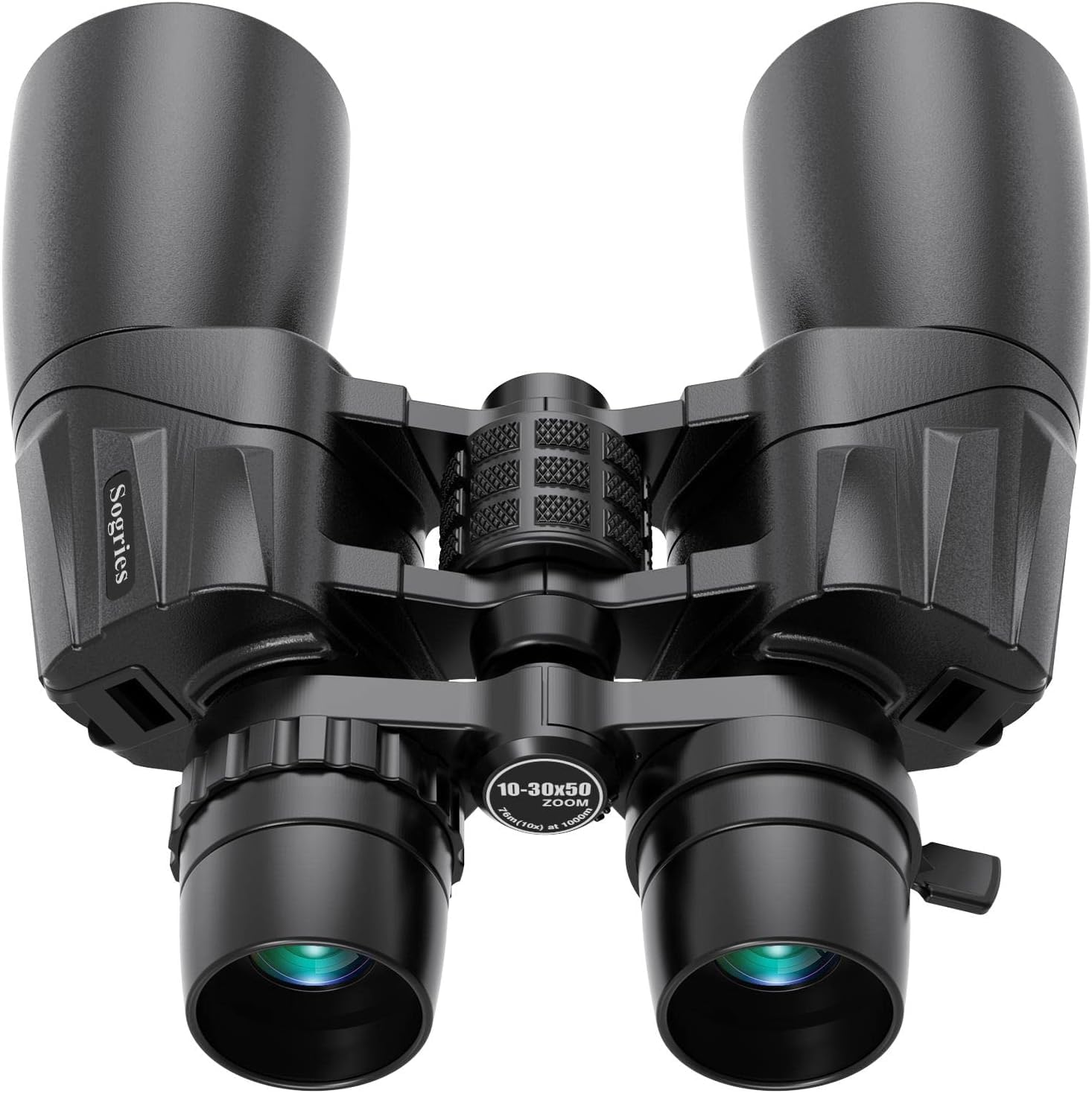
The Sogries 10-30×50 Zoom binoculars offer a highly flexible magnification range, allowing you to zoom from a wide 10x scan to a detailed 30x close-up without switching optics. This is a major advantage when you want to sweep a broad section of coastline and then zoom in on a specific feature like a sea cave or a distant ship. The BaK-4 prisms and FMC broadband green film work to keep the image bright and contrasty, even as you push the zoom.
Build quality is solid for the price tier, with an unscented rubber armor coating and a fingerprint-resistant grip surface. The O-ring sealed lenses provide a degree of weather resistance against light mist and dust, an important feature for the shore. Users have reported clear, sharp images at high power, and the smooth zoom lever is a well-engineered touch for quick adjustments.
At 30x zoom, the image becomes very dim and requires a tripod for stability, which the manufacturer recommends. The 50mm objective helps, but light transmission is a challenge at the maximum end of the zoom range. Stringent low-light performance is not its forte, but for a bright, sunny day on the coast where you need the flexibility of a zoom, this budget-friendly model delivers remarkable versatility.
Why it’s great
- Variable 10-30x zoom provides incredible flexibility for scanning and detailed observation.
- BaK-4 prisms and FMC lenses deliver good image quality for the price.
- Rubber armor and O-ring seals offer basic weather protection.
Good to know
- At 30x, a tripod is required for a steady image.
- Image brightness drops significantly at the high end of the zoom range.
- Heavier than comparable fixed-power binoculars due to the zoom mechanism.
FAQ
Is 16x magnification too high for handheld ocean viewing?
What is the best magnification for ocean viewing?
Why is a BaK-4 prism important for binoculars at sea?
What does field of view mean for ocean binoculars?
Final Thoughts: The Verdict
For most users, the binoculars for ocean viewing from land winner is the Canon 12×36 IS III because its image stabilization system directly solves the hand-shake problem that plagues long-distance viewing over water, all in a portable package. If you want the absolute brightest image for dawn and dusk sessions, grab the Steiner Marine 7×50. And for a versatile all-rounder that balances weight, clarity, and cost for everyday coastal adventures, nothing beats the Nikon PROSTAFF P7 10×42.