
Our readers keep the lights on and the weekend projects moving. As an Amazon Associate, I earn from qualifying purchases.
Finding a stereo amplifier that delivers clean, authoritative power without forcing you to take out a second mortgage is the holy grail for anyone building a dedicated 2-channel system. The market is flooded with budget-friendly Class D options, but separating the genuinely musical units from the noisy, underpowered boxes requires a close look at the components that actually matter.
I’m Rikta — the co-founder and writer behind FitlyFast. I’ve spent years tracking the evolution of Class D amplification, analyzing distortion figures, power supply ripple, and chipset performance to help readers discover real value in a world of marketing hype.
Whether you are reviving vintage speakers, building a desktop near-field rig, or setting up a living room system, these reviews cut through the noise to find a truly affordable stereo amplifier that exceeds expectations without wrecking your budget.
How To Choose The Best Affordable Stereo Amplifier
Navigating the world of affordable amplification means understanding that not all watts are created equal. The cheapest options often inflate peak power figures while ignoring the continuous RMS performance that actually determines how cleanly your music plays at real-world listening levels. Focus on the amplifier chip, the power supply, and the build quality of the output stage. A unit with a genuine TPA3255 chip fed by a 48V power supply will outperform a cheaper design with a weaker chip and a 24V brick, regardless of what the box says.
Amplifier Chipset and Topology
The heart of any modern affordable stereo amplifier is the Class D chip. The Texas Instruments TPA3255 is the reigning champion in this price bracket, offering ultra-low distortion (≤0.003% THD+N) and high efficiency when paired with competent supporting components. Look for implementations that use premium capacitors (German WIMA, Japanese ELNA or Nichicon) and quality inductors (Sumida or SAGAMI). These parts directly affect the signal-to-noise ratio and the perceived clarity of the amplifier. Cheaper chips like the TPA3116 can sound decent but lack the headroom and finesse of the TPA3255.
Power Supply Voltage and Current
The supplied power adapter is arguably as important as the amplifier board itself. A 32V/5A power supply is common for entry-level units, but stepping up to a 48V/5A or 48V/10A supply unlocks the full potential of a TPA3255-based amp, delivering significantly more clean power into 4-ohm loads. Many budget amplifiers allow you to supply your own higher-voltage adapter. If you plan to drive demanding bookshelf speakers, prioritize a model that either includes or is compatible with a 48V power supply. The continuous current rating (in amps) determines how well the amp handles dynamic peaks in music.
Input Connectivity and Extra Features
Determine what sources you need to connect. Bluetooth 5.0 or 5.3 is nearly standard and convenient for phone streaming, but does not replace a wired connection for critical listening. If you have a turntable without a built-in preamp, you need an amplifier with a dedicated phono input. For TV integration, an optical or HDMI ARC input is essential. Features like a high-pass filter (HPF) for subwoofer integration, a subwoofer pre-out, and replaceable op-amps can dramatically improve system flexibility and future upgrade potential without buying a new amplifier.
Quick Comparison
On smaller screens, swipe sideways to see the full table.
| Model | Category | Best For | Key Spec | Amazon |
|---|---|---|---|---|
| Wiim Amp | Streaming Amp | All-in-one smart system | 60W x 2 @8 ohms | Amazon |
| YAMAHA R-S202BL | Traditional Receiver | Classic stereo tuner setup | 100W x 2 @8 ohms | Amazon |
| Ampapa D1 | VU Meter Amp | 2.1 system with HPF | 48V GaN PSU | Amazon |
| Aiyima A07 MAX | Power Amp | High-power mono/stereo | 300W x 2 @4 ohms | Amazon |
| Fosi Audio V3 | Mini Power Amp | Desktop near-field listening | 48V/5A included PSU | Amazon |
| Donner MAMP6 | Multi-Channel | Whole-home audio distribution | 6-channel output | Amazon |
| Fosi Audio MC101 | Vintage Style Amp | Retro aesthetic desktop rig | Analog VU meter | Amazon |
| EYTSE P60 | Customizable Amp | Op-amp tinkerers | Replaceable 4 Op-Amps | Amazon |
| Donner MAMP2 | Karaoke Receiver | Party and karaoke use | Dual mic inputs | Amazon |
In‑Depth Reviews
1. WiiM Amp

The WiiM Amp redefines what an affordable stereo amplifier can be by integrating a high-quality streaming platform, a capable Class D amp stage, and a full suite of modern connectivity into a compact, premium-feeling chassis. It delivers 60 watts per channel into 8 ohms (120W into 4 ohms), making it genuinely useful with a wide range of passive speakers from bookshelf to floor-standing. The inclusion of HDMI ARC, optical, and RCA inputs means it can serve as the nerve center for a living room TV setup or a dedicated music system, and the subwoofer output with adjustable crossover rounds out a true 2.1 system.
Beyond raw power, the software experience is what sets the WiiM Amp apart. The WiiM Home App provides seamless access to Spotify, Tidal, Qobuz, and countless other services, plus support for AirPlay 2, Google Cast, and Alexa voice control. The built-in DSP includes advanced room correction and parametric EQ, allowing you to tailor the sound to your specific space and speakers. This is not just an amplifier; it is a full smart audio hub that simplifies your entire setup.
Build quality is excellent for the price point, with a solid metal shell and a responsive voice remote included. Some users note the absence of a dedicated USB DAC input for a computer (USB is for file playback only) and the lack of a phono preamp for direct turntable connection. However, for anyone building a modern, streamlined system without sacrificing fidelity, the WiiM Amp is an astonishingly complete package that outperforms units costing significantly more. It is the benchmark for this category.
Why it’s great
- Exceptional all-in-one streaming and amplification in a compact chassis.
- HDMI ARC, optical, and sub out with crossover for true 2.1 systems.
- Powerful app with room correction and parametric EQ.
- Solid 60W x 2 @8 ohms and 120W x 2 @4 ohms.
Good to know
- No dedicated USB DAC input for computer audio.
- No built-in phono preamp for turntables.
- Requires app for initial setup and full feature access.
2. YAMAHA R-S202BL

The Yamaha R-S202BL is a throwback to the classic stereo receiver, offering a straightforward, no-fuss approach to amplification. It delivers a conservative but robust 100 watts per channel into 8 ohms, providing plenty of clean headroom for most home speakers. The brushed aluminum front panel and large rotary knobs give it a timeless, quality feel that many modern mini-amps lack. It includes a built-in FM/AM tuner with 40 station presets and Bluetooth connectivity for streaming from a phone, making it a versatile choice for traditionalists.
Yamaha’s advanced circuitry design ensures low distortion and a wide frequency response from 10Hz to 100kHz. The receiver features a speaker selector for two separate pairs of speakers and includes a headphone output. Setup is completely manual and intuitive, with no app required, which appeals to users who want to simply plug in their source, connect speakers, and start listening. The auto power standby function is a nice modern touch for energy savings.
On the downside, the R-S202BL lacks modern digital inputs like optical or coaxial, and there is no subwoofer pre-out, which can limit system expansion. The Bluetooth is version 4.1, which is older and less stable than current standards. While it lacks the streaming smarts and connectivity of newer units, its robust build and proven amplifier section make it an ideal option for a dedicated radio listening station or a simple, reliable stereo system where app-based control is not desired.
Why it’s great
- 100W x 2 clean power from a trusted brand.
- Excellent AM/FM tuner performance with high signal-to-noise ratio.
- Solid build with brushed aluminum finish.
- Simple, intuitive interface with speaker selection for two zones.
Good to know
- No optical, coaxial, or HDMI inputs.
- No subwoofer pre-out for easy 2.1 setup.
- Bluetooth 4.1 is outdated and less reliable.
3. Ampapa D1 (Douk Audio Collaboration)
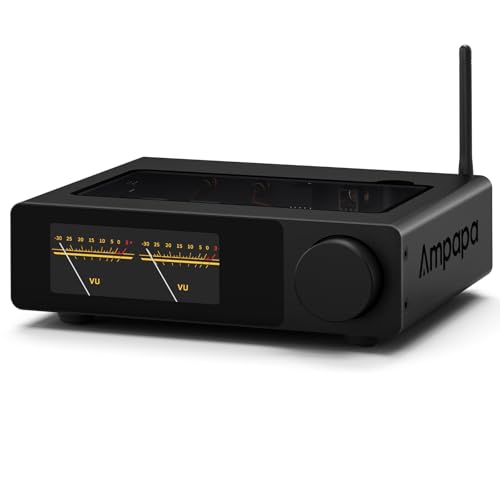
The Ampapa D1, a collaboration with Douk Audio, takes the already excellent Douk A5 platform and adds significant usability and visual upgrades. At its core is the TI TPA3255 chip, supported by premium SAGAMI inductors and a 48V/5A GaN power adapter, which provides clean, dynamic power. The standout feature is the vibrant OLED display with seven different VU meter styles, giving you retro aesthetics with modern clarity. It also introduces a TRS balanced input, which is rare at this price point and useful for reducing noise in longer cable runs.
For system integration, the D1 excels. The adjustable 30–200Hz high-pass filter removes bass from the main speaker outputs, allowing smaller bookshelf speakers to play cleaner and louder without distortion, while the full-range PRE-OUT feeds an active subwoofer. The PFFB (Post-Filter Feedback) technology reduces load dependency and improves sound quality across different speaker impedances. The socketed NE5532 op-amps can be easily swapped for upgrades like Sparkos or MUSES chips, offering a clear upgrade path.
One of the few drawbacks is the non-defeatable auto standby feature, which shuts off the amp after about five minutes of no signal. Users report this can be inconvenient and requires waking the unit with the remote. The glass top panel is elegant but can be fragile. Despite these quirks, the D1 offers a feature set—balanced inputs, HPF, VU display, GaN PSU—that rivals amplifiers twice its price, making it an exceptional choice for a desk or near-field 2.1 system.
Why it’s great
- Adjustable high-pass filter for clean 2.1 systems.
- TRS balanced input for low-noise connections.
- OLED VU display with multiple customizable styles.
- GaN 48V/5A power supply included.
Good to know
- Auto standby cannot be disabled and requires remote to wake.
- Glass top panel is fragile and may come loose.
- Stock op-amps are good but not the highest tier.
4. AIYIMA A07 MAX

The AIYIMA A07 MAX is a serious power amplifier that offers a unique dual-mode switching capability, allowing it to operate as a stereo 300W x 2 amp or a bridged mono 600W amp. This makes it incredibly versatile: use one unit for a high-power stereo setup, or buy two and bridge them for a massive monoblock system. It is built around the reliable TPA3255 chip and features high-quality Japanese Nichicon 63V capacitors and German WIMA caps, ensuring low noise and clean power delivery.
Sound quality is impressive for its size, with a warmer tonality that some users compare favorably to class-AB amplifiers. It has excellent dynamics and a punchy bass response. The replaceable NE5532 op-amps allow for sonic tuning, and the included 36V/6A power supply provides adequate power for most setups, with support for an upgrade to a 48V/10A supply for maximum performance. The unit runs warm to the touch (around 100°F) even at moderate volumes, but the robust heat sink handles dissipation well.
There is no Bluetooth or streaming functionality, which is a deliberate design choice to keep the signal path pure and the cost down. The volume knob acts as the power switch and has a logarithmic taper that can feel uneven at the extremes of its range—volume increases dramatically past the 3 o’clock position. Some users note minor channel crosstalk in mono mode at very high volumes. For audiophiles building a system with a separate preamp or streamer, the A07 MAX offers exceptional value and raw power that few competitors can match.
Why it’s great
- Switchable between stereo and mono operation for system flexibility.
- Warm, engaging sound signature with excellent dynamics.
- High-quality internal components (Nichicon, WIMA caps).
- Can be upgraded with 48V/10A PSU for maximum power.
Good to know
- No Bluetooth or streaming built in.
- Volume knob has a logarithmic taper that can be uneven.
- Runs warm (around 100°F) during use.
5. Fosi Audio V3

The Fosi Audio V3 has quickly become a reference point in the mini Class D amplifier market for good reason. It uses the TPA3255 chip and is supplied with a 48V/5A power adapter out of the box, which is a significant advantage over budget units that ship with weaker 32V adapters. This gives the V3 genuine headroom, capable of delivering clean, detailed sound with a low noise floor of only 140uV and impressive clarity up to 110dB SNR. It comfortably drives speakers with sensitivity as low as 86dB, like the popular ELAC B6.
The build quality is excellent, featuring a compact, all-aluminum chassis with top and bottom vents for efficient passive cooling. The Pre-out function is volume-controlled, allowing you to connect a powered subwoofer or an external amplifier and manage the overall level from the V3. The socketed NE5532 op-amps offer an easy upgrade path for users wanting to refine the sound signature with chips like Sparkos SS3602 or MUSES02. The overall presentation is clean and slightly analytical, with impressive imaging and detail retrieval.
One area to note is that the V3 does not have a dedicated high-pass filter for the main outputs, meaning that small bookshelf speakers will still receive the full bass signal. It is also a pure power amplifier with no tone controls or multiple inputs beyond a single pair of RCAs. For users wanting a straightforward, high-performance amplifier for a desktop near-field setup or a simple stereo system, the V3 is a phenomenal choice that punches far above its price point.
Why it’s great
- Includes a 48V/5A power supply for real power and headroom.
- Very low noise floor (140uV) and high SNR (110dB).
- Volume-controlled Pre-out for subwoofer integration.
- Compact, well-ventilated aluminum build.
Good to know
- No high-pass filter for protecting small speakers from deep bass.
- Single RCA input only, no tone controls.
- Best performance achieved with efficient speakers (90dB+).
6. Donner MAMP6

The Donner MAMP6 is designed for whole-home audio distribution, offering six channels of amplification that can power up to twelve speakers (two per channel) in a single unit. This makes it a uniquely practical solution for filling a home gym, multi-room setup, or commercial space with distributed background music. It features Bluetooth 5.3, USB playback, FM radio, optical and coaxial inputs, and dual 1/4-inch microphone inputs with echo and Talkover functions, making it a versatile hub for karaoke, presentations, or parties.
The amplifier includes independent treble, midrange, and bass controls that can be saved and recalled via the multifunction remote, offering significant sonic customization. The binding posts support up to 6 groups of speakers with 4-16 ohm impedance, and the unit can output to a subwoofer as well. The build is a full-size component chassis, which is larger than the mini-amps, but the feature density is high for the price. For someone needing to drive many speakers from one device, the MAMP6 is unmatched in its category.
The primary compromise is in power. The MAMP6 is rated at 25W RMS per channel (1000W peak is a marketing figure), which is sufficient for efficient speakers in a background music context but may not satisfy critical listening at high volumes. Some users note that the subwoofer output lacks a dedicated crossover control. For a dedicated stereo system where sound quality is the priority, a more focused 2-channel amplifier would be a better choice. The MAMP6 is a specialized tool for a specific multi-speaker job.
Why it’s great
- Six channels for multi-room or whole-home audio distribution.
- Dual mic inputs with echo and Talkover for karaoke.
- Multiple digital inputs (Optical, Coaxial, USB, FM).
- Full EQ control with remote and memory function.
Good to know
- Modest 25W RMS per channel is not for high-volume listening.
- No dedicated subwoofer crossover control.
- Larger full-size chassis compared to mini-amps.
7. Fosi Audio MC101

The Fosi Audio MC101 is a visual and tactile delight, combining the vintage charm of a physical VU meter with modern Class D amplification and Bluetooth 5.3. The meter’s needle swings dynamically with the music, providing both a functional volume guide and a beautiful aesthetic centerpiece for any desk or shelf. It is built from a solid, CNC-machined aluminum alloy block, giving it a weight and quality feel that far exceeds its price point. The metal knobs for bass, treble, and volume add to the premium tactile experience.
Sonically, the MC101 delivers clean, distortion-free sound that brings life to bookshelf speakers. The dedicated bass and treble knobs with central detents allow for easy tone shaping and quick return to neutral. Bluetooth 5.3 is reliable and fast to pair, with good range for most home environments. The setup is trivial: connect speakers, pair your phone, and listen. It is an ideal amplifier for reviving a pair of old speakers in a kitchen, garage, or as a simple desktop system where aesthetics matter as much as audio quality.
The main criticism revolves around the subwoofer pre-out, which lacks a crossover and simply mirrors the master volume. This can make integrating a subwoofer tricky, often requiring the main speakers to be played at very high volumes to drive the sub to a satisfying level. Additionally, the amplifier’s power is lower than the advertised 200W peak figure implies; it distorts at higher volumes when pushed hard. For casual listening in small to medium rooms, the MC101 is a stylish and capable performer, but it is not a high-power solution for demanding setups.
Why it’s great
- Beautiful design with a real analog VU meter.
- Solid CNC-machined aluminum chassis.
- Dedicated bass and treble controls with center detents.
- Reliable Bluetooth 5.3 for wireless streaming.
Good to know
- Subwoofer pre-out lacks a dedicated crossover and volume control.
- Real-world power output is lower than peak advertising suggests.
- Distorts at high listening levels with demanding speakers.
8. EYTSE P60
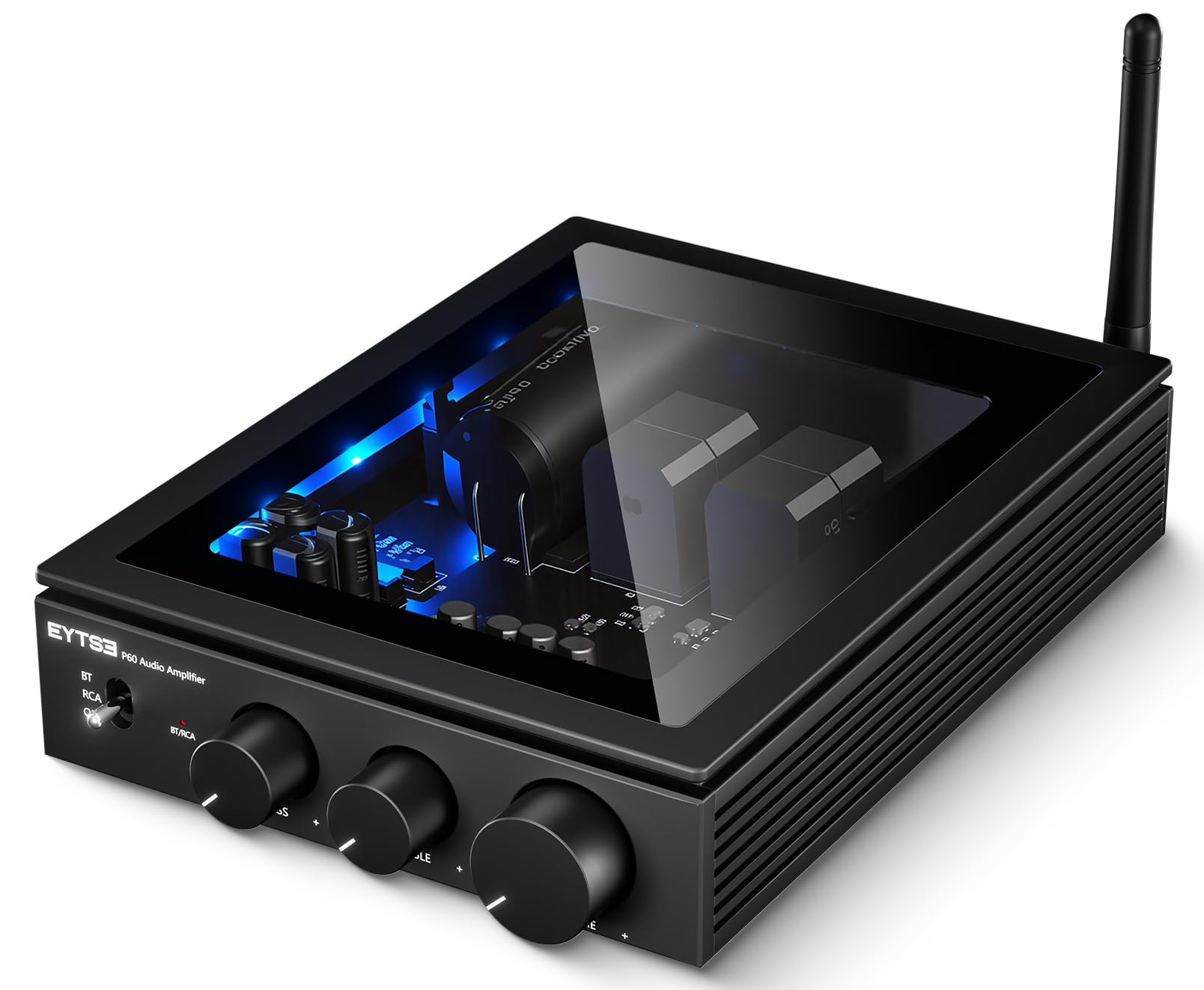
The EYTSE P60 is a feature-packed mini amplifier that offers exceptional value for the tinkerer and the value-conscious audiophile. Its most distinctive feature is the four replaceable Op-Amp sockets, allowing users to swap the standard NE5532 chips for premium alternatives (Sparkos, MUSES, Burson) to fine-tune the sound signature. It is built around the TPA3255 chip and uses premium German WIMA capacitors and Japanese ELNA caps, ensuring a high-quality signal path with ultra-low distortion (≤0.003% THD+N) and a dead-quiet background.
The design is also visually appealing, with a tempered glass top panel that showcases the premium internal components and multi-color RGB LED lighting (7 colors) that can be adjusted or turned off. The aluminum alloy chassis and bottom heat sink keep the unit cool during long listening sessions. The unit includes bass and treble controls, giving you direct tone shaping without needing an app. The included 32V/5A power adapter provides decent power, but performance scales significantly when upgraded to a 48V supply for higher output and cleaner dynamics.
While the P60 is packed with potential, there are some ergonomic quirks. The op-amp sockets are tightly spaced, making it difficult to install wider discrete op-amp modules. The amplifier also has a known behavior of shutting off when left on Bluetooth without a signal for an extended period, requiring a power cycle to reset. Some users report that the soundstage is slightly less expansive than competitors like the Aiyima A07 MAX or Fosi ZA3. For the price, however, the build quality, customizability, and clean sound are hard to beat.
Why it’s great
- Four replaceable Op-Amp sockets for easy sound customization.
- Premium internal components (WIMA, ELNA caps, Sumida inductors).
- Sleek design with tempered glass top and customizable RGB lighting.
- Dedicated bass and treble controls.
Good to know
- Op-amp sockets are too tight for wider discrete op-amps.
- Auto-shutoff on idle Bluetooth requires manual power cycle.
- Soundstage is slightly less wide than some direct competitors.
9. Donner MAMP2
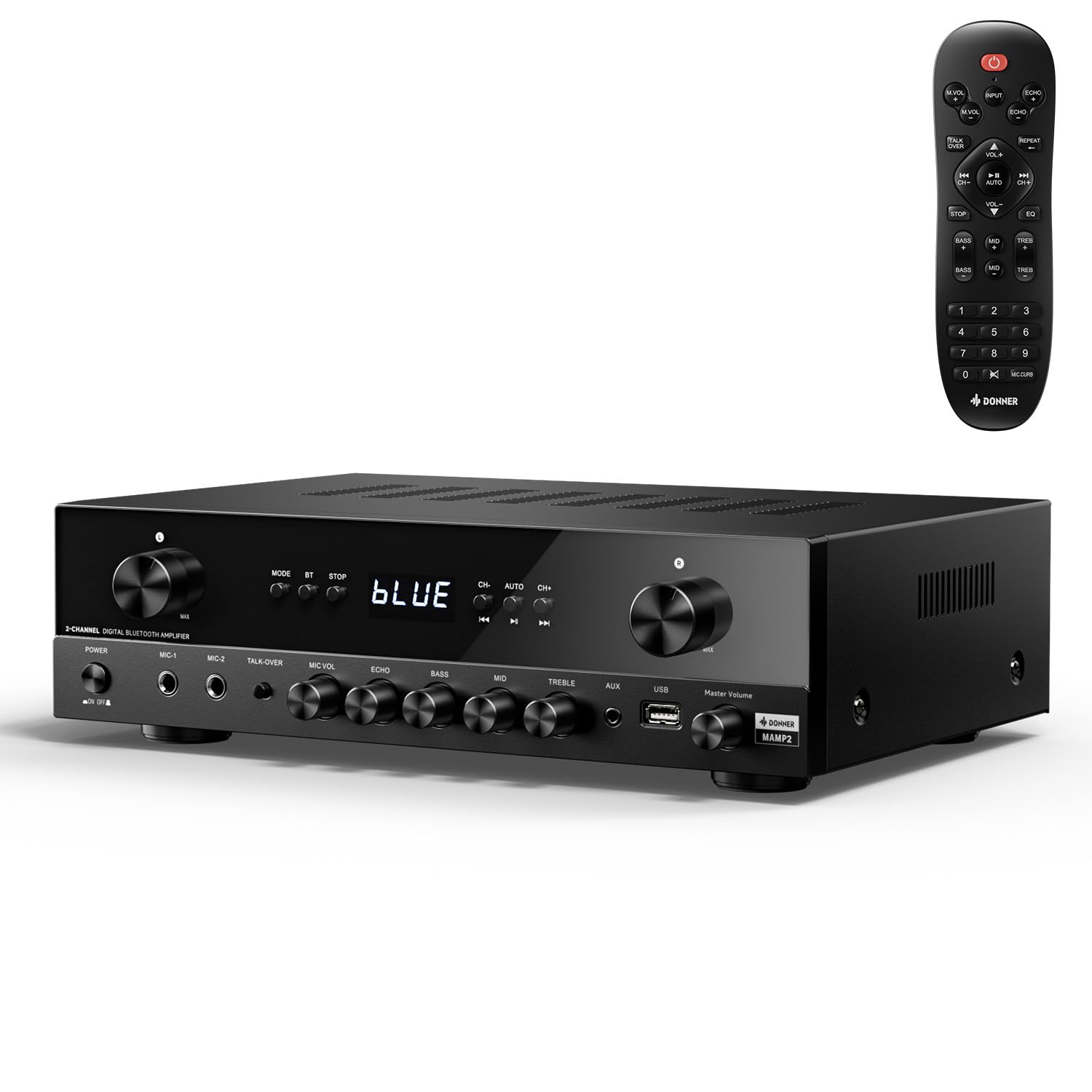
The Donner MAMP2 is a feature-packed stereo receiver designed to be the center of a party or multi-purpose system. It offers a massive list of inputs: Bluetooth 5.3, USB (up to 64GB), RCA, AUX, FM radio, digital optical and coaxial, a dedicated phono input for turntables, and two 1/4-inch microphone inputs. This connectivity makes it incredibly versatile, suitable for everything from casual music listening to TV audio, vinyl playback, and karaoke sessions.
The amplifier delivers a modest but functional 60W RMS per channel, which is enough to power a pair of bookshelf or floor-standing speakers to moderate volumes. The on-unit and remote controls allow for independent adjustment of treble, midrange, and bass, plus an echo effect for the microphones. The Talkover function automatically lowers background music when speaking into a microphone, making it useful for presentations or announcements. The unit also supports up to four speakers (two pairs) and a subwoofer, allowing for a basic surround or distributed audio setup.
Where the MAMP2 compromises is in its long-term performance and build. Some users report that the speaker binding posts are slightly small, and there is only a single RCA line input, which can be limiting if you have multiple analog sources. The optical input has been noted to fail in some units. While it is an exceptional value for a multimedia and karaoke receiver, its sound quality and power output do not rival dedicated stereo amplifiers. It is a jack-of-all-trades that excels in versatility but is outclassed by simpler, more focused units for pure music listening.
Why it’s great
- Extremely versatile input array (Phono, Optical, Coaxial, USB, FM, Mic).
- Dual microphone inputs with echo and Talkover for karaoke.
- Dedicated phono preamp for direct turntable connection.
- Full 3-band EQ control for each input.
Good to know
- Only 60W RMS per channel limits volume with demanding speakers.
- Only one pair of RCA analog inputs.
- Some reports of optical input failure over time.
FAQ
Can I use an affordable stereo amplifier with my TV?
What does a high-pass filter (HPF) do and do I need one?
What is the advantage of replaceable op-amps in an amplifier?
Why does my affordable amplifier get so hot?
Can I use a higher voltage power supply than the one included?
Final Thoughts: The Verdict
For most users, the affordable stereo amplifier winner is the WiiM Amp because it combines high-fidelity amplification with a seamless streaming platform, room correction, and modern connectivity (HDMI ARC) in a compact package that outperforms its price point. If you want a pure power amplifier for a dedicated system and plan to use a separate streamer, grab the AIYIMA A07 MAX for its incredible headroom and flexible mono/stereo modes. And for a specialized whole-home audio project or karaoke party setup, nothing beats the multi-channel versatility of the Donner MAMP6.