
Our readers keep the lights on and the weekend projects moving. As an Amazon Associate, I earn from qualifying purchases.
A basic home printer seems simple, but the real battle starts after you unbox it. Between forced app logins, tiny starter cartridges that run dry after a dozen pages, and connectivity gremlins that drop your job mid-print, the “basic” label hides a lot of complexity. The goal here is to find a machine that prints reliably without costing a fortune in consumables or your sanity.
I’m Rikta — the co-founder and writer behind FitlyFast. I’ve spent the last 15 years analyzing consumer hardware and tracking the real-world cost-per-page of hundreds of printers, from budget inkjets to workhorse lasers.
After digging through the specs and user experiences of the top contenders, this guide cuts through the marketing to help you pick the right basic home printer for your actual workload and budget.
How To Choose The Best Basic Home Printer
Basic home printers today range from ultra-cheap inkjets with high long-term costs to laser machines that cost more upfront but save you headaches later. The key is matching the technology to your actual usage pattern — not your hopes.
Inkjet vs. Laser: The Real Trade-Off
For a basic home printer that only prints a few dozen pages a month, a modern inkjet can be perfectly fine. The risk is that the starter cartridges included in the box have very little ink, and you’ll be forced to buy replacements sooner than expected. If you mostly print black text and the occasional spreadsheet, a monochrome laser printer avoids the ink-drying problem entirely, though it can’t do color photos or graphics.
Wireless Connectivity and Ease of Setup
Most basic home printers rely on a mobile app for initial setup. Some machines are exclusive to 2.4 GHz Wi-Fi networks, which can cause compatibility issues with modern dual-band routers. Look for dual-band support (2.4 and 5 GHz) if you want a smoother connection. Also, be wary of printers that require you to create an account to scan or copy — this is an unnecessary hurdle for a basic device.
Running Costs and Duty Cycle
The purchase price of a basic home printer is only the beginning. The cost per page is what really determines the long-term value. High-yield cartridges or ink tank systems dramatically lower this cost. The duty cycle — the maximum number of pages the printer can handle per month — also matters. A 1,000-page monthly duty cycle is fine for light home use, but if you plan to print even 300 pages a month, look for a model with a 5,000-page or higher duty cycle to avoid wear and tear issues.
Quick Comparison
On smaller screens, swipe sideways to see the full table.
| Model | Category | Best For | Key Spec | Amazon |
|---|---|---|---|---|
| Brother HL-L2480DW | Monochrome Laser | High-volume B&W printing | 36 ppm print speed | Amazon |
| Epson EcoTank ET-2803 | Supertank Inkjet | Lowest cost-per-page color | 4,500 B&W pages per ink set | Amazon |
| Brother Work Smart 1410 | Color Inkjet MFC | Home office with scanning | 20-sheet ADF | Amazon |
| Canon PIXMA TS7720 | Color Inkjet | Touchscreen convenience | 2.7″ LCD touchscreen | Amazon |
| HP DeskJet 2755e | Color Inkjet | Budget-friendly all-in-one | Manual duplex | Amazon |
| Canon PIXMA TS6520 | Color Inkjet | Compact design with OLED | 1.42″ OLED display | Amazon |
| HP DeskJet 2855e | Color Inkjet | Entry-level home printing | 7.5 ppm B&W speed | Amazon |
In‑Depth Reviews
1. Brother HL-L2480DW

If you mainly print black text — school homework, work documents, shipping labels — this monochrome laser is the highest performance machine on this list. With a 36 ppm print speed, it leaves every inkjet in the dust, and the automatic duplex saves both time and paper. The 250-sheet paper tray is generous for a home machine, and the 2.7-inch touchscreen makes navigation smooth without needing your phone.
Wireless setup is painless across dual-band networks (2.4 and 5 GHz), and the printer includes Ethernet for a wired connection if your Wi-Fi is spotty. Users consistently report that the TN830 toner cartridges last far longer than inkjet supplies — even after a year of moderate use, the first cartridge is still going. The flatbed scanner and copier handle everything from ID cards to thick books.
The trade-off is obvious: no color. If you need occasional color prints, you’ll need a separate inkjet. But for black and white, this machine is faster, cheaper per page, and far more reliable than any inkjet. A few users noted it’s a bit noisy during printing, but that’s typical for a compact laser.
Why it’s great
- Blazing 36 ppm print speed for B&W documents
- Automatic duplex printing and large 250-sheet tray
- Low cost per page with high-yield toner options
Good to know
- No color printing capability
- Slightly noisier than inkjet during operation
2. Epson EcoTank ET-2803

The EcoTank line solves the biggest problem with basic home printers: expensive ink. Instead of tiny cartridges, this machine uses high-capacity ink bottles that you pour directly into built-in tanks. The included bottles are equivalent to about 80 cartridges, giving you up to 4,500 black pages and 7,500 color pages before you need a refill. For a home that prints photos, school projects, and color documents, this is the most economical option long-term.
Print quality is impressive for a basic home printer. The Micro Piezo heat-free technology delivers sharp text and vibrant photos without smudging. Setup is straightforward, though the initial filling of the ink tanks requires careful attention to avoid spills. The flatbed scanner and copier are adequate for occasional use, and the color LCD display helps navigate settings without an app.
The biggest complaint across user reviews is the Wi-Fi connectivity. The Epson Smart Panel app is finicky, and some users had to manually configure the printer via its IP address to get it working. It also lacks automatic duplex printing, so two-sided pages require manual flipping. If you’re willing to invest a bit more upfront, the savings on ink are undeniable.
Why it’s great
- Massive ink supply with high-capacity bottles
- Excellent color and photo print quality
- Compact footprint and zero cartridge waste
Good to know
- Wi-Fi setup can be frustrating
- No automatic duplex printing
3. Brother Work Smart 1410 (MFC-J1410DW)
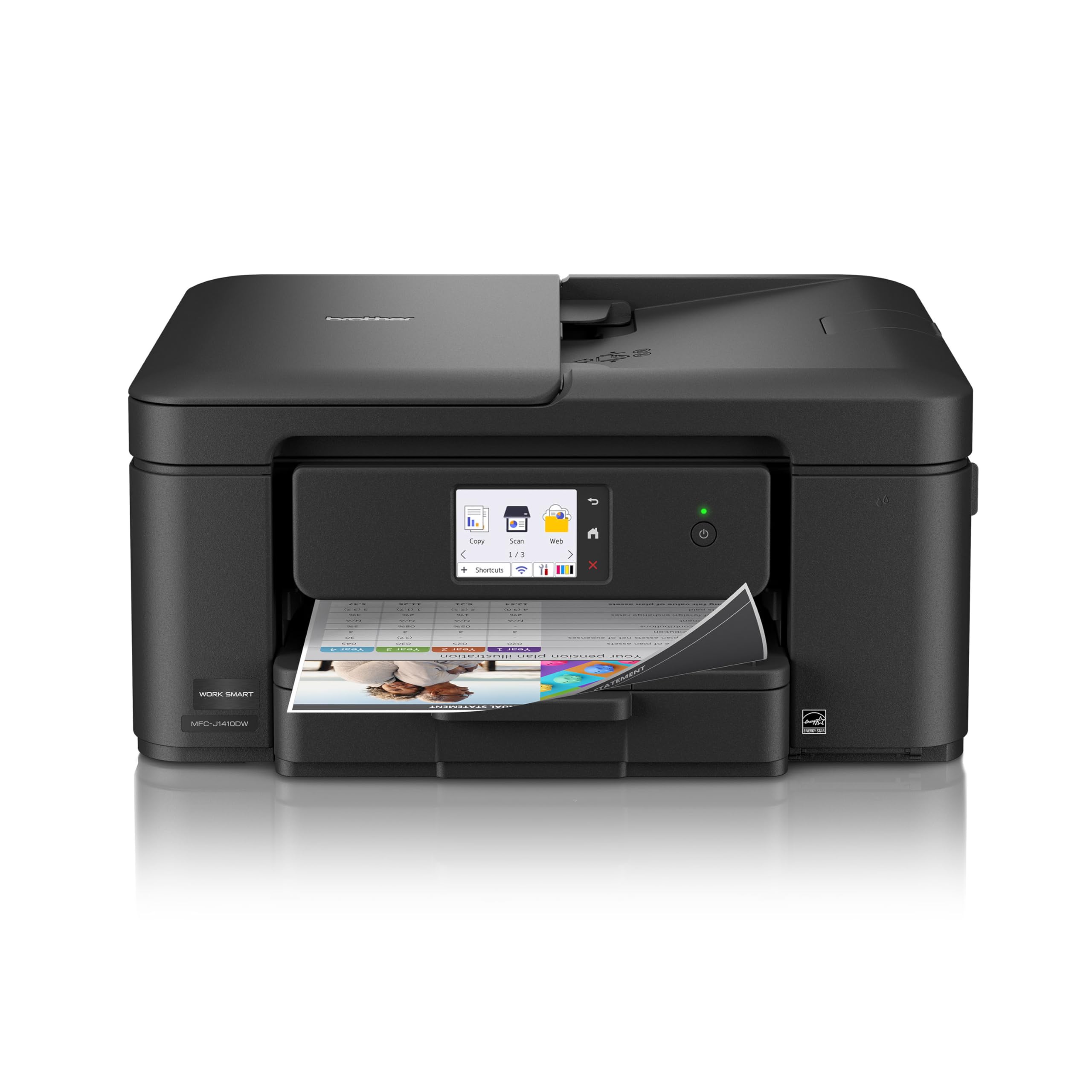
For a home office that needs to scan multi-page documents, this is the color inkjet to beat. The 20-sheet automatic document feeder (ADF) allows you to batch scan or copy without standing at the machine, a feature typically found on much pricier office machines. The 2.7-inch color touchscreen is responsive and integrates with cloud apps like Google Drive and Dropbox, letting you scan directly to the cloud.
Print speeds are competitive at 16 ppm black and 9 ppm color, and the automatic duplex printing works reliably. The Brother Mobile Connect app is one of the better printer apps — it lets you monitor ink levels, manage jobs, and print from anywhere. The LC501 ink cartridges are reasonably priced, and the Refresh subscription trial can save you up to 50% on genuine toner if you choose to subscribe.
Some users reported initial setup took a bit longer than expected due to the app’s network detection process, but once configured, the printer held its connection well. A few complaints about paper jams and customer service responsiveness exist, but the majority of feedback praises its value and compact size for a home office. It’s a solid choice if you regularly deal with multi-page documents and want cloud integration.
Why it’s great
- 20-sheet ADF for batch scanning and copying
- Cloud app integration (Google Drive, Dropbox)
- Reliable automatic duplex and reasonable ink pricing
Good to know
- Initial setup can be time-consuming
- Some reports of paper jam issues
4. Canon PIXMA TS7720

Canon’s PIXMA TS7720 brings a generous 2.7-inch LCD touchscreen to the basic home printer segment, which makes navigating menus, checking ink levels, and setting up wireless printing far easier than push-button alternatives. Print speeds are decent at 15 ppm black and 10 ppm color, and the automatic duplex printing saves paper without manual flipping. The printer handles a variety of media including photo paper up to 8.5 by 11 inches.
Colors are vivid but slightly less saturated than Canon’s 5-ink models, which is expected at this tier. The PG-285 and CL-286 cartridge system is simple to install, though the starter cartridges included in the box are low-yield, so budget for replacements soon. The Canon PRINT app is straightforward and supports AirPrint and Mopria for direct mobile printing.
A common user complaint is that the printer defaults to a 4-hour auto-off mode that can interrupt longer print jobs. You can disable this manually through the device settings, but it’s not obvious. Some users also experienced connection drops with iPhones. Overall, if you value a large screen and don’t mind occasional software quirks, this is a capable all-rounder for home use.
Why it’s great
- Large 2.7-inch color touchscreen
- Automatic duplex printing and decent speeds
- Good color quality for photos and graphics
Good to know
- Aggressive auto-off default setting
- Starter cartridges run out quickly
5. HP DeskJet 2755e

The HP DeskJet 2755e is a solid basic all-in-one for light home use. It prints, scans, and copies with decent quality for everyday documents, recipes, and forms. The setup is handled entirely through the HP Smart app, which includes animated guides that walk you through the process. For tech-savvy users, it’s a 5-minute job; for others, the app’s account requirements and multiple steps can be frustrating. The 60-sheet input tray is minimal but fine for occasional use.
Print quality is acceptable — crisp enough for black text, and color prints are clear if not photo-grade. The machine supports media like envelopes and labels, adding slight versatility. It includes a 6-month trial of HP’s Instant Ink subscription, which can reduce running costs significantly if you sign up, but once the trial ends, the standard HP 67 cartridges are relatively expensive per page. Manual duplex means you have to flip pages yourself for two-sided prints.
User reviews are split. Many appreciate the low entry price and reliable connection once set up, especially with dual-band Wi-Fi. Others report persistent connectivity issues, poor print quality after a few pages, and the need for frequent firmware updates. It works best for households printing fewer than 50 pages a month who don’t mind the occasional software headache.
Why it’s great
- Low initial cost and compact design
- HP Smart app with animated setup guides
- Included Instant Ink trial for lower running costs
Good to know
- Manual duplex only
- Starter cartridges and standard ink are pricey per page
6. Canon PIXMA TS6520
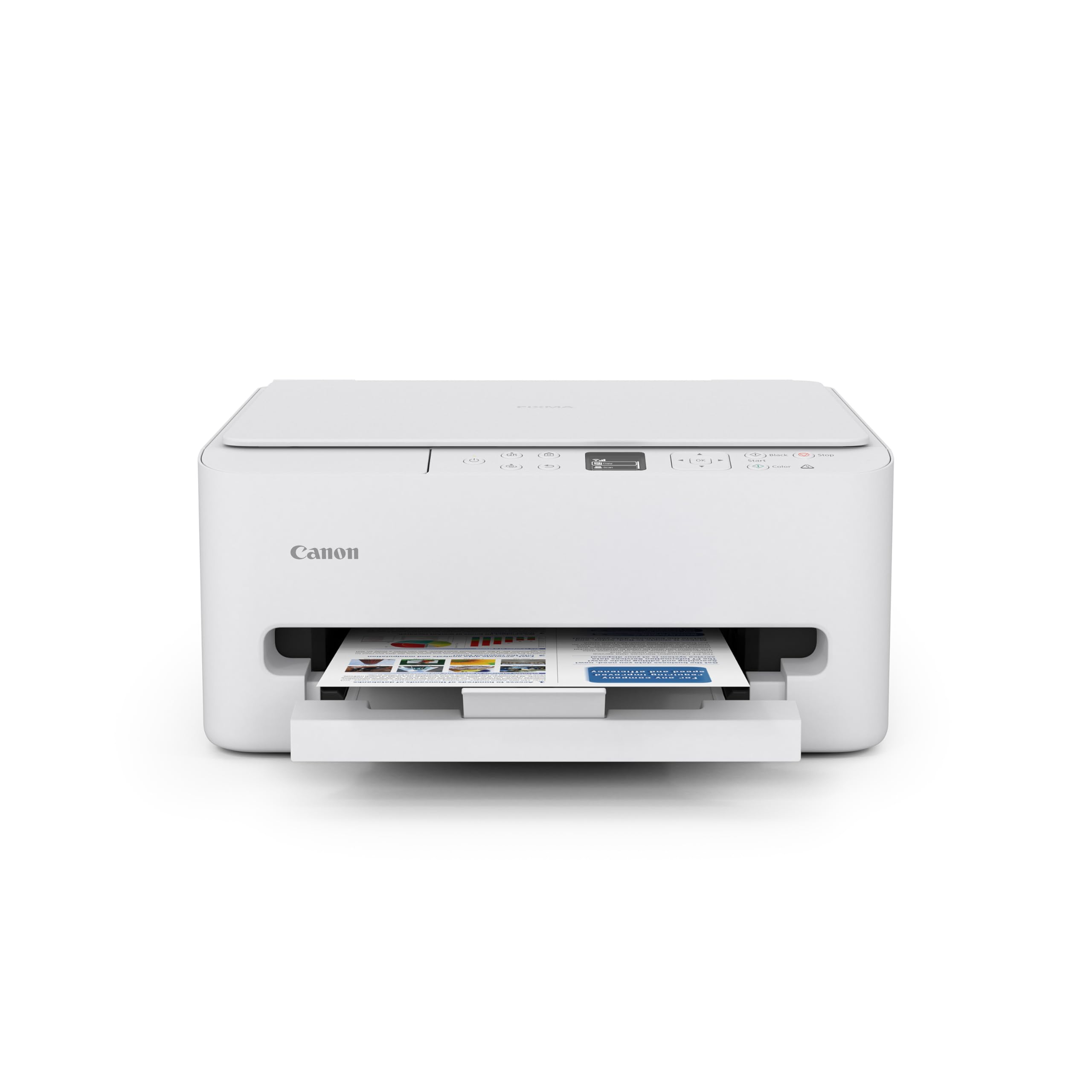
Canon’s PIXMA TS6520 is a budget-friendly inkjet that punches above its weight with a 1.42-inch monochrome OLED display. This screen makes checking ink levels and changing settings quick and intuitive without needing your phone. Print speeds are reasonable at 14 ppm black and 9 ppm color, and the automatic duplex printing is a welcome inclusion at this level.
The dual-band Wi-Fi (2.4 GHz and 5 GHz) provides reliable connections in most home networks, and the initial setup via the Canon PRINT app is smooth for both iOS and Android. The PG-295 and CL-286 ink cartridges are widely available and reasonably priced, though as with all starter cartridges, the trial set won’t last long. The compact white design fits neatly on a small desk or shelf.
Some users noted that the printer can feel slow receiving jobs, and the Canon account registration step can be a minor hassle. There’s no fax function, which is fine for most homes. A few also observed that colors, while vibrant, aren’t as punchy as higher-end Canon photo printers. For a basic home printer for schoolwork and occasional color printing, this is a clean, reliable choice.
Why it’s great
- OLED display for easy menu navigation
- Automatic duplex printing and dual-band Wi-Fi
- Compact, stylish design
Good to know
- Slower print job reception
- Starter cartridges have short lifespan
7. HP DeskJet 2855e
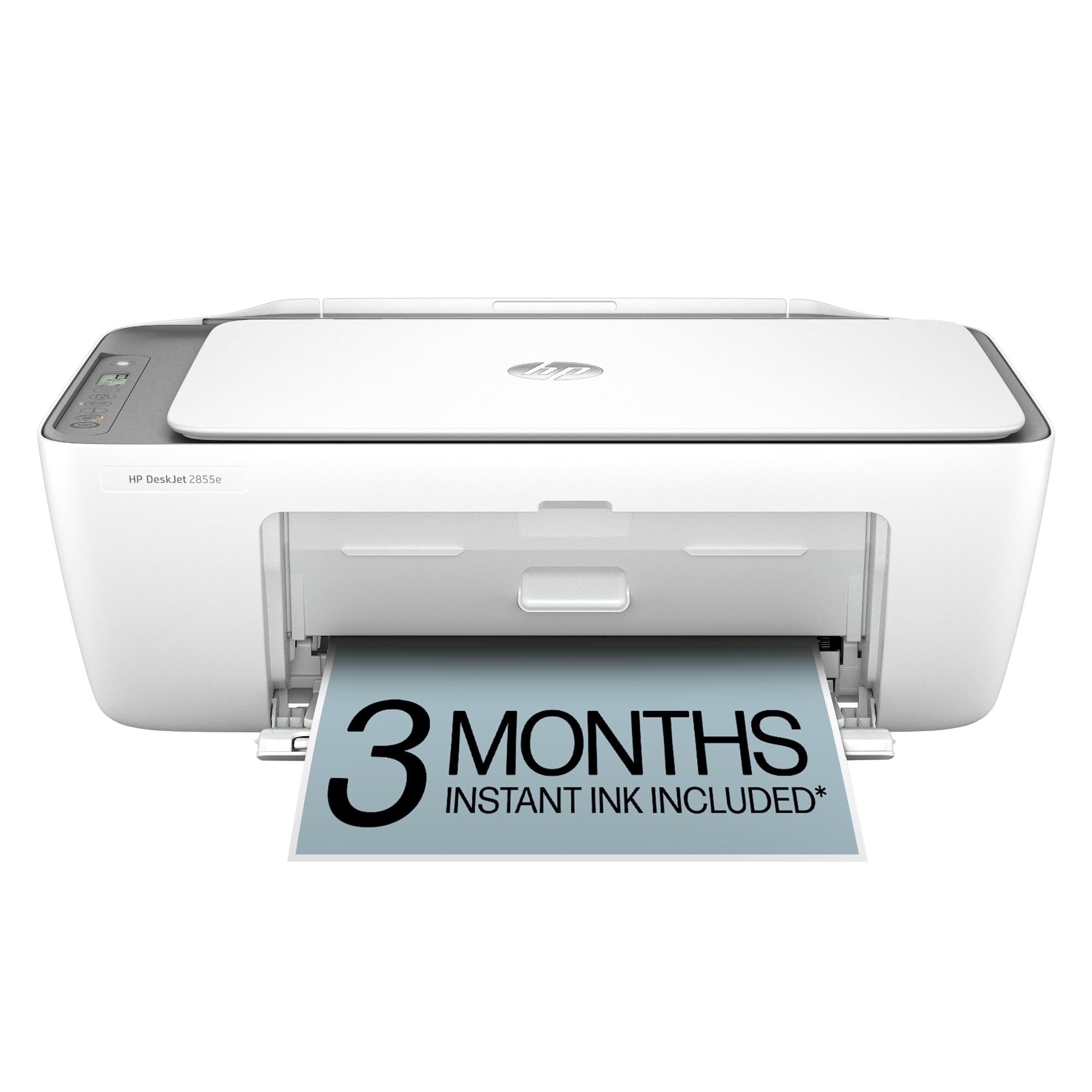
At the entry level, the HP DeskJet 2855e covers the basics: print, scan, copy, and a 60-sheet input tray. The HP AI feature automatically reformats web pages for cleaner printing, which is useful for saving paper and ink. Speed is modest at 7.5 ppm black and 5.5 ppm color, but for the occasional school packet or grocery list, it’s perfectly adequate. The 3-month Instant Ink trial helps mitigate the sting of the starter cartridge’s low ink volume.
Setup via the HP Smart app is straightforward for most users, but this model only supports 2.4 GHz Wi-Fi. If your home network runs on 5 GHz exclusively, you’ll need to adjust your router settings or connect via USB. The printer supports manual duplex only. The HP Smart app offers reliable mobile printing and scanning once connected.
The main drawback is the software. Multiple users reported frustrating experiences with port disconnections and the need to reinstall drivers. The mandatory HP account creation to use basic functions is also a sticking point. Print quality is acceptable for basic documents, but smearing and connectivity drops are recurring complaints. This is a true budget option — best for very light use where ease of wireless printing isn’t critical.
Why it’s great
- Lowest entry price for an all-in-one color printer
- HP AI web page reformatting saves ink
- 3-month Instant Ink trial included
Good to know
- Only 2.4 GHz Wi-Fi, no 5 GHz support
- Software issues and mandatory account creation
FAQ
How long do starter ink cartridges actually last?
Should I buy a printer that requires a subscription for ink?
Does a basic home printer need dual-band Wi-Fi?
Final Thoughts: The Verdict
For most users, the basic home printer winner is the Brother HL-L2480DW because it delivers unmatched reliability, speed, and low running costs for black and white printing — the primary need for most households. If you want low-cost color printing without the cartridge hassle, grab the Epson EcoTank ET-2803. And for a home office that needs batch scanning and cloud integration, nothing beats the Brother Work Smart 1410.