
Our readers keep the lights on and the weekend projects moving. As an Amazon Associate, I earn from qualifying purchases.
A muddy, manure-soaked coop floor isn’t just unpleasant — it’s a direct threat to your flock’s respiratory health and the primary cause of bumblefoot in chickens. The right base creates a barrier between your birds and the damp ground, allows urine and water to drain away, and makes daily cleaning a ten-minute spray-down instead of a shovel-and-scrub ordeal.
I’m Rikta — the co-founder and writer behind FitlyFast. For the past several years I have specialized in analyzing outdoor utility products, studying drainage mat pore sizes, rubber density specs, and interlock durability to identify what actually holds up under a heavy coop in wet weather versus what turns into a brittle, cracked mess within one season.
After scouring customer feedback, material data sheets, and real-world reports from backyard flock owners, I have identified the most effective floor solutions that keep chickens dry, safe, and clean. This guide will help you find the right base for chicken coop that matches your setup, climate, and cleaning routine.
How To Choose The Best Base For Chicken Coop
Selecting the right base for your chicken coop is about matching the material’s drain speed, durability, and cleanability to your specific coop size, climate, and number of birds. A choice that works in a dry New Mexico run may fail in a rainy Pacific Northwest winter. Focus on three critical factors before clicking add to cart.
Drainage Efficiency and Pore Size
Chicken manure is about 70-80% water, so your base must allow liquid to pass through quickly and evaporate or drain away underneath. Tiles with small, tight holes (under 1/4-inch) clog fast with feathers and feed scraps, turning the base into a swampy mat. Look for drainage holes at least 3/8-inch wide. The open area percentage — how much of the tile surface is hole versus solid material — should be above 30% for a coop floor. Grid-style decking tiles naturally excel here, while solid rubber mats with scattered perforations are better suited for dry-season use only.
Interlock Strength and Edge Stability
Chickens scratch constantly with their feet, applying lateral force that pops weak tile connections apart. Once one corner separates, the entire base drifts and creates tripping gaps where a leg can get trapped. The locking mechanism matters: full-perimeter tab-and-slot systems with a positive click hold up better than pressure-fit pegs. Tiles that require a rubber mallet to seat properly are actually a good sign — that tight connection resists daily scratching. Also verify that the outer edges sit flush against the coop walls so bedding cannot sneak underneath and start rotting against the floorboards.
Material Durability in Coop Conditions
Ammonia from decomposing manure attacks certain plastics and rubbers, making them brittle and prone to cracking within months. Recycled rubber (SBR) is naturally resistant to ammonia and stays flexible in cold weather, but it also absorbs odors over time. Hard plastic tiles (polypropylene or HDPE) do not absorb odors and can be pressure-washed without damage, but they become brittle below freezing and may crack under a heavy coop if the ground underneath shifts. PVC composite tiles offer a middle ground — flexible enough for temperature swings, dense enough to resist odor absorption — but check that the specific product is labeled UV-stabilized if your coop has direct sun exposure for part of the day.
Quick Comparison
On smaller screens, swipe sideways to see the full table.
| Model | Category | Best For | Key Spec | Amazon |
|---|---|---|---|---|
| Romlits Fast-Drying Decking Tiles | Hard Plastic Decking | Heavy load & permanent flooring | 0.59″ thick, 6613 lb capacity | Amazon |
| ROVSUN Rubber Drain Mat (2 Pack) | Solid Rubber Mat | Large runs & wet climates | 0.3″ thick, 36″x60″ each | Amazon |
| Mohawk Home Heavy Duty Stall Mat | Recycled Rubber Mat | Heavy scratching & predator guard | 0.5″ thick, 36″x48″ solid sheet | Amazon |
| ToLanbbt Interlocking Cushion Tiles | PVC Drain Tiles | Modular small to medium coops | 0.55″ thick, 11.8″ squares | Amazon |
| JADERLU Interlocking Mat Tiles | Rubber Grid Tiles | Moisture control & budget builds | 0.59″ thick, 11.6″ squares | Amazon |
| ROVSUN Rubber Drain Mat (Single) | Solid Rubber Mat | Entry-level or temporary runs | 0.35″ thick, 36″x60″ single sheet | Amazon |
| VEVOR Rubber Flooring Roll | SBR Roll Mat | Covering dirt floor sheds | 3mm thick, 4×15 ft roll | Amazon |
In‑Depth Reviews
1. Romlits Fast-Drying Outdoor Decking Tiles

These 12×12-inch hard plastic decking tiles are the closest thing to a permanent coop floor. Each tile is 0.59 inches tall with a wide-open grid pattern that allows water and manure liquids to pass straight through without any pooling. The stated load capacity of 6,613 pounds means a fully loaded heavy coop or a tractor frame resting on these will not crack the grid. The interlocking tabs require some pressure to snap together, which is a positive indicator that scratching hens will not separate the panels overnight.
Greenhouse users report that the open grid prevents any standing water issues, and the hard plastic surface does not absorb odors the way rubber mats eventually do. The tiles sit slightly elevated, creating an air gap between the top surface and the ground — critical for under-coop ventilation that keeps bedding dry between cleanings. A ten-tile pack covers roughly 10 square feet, enough for a small stationary coop floor, but you will need multiple packs for a run.
The main drawback is that hard plastic becomes brittle in sustained sub-freezing temperatures. If you live where the ground freezes solid for weeks, these tiles may crack if the soil heaves underneath. They also require a perfectly level, compacted base to avoid rocking. For year-round use in moderate climates or inside a raised coop, however, this is the strongest, most sanitary option available.
Why it’s great
- Extreme load rating prevents any cracking under heavy coops
- Open grid design eliminates standing water and ammonia buildup
- Hard plastic does not absorb odors from manure
Good to know
- Can become brittle in extended deep-freeze conditions
- Requires a level, compacted ground base to sit flat
- Sold in packs of 10 only; larger runs need multiple sets
2. ROVSUN Rubber Floor Mat with Holes (2-Pack)

For covering a large chicken run or a full coop floor quickly, this two-pack of ROVSUN rubber mats delivers 30 square feet of perforated coverage in one purchase. Each sheet measures 36 by 60 inches with a 0.3-inch thickness and multiple drainage holes that let liquids fall through to the ground beneath. The recycled rubber material is naturally slip-resistant and stays grippy even when wet, which helps prevent leg splay in young chicks and provides secure footing for adult birds on sloped ground.
The mats are heavy enough at 16 pounds per sheet to resist curling at the edges, and owners report they lay flat without adhesive within a day of unrolling. The rubber composition handles temperature swings better than PVC, remaining flexible in cold weather without cracking. Cleaning involves simply lifting a corner and hosing down the surface; the water carries debris through the holes onto the ground. The non-slip texture also makes this a good choice for the coop floor where you walk in for egg collection.
Because these are single-piece mats rather than interlocking tiles, you lose the modular adjustability. You can cut them to fit odd dimensions with a utility knife, but the cut edges may fray slightly over time. The 0.3-inch thickness also means they offer less cushioning than a stall mat, so if your coop has concrete underneath, consider a thicker option for comfort.
Why it’s great
- Two large sheets cover 30 sq ft in one purchase
- Drainage holes prevent liquid pooling under straw bedding
- Heavy weight keeps mats flat without adhesive
Good to know
- Cut edges may fray over time if trimmed to fit
- Thinner than stall mats at 0.3 inches
- Rubber will absorb some odor after months of use
3. Mohawk Home Heavy Duty Rubber Stall Mat

At half an inch thick and made from dense recycled rubber, this Mohawk Home mat is effectively a horse stall mat designed for coop duty. The 3×4-foot sheet weighs enough to stay anchored under even aggressive scratching and provides a cushioned surface that reduces stress on chicken leg joints during long days on concrete or hardpack. The high/low backing pattern creates a slip-resistant grip on the underside that prevents the mat from sliding around on smooth surfaces like plywood or sealed concrete.
Dog kennel owners report this mat withstands relentless digging without tearing, which translates directly to predator defense — a determined raccoon digging at the coop edge will find this rubber barrier extremely difficult to shred through. The solid construction means no drainage holes, so this mat functions best when used as a base layer with deep straw or pine shavings on top that absorb moisture. The rubber itself can be hosed off and air-dries quickly thanks to the textured surface.
The absence of drainage holes is the main limitation for wet environments. If water sits on top for extended periods, the mat will trap moisture underneath, potentially leading to mold growth unless the top bedding is changed frequently. The thick rubber also takes a full 48 hours to lay flat after unrolling — some users report slight curling at the edges that persists for a couple of weeks.
Why it’s great
- 0.5-inch thickness provides superior cushioning and insulation
- Dense recycled rubber resists tearing from digging predators
- Non-slip backing keeps mat stable on smooth surfaces
Good to know
- Solid sheet has no drainage holes
- May retain moisture under wet bedding if not changed frequently
- Edges may curl initially and take weeks to fully flatten
4. ToLanbbt Modular Interlocking Cushion Tiles

This 12-pack of interlocking tiles offers a modular approach for coop owners who need to cover irregular floor shapes without cutting large sheets. Each tile measures 11.8 inches square with a 0.55-inch thickness and has a grid of drainage holes that allow liquids to pass through while trapping larger solid debris on the surface for easy sweeping. The PVC-rubber blend material balances flexibility with durability — it stays pliable enough to conform to slightly uneven ground but resists cracking under normal temperature swings.
Pet owners specifically praise these tiles for their ability to catch sand, dirt, and mud from paws before it tracks into the house, which mirrors the scenario of chickens tracking mud and manure out of the coop run. The beveled edges reduce tripping hazards, and the interlocking tabs create a flush finished edge when you trim the outer pieces with scissors. Cleaning involves a simple hose-down, and the self-draining design means the surface dries in minutes rather than hours.
The material feels more like firm plastic than soft rubber underfoot, and some users note that the tiles can slide slightly on smooth surfaces if not fully locked together at every connector. The PVC component may also off-gas a chemical smell initially that dissipates over a week outdoors. For a small coop or a run section that needs frequent rearrangement, this modular system is flexible and practical.
Why it’s great
- Modular tiles adjust to any coop floor shape
- Beveled edges prevent tripping hazards
- Drainage holes keep surface dry minutes after hosing
Good to know
- Feels more like hard plastic than soft rubber
- May slide on smooth surfaces if not fully locked
- Initial chemical smell needs a few days to air out
5. JADERLU Interlocking Rubber Mat Tiles

The JADERLU 12-pack provides a close alternative to the ToLanbbt tiles with a slightly thicker 0.59-inch profile and a pure rubber composition that offers more grip underfoot. The 11.6-inch square tiles snap together with full-perimeter connectors, and the grid design features generous drainage slots that prevent water and sludge from sitting on the surface. Users have successfully deployed these in greenhouses, boat compartments, and under RV mattresses to combat moisture, all of which mirror the drainage and ventilation needs of a coop floor.
One advantage over the PVC-blend tiles is that these are made from rubber rather than PVC, resulting in less chemical off-gassing out of the box. The rubber stays flexible in moderate cold and provides enough cushioning that chickens can scratch vigorously without wearing down their nails abnormally. The tiles can be cut to fit around coop corner posts and water pipes using a utility knife, and the cut edges remain clean without significant fraying.
The locking mechanism is adequate for light scratching but may separate under aggressive birds that dig persistently at the same spot. Once a connection pops, the adjacent tiles drift and create gaps that trap bedding. The rubber surface also holds onto fine dirt particles more than hard plastic, requiring a more thorough rinse during cleaning. For a budget-conscious build with lighter bird loads, these are a solid choice.
Why it’s great
- Pure rubber construction with minimal off-gassing
- 0.59-inch thickness provides good cushioning
- Easy to cut and customize for odd floor shapes
Good to know
- Interlock may pop apart under persistent scratching
- Rubber surface holds fine dirt more than plastic tiles
- Difficult to reassemble once a section separates
6. ROVSUN Rubber Floor Mat with Holes (Single)

This single-sheet version of the ROVSUN rubber mat offers the same 36×60-inch coverage and perforated drainage design as the two-pack but at a lower entry point, making it a practical trial mat for coop owners who want to test a rubber base before committing to a full floor. The 0.35-inch thickness is slightly thinner than the two-pack version, but the polyurethane construction is lightweight at 16 pounds and easy to maneuver into tight coop corners or to lift out for deep cleaning.
The drainage holes are spaced evenly across the entire surface, allowing liquid manure runoff to drop straight onto the ground rather than spreading across the mat. Users have deployed this mat in truck beds, under air vents, and on patios — all environments where keeping the top surface dry is the priority. For a chicken coop run placed directly on grass, this mat prevents the birds from scratching down to bare mud while still allowing rainwater to percolate into the soil below.
The polyurethane material is less durable than natural recycled rubber and shows wear faster under constant exposure to UV light and chicken manure acids. Some users report the color fading within a season. The mat also lacks the weight to stay anchored in high wind, so in an exposed run you may need to stake it down at the corners. For temporary or small coops, it is a cheap and effective moisture barrier.
Why it’s great
- Large 3×5 foot coverage for runs and floors
- Perforated holes prevent standing water and mud
- Lightweight and easy to reposition or lift for cleaning
Good to know
- Polyurethane material wears faster than natural rubber
- Color may fade with prolonged UV exposure
- Lightweight enough to blow around in wind without staking
7. VEVOR Rubber Flooring Roll
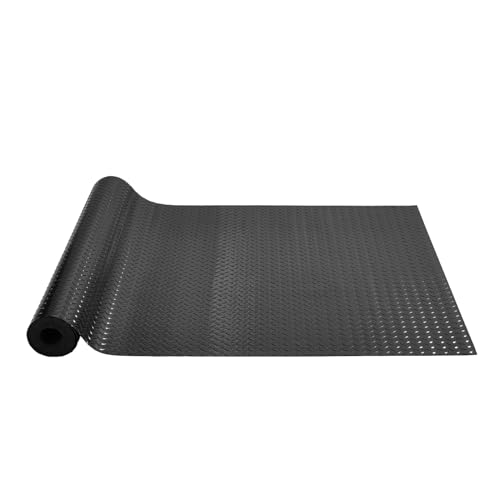
For coop owners working with a dirt-floor shed or a large stationary run that needs a solid ground cover, this 4×15-foot rubber roll from VEVOR provides 60 square feet of coverage from a single piece. The SBR diamond-plate material is the same compound used in commercial garage flooring, chosen specifically for its resistance to oils, brake fluids, and heavy abrasion — which translates to a coop floor that withstands constant chicken traffic, rainwater, and the occasional tractor tire rolling over it. The diamond-plate texture adds grip that prevents birds from slipping on wet surfaces.
The TPE anti-leak backing is a standout feature for coop use: it prevents liquids from seeping through and soaking into the ground underneath, effectively sealing the floor against moisture migration. This means you can hose down the entire coop floor and the water stays on top of the rubber until it evaporates or you squeegee it off. The 3mm thickness is thinner than stall mats, but the roll format allows you to cut a single continuous piece that covers the entire floor without seams where debris could accumulate.
The primary concern for coop use is the strong rubber smell that multiple users report, which can be off-putting in an enclosed space and may take weeks to fully dissipate. The material is also thin enough that sharp rocks or uneven ground beneath can create pressure points that wear through over time. Some users noted that the roll requires tacking or weighting at the edges to prevent curling. For a dirt-floor shed conversion where you want a seamless, liquid-proof barrier, this roll is a pragmatic solution.
Why it’s great
- Single 60 sq ft roll covers entire floors without seams
- TPE anti-leak backing traps liquids on the surface
- Diamond-plate texture provides excellent wet grip
Good to know
- Strong rubber smell persists for weeks in enclosed spaces
- 3mm thickness offers minimal cushioning on hard ground
- Edges may curl and require tacking or weights
FAQ
Can I use horse stall mats directly on dirt for a chicken coop floor?
How often should I replace interlocking tiles in a chicken coop?
Do drainage mat tiles work with deep litter bedding method?
Will a rubber mat base prevent rats from burrowing into my coop?
Final Thoughts: The Verdict
For most users, the best base for chicken coop winner is the Romlits Fast-Drying Decking Tiles because they combine extreme load capacity with a fully open drainage grid that keeps the floor dry and odor-free, making them the most sanitary option for a permanent coop setup. If you want a single-piece floor that covers a large run quickly with good drainage, grab the ROVSUN Rubber Mat 2-Pack. And for heavy-duty predator protection and insulation in a stationary coop, nothing beats the Mohawk Home Heavy Duty Stall Mat.