
Our readers keep the lights on and the weekend projects moving. As an Amazon Associate, I earn from qualifying purchases.
Finding a receiver that delivers real, room-filling power without emptying your bank account is the defining challenge of building a home theater. The market is flooded with underpowered entry-level boxes that claim high wattage but clip the second you turn up the volume, forcing you to choose between muddy sound and an expensive upgrade.
I’m Rikta — the co-founder and writer behind FitlyFast. I’ve spent years analyzing amplifier topologies, HDMI 2.1 chipsets, and THD ratings across hundreds of models to separate the true performers from the spec-sheet fluff.
This guide cuts through the noise to deliver the best affordable receiver for your specific setup, whether you need raw bass for a party or clean surround for movie night.
How To Choose The Best Affordable Receiver
Choosing an affordable receiver means identifying which compromises you can live with and which spec cuts will ruin your experience. The goal is maximum usable power and essential features at a price that leaves room for better speakers.
Channel Count: 5.1 vs 5.2 vs 7.2
A 5.1-channel receiver powers five speakers and one subwoofer, which is the standard for most living rooms. A 5.2 adds a second subwoofer output for more even bass distribution, while 7.2 adds rear surround speakers for a more immersive bubble. For most buyers in the affordable tier, a 5.2 unit offers the best value because it supports a subwoofer upgrade path without paying for extra amplifier channels you may never use.
HDMI Version and eARC
HDMI 2.1 is critical if you plan to connect a PlayStation 5 or Xbox Series X and want 4K at 120Hz. For pure movie watching, HDMI 2.0 with eARC is perfectly fine and much cheaper. eARC allows your TV to send lossless Dolby Atmos back to the receiver from built-in apps, so you don’t need to plug every streaming stick directly into the receiver.
Power Ratings: Peak vs Continuous
Manufacturers often advertise peak power (like 2000W) at 1kHz with 10% THD, which sounds impressive but sounds terrible. Focus on continuous power per channel into 8 ohms with less than 0.1% THD. A receiver delivering 75 watts per channel cleanly will outperform a unit claiming 200 watts that distorts above 50. Look for THX certification or clear FTC-rated specs as a reliability signal.
Quick Comparison
On smaller screens, swipe sideways to see the full table.
| Model | Category | Best For | Key Spec | Amazon |
|---|---|---|---|---|
| Yamaha RX-V4A | Mid-Range | Hi-res music streaming & 4K | 80W/ch (8 ohms, 0.06% THD) | Amazon |
| Denon AVR-S670H | Mid-Range | Ease of setup & phono input | 75W/ch, 5.2 ch, 8K passthrough | Amazon |
| Onkyo TX-NR6100 | Premium | THX Certified gaming rigs | 210W/ch THX Select, 7.2 ch | Amazon |
| JBL MA510 | Mid-Range | 8K gaming & clean aesthetics | 75W/ch, 5.2 ch, 8K HDMI | Amazon |
| Yamaha RX-V6A | Premium | Dolby Atmos & multi-room | 100W/ch, 7.2 ch, MusicCast | Amazon |
| Onkyo TX-NR5100 | Premium | Competitive gaming latency | 80W/ch, 7.2 ch, HDMI 2.1 VRR | Amazon |
| JBL MA310 | Mid-Range | Compact 5.2 cinema setups | 60W/ch, 5.2 ch, 4K HDMI ARC | Amazon |
| Sony STRDH590 | Budget | Entry-level 4K HDR movies | 145W/ch (6 ohms, 1ch driven) | Amazon |
| Pyle PT6060CHAE | Budget | Karaoke & rack-mount power | 2000W peak, 6 ch, dual mics | Amazon |
In‑Depth Reviews
1. Yamaha RX-V4A 5.2-Channel AV Receiver

The Yamaha RX-V4A strikes the best balance between clean amplifier power and modern streaming features at a price that doesn’t hurt. Its 80 watts per channel into 8 ohms with only 0.06% THD means it drives most tower speakers to reference levels without audible distortion. The inclusion of YPAO automatic room calibration is rare at this tier and solves the muddy bass problems caused by room modes without requiring a third-party microphone.
MusicCast multi-room support lets you sync this receiver with other Yamaha wireless speakers throughout your home, a feature usually reserved for mid-range units. Wi-Fi, AirPlay 2, and Spotify Connect are all built-in, so you don’t need a separate streamer. Gaming-wise, it handles 4K at 60Hz and supports eARC for lossless audio from your TV apps.
Some users report the HDMI 2.1 implementation can be finicky with certain monitors, and the remote uses small buttons that require the TV menu for deeper adjustments. Setup is best done via the on-screen display, which has a slight delay, but once configured the receiver runs smoothly.
Why it’s great
- Clean 80W/ch with YPAO room correction
- MusicCast multi-room and AirPlay 2
- eARC for lossless TV audio
Good to know
- HDMI 2.1 can be picky with display handshake
- Remote lacks backlight and is button-dense
2. Denon AVR-S670H 5.2 Ch Home Theater Receiver

The Denon AVR-S670H is the receiver you buy when you want minimal setup frustration and a built-in phono input for your turntable. Denon’s setup wizard guides you through speaker detection, input naming, and network connection without needing a degree in AV engineering. The included Audyssey calibration microphone automatically adjusts speaker distances and levels for balanced sound in under five minutes.
It delivers 75 watts per channel and supports 8K passthrough with HDR10+ and Dolby Vision, making it future-proof for the next generation of displays. HEOS built-in allows multi-room streaming with other Denon or Marantz components, and it works with Amazon Alexa for hands-free volume control.
Wireless streaming via HEOS can occasionally lag or drop connection, especially with Spotify. Also, the 5.2 channel configuration means you cannot expand to a 7-speaker Atmos setup later without buying a new unit. For a pure 5-speaker surround system with vinyl playback, it is the most polished option.
Why it’s great
- Excellent Audyssey room calibration
- Built-in phono input for turntables
- 8K passthrough with Dolby Vision
Good to know
- HEOS wireless streaming can be unreliable
- Limited to 5.2 channels, no Atmos expansion
3. Onkyo TX-NR6100 7.2 Channel THX Certified Receiver
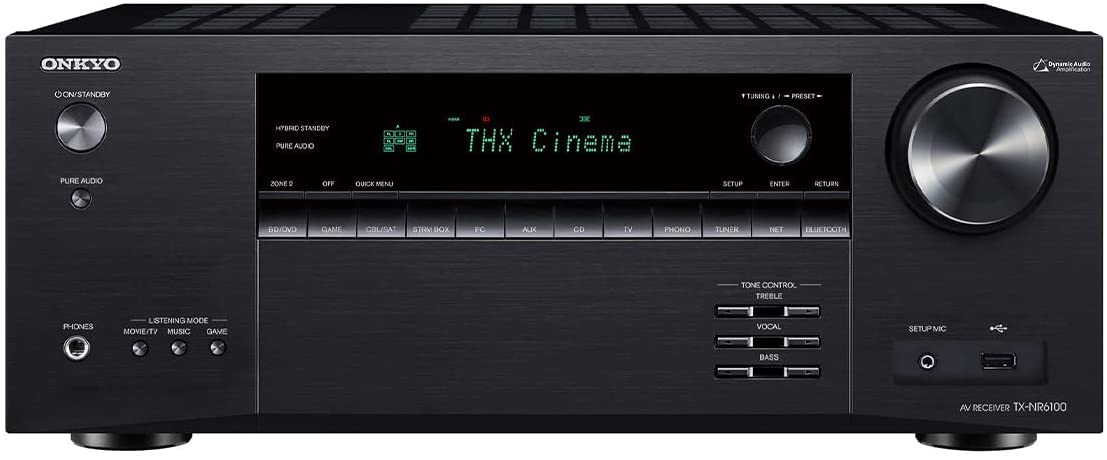
The Onkyo TX-NR6100 is the only affordable receiver with THX Select certification, which guarantees a specific level of distortion-free power and shielding for home theater use. Its dynamic audio amplification delivers a massive 210 watts per channel into 6 ohms, making it loud enough to fill a large room with Klipsch or JBL towers without strain. Three of its HDMI inputs support full 40Gbps 8K pass-through with 4K at 120Hz for high-refresh-rate gaming.
It supports 5.2.2-channel Dolby Atmos and DTS:X, so you can add height speakers for a true 3D soundstage. The built-in calibration is speaker-specific and adjusts for brands like Klipsch automatically on some models. Zone 2 allows you to send a separate audio source to another room.
Reliability concerns exist: some owners report HDMI board failures after 18-24 months. The fan is audible in silent movie scenes, and the remote is not backlit. Also, using bi-amp mode reduces your channel count from 7.1 to 5.1, which may confuse buyers expanding their system.
Why it’s great
- THX Select certification for clean power
- 5.2.2 Dolby Atmos with 40Gbps HDMI
- Massive dynamic headroom for loud scenes
Good to know
- Some reports of HDMI board failure
- Fan noise present in quiet content
4. JBL MA510 5.2 Channel 8K AV Receiver

The JBL MA510 is designed for the buyer who wants 8K support and network streaming without paying for a 7-channel amplifier they won’t use. Its 75 watts per channel into 8 ohms is conservative but clean, and the shallow chassis (just 4.3 inches tall) fits into tight media consoles where other receivers won’t. It supports native 8K at 60Hz and 4K at 120Hz with eARC.
Network streaming is a highlight: Apple AirPlay 2 and Google Chromecast are built-in alongside standard Bluetooth 5.1. You can cast directly from any smartphone app without opening a separate software ecosystem. The setup menu appears on your TV screen and is significantly easier to navigate than its predecessor’s front-panel display.
The remote lacks backlighting, which is annoying in dark home theaters. Also, the MA510 does not support DTS-HD Master Audio downmixing to 2.1 channels, so Blu-ray audio enthusiasts with 2.1 setups should look at the MA710 instead.
Why it’s great
- 8K passthrough with eARC
- AirPlay 2 and Chromecast built-in
- Compact shallow design for tight spaces
Good to know
- No DTS-HD downmix for 2.1 setups
- Remote not backlit
5. Yamaha RX-V6A 7.2-Channel AV Receiver

The Yamaha RX-V6A is the upgrade path for anyone who starts with a 5.1 setup but wants to add front height or rear surround channels later. It provides 100 watts per channel across seven channels and supports Dolby Atmos Height Virtualization, which simulates overhead effects without physical ceiling speakers. Its three 8K HDMI 2.1 inputs deliver 4K at 120Hz for Xbox Series X and PS5.
MusicCast is the star here: it allows whole-home audio with up to 30 rooms. The YPAO R.S.C. (Reflected Sound Control) calibration is more sophisticated than the RX-V4A’s, adjusting for early reflections from furniture and walls. The unit also supports DTS:X for object-based audio on compatible Blu-rays.
Setup is more complex than the Denon AVR-S670H and often requires the MusicCast app to complete network configuration. The eARC implementation may not auto-power on with all Sony Bravia TVs. Some users find the remote buttons too small for comfortable use in the dark.
Why it’s great
- 7.2 channels for Dolby Atmos expansion
- High slew rate for improved sound quality
- MusicCast whole-home audio
Good to know
- Setup requires app for best results
- eARC auto-power not universal across TV brands
6. Onkyo TX-NR5100 7.2-Channel 8K Smart AV Receiver

The Onkyo TX-NR5100 is laser-focused on competitive gaming, with Variable Refresh Rate and Auto Low Latency Mode built into its HDMI 2.1 ports. It eliminates screen tearing and stutter from fast-paced shooters, and the Quick Frame Transport reduces input lag to near-imperceptible levels. It handles 4K at 120Hz natively without scaling artifacts.
Configured as a 7.2-channel receiver, it supports 5.1.2 Dolby Atmos for height effects. The setup menu is displayed on your TV and is straightforward, with visual guides for each speaker position. The remote is simpler than previous Onkyo models, with fewer buttons to learn.
Bluetooth implementation has sync issues with low-latency headphones and Apple TV, making wireless audio playback unreliable. Some users report the unit is actually a 7.1 receiver, not 7.2, as the second subwoofer output is a mirrored mono signal rather than an independent channel. Long-term reliability is a concern, with some units failing within 18 months.
Why it’s great
- VRR, ALLM, and QFT for lag-free gaming
- 7.2 channels for 5.1.2 Atmos
- Simple on-screen setup with visual guides
Good to know
- Bluetooth sync issues with some devices
- Second sub out is mirrored, not independent
7. JBL MA310 5.2 Channel 4K AV Receiver

The JBL MA310 is the most space-friendly 5.2-channel receiver on this list, with a depth of just 13.7 inches and a low profile that slides into an open shelf without sticking out the back. It delivers 60 watts per channel into 8 ohms, which is sufficient for a small to medium living room with high-sensitivity speakers. It supports 4K HDR with HDMI ARC connectivity.
Integration with smart TVs is smooth: HDMI ARC allows the TV remote to control volume and power for the receiver. The Bluetooth 5.1 Low Energy streamer works for casual music listening from a smartphone. The design is minimalist and clean, with a visible front panel that doesn’t scream “tech gear.”
The remote lacks backlighting, making it frustrating to use in a dark room. Setup involves a firmware update that can fail and hang if the network is unstable, requiring a hard reset. For simple 5-speaker surround with basic streaming, it is a fine entry point.
Why it’s great
- Very compact shallow chassis
- TV remote integration via ARC
- Clean minimalist design
Good to know
- Firmware update can hang during setup
- Remote is not backlit
8. Sony STRDH590 5.2 Multi-Channel 4K HDR AV Receiver (Renewed)
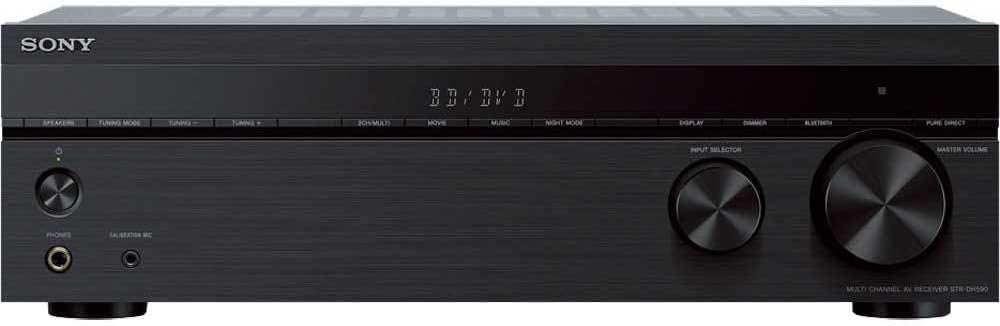
The Sony STRDH590 is the most affordable 5.2-channel receiver that still supports 4K HDR with Dolby Vision and HDCP 2.2. It delivers a claimed 145 watts per channel into 6 ohms (1 channel driven at 1kHz), which in practice means it can drive moderate bookshelf speakers to satisfying levels for movie dialogue and music. The S-Force Pro front surround creates a wider soundstage from a 5.1 speaker layout.
It features four HDMI inputs with ARC and a low-profile design at just 5.25 inches tall. Bluetooth streaming is built-in, and it includes a full-size headphone jack. The renewed versions are often indistinguishable from new units, saving a significant amount.
The receiver lacks a phono input and does not support Dolby Atmos or DTS:X. It also requires a powered subwoofer (it has pre-out, not built-in amplification). Some units experience the “protect” error after 6-12 months, suggesting reliability variability. For a pure stereo or 5.1 movie setup, it is a functional starting point.
Why it’s great
- Lowest cost 5.2 receiver with 4K HDR
- Compact profile fits most cabinets
- Renewed units offer large savings
Good to know
- No phono input or Atmos support
- Some units develop protection fault
9. Pyle PT6060CHAE 6-Channel 2000W Hybrid Amplifier
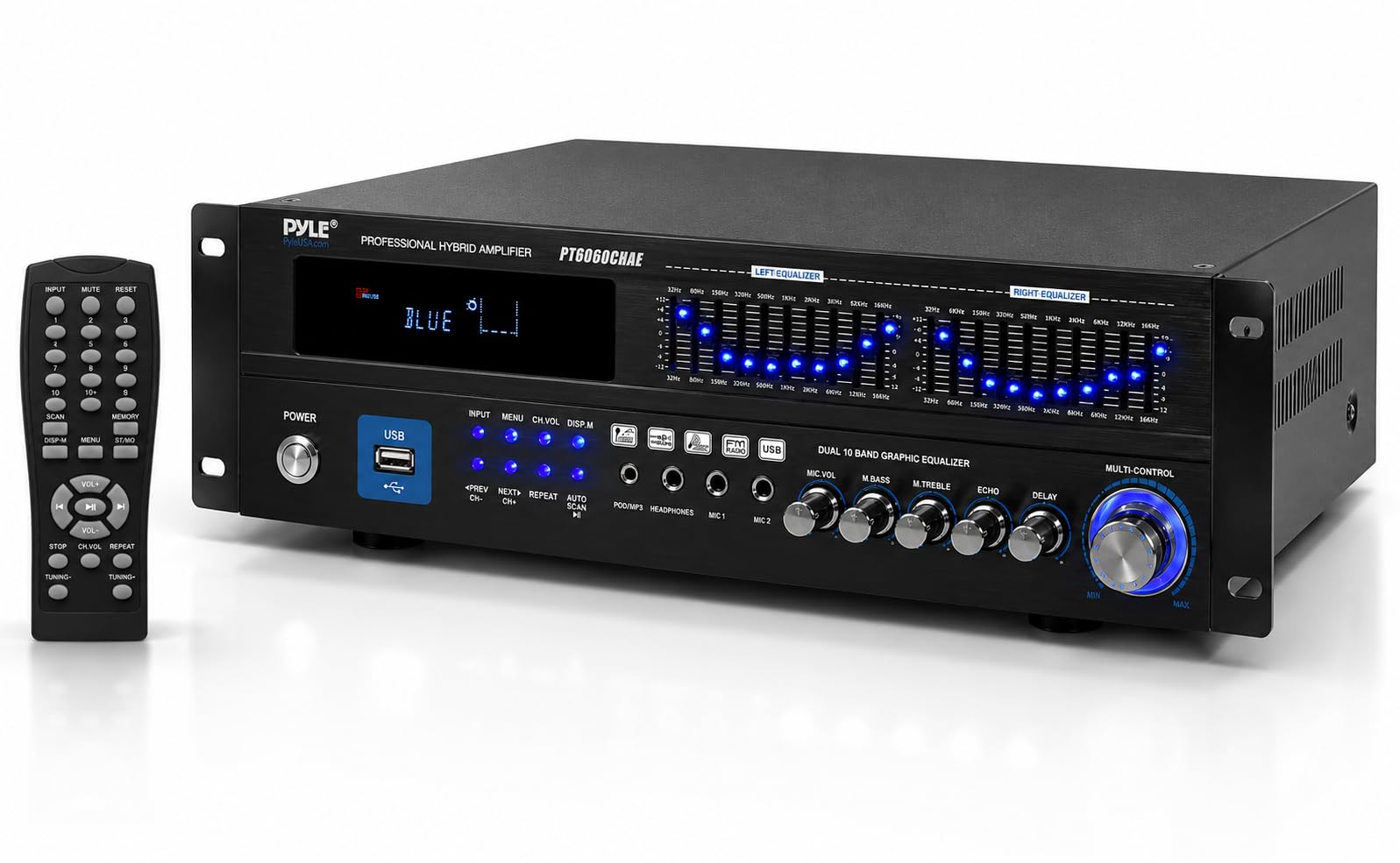
The Pyle PT6060CHAE is not a standard AV receiver — it is a 6-channel hybrid amplifier designed for karaoke, PA systems, and rack-mount installations. Its 2000W peak power rating drives multi-speaker setups with 4-ohm impedance, and it includes two microphone inputs with individual echo and volume controls. The dual 10-band EQ on the front panel allows precise frequency shaping that typical receivers lack.
It connects via Bluetooth for music streaming and includes optical, coaxial, HDMI, and DVD inputs. The rack-mount design with built-in cooling fan is ideal for installations where the amplifier lives in a ventilated equipment rack. It also includes an FM radio tuner with auto-search.
Audio quality suffers at low volumes due to noticeable hiss, and the unit failed for some owners after about one year. The remote control lacks a power button, and the input defaults to DVD on every power-up, requiring manual reselection for optical or Bluetooth. It is best suited for parties, karaoke bars, or large room sound reinforcement rather than critical home theater.
Why it’s great
- Massive peak power for multi-speaker setups
- Dual mic inputs with echo for karaoke
- Rack-mountable with cooling fan
Good to know
- Hissing noise at low volume levels
- Input defaults to DVD after power cycle
FAQ
What wattage do I need for a medium-sized living room?
Is Dolby Atmos worth it on a budget receiver?
Can I use an affordable receiver for both movies and music?
Why do some affordable receivers connect to a subwoofer only if it is powered?
What is HDMI ARC and when should I use it instead of eARC?
Final Thoughts: The Verdict
For most users, the affordable receiver winner is the Yamaha RX-V4A because it packs YPAO room calibration, MusicCast multi-room, and clean 80W/ch power into a package that hits the sweet spot of features and price. If you want the easiest setup with a built-in phono input for your turntable, grab the Denon AVR-S670H. And for THX-certified power that can drive a dedicated gaming theater, nothing beats the Onkyo TX-NR6100.