
Our readers keep the lights on and the weekend projects moving. As an Amazon Associate, I earn from qualifying purchases.
A shaky, noisy bike kills your motivation faster than any sore quads ever will. The biggest mistake buyers make is choosing a bike that feels unstable the moment you push past a casual pedal, turning every ride into a battle with the frame instead of focusing on your fitness goals. The quiet hum of a magnetic belt drive and the solid feel of a reinforced frame are the true markers of a smart investment.
I’m Rikta — the co-founder and writer behind FitlyFast. I spend my days analyzing fitness equipment specs, from resistance mechanisms to frame geometry, so you get a bike that delivers real results without the guesswork.
Whether you are a beginner building foundational cardio or a cyclist seeking a reliable indoor trainer, finding a quiet, stable, and adjustable at home exercise bike is the key to a consistent and enjoyable workout routine that fits your space and schedule.
How To Choose The Best At Home Exercise Bike
An exercise bike is a multi-year purchase that lives in your living space, so the right decision comes down to matching three core elements: resistance type, frame geometry, and adjustability range. If you ignore any of these, you risk buying a bike that is either too loud, too unstable, or simply uncomfortable for your body.
Resistance System: Magnetic vs. Felt
Magnetic resistance uses magnets to create drag against a metal flywheel without physical contact. This means zero friction wear and noise levels below 25 dB — quiet enough for early-morning rides in an apartment. Felt or wool pad resistance systems are cheaper but generate a rubbing sound that worsens over time and accelerates component degradation. Every bike in this list uses magnetic resistance, which is the baseline for any quiet, long-lasting setup.
Frame Stability and Weight Capacity
A bike’s steel frame thickness and overall weight directly affect how stable it feels during out-of-the-saddle sprints. Look for a reinforced triangular or H-frame design and a minimum user weight capacity of 300 lbs. Heavier frames, around 60-110 lbs, absorb vibration better and resist rocking during high-cadence intervals. Lighter entry-level bikes around 40 lbs can still work well for steady-state seated rides, but they will feel less planted under aggressive effort.
Adjustability Range
Proper fit prevents knee strain and lower back pain. Check that the seat adjusts both vertically (height from the pedal) and horizontally (fore-aft distance from the handlebars). Handlebars should also move vertically to accommodate different torso lengths. Bikes labeled for riders from 5’1” to 6’1” cover most households, but taller users over 6’2” need models with extended seat tracks and taller handlebar posts specifically noted in the specs.
Quick Comparison
On smaller screens, swipe sideways to see the full table.
| Model | Category | Best For | Key Spec | Amazon |
|---|---|---|---|---|
| Schwinn 290 Recumbent | Recumbent | Comfort & guided workouts | 7″ LCD, 13 programs, 330 lbs | Amazon |
| VANSWE RB607 Recumbent | Recumbent | Heavy-duty & tall riders | 450 lbs capacity, infinite seat slider | Amazon |
| MERACH S19 Recumbent | Recumbent | Joint-friendly rehab | 8-position seat, 330 lbs, Bluetooth | Amazon |
| Schwinn 130 Upright | Upright | App-based training (Zwift) | 16 magnetic levels, 300 lbs, 5.5″ LCD | Amazon |
| Yesoul S3 | Spin | Interactive classes | 100 resistance levels, 350 lbs | Amazon |
| Merach MR-S29R1 | Spin | Stepless resistance feel | 16 levels, 350 lbs, heavy 77 lb frame | Amazon |
| YPOO BC720 | Spin | App integration & comfort | 330 lbs, infinite resistance, 20 dB | Amazon |
| Lacuffy S1-Pro | Spin | Budget-friendly home use | 32 magnetic levels, 300 lbs, 25 dB | Amazon |
| Wenoker Magnetic-Black-blue | Spin | Entry-level value | 350 lbs capacity, Bluetooth, LCD | Amazon |
In‑Depth Reviews
1. Merach MR-S29R1 Spin Bike
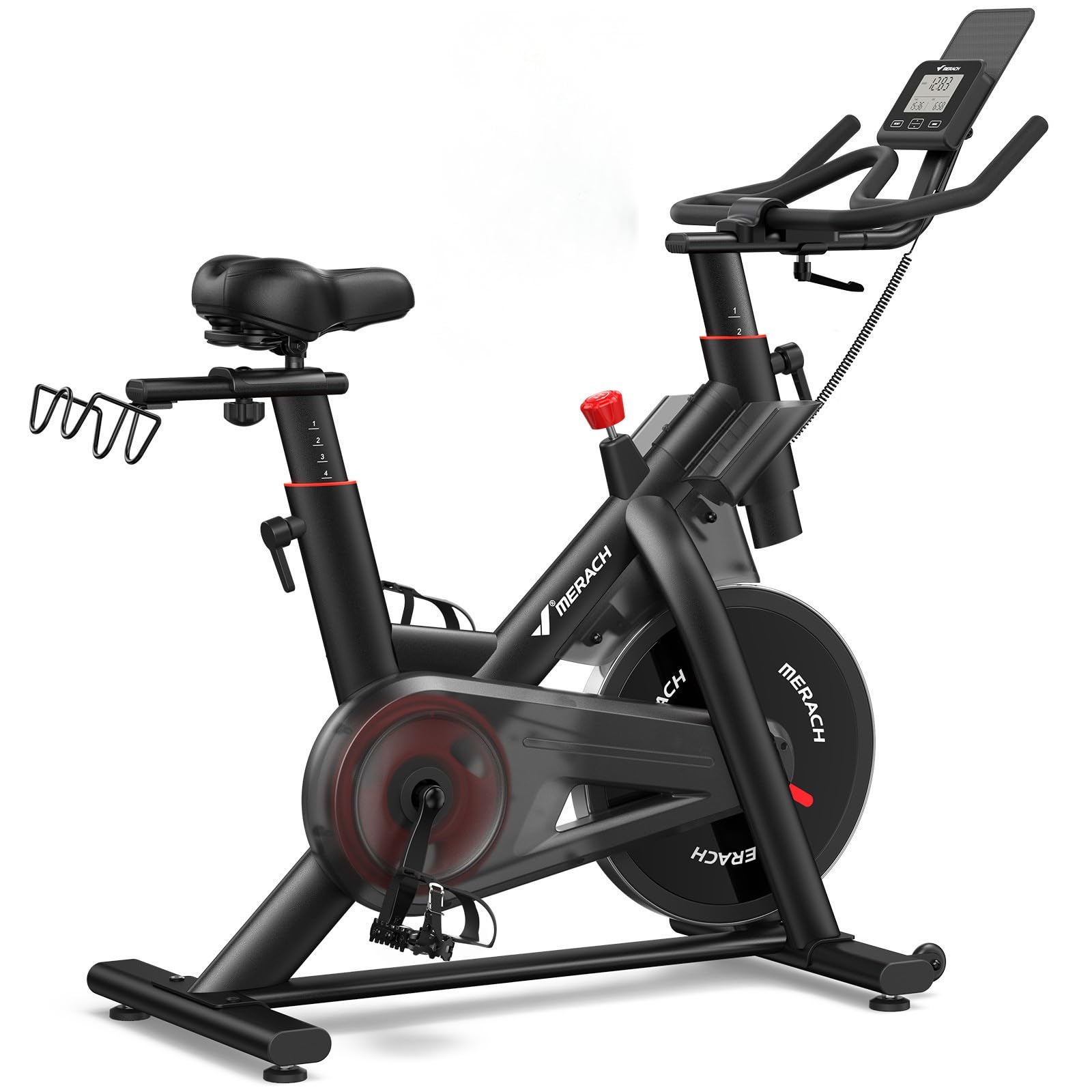
The Merach MR-S29R1 bridges the gap between affordability and gym-grade construction. Its 77-pound steel frame is the heaviest in the mid-range tier, providing a planted feel during high-cadence sprints that lighter sub-50-pound bikes cannot match. The 16-level magnetic resistance operates at under 25 dB, and the stepless knob allows micro-adjustments between levels — a feature riders who chase specific pedal resistance targets will appreciate.
Self-developed app connectivity syncs resistance level, distance, and calories to Apple Health and Google Fit, which is convenient for users already tracking overall wellness metrics. The dual bottle holders and tablet mount keep entertainment within arm’s reach. However, the handlebars sit relatively low, and riders above 6’2” have reported a forward-leaning posture that becomes uncomfortable on rides exceeding 45 minutes.
The seat is padded well enough for seated cruising, but serious spin enthusiasts will still swap it for a gel saddle. Assembly is straightforward with clear instructions, and the front transport wheels make relocation simple for an 77-pound unit. This is the best pick for riders who want a quiet, stable bike without stepping up to premium price territory.
Why it’s great
- Exceptionally stable 77 lb frame reduces wobble
- Stepless magnetic resistance feels natural
- Reliable Bluetooth syncing with health platforms
Good to know
- Handlebar height is limiting for very tall riders
- Felt resistance pad mentioned in some units (verify model)
2. Yesoul S3 Spin Bike

The Yesoul S3 is built around its 100-level magnetic resistance system, which rewards riders who like granular control over their workout intensity. Each quarter-turn of the knob produces a perceptible change, making it easy to replicate a road gradient profile during app-guided rides. The frame supports up to 350 lbs and the carbon steel build keeps vibrations low, even during standing climbs.
Bluetooth integration connects to the YESOUL FITNESS app, where you can browse hundreds of studio-style classes. The 10-inch tablet mount sits high enough to view metrics without dropping your chin. The included SPD-compatible pedals are a rare inclusion at this price — clip-in riders save roughly on upgrade costs. The seat is functional but hard after 30 minutes, a common trade-off in this segment.
Maximum rider height of 6’1” and handlebars that lack fore-aft adjustment mean taller users may need to lean too far forward. Assembly takes about 30 minutes with 70% pre-assembly. For riders who want resistance granularity and a decent app ecosystem without a monthly subscription, the S3 delivers strong value.
Why it’s great
- 100 resistance levels offer precise intensity tuning
- SPD clip-in pedals included, saving upgrade cost
- Carbon steel frame absorbs vibration well
Good to know
- Seat comfort diminishes on rides over 30 minutes
- Handlebar lacks horizontal adjustment
3. YPOO BC720 Spin Bike
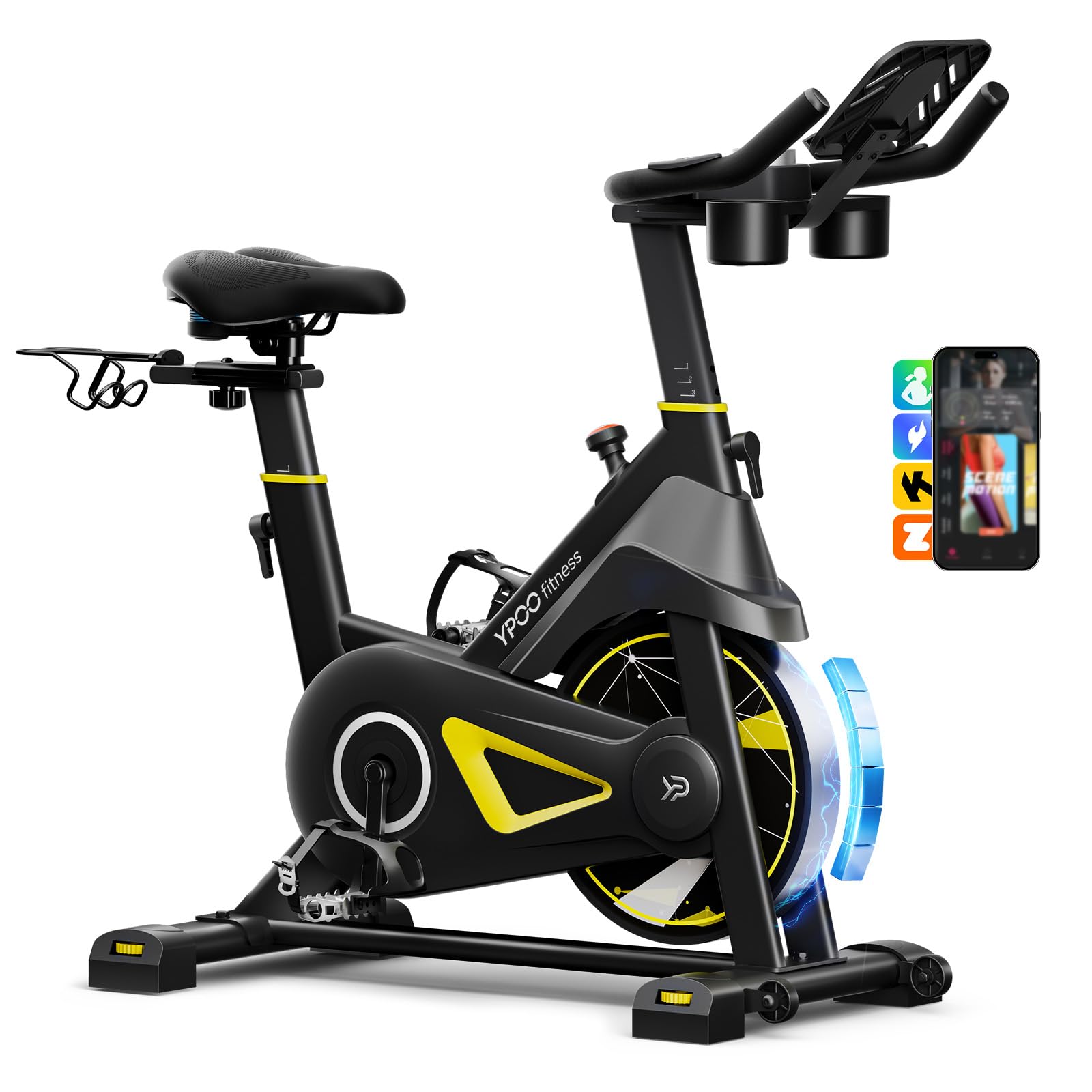
The YPOO BC720 distinguishes itself with an infinite stepless resistance knob that provides continuous tension from zero to 100% without the click-stops of indexed systems. This means you can dial in a specific pedal feel rather than jumping from level 8 to 9. Noise output is cited at under 20 dB — genuinely library-quiet — making it ideal for shared walls or bedroom setups.
The ypoofit app delivers structured training courses and supports third-party integration with KINOMAP and Zwift. A high-density foam saddle with dual-spring suspension improves long-ride comfort over standard padded seats. The H-frame dual-triangle steel design keeps the bike planted even during aggressive standing efforts at 330 lbs capacity.
Some users note that the rear stabilizer feels narrow for the frame’s height, which can cause a tipping sensation during out-of-the-saddle sprints at heavier body weights. The LCD monitor tracks the basics but displays no cadence — a detail that matters for data-focused riders. Assembly is fast at under 30 minutes, and the included dumbbell rack adds upper-body cross-training capability.
Why it’s great
- Stepless resistance adjustment is smooth and precise
- Under 20 dB noise level is apartment-friendly
- Foam saddle with suspension improves ride comfort
Good to know
- Narrow rear stabilizer may feel unstable for heavy sprinters
- LCD monitor does not show cadence
4. Schwinn 130 Upright Bike
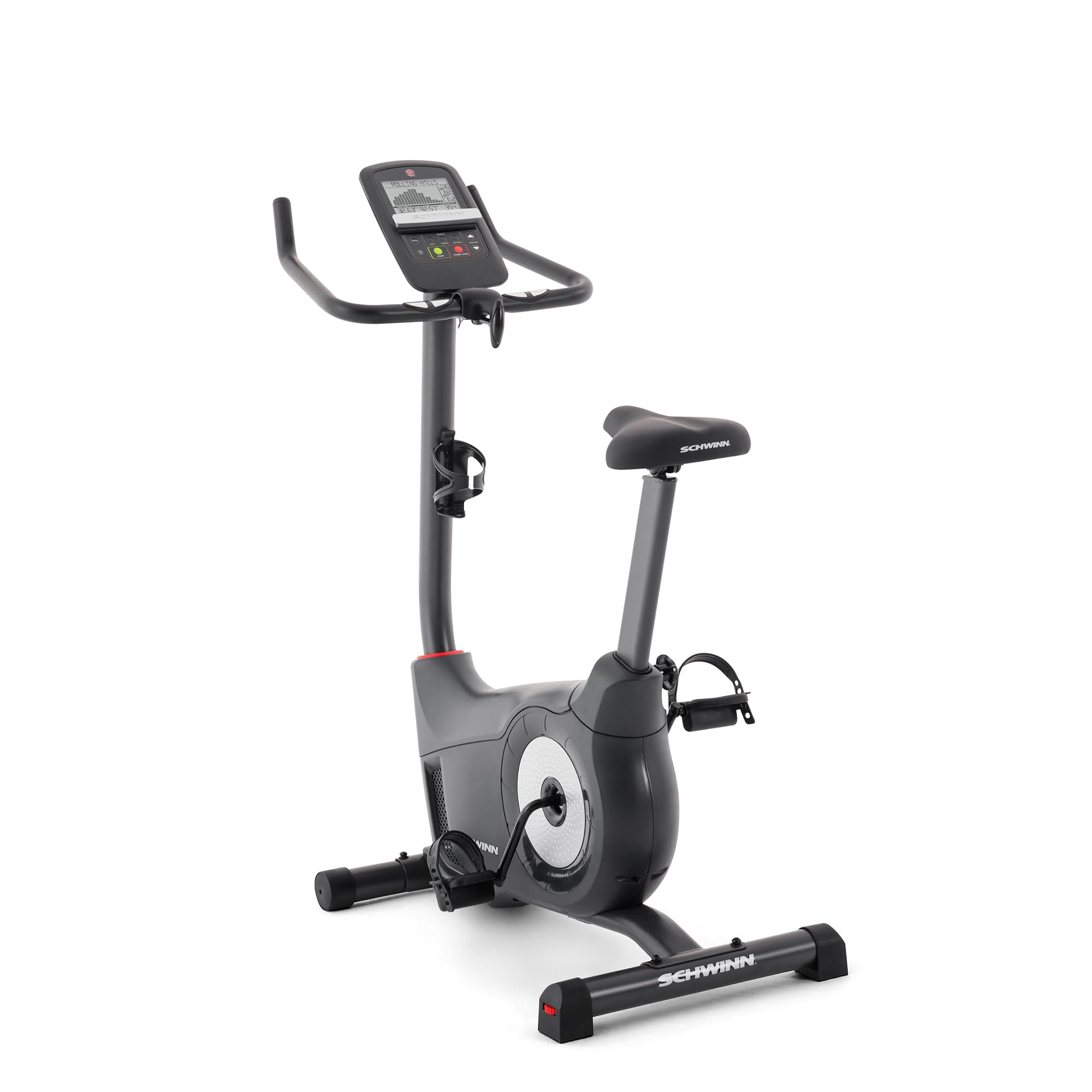
The Schwinn 130 is an upright bike that prioritizes app integration and program variety over raw resistance depth. Its 5.5-inch LCD displays 13 workout programs, and Bluetooth connectivity pairs reliably with Zwift, Fulgaz, and Explore the World for guided virtual rides. The 40-plus global routes auto-adjust resistance according to terrain elevation, providing a surprisingly immersive experience for a bike in this tier.
The 16 levels of magnetic resistance cover steady-state cardio and light climbing, but the range is narrower than spin bikes — serious cyclists may top out on resistance during powerful efforts. The foam comfort seat and ergonomic grip heart rate sensors promote a relaxed upright posture that reduces lower back strain for users with flexibility limitations. The AC-powered console eliminates battery anxiety and keeps the display lit without requiring pedal RPM.
Assembly requires two people for certain steps, and some plastic flywheel covers may fit loosely. The pedals are weighted and strapped but not SPD-compatible. This bike is best for users who want a comfortable upright posture for 30-60 minute app-based sessions rather than HIIT-style stand-up sprints.
Why it’s great
- Zwift and Explore the World integration for guided rides
- AC-powered display stays on without pedaling
- Comfortable upright geometry reduces back strain
Good to know
- 16 resistance levels may feel limited for advanced cyclists
- Plastic flywheel covers can fit loosely
5. Schwinn 290 Recumbent

The Schwinn 290 Recumbent is the gold standard for comfort-first riders who want a full-featured console and app ecosystem in a recumbent package. Its 7-inch LCD display gives you 13 preset workout programs covering heart rate control, interval, and manual modes. Terrain Control Technology automatically changes resistance during JRNY guided routes, simulating real elevation changes without you touching a knob.
The seat slides on a smooth rail system, and the breathable mesh backrest keeps your spine aligned and cool during longer sessions. Riders rehabbing from knee or hip surgery find the recumbent position significantly gentler than upright bikes because the seat supports your lower back and reduces joint compression. The belt drive is exceptionally quiet, and the 110-pound frame mass anchors the bike firmly against the floor.
Assembly takes around 2-3 hours and requires patience with alignment — some users report misaligned seat bracket holes that need light filing. The heart rate monitor on the lower handles occasionally reads high compared to a chest strap. At 6’3” the bike feels compact; taller riders should confirm their inseam fits the 28-35 inch seat range. This bike excels for pre-correction rehab, steady-state cardio, and households with multiple users who value different seat positions.
Why it’s great
- Terrain Control auto-adjusts resistance on guided rides
- Recumbent design supports low-impact joint recovery
- Very stable 110 lb frame eliminates rocking
Good to know
- Assembly is involved and may need minor alignment work
- Heart rate handle sensors can over-report readings
6. VANSWE RB607 Recumbent
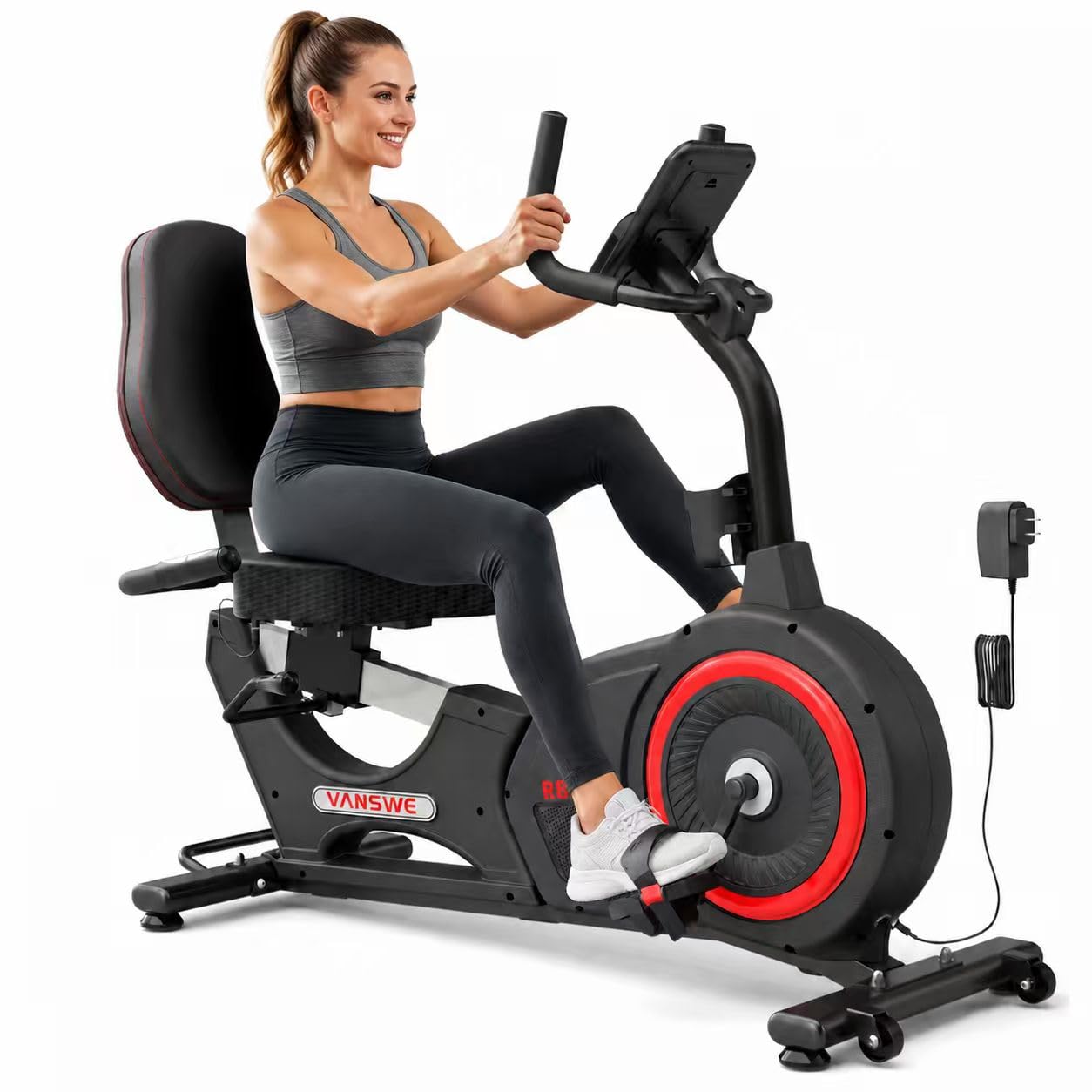
The VANSWE RB607 targets the underserved niche of heavier riders and very tall users with its 450-pound weight capacity and infinite slider seat system. The seat track adjusts seamlessly from 29” to 40” inseam instead of using fixed hole positions, allowing millimeter-precise leg extension that protects knee joints during high-cadence work. The 16-level electronic magnetic resistance is controlled via buttons on the handlebar, which is easier than reaching for a knob mid-ride.
The backlit LED display shows 19 built-in programs ranging from fat burn to interval, and Bluetooth syncs workout data to Kinomap and Zwift for virtual cycling. The 3.4-inch extra-thick seat cushion contoured with a supportive backrest is genuinely comfortable for hour-plus sessions — the best seat cushion in this entire list. The 90% pre-assembly out of the box means you can be riding within an hour.
The frame feels solid at 75 pounds but some riders over 6’ have noted the distance from the seat to the pedals maxes out earlier than expected, causing slight knee bend at full extension. The pedal cages are small for shoe sizes above 12. For seniors and heavy riders seeking a durable, low-impact machine with comprehensive program options, the RB607 is a standout.
Why it’s great
- 450 lb capacity with reinforced steel frame
- Infinite slider seat fits very tall and short riders
- Extra-thick 3.4” seat cushion reduces pressure points
Good to know
- Top end of height range is tight for 6’3”+ riders
- Pedal cages are too small for large shoe sizes
7. MERACH S19 Recumbent
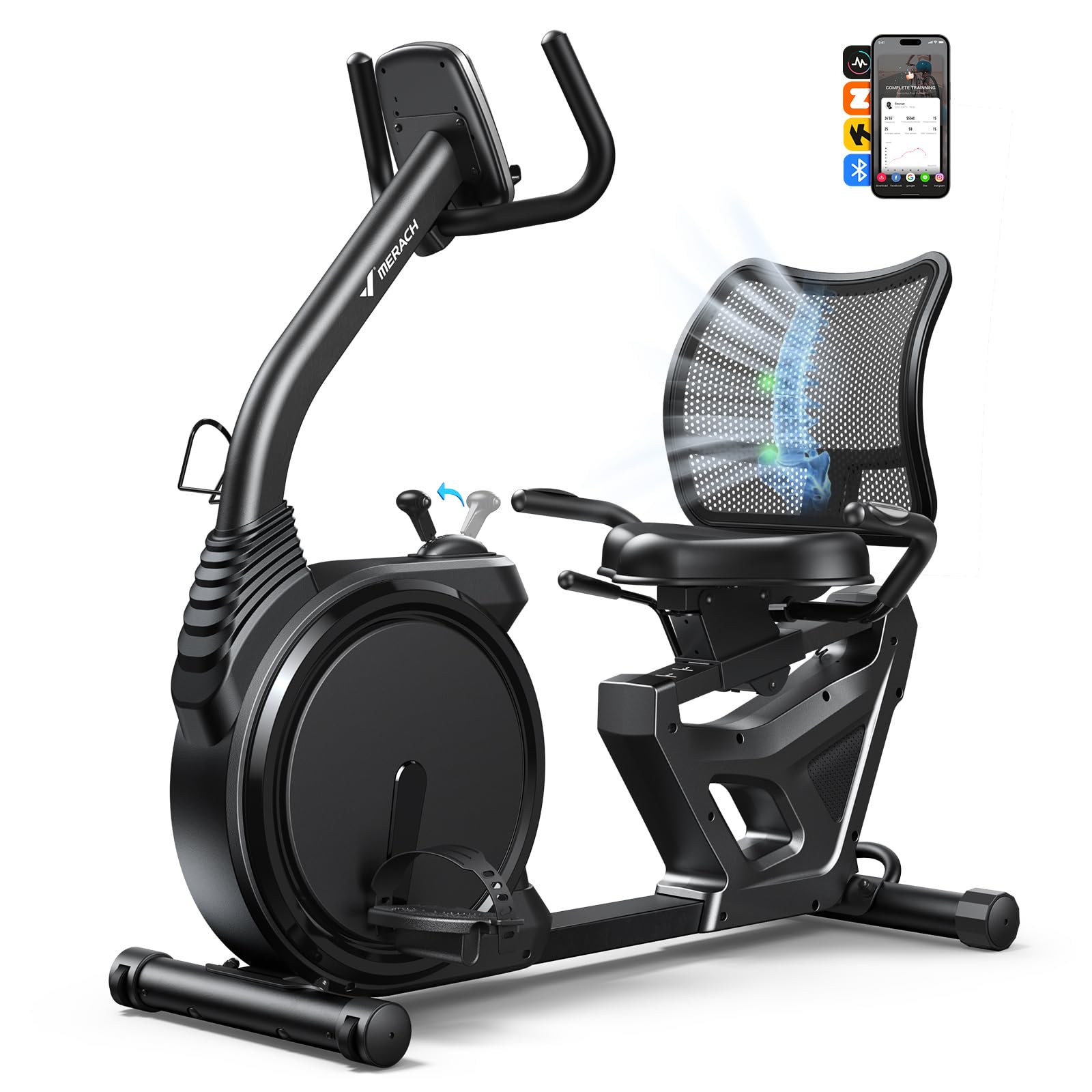
The MERACH S19 Recumbent Bike is purpose-designed for low-impact rehab and senior fitness. Its 8-position seat adjustment and ergonomic backrest with breathable mesh keep the rider’s spine in a neutral position during extended sessions, taking pressure off the lower back. The 6.6-pound perimeter-weighted flywheel delivers a smooth, consistent motion ideal for steady-state cardio and active recovery days.
A lever-style resistance system shifts through 8 car-like levels, making intensity changes intuitive for those who dislike digital menus. The frosted handlebars resist sweat buildup and provide a secure non-slip grip. Bluetooth pairs with the MERACH app and FantomFite gamification platform for an entertaining workout experience. The LCD tracks time, distance, speed, calories, and heart rate from the pulse handle.
The 84.9-pound product weight provides excellent stability, and the compact 48” x 23.6” footprint fits easily in tight corners. Some users note that resistance levels 1-5 feel similar in pedal force, requiring jumps to higher settings for visible intensity change. The recommended height range tops at 5’10”, so taller individuals may feel cramped. For knee rehabilitation and comfortable daily movement, the S19 stands as a solid choice.
Why it’s great
- Ergonomic mesh backrest supports posture during long rides
- Car-style lever resistance is intuitive to operate
- Heavy 85 lb frame provides wobble-free stability
Good to know
- Resistance feels clustered near the lower end
- Best for riders 5’10” and under
8. Lacuffy S1-Pro Spin Bike
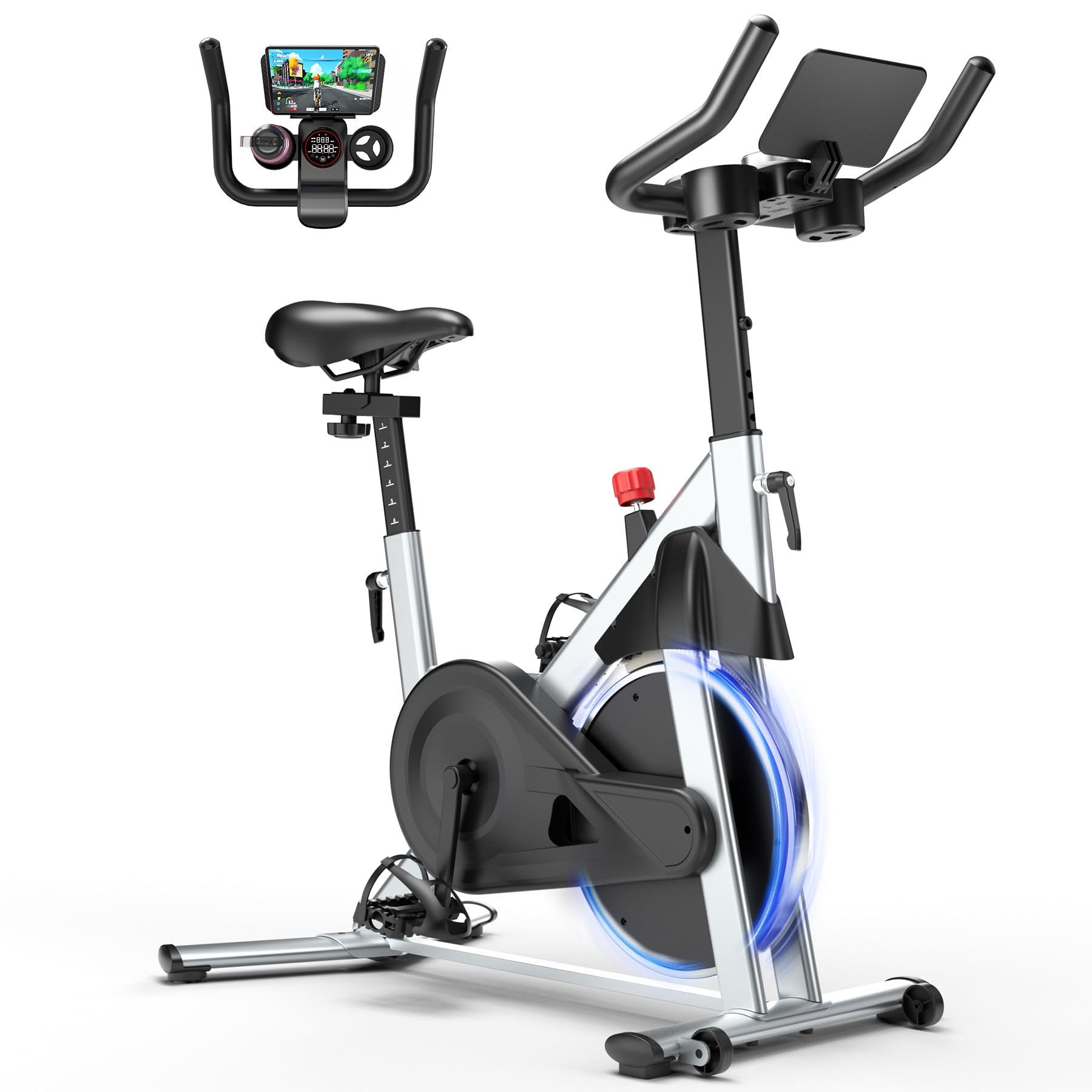
The Lacuffy S1-Pro packs 32 magnetic resistance levels into a 43-pound frame, making it one of the lightest and most affordable bikes on this list. The 32-level range is generous for the price, giving riders enough granularity to find a comfortable cadence from recovery spin to moderate climbing. The belt drive registers under 25 dB, ensuring neighbors won’t hear your evening ride sessions.
The S1-Pro’s 6.61-pound flywheel provides enough momentum for smooth pedaling, but the lighter frame will transmit slight vibration during standing efforts above level 20. The seat and handlebars adjust through 7 height positions, accommodating riders from 5’1” to 5’11”. The cage pedals keep shoes secure during HIIT intervals.
One user noted the bike feels best for riders around 5’7”, and taller individuals at 5’11” may find the top end of the handlebar range insufficient for full extension. Assembly is quick at around 20 minutes with clear instructions. For riders on a budget who prioritize resistance depth and noise control over heavy-duty stability, the S1-Pro is a capable entry point into home cycling.
Why it’s great
- 32 resistance levels for fine intensity control
- Very quiet belt drive under 25 dB
- Quick 20-minute assembly from flat box
Good to know
- Light 43 lb frame vibrates at higher resistance
- Handlebar height maxes out early for taller riders
9. Wenoker Magnetic-Black-blue Spin Bike
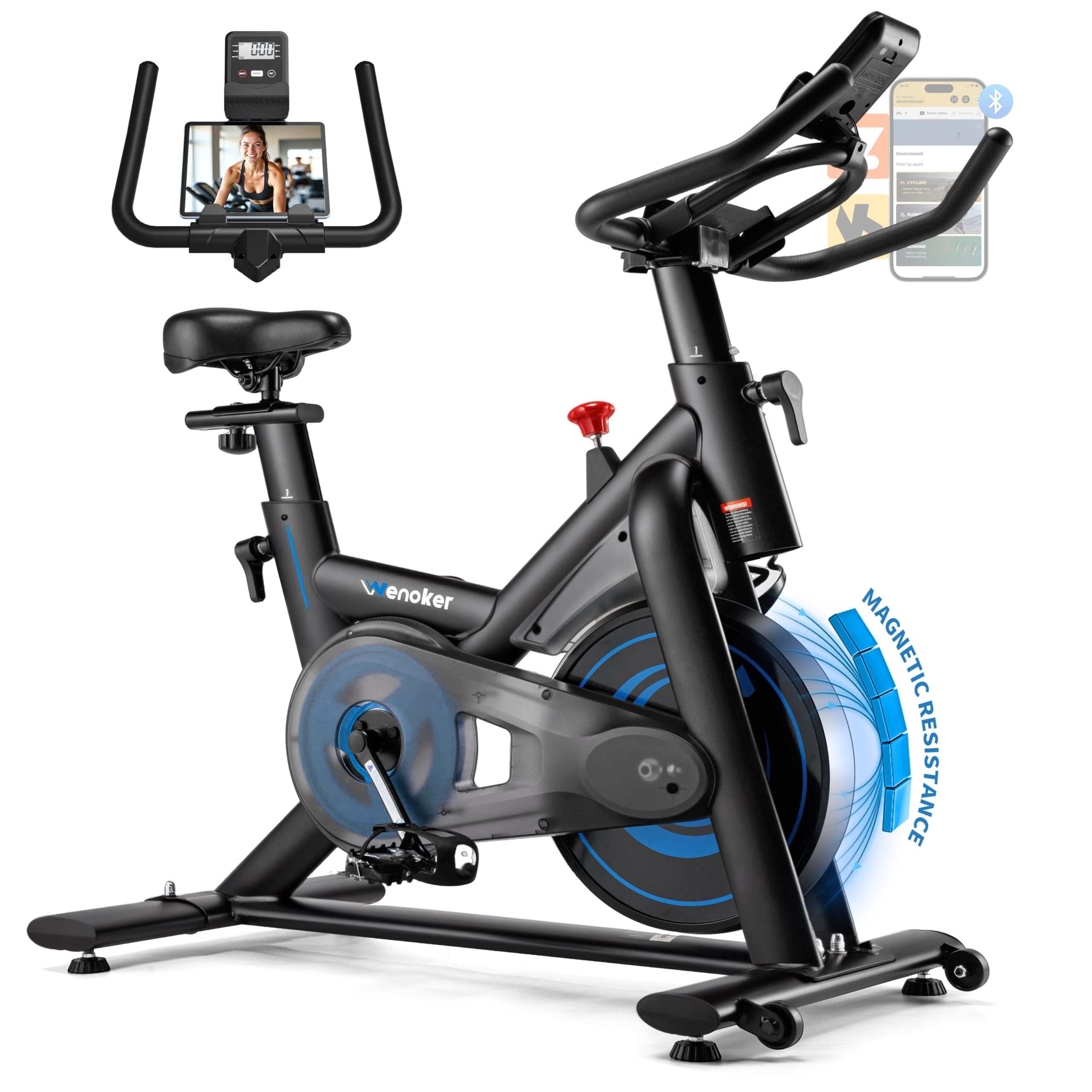
The Wenoker exercise bike delivers the highest weight capacity in the entry-level tier at 350 lbs, paired with a reinforced triangular steel frame that stays stable under load. The magnetic resistance system is whisper-quiet, and Bluetooth connectivity syncs with fitness apps to track time, distance, calories, and speed. The LCD monitor sits front and center, while a tablet holder and dual water bottle mount keep entertainment and hydration within reach.
Assembly is claimed at under 30 minutes with mostly pre-installed components, and the compact 37.4” x 7.48” footprint slides into tighter living spaces better than most spin bikes. The adjustable seat and handlebars accommodate a range of heights, though the handlebar lacks fore-aft adjustment, which may push taller users into a more extended forward position than ideal.
The padded seat is adequate for 20-30 minute rides, but longer sessions will expose the thin foam. The bike weighs 62 pounds, which provides reasonable stability for seated pedaling at moderate resistance. This is a solid choice for anyone new to home cycling who wants a quiet, stable ride with app tracking at an accessible entry point.
Why it’s great
- 350 lb capacity with reinforced triangular frame
- Bluetooth syncs with fitness apps for data tracking
- Compact footprint fits small apartments
Good to know
- Seat cushion is thin for rides over 30 minutes
- Handlebar lacks fore-aft adjustment
FAQ
How do I measure the correct seat height for my exercise bike?
Should I buy an upright or recumbent exercise bike for back pain?
Why is magnetic resistance preferred over felt pad resistance?
How much floor space do I need for an exercise bike?
Final Thoughts: The Verdict
For most users, the at home exercise bike winner is the Merach MR-S29R1 because it combines a rock-solid 77-pound frame with quiet magnetic resistance and smooth Bluetooth integration at a mid-range cost. If you want a data-rich interactive experience with virtual route auto-resistance, grab the Schwinn 290 Recumbent. And for a heavy-duty recumbent that accommodates heavier riders with an infinite seat slider, nothing beats the VANSWE RB607.